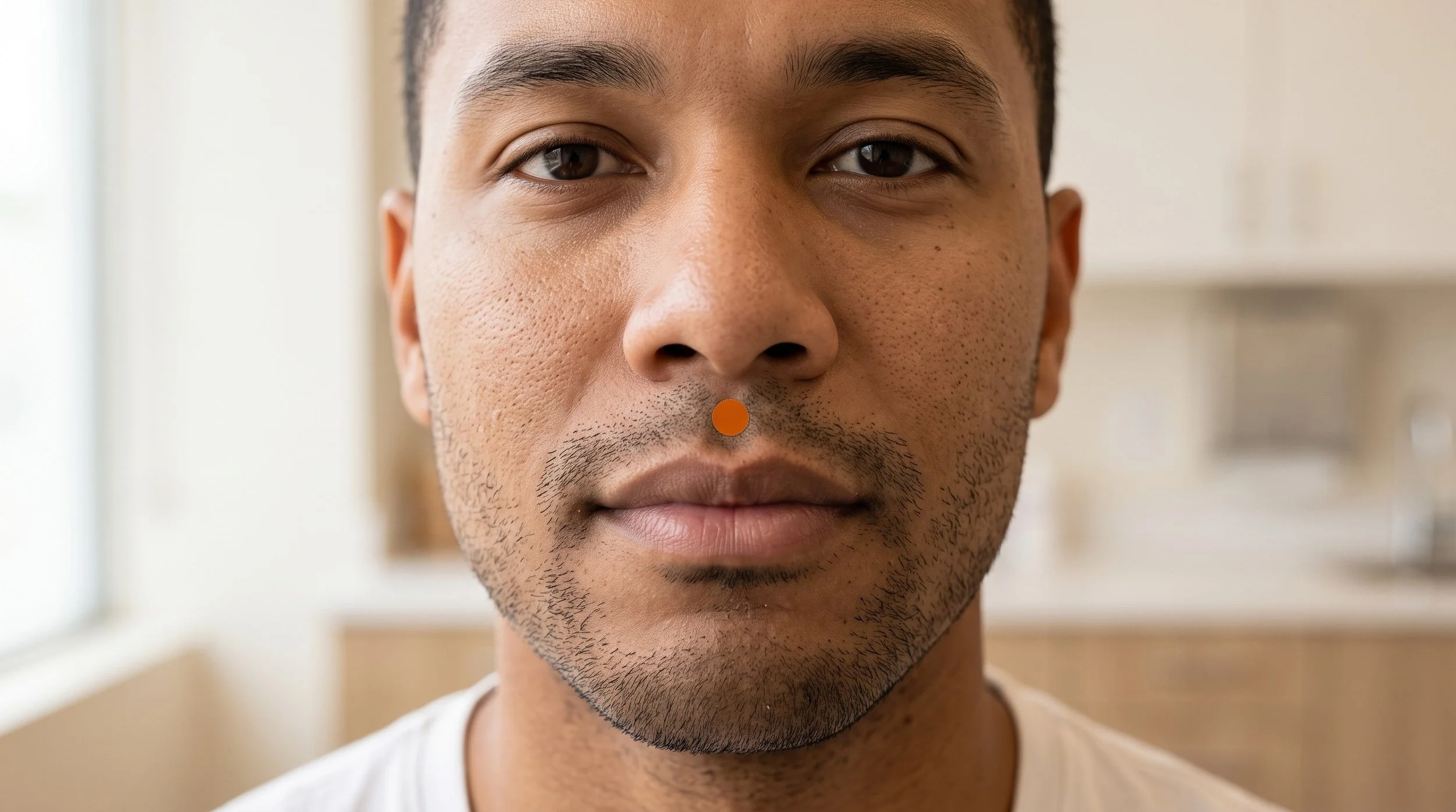
DU26 Acupuncture Point (Renzhong)
The Point in the Philtrum: Anatomy, Trigeminal Mechanism, and Why Renzhong Is Used for Fainting and Acute Low Back Sprain
DU26 (Renzhong, "Man's Middle," also written Shuigou or "Water Ditch"), also written GV26, sits on the midline of the upper lip, in the vertical groove between the nose and the mouth, at the junction of the upper third and lower two thirds of the philtrum (Deadman et al., 2009).
It is one of the smallest and most sensitive locations on the body, and in the classical literature it carries an outsized reputation: the DU 26 philtrum point is described as the foremost point for restoring consciousness, a crossing point of the Governing vessel with the Large Intestine and Stomach channels, and one of Sun Si-miao's ghost points (Deadman et al., 2009).
Modern clinics use it far less often than that reputation suggests, but two applications stay in regular rotation: brief stimulation if a patient becomes faint on the table, and distal needling for acute, midline low back sprain while the patient gently moves. This guide covers the anatomy of the GV26 acupuncture point, the trigeminal and autonomic mechanisms that plausibly explain what it does, its traditional indications, and what the research picture actually supports.
- Location and layers: governing vessel 26 lies on the midline of the philtrum, at the junction of its upper third and lower two thirds, with the needle passing through thin skin and the fibers of orbicularis oris toward the base of the nasal septum (Deadman et al., 2009). Needling is oblique and superior, roughly 0.3 to 0.5 cun, and firm upward thumbnail pressure is the classical alternative when a needle is not available (Deadman et al., 2009).
- Traditional categories, translated: the classical designations (meeting point of the Governing vessel with the hand and foot yangming channels, ghost point Guigong, and later inclusion among the six command points with PC6) are traditional attributions, and they map neatly onto a point with dense trigeminal innervation in a facial territory shared with the Large Intestine and Stomach channels (Deadman et al., 2009).
- Mechanism: the philtrum is supplied by branches of the maxillary division of the trigeminal nerve, and strong input here reaches the spinal trigeminal nucleus, brainstem reticular and autonomic centers, and descending pain modulatory pathways, which is the current framework for acupuncture analgesia and arousal effects (Zhao, 2008).
- Research picture: a systematic review of trials using DU26 alone or as an added point reported small favorable effects on efficacy rates and modest rises in blood pressure during revival, with no adverse effects reported, but the included trials were methodologically weak (Hu et al., 2015). Protocols built around DU26 and PC6 for acute ischemic stroke have shown reduced disability rates in pooled analysis, again with high risk of bias (Yang et al., 2017).
- Clinical practice framing: in a modern clinic DU26 is a situational point rather than a routine one. It is used briefly for light-headedness during a session (alongside standard first aid), and as a distal point for acute midline lumbar sprain needled while the patient moves the waist, an approach supported at the whole-treatment level by reviews of acupuncture for acute low back pain (Su et al., 2021; Lin et al., 2024).
- De qi at this point is unusually sharp: patients describe a hot, jolting ache spreading toward the root of the nose with watering eyes, which is why practitioners use fine needles, brief stimulation, and clear consent before needling (Deadman et al., 2009).
Stuck With Sudden, Sharp Low Back Pain That Locks Up When You Move?
Acute midline low back sprain responds well to a combination approach: distal needling (including DU26 in selected cases) paired with gentle guided movement, then local dry needling of the lumbar paraspinals and quadratus lumborum once the guarding settles. Our licensed acupuncturists assess the mechanism of injury first, so treatment matches whether the problem is joint, muscle, or protective spasm. Most patients feel a change in range of motion within the first visit. Schedule an appointment at Morningside Acupuncture and let's get you moving again.
Schedule NowAnatomy of DU26: Why the Philtrum Is Such an Important Location
The philtrum is the shallow vertical groove running from the base of the nasal septum to the top edge of the upper lip, and DU26 sits on its midline where the upper third meets the lower two thirds (Deadman et al., 2009). The tissue here is thin: skin, a small amount of subcutaneous fat, and the decussating fibers of orbicularis oris blending with depressor septi nasi, all lying over the maxilla and the anterior nasal spine. Nothing in this region carries mechanical load in the way a lumbar or shoulder muscle does, which is a clue that DU26 was never selected for local tissue reasons. It was selected because of what the nervous system does with input from this exact patch of skin.
The philtrum is densely supplied by superior labial branches of the infraorbital nerve, part of the maxillary division of the trigeminal nerve, with facial nerve motor fibers running to the surrounding muscles. Trigeminal afferents from the face project to the spinal trigeminal nucleus, a column continuous with the upper cervical dorsal horn, and from there to brainstem regions involved in arousal, autonomic control, and pain modulation, including the reticular formation, the nucleus tractus solitarius, and the periaqueductal gray.
Acupuncture stimulation is understood to recruit these ascending and descending systems, releasing endogenous opioids and monoamines that dampen nociceptive transmission at the spinal level (Zhao, 2008). A strong, brief, highly salient stimulus at the philtrum is therefore an efficient way to produce a large central signal from a very small needle.
Vascular structures here are small but real: superior labial branches of the facial artery and vein run in the lip tissue, so bruising and brisk bleeding on withdrawal are the practical risks rather than anything deep or dangerous. The conventional technique is a fine needle inserted obliquely upward toward the nasal septum, roughly 0.3 to 0.5 cun, with brief stimulation rather than long retention, and firm upward pressure with the thumbnail as the non-needle option in urgent situations (Deadman et al., 2009). Because the area is so sensitive, most clinicians warn the patient first, needle once with intention, and avoid repeated manipulation.
Related Governing Vessel Related LI4 Acupuncture PointDU26 (GV26) at a Glance: Classification, Location, and Clinical Use
| Category | Detail |
|---|---|
| Traditional Name | Renzhong (Man's Middle), also known as Shuigou (Water Ditch) and Guigong (Ghost Palace) |
| Channel Classification | Governing Vessel (Du Mai), point 26 (DU26, also written GV26) |
| Point Categories | Meeting point of the Governing vessel with the Large Intestine and Stomach channels; one of Sun Si-miao's thirteen ghost points; added by later commentators, with PC6, to the four command points to form the six command points; traditionally the foremost point for restoring consciousness |
| Precise Location | On the anterior midline of the upper lip, in the philtrum, at the junction of the upper third and lower two thirds of the groove between the nasal septum and the lip margin |
| Tissue Stimulated | Thin philtral skin, subcutaneous tissue, and fibers of orbicularis oris over the maxilla, richly innervated by superior labial branches of the infraorbital nerve (maxillary division of the trigeminal nerve) |
| Needle Depth / Direction | Oblique insertion angled superiorly toward the root of the nose, approximately 0.3 to 0.5 cun with a fine gauge needle and brief stimulation; firm upward thumbnail pressure is the classical alternative |
| De Qi Sensation | Sharp, hot, and intense out of proportion to the needle size, often with watering eyes and an ache radiating toward the nasal root; it settles quickly once stimulation stops |
| Primary Clinical Uses | Faintness and loss of consciousness as classical first aid alongside emergency care; acute midline low back sprain needled with active movement; deviation of the face and mouth and lockjaw in classical listings; nasal congestion, nasal discharge, and nosebleed |
| Common Point Combinations |
|
Deadman, Al-Khafaji, and Baker record the traditional reading of this point in unusual detail. The name places a human being between heaven and earth: the Governing vessel and the nose, which takes in air, are read as yang and heavenly, while the Conception vessel and the mouth, which takes in food, are read as yin and earthly, and DU26 sits at the junction between them (Deadman et al., 2009).
In that framework, loss of consciousness is described as yin and yang beginning to separate, so a point positioned at their meeting was assigned the job of re-establishing the connection, which is why later commentators added it, with PC6, to the four command points (Deadman et al., 2009).
The same text lists the traditional actions as restoring consciousness and calming the spirit, benefiting the face and nose and expelling wind, and benefiting the spine in acute lumbar sprain, along with classical indications spanning collapse and childhood fright wind, facial deviation and lockjaw, nasal blockage, discharge, bleeding and loss of smell, facial swelling, and severe psycho-emotional presentations that earned it a place among the thirteen ghost points under the name Guigong (Deadman et al., 2009).
Other authors preserve the alternative name Shuigou and group it with points used traditionally for facial puffiness and fluid regulation in the upper body (Cunningham, 2000; Maciocia, 2006). What is striking is the coherence of the pattern: one tiny midline location, three very different families of use (arousal, face and nose, low back), and every one of them traceable to a structure with unusually rich trigeminal input.
Why DU26 Is Used for Acute Low Back Sprain
Patients are usually surprised that a point on the upper lip is chosen for a back that just seized up. The classical justification, quoted in Deadman, is the principle that a problem below can be treated from above, with DU26 sitting near the upper end of the same vessel that runs the length of the spine (Deadman et al., 2009). The neurophysiological account is different but compatible. Acute lumbar sprain is dominated by protective muscle guarding, and guarding is a nervous system output, not a tissue lesion.
A strong, brief, salient stimulus far from the painful area recruits widespread descending inhibition, temporarily lowering the gain of the dorsal horn, and it changes the patient's attention long enough for them to move a back they were bracing against (Zhao, 2008). Movement performed during that window is the therapeutic part.
There is limited direct evidence for the point itself. An uncontrolled case series reported that most patients with acute lumbar sprain improved after strong stimulation at DU26 alone, which is encouraging but cannot separate the point from natural recovery or expectation (Hong-li & Xi-min, 2005). The pooled review of DU26 trials found small favorable effects on efficacy rates for acute low back strain when the point was added to other points, while explicitly cautioning that trial quality was weak (Hu et al., 2015).
At the level of whole treatments, reviews of acupuncture for acute and subacute low back pain report short-term pain benefit compared with control interventions and oral medication, with substantial heterogeneity (Su et al., 2021; Lin et al., 2024), and individual patient data across chronic pain conditions show effects that are modest but durable (Vickers et al., 2018).
In practice, this means DU26 is used sparingly and as an opener rather than the whole treatment. Once the acute spasm eases, attention shifts to the tissues that are actually irritated, which is where local needling, dry needling, and graded loading take over. That sequencing matters more than any single point.
What the Research Shows for DU26 (GV26)
One note on naming before the evidence: in the research literature this point is almost always listed as GV26, the WHO standard code, so GV26 is the term to search if you want to read the studies below in full.
Nearly all acupuncture research tests multi-point protocols, so evidence about DU26 specifically is thin and mostly comes from trials where it is one component of a larger prescription. The exception is a systematic review that gathered trials using DU26 alone or as an added point, and it concluded that the signal is real but the underlying studies are methodologically limited. Read the table below as a picture of plausible, modest contributions within a larger treatment, not as proof that any one point produces a given outcome.
| Study | Type | Focus | Key Finding |
|---|---|---|---|
| Hu et al., 2015 | Systematic review and meta-analysis | Trials using DU26 alone or added to other points across conditions including acute low back strain, shock, enuresis, and hiccups | Pooled data suggested a small improvement in efficacy rates and modest increases in systolic and diastolic blood pressure during revival, with no adverse effects reported and consistently weak trial quality. |
| Yang et al., 2017 | Meta-analysis | Xingnao Kaiqiao needling for acute ischemic stroke, a protocol built around DU26 and PC6 | Pooled results reported lower disability rates and better activities of daily living than control treatment, with no mortality difference and a high likelihood of selection and measurement bias. |
| Su et al., 2021 | Systematic review and meta-analysis | Acupuncture for acute low back pain | Reported short-term pain and function benefits compared with control interventions, with the authors noting variable methodological quality across included trials. |
| Lin et al., 2024 | Systematic review and meta-analysis | Acupuncture versus oral medication for acute and subacute non-specific low back pain | Acupuncture was slightly more effective than oral medication for pain across 14 studies, though heterogeneity was very high, so the estimate should be read cautiously. |
| Vickers et al., 2018 | Individual patient data meta-analysis | Acupuncture across chronic pain conditions including back and neck pain | Acupuncture outperformed both sham and no-acupuncture controls with modest effect sizes that persisted over roughly a year. |
| Zhao, 2008 | Mechanistic review | Neural pathways of acupuncture analgesia | Needle stimulation activates afferent input to spinal and brainstem circuits, engaging descending inhibition and endogenous opioid and monoamine systems. |
| Hong-li & Xi-min, 2005 | Uncontrolled case series | Strong stimulation at DU26 for acute lumbar sprain | Most of the 42 patients were reported as improved or resolved, but without a control group the result cannot be separated from natural recovery. |
Nervous About Fainting, Needle Anxiety, or Feeling Light-Headed During Treatment?
Feeling woozy during acupuncture is uncommon and manageable, and our clinicians are trained to handle it calmly: needles out, legs elevated, and brief stimulation or pressure at DU26 if it is appropriate, with medical care called when indicated. We also adjust technique for anxious or needle-sensitive patients using fewer needles, gentler stimulation, and supine positioning. Comfort is part of the treatment plan, not an afterthought. Book a first visit and tell us your concerns in advance.
Schedule NowDU26 in the Context of Trigger Point Work
DU26 is not a trigger point target. The philtrum contains no muscle bulk worth needling for taut bands, and orbicularis oris is rarely the driver of a patient's pain. What DU26 offers in an orthopedic session is a strong, brief central input, which is a different tool from the local twitch response that defines trigger point dry needling (Simons et al., 1999).
At Morningside we treat the two as complementary: a moment of distal stimulation with movement, then targeted work on the muscles actually generating symptoms.
For acute low back sprain that means the lumbar multifidus, iliocostalis and longissimus, quadratus lumborum, and often gluteus medius, needled once guarding has eased enough for the patient to lie comfortably. For facial and jaw presentations that overlap with the classical DU26 indications, the relevant myofascial targets are masseter, temporalis, and the medial pterygoid, since referred pain from these muscles can mimic facial and dental pain patterns (Simons et al., 1999).
You can read more about that in our guide to dry needling for temporalis trigger points.
DU26 Low Back and Facial Pain Treatment at NYC's Highest-Rated Acupuncture Clinic
Morningside Acupuncture is the highest-rated acupuncture and dry needling clinic in New York City with over 500 five-star Google reviews, and our approach blends classical point selection with orthopedic assessment and trigger point dry needling. We use Renzhong selectively, in the situations the classics describe best (acute midline lumbar sprain, faintness, facial and nasal patterns) rather than as a default point. Every plan is built around your presentation, your tolerance, and measurable change in pain and movement. Schedule your visit today.
Schedule NowFrequently Asked Questions
Is DU26 the same point as GV26?
Yes. DU26 and GV26 are two codes for the same point, Renzhong. DU comes from Du Mai, the Chinese name of the Governing Vessel, and it is the code used in most Chinese texts and many acupuncture schools. GV is the WHO standard abbreviation and the one you will see in most Western textbooks and research papers. You will also come across it written as Du 26, GV-26, or Governing Vessel 26. Whichever code is used, the location and the uses are the same.
What does DU26 feel like when needled?
Intense, and briefly so. Most people describe a sharp, hot, jolting sensation with an ache spreading up toward the root of the nose, and watering eyes are common. Because the philtrum is so densely innervated, the sensation is much stronger than the needle size suggests, but it fades within seconds of the stimulation stopping. This is why clinicians warn patients first, use a fine needle, stimulate briefly, and rarely retain the needle for long.
Why would an acupuncturist needle my upper lip for low back pain?
Because acute midline low back pain is largely a protective guarding response, and a strong distal stimulus can temporarily reduce that guarding through descending inhibitory pathways while the patient moves (Zhao, 2008). Classically, the choice was justified by the principle of treating a problem below by using a point above, with DU26 near the upper end of the Governing vessel that runs along the spine (Deadman et al., 2009). It is used as a short opener alongside movement, and local treatment of the lumbar tissues follows once you can move more freely.
Can I press DU26 myself between sessions?
Yes, and acupressure here is easy to do safely. Find the groove between your nose and upper lip, place a fingertip or thumbnail about one third of the way down from the base of the nasal septum, and press firmly upward and inward toward the nasal root. Hold for 5 to 10 seconds, release, and repeat three to five times, keeping total time under a minute or two. Expect it to be sharp rather than pleasant. For a stiff, sore low back, press while gently rocking your pelvis or bending side to side, then stop and move without pressure. If you feel light-headed at any point, stop and lie down with your legs elevated.
Is DU26 safe to needle?
In trained hands it is safe, and the systematic review of DU26 trials found no reported adverse effects, though reporting standards in those trials were poor (Hu et al., 2015). The realistic risks are pain, brief bleeding, and bruising of the lip, since small branches of the facial artery and vein run through the tissue. It should not be needled without clear consent, and it is not appropriate as a routine point for sensitive or anxious patients when gentler options exist. Most importantly, the classical use of DU26 for collapse or loss of consciousness is first aid at best: call emergency services first, position the person safely, and never delay medical care to needle or press a point.
Where exactly is DU26 located?
On the midline of the philtrum, the vertical groove between the base of the nasal septum and the top edge of the upper lip. Divide that groove into thirds: DU26 sits where the upper third meets the lower two thirds, closer to the nose than to the lip margin (Deadman et al., 2009). Some modern texts place it at the junction of the upper and middle thirds, so a small variation between sources is normal, and clinicians locate it by feel within the groove.
References
- Deadman, P., Al-Khafaji, M., & Baker, K. (2009). A manual of acupuncture. Journal of Chinese Medicine Publications.
- Cunningham, P. M. (2000). Acupuncture points: A practical guide to classical and modern usage. Odyssey Press.
- Maciocia, G. (2006). The channels of acupuncture: Clinical use of the secondary channels and eight extraordinary vessels. Churchill Livingstone Elsevier.
- Simons, D. G., Travell, J. G., & Simons, L. S. (1999). Travell & Simons' myofascial pain and dysfunction: The trigger point manual, Vol. 1: Upper half of body (2nd ed.). Williams & Wilkins.
- Hu, X.-Y., Trevelyan, E., Chai, Q.-Y., Wang, C.-C., Fei, Y.-T., Liu, J.-P., & Robinson, N. (2015). Effectiveness and safety of using acupoint Shui Gou (GV 26): A systematic review and meta-analysis of randomized controlled trials. Acupuncture and Related Therapies, 3(1), 1-10. https://doi.org/10.1016/j.arthe.2014.12.001
- Yang, Z.-X., Xie, J.-H., & Liu, D.-D. (2017). Xingnao Kaiqiao needling method for acute ischemic stroke: A meta-analysis of safety and efficacy. Neural Regeneration Research, 12(8), 1308-1314. https://doi.org/10.4103/1673-5374.213551
- Su, X., Qian, H., Chen, B., Fan, W., Xu, D., Tang, C., & Lu, L. (2021). Acupuncture for acute low back pain: A systematic review and meta-analysis. Annals of Palliative Medicine, 10(4), 3924-3936. https://doi.org/10.21037/apm-20-1998
- Lin, H., Wang, X., Feng, Y., Liu, X., Liu, L., Zhu, K., Shen, J., Zhang, P., Yu, J., & Yang, T. (2024). Acupuncture versus oral medications for acute/subacute non-specific low back pain: A systematic review and meta-analysis. Current Pain and Headache Reports, 28, 489-500. https://doi.org/10.1007/s11916-023-01201-7
- Hong-li, C., & Xi-min, S. (2005). Treatment of acute lumbar sprain by needling Shuigou (GV 26). Journal of Acupuncture and Tuina Science, 3, 58. https://doi.org/10.1007/BF02873765
- Vickers, A. J., Vertosick, E. A., Lewith, G., MacPherson, H., Foster, N. E., Sherman, K. J., Irnich, D., Witt, C. M., & Linde, K. (2018). Acupuncture for chronic pain: Update of an individual patient data meta-analysis. Journal of Pain, 19(5), 455-474. https://doi.org/10.1016/j.jpain.2017.11.005
- Zhao, Z. Q. (2008). Neural mechanism underlying acupuncture analgesia. Progress in Neurobiology, 85(4), 355-375. https://doi.org/10.1016/j.pneurobio.2008.05.004
Disclaimer: This web site is intended for educational and informational purposes only. Reading this website does not constitute providing medical advice or any professional services. This information should not be used for diagnosing or treating any health issue or disease. Those seeking medical advice should consult with a licensed physician. Seek the advice of a medical doctor or other qualified health professional for any medical condition. If you think you have a medical emergency, call 911 or go to the emergency room. No acupuncturist-patient relationship is created by reading this website or using the information. Morningside Acupuncture PLLC and its employees and contributors do not make any express or implied representations with respect to the information on this site or its use. For any legal interpretation of scope of practice in your state, consult a licensed attorney or regulatory authority.
Read more from our blog



