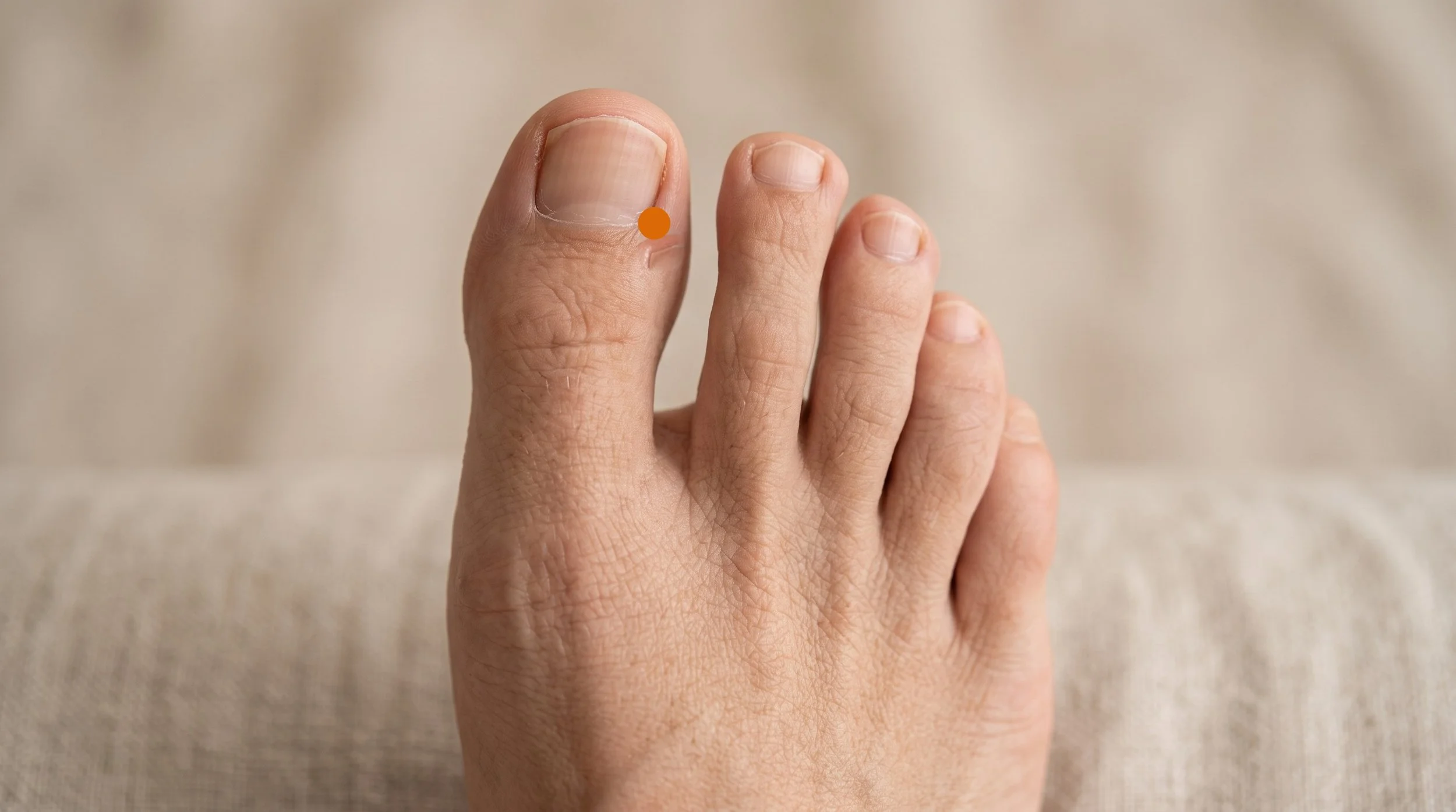
LV1 Acupuncture Point (Dadun)
The Jing-Well Point at the Corner of the Big Toenail: Anatomy, Mechanism, and Why LV1 Anchors Classical Treatment of Groin, Genital, and Menstrual Complaints
LV1 (Dadun, often translated as Big Mound), also written LR1, is the first point of the Liver channel and sits at the outer corner of the big toenail, on the side facing the second toe, about 0.1 cun back from the nail corner. It's classified in the classical literature as both the jing-well point and the Wood point of the channel, which places it at the very start of the Liver pathway and gives it an unusual profile among the acupuncture points of the foot.
Most jing-well points were used historically for problems of the head and chest, but LV1 is the exception: the classical indication lists are dominated by groin, genital, urinary and menstrual complaints, which mirrors the described course of the Liver channel around the external genitalia and into the lower abdomen (Deadman et al., 2009).
In modern practice, the LV1 acupuncture point is a small, quick, distally located needle that clinicians add to pelvic and menstrual protocols rather than a stand-alone treatment, and it's one of the few points still commonly treated with moxibustion or with a single drop-of-blood technique.
- Dadun point location is simple once you find the landmarks: on the top of the big toe, where a line along the outer nail border meets a line along the nail base, roughly 0.1 cun from the nail corner on the second-toe side. There's essentially no muscle here, just skin, nail fold, subcutaneous tissue and a very dense field of sensory endings (Deadman et al., 2009).
- Classically, liver 1 is the jing-well and Wood point of the Liver channel, and its traditional attributions are described as regulating qi in the lower abdomen, benefiting the genitals, adjusting urination, settling menstrual bleeding and restoring consciousness (Deadman et al., 2009). We translate those attributions as strong distal sensory input aimed at pelvic pain and autonomic regulation, not as literal energy movement.
- The LV 1 big toe location is supplied by terminal dorsal digital branches of the deep and superficial fibular nerves, whose cell bodies enter the cord around the L4 and L5 levels. Because pelvic organs are wired at very different levels, the effect of LV1 on pelvic symptoms is best explained heterosegmentally, through brainstem descending inhibition and opioid-mediated pathways rather than same-segment convergence (Zhao, 2008).
- The research picture is indirect. Acupuncture protocols that include distal leg and foot points show modest, durable benefit for chronic pain (Vickers et al., 2018), an eight-week sham-controlled trial supported acupuncture for chronic prostatitis and chronic pelvic pain syndrome (Sun et al., 2021), and a large trial supported electroacupuncture for stress urinary incontinence (Liu et al., 2017), but no trial has isolated LV1 itself.
- In clinic, LV1 is used briefly and precisely: a shallow 0.1 to 0.2 cun insertion angled toward the foot, sometimes a small bleeding technique, and in many classical prescriptions moxibustion instead of needling (Deadman et al., 2009). It's almost always combined with abdominal, sacral or leg points that carry the bulk of the treatment.
- De qi here is different from a thick muscular point. Patients usually report a bright, sharp, quickly rising sensation at the toe that fades within seconds rather than the dull, spreading ache typical of points like ST36, and the intensity of that sensation is one of the reasons jing-well points were reserved historically for urgent presentations (Deadman et al., 2009).
Dealing With Groin, Pelvic, or Testicular Pain in New York City?
Persistent groin, lower abdominal and genital pain often involves several layers at once: irritable nerves, guarded abdominal and adductor muscles, and a nervous system that has learned to amplify signals from the pelvis.
At Morningside Acupuncture, LV1 is used as a distal anchor within a wider plan that may include abdominal wall points, sacral points and dry needling of the adductors and lower abdominal muscles. We'll assess where your symptoms are actually being generated before any needle goes in. Schedule a visit to get a clear, individualized starting point.
Schedule NowAnatomy of LV1: Why the Corner of the Big Toenail Is Such an Important Location
LV1 sits in a very thin piece of real estate. Under the needle there's epidermis, a thin dermis, the lateral nail fold and a small amount of subcutaneous tissue over the periosteum of the distal phalanx of the great toe, with no muscle belly to engage (Deadman et al., 2009). What loads this area is walking: the great toe absorbs high pressure at push-off, and footwear, hallux valgus, turf toe and long standing days all concentrate mechanical stress into the tip of the toe.
That means the tissue at LV1 is often already sensitized in athletes and in people who spend the day on hard city floors, which is worth knowing before you needle it.
The nerve geography is what makes this a useful point. Terminal dorsal digital branches of the deep fibular nerve supply the adjacent sides of the great and second toes, with contributions from the superficial fibular nerve to the surrounding dorsal skin, and these fibers carry information into the spinal cord at roughly the L4 and L5 levels. Digit tips are among the most densely innervated skin in the body, so a shallow needle here produces a disproportionately large afferent volley.
Experimental work on acupuncture analgesia shows that this kind of input recruits brainstem and midbrain structures including the periaqueductal gray and nucleus raphe magnus, and engages opioid-mediated descending inhibition of dorsal horn transmission (Zhao, 2008). That's a plausible route by which a needle at the toe may influence pain felt in the groin and lower abdomen, and it fits the broader finding that acupuncture produces small but persistent effects on chronic pain conditions (Vickers et al., 2018).
Deep structures are minimal, which is part of why LV1 is considered a low-risk location, but there are still practical cautions. Dorsal digital arteries and veins run along the nail borders, so bleeding is common and expected, particularly with the classical prick-to-bleed technique. Standard needling is perpendicular or oblique toward the foot at 0.1 to 0.2 cun, and moxibustion appears in many classical prescriptions for this point (Deadman et al., 2009).
Because toes carry a high bacterial load, sterile technique matters more here than at most points, and we avoid needling through fungal nail changes, paronychia or broken skin. Patients on anticoagulants, and anyone with diabetic neuropathy, peripheral vascular disease or poor healing in the feet, should not receive bleeding techniques at the toes.
Related Liver Channel Related LV3 Acupuncture PointLV1 (LR1) at a Glance: Classification, Location, and Clinical Use
| Category | Detail |
|---|---|
| Traditional Name | Dadun (Big Mound), LV1, also written LIV-1 or LR1 |
| Channel Classification | First point of the Liver channel of the foot jueyin (LV1, also written LIV1 or LR1) |
| Point Categories | Jing-well point of the Liver channel; Wood point of the Liver channel; described in classical channel theory as the Origin of the Liver channel and as the point where a branch of the Gall Bladder channel links with the Liver channel |
| Precise Location | On the top of the big toe, at the junction of a line along the outer nail border and a line along the nail base, about 0.1 cun from the nail corner on the side facing the second toe. Some classical sources, including the Spiritual Pivot, place it further back, roughly midway between the nail corner and the interphalangeal joint. |
| Tissue Stimulated | Skin, lateral nail fold and subcutaneous tissue over the distal phalanx, with dense dorsal digital nerve endings. There's no muscle at LV1 itself, so clinicians often pair it with needling of the deep intrinsic foot muscles for foot complaints and the adductor longus and adductor brevis for groin pain. |
| Needle Depth / Direction | Perpendicular or oblique toward the foot, 0.1 to 0.2 cun, or a quick prick-to-bleed technique with a lancet. Moxibustion is used at this point in many classical prescriptions. |
| De Qi Sensation | Sharp, bright and immediate at the toe, rising fast and settling within seconds, rather than the dull heaviness felt at thicker muscular points |
| Primary Clinical Uses | Groin and lower abdominal pain patterns (shan disorder in classical texts), genital pain and swelling, heavy or prolonged menstrual bleeding in classical use, urinary retention, painful urination and bedwetting in classical use, and revival from collapse among the jing-well points |
| Common Point Combinations |
|
Deadman, Al-Khafaji and Baker's point compendium presents LV1 as the leading distal point for what classical medicine called shan disorder, a broad umbrella that took in hernia, genital swelling and pain, and severe lower abdominal pain, with the Song of the Jade Dragon singling it out for the seven types of shan disorder and the Inner Classic instructing practitioners to needle above the nail of the big toe when the pathogen sits in the foot jueyin network vessels.
The commentary explains the reasoning traditionally: the Liver channel is described as encircling the genitals and entering the lower abdomen, so its first point was considered the natural distal lever for that region, and its status as a jing-well point made it especially suited to sudden, urgent pain.
The same tradition extended LV1 to urinary complaints of both excess and deficiency type, from painful retention through to bedwetting and frequency, and to excessive bleeding, where it was contrasted with the neighboring point SP1: SP1 was applied broadly to hemorrhage, while LV1 was reserved for bleeding attributed to heat in the blood. Both the Inner Classic and the Great Compendium recommended cross-needling for shan disorder, treating the left toe for right-sided symptoms and the reverse (Deadman et al., 2009).
What makes this pattern striking is how far it departs from the rest of the jing-well points: nearly all the others focus on the head and chest, and LV1 alone points its attention squarely at the pelvis.
Why LV1 Is Used for Groin, Genital, and Pelvic Symptoms Rather Than Foot Pain
The first question patients ask is how a needle in the big toe could possibly matter for a symptom in the groin. It's a fair question, and the honest answer is that the mechanism isn't segmental. The skin at LV1 feeds into the spinal cord around L4 and L5, while the pelvic organs and genital structures are wired through very different routes, mainly thoracolumbar sympathetic and sacral parasympathetic pathways. So there's no shared spinal segment doing the work, and we don't explain LV1 as energy traveling up a line on the leg.
What's left is a heterosegmental, or extrasegmental, mechanism. Strong sensory input from a densely innervated site like a digit tip travels centrally and recruits brainstem and midbrain circuitry, including the periaqueductal gray and raphe nuclei, which then dampens transmission in dorsal horn neurons across widespread regions of the body through opioid, serotonergic and noradrenergic signaling (Zhao, 2008).
This is the same general machinery that supports the broader clinical picture, where acupuncture protocols using distal and local points together produce modest but persistent reductions in chronic pain compared with sham and no-acupuncture controls (Vickers et al., 2018). There may also be somato-autonomic effects, since strong cutaneous stimulation can shift sympathetic tone and local blood flow, which is one reason distal points are often paired with lower abdominal and sacral points in pelvic protocols.
Practically, this means LV1 should be understood as a contributor rather than the engine of a treatment. When we're treating pelvic pain, urinary symptoms or menstrual complaints, the heavy lifting usually comes from points positioned in the same neurological neighborhood as the target tissue, and LV1 adds a strong distal signal on top of that.
Studies of pelvic conditions have tested exactly this kind of multi-point approach, with sham-controlled trials in chronic prostatitis and chronic pelvic pain syndrome (Sun et al., 2021) and in stress urinary incontinence (Liu et al., 2017) showing meaningful symptom improvement from full protocols, not from single points.
What the Research Shows for LV1 (LR1)
One note on naming before the evidence: in the research literature this point is usually listed as LR1, the WHO standard code, and sometimes as LV1 or LIV1, so it is worth searching all three if you want to read the studies below in full.
There's no clinical trial that isolates LV1, and that's true of nearly every individual acupuncture point. Trials test protocols, and protocols usually combine four to fifteen points chosen for a specific condition, so the fairest way to read the evidence is that LV1 may contribute to results seen in studies of pelvic pain, urinary and menstrual conditions where distal Liver channel points are commonly included. The table below summarizes the most relevant reviews and trials along with their limitations.
Evidence quality varies considerably: the pain literature is comparatively strong, while the menstrual and enuresis literature is dominated by small trials with high risk of bias.
| Study | Type | Focus | Key Finding |
|---|---|---|---|
| Vickers et al., 2018 | Individual patient data meta-analysis (39 trials, about 20,800 patients) | Acupuncture for chronic musculoskeletal, headache and osteoarthritis pain | Acupuncture produced modest but statistically significant improvements over both sham and no-acupuncture control, with effects that persisted over a year. |
| Sun et al., 2021 | Multicenter randomized sham-controlled trial (440 men) | Acupuncture for chronic prostatitis and chronic pelvic pain syndrome | Twenty sessions over eight weeks produced greater symptom improvement than sham, with benefit maintained through 24 weeks of follow-up. |
| Liu et al., 2017 | Randomized clinical trial (504 women, JAMA) | Electroacupuncture for stress urinary incontinence | Electroacupuncture reduced urine leakage more than sham over six weeks, suggesting acupuncture may influence lower urinary tract function. |
| Smith et al., 2016 | Cochrane systematic review | Acupuncture and acupressure for period pain | The authors concluded that evidence was insufficient to determine whether acupuncture helps primary dysmenorrhea, with low or very low quality evidence throughout. |
| Kannan & Bello, 2022 | Systematic review and meta-analysis (13 trials, 890 children) | Acupuncture-based therapies for nocturnal enuresis in children | Some forms of acupoint stimulation outperformed control conditions, though the authors rated the evidence as limited and of very low quality. |
| Zhao, 2008 | Narrative review of experimental neurophysiology | Central mechanisms of acupuncture analgesia | Needling activates a distributed brainstem and midbrain network and engages opioid-mediated descending inhibition of spinal pain transmission. |
Heavy Periods and Cycle Pain: Could Acupuncture Support Your Treatment?
Classical texts leaned on Dadun for heavy or prolonged bleeding and for painful, irregular cycles, and modern acupuncture for menstrual health builds on the same distal-plus-local logic. Our licensed acupuncturists combine points like LV1 and LV3 with SP6, lower abdominal points and gentle myofascial work to support comfort across the cycle, always alongside appropriate gynecologic care. Heavy bleeding deserves a medical workup first, and we'll say so plainly. Book a consultation to see whether acupuncture fits into your plan.
Schedule NowLV1 in the Context of Trigger Point Work
LV1 doesn't sit on a muscle, so it isn't a dry needling target in the usual sense. It's a cutaneous point, and its value in a mixed treatment is as a strong distal input alongside the muscular work that addresses the mechanical side of a complaint. When someone presents with groin or lower abdominal pain, we look first for myofascial contributors, because trigger points in the abdominal wall and hip adductors refer pain into the groin, testicles and lower abdomen in patterns that patients frequently describe as visceral (Simons et al., 1999).
Sorting that out matters: pain that reproduces from palpating the external oblique or adductor longus is a very different problem from pain arising from the pelvic organs.
In practice, a Morningside session for these presentations might combine dry needling of the external abdominal oblique and adductor longus and brevis with distal points such as LV1, LV3 and SP6, plus manual work and a home program.
For patients whose big toe itself hurts, from hallux rigidus, turf toe or nail trauma, LV1 sits right in the symptomatic area, and we'll usually work the deep intrinsic foot muscles and adductor hallucis instead of needling an already irritated nail fold. Remember that acupuncture, in any of its hundreds of styles, is defined by the use of an acupuncture needle, and dry needling is one of those styles rather than a separate therapy.
LV1 Pelvic and Menstrual Treatment at NYC's Highest-Rated Acupuncture Clinic
Morningside Acupuncture is the highest-rated acupuncture and dry needling clinic in New York City with over 500 five-star Google reviews, and our approach blends classical point selection with modern pain science. Points like LV1 are chosen for a reason, explained in plain language, and paired with orthopedic assessment and trigger point work when that's what the case calls for. You'll leave knowing what we did and why. Schedule your appointment at our Upper West Side office today.
Schedule NowFrequently Asked Questions
Is LV1 the same point as LR1 or LIV1?
Yes. LV1, LR1, and LIV1 are all codes for the same point, Dadun, point 1 of the Liver channel. LR is the WHO standard abbreviation and the one you will see in most research papers. LV is the form used by many American schools and clinics, and LIV appears in several widely used textbooks. You will also come across it written as Liver 1 or LIV-1. Whichever code is used, the location and the uses are the same.
What does LV1 feel like when needled?
Sharper and quicker than most points. Because the tip of the toe is so densely innervated, a shallow 0.1 to 0.2 cun insertion produces a bright, immediate sensation that peaks fast and usually fades within a few seconds. Some people feel a brief flash up the foot. It isn't the dull, heavy, spreading ache that patients associate with points like ST36 or GB34, and the needle typically stays in for only a short time or is withdrawn right away. If a bleeding technique is used, you'll feel a quick prick and see a drop or two of blood, which we absorb with sterile gauze.
Why treat a point on the big toe for pain in the groin or lower abdomen?
Traditionally, LV1 was chosen because it's the first point of the Liver channel, which classical texts describe as wrapping around the genitals and entering the lower abdomen, making it the go-to distal point for groin and genital pain (Deadman et al., 2009). Neurophysiologically, the explanation is different: the toe and the pelvis don't share spinal segments, so LV1 works through heterosegmental pathways, where a strong sensory volley from a densely innervated site recruits brainstem descending inhibition that dampens pain transmission more widely (Zhao, 2008). Either way, it's used as a distal addition to points placed closer to the symptomatic region, not as a stand-alone treatment.
Can I press LV1 myself between sessions?
Yes, and acupressure at this point is easy to do anywhere. Find the outer corner of your big toenail on the side facing the second toe, then move about a fingernail's width back toward the ankle. Use your thumbnail edge or the pad of your thumb and apply firm, steady pressure for 30 to 60 seconds, enough to feel a clear ache without sharp pain. Release, rest for 20 seconds and repeat two or three times per foot, once or twice a day. Small circular pressure works just as well as static pressure. Stop if the area is bruised, inflamed or numb, and skip acupressure entirely on toes with infection, an ingrown nail or reduced sensation from neuropathy. Acupressure is a reasonable self-care habit between visits, not a replacement for treatment or for medical evaluation of pelvic, urinary or bleeding symptoms.
Is LV1 safe to needle?
In trained hands it's a low-risk point, since insertion is very shallow and there are no deep structures beneath it. The realistic considerations are bleeding from the small dorsal digital vessels along the nail borders, brief sharpness during insertion, and infection risk, which is higher at the toes than elsewhere because of local bacterial load. Sterile single-use needles and careful skin prep are standard. We avoid needling through fungal nail changes, an infected nail fold or broken skin, and we skip bleeding techniques in people taking anticoagulants or with diabetes, peripheral neuropathy or peripheral vascular disease affecting the feet. Anyone with heavy menstrual bleeding, testicular pain or swelling, urinary retention or blood in the urine needs a medical evaluation, since those symptoms can reflect conditions that require prompt care.
Where exactly is LV1 located?
On the top of the big toe at the outer nail corner, specifically the corner facing the second toe. Draw one imaginary line along the outer border of the nail and another along the base of the nail; LV1 sits where they meet, about 0.1 cun (roughly the width of your own thumbnail edge) from the corner. It's worth noting that classical sources aren't unanimous: the Spiritual Pivot and some later texts place the point further back on the toe, about 0.4 cun proximal to the nail corner, closer to the interphalangeal joint (Deadman et al., 2009). Most modern practitioners use the nail corner location, and in practice we palpate for the most tender or reactive spot within that small area.
References
- Deadman, P., Al-Khafaji, M., & Baker, K. (2009). A manual of acupuncture. Journal of Chinese Medicine Publications.
- Simons, D. G., Travell, J. G., & Simons, L. S. (1999). Travell & Simons' myofascial pain and dysfunction: The trigger point manual, Vol. 1: Upper half of body (2nd ed.). Williams & Wilkins.
- Zhao, Z. Q. (2008). Neural mechanism underlying acupuncture analgesia. Progress in Neurobiology, 85(4), 355-375. https://doi.org/10.1016/j.pneurobio.2008.05.004
- Vickers, A. J., Vertosick, E. A., Lewith, G., MacPherson, H., Foster, N. E., Sherman, K. J., Irnich, D., Witt, C. M., & Linde, K. (2018). Acupuncture for chronic pain: Update of an individual patient data meta-analysis. Journal of Pain, 19(5), 455-474. https://doi.org/10.1016/j.jpain.2017.11.005
- Smith, C. A., Armour, M., Zhu, X., Li, X., Lu, Z. Y., & Song, J. (2016). Acupuncture for dysmenorrhoea. Cochrane Database of Systematic Reviews, 2016(4), CD007854. https://doi.org/10.1002/14651858.CD007854.pub3
- Sun, Y., Liu, Y., Liu, B., Zhou, K., Yue, Z., Zhang, W., Fu, W., Yang, J., Li, N., He, L., Zang, Z., Su, T., Fang, J., Ding, Y., Qin, Z., Song, H., Hu, H., Zhao, H., Mo, Q., ... Liu, Z. (2021). Efficacy of acupuncture for chronic prostatitis/chronic pelvic pain syndrome: A randomized trial. Annals of Internal Medicine, 174(10), 1357-1366. https://doi.org/10.7326/M21-1814
- Liu, Z., Liu, Y., Xu, H., He, L., Chen, Y., Fu, L., Li, N., Lu, Y., Su, T., Sun, J., ... Liu, B. (2017). Effect of electroacupuncture on urinary leakage among women with stress urinary incontinence: A randomized clinical trial. JAMA, 317(24), 2493-2501. https://doi.org/10.1001/jama.2017.7220
- Kannan, P., & Bello, U. M. (2022). The efficacy of different forms of acupuncture for the treatment of nocturnal enuresis in children: A systematic review and meta-analysis. Explore, 18(4), 488-497. https://doi.org/10.1016/j.explore.2021.11.008
Disclaimer: This web site is intended for educational and informational purposes only. Reading this website does not constitute providing medical advice or any professional services. This information should not be used for diagnosing or treating any health issue or disease. Those seeking medical advice should consult with a licensed physician. Seek the advice of a medical doctor or other qualified health professional for any medical condition. If you think you have a medical emergency, call 911 or go to the emergency room. No acupuncturist-patient relationship is created by reading this website or using the information. Morningside Acupuncture PLLC and its employees and contributors do not make any express or implied representations with respect to the information on this site or its use. For any legal interpretation of scope of practice in your state, consult a licensed attorney or regulatory authority.
Read more from our blog



