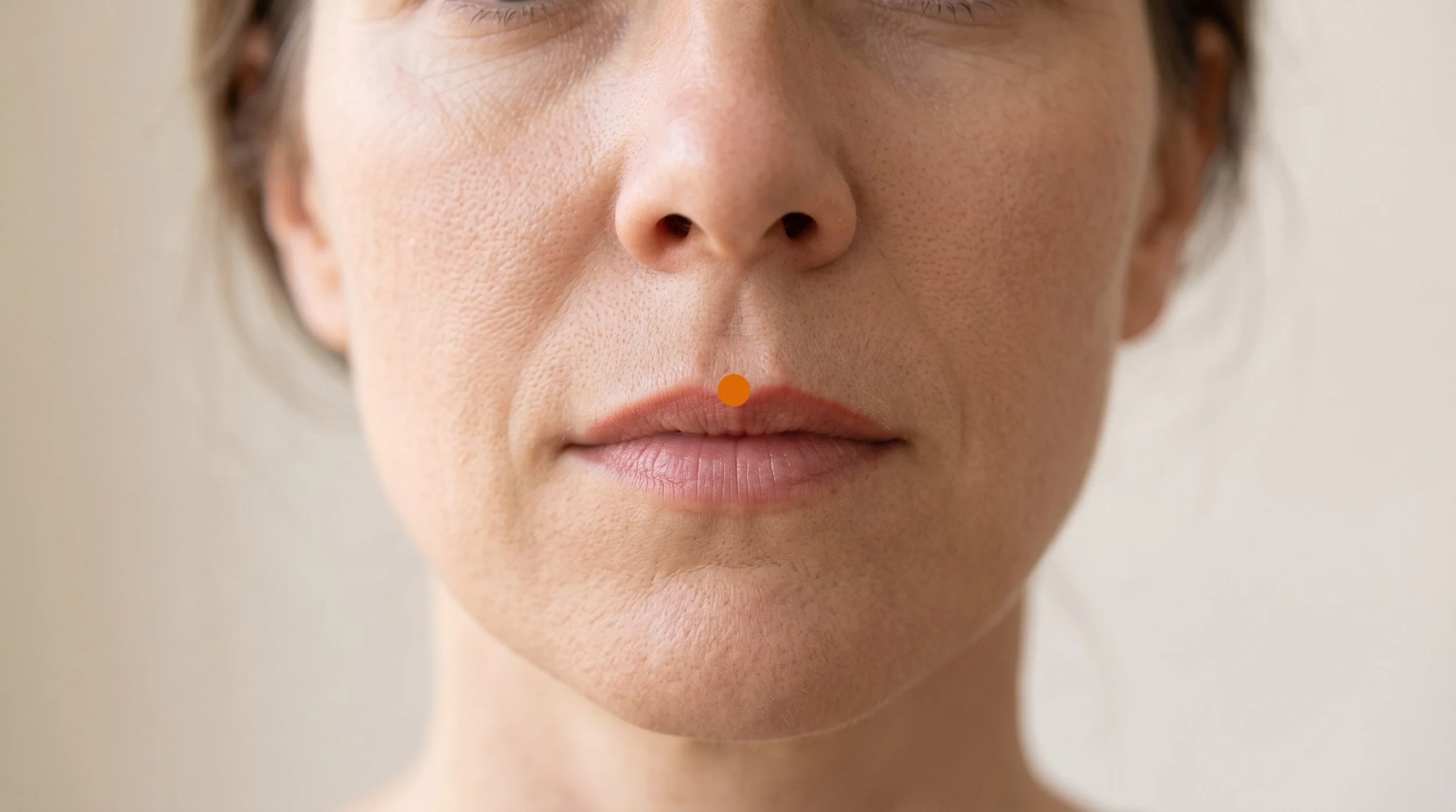
DU27 Acupuncture Point (Duiduan)
The Extremity of the Mouth at the Upper Lip: Anatomy, Trigeminal Mechanism, and Why Governing Vessel 27 Still Earns a Place in Orofacial Treatment
DU27 (also written GV27), known in Chinese as Duiduan and usually translated as Extremity of the Mouth, is the second to last point of the Governing Vessel. You can find it without a mirror: run a fingertip down the philtrum, the vertical groove under the nose, until the skin meets the pink border of the upper lip, and stop on the small central bump of the lip itself. That tiny piece of real estate sits in one of the most densely innervated regions of the human body, which is exactly why the classical record for the GV27 acupuncture point centers on the mouth, gums, lips and nose rather than on anything distant.
Clinically it is a small, precise, short-retention point that we use as an accent within a larger facial or orofacial plan, not as a standalone treatment.
- Location and layers: DU27 lies on the midline at the junction of the philtrum and the vermilion border of the upper lip, over the labial tubercle, with the needle passing through thin skin into dense connective tissue and the upper fibers of orbicularis oris (Deadman's Manual of Acupuncture; Cheng, 1999).
- Traditional attributions: classical sources credit Duiduan with clearing heat, generating fluids, benefiting the mouth and settling the spirit, and list mouth ulceration, foul breath, gum pain, dry tongue, swollen or stiff lips, nosebleed and nasal congestion among its indications (Deadman's Manual of Acupuncture).
- Mechanism in modern terms: sensory supply here comes from superior labial branches of the infraorbital nerve (a division of the trigeminal nerve), with the buccal branch of the facial nerve supplying the surrounding muscle, so stimulation feeds directly into the trigeminal brainstem complex, a hub that also modulates cranial vasculature and autonomic outflow (Powell et al., 2023).
- Analgesic pathways: needle stimulation of richly innervated tissue recruits segmental inhibition and descending pain control through midbrain and brainstem circuits with endogenous opioid involvement, which is the best supported explanation for local and regional relief after facial needling (Zhao, 2008).
- Research picture: no trial isolates DU27, so the evidence sits at the protocol level, where individual patient data show acupuncture outperforming sham and no acupuncture for chronic pain with modest effect sizes (Vickers et al., 2018), and orofacial reviews report short term pain benefit for temporomandibular disorders alongside notable risk of bias (Di Francesco et al., 2024; Park et al., 2023).
- De qi and practice framing: the lip reports needling loudly, so expect a brief sharp sting followed by a spreading ache toward the upper gum and front teeth, with shallow oblique insertion of 0.2 to 0.3 cun, short retention, and firm pressure on withdrawal because superior labial vessels bruise easily (Deadman's Manual of Acupuncture).
Struggling With Mouth, Gum, or Jaw Discomfort That Nothing Seems to Settle?
At Morningside Acupuncture we treat orofacial complaints as a nerve and muscle problem first, mapping which tissues are irritable and which movements provoke them. DU27 may be added as a precise midline accent alongside jaw, cheek and neck points when lips, gums and the front of the mouth are involved. Treatment is gentle, sessions are short at this location, and we build a plan around your dental and medical care rather than replacing it. Schedule a visit and let's map what is actually driving your symptoms.
Schedule NowAnatomy of DU27: Why the Upper Lip Border Is Such an Important Location
DU27 sits exactly where facial skin gives way to the vermilion of the upper lip, on the small central tubercle at the midline. The needle passes through thin, highly vascular skin into a compact layer of connective tissue and the superficial fibers of orbicularis oris, the sphincter-like muscle that closes and purses the mouth. This tissue works constantly. Speaking, chewing, drinking, smiling and expressing all load it, and it also absorbs mechanical stress from the upper incisors pressing behind it, from orthodontic appliances and dentures, and from chronic mouth breathing or lip biting.
Dryness matters too: reduced saliva changes the mucosal surface and makes the lip and gum line more reactive, which is one reason classical descriptions of this point pair mouth ulceration and dry tongue with a sense of oral heat.
The nerve geography is what makes this point interesting. Sensation at the upper lip arrives through the superior labial branches of the infraorbital nerve, part of the maxillary division of the trigeminal nerve, while the muscle around it is driven by buccal branches of the facial nerve (Cheng, 1999). Trigeminal afferents from the lip, upper gum and anterior teeth converge in the trigeminal brainstem sensory nuclear complex, where they share second-order neurons with input from the nose, sinuses, jaw muscles and upper cervical segments.
That convergence is the practical explanation for why symptoms in this region blur together and why stimulating one part of the territory can change reporting from another. Experimental and clinical work on trigeminal nerve stimulation shows that activating this system influences cranial vasodilation, brain metabolism and autonomic tone rather than acting only as a local pain signal (Powell et al., 2023).
Layered on top is the general analgesic response to needling, which recruits descending inhibitory pathways involving the periaqueductal gray and rostral ventromedial medulla along with endogenous opioid mechanisms (Zhao, 2008).
The relevant vascular structures are the superior labial artery and vein, branches of the facial artery that run close to the vermilion border and give the lip its rich blood supply and quick healing (Cheng, 1999). They also make this a point that bleeds and bruises readily, so needling conventions are conservative: a fine needle, oblique insertion directed superiorly to a depth of roughly 0.2 to 0.3 cun, brief retention, and immediate firm pressure with a clean cotton ball on withdrawal (Deadman's Manual of Acupuncture).
Some texts also list moxibustion as contraindicated at this location (Cunningham's Point Therapeutics), which fits both the cosmetic sensitivity of the lip and the risk of thermal injury to thin mucocutaneous tissue. Facial points can provoke lightheadedness in needle-sensitive patients, so we treat supine and check in during the session.
Related Governing Vessel Related LI4 Acupuncture PointDU27 (GV27) at a Glance: Classification, Location, and Clinical Use
| Category | Detail |
|---|---|
| Traditional Name | Duiduan (Extremity of the Mouth), also rendered as Exchange Terminus or Mouth Tip |
| Channel Classification | Governing Vessel, point 27 of 28, on the anterior midline of the face (DU27, also written GV27; also called the Du Mai or Du channel) |
| Point Categories | A Governing Vessel point at the border of the upper lip. The reference sources record no five-shu status, no hui-meeting role, and no extraordinary vessel intersection for this point. Its traditional actions are listed as clearing heat, generating fluids, benefiting the mouth, and calming the spirit. |
| Precise Location | On the midline, at the junction of the margin of the upper lip and the philtrum, on the labial tubercle at the vermilion border |
| Tissue Stimulated | Thin mucocutaneous skin at the vermilion border, dense subdermal connective tissue, and superficial fibers of orbicularis oris; regional connective tissue continuity means the point is often treated alongside broader facial and jaw soft tissue work (see our overview of how fascia can drive pain and stiffness) |
| Needle Depth / Direction | Oblique insertion directed superiorly, 0.2 to 0.3 cun, using a fine needle with short retention; moxibustion is listed as contraindicated here |
| De Qi Sensation | A brief sharp sting on insertion, since lip innervation density is high, followed by a dull spreading ache or pressure toward the upper gum and front teeth; sensation is usually strong and short-lived rather than deep and heavy |
| Primary Clinical Uses | Traditionally used for mouth ulceration and foul breath, gum pain, swelling or stiffness of the lips, nosebleed and nasal congestion; in modern practice a small adjunct within orofacial, facial palsy, and jaw tension protocols |
| Common Point Combinations |
|
In Deadman's Manual of Acupuncture, Duiduan is presented as a point that traditionally clears heat, generates fluids, benefits the mouth and calms the spirit, and its classical indication list divides neatly into three groups. The first and largest is oral and nasal: ulceration in the mouth, foul breath, painful gums, a dry tongue, swollen or stiff lips, wasting and thirsting disorder with heavy drinking, unrelenting nosebleed and blocked nose.
The second is neurological and psychological in the old idiom, covering manic depressive presentations, epilepsy and lockjaw, and later commentators grouped it with the other Governing Vessel points carrying mental and emotional attributions. The third is a short miscellaneous list including dark urine and vomiting of foam.
These are traditional attributions rather than modern clinical claims, but the pattern is striking: a point the size of a lentil, sitting on the lip, whose entire classical record maps onto the territory of a single cranial nerve division plus the states of arousal and consciousness that the trigeminal system is now known to influence.
Why DU27 Is Used for Nosebleeds and Nasal Congestion Even Though It Sits on the Lip
The classical indication list for Duiduan includes ceaseless nosebleed and blocked nose, which looks odd for a point below the nostrils until you follow the wiring. The upper lip, the nasal vestibule, the nasal septum, the upper gum and the anterior teeth are all supplied by branches of the maxillary division of the trigeminal nerve, and those afferents converge on shared second-order neurons in the trigeminal brainstem complex. In practical terms, the nervous system does not file the lip and the nose in separate folders.
Stimulating one part of that shared territory changes the traffic arriving from the rest of it, which is the same convergence logic that explains why sinus pressure can feel like toothache and why an irritated upper molar can make the cheek and nose ache.
There is also a vascular and autonomic layer. Trigeminal afferents connect to brainstem circuits that regulate cranial blood flow and parasympathetic outflow to the nasal mucosa and salivary glands, and reviews of trigeminal nerve stimulation describe measurable effects on cerebral vasodilation, autonomic tone and neurotransmitter release rather than pain signaling alone (Powell et al., 2023). That gives a plausible framework for why a mucosal or secretory complaint might respond to stimulation in this region, though it is a framework rather than proof for any specific outcome at this specific point.
For pain itself, the mechanism is better characterized. Needling recruits segmental inhibition at the level of the brainstem trigeminal nuclei and engages descending inhibitory control from midbrain and medullary structures, with endogenous opioids and monoamines involved in the response (Zhao, 2008). At the outcome level, individual patient data across chronic pain conditions show effects that persist beyond the treatment period and are larger than sham comparison, though the differences are modest rather than dramatic (Vickers et al., 2018). We frame DU27 accordingly: a small local contributor within a plan, not the reason anyone gets better.
What the Research Shows for DU27 (GV27)
One note on naming before the evidence: in the research literature this point is almost always listed as GV27, the WHO standard code, so GV27 is the term to search if you want to read the studies below in full.
There is no clinical trial that isolates DU27, and it would be misleading to suggest otherwise. Acupuncture research tests whole protocols, and this point, when it appears at all, is one of several needles in a facial or orofacial prescription. The reasonable way to read the literature is in two tiers: general evidence that needling produces measurable analgesic and physiological effects, and condition-level reviews in the mouth and jaw region that give a sense of whether treatment plans containing points like this one tend to help.
Most of the orofacial literature carries meaningful risk of bias, small samples and short follow-up, so the honest summary is promising signal with weak certainty.
| Study | Type | Focus | Key Finding |
|---|---|---|---|
| Vickers et al., 2018 | Individual patient data meta-analysis | Acupuncture for chronic pain across musculoskeletal, headache and osteoarthritis conditions | Acupuncture was more effective than both sham and no-acupuncture control, with effects that persisted over time, though the size of the difference over sham was modest. |
| Zhao, 2008 | Mechanistic review | Neural mechanisms of acupuncture analgesia | Reviews evidence that needling activates segmental spinal and brainstem inhibition plus descending control involving endogenous opioids, which supports a physiological rather than mystical explanation for point effects. |
| Powell et al., 2023 | State-of-the-art narrative review | Trigeminal nerve stimulation and its central, vascular and autonomic effects | Stimulating trigeminal territory modulates cerebral blood flow, autonomic outflow and neurotransmission, offering a plausible mechanism for effects reported after needling in the lip and midface region. |
| Di Francesco et al., 2024 | Systematic review and meta-analysis | Acupuncture and laser acupuncture for temporomandibular disorder pain | Pooled results favored acupuncture over placebo control for TMD pain, but the included trials were heterogeneous and the authors flagged methodological limitations. |
| Park et al., 2023 | Systematic review and meta-analysis | Acupuncture for temporomandibular disorder across 11 databases | Findings suggested benefit for TMD symptoms, particularly as an add-on to usual care, with the authors cautioning that risk of bias limits confidence in the estimates. |
| Assy & Brand, 2018 | Systematic review | Acupuncture for xerostomia and hyposalivation | Some trials reported improvement in salivary flow or subjective dryness, but overall study quality was rated low and the review concluded the evidence remains inconclusive. |
| Ni et al., 2020 | Systematic review and meta-analysis | Acupuncture for radiation-induced xerostomia in cancer patients | Pooled data suggested improvement in patient-reported dry mouth symptoms, while the authors described the overall evidence base as limited in both quality and quantity. |
Facial Tension, Clenching, and Congestion Under One Treatment Plan?
Patients often arrive describing three separate problems: a tight jaw, a stuffy nose, and lips or gums that feel sore or stiff. Because the trigeminal system links all of these territories, we frequently combine midline points like DU27 and DU26 with jaw and cheek needling plus dry needling of masseter and temporalis. Our clinicians explain each step, keep facial needling minimal and comfortable, and track your response session by session. Book an evaluation and we'll build the plan around your priorities.
Schedule NowDU27 in the Context of Trigger Point Work
Acupuncture, as we define it, is the use of an acupuncture needle, and that includes the hundreds of styles practiced worldwide, dry needling among them. DU27 itself is not a myofascial trigger point target: orbicularis oris at the midline is thin, and there is no taut band worth chasing there. Its value in a trigger point session is as a midline sensory accent that sits inside the same trigeminal territory as the muscles we actually needle.
The muscles that generate lip, tooth, gum and midface complaints are the jaw closers and their neighbors, and referral patterns from masseter, temporalis, medial pterygoid and the digastric group can convincingly mimic toothache, gum soreness and pressure across the upper lip and maxilla (Simons et al., 1999). Sternocleidomastoid deserves mention as well, since its referral reaches the face and can confuse the picture entirely.
In practice, a Morningside session for someone with clenching, jaw pain and vague upper mouth discomfort usually begins with palpation and dry needling of masseter and temporalis, adds medial pterygoid or suboccipital work when indicated, and layers in cervical treatment when the neck is clearly feeding the problem. DU27 and DU26 may then be used briefly at the midline, with LI4 distally, as part of the same plan. We keep facial needling minimal, treat supine, and pay attention to bruising risk near the labial vessels.
Between visits, the durable gains almost always come from the jaw muscles and from habit change around clenching, chewing and sleep position, not from any single point.
DU27 Orofacial Treatment at NYC's Highest-Rated Acupuncture Clinic
Morningside Acupuncture is the highest-rated acupuncture and dry needling clinic in New York City with over 500 five-star Google reviews, and our practice is built on precise anatomy rather than guesswork. We use DU27 as a small, targeted part of comprehensive orofacial care that may also include jaw muscle dry needling, distal points, and self-care between visits. You'll get a clear explanation of what we're treating and why, with realistic expectations about pace of change. Schedule your appointment today.
Schedule NowFrequently Asked Questions
Is DU27 the same point as GV27?
Yes. DU27 and GV27 are two codes for the same point, Duiduan. DU comes from Du Mai, the Chinese name of the Governing Vessel, and it is the code used in most Chinese texts and many acupuncture schools. GV is the WHO standard abbreviation and the one you will see in most Western textbooks and research papers. You will also come across it written as Du 27, GV-27, or Governing Vessel 27. Whichever code is used, the location and the uses are the same.
What does DU27 feel like when needled?
Expect a brief, distinct sting on insertion. The lip is one of the most densely innervated areas of the body, so the first second is sharper than it would be on an arm or leg. That fades quickly into a dull, spreading ache or pressure that many patients feel move toward the upper gum and front teeth. Needling here is shallow and short, often only a few minutes, and the sensation typically settles as soon as the needle stops being manipulated. A little tenderness or a small bruise afterward is not unusual.
Why needle a point on the lip for symptoms in the nose, gums, or teeth?
Because they share a nerve supply. The upper lip, nasal vestibule, upper gum and front teeth are all served by branches of the maxillary division of the trigeminal nerve, and those signals converge on the same brainstem relay neurons. Stimulating one part of that territory can influence how the rest of it is processed, which is the same convergence that makes sinus pressure feel like toothache. Trigeminal stimulation has also been shown to affect cranial blood flow and autonomic tone rather than pain alone (Powell et al., 2023). That said, DU27 is a supporting player, and we generally use it alongside local jaw points and distal points rather than by itself.
Can I press DU27 myself between sessions?
Yes, acupressure here is safe and easy to do. Wash your hands, then place a clean fingertip or the pad of your thumb on the midline where the philtrum meets the top edge of your upper lip. Press upward and inward toward the base of the nose with light to moderate pressure, enough to feel a clear ache but not enough to make your eyes water. Hold steady for 30 to 60 seconds, release for 10 seconds, and repeat two or three times. Two or three rounds a day is plenty. Many people find it useful to combine this with a slow-breathing minute, and with gentle pressure on LI4 in the web of the hand. Stop if you have an active cold sore, broken skin, a lip piercing site that is healing, or any recent dental or facial surgery in the area, and check with your clinician first if you are on blood thinners.
Is DU27 safe to needle?
In trained hands, yes. The technique is deliberately conservative: a fine needle inserted obliquely upward only 0.2 to 0.3 cun, briefly retained. The main practical issues are bleeding and bruising, since branches of the superior labial artery and vein run close to the surface, so we apply firm pressure with a clean cotton ball on withdrawal. Several point references list moxibustion as contraindicated at this location. Facial needling can also make needle-sensitive patients lightheaded, so we treat lying down. We avoid the point over active lesions, infections or healing surgical sites, and use extra care with patients on anticoagulants. As always, this is not a substitute for dental or medical evaluation of mouth pain, ulcers that do not heal, or recurrent nosebleeds.
Where exactly is DU27 located?
On the anterior midline of the face, at the point where the philtrum meets the margin of the upper lip. The philtrum is the vertical groove running from the base of the nose down to the lip. Trace it downward with a fingertip and stop right where the facial skin transitions into the pink vermilion of the lip, on the small central bump called the labial tubercle. That is DU 27 lip territory, one step below DU26 in the philtrum groove and one step above DU28, which sits inside the mouth at the upper gum frenulum.
References
- Deadman, P., Al-Khafaji, M., & Baker, K. (2009). A manual of acupuncture. Journal of Chinese Medicine Publications.
- Cheng, X. (Ed.). (1999). Chinese acupuncture and moxibustion (Rev. ed.). Foreign Languages Press.
- Cunningham, P. M. (2000). Acupuncture points: A practical guide to classical and modern usage. Odyssey Press.
- Maciocia, G. (2006). The channels of acupuncture: Clinical use of the secondary channels and eight extraordinary vessels. Churchill Livingstone Elsevier.
- Simons, D. G., Travell, J. G., & Simons, L. S. (1999). Travell & Simons' myofascial pain and dysfunction: The trigger point manual, Vol. 1: Upper half of body (2nd ed.). Williams & Wilkins.
- Vickers, A. J., Vertosick, E. A., Lewith, G., MacPherson, H., Foster, N. E., Sherman, K. J., Irnich, D., Witt, C. M., & Linde, K. (2018). Acupuncture for chronic pain: Update of an individual patient data meta-analysis. Journal of Pain, 19(5), 455-474. https://doi.org/10.1016/j.jpain.2017.11.005
- Zhao, Z. Q. (2008). Neural mechanism underlying acupuncture analgesia. Progress in Neurobiology, 85(4), 355-375. https://doi.org/10.1016/j.pneurobio.2008.05.004
- Powell, K., Lin, K., Tambo, W., Palomo Saavedra, A., Sciubba, D., Al Abed, Y., & Li, C. (2023). Trigeminal nerve stimulation: A current state-of-the-art review. Bioelectronic Medicine, 9(1), 30. https://doi.org/10.1186/s42234-023-00128-z
- Di Francesco, F., Minervini, G., Siurkel, Y., Cicciù, M., & Lanza, A. (2024). Efficacy of acupuncture and laser acupuncture in temporomandibular disorders: A systematic review and meta-analysis of randomized controlled trials. BMC Oral Health, 24(1), 174. https://doi.org/10.1186/s12903-023-03806-1
- Park, E. Y., Cho, J. H., Lee, S. H., Kim, K. W., Ha, I. H., & Lee, Y. J. (2023). Is acupuncture an effective treatment for temporomandibular disorder? A systematic review and meta-analysis of randomized controlled trials. Medicine, 102(38), e34950. https://doi.org/10.1097/MD.0000000000034950
- Assy, Z., & Brand, H. S. (2018). A systematic review of the effects of acupuncture on xerostomia and hyposalivation. BMC Complementary and Alternative Medicine, 18, 57. https://doi.org/10.1186/s12906-018-2124-x
- Ni, X., Tian, T., Chen, D., Liu, L., Li, X., Li, F., Liang, F., & Zhao, L. (2020). Acupuncture for radiation-induced xerostomia in cancer patients: A systematic review and meta-analysis. Integrative Cancer Therapies, 19, 1534735420980825. https://doi.org/10.1177/1534735420980825
Disclaimer: This web site is intended for educational and informational purposes only. Reading this website does not constitute providing medical advice or any professional services. This information should not be used for diagnosing or treating any health issue or disease. Those seeking medical advice should consult with a licensed physician. Seek the advice of a medical doctor or other qualified health professional for any medical condition. If you think you have a medical emergency, call 911 or go to the emergency room. No acupuncturist-patient relationship is created by reading this website or using the information. Morningside Acupuncture PLLC and its employees and contributors do not make any express or implied representations with respect to the information on this site or its use. For any legal interpretation of scope of practice in your state, consult a licensed attorney or regulatory authority.
Read more from our blog



