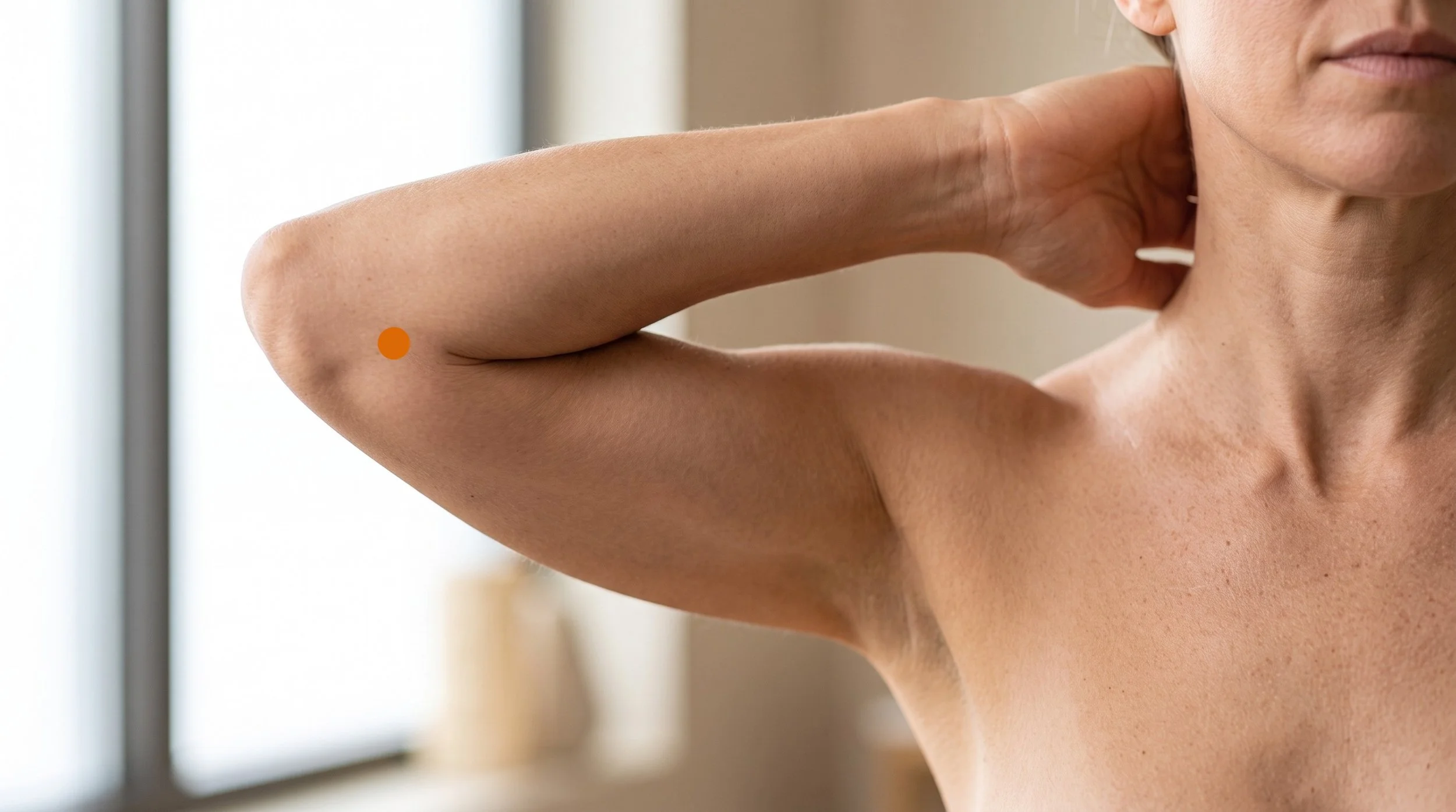
HT3 Acupuncture Point (Shaohai)
The Lesser Sea at the Inner Elbow Crease: Anatomy, Mechanism, and Why This Heart Channel Point Anchors Medial Elbow and Forearm Treatment
HT3, known in Chinese as Shaohai and usually translated as Lesser Sea, sits at the inner end of the elbow crease, in the soft hollow just in front of the bony knob on the inside of the elbow (the medial epicondyle of the humerus). It is classified in the traditional literature as the he-sea point and the water point of the Heart channel, and it happens to land exactly where the common flexor tendon origin, the pronator teres, and the medial elbow soft tissues take load during gripping, throwing, swinging a club, and hours of keyboard work.
That overlap is why the ht3 acupuncture point shows up so often in modern practice: it is a classical Heart channel point that doubles as a precise local access point for golfer's elbow region pain, medial forearm aching, and ulnar-side arm symptoms, and the same point is traditionally credited with settling an agitated mind.
- HT3 lies at the medial end of the flexed elbow crease, anterior to the medial epicondyle, with the needle passing through skin and subcutaneous tissue into the region where the pronator teres and the common flexor tendon origin begin (Deadman point manual grounding). Depth is modest, typically 0.5 to 1 cun perpendicular, or angled distally or toward LI11 when a broader forearm effect is wanted.
- Traditionally HT3 is described as the he-sea and water point of the Heart channel, said to calm the spirit, transform phlegm, clear heat, and free up the arm. In neurophysiological language, those traditional headings describe a point that modulates nociceptive input from the medial elbow and forearm while also engaging autonomic and arousal-related pathways (Zhao, 2008).
- The nerve geography is the clinical story here: the median nerve and brachial artery lie just lateral to the point and the ulnar nerve runs behind the medial epicondyle, so needling is deliberately aimed away from both. Local C6 to T1 afferents converge with input from the same segments in the cervical dorsal horn, which is the plausible basis for segmental pain modulation at this site (Zhao, 2008).
- The research picture for needling at the elbow is promising but not settled. A sham-controlled trial found that needling at selected points beat invasive sham for chronic epicondylitis at early follow-up, with the difference fading by two months (Fink et al., 2002), while a meta-analysis reported short-term pain reduction with manual acupuncture but no clear superiority for electroacupuncture (Navarro-Santana et al., 2021) and an earlier GRADE-rated review found the trial base too weak for firm conclusions (Tang et al., 2015).
- In practice HT3 is rarely used alone. We pair it with LI11 across the joint for elbow pain, with HT7 when arm pain travels alongside stress and poor sleep, and with dry needling of the pronator teres and wrist flexors when palpation reproduces the patient's symptoms (Simons et al., 1999).
- De qi at HT3 is usually a heavy, spreading ache or fullness at the inner elbow that may drift into the forearm. A brief electrical flick down toward the hand means the needle is close to the median or ulnar nerve, and the angle should be adjusted rather than pushed further.
Inner Elbow Pain That Flares Every Time You Grip Something?
Medial elbow pain rarely stays local: it spreads into the forearm, weakens your grip, and makes ordinary tasks feel risky. At Morningside Acupuncture we needle HT3 in the tender hollow in front of the medial epicondyle, then follow the flexor group down the forearm with dry needling where palpation reproduces your pain. We combine that with load guidance so the tendon gets stronger, not just quieter. Schedule a visit and let's map exactly where your elbow pain is coming from.
Schedule NowAnatomy of HT3: Why the Medial Epicondyle Is Such an Important Location
With the elbow bent, HT3 sits at the innermost end of the elbow crease, just in front of the medial epicondyle. Under the skin and a thin subcutaneous layer, the needle enters the region where the pronator teres and the common flexor tendon origin arise from that bony prominence. This is a genuine load hub: wrist flexion, forearm pronation, and hard gripping all pull on this small footprint of tendon and muscle, which is why repetitive club swings, racket work, tool use, and long typing days concentrate strain here.
Palpating the area before needling usually reveals a tender band or two, and those tender spots frequently sit within a fingerbreadth of the classical location.
The nerve story explains both the mechanism and the technique. Sensory and motor supply to this region travels in the median and ulnar nerves, drawing on cervical segments roughly C6 through T1, and afferents from skin, muscle, and tendon at HT3 converge on the same dorsal horn levels that receive input from the painful elbow itself. Needling a tender site inside that shared segmental territory can dampen the dorsal horn's response to nociceptive traffic and recruit descending inhibitory pathways from the brainstem, which is the standard neurophysiological account of acupuncture analgesia (Zhao, 2008).
When needling reproduces and then releases a patient's familiar ache, the myofascial contribution from the pronator teres and adjacent flexors is usually part of the picture (Simons et al., 1999), and clinical work at the elbow suggests that point selection within this region matters rather than being interchangeable with random skin sites (Fink et al., 2002).
Deeper and slightly lateral to HT3 lie the brachial artery and the median nerve, and the ulnar nerve passes behind the medial epicondyle in its groove. Those structures set the conventions: shallow to moderate depth (about 0.5 to 1 cun), perpendicular insertion or an oblique angle directed distally, proximally, or toward LI11, and a firm rule that sharp electrical sensations toward the hand prompt withdrawal and redirection rather than deeper insertion.
A number of classical sources list this point as unsuitable for moxibustion, a caution recorded in the standard point manuals and one reason modern practice here is needle-based. In trained hands, needling at HT3 is low risk, and the anatomy is simply respected rather than feared.
Related Pronator Teres Trigger Points Related Heart ChannelHT3 at a Glance: Classification, Location, and Clinical Use
| Category | Detail |
|---|---|
| Traditional Name | Shaohai (Lesser Sea), HT3, also written Heart 3 or HE-3 |
| Channel Classification | Heart channel of the hand shaoyin (lesser yin) (HT3, also written HE3) |
| Point Categories | He-sea point of the Heart channel; water point of the Heart channel within the five-shu (five transporting point) system; noted in classical sources as contraindicated to moxibustion |
| Precise Location | With the elbow flexed, at the medial end of the transverse elbow crease, in the depression immediately anterior to the medial epicondyle of the humerus, roughly midway between PC3 and the epicondyle |
| Tissue Stimulated | Skin and subcutaneous tissue over the common flexor tendon origin and the pronator teres origin region, with the median nerve and brachial artery lateral and the ulnar nerve behind the epicondyle |
| Needle Depth / Direction | Perpendicular insertion 0.5 to 1 cun; alternatively oblique distally or proximally, or angled toward LI11 for a broader arm effect. Angle away from the median nerve, brachial artery, and ulnar groove. |
| De Qi Sensation | Heavy, spreading fullness or dull ache at the inner elbow, sometimes travelling into the medial forearm. Brief electric sensations toward the hand indicate proximity to the median or ulnar nerve and call for a change of angle. |
| Primary Clinical Uses | Medial elbow (golfer's elbow region) pain, medial forearm pain and heaviness, ulnar-side arm symptoms, arm numbness and tremor (traditional), anxiety and agitation (traditional) |
| Common Point Combinations |
|
Deadman's point manual groups the traditional actions of HT3 under three headings, and each is presented there as classical attribution rather than physiology. First, as a spirit-calming point it appears in old indication lists for agitation, mania and laughter, epilepsy, poor memory, and phlegm-type presentations such as vomiting of watery saliva, though the manual notes that other points are used far more often for these purposes today.
Second, because it is the water point of a fire channel, it was used to drain heat upward from the head, with indications such as red eyes, toothache with chills and fever, and swollen, eroded gums. Third, and most relevant to modern clinics, it was a mainstay for problems of the arm itself: numbness, trembling, swelling and pain at the elbow, difficulty lifting the limb, and wind painful obstruction, with the Classic of the Jade Dragon linking chest fullness and heart agitation to a numb arm that cannot be raised.
What is striking is that a point named for the interior organ (Heart) carried such a heavily musculoskeletal indication list, and that the classical writers already noticed a pattern clinicians still see: agitated patients with aching, heavy arms tend to arrive together.
Why HT3 Is Used for Golfer's Elbow, Forearm Heaviness, and the Stress That Travels With Them
The most practical reason HT3 works for medial elbow pain is location. The point sits directly over the tissue that hurts in golfer's elbow, and the sensory nerves supplying that tissue enter the spinal cord at the same cervical and upper thoracic levels as the nerves carrying the pain. Needling within that shared segmental territory can reduce how strongly the dorsal horn amplifies incoming signals, which is one of the better-supported explanations for local needling effects (Zhao, 2008).
When the pronator teres or the wrist flexors carry taut, tender bands that reproduce a patient's familiar ache, the point also functions as a myofascial target rather than a purely channel-based one (Simons et al., 1999).
Needling also recruits system-wide responses. Stimulation of somatic afferents triggers descending inhibition from brainstem centers using endogenous opioid and monoamine signalling, along with local vascular and neuropeptide changes at the needle site (Zhao, 2008). Those broader effects help explain why a course of acupuncture for chronic musculoskeletal pain tends to produce benefits over both sham and no-acupuncture comparisons in pooled patient-level data, with effects that do not vanish the moment treatment ends (Vickers et al., 2018).
The traditional spirit-calming role deserves a plain-language translation. HT3 does not literally sedate the heart, but needling protocols that include arm and wrist points on the Heart and Pericardium channels are commonly used in anxiety care, and reviews of acupuncture for anxiety disorders report reductions in anxiety scores with an acceptable safety profile, tempered by methodological limitations across the trial base (Yang et al., 2021).
For a patient with a painful forearm plus a clenched jaw and shallow breathing, adding HT3 addresses local tissue and general arousal in the same treatment, which is often how patients describe the improvement they actually notice.
What the Research Shows for HT3
It is worth being clear about what the evidence can and cannot say. No trial tests HT3 in isolation, because acupuncture research almost always evaluates multi-point protocols, and elbow studies have mostly focused on lateral rather than medial epicondylalgia.
The reasonable reading is that needling at and around the elbow, including local tender points that coincide with HT3, appears to offer short-term pain and function benefits for elbow tendinopathy, that the certainty of that evidence is limited by small samples and design problems, and that needling generally works best combined with progressive tendon loading rather than as a stand-alone fix.
| Study | Type | Focus | Key Finding |
|---|---|---|---|
| Fink et al., 2002 | Randomized, patient- and investigator-blinded sham-controlled trial | Chronic epicondylitis, 45 patients, 10 treatments | Both groups improved, and needling at selected points was superior to invasive sham for pain, function, and strength at two weeks, with most differences no longer significant by two months. |
| Navarro-Santana et al., 2021 | Systematic review and meta-analysis | Manual acupuncture and electroacupuncture for lateral epicondylalgia | Manual needling was associated with moderate short-term pain reduction, with no clear advantage for electroacupuncture and limited certainty overall. |
| Tang et al., 2015 | Systematic review with GRADE assessment | Acupuncture for lateral epicondylitis, 4 RCTs, 309 participants | Included trials suggested improvement in elbow function and strength, but methodological quality was poor and the authors drew no firm conclusion. |
| Nuhmani et al., 2023 | Systematic review of randomized controlled trials | Dry needling for tendinopathy, including the elbow | Dry needling appeared broadly comparable to other treatment approaches for pain and symptoms immediately after treatment and up to six months. |
| Vickers et al., 2018 | Individual patient data meta-analysis | Chronic musculoskeletal pain, including peripheral joint pain | Acupuncture was modestly superior to sham and clearly superior to no acupuncture, with benefits only partly diminishing over a year. |
| Choi et al., 2018 | Cochrane systematic review | Acupuncture and related interventions for carpal tunnel symptoms | Evidence for benefit was of low or very low certainty, a useful reminder that upper limb nerve-related complaints need cautious claims. |
| Yang et al., 2021 | Systematic review and meta-analysis | Acupuncture for anxiety disorder, 20 RCTs | Pooled results favored acupuncture for reducing anxiety symptoms with good tolerability, though trial quality limits confidence. |
Arm Pain, Tight Forearms, and a Nervous System Stuck in High Gear?
Many patients with forearm and elbow pain also arrive wound tight, sleeping badly, and clenching through the day. HT3 is traditionally used to settle an agitated mind, and it sits on tissue that stress-related muscle guarding loads directly, which makes it a useful bridge point in these cases. We often combine it with HT7 and a short course of down-regulating needling so pain relief and calm arrive together. Book an appointment and treat both halves of the problem in one session.
Schedule NowHT3 in the Context of Trigger Point Work
Acupuncture, defined simply as treatment using an acupuncture needle, covers hundreds of styles, and dry needling is one of them. At Morningside we treat HT3 as both a classical Heart channel point and a doorway into the medial elbow soft tissues, which means the needle often goes exactly where palpation says it should.
In practice that involves checking the common flexor origin at the epicondyle, then following the pronator teres, flexor carpi radialis, flexor carpi ulnaris, and palmaris longus down the forearm for taut bands that reproduce the patient's pain pattern (Simons et al., 1999). Needling those bands, with or without a local twitch response, is a routine part of a medial elbow plan.
The overlap between point and muscle is unusually tidy here, since the pronator teres origin sits immediately deep to the classical HT3 location. That does not make the traditional and myofascial maps identical, but it does mean one needle can address both frames of reference. We generally combine HT3 and forearm trigger point needling with LI11 across the joint, sometimes with electrical stimulation for chronic cases, and always with grip and wrist-flexor loading between visits, since needling appears to work best alongside exercise rather than instead of it (Nuhmani et al., 2023).
HT3 Golfer's Elbow Treatment at NYC's Highest-Rated Acupuncture Clinic
Morningside Acupuncture is the highest-rated acupuncture and dry needling clinic in New York City with over 500 five-star Google reviews, and medial elbow and forearm complaints are among the cases we see most. Treatment plans built around HT3 typically pair local needling at the flexor origin with trigger point work in the pronator teres and wrist flexors, plus tendon-loading homework between visits. Most patients start with a short course and reassess grip comfort and pain at each session. Schedule your visit today and get a clear plan for your elbow.
Schedule NowFrequently Asked Questions
What does HT3 feel like when needled?
Most people feel a brief pinch as the needle passes the skin, then a heavy, spreading ache or fullness at the inner elbow that may drift toward the forearm. That dull, distributed sensation is the classical de qi response and it usually eases within a minute. Because the median and ulnar nerves run near this point, a short electric flick toward the hand can occur, and if it does the practitioner adjusts the angle immediately rather than needling deeper. Sharp, ongoing pain is not expected and should always be reported.
Why needle the inner elbow when my pain is in the forearm or wrist?
Because the tissues that hurt in the forearm often originate at the elbow. The wrist flexors and pronator teres attach at or near the medial epicondyle, and the nerves supplying that whole region enter the spinal cord at shared cervical and upper thoracic levels, so needling at HT3 sits within the same segmental territory as your symptoms (Zhao, 2008). Treating the origin as well as the painful belly of the muscle tends to give more durable change than chasing the sore spot alone, and traditional sources likewise credited this point with effects across the whole arm rather than just the joint.
Can I press HT3 myself between sessions?
Yes, and it is easy to find on yourself. Bend your elbow to about 90 degrees, feel for the bony knob on the inner side, then slide your thumb just in front of it into the soft hollow at the end of the elbow crease. Press with your thumb using steady, moderate pressure for 30 to 60 seconds, breathe slowly, and hold for up to two or three minutes if it feels productive. You can repeat this two or three times a day, and small circular pressure along the tender forearm flexors afterward often helps. Keep pressure firm but comfortable, ease off if you feel tingling or electrical sensations shooting into your hand, and treat acupressure as a supplement to treatment and loading exercises, not a replacement.
Is HT3 safe to needle?
In trained hands, yes. The relevant structures are known and avoidable: the brachial artery and median nerve lie lateral to the point and the ulnar nerve runs behind the medial epicondyle, so needling stays at moderate depth (about 0.5 to 1 cun) and is angled away from them. Transient soreness or a small bruise are the most common side effects. Several classical texts list this point as contraindicated to moxibustion, so heat is generally not applied here. Tell your practitioner about blood thinners, prior elbow surgery, ulnar nerve transposition, or any known nerve entrapment, since these change technique choices.
Where exactly is HT3 located?
The standard HT 3 location is at the medial end of the elbow crease with the elbow flexed, in the depression directly in front of the medial epicondyle of the humerus, roughly midway between PC3 in the middle of the crease and that bony knob. If you flex your elbow and trace the crease inward until your finger drops into a soft hollow just before the bone, you are at HT3 (Shaohai), also written Heart 3 or HE-3. In clinic we confirm the site by palpating for tenderness in the flexor origin, since the treatable spot is usually within a fingerbreadth of the textbook location.
References
- Deadman, P., Al-Khafaji, M., & Baker, K. (2009). A manual of acupuncture. Journal of Chinese Medicine Publications.
- Maciocia, G. (2005). The foundations of Chinese medicine: A comprehensive text for acupuncturists and herbalists (2nd ed.). Elsevier Churchill Livingstone.
- Maciocia, G. (2006). The channels of acupuncture: Clinical use of the secondary channels and eight extraordinary vessels. Churchill Livingstone Elsevier.
- Simons, D. G., Travell, J. G., & Simons, L. S. (1999). Travell & Simons' myofascial pain and dysfunction: The trigger point manual, Vol. 1: Upper half of body (2nd ed.). Williams & Wilkins.
- Fink, M., Wolkenstein, E., Karst, M., & Gehrke, A. (2002). Acupuncture in chronic epicondylitis: A randomized controlled trial. Rheumatology, 41(2), 205-209. https://doi.org/10.1093/rheumatology/41.2.205
- Navarro-Santana, M. J., Sanchez-Infante, J., Gómez-Chiguano, G. F., Cummings, M., Fernández-de-las-Peñas, C., & Plaza-Manzano, G. (2021). Effects of manual acupuncture and electroacupuncture for lateral epicondylalgia of musculoskeletal origin: A systematic review and meta-analysis. Acupuncture in Medicine, 39(5), 405-422. https://doi.org/10.1177/0964528420967364
- Tang, H., Fan, H., Chen, J., Yang, M., Yi, X., Dai, G., Chen, J., Tang, L., Rong, H., Wu, J., & Liang, F. (2015). Acupuncture for lateral epicondylitis: A systematic review. Evidence-Based Complementary and Alternative Medicine, 2015, 861849. https://doi.org/10.1155/2015/861849
- Nuhmani, S., Khan, M. H., Ahsan, M., Abualait, T. S., & Muaidi, Q. (2023). Dry needling in the management of tendinopathy: A systematic review of randomized control trials. Journal of Bodywork and Movement Therapies, 33, 128-135. https://doi.org/10.1016/j.jbmt.2022.09.021
- Choi, G. H., Wieland, L. S., Lee, H., Sim, H., Lee, M. S., & Shin, B. C. (2018). Acupuncture and related interventions for the treatment of symptoms associated with carpal tunnel syndrome. Cochrane Database of Systematic Reviews, 2018(12), CD011215. https://doi.org/10.1002/14651858.CD011215.pub2
- Yang, X. Y., Yang, N. B., Huang, F. F., Ren, S., & Li, Z. J. (2021). Effectiveness of acupuncture on anxiety disorder: A systematic review and meta-analysis of randomised controlled trials. Annals of General Psychiatry, 20(1), 9. https://doi.org/10.1186/s12991-021-00327-5
- Vickers, A. J., Vertosick, E. A., Lewith, G., MacPherson, H., Foster, N. E., Sherman, K. J., Irnich, D., Witt, C. M., & Linde, K. (2018). Acupuncture for chronic pain: Update of an individual patient data meta-analysis. Journal of Pain, 19(5), 455-474. https://doi.org/10.1016/j.jpain.2017.11.005
- Zhao, Z. Q. (2008). Neural mechanism underlying acupuncture analgesia. Progress in Neurobiology, 85(4), 355-375. https://doi.org/10.1016/j.pneurobio.2008.05.004
Disclaimer: This web site is intended for educational and informational purposes only. Reading this website does not constitute providing medical advice or any professional services. This information should not be used for diagnosing or treating any health issue or disease. Those seeking medical advice should consult with a licensed physician. Seek the advice of a medical doctor or other qualified health professional for any medical condition. If you think you have a medical emergency, call 911 or go to the emergency room. No acupuncturist-patient relationship is created by reading this website or using the information. Morningside Acupuncture PLLC and its employees and contributors do not make any express or implied representations with respect to the information on this site or its use. For any legal interpretation of scope of practice in your state, consult a licensed attorney or regulatory authority.
Read more from our blog



