HT4 Acupuncture Point (Lingdao)
The Spirit Path Above the Wrist: Anatomy, Mechanism, and Why This Small Heart Channel Point Bridges Calming Work and Ulnar-Side Forearm Pain
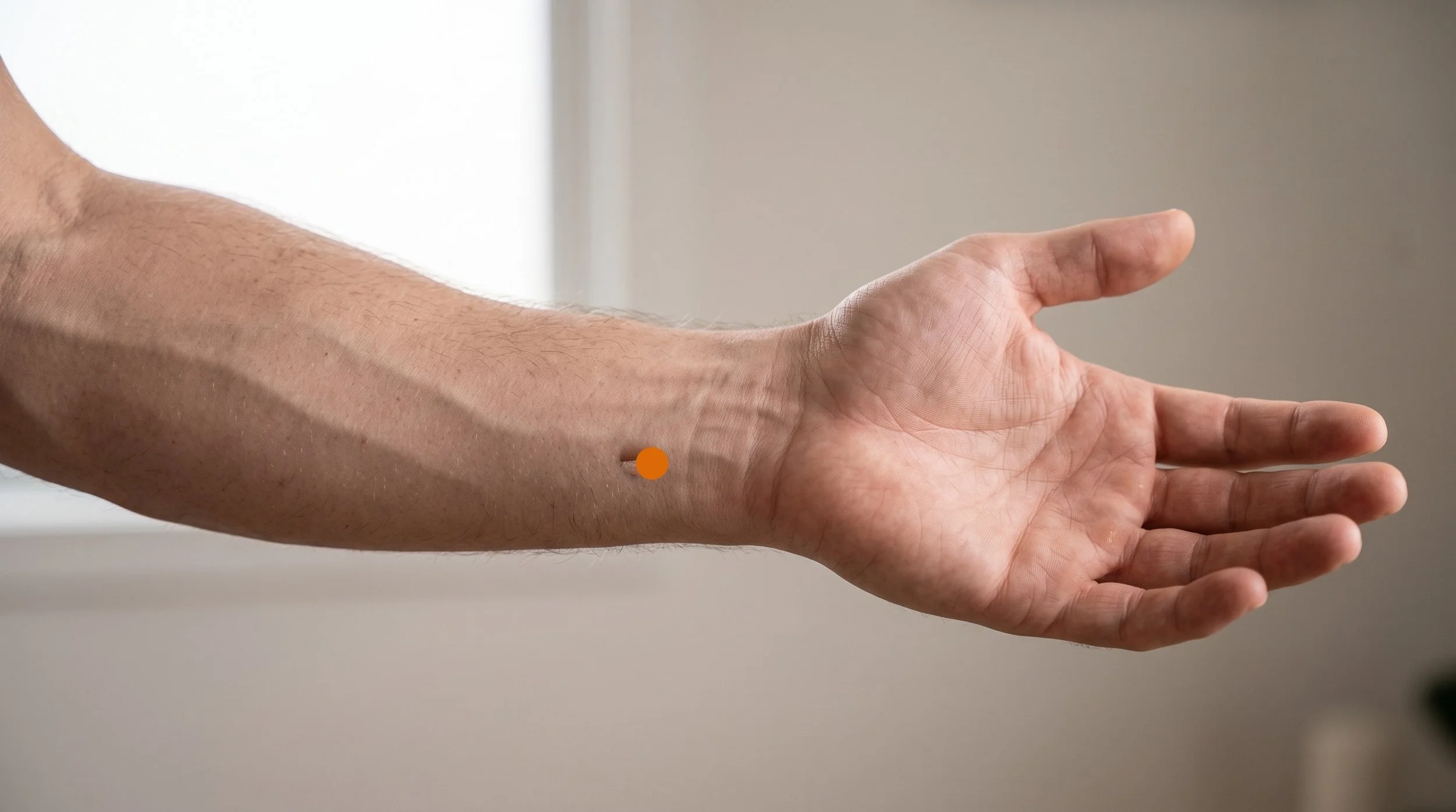
HT4 (Lingdao, often translated as Spirit Path) sits on the palm side of the forearm, one and a half cun above the wrist crease at HT7, tucked against the thumb-side edge of the flexor carpi ulnaris tendon. It is the jing-river point and the Metal point of the Heart channel, which in classical texts made it a go-to choice for problems that show up in the voice and in the emotions.
In a modern clinic, the ht4 acupuncture point matters for two reasons that have nothing to do with mysticism: it sits in a dense sensory corridor near the ulnar nerve and the tendons that flex the wrist, and it belongs to a small cluster of distal Heart channel points (HT4, HT5, HT6, HT7) that practitioners reach for when a patient presents with anxiety, chest tightness, vocal strain, or ulnar-sided wrist and forearm discomfort.
- Location and layers: HT4 is found 1.5 cun proximal to HT7 on the radial side of the flexor carpi ulnaris tendon, so a needle passes through thin skin and subcutaneous tissue into the tendon margin and the fascial plane over the deeper finger flexors. The ht 4 wrist region is superficial, mobile, and easy to palpate on most patients.
- Traditional categories, plainly stated: classical sources classify Lingdao as the jing-river and Metal point of the Heart channel and attribute to it the traditional actions of calming the spirit, benefiting the voice, and relaxing the sinews. These are historical attributions from texts such as Deadman's A Manual of Acupuncture, not physiological claims.
- Nerve geography drives the mechanism: the point overlies the corridor where the ulnar nerve and artery travel toward the wrist, with skin supplied by the medial antebrachial cutaneous nerve at roughly the C8 and T1 segmental level, so stimulation feeds afferent input into the same cord segments that serve the ulnar hand and the medial forearm (Zhao, 2008).
- Research picture: no trial has isolated heart 4 by itself, but wrist-level needling has measurable effects on nerve function and cortical maps in entrapment neuropathy (Maeda et al., 2017), and pooled patient-level data support acupuncture for chronic musculoskeletal pain (Vickers et al., 2018). Anxiety reviews are encouraging but methodologically mixed (Yang et al., 2021).
- A point-specific physiological signal exists in a small way: a double-blind crossover trial applying magnetic stimulation along the Heart channel segment between HT4 and HT6 examined heart rate variability outcomes, and needling at the neighboring HT7 has been associated with short-term autonomic changes in healthy volunteers (Jo, 2021; Huang et al., 2015).
- De qi and practice framing: patients usually report a dull, heavy, spreading ache at the ulnar edge of the forearm, sometimes traveling toward the little finger. HT4 is almost never used alone; it is one component of a treatment that may also address the neck, chest, jaw, or forearm muscles depending on the presentation.
Struggling With Anxiety, Chest Tightness, or a Racing Mind?
At Morningside Acupuncture we use distal Heart channel points like HT4 and HT7 as part of calming, parasympathetic-leaning treatments rather than as standalone fixes. Sessions are built around your history, your sleep, your breathing pattern, and where you actually hold tension. Many patients notice they settle within the first few needles, and we track changes visit to visit. Schedule a visit and let's map out a plan that fits your nervous system.
Schedule NowAnatomy of HT4: Why the Radial Edge of the Flexor Carpi Ulnaris Tendon Is Such an Important Location
Find the pisiform bone at the base of the little finger side of the palm, follow the flexor carpi ulnaris tendon proximally, and move about one and a half cun (roughly two finger widths) above the wrist crease. HT4 sits on the thumb side of that tendon. The layers here are thin: skin, a modest layer of subcutaneous fat, then the tendon border and the fascial plane covering flexor digitorum superficialis and profundus. This zone is loaded constantly by ordinary life, since typing, gripping a phone, holding a bag, lifting weights, and playing an instrument all recruit the wrist and finger flexors. Repeated loading leaves the tissue tender and the tendon margin sensitive long before imaging shows anything at all.
Beneath and slightly deep to the point, the ulnar nerve and ulnar artery run together toward the wrist, and the overlying skin is supplied largely by the medial antebrachial cutaneous nerve at approximately the C8 and T1 spinal levels. That segmental address is the practical reason HT4 behaves the way it does: afferent signals from the point converge in the same dorsal horn territory that receives input from the ulnar wrist, the medial forearm, and the fourth and fifth fingers, which is the standard convergence model behind local and near-segmental needling effects (Zhao, 2008).
Needling at the wrist has also been shown to change more than local tissue. In carpal tunnel syndrome, verum acupuncture at wrist-level and distal points improved median nerve conduction and increased the separation of finger representations in the primary somatosensory cortex, while sham needling did not (Maeda et al., 2017). That study concerned the median nerve rather than the ulnar nerve, so it should be read as a demonstration that wrist needling can reach both peripheral and central levels, not as direct proof about HT4.
The vascular and neural structures at this location are the reason needling conventions here are conservative. Standard depth is a perpendicular insertion of about 0.3 to 0.5 cun, or an oblique insertion up or down the channel of 0.5 to 1 cun, which keeps the needle in the tendon margin and fascial plane rather than driving toward the neurovascular corridor. If a patient reports a sharp electrical sensation shooting into the little finger, the needle is withdrawn and redirected, since paresthesia is a signal to change course rather than something to chase.
Clean technique, single-use sterile needles, and attention to anticoagulant use are routine, and adverse events from wrist needling in controlled trials have generally been minor, such as brief local pain or bruising (Choi et al., 2018).
Related Flexor Carpi Ulnaris Trigger Points Related Heart ChannelHT4 at a Glance: Classification, Location, and Clinical Use
| Category | Detail |
|---|---|
| Traditional Name | Lingdao (Spirit Path), HT4, also written Heart 4 or HE-4 |
| Channel Classification | Heart channel of the hand shaoyin, distal forearm segment (HT4, also written HE4) |
| Point Categories | Jing-river (river) point of the Heart channel; Metal point of the Heart channel within the five shu transporting point system |
| Precise Location | Palm side of the forearm, 1.5 cun proximal to HT7 at the wrist crease, on the radial (thumb) side of the flexor carpi ulnaris tendon |
| Tissue Stimulated | Skin and subcutaneous tissue over the radial border of the flexor carpi ulnaris tendon, with the fascial plane over flexor digitorum superficialis and flexor digitorum profundus lying deeper |
| Needle Depth / Direction | Perpendicular 0.3 to 0.5 cun, or oblique proximally or distally along the channel 0.5 to 1 cun; shallow technique preferred over deep thrusting |
| De Qi Sensation | Dull, heavy, slightly aching fullness at the ulnar forearm, sometimes spreading toward the little finger or up the medial forearm; sharp electric radiation means the needle should be repositioned |
| Primary Clinical Uses | Traditionally used for sudden loss of voice and hoarseness, sadness and fearfulness with restlessness, and contraction of the elbow and arm; in modern practice, ulnar-side wrist and forearm discomfort and as a supporting point in calming treatments |
| Common Point Combinations |
|
In Deadman's A Manual of Acupuncture, Lingdao is presented as a point whose name (Spirit Path) points directly at its traditional role: calming the spirit in states described as sadness, fearfulness, and the restless zang pattern, a classical picture of emotional volatility, low mood, agitation, poor sleep, and sometimes loss of voice that older commentaries linked to prolonged worry and rumination.
The same source explains the voice indications through the five shu system, since the Spiritual Pivot advised needling jing-river points when a disorder shows itself in changes to the patient's voice, and Maciocia's channel writing lists HE-4 among the river points cited for loss of voice.
A second classical rationale covers the musculoskeletal indications: the Spiritual Pivot line about treating the yin within yang, meaning sinews and bones, at the jing-river point of a yin channel is used to justify the traditional listing for contraction of the elbow and arm along with a deep cold sensation in the bones.
All of these are traditional attributions rather than physiological findings, but the pattern is striking, because a single small forearm point was assigned to emotion, to voice, and to arm contracture, three things that a modern clinician would recognize as sharing a nervous system rather than a metaphysical thread.
Why HT4 Is Used for Voice Problems and Vocal Strain
The classical indication that surprises most patients is voice. Sudden hoarseness or loss of voice appears repeatedly in HT4's traditional indication lists, and the historical justification came from five shu theory rather than anatomy. A modern reading is less exotic. Voice production depends on laryngeal muscles that are exquisitely sensitive to autonomic state and to global muscle tone, and clinicians who treat vocal complaints regularly see them tighten under stress.
Needling a distal point does not touch the larynx, but sensory input from the forearm reaches the central nervous system, where it can engage descending pain-modulating and autonomic pathways that influence tone and arousal (Zhao, 2008).
There is limited direct evidence for acupuncture and the voice, and it does not test HT4 specifically. A randomized three-armed trial in primary muscle tension dysphonia found that acupuncture, alone or combined with voice training, was associated with improvements in voice-related outcomes and reduced anxiety, with the combined approach performing best (Liang et al., 2023). That trial used a different point prescription, so the fair conclusion is that needling appears plausible as an adjunct to voice therapy, not that a single forearm point restores a voice.
The autonomic angle is the more testable part of the story. Needling at HT7, immediately distal to HT4, was associated with short-term increases in heart rate variability measures in healthy volunteers during stimulation, suggesting a shift in cardiac autonomic regulation that did not persist after the needles were removed (Huang et al., 2015). A separate double-blind crossover experiment applying magnetic stimulation along the Heart channel line between HT4 and HT6 also used heart rate variability as its outcome measure, which shows this forearm segment has been studied as an autonomic input site (Jo, 2021).
These findings are small, short in duration, and not proof of clinical benefit, but they fit the way HT4 is used in practice: as one input among several intended to lower arousal.
What the Research Shows for HT4
Point-specific research on HT4 is thin, and that should be said plainly. Almost all acupuncture trials test multi-point protocols delivered over several weeks, so the honest framing is that HT4 appears within Heart channel and calming prescriptions rather than as a tested intervention on its own. The table below summarizes the reviews and studies most relevant to how the point is actually used: chronic pain evidence for the general method, wrist-level neurophysiology, anxiety reviews with acknowledged quality limits, and small autonomic studies involving neighboring or overlapping Heart channel points.
| Study | Type | Focus | Key Finding |
|---|---|---|---|
| Vickers et al., 2018 | Individual patient data meta-analysis | Acupuncture for chronic musculoskeletal, headache, and osteoarthritis pain | Acupuncture was associated with modest but statistically significant benefits over both sham and no-acupuncture controls, with effects persisting over about a year. |
| Choi et al., 2018 | Cochrane systematic review | Acupuncture and related interventions for carpal tunnel syndrome symptoms | Twelve trials with 869 participants provided low-certainty evidence, with no clear difference from sham and only minor adverse events such as local pain and bruising reported. |
| Maeda et al., 2017 | Randomized neuroimaging trial | Wrist-level and distal needling in carpal tunnel syndrome | Verum acupuncture improved median nerve conduction latency and increased somatosensory cortical separation of affected digits, while sham needling did not. |
| Yang et al., 2021 | Systematic review and meta-analysis | Acupuncture for anxiety disorder | Pooled results favored acupuncture over control conditions with a small to moderate effect size, though the authors noted heterogeneity and methodological limitations. |
| Huang et al., 2015 | Exploratory randomized study | Needling at HT7 and heart rate variability in 120 healthy volunteers | HRV components were higher during verum needling than in sham and no-treatment groups, but the difference did not persist after stimulation ended. |
| Jo, 2021 | Double-blind randomized crossover trial | Magnetic stimulation along the Heart channel line between HT4 and HT6 | The study examined heart rate variability outcomes from stimulation of this forearm segment in healthy young adults, providing preliminary rather than clinical evidence. |
| Liang et al., 2023 | Randomized three-armed clinical trial | Acupuncture with voice training in primary muscle tension dysphonia | Acupuncture alone or with voice training was associated with improved voice-related measures and lower anxiety, with the combination performing best. |
Ulnar-Side Wrist and Forearm Pain That Will Not Quit?
Pain along the little-finger side of the wrist often involves the flexor carpi ulnaris, the deep finger flexors, and irritable tissue around the ulnar nerve corridor. We combine channel points such as HT4 and HT7 with precise dry needling of the forearm flexors, plus grip and wrist loading advice you can actually follow at a desk. Treatment is graded so we do not flare a sensitive nerve. Book an assessment and we'll find the tissue driving it.
Schedule NowHT4 in the Context of Trigger Point Work
HT4 sits directly on real estate that matters for myofascial forearm pain. The radial border of flexor carpi ulnaris, along with the deeper finger flexors, is a common source of aching along the ulnar forearm and into the wrist and hand, and the trigger point literature describes referral patterns from the wrist and finger flexors that patients often mistake for nerve problems (Simons et al., 1999). When a patient with ulnar-sided wrist pain has a tender, taut band right where the spirit path point is located, the distinction between needling a classical point and needling a myofascial target becomes academic. Acupuncture is the use of an acupuncture needle, and dry needling is one of the hundreds of styles in which that needle is used.
At Morningside Acupuncture, treatment for ulnar wrist and forearm complaints usually pairs channel points like HT4 and HT7 with dry needling of the flexor carpi ulnaris, flexor digitorum superficialis and profundus, and often the extensor carpi ulnaris on the back of the forearm, since gripping loads both sides. We stay shallow near the ulnar neurovascular corridor, we avoid provoking nerve paresthesia, and we follow needling with grip loading, wrist mobility, and workstation adjustments so the tissue tolerates daily demands. If symptoms suggest nerve entrapment rather than muscle pain, we say so and refer for appropriate evaluation.
HT4 Anxiety and Forearm Pain Treatment at NYC's Highest-Rated Acupuncture Clinic
Morningside Acupuncture is the highest-rated acupuncture and dry needling clinic in New York City with over 500 five-star Google reviews, and our practitioners integrate classical point selection with modern pain science. Whether your concern is anxiety, vocal strain, or ulnar-sided wrist discomfort, we explain exactly what we are needling and why. Every plan is written down so you know what progress should look like. Schedule your first session and get started.
Schedule NowFrequently Asked Questions
What does HT4 feel like when needled?
Most people feel a brief pinch at the skin, then a dull, heavy, spreading ache or fullness at the ulnar edge of the forearm. That heaviness is the de qi sensation practitioners look for, and it may travel slightly toward the little finger or up the medial forearm. Because the point sits near the ulnar nerve corridor, a small number of patients feel a quick buzzing or tingling. A sharp electric zap into the little finger is not the goal, and it tells the practitioner to withdraw slightly and redirect.
Why would a forearm point be used for voice or emotional symptoms rather than needling the throat?
Classically, HT4 was chosen because it is the jing-river point of the Heart channel, and older texts advised using jing-river points when symptoms show up in the voice. Physiologically, distal points work through the nervous system rather than through direct contact with the affected structure: sensory input from the forearm ascends to the spinal cord and brainstem, where it can engage descending modulatory and autonomic pathways that influence arousal, muscle tone, and pain processing (Zhao, 2008). In practice, distal points like HT4 are usually combined with local points near the throat or neck when the complaint is vocal, so it is rarely an either-or choice.
Can I press HT4 myself between sessions?
Yes, and it is easy to reach. Rest your forearm palm-up, find the wrist crease, then move about two finger widths (roughly 1.5 cun) up the forearm toward the elbow and slide to the thumb side of the prominent tendon on the little-finger edge. Press with the pad of your opposite thumb using firm, comfortable pressure, around a 4 to 6 out of 10, and hold for 30 to 60 seconds while breathing slowly with a longer exhale. Repeat two or three times per side, once or twice a day, and add small circular motions if the tissue feels ropey. Stop if you feel tingling or electrical sensation into the little finger, and skip acupressure over broken skin, bruising, or an area that is sharply painful to touch.
Is HT4 safe to needle?
In trained hands, yes. The needling depth is shallow (about 0.3 to 0.5 cun perpendicular, or 0.5 to 1 cun oblique along the channel), which keeps the needle in the tendon border and fascial plane rather than the deeper corridor where the ulnar nerve and artery travel. Practitioners use single-use sterile needles, avoid deep aggressive thrusting, and reposition immediately if a patient reports electrical radiation into the hand. Reported adverse events from wrist-area needling in controlled trials have generally been minor, such as brief local soreness or bruising, with no serious events reported (Choi et al., 2018). Tell your practitioner if you take blood thinners, have a known nerve entrapment, or have had recent wrist surgery.
Where exactly is HT4 located?
Turn your palm up and locate the wrist crease. HT7 sits at the crease just on the thumb side of the flexor carpi ulnaris tendon, at the ulnar edge of the wrist. From there, measure 1.5 cun (about two finger widths of your own hand) up toward the elbow, staying on the radial side of that same tendon. That is HT4. HT5 and HT6 sit between HT4 and the wrist crease, so if you are palpating a cluster of tender spots in that short stretch, you are in the right neighborhood.
References
- Deadman, P., Al-Khafaji, M., & Baker, K. (2009). A manual of acupuncture. Journal of Chinese Medicine Publications.
- Maciocia, G. (2006). The channels of acupuncture: Clinical use of the secondary channels and eight extraordinary vessels. Churchill Livingstone Elsevier.
- Cunningham, P. M. (2000). Acupuncture points: A practical guide to classical and modern usage. Odyssey Press.
- White, A., Cummings, M., & Filshie, J. (2008). An introduction to Western medical acupuncture. Churchill Livingstone Elsevier.
- Simons, D. G., Travell, J. G., & Simons, L. S. (1999). Travell & Simons' myofascial pain and dysfunction: The trigger point manual, Vol. 1: Upper half of body (2nd ed.). Williams & Wilkins.
- Zhao, Z. Q. (2008). Neural mechanism underlying acupuncture analgesia. Progress in Neurobiology, 85(4), 355-375. https://doi.org/10.1016/j.pneurobio.2008.05.004
- Vickers, A. J., Vertosick, E. A., Lewith, G., MacPherson, H., Foster, N. E., Sherman, K. J., Irnich, D., Witt, C. M., & Linde, K. (2018). Acupuncture for chronic pain: Update of an individual patient data meta-analysis. Journal of Pain, 19(5), 455-474. https://doi.org/10.1016/j.jpain.2017.11.005
- Choi, G. H., Wieland, L. S., Lee, H., Sim, H., Lee, M. S., & Shin, B. C. (2018). Acupuncture and related interventions for the treatment of symptoms associated with carpal tunnel syndrome. Cochrane Database of Systematic Reviews, 2018(12), CD011215. https://doi.org/10.1002/14651858.CD011215.pub2
- Maeda, Y., Kim, H., Kettner, N., Kim, J., Cina, S., Malatesta, C., Gerber, J., McManus, C., Ong-Sutherland, R., Mezzacappa, P., Libby, A., Mawla, I., Morse, L. R., Kaptchuk, T. J., Audette, J., & Napadow, V. (2017). Rewiring the primary somatosensory cortex in carpal tunnel syndrome with acupuncture. Brain, 140(4), 914-927. https://doi.org/10.1093/brain/awx015
- Yang, X. Y., Yang, N. B., Huang, F. F., Ren, S., & Li, Z. J. (2021). Effectiveness of acupuncture on anxiety disorder: A systematic review and meta-analysis of randomised controlled trials. Annals of General Psychiatry, 20, 9. https://doi.org/10.1186/s12991-021-00327-5
- Huang, H., Zhong, Z., Chen, J., Huang, Y., Luo, J., Wu, J., Liao, H., Zhen, E., Lin, R., Fasmer, O. B., & Wik, G. (2015). Effect of acupuncture at HT7 on heart rate variability: An exploratory study. Acupuncture in Medicine, 33(1), 30-35. https://doi.org/10.1136/acupmed-2013-010441
- Jo, H. G. (2021). Effect of line-magnet stimulation on HRV: A double-blind, randomized, crossover trial. Healthcare, 9(4), 421. https://doi.org/10.3390/healthcare9040421
- Liang, F. Q., Shi, Y., Dong, L., Xie, Y., Wang, X. C., He, X. N., Zhang, R., Liu, T., & Zhou, L. (2023). Acupuncture combined with voice training improved voice function in patients with primary muscular tension dysphonia (MTD): A randomized, three-armed, open-label clinical trial. Evidence-Based Complementary and Alternative Medicine, 2023, 2418719. https://doi.org/10.1155/2023/2418719
Disclaimer: This web site is intended for educational and informational purposes only. Reading this website does not constitute providing medical advice or any professional services. This information should not be used for diagnosing or treating any health issue or disease. Those seeking medical advice should consult with a licensed physician. Seek the advice of a medical doctor or other qualified health professional for any medical condition. If you think you have a medical emergency, call 911 or go to the emergency room. No acupuncturist-patient relationship is created by reading this website or using the information. Morningside Acupuncture PLLC and its employees and contributors do not make any express or implied representations with respect to the information on this site or its use. For any legal interpretation of scope of practice in your state, consult a licensed attorney or regulatory authority.
Read more from our blog