HT5 Acupuncture Point (Tongli)
The Luo Point One Cun Above the Wrist Crease: Anatomy, Mechanism, and Why Tongli Connects Speech, Heart Rhythm, and Calm
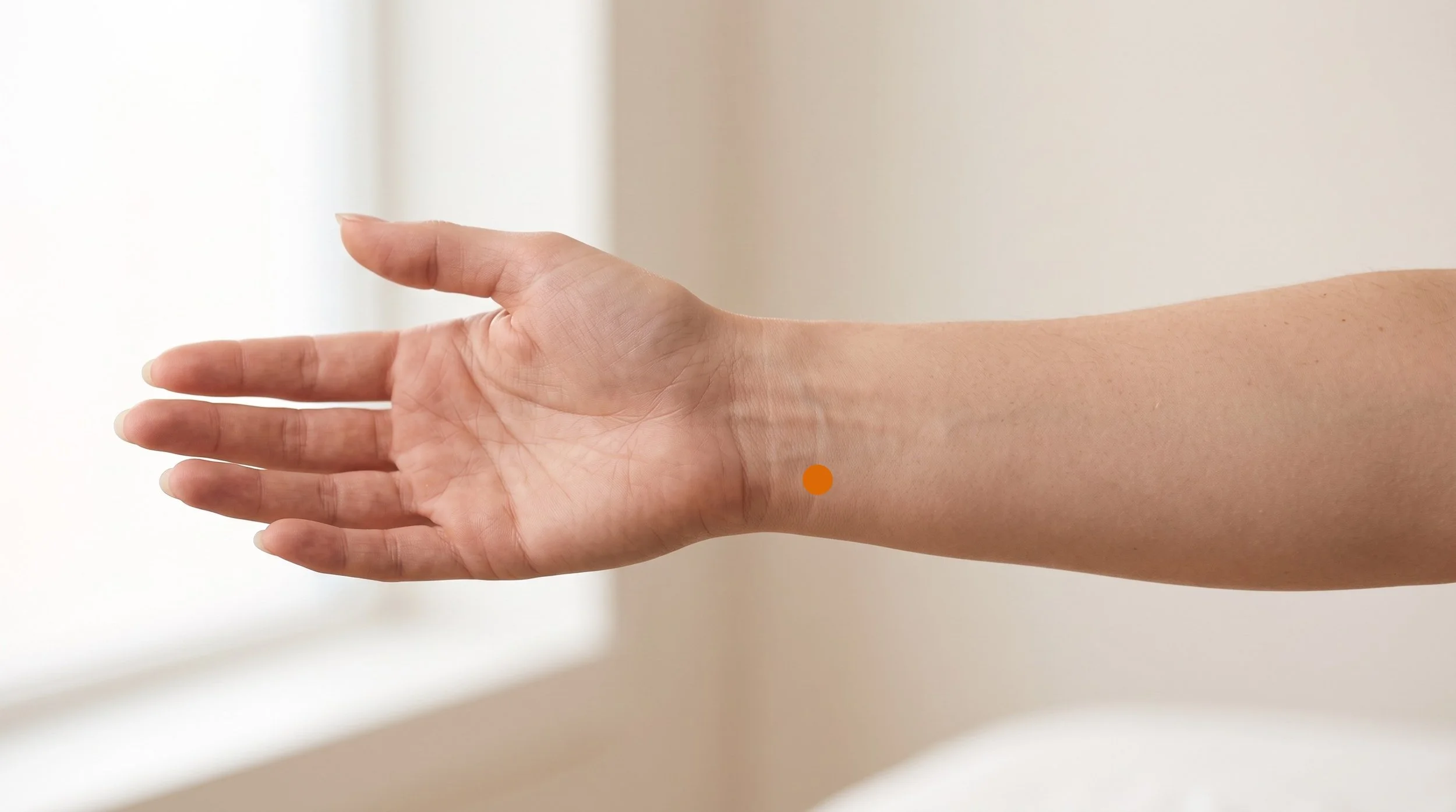
HT5 (Tongli, often translated as Penetrating the Interior or Inner Communication) sits on the palm side of the forearm, one finger's width above the wrist crease, tucked against the thumb side of the flexor carpi ulnaris tendon.
It's the luo-connecting point of the Heart channel, and in classical texts that structural role carries real clinical weight: the connecting branch was described as diving into the Heart itself and then running up to the root of the tongue and the eye, which is why a small point at the wrist collected indications for speech, voice, palpitations, and emotional restlessness (Deadman et al., 2007).
Modern practice keeps the same address for different reasons. The ht5 acupuncture point sits over a C8 and T1 territory that shares spinal segments with cardiac autonomic traffic, it's one of the few forearm points studied directly with brain imaging, and it's easy to reach in a chair with the palm turned up, which makes it a practical addition to sessions for anxiety, stress-related palpitations, and ulnar-side forearm complaints.
- Location and layers: heart 5 lies 1 cun proximal to HT7 on the radial edge of the flexor carpi ulnaris tendon, so the needle passes through thin skin and subcutaneous fascia into the tendon border and the fascial plane over the deep finger flexors (Deadman et al., 2007). This is a shallow, low-tissue-volume site, which shapes both depth and technique.
- Traditional categories, translated: classical sources list HT5 as the Heart luo-connecting point and one of Ma Dan-yang's Heavenly Star points, with attributed actions of settling the mind, regulating Heart rhythm, benefiting the tongue, and freeing the channel locally (Deadman et al., 2007; Maciocia, 2015). Read neurophysiologically, that cluster maps onto autonomic modulation plus segmental input at the wrist.
- Mechanism: the point sits in the ulnar neurovascular corridor, innervated by the medial antebrachial cutaneous nerve with the ulnar nerve running just deep and ulnar, feeding C8 and T1 dorsal horn segments that also receive upper thoracic autonomic afferents. Needling recruits A-delta and C fibers and engages descending inhibitory pathways involving endogenous opioids, serotonin, and noradrenaline (Zhao, 2008).
- Research picture: HT5 is unusual among forearm points in having point-specific imaging work, with electroacupuncture at Tongli associated with activation in language-related cortical regions including the left inferior frontal gyrus in healthy volunteers (Li et al., 2018; Liu et al., 2017). These are small mechanistic studies, not treatment trials, and they don't establish clinical benefit on their own.
- Clinical framing: HT5 is rarely used alone. It's typically one point in a protocol that may also address the neck, chest, and distal limb, and reviews of acupuncture for anxiety, autonomic balance, and post-stroke language function test whole protocols rather than single points (Yang et al., 2021; Hamvas et al., 2023; Zhang et al., 2019).
- De qi: patients usually report a contained ache, heaviness, or spreading fullness at the wrist, sometimes traveling toward the little finger or up the forearm. A study comparing Tongli-based stimulation with non-acupoint sites found fullness, heaviness, numbness, soreness, and throbbing rated more intensely at the real points (Li et al., 2018).
Anxious, Wired, and Feeling Your Heartbeat All Day?
Stress that shows up as a racing chest, a tight throat, and a mind that won't settle is one of the most common reasons New Yorkers come to us. At Morningside Acupuncture we often use HT5 with HT7, PC6, and points at the neck and abdomen to encourage a shift toward parasympathetic tone during the session, then build a plan around sleep, breathing, and workload. Cardiac symptoms always deserve medical evaluation first, and we work alongside your physician rather than in place of them. Schedule a visit and we'll map out a sensible course of care.
Schedule NowAnatomy of HT5: Why the Radial Edge of the Flexor Carpi Ulnaris Tendon Is Such an Important Location
To find the ht 5 wrist location, turn the palm up and follow the flexor carpi ulnaris tendon toward the pisiform bone at the little-finger side of the wrist crease. HT7 sits at the crease on the thumb side of that tendon, and HT5 is one cun (roughly one thumb width) directly above it, still hugging the radial border of the tendon (Deadman et al., 2007). Under the needle there's very little bulk: skin, a thin subcutaneous layer, then the tendon edge and the fascial plane leading toward flexor digitorum superficialis and profundus.
This region takes constant low-grade load from typing, phone use, gripping, and any sport that involves sustained wrist flexion or ulnar deviation, so it's frequently tender even in people who never think of their forearm as a problem area.
The neural geography is what makes this small window interesting. Skin here is supplied by the medial antebrachial cutaneous nerve, while the ulnar nerve and ulnar artery travel just deep and ulnar to the point, and those structures feed the C8 and T1 spinal segments. Those same segments and their upper thoracic neighbors receive visceral afferent traffic from the heart, which gives a plausible convergence-based account of why a wrist point kept turning up in classical entries about palpitations and chest oppression.
Needling at this depth recruits A-delta and C fibers, drives dorsal horn activity, and engages descending inhibitory control involving opioid, serotonergic, and noradrenergic systems, mechanisms mapped in detail in the acupuncture analgesia literature (Zhao, 2008). Systemic effects matter here too: pooled data suggest real needling shifts heart rate variability toward greater parasympathetic tone compared with placebo needling, though the authors urge caution given study quality (Hamvas et al., 2023).
Safety comes down to respecting the ulnar corridor. The ulnar artery and nerve run close enough that careless deep or ulnar-directed insertion can produce a sharp electric sensation down to the fourth and fifth fingers, which is a signal to withdraw and redirect rather than push through. Standard technique is a perpendicular insertion of 0.3 to 0.5 cun, or an oblique insertion of 0.5 to 1 cun angled proximally or distally along the channel, staying on the tendon's radial edge rather than sliding beneath it (Deadman et al., 2007). Thin needles, gentle stimulation, and a supported forearm make the point comfortable for most patients, including those who are needle-cautious.
Related Heart Channel Related Luo Connecting PointsHT5 at a Glance: Classification, Location, and Clinical Use
| Category | Detail |
|---|---|
| Traditional Name | Tongli (Penetrating the Interior, also rendered as Inner Communication) |
| Channel Classification | Heart channel of the hand shaoyin, fifth point (HT5 / HE-5) |
| Point Categories | Luo-connecting point of the Heart channel, linking with the Small Intestine channel; one of Ma Dan-yang's eleven Heavenly Star points; classically assigned excess and deficiency luo indications in the Great Compendium |
| Precise Location | Palm side of the forearm, 1 cun proximal to HT7 at the wrist crease, on the radial (thumb) side of the flexor carpi ulnaris tendon |
| Tissue Stimulated | Skin and subcutaneous fascia, the radial border of the flexor carpi ulnaris tendon, and the fascial plane over flexor digitorum superficialis and flexor digitorum profundus, with the ulnar nerve and artery lying deep and ulnar |
| Needle Depth / Direction | Perpendicular 0.3 to 0.5 cun, or oblique 0.5 to 1 cun directed proximally or distally along the channel; angle away from the ulnar neurovascular bundle |
| De Qi Sensation | A contained ache, heaviness, or fullness at the wrist that may spread up the forearm or toward the little finger; sharp electric sensation into the fourth and fifth fingers means the needle should be withdrawn and redirected |
| Primary Clinical Uses | Anxiety with restlessness, stress-related palpitations after medical evaluation, classical speech and voice indications including sudden voice loss and stuttering, and ulnar-side wrist and forearm heaviness |
| Common Point Combinations |
|
The Manual of Acupuncture summarizes a strikingly broad classical profile for this small point (Deadman et al., 2007). Traditionally, HT5 was said to settle the mind, steady the rhythm of the Heart, benefit the tongue, and free the local channel, and the reasoning offered in the classics is architectural rather than mystical: as the Heart's luo-connecting point, its branch was described as penetrating inward to the organ and then rising to the root of the tongue and the region of the eye, which is exactly where its indications cluster.
Older sources attribute to it emotional states from fright and vexation to sadness and low mood, palpitations of several graded types, sudden voice loss, tongue stiffness affecting speech, stuttering, headache and dizziness with red eyes, and heaviness or pain through the wrist and elbow, along with a small set of gynecological and urinary entries unusual for the Heart channel.
Ma Dan-yang's inclusion of it among his Heavenly Star points, with a description contrasting excess presentations (heaviness of the limbs, red face) against deficient ones (voice loss, a flat expression), tells you how much clinical mileage earlier physicians expected from a single spot above the wrist crease. What makes the pattern striking is its coherence: speech, emotion, and heartbeat were treated as one connected system, and one point was chosen to address all three.
Why HT5 Is Used for Speech, Voice, and Emotional Restlessness Rather Than Just the Wrist
The first part of the answer is segmental. HT5 sits in a C8 and T1 sensory field, and those dorsal horn segments, together with their upper thoracic neighbors, also receive autonomic afferent input related to the heart. When several inputs converge on shared spinal neurons, stimulating the somatic one can modulate how that pool behaves, which offers a modern account of why forearm points near the wrist have long been paired with chest symptoms such as palpitations and a sense of oppression (Zhao, 2008). Nothing about this claims to control heart rhythm directly, and any new or worsening palpitation belongs with a physician first.
The second part is supraspinal. Needling drives ascending signals that engage brainstem and hypothalamic circuits, activating descending inhibition and shifting autonomic balance, effects visible in pooled heart rate variability data where real needling outperformed placebo needling for markers of parasympathetic tone (Hamvas et al., 2023). That's the most plausible physiological framing for the classical claim that this point calms agitation: a measurable move away from sympathetic dominance, felt by patients as slower breathing, a warmer periphery, and a quieter chest.
The speech indications have their own small but interesting literature. Tongli is one of the acupoints used in Chinese stroke rehabilitation for aphasia, and imaging studies in healthy volunteers report that stimulation at HT5 is associated with activation in anterior and posterior language-related regions, including the left inferior frontal gyrus, with side-specific effects reported when the right-sided point was stimulated (Li et al., 2018; Liu et al., 2017). These are exploratory findings in small samples, and they describe brain responses rather than recovery of function.
Clinical reviews of acupuncture added to speech and language therapy after stroke report improvements in communication measures but flag substantial methodological limitations (Zhang et al., 2019), so the honest summary is that HT5 has a mechanistic rationale for speech work and a research base that is suggestive rather than settled.
What the Research Shows for HT5
Almost every trial relevant to this point tests a multi-point protocol, not HT5 in isolation, so the studies below tell you about acupuncture as a therapy that may include Tongli rather than about the point itself. Two exceptions are the imaging studies that stimulated HT5 specifically, and those measure brain responses in healthy volunteers rather than clinical outcomes.
Read together, they support a cautious position: there's a coherent physiological rationale for using heart 5 in protocols for anxiety, autonomic imbalance, and language rehabilitation, and the clinical evidence in those areas ranges from moderate to low certainty.
| Study | Type | Focus | Key Finding |
|---|---|---|---|
| Li et al., 2018 | fMRI mechanistic study (healthy volunteers) | Electroacupuncture at HT5 and language-implicated brain regions | Stimulation at HT5 was associated with activation in anterior and posterior language regions, including the left inferior frontal gyrus, supporting a mechanistic rationale rather than a clinical outcome. |
| Liu et al., 2017 | fMRI observational study | HT5 alone and HT5 paired with GB39 in healthy adults | Needling the right-sided HT5 was reported to activate bilateral language-related cortical regions, with results limited by a very small sample. |
| Zhang et al., 2019 | Systematic review and meta-analysis | Acupuncture for functional communication in post-stroke aphasia | Pooled results favored acupuncture for communication and language measures, though the authors noted risk of bias across the included trials. |
| Yang et al., 2021 | Systematic review and meta-analysis | Acupuncture for anxiety disorders | Acupuncture was associated with reductions in anxiety symptoms compared with controls, with the authors calling for higher-quality trials. |
| Hamvas et al., 2023 | Systematic review and meta-analysis | Needle acupuncture and heart rate variability versus placebo | Real needling was associated with increased parasympathetic indices compared with sham, with results to be interpreted cautiously given heterogeneity. |
| Cai et al., 2022 | Systematic review and meta-analysis | Acupuncture for premature ventricular complexes without structural heart disease | Some benefit was reported for symptom and beat-count outcomes, but the review concluded that better-designed trials with validated measures are needed. |
| Vickers et al., 2018 | Individual patient data meta-analysis | Acupuncture for chronic pain conditions | Acupuncture outperformed both sham and no-acupuncture controls for chronic pain, with effects persisting over time, which supports its use for musculoskeletal forearm complaints. |
Ulnar Wrist Heaviness From Typing, Lifting, and Gripping?
Aching along the little-finger side of the wrist and forearm often traces back to overloaded wrist flexors rather than the joint itself. We combine HT5 and neighboring Heart channel points with careful dry needling of flexor carpi ulnaris and the deep finger flexors, plus grip and loading advice for desk work, climbing, and gym training. Most people notice a change in how heavy the forearm feels within a few sessions. Book an evaluation and we'll test the tissue before we needle it.
Schedule NowHT5 in the Context of Trigger Point Work
HT5 sits directly on the border of flexor carpi ulnaris, a muscle that refers discomfort toward the ulnar side of the wrist and palm when it develops taut bands, and it neighbors the deep finger flexors that contribute to forearm fatigue in heavy keyboard and grip users (Simons et al., 1999).
In practice that means a needle placed at the ht5 acupuncture point is often within reach of tissue that's genuinely irritable, which is one reason patients report the spot feels tender before anything is inserted. We'll frequently palpate the flexor group first and decide whether the session calls for a shallow channel-based insertion at HT5, deeper dry needling into the muscle belly proximally, or both in sequence.
At Morningside, forearm-dominant cases usually pair HT5 with dry needling of flexor carpi ulnaris, flexor digitorum superficialis, and flexor digitorum profundus, extending to extensor carpi ulnaris when the complaint wraps around the wrist. Anxiety-dominant cases use the point differently: quiet retention with minimal stimulation, combined with HT7, PC6, and points that encourage a parasympathetic shift, and no aggressive muscle work. Same address, two different intentions, chosen by what the exam shows rather than by protocol.
HT5 Anxiety and Palpitation Treatment at NYC's Highest-Rated Acupuncture Clinic
Morningside Acupuncture is the highest-rated acupuncture and dry needling clinic in New York City with over 500 five-star Google reviews, and our sessions are built around clear reasoning rather than mystique. We use the penetrating the interior point as part of individualized protocols for anxiety, stress-related palpitations after cardiology clearance, and forearm complaints, always with an explanation of what we're doing and why. Every plan includes measurable goals and a realistic timeline. Schedule your first visit and let's get started.
Schedule NowFrequently Asked Questions
What does HT5 feel like when needled?
Most people describe a mild ache, heaviness, or spreading fullness right at the wrist, occasionally traveling up the forearm or toward the little finger. Because the tissue here is thin, the sensation tends to be crisp and short-lived rather than deep and dull. In a study comparing stimulation at Tongli-based points with non-acupoint sites, participants rated fullness, heaviness, numbness, soreness, and throbbing as more intense at the real points (Li et al., 2018). A brief sharp zing into the fourth and fifth fingers isn't the goal and simply means the needle needs repositioning.
Why would a point at the wrist be used for speech or heartbeat symptoms?
Classically, the answer was the luo-connecting branch, which was described as entering the Heart and ascending to the root of the tongue and the eye, giving one wrist point jurisdiction over speech, voice, and rhythm (Deadman et al., 2007). Neurophysiologically, the point sits in C8 and T1 territory, segments that share spinal processing with autonomic input related to the chest, and needling also engages descending inhibitory and autonomic pathways that operate well beyond the local area (Zhao, 2008). Imaging work adds a further layer, reporting activation in language-related cortex during stimulation at HT5 (Liu et al., 2017).
Can I press HT5 myself between sessions?
Yes, and it's an easy point to self-treat. Turn your palm up, find the crease at your wrist, locate the tendon on the little-finger side, then move about one thumb width up the forearm and press on the thumb-side edge of that tendon. Use the pad of your opposite thumb with steady, moderate pressure until you feel a dull ache rather than sharp pain, hold for 30 to 60 seconds, release for 10 seconds, and repeat two or three times per side. Slow nasal breathing while you hold makes the technique more useful for anxious moments. Two or three rounds a day is plenty, and you should stop if you feel tingling into the fingers.
Is HT5 safe to needle?
It's safe in trained hands, with the usual caveat that the ulnar nerve and artery run close by. Practitioners keep insertion shallow (0.3 to 0.5 cun perpendicular, or 0.5 to 1 cun oblique along the channel) and stay on the radial edge of the tendon rather than angling underneath it (Deadman et al., 2007). Transient tenderness or a small bruise is the most common side effect. If you take anticoagulants, have a bleeding disorder, or have known ulnar nerve issues, tell your practitioner so technique can be adjusted, and remember that palpitations or chest symptoms should always be evaluated medically before they're treated as a stress problem.
Where exactly is HT5 located?
On the palm side of the forearm, 1 cun (about one thumb width) above the wrist crease, on the thumb side of the flexor carpi ulnaris tendon, directly proximal to HT7. A reliable way to find it is to press against the pisiform bone at the little-finger corner of the wrist, follow the tendon attached to it upward, then slide slightly toward the thumb and measure one thumb width above the crease. That small dip beside the tendon is the penetrating the interior point.
References
- Deadman, P., Al-Khafaji, M., & Baker, K. (2009). A manual of acupuncture. Journal of Chinese Medicine Publications.
- Maciocia, G. (2005). The foundations of Chinese medicine: A comprehensive text for acupuncturists and herbalists (2nd ed.). Elsevier Churchill Livingstone.
- Simons, D. G., Travell, J. G., & Simons, L. S. (1999). Travell & Simons' myofascial pain and dysfunction: The trigger point manual, Vol. 1: Upper half of body (2nd ed.). Williams & Wilkins.
- Li, L. L., Liu, X. W., Wu, F., Tong, D. C., Ye, L. P., Tao, H. X., Liu, P., Qiu, Y. H., & Yang, W. Z. (2018). Electroacupuncture stimulation of language-implicated acupoint Tongli (HT 5) in healthy subjects: An fMRI evaluation study. Chinese Journal of Integrative Medicine, 24(11), 822-829. https://doi.org/10.1007/s11655-017-2924-8
- Liu, S., Li, M., Tang, W., Wang, G., & Lv, Y. (2017). An fMRI study of the effects on normal language areas when acupuncturing the Tongli (HT5) and Xuanzhong (GB39) acupoints. Journal of International Medical Research, 45(6), 1961-1975. https://doi.org/10.1177/0300060517720344
- Zhang, B., Han, Y., Huang, X., & Liu, Z. (2019). Acupuncture is effective in improving functional communication in post-stroke aphasia: A systematic review and meta-analysis of randomized controlled trials. Wiener klinische Wochenschrift, 131(9-10), 221-232. https://doi.org/10.1007/s00508-019-1478-5
- Yang, X. Y., Yang, N. B., Huang, F. F., Ren, S., & Li, Z. J. (2021). Effectiveness of acupuncture on anxiety disorder: A systematic review and meta-analysis of randomised controlled trials. Annals of General Psychiatry, 20, 9. https://doi.org/10.1186/s12991-021-00327-5
- Hamvas, S., Hegyi, P., Kiss, S., Lohner, S., McQueen, D., & Havasi, M. (2023). Acupuncture increases parasympathetic tone, modulating HRV: Systematic review and meta-analysis. Complementary Therapies in Medicine, 72, 102905. https://doi.org/10.1016/j.ctim.2022.102905
- Cai, Y., Zhang, C. S., Liu, S., Zhou, L., Tang, B., & Chen, W. (2022). Acupuncture for premature ventricular complexes without ischemic or structural heart diseases: A systematic review and meta-analysis of clinical and pre-clinical evidence. Frontiers in Medicine, 9, 1019051. https://doi.org/10.3389/fmed.2022.1019051
- Zhao, Z. Q. (2008). Neural mechanism underlying acupuncture analgesia. Progress in Neurobiology, 85(4), 355-375. https://doi.org/10.1016/j.pneurobio.2008.05.004
- Vickers, A. J., Vertosick, E. A., Lewith, G., MacPherson, H., Foster, N. E., Sherman, K. J., Irnich, D., Witt, C. M., & Linde, K. (2018). Acupuncture for chronic pain: Update of an individual patient data meta-analysis. Journal of Pain, 19(5), 455-474. https://doi.org/10.1016/j.jpain.2017.11.005
Disclaimer: This web site is intended for educational and informational purposes only. Reading this website does not constitute providing medical advice or any professional services. This information should not be used for diagnosing or treating any health issue or disease. Those seeking medical advice should consult with a licensed physician. Seek the advice of a medical doctor or other qualified health professional for any medical condition. If you think you have a medical emergency, call 911 or go to the emergency room. No acupuncturist-patient relationship is created by reading this website or using the information. Morningside Acupuncture PLLC and its employees and contributors do not make any express or implied representations with respect to the information on this site or its use. For any legal interpretation of scope of practice in your state, consult a licensed attorney or regulatory authority.
Read more from our blog