HT6 Acupuncture Point (Yinxi)
The Yin Cleft at the Ulnar Wrist: Anatomy, Autonomic Mechanisms, and Why the Heart Channel's Xi Cleft Point Anchors Night Sweat Treatment
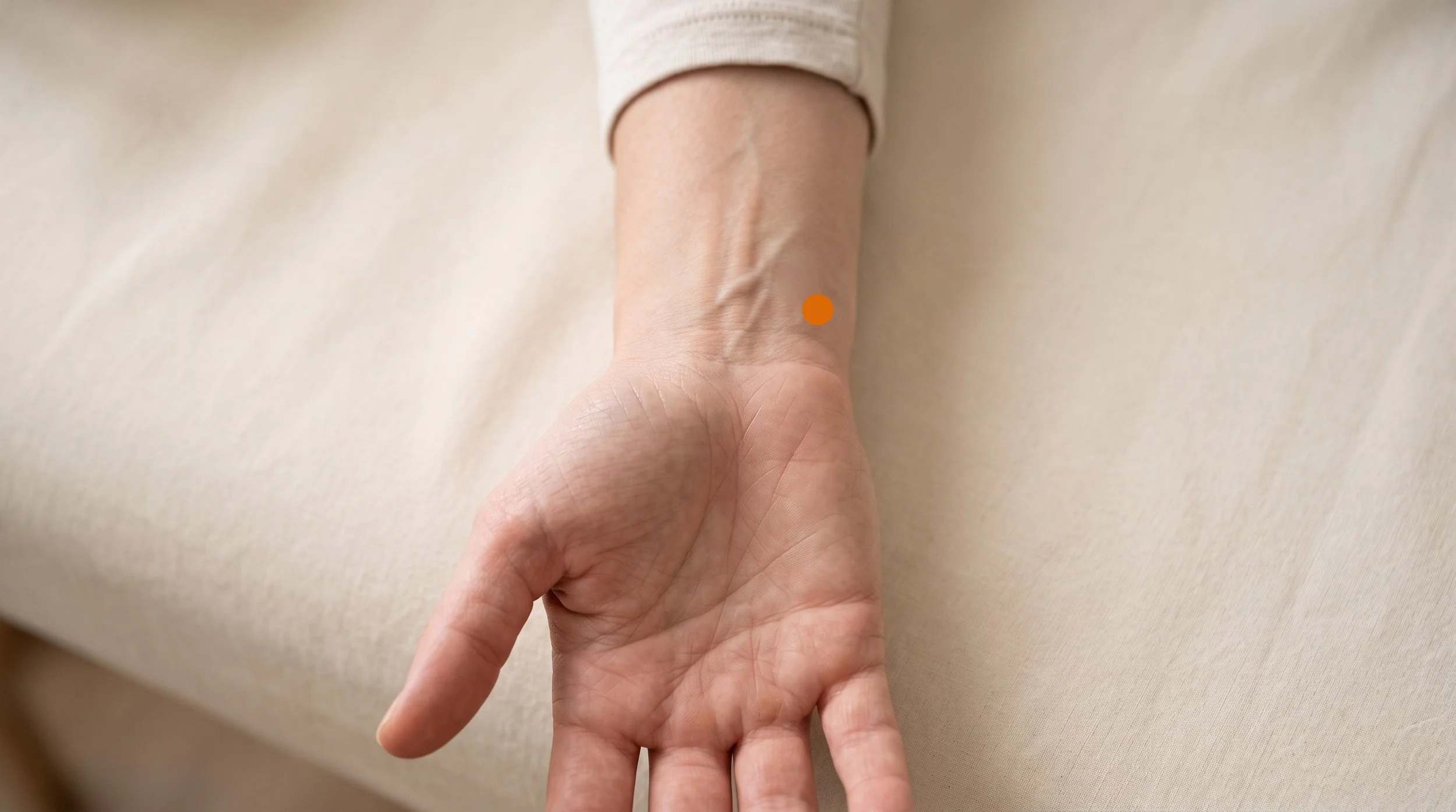
HT6 (Yinxi, often translated as Yin Cleft) is the xi-cleft point of the Heart channel, and it sits in one of the most useful pieces of real estate on the forearm: the palm side of the wrist, half a cun above the crease, tucked against the thumb side of the flexor carpi ulnaris tendon.
In plain terms, if you find the classic wrist point HT7 in the hollow beside that tendon and then slide about a fingertip's width up the forearm, you are at the ht 6 wrist location. Classical sources single out heart 6 for one thing above all others, night sweating, and secondarily for sudden Heart-region symptoms such as palpitations with fright (Deadman et al., 2007).
Modern clinicians keep using the yin cleft point for a practical reason: it sits in a C8 to T1 segmental field that overlaps the neural territory associated with cardiac and thoracic sensation, it is easy to needle safely and shallowly, and it pairs naturally with the sleep, anxiety, and vasomotor protocols that patients most often come in asking about.
- Location and layers: HT6 lies 0.5 cun proximal to HT7 on the radial side of the flexor carpi ulnaris tendon (Deadman et al., 2007), which places the needle in thin skin, superficial fascia, and the tendinous border of the ulnar flexor compartment rather than in bulky muscle.
- Traditional category, translated: the reference texts classify HT6 as the xi-cleft point of the Heart channel, a class of points described as places where channel qi and blood gather deeply and which were traditionally reserved for acute presentations and, on yin channels, for blood-related complaints (Deadman et al., 2007). In neurophysiological language, this is a fixed, easily located distal site in a segmental field that shares spinal levels with the chest and upper limb.
- Mechanism: needling here recruits small-diameter afferents in the C8 to T1 dermatomes, engaging segmental dorsal horn processing and descending inhibitory pathways involving the periaqueductal gray, rostral ventromedial medulla, and endogenous opioid systems (Zhao, 2008).
- Autonomic angle: forearm needling has measurable effects on cardiac autonomic markers, with a meta-analysis of sham-controlled trials reporting increases in parasympathetic heart rate variability indices after real acupuncture (Hamvas et al., 2023), which is the plausible bridge between a wrist point and symptoms such as sweating, palpitations, and sleeplessness.
- Research picture: trials relevant to HT6's signature uses test multi-point protocols rather than this point alone, and results are mixed. A Cochrane review found no clear advantage over sham for hot flush frequency (Dodin et al., 2013), while a pooled analysis of parallel randomized trials in hormone receptor positive breast cancer reported reduced hot flash scores with acupuncture (Lu et al., 2024).
- Clinical framing and de qi: expect a dull, slightly heavy ache that may spread toward the palm or little finger, not a sharp electric zing. Persistent night sweats and any chest pain need medical evaluation first, and acupuncture is used alongside that workup, never instead of it.
Waking Up Soaked and Exhausted Night After Night?
Night sweating is the classical signature use of HT6, and it is one of the most common complaints we hear from perimenopausal patients, breast cancer survivors on endocrine therapy, and people under sustained stress.
At Morningside Acupuncture, we needle HT6 alongside points on the Kidney and Spleen channels, then layer in sleep and thermoregulation strategies you can use between sessions. We also make sure you have been medically evaluated, because night sweats occasionally point to something that needs a physician. Book an initial visit and let's map out what is driving yours.
Schedule NowAnatomy of HT6: Why the Ulnar Wrist Corridor Is Such an Important Location
HT6 sits on the palm side of the distal forearm, half a cun above the wrist crease, immediately radial to the tendon of flexor carpi ulnaris (Deadman et al., 2007). The layers are shallow and predictable: thin skin, a loose subcutaneous layer carrying small cutaneous veins, the antebrachial fascia, then the firm cord of the flexor carpi ulnaris tendon forming the ulnar wall of the point. Just radial and slightly deeper lie the tendons of flexor digitorum superficialis and profundus, with pronator quadratus and the interosseous membrane at the floor of the compartment.
This corridor gets loaded by everything New Yorkers do all day: sustained gripping, mousing and keyboard work with the wrist in flexion and ulnar deviation, phone holding, kettlebells, racquet sports, and instrument playing. Tenderness at or near HT6 is therefore common even in patients who came in for sleep or sweating rather than wrist pain.
The nerve geography here explains most of what the point does. Skin over HT6 is supplied by the medial antebrachial cutaneous nerve, a C8 to T1 branch, and the ulnar nerve with the ulnar artery runs just ulnar and deep to the flexor carpi ulnaris tendon on its way into the hand. Needling in this segmental field activates A-delta and group III afferents that terminate in the lower cervical and upper thoracic dorsal horn, the same neighborhood where visceral afferents from the chest converge, which is the standard convergence explanation for why cardiac sensation is so often referred down the ulnar side of the arm.
From that entry point, stimulation engages spinal gating and supraspinal descending inhibition through the periaqueductal gray and rostral ventromedial medulla, with opioid and monoaminergic transmitters doing much of the work (Zhao, 2008). Because the same brainstem circuitry sits close to autonomic control nuclei, sensory input at the wrist can also shift sympathetic and parasympathetic balance, which is consistent with heart rate variability changes seen after real versus sham needling (Hamvas et al., 2023).
Safety at HT6 comes down to respecting the ulnar neurovascular bundle. The point is deliberately placed on the radial side of the flexor carpi ulnaris tendon, which keeps the needle away from the ulnar artery and nerve sitting on the far side of that tendon. Standard technique is perpendicular insertion of 0.3 to 0.5 cun, or oblique insertion proximally or distally along the channel of 0.5 to 1 cun (Deadman et al., 2007). If a patient reports a sharp electric sensation shooting into the ring or little finger, the needle should be withdrawn and redirected rather than manipulated.
Practitioners use extra care with patients on anticoagulants, since superficial veins cross this area and small bruises are the most common minor side effect.
Related Heart Channel Related Flexor Carpi Ulnaris Trigger PointsHT6 at a Glance: Classification, Location, and Clinical Use
| Category | Detail |
|---|---|
| Traditional Name | Yinxi (HT6), commonly translated as Yin Cleft or Yin Crevice |
| Channel Classification | Heart channel of Hand Shaoyin, sixth point of the channel (HE-6 in Deadman) |
| Point Categories | Xi-cleft point of the Heart channel, the class of points traditionally described as deep gathering places of channel qi and blood and used for acute conditions, with yin channel xi-cleft points additionally applied to blood disorders (Deadman et al., 2007) |
| Precise Location | Palm side of the forearm, 0.5 cun proximal to HT7, on the radial (thumb side) border of the flexor carpi ulnaris tendon |
| Tissue Stimulated | Skin and subcutaneous tissue of the ulnar wrist, antebrachial fascia, the radial border of the flexor carpi ulnaris tendon, with flexor digitorum superficialis and flexor digitorum profundus deeper and radial |
| Needle Depth / Direction | Perpendicular 0.3 to 0.5 cun, or oblique proximally or distally along the channel 0.5 to 1 cun, angled away from the ulnar neurovascular bundle |
| De Qi Sensation | Dull ache, pressure, or mild heaviness at the wrist that may spread toward the palm or little finger; sharp electric sensations into the ulnar fingers mean the needle should be redirected |
| Primary Clinical Uses | Night sweating (its signature classical indication), restless sleep with heat sensations and hot flashes, palpitations with fright or startle, and acute chest-region complaints after appropriate medical evaluation |
| Common Point Combinations |
|
In the classical literature summarized by Deadman and colleagues, HT6 is defined by its xi-cleft status: these are the points where channel qi and blood were said to pool and sink more deeply, which made them the traditional choice for sudden, intense conditions, and on the yin channels for disorders of blood as well (Deadman et al., 2007).
Within that logic, Yinxi was listed for stabbing Heart pain, chest fullness, fright palpitations, loss of voice, sudden collapse patterns, and bleeding presentations attributed to heat pressing on the blood, although the same commentary notes that the Pericardium channel's xi-cleft point carried more clinical weight for severe cardiac presentations because the Pericardium was framed as the Heart's protector. The point's real classical reputation lies elsewhere.
Traditional physiology treated sweat as the fluid associated with the Heart and the outward counterpart of blood, so a Heart channel point that could hold fluids inside became the standard prescription for sweating that happens during sleep, along with the yin-deficiency fever pattern classically called steaming bone disorder.
What is striking is how narrow and consistent that reputation is: across centuries of eclectic indication lists, one small wrist point kept being named for one specific nocturnal symptom.
Why HT6 Is Used for Night Sweats, Hot Flashes, and Restless Sleep
The segmental story starts with where the point sits. HT6 lies in a C8 to T1 sensory field on the palmar ulnar forearm, and afferents from that region enter the spinal cord at levels that also receive input from the chest and upper thoracic viscera. That anatomical overlap is the same reason cardiac symptoms are classically felt down the inner arm, and it gives a plain explanation for why a wrist point was historically assigned to chest-region complaints.
Needling recruits small-diameter fibers that trigger local segmental modulation and then travel upward to brainstem centers that coordinate both pain control and autonomic outflow (Zhao, 2008).
Sweating is an autonomic output, controlled by sympathetic cholinergic fibers under hypothalamic and brainstem supervision, so the mechanistic question is whether needling can shift that balance. Sham-controlled trials pooled in a systematic review suggest that real needling produces measurable changes in heart rate variability indices consistent with increased parasympathetic tone, while sham stimulation does not (Hamvas et al., 2023).
A randomized trial using a single Heart channel wrist point also reported reduced anticipatory anxiety compared with control conditions, which supports the idea that this specific corridor influences arousal rather than only local tissue (Fleckenstein et al., 2018). None of that proves HT6 stops night sweats, but it does place the point inside a plausible, testable physiology rather than a metaphor.
Clinically, we use HT6 for the patient whose sweating, palpitations, and broken sleep travel together: waking hot at 2 or 3 a.m., heart pounding, then unable to settle. Acupuncture protocols for insomnia have shown improvements in sleep quality measures in meta-analysis, though the trials vary widely in quality and comparators (Kim et al., 2021). Our expectation setting is deliberate: several sessions, tracking of night waking and sweat episodes, and a parallel medical workup when the pattern is new, one-sided, or accompanied by weight loss, fever, or chest symptoms.
What the Research Shows for HT6
No high-quality trial has isolated HT6 as a single intervention, and it would be unusual if one had. The studies that speak to this point's classical territory, hot flashes, night sweating, insomnia, and autonomic regulation, all test multi-point protocols in which HT6 may or may not be included, so the honest reading is that the evidence supports the treatment approach rather than the individual needle. The table below summarizes the most relevant reviews and pooled analyses, including the negative findings, so you can see the range.
| Study | Type | Focus | Key Finding |
|---|---|---|---|
| Dodin et al., 2013 | Cochrane systematic review | Acupuncture for menopausal hot flushes, 16 trials with 1,155 women | Compared with sham, the review found no clear difference in hot flush frequency, with low-quality evidence and considerable heterogeneity. |
| Lu et al., 2024 | Pooled analysis of individual patient data from parallel randomized trials | Acupuncture for hot flashes in hormone receptor positive breast cancer | Pooled data suggested acupuncture reduced hot flash burden in this population, which is relevant to the deficiency-heat presentations HT6 traditionally addresses. |
| Kim et al., 2021 | Systematic review and meta-analysis | Acupuncture for insomnia across 24 randomized controlled trials | Acupuncture was associated with improved sleep quality index scores relative to pharmacotherapy in pooled analyses, though trial quality limits confidence. |
| Hamvas et al., 2023 | Systematic review and meta-analysis | Effect of manual needling on heart rate variability versus placebo controls | Real acupuncture was associated with significant shifts in parasympathetic HRV markers that were not seen with sham, supporting an autonomic mechanism. |
| Fleckenstein et al., 2018 | Randomized controlled trial | Single Heart channel wrist point (HT7) for test anxiety | Needling a single point on the same wrist corridor reduced anxiety measures compared with control, suggesting effects beyond local tissue. |
| Vickers et al., 2018 | Individual patient data meta-analysis | Acupuncture for chronic pain across roughly 20,000 patients | Acupuncture outperformed both sham and no-acupuncture controls for chronic pain, with effects persisting over time, which supports its use for the musculoskeletal complaints that often accompany wrist-level treatment. |
Palpitations, Racing Thoughts, and a Body That Will Not Downshift?
When patients describe a heart that pounds at bedtime or startles awake at 3 a.m., we often use the ht6 acupuncture point with PC6 and HT7 to target the same wrist corridor from two channels at once. The goal is straightforward: a calmer autonomic baseline, better sleep continuity, and fewer of those adrenaline surges. Treatments are gentle, evidence-informed, and tailored to your cardiology clearance if you have one. Schedule a session and start with a full intake rather than guesswork.
Schedule NowHT6 in the Context of Trigger Point Work
Acupuncture is defined by the tool, an acupuncture needle, and that includes dry needling, so at Morningside the question is never which tradition to use but which tissue and which nervous system target the patient needs. When someone presents with ulnar wrist ache, grip fatigue, or a forearm that feels tight after long computer days, HT6 sits directly at the tendinous edge of flexor carpi ulnaris and gives us a shared address for both the channel point and the myofascial target.
Trigger points in flexor carpi ulnaris characteristically refer discomfort toward the ulnar wrist and hand, and points in flexor digitorum superficialis and profundus refer into the fingers (Simons et al., 1999), so palpating those muscles before needling often changes the plan.
In practice, a forearm-focused session might combine shallow needling at HT6 and HT7 for the autonomic and sleep-related goals with dry needling of the flexor carpi ulnaris muscle belly higher in the forearm, plus the finger flexors if there is grip or digit involvement. We keep the wrist itself shallow and precise because of the ulnar neurovascular bundle, and reserve stronger local techniques for the muscular midforearm where there is more room.
Patients treated for chronic pain generally do better with a course of care rather than a single visit, which matches the pattern seen in large pooled analyses of acupuncture for chronic pain (Vickers et al., 2018).
HT6 Night Sweat Treatment at NYC's Highest-Rated Acupuncture Clinic
Morningside Acupuncture is the highest-rated acupuncture and dry needling clinic in New York City with over 500 five-star Google reviews, and our Yinxi work sits inside a broader plan that addresses sleep, stress physiology, and any musculoskeletal pain riding along with it. Every session combines classical point selection with modern anatomy, including trigger point needling of the forearm flexors when the wrist itself is symptomatic. You get clear explanations, cautious expectations, and a treatment plan with checkpoints. Book your appointment online and get started this week.
Schedule NowFrequently Asked Questions
What does HT6 feel like when needled?
Most patients feel a brief pinch at insertion, then a dull ache, mild pressure, or heaviness that can spread a short distance toward the palm or the little finger. That heavy, spreading quality is the de qi sensation practitioners look for. Because the needle is shallow, the sensation is usually modest, and many patients find the point relaxing rather than intense. A sharp, electric zap into the ring or little finger is not the goal, and it simply means the needle needs to be withdrawn and repositioned slightly.
Why treat night sweats or palpitations at the wrist instead of the chest?
Two reasons, one traditional and one anatomical. Classically, HT6 is the xi-cleft point of the Heart channel and was described as a deep gathering place of channel qi and blood, which made distal Heart channel points the standard choice for Heart-region symptoms (Deadman et al., 2007). Anatomically, the palmar ulnar wrist sits in a C8 to T1 sensory field whose afferents enter the spinal cord alongside input from the chest, so stimulation there reaches shared segmental circuitry and then engages brainstem systems that influence pain modulation and autonomic tone (Zhao, 2008). Distal points are also far easier to needle safely than points over the ribs and sternum.
Can I press HT6 myself between sessions?
Yes, and it is one of the easier points to self-treat. Turn your palm up, find the crease at the base of the hand, locate the firm tendon of flexor carpi ulnaris on the little finger side, then move about half a thumb width up the forearm and press just on the thumb side of that tendon. Use your opposite thumb with steady, moderate pressure that feels achy but never sharp, hold for 30 to 60 seconds, release, and repeat two or three times per wrist. Doing this on both wrists for two to three minutes total before bed, paired with slow nasal breathing at roughly six breaths per minute, is a reasonable nightly routine. Ease off immediately if you feel tingling into the fingers, and stop if the area bruises or stays sore.
Is HT6 safe to needle?
It is considered a low-risk point when standard technique is used. The main structures to respect are the ulnar nerve and ulnar artery, which run on the far side of the flexor carpi ulnaris tendon, and the point is deliberately placed on the thumb side of that tendon to stay clear of them. Insertion is shallow, typically 0.3 to 0.5 cun perpendicular or 0.5 to 1 cun oblique along the channel (Deadman et al., 2007). Small bruises are the most common minor effect, and we take additional care with patients on blood thinners. Just as important is context: new or unexplained night sweats, and any chest pain, shortness of breath, or new palpitations, need medical evaluation, and acupuncture should complement that assessment rather than delay it.
Where exactly is HT6 located?
On the palm side of the forearm, 0.5 cun proximal to HT7, on the radial border of the flexor carpi ulnaris tendon (Deadman et al., 2007). To find it, rest your forearm palm up, feel for the prominent tendon on the little finger side of the wrist crease, place a fingertip in the hollow just thumb-side of that tendon at the crease (that is HT7), then slide roughly one fingertip width up toward the elbow. Cun measurements are proportional to the individual, so on a larger forearm the distance is slightly greater. Gently flexing the wrist against light resistance makes the tendon stand out and simplifies the landmark.
References
- Deadman, P., Al-Khafaji, M., & Baker, K. (2009). A manual of acupuncture. Journal of Chinese Medicine Publications.
- Simons, D. G., Travell, J. G., & Simons, L. S. (1999). Travell & Simons' myofascial pain and dysfunction: The trigger point manual, Vol. 1: Upper half of body (2nd ed.). Williams & Wilkins.
- Dodin, S., Blanchet, C., Marc, I., Ernst, E., Wu, T., Vaillancourt, C., Paquette, J., & Maunsell, E. (2013). Acupuncture for menopausal hot flushes. Cochrane Database of Systematic Reviews, 2013(7), CD007410. https://doi.org/10.1002/14651858.CD007410.pub2
- Lu, W., Giobbie-Hurder, A., Tanasijevic, A., Kassis, S. B., Park, S. H., Jeong, Y. J., Shin, I. H., Yao, C., Jung, H. J., Zhu, Z., Bao, C., Bao, T., Yang, E., Bierer, B. E., & Ligibel, J. A. (2024). Acupuncture for hot flashes in hormone receptor-positive breast cancer: A pooled analysis of individual patient data from parallel randomized trials. Cancer, 130(18), 3219-3228. https://doi.org/10.1002/cncr.35374
- Kim, S. A., Lee, S. H., Kim, J. H., van den Noort, M., Bosch, P., Won, T., Yeo, S., & Lim, S. (2021). Efficacy of acupuncture for insomnia: A systematic review and meta-analysis. American Journal of Chinese Medicine, 49(5), 1135-1150. https://doi.org/10.1142/S0192415X21500543
- Hamvas, S., Hegyi, P., Kiss, S., Lohner, S., McQueen, D., & Havasi, M. (2023). Acupuncture increases parasympathetic tone, modulating HRV: Systematic review and meta-analysis. Complementary Therapies in Medicine, 72, 102905. https://doi.org/10.1016/j.ctim.2022.102905
- Fleckenstein, J., Krüger, P., & Ittner, K. P. (2018). Effects of single-point acupuncture (HT7) in the prevention of test anxiety: Results of an RCT. PLOS ONE, 13(8), e0202659. https://doi.org/10.1371/journal.pone.0202659
- Zhao, Z. Q. (2008). Neural mechanism underlying acupuncture analgesia. Progress in Neurobiology, 85(4), 355-375. https://doi.org/10.1016/j.pneurobio.2008.05.004
- Vickers, A. J., Vertosick, E. A., Lewith, G., MacPherson, H., Foster, N. E., Sherman, K. J., Irnich, D., Witt, C. M., & Linde, K. (2018). Acupuncture for chronic pain: Update of an individual patient data meta-analysis. Journal of Pain, 19(5), 455-474. https://doi.org/10.1016/j.jpain.2017.11.005
Disclaimer: This web site is intended for educational and informational purposes only. Reading this website does not constitute providing medical advice or any professional services. This information should not be used for diagnosing or treating any health issue or disease. Those seeking medical advice should consult with a licensed physician. Seek the advice of a medical doctor or other qualified health professional for any medical condition. If you think you have a medical emergency, call 911 or go to the emergency room. No acupuncturist-patient relationship is created by reading this website or using the information. Morningside Acupuncture PLLC and its employees and contributors do not make any express or implied representations with respect to the information on this site or its use. For any legal interpretation of scope of practice in your state, consult a licensed attorney or regulatory authority.
Read more from our blog