HT7 Acupuncture Point (Shenmen)
The Spirit Gate at the Ulnar Wrist: Anatomy, Autonomic Mechanism, and Why This Heart Channel Point Anchors Anxiety and Insomnia Treatment
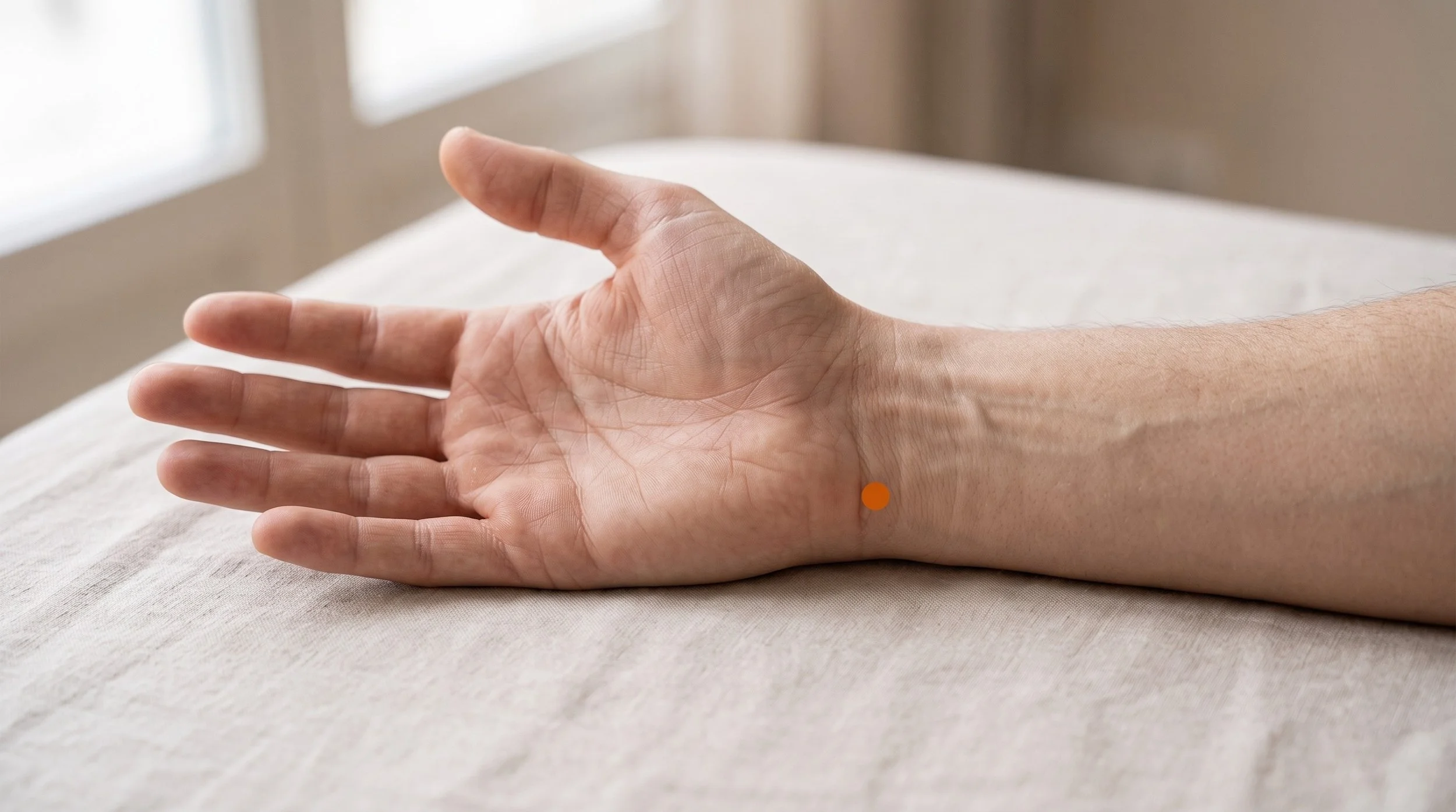
HT7, called Shenmen (Spirit Gate) in Chinese and Heart 7 in the numbered system used in most clinics, sits at the wrist crease on the little finger side, in the small hollow just radial to the thick tendon of flexor carpi ulnaris where it meets the pisiform bone. In classical texts it carries three designations at once (shu-stream, yuan-source, and Earth point of the Heart channel), which is why it appears in so many traditional formulas for what those texts describe as disturbance of the spirit.
In modern practice HT7 is one of the most frequently chosen points for anxiety, stress, insomnia, and palpitations, partly because of that classical reputation and partly because the wrist offers an accessible, well innervated site that patients tolerate easily. It also happens to be one of the few individual points studied on its own in physiological research, which makes it a useful place to talk honestly about what a single needle can and cannot do.
- HT7 lies at the ulnar wrist in the depression on the radial side of the flexor carpi ulnaris tendon, at the proximal edge of the pisiform. Because wrist creases vary between people, Deadman's Manual of Acupuncture advises locating the point against the pisiform rather than the skin fold, which is the approach we use clinically.
- The classical categories translate reasonably well into modern language: a shu-stream and yuan-source point was traditionally reserved for disorders of the internal organs and for deficiency states, meaning it was treated as a regulating rather than a forcing point, which matches how gently HT7 is usually needled today.
- Mechanistically, needling here stimulates cutaneous and deep afferents in the C8 and T1 territory of the ulnar nerve, and this segmental input can influence brainstem circuits involved in autonomic tone as well as engaging descending pain modulating pathways (Zhao, 2008).
- Point-specific physiology exists: needling HT7 in healthy volunteers was associated with increased heart rate variability during stimulation compared with sham and no-needling controls (Huang et al., 2015), and in patients with insomnia heart rate fell while total variability rose immediately after stimulation, with no lasting carryover (Litscher et al., 2012).
- The clinical trial picture is mixed and should be read cautiously. Reviews of acupuncture for insomnia describe widespread use but low certainty evidence (Cheuk et al., 2012), reviews for anxiety report favorable signals alongside methodological limits with HT7 among the most commonly used points (Amorim et al., 2018; Hong et al., 2023), and a single-session HT7 trial using an experimental stress test found no difference from sham laser (Fleckenstein et al., 2018).
- De qi at HT7 is usually a dull, heavy, slightly aching fullness that may spread toward the palm or little finger. A sharp electrical zing into the little finger means the needle is too close to the ulnar nerve, and the correct response is to withdraw and reposition rather than to continue.
Feeling Wired, Anxious, or Unable to Switch Off at Night?
At Morningside Acupuncture, HT7 is one of the first points we reach for when a patient describes a racing mind, a tight chest, or sleep that never quite arrives. We pair it with points at the forearm, lower leg, and forehead so the treatment addresses both the physical tension you can feel and the autonomic overdrive driving it. Sessions are quiet, unhurried, and designed so you leave calmer than you arrived. Schedule a visit and let's build a plan around how your stress actually shows up.
Schedule NowAnatomy of HT7: Why the Pisiform Border Is Such an Important Location
The tissue at HT7 is thin and layered in a way that makes precision matter. Under the skin there is very little fat before the needle reaches the dense fascia at the wrist and the edge of the flexor carpi ulnaris tendon, which inserts onto the pisiform bone. That tendon works hard in anyone who grips, types, lifts weights, carries bags, or plays racket sports, and the pisiform acts as a bony pulley for repeated ulnar deviation and wrist flexion. Patients often arrive with tenderness in this area that has nothing to do with why they came in, simply because the ulnar wrist absorbs so much daily load.
Sensory supply to this region comes largely from the ulnar nerve and its palmar cutaneous branch, with contribution from the medial antebrachial cutaneous nerve, placing the point in the lower cervical and upper thoracic segmental range of roughly C8 to T1.
That segmental address is the practical reason a wrist point can influence how the body feels overall: afferent input entering the dorsal horn at those levels converges with input from deeper structures and ascends to brainstem centers that regulate autonomic outflow, while also recruiting descending inhibitory pathways from the midbrain and medulla that dampen incoming nociceptive traffic (Zhao, 2008).
Measurable autonomic shifts have been recorded during HT7 needling, including increased heart rate variability in healthy volunteers (Huang et al., 2015) and reduced heart rate in patients with insomnia (Litscher et al., 2012).
The deep caution at HT7 is vascular and neural rather than visceral. The ulnar artery and ulnar nerve run immediately radial to the flexor carpi ulnaris tendon as they pass toward the hand, which is exactly the tissue plane the point occupies.
Deadman's Manual of Acupuncture explicitly flags both structures and gives a conservative depth of 0.3 to 0.5 cun perpendicular, with oblique angulation as an alternative. In practice we palpate for the ulnar pulse first, angle slightly away from it, and keep the insertion shallow. Maciocia's channel writings note that this same spot is used diagnostically precisely because the ulnar pulse is palpable there, which is a useful reminder of what lies beneath the needle.
Related Best Acupuncture Points For Anxiety Related Acupuncture And Chinese Medicine For InsomniaHT7 at a Glance: Classification, Location, and Clinical Use
| Category | Detail |
|---|---|
| Traditional Name | Shenmen (Spirit Gate), also written shen men point or Heart 7 |
| Channel Classification | Heart channel (hand shaoyin), seventh point of the channel (HT7, also written HE7) |
| Point Categories | Shu-stream point of the Heart channel; yuan-source point of the Heart channel; Earth point within the five-phase assignments of the channel |
| Precise Location | At the wrist crease on the ulnar side, in the depression on the radial side of the flexor carpi ulnaris tendon, at the proximal border of the pisiform bone. Because creases vary, locate the pisiform first and settle into the hollow just radial to the tendon. |
| Tissue Stimulated | Skin and thin subcutaneous tissue, wrist fascia, and the radial border of the flexor carpi ulnaris tendon at its pisiform insertion, with the ulnar nerve and ulnar artery lying immediately radial to the tendon |
| Needle Depth / Direction | Perpendicular insertion 0.3 to 0.5 cun, or oblique angulation proximally or distally when a flatter approach is preferred. Palpate the ulnar pulse before insertion and angle away from it. |
| De Qi Sensation | Dull heaviness, mild ache, or a spreading fullness that may travel toward the palm or little finger. A sharp electrical sensation into the little finger indicates ulnar nerve contact and calls for withdrawal and repositioning. |
| Primary Clinical Uses | Anxiety, stress and emotional regulation, insomnia and disturbed sleep, palpitations and chest tightness, and ulnar-sided wrist tension as a local target |
| Common Point Combinations |
|
Deadman's Manual of Acupuncture presents HT7 as the leading point for what the tradition calls calming the spirit, and it is worth being clear that this is a traditional attribution rather than a physiological claim. The reasoning in the classical sources runs through categories: the Spiritual Pivot recommends shu-stream points for disorders of the internal organs and yuan-source points when the five zang are affected, and since the Heart was regarded as the residence of the spirit, a point holding both designations became the natural choice for mental and emotional complaints.
The traditional indication lists that follow are broad and grouped in a way modern readers can still recognize: sleep disturbance and talking in sleep, poor memory and disorientation, fear, sadness, and fright, inappropriate laughter and severe agitation, palpitations of several described types, chest and rib-side discomfort, throat dryness and pain, heat in the palms, and bed-wetting.
The tradition explained the emotional and the cardiac indications through the same organ and the urinary indications through channel pairings, and what is striking is how durable that grouping proved: anxiety, sleep, and palpitations still cluster together in the modern clinic, even though we now describe the link in terms of autonomic arousal rather than the spirit.
Why HT7 Is Used for Racing Heart and Sleep Onset Problems Rather Than Just Wrist Pain
Patients are often surprised that a point on the wrist is chosen for palpitations or insomnia. The segmental explanation is straightforward: sensory fibers from the ulnar wrist enter the spinal cord at roughly C8 and T1, and neurons at those levels sit close to the segmental territory that handles autonomic traffic to and from the chest and upper limb. Input arriving from the skin and deep tissue at HT7 travels to brainstem nuclei that help set sympathetic and parasympathetic balance, so a stimulus that feels purely local can register centrally as a shift in arousal rather than simply a sensation in the hand.
The second half of the story is descending modulation. Needling recruits pathways from the periaqueductal gray and rostral medulla that release endogenous opioids, serotonin, and noradrenaline onto the spinal cord, reducing the transmission of nociceptive signals and contributing to the drowsy, settled feeling many patients report on the table (Zhao, 2008). This is also why the effect is often felt body-wide rather than at the needle site alone.
Point-specific measurements support at least the acute part of this. In an exploratory controlled study, needling HT7 produced higher heart rate variability during stimulation than sham needling, a sham point, or no needling, though the difference did not persist afterward (Huang et al., 2015). In patients with insomnia, heart rate dropped significantly during and after HT7 stimulation and total variability increased immediately afterward, again without a lasting effect (Litscher et al., 2012).
These findings suggest a real, measurable autonomic response to needling this location, while also making the honest point that single-session physiology is not the same thing as durable clinical improvement, which is why we treat in courses rather than one-offs.
What the Research Shows for HT7
A note on how to read the evidence for any single point: almost no clinical trial tests HT7 by itself. Reviews evaluate multi-point protocols for insomnia, anxiety, or stress, in which HT7 is usually one of four to ten needles, so the honest conclusion is about the whole treatment rather than the point.
What the literature does tell us is that HT7 is among the most frequently selected points in these protocols, that it produces measurable short-term autonomic changes when needled, and that the clinical trial evidence for the conditions it targets ranges from promising to inconclusive depending on the comparison used and the quality of the studies included.
| Study | Type | Focus | Key Finding |
|---|---|---|---|
| Cheuk et al., 2012 | Cochrane systematic review | Acupuncture for insomnia, 33 randomized trials and 2,293 participants | The reviewers judged all included studies to be at high risk of bias and concluded that high-quality evidence was lacking, so efficacy and safety could not be established with confidence. |
| Ma et al., 2025 | Cochrane systematic review | Acupuncture for insomnia in people with cancer | Compared with sham acupuncture, acupuncture may have little to no effect on insomnia severity or overall sleep quality, though slight improvements in some sleep diary measures were reported. |
| Amorim et al., 2018 | Systematic review | Acupuncture and electroacupuncture for anxiety disorders | The review reported generally favorable clinical findings without significant adverse effects, while noting that the trial base is limited in size and quality; HT7 was among the points used most often across the included studies. |
| Hong et al., 2023 | Systematic review and meta-analysis | Electroacupuncture for anxiety, 37 randomized controlled trials | Pooled anxiety scale scores favored electroacupuncture, but risk of bias across trials was substantial; HT7 and SP6 were among the most frequently selected points. |
| Huang et al., 2015 | Exploratory randomized study | Effect of needling HT7 on heart rate variability in 120 healthy volunteers | Verum needling at HT7 was associated with higher heart rate variability during stimulation than sham needling, a sham point, or no needling, with the effect not persisting after removal. |
| Litscher et al., 2012 | Clinical physiological study | HT7 stimulation and cardiac autonomic measures in 28 patients with insomnia | Heart rate fell significantly during and after needling and total heart rate variability rose immediately afterward, but the authors found no long-lasting effect. |
| Fleckenstein et al., 2018 | Randomized placebo-controlled pilot trial | Single-session bilateral HT7 versus sham laser for experimentally induced test anxiety | No between-group differences were seen in anxiety questionnaires, salivary cortisol, amylase, or heart rate variability, leading the authors to caution that one treatment may not be enough to demonstrate point-specific effects. |
| Zhao, 2008 | Narrative review of mechanism research | Neural mechanisms of acupuncture analgesia | Needle stimulation engages segmental spinal processing and descending inhibitory pathways involving endogenous opioids and monoamines, which provides a plausible framework for effects felt beyond the needled site. |
Acupuncture for Insomnia and Anxiety: Why the Shenmen Point Shows Up in Almost Every Protocol
If you search for acupuncture for insomnia, the shenmen point will appear in nearly every point list you find, and there is a reason beyond tradition. HT7 is easy to reach with the patient lying comfortably on their back, it tolerates very shallow needling, and the sensation is usually mild, which matters when someone is already anxious about needles.
Reviews of anxiety trials confirm that it is one of the most frequently chosen points in published protocols (Amorim et al., 2018; Hong et al., 2023), and acute physiological studies at this exact location have documented reductions in heart rate and increases in heart rate variability during and just after stimulation (Huang et al., 2015; Litscher et al., 2012).
That said, the honest framing matters more here than in almost any other application. Cochrane reviewers examining acupuncture for insomnia concluded that the evidence base is too weak to draw firm conclusions (Cheuk et al., 2012), and a more recent Cochrane review in cancer-related insomnia found little to no difference from sham acupuncture on the main outcomes (Ma et al., 2025). A trial that needled HT7 alone against sham laser during an experimental stress challenge found no group differences at all (Fleckenstein et al., 2018). Our reading is that HT7 is a sensible and well-tolerated component of a broader treatment plan, not a standalone sleep or anxiety solution.
In our clinic, HT7 is typically combined with PC6 for anxiety with chest tightness, with SP6 when sleep onset is the main complaint, and with Yintang when a patient arrives visibly keyed up. We often add dry needling for the neck, jaw, and upper back tension that so often travels with poor sleep, and we talk through caffeine timing, screen exposure, and wind-down routines, because the needles work best alongside changes that support them. Many patients also find the shen men point useful as an ht7 pressure point they can use themselves between visits.
Struggling With Insomnia That Sleep Hygiene Alone Has Not Fixed?
Poor sleep rarely has a single cause, so we treat it as a pattern rather than a symptom. HT7 combined with SP6 and calming points at the head is a common starting protocol in our clinic, layered with breathing guidance and practical evening changes you can actually keep. We also look for neck and jaw tension that keeps the nervous system on alert. Book an appointment and we'll map out a realistic course of care.
Schedule NowHT7 in the Context of Trigger Point Work
HT7 sits directly on the flexor carpi ulnaris tendon border, which makes it a natural bridge between classical point selection and orthopedic dry needling. Patients with ulnar-sided wrist pain, gripping fatigue, or forearm heaviness from keyboard and mouse work often have taut, tender bands in the flexor carpi ulnaris itself, and referred pain from this muscle characteristically travels toward the ulnar wrist and hand (Simons et al., 1999).
When we needle HT7 in these patients, the traditional indication and the myofascial finding point to the same tissue neighborhood, which is a useful coincidence rather than a claim that the two frameworks are the same thing.
In a typical session we might use HT7 shallowly as part of a calming protocol, then treat the flexor carpi ulnaris, flexor carpi radialis, and extensor carpi ulnaris more directly for the mechanical complaint, moving proximally into the forearm rather than needling deeply at the wrist itself where the ulnar nerve and artery run. Keeping the local needling shallow at HT7 and doing the heavier muscular work away from the neurovascular corridor is a safety habit as much as a technique preference. It also lets one visit address both the tension in the arm and the arousal state that keeps a patient clenching in the first place.
HT7 Anxiety and Insomnia Treatment at NYC's Highest-Rated Acupuncture Clinic
Morningside Acupuncture is the highest-rated acupuncture and dry needling clinic in New York City with over 500 five-star Google reviews, and stress-related complaints are among the most common reasons patients come to us. Our licensed acupuncturists combine classical point selection like HT7 with orthopedic dry needling and clear explanations of why each needle is where it is. You will always know what we are doing and why. Schedule your first visit today.
Schedule NowFrequently Asked Questions
What does HT7 feel like when needled?
Most people feel a brief pinch as the needle passes the skin, then a dull, heavy, or slightly achy fullness in the wrist that may spread toward the palm or little finger. That heaviness is the de qi sensation practitioners aim for, and it is usually mild here because the needle stays shallow. Many patients report a wave of drowsiness or a slower breathing rhythm within a minute or two, which fits the short-term autonomic changes documented during HT7 needling (Huang et al., 2015). What you should not feel is a sharp electrical shock shooting into the little finger. If that happens, tell your acupuncturist, and the needle should be withdrawn and repositioned.
Why treat anxiety and sleep at the wrist instead of the head or chest?
Two reasons, one practical and one physiological. Practically, the wrist is accessible with a patient lying comfortably, requires no undressing, and takes shallow needling, so it is well tolerated by people who are already tense. Physiologically, sensory input from this area enters the spinal cord around the C8 and T1 segments and projects to brainstem regions that help regulate autonomic tone, and needling also recruits descending pathways that quiet incoming nociceptive traffic (Zhao, 2008). That is why a stimulus at the hand can register as a whole-body shift in arousal. The Heart channel classification in traditional theory arrived at a similar conclusion by a completely different route.
Can I press HT7 myself between sessions?
Yes, and it is one of the easier points to self-treat. Turn your palm up and find the crease at the little finger side of the wrist, then feel for the small pea-shaped pisiform bone just beyond the crease. Slide your fingertip slightly toward the thumb side of the thick tendon there and you will drop into a small hollow, which is the point. Press with your opposite thumb at a firmness that feels like a solid ache rather than pain, hold for 30 to 60 seconds, release, and repeat two or three times per wrist. Doing this on both wrists for two to three minutes total, ideally with slow nasal breathing and a longer exhale, is a reasonable routine before bed or during a stressful moment. Skip it over any broken or irritated skin, and if you feel pulsing under your thumb you are on the ulnar artery, so shift your contact slightly toward the tendon.
Is HT7 safe to needle?
In trained hands, yes, and it is used very widely. The main caution is anatomical: the ulnar artery and ulnar nerve lie immediately radial to the flexor carpi ulnaris tendon, right where the point sits, which is why textbooks including Deadman's Manual of Acupuncture keep the recommended depth to 0.3 to 0.5 cun and flag both structures explicitly. A trained acupuncturist palpates for the pulse, angles away from it, and keeps the insertion shallow. Expected minor effects are a brief ache, occasional small bruising, or a dull sensation lingering for a few minutes after needle removal. Anyone taking anticoagulants should mention it so we can adjust technique, and needling should be avoided over local infection, open skin, or an area with altered sensation from a known nerve injury.
Where exactly is HT7 located?
For ht 7 point location, start with the palm facing up and trace the crease at the wrist. On the little finger side, feel for the pisiform, a small round bone that sits just beyond the crease, and identify the thick flexor carpi ulnaris tendon attaching to it. HT7 is in the depression immediately on the thumb side of that tendon, at the proximal border of the pisiform. Because wrist creases are variable and superficial, Deadman's Manual of Acupuncture recommends orienting to the pisiform rather than the skin fold, which produces a more consistent location across different patients.
How many acupuncture sessions does it usually take to notice a change in sleep or anxiety?
Most patients begin to notice something within two to four sessions, often a feeling of being less reactive during the day before sleep itself changes. We generally suggest a trial of six to eight weekly visits before judging results, then taper based on what has actually improved. Because the autonomic effects measured in HT7 research were short-lived after a single needling (Huang et al., 2015; Litscher et al., 2012), repeated treatment plus practical sleep and stress habits gives a much better chance of lasting change than isolated sessions.
References
- Deadman, P., Al-Khafaji, M., & Baker, K. (2009). A manual of acupuncture. Journal of Chinese Medicine Publications.
- Maciocia, G. (2005). The foundations of Chinese medicine: A comprehensive text for acupuncturists and herbalists (2nd ed.). Elsevier Churchill Livingstone.
- Maciocia, G. (2006). The channels of acupuncture: Clinical use of the secondary channels and eight extraordinary vessels. Churchill Livingstone Elsevier.
- Zhao, Z. Q. (2008). Neural mechanism underlying acupuncture analgesia. Progress in Neurobiology, 85(4), 355-375. https://doi.org/10.1016/j.pneurobio.2008.05.004
- Huang, H., Zhong, Z., Chen, J., Huang, Y., Luo, J., Wu, J., Liao, H., Zhen, E., Lin, R., Fasmer, O. B., & Wik, G. (2015). Effect of acupuncture at HT7 on heart rate variability: An exploratory study. Acupuncture in Medicine, 33(1), 30-35. https://doi.org/10.1136/acupmed-2013-010441
- Litscher, G., Cheng, G., Cheng, W., Wang, L., Niu, Q., Feng, X., Gaischek, I., & Kuang, H. (2012). Sino-European transcontinental basic and clinical high-tech acupuncture studies, part 2: Acute stimulation effects on heart rate and its variability in patients with insomnia. Evidence-Based Complementary and Alternative Medicine, 2012, 916085. https://doi.org/10.1155/2012/916085
- Fleckenstein, J., Krüger, P., & Ittner, K. P. (2018). Effects of single-point acupuncture (HT7) in the prevention of test anxiety: Results of a RCT. PLOS ONE, 13(8), e0202659. https://doi.org/10.1371/journal.pone.0202659
- Cheuk, D. K. L., Yeung, W. F., Chung, K. F., & Wong, V. (2012). Acupuncture for insomnia. Cochrane Database of Systematic Reviews, 2012(9), CD005472. https://doi.org/10.1002/14651858.CD005472.pub3
- Ma, Q., Liu, C., Zhao, G., Guo, S., Li, H., Zhang, B., Li, B., & Cai, Z. (2025). Acupuncture for insomnia in people with cancer. Cochrane Database of Systematic Reviews, 2025(12), CD015177. https://doi.org/10.1002/14651858.CD015177.pub2
- Amorim, D., Amado, J., Brito, I., Fiuza, S. M., Amorim, N., Costeira, C., & Machado, J. (2018). Acupuncture and electroacupuncture for anxiety disorders: A systematic review of the clinical research. Complementary Therapies in Clinical Practice, 31, 31-37. https://doi.org/10.1016/j.ctcp.2018.01.008
- Hong, W., Kim, Y. J., Lee, Y., Jeong, H. I., Kim, K. H., & Ko, S. G. (2023). Effectiveness of electroacupuncture on anxiety: A systematic review and meta-analysis of randomized controlled trials. Frontiers in Psychology, 14, 1196177. https://doi.org/10.3389/fpsyg.2023.1196177
- Simons, D. G., Travell, J. G., & Simons, L. S. (1999). Travell & Simons' myofascial pain and dysfunction: The trigger point manual, Vol. 1: Upper half of body (2nd ed.). Williams & Wilkins.
Disclaimer: This web site is intended for educational and informational purposes only. Reading this website does not constitute providing medical advice or any professional services. This information should not be used for diagnosing or treating any health issue or disease. Those seeking medical advice should consult with a licensed physician. Seek the advice of a medical doctor or other qualified health professional for any medical condition. If you think you have a medical emergency, call 911 or go to the emergency room. No acupuncturist-patient relationship is created by reading this website or using the information. Morningside Acupuncture PLLC and its employees and contributors do not make any express or implied representations with respect to the information on this site or its use. For any legal interpretation of scope of practice in your state, consult a licensed attorney or regulatory authority.
Read more from our blog