Muscles That Cause Knee Pain
How Trigger Points in the Quadriceps, Hamstrings, TFL, and Calf Muscles Produce, Amplify, and Sustain Knee Pain
Much of what presents as knee joint pain originates in the muscles surrounding the knee, not inside the joint itself. This post explains which muscles refer pain to the knee, how to recognize each pattern, and why these sources are routinely overlooked.
- Myofascial trigger points are found in the majority of patients with painful knee osteoarthritis; one study identified active trigger points in all four quadriceps heads in 100% of participants with moderate knee OA (Sánchez Romero et al., 2020).
- The quadriceps group, particularly the vastus lateralis and vastus medialis, is the most consistently involved muscle group in knee pain, with trigger points producing anterior, medial, and lateral knee referral patterns that closely mimic structural joint pathology.
- Trigger point activity correlates not only with pain intensity but also with functional deficits: knee extension strength, stair-climbing ability, and sleep quality are all significantly affected in patients with active quadriceps trigger points (Alburquerque-García et al., 2015).
- The hamstrings and gastrocnemius are frequent contributors to posterior knee pain, and their trigger points are routinely missed when clinical evaluation focuses exclusively on anterior structures and imaging findings (Dor & Kalichman, 2017).
- The tensor fasciae latae and iliotibial band system can produce lateral knee pain patterns that are virtually indistinguishable from IT band syndrome on the basis of pain location alone.
- Dry needling targeting the quadriceps, hamstrings, and posterior calf trigger points has demonstrated measurable reductions in knee pain and improvements in function in clinical research (Rozenfeld & Kalichman, 2019).
Could Muscles Be the Source of Your Knee Pain?
Many patients who come to Morningside Acupuncture for knee pain have already tried cortisone injections, physical therapy, or been told their imaging is "unremarkable." A thorough assessment of the muscles surrounding the knee frequently reveals trigger points that have been driving their symptoms all along. Dry needling can reach the quadriceps, hamstrings, and posterior calf directly, releasing tension that surface therapies cannot access.
Schedule NowWhy the Knee Is So Often Mislabeled
The knee is one of the most imaged joints in orthopedic medicine, and also one of the most over-diagnosed on the basis of imaging alone. MRI findings such as mild cartilage thinning, small meniscal tears, or joint space narrowing are present in a substantial proportion of pain-free adults, which means the imaging correlates poorly with symptom severity. What imaging cannot capture is trigger point activity in the muscles that surround the joint.
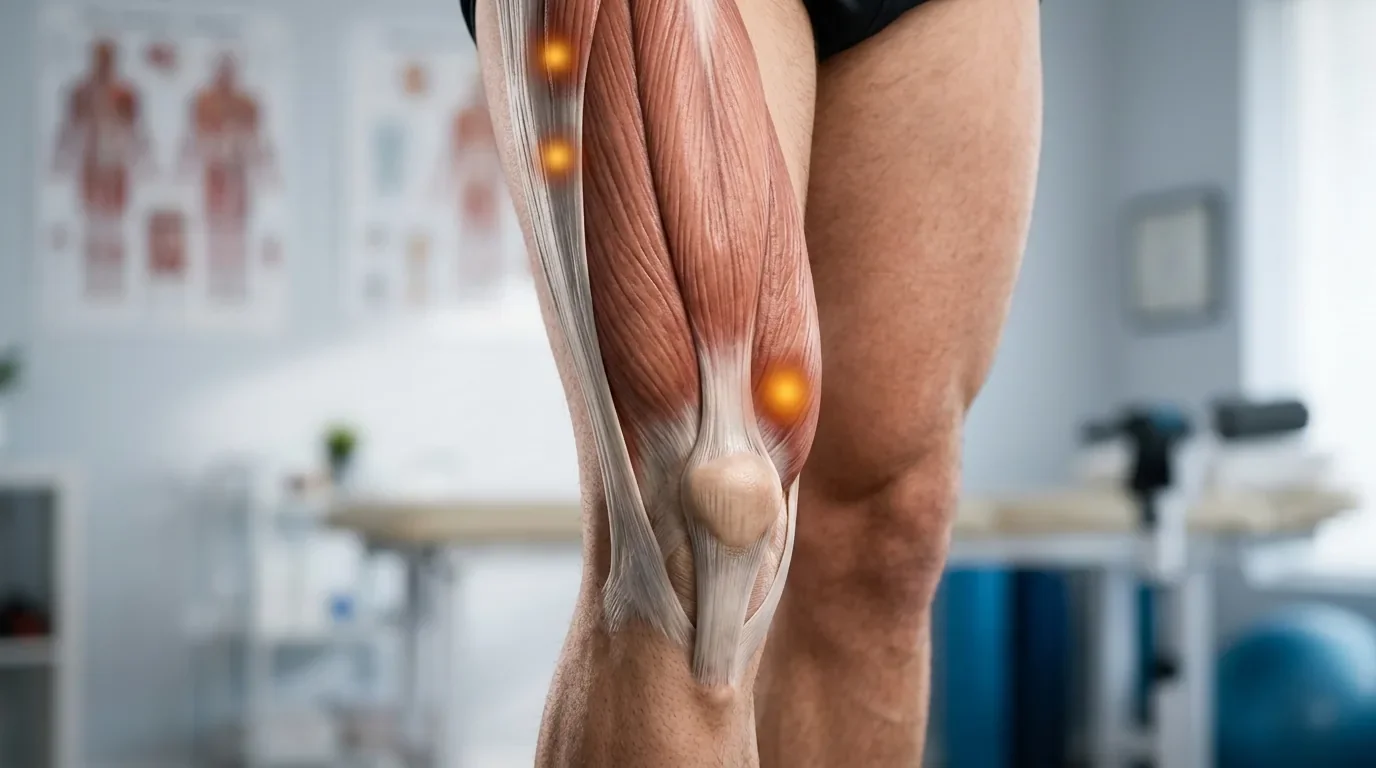
Myofascial trigger points in the quadriceps group, the hamstrings, the gastrocnemius, the popliteus, and the tensor fasciae latae all refer pain into the knee in patterns that are felt as joint-level pain by the patient. From the patient's perspective, the pain is in the knee. From a myofascial perspective, the knee is simply where the pain lands, while the generating source is somewhere in the surrounding musculature.
Research conducted specifically in knee osteoarthritis populations has found that trigger point burden is high and that it tracks with symptom severity in ways that structural findings alone do not explain (Sánchez Romero et al., 2020; Dor & Kalichman, 2017). This does not mean structural changes are irrelevant; it means that for many patients, the myofascial layer is an undertreated source of pain operating on top of, or independently from, any underlying joint pathology.
Tool Trigger Point Pain Finder — Locate the Muscle Behind Your Knee Pain| Muscle | Referred Pain Location | Commonly Confused With | Key Clinical Note |
|---|---|---|---|
| Vastus Lateralis | Lateral thigh, outer knee, lateral patella | IT band syndrome, lateral meniscal tear | Most commonly active quadriceps trigger point; refers distally along outer thigh to lateral knee |
| Vastus Medialis | Medial knee, inner joint line | Medial meniscal tear, MCL sprain, pes anserine bursitis | VMO trigger points produce medial knee pain that is felt precisely at the joint line, making meniscal pathology difficult to rule out clinically |
| Rectus Femoris | Anterior knee, kneecap, deep ache inside the joint | Patellofemoral syndrome, patellar tendinopathy | Crosses both hip and knee; trigger points at mid-belly refer to the anterior knee and patellar region |
| Biceps Femoris | Posterior lateral knee, popliteal region | Lateral meniscal tear, common peroneal nerve irritation, popliteal cyst | Lateral hamstring; trigger points concentrate near the fibular head attachment and refer into the posterior-lateral knee |
| Gastrocnemius | Posterior knee, upper calf, sometimes instep | Popliteal cyst, DVT, posterior capsule irritation | Upper gastrocnemius trigger points refer proximally into the posterior knee and are frequently missed when evaluation centers on the calf and ankle |
| Tensor Fasciae Latae (TFL) | Lateral knee, lateral joint line, outer thigh | IT band syndrome, lateral knee bursitis | TFL trigger points load the iliotibial band and produce lateral knee pain that is clinically indistinguishable from IT band friction syndrome without palpation |
| Popliteus | Posterior knee, directly behind the knee joint | Popliteal cyst, posterior capsule sprain, PCL injury | Small but frequently overlooked; trigger points produce a concentrated posterior knee ache that worsens going downhill or descending stairs |
The Quadriceps Group: The Dominant Source of Anterior Knee Pain
The four muscles of the quadriceps group share the function of extending the knee, but each has a distinct referral pattern that, when present, produces a different quality and location of knee-level pain. Understanding which muscle is involved can help explain why two patients with "knee pain" describe entirely different sensations at entirely different locations around the same joint.
Vastus Lateralis
The vastus lateralis is the largest of the four quadriceps heads and the most common site of active trigger points in knee pain patients. Its trigger points are typically located along the lateral surface of the thigh, and they refer pain in a band that runs down the outer thigh and concentrates around the lateral knee and outer edge of the patella. Patients often describe this as a nagging lateral ache that worsens going up stairs or rising from a chair.
Because the vastus lateralis also contributes to patellar tracking, trigger point shortening in this muscle can pull the patella laterally, creating or amplifying patellofemoral contact stress. This mechanical consequence compounds the referred pain, producing both a direct myofascial ache and a secondary structural irritation. In a study examining trigger point prevalence in knee OA, the vastus lateralis was among the most consistently affected muscles across all severity levels (Sánchez Romero et al., 2020).
Related Vastus Lateralis Trigger Points — Lateral Knee and Outer Thigh PainVastus Medialis
The vastus medialis oblique (VMO) is the teardrop-shaped portion of the medial quadriceps that sits just above and medial to the kneecap. Its trigger points refer pain directly to the inner knee, often landing precisely at the medial joint line, which is the same location where medial meniscal tears are reported. This anatomical coincidence is responsible for a substantial number of false-positive meniscal diagnoses when imaging or clinical testing is not sufficiently specific.
Beyond referred pain, active VMO trigger points alter the muscle's recruitment timing, contributing to the lateral patellar maltracking that underlies patellofemoral pain syndrome. Treating the vastus medialis trigger point directly, rather than relying on VMO strengthening exercises alone, can resolve pain that has failed to respond to standard rehabilitation protocols.
Rectus Femoris
The rectus femoris is unique among the quadriceps in that it crosses both the hip and the knee. Its trigger points, typically located at mid-belly in the anterior thigh, refer pain deep into the anterior knee and the kneecap itself, producing a sensation that patients describe as coming from "inside the joint." This deep, diffuse anterior ache is frequently attributed to patellofemoral syndrome or early chondromalacia without consideration of the muscle's role.
Hip flexor tightness, which commonly coexists with rectus femoris trigger points in sedentary or desk-bound patients, also increases anterior pelvic tilt and alters the mechanics of knee extension throughout the gait cycle. Addressing the rectus femoris as a hip-to-knee structure, rather than treating only the knee, is often necessary for lasting resolution of anterior knee pain.
Related Rectus Femoris Trigger Points — Anterior Knee and Kneecap PainKnee Pain That Worsens Going Down Stairs? The Muscles May Be the Missing Piece.
Stair descent is one of the most reliable provocateurs of trigger point-related knee pain, particularly from the popliteus and rectus femoris. If your knee pain is predictably worse going downstairs, downhill, or rising from seated, a myofascial assessment at Morningside Acupuncture can clarify whether the joint or the surrounding muscles are the primary pain generator. Dry needling often provides relief that strengthening and stretching alone have not achieved.
Schedule NowThe Hamstrings: Posterior Knee Pain That Looks Like a Structural Problem
Posterior knee pain is diagnostically challenging because the popliteal region is anatomically dense, and several structures, including the posterior capsule, the popliteal artery, the common peroneal nerve, and the proximal attachments of the gastrocnemius, converge in a small space. Popliteal cysts, posterior meniscal tears, and PCL injuries all produce posterior knee pain, and they are often the first conditions considered. Hamstring trigger points are rarely among them.
The biceps femoris, as the lateral hamstring, attaches to the fibular head and produces a focal posterior-lateral knee ache when its trigger points are active. This pain is reproduced reliably with resisted knee flexion and with palpation of the muscle belly in the posterior-lateral thigh, which distinguishes it clinically from joint-derived sources. The medial hamstrings, the semimembranosus and semitendinosus, produce a complementary posterior-medial ache and are frequently implicated in knee pain presentations that have been attributed to medial compartment arthritis or pes anserine bursitis.
A review of the myofascial component in knee pain noted that the hamstrings are consistently under-evaluated in standard knee pain workups, in part because clinicians are primarily trained to assess anterior structures and imaging findings, and posterior knee pain without clear structural correlates is often labeled non-specifically (Dor & Kalichman, 2017).
Related Biceps Femoris Trigger Points — Posterior Lateral Knee Pain| Muscle | Pain Pattern | Structural Diagnosis It Mimics | What Distinguishes It |
|---|---|---|---|
| Vastus Medialis | Medial knee, inner joint line | Medial meniscal tear, MCL sprain | Pain reproduced by palpating VMO belly, not joint line stress tests; no effusion or mechanical locking |
| Vastus Lateralis | Lateral knee, outer patella | IT band syndrome, lateral meniscal tear | Pain reproduced by VL palpation at mid-thigh, not at the lateral femoral condyle; no Noble compression test positive |
| Rectus Femoris | Deep anterior knee, patella | Patellofemoral syndrome, patellar tendinopathy | Pain referral from mid-thigh palpation; hip extension stretch reproduces or aggravates; no patellar grind sign |
| Biceps Femoris | Posterior lateral knee | Lateral meniscal tear, popliteal cyst, peroneal nerve entrapment | Pain reproduced by resisted knee flexion and posterior-lateral thigh palpation; normal nerve conduction studies |
| Popliteus | Posterior knee, directly behind joint | Popliteal cyst, PCL sprain, posterior capsule tear | Worsens with downhill walking and stair descent; trigger point palpation in popliteal fossa reproduces pain; normal posterior drawer test |
| Gastrocnemius | Posterior knee and upper calf | Popliteal cyst, DVT, posterior capsule irritation | No warmth, swelling, or vascular signs; pain reproduced by calf palpation; normal Homans sign |
| TFL | Lateral knee, outer thigh | IT band friction syndrome, lateral bursitis | TFL palpation at anterior iliac crest reproduces lateral knee pain; no positive Ober's test required for diagnosis |
The Gastrocnemius and Popliteus: The Most Overlooked Knee Pain Generators
Two muscles warrant particular attention because they produce posterior knee pain with enough clinical specificity to be diagnostic yet are rarely included in standard knee pain evaluations.
Gastrocnemius
The gastrocnemius originates from the posterior femoral condyles just above the knee joint, which means its proximal musculotendinous junction sits directly behind the knee, not in the calf where most patients and clinicians associate it. Trigger points in the upper portion of the medial or lateral gastrocnemius head refer pain proximally into the posterior knee as well as distally down the posterior calf. Patients who describe an aching behind the knee that worsens after prolonged standing or walking, without any swelling or vascular symptoms, are frequently describing gastrocnemius trigger point referral.
The clinical significance of this pattern is that it can mimic a popliteal (Baker's) cyst in symptom location while being entirely myofascial in origin. Imaging will confirm or rule out the cyst, but the trigger point can persist and produce ongoing pain even when the cyst has resolved, unless it is specifically treated.
Popliteus
The popliteus is a small, triangular muscle that sits at the back of the knee and functions to internally rotate the tibia during knee flexion, essentially "unlocking" the knee from full extension. Its trigger points produce a concentrated ache directly behind the knee that is distinctly worse during activities requiring controlled knee flexion under load, particularly descending stairs, walking downhill, or squatting. This stair-descent symptom pattern is one of the most consistent clinical clues pointing to popliteus involvement.
Because the popliteus sits deep in the popliteal fossa, it is almost never assessed in routine clinical evaluation and is inaccessible to most manual therapy approaches. Dry needling is one of the few techniques capable of reaching it directly. In patients with persistent posterior knee pain who have had normal imaging and failed conservative treatment, popliteus trigger points should be among the first targets considered (Rozenfeld & Kalichman, 2019).
Related Dry Needling for Knee Pain — Evidence, Technique, and What to ExpectThe Tensor Fasciae Latae and Lateral Knee Pain
The tensor fasciae latae originates at the anterior superior iliac spine and inserts into the iliotibial band, which in turn attaches to the lateral tibial condyle. Trigger points in the TFL increase tension throughout the IT band, loading the lateral knee with every step. The resulting lateral knee pain, felt at the outer joint line and sometimes radiating slightly above and below it, is the same location where IT band friction syndrome produces symptoms.
The distinction matters because IT band syndrome is typically managed with stretching, foam rolling, and activity modification, while TFL trigger points require direct treatment of the muscle at the hip, not the band itself. Patients who foam roll aggressively without relief, or who have tried IT band stretches with minimal improvement, may simply be working on the wrong tissue. Releasing the TFL trigger points that are generating the band tension addresses the problem at its source rather than at the symptom location.
Related TFL Trigger Points — Lateral Knee and Hip Pain Tool Pain Finder: Hip, Thigh, and Knee — Find Your Muscle SourceKnee Pain That Hasn't Responded to Rest, Injections, or Physical Therapy?
At Morningside Acupuncture, we are the highest-rated acupuncture and dry needling clinic in New York City with over 500 five-star Google reviews. We specialize in identifying and treating the myofascial sources of knee pain that standard evaluations routinely miss, including deep trigger points in the quadriceps, popliteus, hamstrings, and posterior calf. If you have been managing knee pain without lasting relief, a myofascial assessment may reveal what imaging alone cannot. We would be glad to help you find answers.
Schedule NowFrequently Asked Questions
Can muscle trigger points really cause pain that feels like it's coming from inside the knee joint?
Yes. Trigger points in the quadriceps, hamstrings, gastrocnemius, and popliteus all produce referred pain that is felt at the knee, even when the joint itself has no structural pathology. The brain interprets the referred signal as coming from the area where pain is felt, not from the muscle generating it. This is the same mechanism that causes arm pain during a cardiac event: the source and the location are in different places.
How do I know if my knee pain is coming from muscles or from the joint?
There is no reliable way to determine this without a hands-on evaluation, because the pain patterns overlap significantly. Some clues that point toward a myofascial source include pain that moves or changes location, pain that varies a great deal with stress or sleep, absence of swelling or joint warmth, normal imaging, and pain that reproduces when the surrounding muscle bellies are firmly pressed. A practitioner trained in myofascial assessment can map the pattern precisely and test whether palpating specific muscles reproduces your knee symptoms.
Does dry needling for knee trigger points hurt?
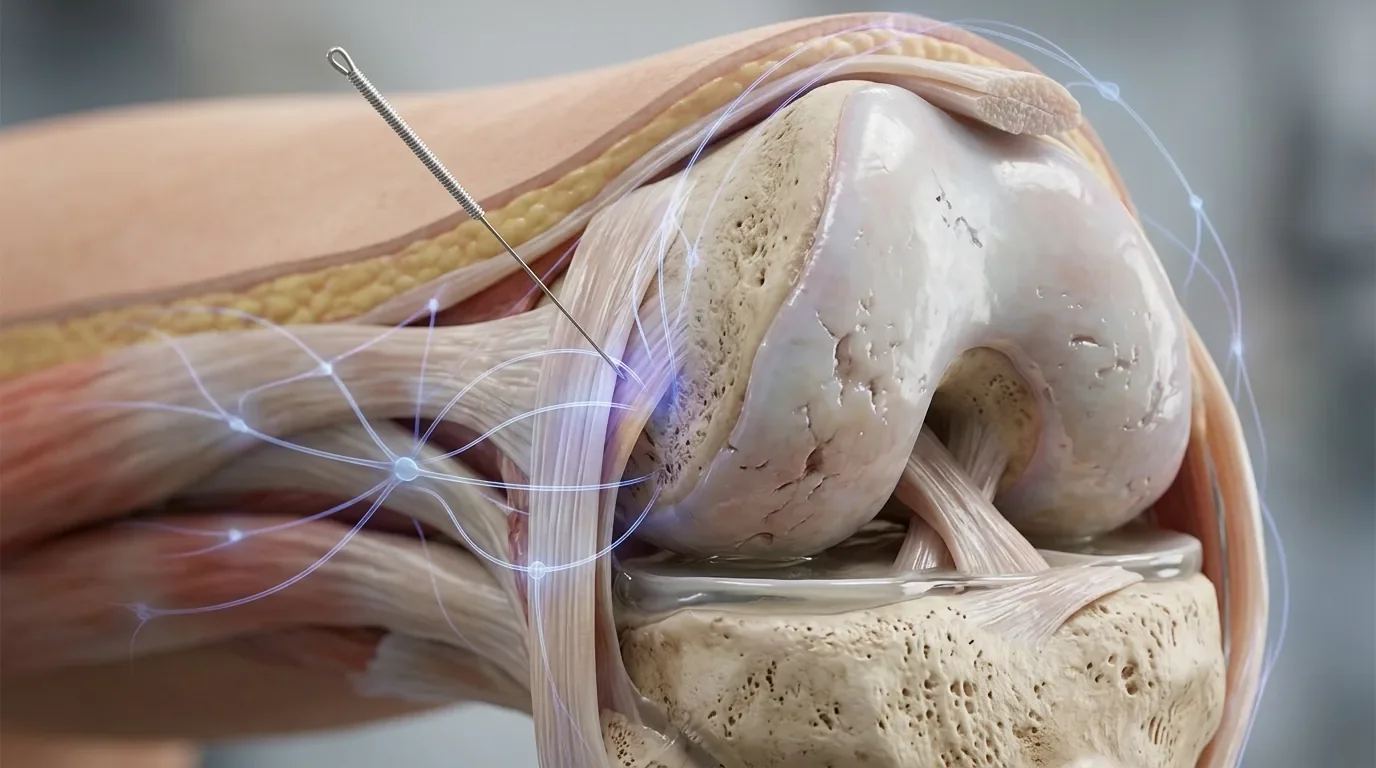
Most patients experience a brief, deep cramping sensation, called a local twitch response, when the needle contacts an active trigger point. This sensation typically lasts one to three seconds and is a sign that the trigger point is being deactivated. Between twitches the sensation is usually mild. Post-treatment soreness lasting one to two days is common, similar to what follows an intense workout, and is followed by a reduction in pain and an improvement in range of motion for most patients.
Can dry needling help knee pain from osteoarthritis?
Research suggests it can, particularly when trigger points are contributing to the symptom load. Studies in knee OA populations have found that patients carry a significant myofascial burden on top of their structural changes, and that addressing trigger points reduces pain and improves function independently of changes to the joint itself (Alburquerque-García et al., 2015). Dry needling does not alter joint cartilage, but reducing the muscular pain layer often produces meaningful relief even in the presence of confirmed structural pathology.
How many dry needling sessions are typically needed for knee pain?
Most patients with knee pain of myofascial origin see meaningful improvement within three to six sessions, with initial changes often noticeable after the first or second. The number depends on how long the problem has been present, how many muscles are involved, and whether there is an underlying structural or postural factor that needs to be addressed alongside the trigger point treatment. Your practitioner will reassess progress at each visit and adjust the plan accordingly.
Can Morningside Acupuncture treat knee pain caused by a meniscal tear or OA?
We work with patients who have confirmed structural diagnoses, including meniscal tears and knee OA, and we regularly find a significant myofascial component that is addressable even when the structural lesion cannot be reversed. Our goal is to reduce the total pain burden, restore as much function as possible, and help patients understand which part of their pain comes from the muscles and which comes from the joint. Many patients find that addressing the myofascial layer significantly reduces the urgency of surgical consideration.
References
- Sánchez Romero, E. A., Fernández-Carnero, J., Calvo-Lobo, C., Ochoa Sáez, V., Burgos Caballero, V., & Pecos-Martín, D. (2020). Prevalence of myofascial trigger points in patients with mild to moderate painful knee osteoarthritis. Journal of Clinical Medicine, 9(8), 2561. https://doi.org/10.3390/jcm9082561
- Alburquerque-García, A., Rodrigues-de-Souza, D. P., Fernández-de-las-Peñas, C., & Alburquerque-Sendín, F. (2015). Association between muscle trigger points, ongoing pain, function, and sleep quality in elderly women with bilateral painful knee osteoarthritis. Journal of Manipulative and Physiological Therapeutics, 38(4), 262–268. https://doi.org/10.1016/j.jmpt.2014.10.018
- Dor, A., & Kalichman, L. (2017). A myofascial component of pain in knee osteoarthritis. Journal of Bodywork and Movement Therapies, 21(3), 642–647. https://doi.org/10.1016/j.jbmt.2017.03.025
- Rozenfeld, E., & Kalichman, L. (2019). New is the well-forgotten old: The use of dry needling in the treatment of pain and muscle dysfunction. Journal of Bodywork and Movement Therapies, 20(2), 374–381. https://doi.org/10.1016/j.jbmt.2019.05.010
- Kordi Yoosefinejad, A., Motealleh, A., Mohamadtaghi, A., Panahandeh, M., & Haghighat, S. (2021). Comparison of the prevalence and sites of myofascial trigger points in patients with unilateral knee osteoarthritis and healthy individuals. Journal of Bodywork and Movement Therapies, 25, 197–202. https://doi.org/10.1016/j.jbmt.2020.10.012
Disclaimer: This web site is intended for educational and informational purposes only. Reading this website does not constitute providing medical advice or any professional services. This information should not be used for diagnosing or treating any health issue or disease. Those seeking medical advice should consult with a licensed physician. Seek the advice of a medical doctor or other qualified health professional for any medical condition. If you think you have a medical emergency, call 911 or go to the emergency room. No acupuncturist-patient relationship is created by reading this website or using the information. Morningside Acupuncture PLLC and its employees and contributors do not make any express or implied representations with respect to the information on this site or its use. For any legal interpretation of scope of practice in your state, consult a licensed attorney or regulatory authority.
Read more from our blog