Muscles That Cause Shoulder Pain
How Trigger Points in the Infraspinatus, Supraspinatus, Subscapularis, and Trapezius Refer Pain to the Shoulder
Shoulder pain is among the most commonly misattributed musculoskeletal complaints. What patients and clinicians often assume is a structural problem with the joint or rotator cuff tendons is frequently myofascial in origin, driven by trigger points in specific muscles that refer pain, restrict motion, and alter muscle activation patterns in the shoulder complex.
- Myofascial trigger points are prevalent in patients with chronic non-traumatic shoulder pain, and the infraspinatus, supraspinatus, and subscapularis are the most commonly involved muscles; six intervention studies demonstrated effectiveness of dry needling, ischemic compression, and multimodal myofascial treatment in reducing shoulder pain and improving range of motion (Sergienko & Kalichman, 2015).
- A randomized controlled trial of trigger point treatment in chronic shoulder pain found significantly greater reductions in pain, disability, and active trigger point count in the treatment group compared to a wait-list control, providing direct evidence that myofascial treatment produces clinically meaningful results (Bron et al., 2011).
- The infraspinatus is the single most important muscle in shoulder pain: its trigger points refer deep pain to the front of the shoulder joint and down the outer arm, a pattern that is directly reproduced by pressing on the infraspinatus in the suprascapular fossa; pressure pain threshold at active infraspinatus trigger points is significantly lower on the painful side than the non-painful side (Ge et al., 2008).
- The subscapularis, the only rotator cuff muscle on the anterior scapula, refers pain to the posterior shoulder and sends a distinct "bracelet" of referred pain around the wrist; trigger points here restrict external rotation in a pattern nearly identical to frozen shoulder, leading to frequent misdiagnosis.
- Active trigger points in the supraspinatus and infraspinatus were found in 67% and 42% of patients with unilateral shoulder impingement respectively, and these muscles showed significantly lower pressure pain thresholds at trigger point sites bilaterally, indicating central sensitization is present alongside the peripheral myofascial pain (Hidalgo-Lozano et al., 2010).
- Trigger point weakness and inhibition in the rotator cuff alter scapular kinematics and glenohumeral loading, which can contribute to impingement, tendinopathy, and mechanical shoulder pain as secondary consequences of primary myofascial dysfunction.
- Myofascial treatment targeting shoulder trigger points using ischemic compression reduced chronic shoulder pain significantly in a randomized trial, with patients also showing improved shoulder disability scores compared to a cervical control treatment group (Hains et al., 2010).
- Dry needling and acupuncture address shoulder trigger points by targeting the infraspinatus, supraspinatus, subscapularis, and upper trapezius directly, eliciting local twitch responses, normalizing biochemical conditions at the trigger point, and activating central descending inhibition.
Is a Muscle Trigger Point Behind Your Shoulder Pain?
Many patients with shoulder pain have been told they have impingement, bursitis, or rotator cuff tendinopathy, but the primary driver is a trigger point in the infraspinatus, subscapularis, or upper trapezius. At Morningside Acupuncture, we systematically assess and treat the muscular sources of your shoulder pain with dry needling and acupuncture techniques designed to reach deep into the rotator cuff.
Schedule NowWhy Shoulder Pain Is Frequently Myofascial
The shoulder is the most mobile joint in the body, which means it is also the most dependent on muscular coordination for stability. The rotator cuff, a group of four muscles that surround and compress the glenohumeral joint, must activate precisely and in the right sequence during every overhead movement. When any of these muscles develops trigger points, several things happen: the painful muscle generates referred pain felt at a distance from the trigger point itself; the muscle's force output decreases; and its activation timing changes, disrupting the coordinated scapular and glenohumeral movement patterns that protect the joint.
The literature consistently finds a high prevalence of active trigger points in patients with chronic shoulder pain and a significantly lower pressure pain threshold at trigger point sites in the painful shoulder compared to the non-painful side (Ge et al., 2008). The myofascial component of shoulder pain has historically been underappreciated in clinical practice, where imaging findings such as subacromial narrowing or partial rotator cuff tears often anchor the diagnosis even when those findings are asymptomatic in a significant proportion of the population.
Related Trigger Point Pain Finder — Interactive Muscle Pain MapThe Infraspinatus: The Front-of-Shoulder Impostor
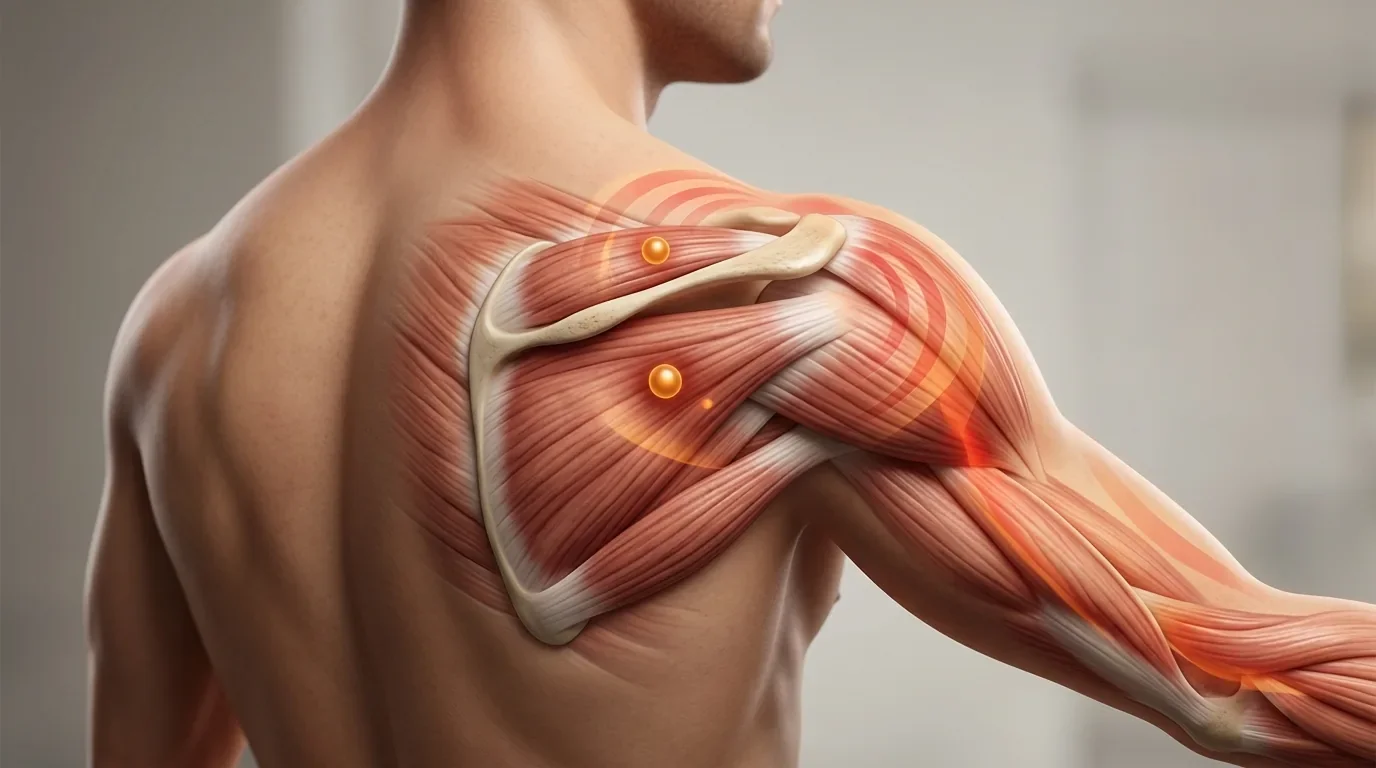
The infraspinatus occupies the infraspinous fossa of the scapula and is the primary external rotator of the glenohumeral joint. It stabilizes the humeral head in the glenoid during arm elevation and is one of the four rotator cuff muscles. Despite being located on the back of the shoulder blade, its trigger points refer pain to the front of the shoulder, into the bicipital groove, and down the outer arm, and sometimes into the forearm and hand in more severe cases.
This anterior referral pattern is clinically disorienting. Patients report deep, aching pain in the front of the shoulder that they cannot connect to the posterior muscle source. Many describe it as feeling like it is inside the joint, and some report that reaching behind their back or lying on the affected side is particularly aggravating. In a study using topographical pressure pain threshold mapping of the infraspinatus muscle, Ge et al. (2008) found that the painful shoulder side had significantly lower pressure pain threshold throughout the infraspinatus, with the midfiber region most hypersensitive, and that active trigger points correlated with reduced pressure pain thresholds bilaterally, indicating that infraspinatus trigger points contribute to widened pain sensitivity beyond the shoulder itself.
The infraspinatus is particularly vulnerable to trigger point development in activities requiring sustained internal rotation of the arm (such as keyboard work with the elbows at the side), overhead reaching, and sports involving throwing or racquet movements. It is also a common contributor to night pain because lying on the affected side compresses the infraspinatus directly.
Related Infraspinatus Trigger Points — Referred Pain Patterns and TreatmentThe Supraspinatus: The Arc Pain Muscle
The supraspinatus occupies the supraspinous fossa above the spine of the scapula and initiates abduction of the arm, working with the deltoid to elevate the shoulder. It is the most commonly involved muscle in rotator cuff pathology, and it is also a common trigger point site. Supraspinatus trigger points refer pain to the middle deltoid region, along the outer arm, and sometimes to the outer elbow in a pattern that can closely mimic lateral epicondylitis or C5 radiculopathy.
Clinically important is the finding that supraspinatus trigger points were the most prevalent in patients with unilateral shoulder impingement syndrome, found in 67% of subjects, with significantly lower pressure pain thresholds at the trigger point sites compared to controls (Hidalgo-Lozano et al., 2010). This suggests that in many patients diagnosed with impingement, the supraspinatus trigger point is an important contributor to both the pain experience and, through its effect on force production and muscle activation timing, to the altered mechanics that characterize impingement presentations.
The supraspinatus is vulnerable to overload in any context requiring repeated or sustained overhead elevation, including painting, reaching to high shelves, overhead sports, and certain manual jobs. Because it passes beneath the acromion, supraspinatus trigger points can coexist with true subacromial impingement, and in some cases the trigger point-driven inhibition of the muscle may itself contribute to increased subacromial contact forces.
Related Supraspinatus Trigger Points — Pain Patterns and Treatment| Muscle | Location | Referred Pain Pattern | Commonly Mistaken For |
|---|---|---|---|
| Infraspinatus | Posterior scapula (suprascapular fossa) | Front of shoulder joint, outer upper arm, sometimes forearm and hand | Bicipital tendinitis, AC joint pain, C5-C6 radiculopathy |
| Supraspinatus | Superior scapula above spine | Middle deltoid, outer arm, lateral elbow | Subacromial impingement, rotator cuff tear, C5 radiculopathy, lateral epicondylitis |
| Subscapularis | Anterior scapula (subscapular fossa) | Posterior shoulder, band of pain around the wrist | Frozen shoulder (adhesive capsulitis), posterior instability |
| Upper Trapezius | Upper neck to outer clavicle/acromion | Side of neck, temple, back of shoulder, outer shoulder | AC joint pathology, cervical disc problem, shoulder bursitis |
| Levator Scapulae | Cervical spine to superomedial scapula | Posterior-lateral neck, medial shoulder, scapular angle | Cervical facet arthropathy, rhomboid strain, muscle spasm |
| Deltoid | Covering the shoulder joint | Anterior or lateral shoulder; local pain in the deltoid itself | Rotator cuff partial tear, subdeltoid bursitis |
Shoulder Pain That Hasn't Cleared Up? The Muscles May Be the Answer.
If you have been managing your shoulder pain with rest, physical therapy, or injections without lasting relief, a myofascial assessment of the infraspinatus, subscapularis, supraspinatus, and trapezius may reveal the missing piece. Morningside Acupuncture uses precise dry needling to reach deep rotator cuff muscles that cannot be fully addressed through surface treatment alone.
Schedule NowThe Subscapularis: The Hidden Rotator Cuff Muscle
The subscapularis is the only rotator cuff muscle on the front surface of the scapula. It fills the subscapular fossa and attaches to the lesser tuberosity of the humerus, producing internal rotation and anterior stabilization of the glenohumeral joint. Because it sits against the anterior surface of the scapula, sandwiched between the scapula and the rib cage, it is inaccessible to direct manual compression from the posterior approach. This anatomical position means that subscapularis trigger points are among the most chronically under-treated in the shoulder.
The subscapularis produces two distinct referral patterns. The primary pattern is deep posterior shoulder pain concentrated in the area of the posterior deltoid. The secondary pattern is unique to the subscapularis: a band of referred pain that wraps around the wrist like a bracelet, typically on the dorsal surface. Patients with subscapularis trigger points report difficulty combing hair, reaching behind the back, or placing an arm in a coat sleeve, and their external rotation is restricted in a pattern so characteristic that it has historically been attributed to capsular tightening in frozen shoulder. Research and clinical experience both suggest that what appears to be frozen shoulder is in many cases subscapularis trigger point activity limiting the range of motion through protective muscle guarding rather than true adhesive capsulitis.
Related Subscapularis Trigger Points — The Frozen Shoulder MuscleThe Upper Trapezius and Levator Scapulae: The Neck-to-Shoulder Connection
While the rotator cuff muscles generate the most diagnostically specific patterns, the upper trapezius and levator scapulae are the most commonly symptomatic muscles in everyday shoulder pain presentations. Both are chronically overloaded in desk work and smartphone use, both develop trigger points rapidly in response to psychological stress, and both refer pain into the shoulder complex as part of broader neck-shoulder pain syndromes.
Upper trapezius trigger points refer to the back and side of the neck, the temple, and the outer shoulder. Because the referral follows the path from the neck to the shoulder, patients often describe a continuous aching that covers the entire neck-shoulder junction, and clinicians may not clearly attribute it to a single muscle source. A randomized controlled trial on myofascial treatment for chronic shoulder pain found significant reductions in active trigger point count in the upper trapezius, infraspinatus, and teres minor muscles following a program of manual compression, stretching, and ergonomic advice, with meaningful improvements in shoulder pain and disability compared to the wait-list group (Bron et al., 2011).
The levator scapulae originates on the transverse processes of C1 through C4 and inserts on the superomedial angle of the scapula. Its trigger points produce a characteristic stiff neck with restricted ipsilateral rotation and a referred aching at the medial shoulder and the scapular angle. Levator scapulae trigger points are frequently activated by sustained neck rotation to the contralateral side, such as working at a second monitor placed to the side, or by carrying a bag over the ipsilateral shoulder.
| Muscle | Primary Activating Factors | Why This Muscle Is Vulnerable |
|---|---|---|
| Infraspinatus | Sustained arm use at keyboard, overhead sports, throwing, sleeping on affected side | Required for both external rotation and posterior capsule protection; easily overloaded in internal-rotation-dominant postures |
| Supraspinatus | Overhead reaching, painting, sports with arm elevation, carrying weight with arm dependent | Initiates abduction; passes through the subacromial space and is vulnerable to compressive and tensile overload |
| Subscapularis | Immobilization, post-surgical restriction, repetitive internal rotation, sleeping on the shoulder | Hidden on anterior scapula; rarely treated; restricted motion perpetuates protective guarding and further shortening |
| Upper Trapezius | Sustained desk posture, psychological stress, elevated shoulders, carrying bags on one side | Under continuous low-level postural demand; first muscle to respond to stress with increased tone |
| Levator Scapulae | Prolonged unilateral screen rotation, bag-carrying, whiplash, poor pillow support | Connects cervical spine to scapula; overloaded when head and shoulder move asymmetrically |
Dry Needling the Rotator Cuff: Accessing the Inaccessible
The central argument for dry needling in shoulder pain is access. The subscapularis is practically unreachable through manual therapy using a posterior approach; reaching it requires either axillary entry or anterior approach techniques that use the acupuncture needle's length and fine gauge to navigate past surrounding structures. The supraspinatus is covered by the trapezius and acromion; direct compression cannot reliably reach its trigger points without addressing the overlying muscles first. Dry needling allows practitioners to address these deep structures with a level of precision that manual therapy cannot achieve in most shoulder presentations.
In the randomized controlled trial by Bron et al. (2011), patients receiving comprehensive myofascial treatment including manual compression and stretching of the rotator cuff and shoulder girdle muscles showed significantly greater improvements than wait-list controls in shoulder pain, disability scores, number of active trigger points, and pressure pain threshold at trigger point sites. This provides a direct clinical evidence base for targeting these muscles specifically rather than treating the shoulder region in general.
Acupuncture complements the local trigger point work by activating central pain-modulating systems. In patients with longstanding shoulder pain, central sensitization contributes to the widespread pressure pain hypersensitivity seen at non-shoulder sites, and descending inhibitory modulation through the periaqueductal gray and endogenous opioid systems addresses this central component while the direct needling manages the peripheral trigger points.
Address the Muscle Sources of Your Shoulder Pain
At Morningside Acupuncture, we are the highest-rated acupuncture and dry needling clinic in New York City with over 500 five-star Google reviews. We specialize in precise dry needling of the infraspinatus, subscapularis, supraspinatus, upper trapezius, levator scapulae, and deltoid, addressing the myofascial sources of your shoulder pain that other treatments may have missed. Whether your pain started gradually or following an injury, a thorough myofascial assessment is the right place to begin.
Schedule NowFrequently Asked Questions
Can muscle trigger points really cause the same symptoms as a rotator cuff tear?
Yes. Active trigger points in the infraspinatus and supraspinatus produce pain, restricted range of motion, and reduced muscle strength that closely mimic the clinical presentation of a partial or full rotator cuff tear. The referred pain from the infraspinatus in particular is felt deep inside the front of the shoulder, a location patients typically associate with structural joint pathology. Without direct muscle palpation and trigger point assessment, the two can be difficult to distinguish on presentation alone.
Could my frozen shoulder actually be a trigger point problem?
Possibly. The subscapularis restricts external rotation when it develops trigger points, producing a motion restriction pattern nearly identical to adhesive capsulitis. Some patients diagnosed with frozen shoulder have significant subscapularis trigger point activity as the primary driver of their restricted motion, and these patients may respond well to targeted myofascial treatment of the subscapularis even when the shoulder has been restricted for months. A clinical assessment can help determine whether the restriction is primarily capsular or muscular.
What is the difference between dry needling and acupuncture for shoulder pain?
Dry needling is a specific style of acupuncture focused on targeting trigger points within muscles, typically using a rapid in-and-out needling technique aimed at eliciting a local twitch response in the dysfunctional muscle tissue. Broader acupuncture treatment may incorporate distal points along the arm and shoulder that activate descending pain-inhibitory pathways. At Morningside Acupuncture, we integrate both approaches based on the patient's specific muscle involvement and the degree of central sensitization present.
How many sessions are typically needed for shoulder trigger point treatment?
In the randomized controlled trial by Bron et al. (2011), treatment consisted of weekly sessions for several months. In clinical practice, many patients notice meaningful improvement within three to six sessions for acute or subacute presentations. Chronic shoulder pain with multiple involved muscles and some degree of central sensitization generally requires a longer treatment course. Your practitioner at Morningside will give you a realistic prognosis after the initial assessment.
Can dry needling help shoulder pain that has not responded to physical therapy or cortisone injections?
Many patients who come to Morningside Acupuncture have already undergone physical therapy or received corticosteroid injections with incomplete or temporary relief. These treatments address different aspects of shoulder pain: physical therapy focuses on movement patterns and strength, while cortisone injections reduce local inflammation. Neither specifically targets trigger points in the rotator cuff muscles. Dry needling addresses the myofascial component directly and often produces results in patients who have not responded to other modalities.
Does dry needling the shoulder hurt?
Needling the infraspinatus and supraspinatus produces a characteristic deep cramping or aching sensation when a trigger point is contacted and a local twitch response is elicited. This sensation lasts one to two seconds and is followed by a notable release of muscle tension. The subscapularis, accessed from the axillary approach, is more sensitive, and most practitioners use a more careful technique for this muscle. Post-treatment soreness for 24 to 48 hours is common in the shoulder muscles, particularly the infraspinatus and supraspinatus.
References
- Bron, C., de Gast, A., Dommerholt, J., Stegenga, B., Wensing, M., & Oostendorp, R. A. (2011). Treatment of myofascial trigger points in patients with chronic shoulder pain: A randomized, controlled trial. BMC Medicine, 9, 8. https://doi.org/10.1186/1741-7015-9-8
- Hidalgo-Lozano, A., Fernández-de-las-Peñas, C., Alonso-Blanco, C., Ge, H. Y., Arendt-Nielsen, L., & Arroyo-Morales, M. (2010). Muscle trigger points and pressure pain hyperalgesia in the shoulder muscles in patients with unilateral shoulder impingement: A blinded, controlled study. Experimental Brain Research, 202(4), 915–925. https://doi.org/10.1007/s00221-010-2196-4
- Ge, H. Y., Fernández-de-las-Peñas, C., & Arendt-Nielsen, L. (2008). Topographical mapping and mechanical pain sensitivity of myofascial trigger points in the infraspinatus muscle. European Journal of Pain, 12(7), 859–865. https://doi.org/10.1016/j.ejpain.2007.12.005
- Sergienko, S., & Kalichman, L. (2015). Myofascial origin of shoulder pain: A literature review. Journal of Bodywork and Movement Therapies, 19(1), 91–101. https://doi.org/10.1016/j.jbmt.2014.05.004
- Hains, G., Descarreaux, M., & Hains, F. (2010). Chronic shoulder pain of myofascial origin: A randomized clinical trial using ischemic compression therapy. Journal of Manipulative and Physiological Therapeutics, 33(5), 362–369. https://doi.org/10.1016/j.jmpt.2010.05.003
Disclaimer: This web site is intended for educational and informational purposes only. Reading this website does not constitute providing medical advice or any professional services. This information should not be used for diagnosing or treating any health issue or disease. Those seeking medical advice should consult with a licensed physician. Seek the advice of a medical doctor or other qualified health professional for any medical condition. If you think you have a medical emergency, call 911 or go to the emergency room. No acupuncturist-patient relationship is created by reading this website or using the information. Morningside Acupuncture PLLC and its employees and contributors do not make any express or implied representations with respect to the information on this site or its use. For any legal interpretation of scope of practice in your state, consult a licensed attorney or regulatory authority.
Read more from our blog