Acupuncture for Biceps Tendinitis
Bicipital Groove Anatomy, the Tendinosis Distinction, and Why Rotator Cuff Function Determines Long-Term Outcome
Biceps tendinitis is one of the most common shoulder diagnoses, yet most cases involve tendinosis (degenerative tissue change without active inflammation) rather than true tendinitis, and the rotator cuff dysfunction that drives the biceps tendon into pathological loading is more clinically important than the tendon itself. Understanding this distinction guides a treatment approach that addresses the underlying biomechanical cause, not just the painful structure.
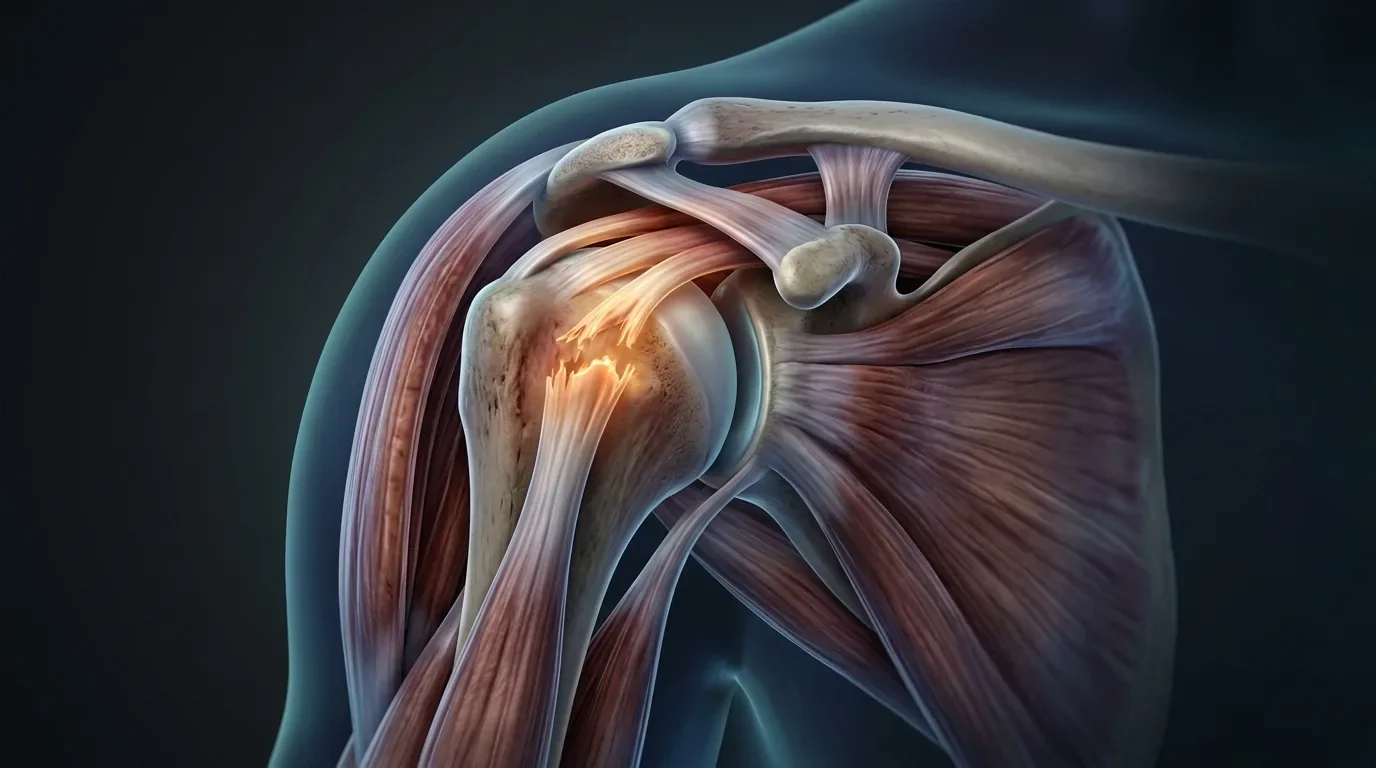
- The long head of the biceps originates from the supraglenoid tubercle and superior glenoid labrum, runs through the bicipital groove between the greater and lesser tuberosities, and is held in the groove by the transverse humeral ligament; this groove is the site of the tendon inflammation in bicipital tendinitis.
- True bicipital tendinitis involves active inflammatory change in the tendon or its synovial sheath (tenosynovitis); chronic cases more commonly involve tendinosis, an angiofibroblastic degenerative process with disorganized collagen and neovascularity but minimal inflammatory infiltrate.
- Biceps tendon pathology rarely exists in isolation: the long head of the biceps functions as a secondary stabilizer of the glenohumeral joint, and it is subjected to increased load when the rotator cuff (particularly the subscapularis and supraspinatus) fails to maintain optimal humeral head centering.
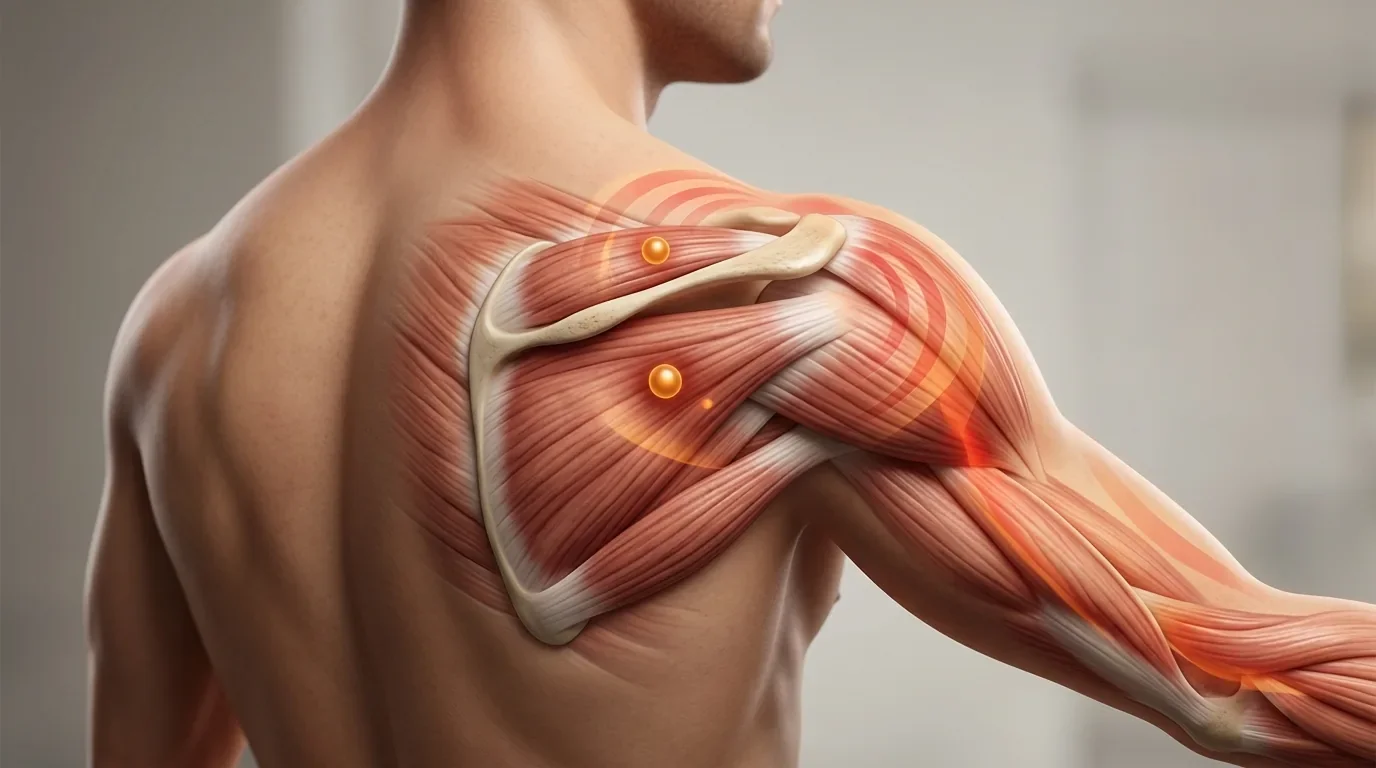
- Anterior shoulder trigger points in the infraspinatus refer pain to the anterior shoulder and down the anterior arm in a pattern that closely mimics biceps tendinitis, and these trigger points are among the most commonly missed contributors to the symptom picture (Simons et al., 1999).
- Corticosteroid injections into the bicipital groove provide short-term relief but carry risk of tendon weakening with repeated injection; dry needling of the tendon and the surrounding myofascial layer promotes tissue remodeling without the atrophy risk.
- Acupuncture and dry needling may significantly reduce pain and improve shoulder function in biceps tendinitis by addressing both the local tendinopathic tissue and the rotator cuff trigger points that maintain abnormal biceps loading (Vickers et al., 2018; Kietrys et al., 2013).
Anterior Shoulder Pain That Has Lingered Despite Rest?
Biceps tendinitis that does not resolve with standard conservative management almost always has a rotator cuff component that has not been addressed. At Morningside, we assess both the biceps tendon and the rotator cuff muscles that are loading it abnormally, then target both with dry needling and acupuncture to address the full pattern driving your anterior shoulder pain.
Schedule NowAnatomy: Why the Biceps Tendon Is Vulnerable
The biceps brachii has two heads. The short head arises from the coracoid process with the coracobrachialis and is relatively protected from pathological loading. The long head has a more complex and mechanically challenging path: it originates at the superior glenoid rim and labrum, passes through the glenohumeral joint as an intra-articular (but extra-synovial) structure, turns 90 degrees to pass through the bicipital groove, and then descends to the muscle belly. This architecture means the long head tendon must glide through the groove with every shoulder movement, and the cumulative friction of this gliding, especially when the groove is shallow or the transverse humeral ligament is lax, predisposes the tendon to chronic irritation.
The bicipital groove occupies the anterior humerus between the greater tuberositis (supraspinatus attachment) and the lesser tuberosity (subscapularis attachment). When the subscapularis is weak or inhibited, the groove loses medial wall support, and the transverse humeral ligament carries more of the load in containing the tendon. Repetitive overload in this configuration produces the tenosynovitis and eventual tendinosis that clinicians diagnose as biceps tendinitis.
The relationship between biceps pathology and superior labral (SLAP) tears is bidirectional: the long head anchors to the superior labrum at its origin, and excessive traction on the tendon from biceps overload can progressively destabilize this anchor, producing a superior labral tear. Conversely, a SLAP tear changes the direction of pull on the long head of the biceps, increasing eccentric load on the tendon during forearm supination and elbow flexion activities.
What Actually Drives Biceps Tendon Pain
| Structure | Mechanism | Key Finding | Treatment Target |
|---|---|---|---|
| Biceps tendon / tenosynovitis | Repetitive friction and compressive load in the bicipital groove; inflammatory change in the tendon sheath; tendinosis in chronic cases | Tenderness directly in the bicipital groove; pain with Speed's test (resisted shoulder flexion with elbow extended); Yergason's test (resisted supination) | Load management; dry needling of tendinopathic tissue; graduated loading exercises |
| Infraspinatus trigger points | Active TrPs in the infraspinatus belly refer to anterior shoulder and down the anterior arm; pattern may perfectly mimic bicipital groove pain | Tenderness in the infraspinatus belly (posterior shoulder, below the spine of the scapula); reproduces the anterior pain with sustained pressure | Dry needling of infraspinatus; most commonly missed contributor to "biceps tendinitis" symptom pattern |
| Subscapularis | Subscapularis weakness increases anterior instability; TrPs refer to the posterior shoulder and may produce a band of tenderness across the posterior axilla | Reduced internal rotation strength; anterior shoulder instability on testing; tenderness accessed via the axilla | Subscapularis activation exercises; dry needling via axillary approach |
| Biceps Brachii trigger points | TrPs in the biceps belly refer to anterior shoulder and anterior cubital fossa; may produce the characteristic bicipital groove pain independently of tendon pathology | Trigger point tenderness in the belly of the muscle, away from the groove; palpable taut band in the biceps | Dry needling of biceps brachii belly |
| Coracobrachialis | Originates at the coracoid with the short head biceps; TrPs refer to anterior deltoid region and dorsal arm; often overlooked in shoulder pain assessment | Deep anterior shoulder tenderness with arm at side; pain with shoulder flexion resisted against the coracoid | Dry needling of coracobrachialis belly |
| Supraspinatus | Supraspinatus failure to depress the humeral head allows superior migration, increasing impingement of the biceps tendon under the acromion | Supraspinatus trigger point; empty can test weakness; pain with mid-arc elevation (painful arc 60-120 degrees) | Supraspinatus strengthening; dry needling of TrPs |
Tendinitis Versus Tendinosis: Why the Distinction Matters
The term tendinitis implies active inflammatory infiltrate in the tendon. Histological studies of chronically painful tendons, including the biceps long head, consistently find minimal inflammatory cells and instead show angiofibroblastic hyperplasia: disorganized collagen, increased ground substance, neovascularity, and fibroblast proliferation. This degenerative pattern is tendinosis, not tendinitis, and it responds poorly to anti-inflammatory treatments like corticosteroids because the pathology is not primarily inflammatory.
This distinction has direct therapeutic implications. Cortisone injections into the bicipital groove temporarily reduce any synovial sheath inflammation but do not address the underlying tendinosis, and repeated injection carries well-documented risk of collagen weakening and tendon rupture. The clinical scenario of a patient receiving multiple bicipital groove injections with progressively shorter periods of relief and eventual complete rupture is a predictable consequence of treating tendinosis with anti-inflammatory injections.
Dry needling, by contrast, provides a controlled mechanical stimulus to the disorganized tendon tissue, activating fibroblasts and promoting PDGF- and TGF-beta-mediated collagen remodeling without the atrophy risk of corticosteroid injection. Combined with eccentric loading exercises (the most evidence-supported conservative intervention for tendinopathy), dry needling supports the biological environment needed for structural tendon repair.
Received Cortisone Injections Without Lasting Relief?
If cortisone injections have provided only temporary improvement for your biceps or anterior shoulder pain, the underlying tissue pathology is likely tendinosis rather than acute inflammation, and it needs a different approach. At Morningside, dry needling of the tendinopathic tissue, combined with targeted work on the rotator cuff muscles that are driving the abnormal biceps loading, provides the biological stimulus for genuine tissue repair rather than temporary suppression of inflammation.
Schedule NowThe Rotator Cuff Connection
Isolated biceps tendinitis without any rotator cuff involvement is uncommon. The long head of the biceps serves as a secondary stabilizer of the glenohumeral joint, depressing and centering the humeral head when the primary stabilizers (supraspinatus, infraspinatus, subscapularis) are fatigued or dysfunctional. Under conditions of rotator cuff fatigue or partial tearing, the biceps tendon carries an increased percentage of the centering force, subjecting it to abnormal tensile and compressive loads.
The practical implication is that treating only the biceps tendon in this context produces incomplete and temporary results. The rotator cuff dysfunction that is overloading the tendon must be addressed concurrently; otherwise the biceps will continue to be abnormally loaded and the tendinopathy will recur or progress. Assessment of subscapularis and supraspinatus strength and trigger point status is therefore an essential component of any comprehensive biceps tendinitis treatment plan.
Related Dry Needling for Shoulder PainTreatment Approach at Morningside
Assessment begins with determining which structure is actually the dominant pain generator. Palpation of the bicipital groove and Speed's and Yergason's tests confirm biceps tendon involvement. Palpation of the infraspinatus and biceps brachii muscle bellies away from the groove tests for myofascial referred pain. Supraspinatus, subscapularis, and infraspinatus strength testing assesses the rotator cuff component. This differentiation determines treatment priority and sequence.
For tendinopathic tissue in the bicipital groove, dry needling using a peritendinous approach promotes fibroblast activation and collagen remodeling in the affected tendon segment. Dry needling of the infraspinatus and biceps brachii muscle bellies eliminates the referred pain contribution. Subscapularis and supraspinatus trigger point treatment restores the rotator cuff function that reduces the abnormal load on the biceps tendon.
Traditional acupuncture complements dry needling by activating descending inhibitory pathways through the periaqueductal gray that reduce central sensitization (Zhao, 2008). This is particularly relevant in persistent biceps tendinitis where central sensitization has developed, making the shoulder broadly hypersensitive beyond what local tissue status would predict. A large meta-analysis of acupuncture for chronic pain found significant superiority over both sham and no-treatment controls for shoulder pain, with effect sizes persisting at 12-month follow-up (Vickers et al., 2018).
Dealing with Persistent Anterior Shoulder Pain in New York City?
At Morningside Acupuncture, we are the highest-rated acupuncture and dry needling clinic in New York City with over 500 five-star Google reviews. We treat biceps tendinitis and anterior shoulder pain by assessing the full picture: the tendon, the surrounding myofascial layer, and the rotator cuff function that determines long-term outcome. Whether your shoulder has been painful for months or is a recurrent problem, we develop a treatment plan that addresses what is actually driving the pain, not just the diagnosis on the imaging report. Schedule a visit to find out what is maintaining your shoulder symptoms.
Schedule NowFrequently Asked Questions
Where does biceps tendinitis hurt?
Biceps tendinitis typically produces pain at the front of the shoulder, specifically in the bicipital groove, which is the channel between the two bumps at the top of the upper arm bone (the greater and lesser tuberosities). The pain may radiate down the front of the arm. It is typically worsened by overhead reaching, lifting with the palm up, or lowering heavy objects. Direct pressure on the groove between the tuberosities reproduces the pain. Pain felt in the exact same location can also be produced by infraspinatus trigger points, which refer to the anterior shoulder from the back of the shoulder, and differentiating these two sources requires careful examination.
Can biceps tendinitis heal on its own?
Mild biceps tendinitis related to acute overuse often resolves with activity modification and relative rest over a few weeks. Chronic biceps tendinitis that has progressed to tendinosis (degenerative tissue change) is less likely to resolve without intervention because the disorganized collagen does not remodel effectively without a mechanical stimulus. Graduated loading exercises and dry needling provide the appropriate biological stimulus for tendon remodeling that self-management alone cannot reliably achieve in established tendinosis.
Is dry needling effective for biceps tendinitis?
Dry needling addresses biceps tendinitis through two mechanisms. For the myofascial component (infraspinatus and biceps brachii trigger points producing referred anterior shoulder pain), dry needling is highly effective and often produces rapid relief. For the tendinopathic tissue itself, dry needling provides a mechanical fibroblast stimulus that promotes collagen remodeling, similar in principle to the effect observed in lateral epicondylitis and plantar fasciitis tendinopathy. Evidence for dry needling in tendinopathy is supported by systematic review (Kietrys et al., 2013), though biceps-specific RCTs are limited.
Should I get a cortisone injection for biceps tendinitis?
A single cortisone injection may provide meaningful short-term relief for acute bicipital tenosynovitis (inflammation of the tendon sheath) and is a reasonable option for managing a flare. However, repeated injections carry documented risk of tendon weakening and rupture, and they do not address the underlying tendinosis or the rotator cuff dysfunction driving abnormal biceps loading. If you have received more than one injection without lasting benefit, the ongoing pathology is likely not primarily inflammatory, and a different treatment approach is warranted.
How does Morningside treat biceps tendinitis?
We start by identifying the primary pain generator, because anterior shoulder pain attributed to the biceps tendon is frequently driven significantly by infraspinatus trigger points and rotator cuff dysfunction rather than the tendon itself. Treatment combines dry needling of any active trigger points in the infraspinatus, biceps brachii, and coracobrachialis with peritendinous dry needling if tendinopathic tissue is identified, plus targeted rotator cuff work to restore the muscle balance that reduces abnormal biceps loading. Traditional acupuncture addresses central sensitization when the shoulder pain pattern suggests significant amplification beyond local tissue status.
References
- Vickers, A. J., Vertosick, E. A., Lewith, G., MacPherson, H., Foster, N. E., Sherman, K. J., Irnich, D., Witt, C. M., & Linde, K. (2018). Acupuncture for chronic pain: Update of an individual patient data meta-analysis. Journal of Pain, 19(5), 455-474. https://doi.org/10.1016/j.jpain.2017.11.005
- Simons, D. G., Travell, J. G., & Simons, L. S. (1999). Travell & Simons' Myofascial Pain and Dysfunction: The Trigger Point Manual (2nd ed.). Williams & Wilkins.
- Kietrys, D. M., Palombaro, K. M., Azzaretto, E., Hubler, R., Schaller, B., Schlussel, J. M., & Tucker, M. (2013). Effectiveness of dry needling for upper-quarter myofascial pain: A systematic review and meta-analysis. Journal of Orthopaedic & Sports Physical Therapy, 43(9), 620-634. https://doi.org/10.2519/jospt.2013.4668
- Coombes, B. K., Bisset, L., & Vicenzino, B. (2010). Efficacy and safety of corticosteroid injections and other injections for management of tendinopathy: A systematic review of randomised controlled trials. The Lancet, 376(9754), 1751-1767. https://doi.org/10.1016/S0140-6736(10)61160-9
- Zhao, Z. Q. (2008). Neural mechanism underlying acupuncture analgesia. Progress in Neurobiology, 85(4), 355-375. https://doi.org/10.1016/j.pneurobio.2008.05.004
- Shah, J. P., Danoff, J. V., Desai, M. J., Parikh, S., Nakamura, L. Y., Phillips, T. M., & Gerber, L. H. (2008). Biochemicals associated with pain and inflammation are elevated in sites near to and remote from active myofascial trigger points. Archives of Physical Medicine and Rehabilitation, 89(1), 16-23. https://doi.org/10.1016/j.apmr.2007.10.018
Disclaimer: This web site is intended for educational and informational purposes only. Reading this website does not constitute providing medical advice or any professional services. This information should not be used for diagnosing or treating any health issue or disease. Those seeking medical advice should consult with a licensed physician. Seek the advice of a medical doctor or other qualified health professional for any medical condition. If you think you have a medical emergency, call 911 or go to the emergency room. No acupuncturist-patient relationship is created by reading this website or using the information. Morningside Acupuncture PLLC and its employees and contributors do not make any express or implied representations with respect to the information on this site or its use. For any legal interpretation of scope of practice in your state, consult a licensed attorney or regulatory authority.
Read more from our blog