LI15 Acupuncture Point (Jianyu)
LI15 Acupuncture Point
The Shoulder Bone Point Below the Acromion: Anatomy, Mechanism, and Why LI15 Anchors Almost Every Shoulder Treatment
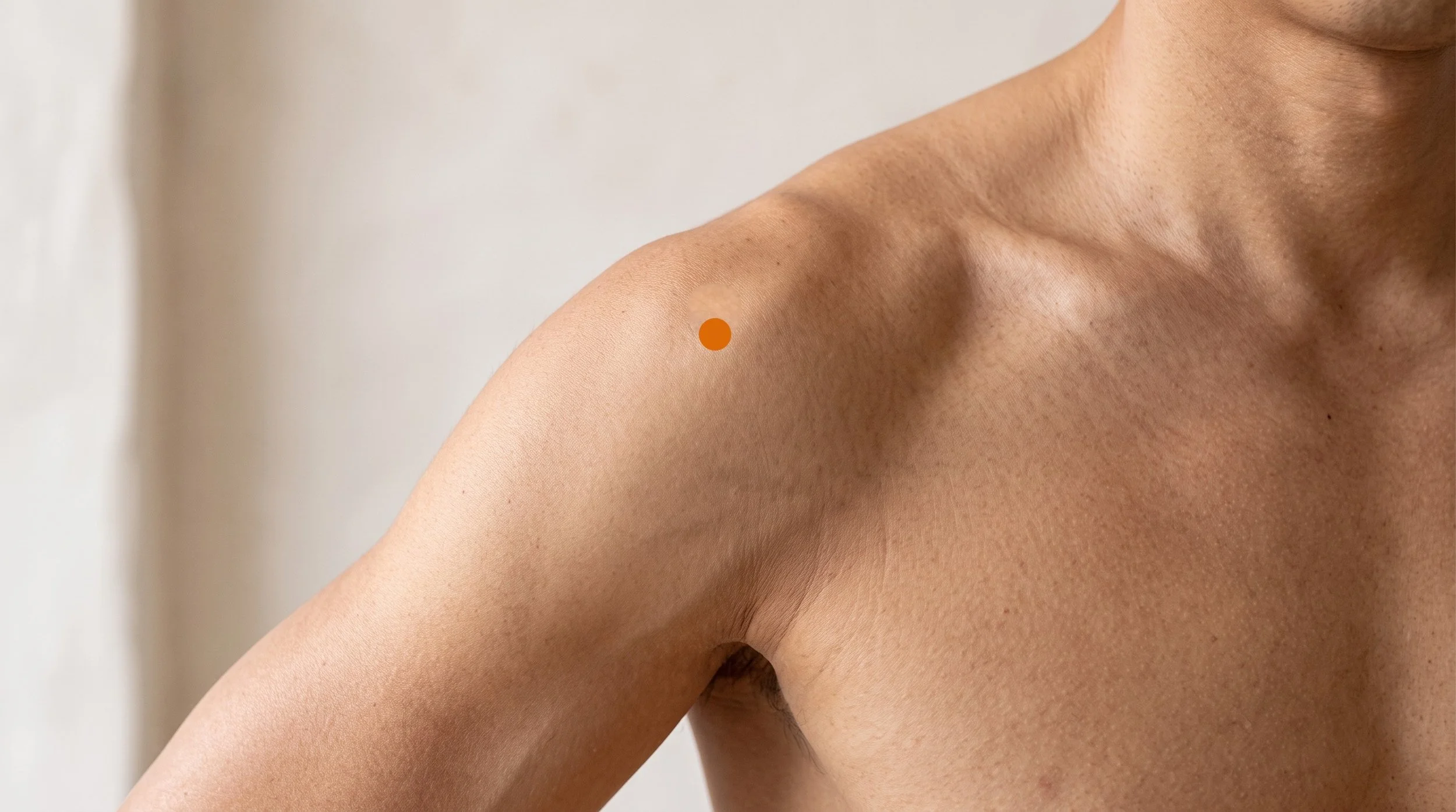
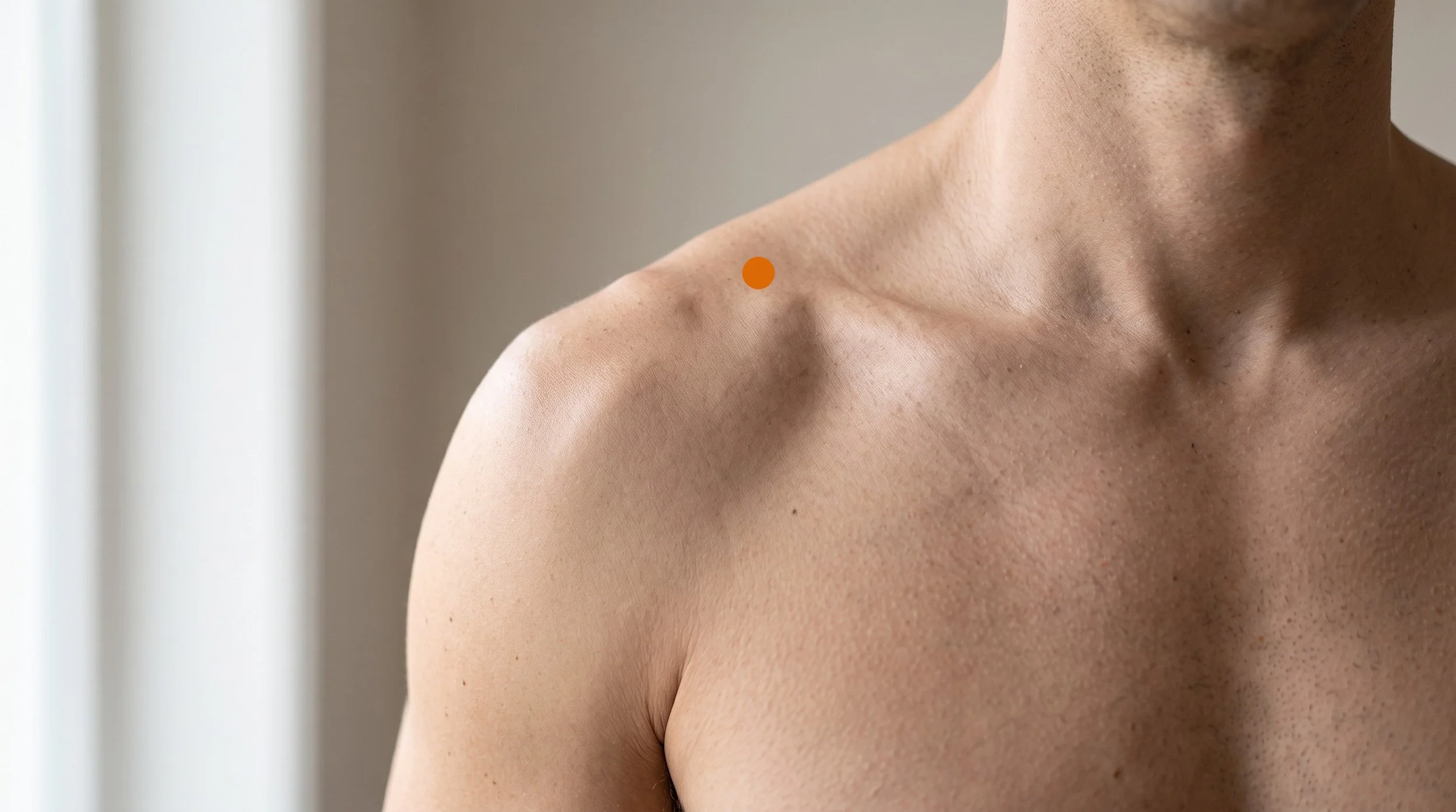
LI15 (Jianyu, often translated as Shoulder Bone) is the fifteenth point of the Large Intestine channel and the point most acupuncturists reach for first when a patient cannot lift the arm. In plain terms, the li 15 location is on the outer shoulder: lift the arm out to the side and two small dimples appear just under the front and back corners of the acromion, and LI15 sits in the front one, right where the deltoid takes origin from bone.
That small hollow is a doorway to the tissues that actually generate most shoulder pain, including the anterior and middle deltoid, the subdeltoid fat plane, the subacromial bursa, and the supraspinatus tendon on its way to the greater tuberosity.
Classical texts describe LI15 as a meeting point of the Large Intestine channel with the Yang Motility Vessel and as the leading point for shoulder problems (Deadman et al., 2001), and modern practice keeps it central for rotator cuff pain, impingement, frozen shoulder, and deltoid pain because a needle placed here can reach both muscle and the subacromial space (Lee, 2021).
- The li15 acupuncture point sits in the anterior depression below the acromion at the deltoid origin, with LI15 in the front hollow and TE14 in the back one, a distinction the classical texts are careful to make (Deadman et al., 2001). Layer by layer, a needle passes skin, thin subcutaneous tissue, deltoid, then the subdeltoid plane, subacromial bursa, and supraspinatus tendon.
- Traditionally, large intestine 15 is categorized as a meeting point of the Large Intestine channel with the Yang Motility Vessel (Yang Qiao Mai), and it is listed among points that traditionally dispel wind-damp, benefit the shoulder joint, and move qi and blood through the arm (Deadman et al., 2001). Read neurophysiologically, those descriptions map onto local nociceptive input, segmental modulation, and changes in regional blood flow and muscle tone.
- The territory belongs to the axillary nerve and its superior lateral cutaneous branch, while cuff tendon and capsule are supplied largely from the same C5 and C6 levels, so needling here converges on the dorsal horn segments that receive shoulder pain input (Zhao, 2008).
- An imaging and technique study using the LI15 approach showed that a 30 to 40 mm insertion can place the needle shaft in the subacromial space, and that arm position changes what the needle actually reaches (Lee, 2021). This is one of the few point-specific papers that documents what happens under the skin at a named acupuncture point.
- The research picture is mixed but not empty: an older Cochrane review of acupuncture for shoulder pain found limited evidence and called for better trials (Green et al., 2005), while more recent syntheses on impingement and frozen shoulder report modest pain and function gains with acceptable safety (An et al., 2024; Ben-Arie et al., 2020), and large individual patient data work supports a real, persisting effect for chronic musculoskeletal pain (Vickers et al., 2018).
- De qi at LI15 tends to be a heavy, spreading fullness deep in the joint that may travel down the deltoid toward the elbow; with dry needling of the deltoid, a brief local twitch response is common and usually settles within seconds (Simons et al., 1999).
Can't Lift Your Arm Overhead Without a Catch of Pain?
Loss of overhead reach is one of the most common reasons patients walk into our Midtown office, and LI15 is usually part of the plan on day one. We combine precise needling at the deltoid origin and subacromial plane with dry needling of the cuff muscles and graded loading so the shoulder gets both relief and capacity. Our acupuncturists palpate before every insertion, so the needle goes where your pain actually lives. Schedule a shoulder evaluation and let's find out how much range you can get back.
Schedule NowAnatomy of LI15: Why the Anterior Depression Below the Acromion Is Such an Important Location
Abduct the arm and the outer shoulder gives up its landmarks: the acromion becomes a shelf, and two small hollows appear beneath its front and back corners. LI15 occupies the anterior hollow, where the anterior and middle heads of the deltoid converge on their bony origin. Under the skin and a thin subcutaneous layer, the needle enters muscle that is constantly loaded by overhead reaching, carrying a bag on one side, pressing and pulling in the gym, and long hours at a keyboard with the shoulders rounded forward.
Deeper still lies the subdeltoid fat plane, the subacromial bursa, and the supraspinatus tendon traveling toward the greater tuberosity, with the glenohumeral capsule beneath that. In other words, a single well-placed needle at large intestine 15 can address contractile tissue and the sensitive bursal and tendinous layer that so often drive impingement-type pain.
The skin and muscle here are supplied by the axillary nerve (C5 and C6) and its superior lateral cutaneous branch, and the rotator cuff tendons, bursa, and capsule draw on the same upper cervical segments through the suprascapular and other branches of the brachial plexus. That shared segmental supply matters.
When a needle stimulates A-delta and group III afferents in the deltoid and periarticular tissue, that input enters the same dorsal horn levels that are already processing pain from a cranky cuff tendon, which allows segmental inhibition of the sensitized pathway and recruitment of descending inhibitory control from the brainstem (Zhao, 2008). Local effects add to this: needling changes microcirculation and can reduce the resting tone of a taut band, and deltoid trigger points themselves refer pain around the shoulder in patterns patients often describe as bursitis (Simons et al., 1999).
Deep and medial to the point sit the humeral head, the joint capsule, and the vessels that wrap the surgical neck of the humerus, including the anterior and posterior circumflex humeral arteries traveling with the axillary nerve. Because of this, needling conventions keep the needle inside the deltoid and subacromial plane rather than driving blindly toward the armpit.
Standard practice is perpendicular or oblique insertion of roughly 1 to 1.5 cun (about 25 to 40 mm) toward the deltoid, with the arm abducted and supported when the target is the joint itself, or angled distally when pain runs down the arm (Deadman et al., 2001; Kim, 2018). A technique paper using radiographic verification found that a 30 to 40 mm insertion with the arm lowered can place the shaft in the subacromial space toward the supraspinatus tendon, which is a useful reminder that arm position, not just point location, determines what gets stimulated (Lee, 2021).
Clean technique is standard, and needling is avoided over infected skin, into a joint prosthesis, or in an acutely inflamed and grossly swollen shoulder without medical clearance.
Related Best Acupuncture Points For Shoulder Pain Related Acupuncture For Deltoid PainLI15 at a Glance: Classification, Location, and Clinical Use
| Category | Detail |
|---|---|
| Traditional Name | Jianyu (Shoulder Bone) |
| Channel Classification | Large Intestine channel of the hand (Hand Yangming), fifteenth point |
| Point Categories | Meeting point of the Large Intestine channel with the Yang Motility Vessel (Yang Qiao Mai); also described as a crossing point for the Lung and Bladder sinew channels, the Large Intestine divergent channel, and the Small Intestine luo-connecting channel; listed classically among the points for draining heat from the extremities |
| Precise Location | On the lateral shoulder, in the depression anterior and inferior to the acromion at the origin of the deltoid. With the arm abducted, two hollows appear below the acromion: LI15 is the anterior one, and TE14 (Jianliao) is the posterior one. |
| Tissue Stimulated | Anterior and middle deltoid, subdeltoid fat plane, subacromial bursa, and the supraspinatus tendon approaching the greater tuberosity, with cutaneous supply from the axillary nerve |
| Needle Depth / Direction | Perpendicular or oblique insertion 1 to 1.5 cun (about 25 to 40 mm) into the deltoid; with the arm abducted and supported, angled toward the joint for capsular pain, or directed distally toward the elbow when pain radiates down the arm |
| De Qi Sensation | Deep, heavy, spreading fullness in the shoulder, often with a dull ache traveling down the outer arm; a short deltoid twitch response is common with dry needling |
| Primary Clinical Uses | Shoulder pain, rotator cuff pain and subacromial pain syndrome, frozen shoulder and restricted abduction, deltoid pain, arm pain and post-stroke arm weakness (traditionally described as atrophy and painful obstruction disorders) |
| Common Point Combinations |
|
In Deadman, Al-Khafaji, and Baker's A Manual of Acupuncture, LI15 is presented as the pre-eminent point of the shoulder, and the commentary explains why in traditional terms: it lies on a yangming channel considered abundant in qi and blood, it meets the Yang Motility Vessel, and it is touched by several sinew, divergent, and connecting pathways, which is why it is traditionally used not only for local joint problems but for weakness, numbness, and wasting through the whole upper limb (Deadman et al., 2001).
Classical writers grouped shoulder complaints into three broad stories: invasion by external wind, cold, damp, or heat producing painful obstruction; stagnation of qi and blood after trauma, misuse, or overuse; and depletion of qi and blood from age or long-standing blockage. These are traditional attributions rather than physiological claims, but the framework maps neatly onto how clinicians still sort shoulders today into irritable and inflamed, mechanically overloaded, or deconditioned and stiff.
What makes the classical pattern striking is that the same point also appears in wind-heat skin conditions and in lists of points for draining heat from the limbs, which suggests early practitioners saw LI15 as more than a hinge for the arm.
Why LI15 Is Used for Night Pain and Lost Overhead Reach, Not Just Local Soreness
Patients often expect a needle to be placed where the pain feels sharpest, usually the front or outer shoulder. That is roughly where LI15 sits, but the reason it works is less about the spot and more about the wiring. Skin, deltoid, bursa, capsule, and cuff tendon around this region share input from the C5 and C6 spinal levels, so stimulation at the point converges on the same dorsal horn neurons that have become sensitized by months of impingement or a stiffening capsule.
Once those neurons are receiving a competing, non-threatening barrage of input, their response to the original nociceptive signal can drop, which is part of why patients frequently gain a few degrees of pain-free abduction on the treatment table (Zhao, 2008).
The second mechanism reaches further. Needle stimulation with de qi recruits descending inhibitory pathways from the midbrain and brainstem that use endogenous opioids, serotonin, and noradrenaline to damp spinal transmission, and it also produces autonomic and vascular changes in the treated region (Zhao, 2008). This helps explain the two effects patients report most often after LI15 treatment: sleep that is less interrupted by pain when they roll onto that side, and a shoulder that tolerates reaching sooner in the session.
Individual patient data from many acupuncture trials for chronic musculoskeletal pain suggests these effects are not purely momentary, with benefits still measurable at twelve months, although the differences relative to sham are modest (Vickers et al., 2018).
There is also a mechanical piece specific to this point. Because the anterior depression sits directly over the subdeltoid plane, needle placement and arm position determine whether the stimulus lands in muscle, near the bursa, or against the supraspinatus tendon. A published technique paper using radiographic confirmation found that inserting around 30 to 40 mm with the arm lowered brings the needle shaft into the subacromial space, while an abducted arm changes the trajectory entirely (Lee, 2021). In practice, that means we choose the LI15 approach based on whether we are treating a taut deltoid, an irritable bursa, or a restricted capsule.
What the Research Shows for LI15
A word of caution before the table: almost no trial tests LI15 by itself. Shoulder studies use multi-point protocols in which LI15 is one member of a local group alongside points such as TE14, SI11, and LI11, sometimes with electroacupuncture or with physical therapy layered on top. So the honest reading is that the evidence supports acupuncture treatment of shoulder conditions in which LI15 is nearly always included, not the point in isolation.
Trial quality is also variable, sample sizes are often small, and sham comparisons in musculoskeletal work remain difficult to design, so effects should be understood as modest and adjunctive rather than definitive.
| Study | Type | Focus | Key Finding |
|---|---|---|---|
| Green et al., 2005 | Cochrane systematic review | Acupuncture for shoulder pain in adults | The review found too few adequate trials to draw firm conclusions, with only short-term benefit suggested in some studies and no serious safety signal. |
| An et al., 2024 | Systematic review and meta-analysis | Manual acupuncture for shoulder impingement syndrome | Pooled data suggested manual acupuncture may reduce pain and improve shoulder function and disability, with small samples and heterogeneous acupoint selection limiting confidence. |
| Ben-Arie et al., 2020 | Systematic review and meta-analysis | Acupuncture and electroacupuncture for frozen shoulder (adhesive capsulitis) | The authors reported improvements in pain and range of motion alongside a favorable safety profile, while noting methodological weaknesses across the included trials. |
| Navarro-Santana et al., 2021 | Systematic review and meta-analysis | Trigger point dry needling for nontraumatic shoulder pain of musculoskeletal origin | Dry needling produced small short-term reductions in pain and related disability compared with a range of comparators, with low certainty of evidence. |
| Vickers et al., 2018 | Individual patient data meta-analysis | Acupuncture for chronic musculoskeletal pain, including shoulder pain | Acupuncture outperformed both sham and no-acupuncture controls, with about half the benefit retained at twelve months, indicating effects are unlikely to be placebo alone. |
| Lee, 2021 | Technique and imaging report | Needling the subacromial space through LI15 | Radiographic verification indicated that a 30 to 40 mm insertion with the arm lowered can place the needle in the subacromial space toward the supraspinatus tendon. |
| Zhao, 2008 | Narrative review of mechanisms | Neural mechanisms of acupuncture analgesia | Needle stimulation engages segmental spinal inhibition and descending opioid, serotonergic, and noradrenergic pathways, providing a plausible mechanism for local shoulder point effects. |
Rotator Cuff Pain, Impingement, or a Shoulder That Wakes You at Night?
Night pain and painful arcs of motion often respond to work at LI15 paired with SI11, TE14, and the trigger points that keep the shoulder guarded. We use acupuncture needles, including dry needling techniques, alongside movement retraining rather than as a stand-alone fix. Studies suggest acupuncture may reduce shoulder pain and improve function when it is part of an active rehab plan (An et al., 2024). Book a visit and we'll map your shoulder pattern in the first session.
Schedule NowLI15 in the Context of Trigger Point Work
At Morningside Acupuncture we treat LI15 and the deltoid as overlapping targets rather than competing systems. The anterior depression below the acromion sits directly over the upper anterior and middle deltoid, and taut bands in those fibers refer pain around the front and side of the shoulder in a pattern patients often mistake for bursitis or a cuff tear (Simons et al., 1999).
Needling at the point with an eye for local twitch responses lets us address the classical shoulder point and the myofascial band in the same insertion, then move outward to the rest of the deltoid, supraspinatus, infraspinatus, subscapularis, and the scapular stabilizers depending on what palpation and movement testing reveal.
Dry needling is acupuncture performed with an acupuncture needle, so the distinction in our clinic is one of reasoning rather than tool. A treatment might use LI15 with SI11 and TE14 as a local frame, add trigger point needling of the deltoid and rotator cuff, and finish with LI11 and LI4 down the channel for arm symptoms. Evidence for dry needling in nontraumatic shoulder pain shows small short-term improvements in pain and disability rather than dramatic change (Navarro-Santana et al., 2021), which is exactly why we pair needling with loading exercise and scapular control work. The needle buys a window of reduced pain and better motion; the rehab makes it stick.
LI15 Shoulder Pain Treatment at NYC's Highest-Rated Acupuncture Clinic
Morningside Acupuncture is the highest-rated acupuncture and dry needling clinic in New York City with over 500 five-star Google reviews, and shoulder complaints are one of the conditions we treat most. Every LI15 treatment is built around your exam findings, your imaging if you have it, and the movements that hurt. You'll leave with a clear plan, not a vague promise. Schedule your appointment today and start working on that shoulder.
Schedule NowFrequently Asked Questions
What does LI15 feel like when needled?
Most people feel a brief pinch at the skin, then a deep, heavy, spreading fullness inside the shoulder. That ache is de qi, and it may travel down the outer arm toward the elbow, which is expected here because the point sits in axillary nerve territory. If the deltoid holds a taut band, you may feel a quick twitch and a short cramp-like sensation that fades within seconds. Sharp, electric, or radiating pain into the hand is not the goal, and we adjust the needle immediately if it occurs. Some soreness at the site for a day afterward is common, similar to how a muscle feels after a workout.
Why needle the shoulder directly when so many acupuncture points are far from the problem?
Both approaches have a place, and LI15 is chosen precisely because it is local. Skin, deltoid, bursa, capsule, and cuff tendon in this region share input from the C5 and C6 spinal segments, so stimulation here converges on the same spinal neurons that are amplifying your shoulder pain (Zhao, 2008). Local needling also allows mechanical access to the subdeltoid plane and subacromial space, which distal points cannot reach (Lee, 2021). In practice we usually do both, treating LI15 locally while adding LI11 or LI4 further down the channel for referred arm pain, a strategy the classical texts described long before segmental anatomy was mapped (Deadman et al., 2001).
Can I press LI15 myself between sessions?
Yes, acupressure at LI15 is simple and safe for most people. Sit upright, lift the affected arm out to the side until you feel a small dimple appear just in front of the bony corner at the top of your shoulder, then let the arm relax. Using the opposite thumb or two fingers, press into that hollow with firm, steady pressure at an intensity you would rate about 4 to 6 out of 10, holding 30 to 60 seconds, then release. Repeat for three to five rounds, and try slow, small circles for another 30 seconds if the tissue feels ropey. Two or three sessions a day is plenty, and it works well before gentle range of motion drills such as pendulum swings or wall slides. Stop if pressure produces sharp pain, numbness, or tingling into the hand.
Is LI15 safe to needle?
In trained hands, yes. It is a muscular region with no lung underneath, so pneumothorax is not a concern at this point, which is one reason it is considered a comparatively forgiving shoulder location. The cautions are practical: the axillary nerve and circumflex humeral vessels wrap the neck of the humerus deep and medial to the point, so needling stays within the deltoid and subacromial plane at roughly 1 to 1.5 cun rather than being driven toward the armpit (Deadman et al., 2001). We avoid needling over infected or broken skin, over a joint prosthesis, and into an acutely hot, grossly swollen shoulder without medical clearance, and we use single-use sterile needles and clean technique. Mild soreness or a small bruise are the usual side effects. Tell your acupuncturist if you take blood thinners or have had shoulder surgery or an injection recently.
Where exactly is LI15 located?
LI15 is on the outer shoulder, in the depression anterior and inferior to the acromion, at the origin of the deltoid muscle. To find it, abduct the arm out to about shoulder height: two hollows become visible or easily palpable below the bony shelf of the acromion. The front hollow is LI15 (Jianyu), and the back hollow is TE14 (Jianliao), a distinction the classical texts make explicitly (Deadman et al., 2001). Lower the arm and the dimple usually flattens, so most practitioners mark the point while the arm is raised. If you are unsure, trace forward from the tip of the acromion until your finger drops into a soft notch just before the deltoid muscle bulk begins.
References
- Deadman, P., Al-Khafaji, M., & Baker, K. (2009). A manual of acupuncture. Journal of Chinese Medicine Publications.
- Kim, H. (2008). Handbook of Oriental medicine (3rd ed.). Harmony & Balance Press.
- Simons, D. G., Travell, J. G., & Simons, L. S. (1999). Travell & Simons' myofascial pain and dysfunction: The trigger point manual, Vol. 1: Upper half of body (2nd ed.). Williams & Wilkins.
- Green, S., Buchbinder, R., & Hetrick, S. (2005). Acupuncture for shoulder pain. Cochrane Database of Systematic Reviews, 2005(2), CD005319. https://doi.org/10.1002/14651858.CD005319
- An, S. J., Shin, W. C., Joo, S., Cho, J. H., Chung, W. S., Song, M. Y., & Kim, H. (2024). Effects of acupuncture on shoulder impingement syndrome: A systematic review and meta-analysis. Medicine, 103(37), e39696. https://doi.org/10.1097/MD.0000000000039696
- Ben-Arie, E., Kao, P. Y., Lee, Y. C., Ho, W. C., Chou, L. W., & Liu, H. P. (2020). The effectiveness of acupuncture in the treatment of frozen shoulder: A systematic review and meta-analysis. Evidence-Based Complementary and Alternative Medicine, 2020, 9790470. https://doi.org/10.1155/2020/9790470
- Navarro-Santana, M. J., Gómez-Chiguano, G. F., Cleland, J. A., Arias-Buría, J. L., Fernández-de-las-Peñas, C., & Plaza-Manzano, G. (2021). Effects of trigger point dry needling for nontraumatic shoulder pain of musculoskeletal origin: A systematic review and meta-analysis. Physical Therapy, 101(2), pzaa216. https://doi.org/10.1093/ptj/pzaa216
- Lee, K. H. (2021). How to insert acupuncture needles into the subacromial space through LI15. Journal of Acupuncture Research, 38(3), 242-244. https://doi.org/10.13045/jar.2021.00129
- Vickers, A. J., Vertosick, E. A., Lewith, G., MacPherson, H., Foster, N. E., Sherman, K. J., Irnich, D., Witt, C. M., & Linde, K. (2018). Acupuncture for chronic pain: Update of an individual patient data meta-analysis. Journal of Pain, 19(5), 455-474. https://doi.org/10.1016/j.jpain.2017.11.005
- Zhao, Z. Q. (2008). Neural mechanism underlying acupuncture analgesia. Progress in Neurobiology, 85(4), 355-375. https://doi.org/10.1016/j.pneurobio.2008.05.004
Disclaimer: This web site is intended for educational and informational purposes only. Reading this website does not constitute providing medical advice or any professional services. This information should not be used for diagnosing or treating any health issue or disease. Those seeking medical advice should consult with a licensed physician. Seek the advice of a medical doctor or other qualified health professional for any medical condition. If you think you have a medical emergency, call 911 or go to the emergency room. No acupuncturist-patient relationship is created by reading this website or using the information. Morningside Acupuncture PLLC and its employees and contributors do not make any express or implied representations with respect to the information on this site or its use. For any legal interpretation of scope of practice in your state, consult a licensed attorney or regulatory authority.
Read more from our blog