Best Acupuncture Points for Shoulder Pain
Local Shoulder Points, the Famous ST38 Frozen Shoulder Protocol, and the Rotator Cuff Muscles These Selections Address
Shoulder pain is one of the conditions where the distinction between local and distal acupuncture point selection is most clinically apparent. Some of the most effective points for frozen shoulder and rotator cuff pain are on the lower leg, a distance that initially surprises patients but reflects well-established neurophysiological principles.
- A meta-analysis of individual patient data found that acupuncture produced significantly greater reductions in shoulder pain and disability than sham acupuncture or usual care, with clinically meaningful effect sizes at both short- and long-term follow-up (Vickers et al., 2018).
- Local shoulder points, including LI15, TE14, and SI9, are placed at the anterior, posterior, and inferior aspects of the shoulder joint to access the deltoid, infraspinatus, and teres minor muscles and their adjacent bursae and joint capsule, providing segmental C5–C6 modulation.
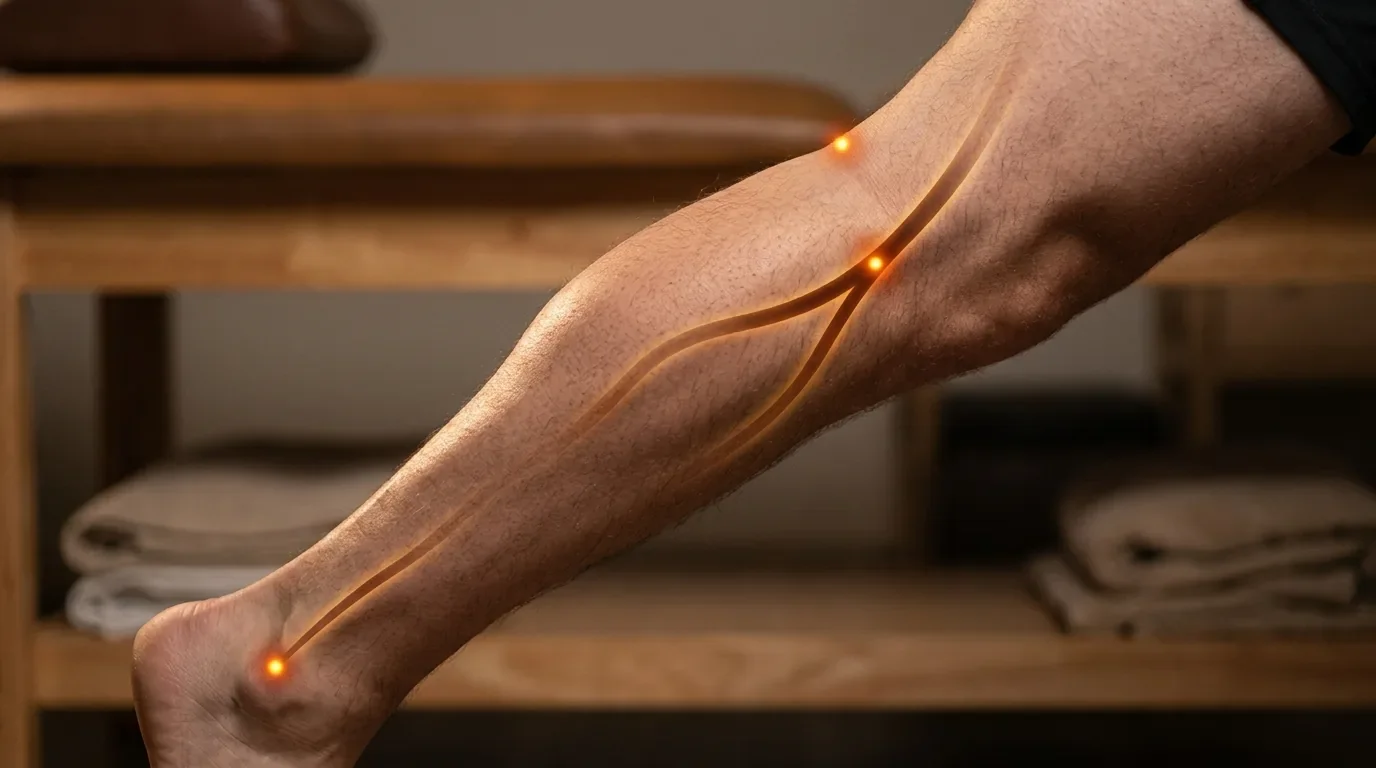
- ST38 (Tiaokou), on the anterior lower leg midpoint of the tibia, is one of the best-known distal points in acupuncture practice and is classically paired with contralateral shoulder mobilization as a treatment for frozen shoulder (adhesive capsulitis); its mechanism involves activation of supraspinal descending inhibition and may also influence the autonomic nervous system regulation of shoulder capsule inflammation.
- Subscapularis trigger points are the most commonly missed driver of shoulder pain and are accessible via acupuncture points in the axillary and posterior shoulder region, particularly at SI9 and SI10, making their inclusion in any shoulder protocol important for presentations with restricted internal rotation.
- GB21 at the upper trapezius is regularly included in shoulder pain treatment because upper trapezius trigger points alter scapular kinematics, reducing supraspinatus tendon clearance on overhead movement (Ludewig & Cook, 2000).
- For rotator cuff tendinopathy specifically, the combination of local needling at the supraspinatus tendon region (via LI15 area points) and infraspinatus points (SI10, TE14 area) with distal analgesic points produces both a local anti-inflammatory environment and systemic pain modulation.
Has your shoulder pain been limiting your reach, your sleep, or your training?
Shoulder pain responds well to acupuncture when treatment is directed at the specific muscles limiting joint mechanics rather than just the area of pain. Our practitioners evaluate which rotator cuff muscles and scapular stabilizers are involved in your presentation and select points accordingly.
Schedule NowHow Acupuncture Targets the Shoulder: Local and Distal Strategies
The shoulder joint is the most mobile joint in the body, and the trade-off for that mobility is a dependence on muscular coordination that fails when any of the rotator cuff muscles becomes overloaded, injured, or inhibited. Acupuncture for shoulder pain addresses this muscular coordination problem from two angles simultaneously.
Local points at the shoulder provide segmental spinal cord modulation at the C5–C6 levels, which supply the deltoid, supraspinatus, infraspinatus, and teres minor. Needling in these muscles or at the joint capsule reduces the afferent barrage arriving at the dorsal horn from sensitized shoulder tissue and lowers the protective muscle guarding that compounds range of motion limitation. The local anti-inflammatory effects of needling, mediated through the release of neuropeptides and the promotion of local circulation, are also relevant for tendinopathy and bursal presentations.
Distal points on the leg and hand work through supraspinal mechanisms, activating the periaqueductal gray and descending pain inhibitory systems that reduce pain sensitivity across the entire C5–C6 segmental territory simultaneously. This is particularly valuable for frozen shoulder, where the pain is severe enough that local needling alone may be poorly tolerated, and distal needling while the patient gently moves the shoulder can produce substantial immediate improvement in range of motion without the inflammatory provocation of needling directly into the inflamed capsule.
Related Dry Needling for Shoulder Pain: Rotator Cuff, Impingement, and TendinopathyKey Acupuncture Points for Shoulder Pain
| Point | Anatomical Location | Primary Target | Indication |
|---|---|---|---|
| LI15 (Jianyu) | Anterior shoulder, in the depression between the clavicular and acromial heads of deltoid when the arm is abducted | Deltoid; subacromial space; axillary nerve territory | Subacromial impingement, rotator cuff tendinopathy, restricted abduction; most commonly selected local shoulder point |
| TE14 (Jianliao) | Posterior-lateral shoulder, in the depression inferior and posterior to the acromion | Posterior deltoid; Infraspinatus via posterior capsule; teres minor region | Posterior shoulder pain, restricted external rotation, internal impingement patterns |
| SI9 (Jianzhen) | 1 cun above the posterior end of the axillary fold, over the teres major and inferior border of the posterior deltoid | Teres Major; posterior axillary region; Subscapularis accessible from posterior | Shoulder pain with restricted internal rotation; posterior axillary aching; important for adhesive capsulitis |
| SI10 (Naoshu) | Directly above SI9, in the depression below the spine of the scapula | Infraspinatus and teres minor at their scapular origins | Posterior shoulder pain, restricted overhead reach, rotator cuff soreness after repetitive use |
| ST38 (Tiaokou) | On the anterior lower leg, midpoint between ST35 (knee) and ST41 (ankle), lateral to the tibia | Tibialis anterior; deep peroneal nerve | Frozen shoulder (adhesive capsulitis); used contralaterally with shoulder mobilization; distal analgesic for shoulder via supraspinal pathways |
| GB21 (Jianjing) | Midpoint of the superior trapezius, between C7 and the acromion | Upper Trapezius belly; trigger point location; accessory nerve territory | Shoulder girdle tension, scapular kinematics correction, upper trapezius trigger point release |
| LI11 (Quchi) | At the lateral end of the elbow crease when the elbow is flexed, over the extensor carpi radialis longus origin | Brachioradialis origin; lateral elbow; radial nerve | Distal anti-inflammatory and analgesic point; used for shoulder pain in combination with local points; also useful when shoulder pain extends into the elbow |
The Subscapularis Problem: Why SI9 Matters
The subscapularis, the anterior rotator cuff muscle that lines the front surface of the scapula, is the most commonly missed muscle in shoulder pain assessment and one of the most important to treat. Its trigger points refer pain into the posterior shoulder and down the arm, and the muscle's deep, anterior location makes it inaccessible to most self-treatment and difficult to needle safely through anterior approaches. Acupuncture at SI9 and nearby posterior shoulder points allows access to the subscapularis from the posterior axillary region, where the muscle wraps around the inferior angle of the scapula and becomes palpable from behind.
Restricted internal rotation is the clearest clinical sign of subscapularis involvement, and patients who cannot comfortably reach behind their back, fasten a bra strap, or tuck in a shirt on the affected side typically have significant subscapularis trigger point activity. Including SI9 in the shoulder point selection for these patients, combined with direct dry needling of accessible subscapularis trigger points through the axilla, addresses the primary driver of the restriction rather than the secondary pain pattern in the posterior shoulder that the subscapularis refers.
Related Subscapularis Trigger Points: Internal Rotation Restriction and Shoulder Pain Related Infraspinatus Trigger Points: Posterior Shoulder and Deep Arm AchingIs frozen shoulder or persistent rotator cuff pain keeping you from daily activities?
Adhesive capsulitis and chronic rotator cuff tendinopathy both respond to acupuncture treatment that addresses the local joint and muscle environment alongside systemic pain modulation. The ST38 protocol for frozen shoulder is one of our most frequently used approaches, often producing meaningful range-of-motion improvement within the first few sessions. Our practitioners at Morningside are experienced in evaluating which muscles and joint structures are most involved in your presentation.
Schedule NowIntegrating Acupuncture Points with Rotator Cuff Trigger Point Work
At Morningside, the acupuncture point selection for shoulder pain works alongside trigger point dry needling of the rotator cuff muscles rather than replacing it. The local shoulder points, LI15, TE14, SI9, and SI10, access the deltoid, infraspinatus, teres minor, and subscapularis through their classical locations, while dry needling can precisely target the active trigger point bands within the supraspinatus, infraspinatus, and subscapularis that are generating the specific pain referral patterns each patient describes. The local points provide segmental modulation of C5–C6; the trigger point work addresses the myofascial drivers of restricted mechanics; the distal points at ST38, LI11, or GB34 provide supraspinal pain modulation. The three layers together produce more complete and durable results than any single approach alone.
Ready to restore your shoulder's range of motion and reduce pain?
At Morningside Acupuncture, we are the highest-rated acupuncture and dry needling clinic in New York City with over 500 five-star Google reviews. We treat shoulder pain from impingement, tendinopathy, frozen shoulder, and rotator cuff injury using a combination of local acupuncture points, the ST38 frozen shoulder protocol where applicable, and trigger point dry needling of the muscles most involved. We are glad to evaluate your shoulder and develop a targeted treatment plan.
Schedule NowFrequently Asked Questions
What is ST38 and why is it used for frozen shoulder?
ST38 (Tiaokou) is an acupuncture point on the anterior lower leg, roughly halfway between the knee and ankle. It is used for frozen shoulder by needling it on the opposite side from the affected shoulder while the patient gently moves the arm through its available range. The mechanism involves supraspinal descending inhibition that reduces pain sensitivity in the shoulder's C5–C6 territory, allowing movement that would otherwise provoke pain. Many patients experience an immediate increase in pain-free range of motion during the procedure.
How many sessions does acupuncture for shoulder pain typically take?
Rotator cuff tendinopathy and impingement often show meaningful improvement within four to six sessions. Frozen shoulder, which involves structural thickening of the joint capsule alongside severe muscle guarding, typically requires a longer course of eight to twelve sessions, with range of motion improving gradually as treatment reduces the protective muscle tension around the joint. Your practitioner will assess your progress after the initial sessions and adjust the approach as needed.
Can acupuncture help if I've already had shoulder surgery?
Yes. Post-surgical shoulder pain, residual scar tissue limitation, and chronic muscle tension after rotator cuff repair or labral surgery are all conditions we commonly treat. Acupuncture can help reduce post-surgical pain sensitivity, address the secondary muscle compensations that develop during immobilization, and support the reactivation of inhibited muscles during rehabilitation. Treatment timing and approach should be coordinated with your surgical team.
Is acupuncture painful at the shoulder points?
Local shoulder points such as LI15 and TE14 often produce a strong de qi sensation, a spreading ache or pressure, when needled into the deltoid and joint capsule region. This sensation is expected and indicates effective stimulation. Points directly over active trigger points in the infraspinatus or subscapularis may produce a referred ache into the arm when the needle contacts the taut band, which resolves rapidly as the trigger point releases. Distal points like ST38 are generally painless to needle.
Does Morningside treat rotator cuff tears with acupuncture?
Acupuncture is not a treatment for the structural tissue tear itself, which may require surgical evaluation if the tear is complete and causing significant weakness. However, acupuncture can meaningfully reduce the pain, protective muscle guarding, and secondary trigger point patterns that accompany partial tears and tendinopathy, improving function and quality of life while other interventions are being considered or during conservative management. We work with patients who have imaging-confirmed partial tears and those with tendinopathy without structural damage.
References
- Vickers, A. J., Vertosick, E. A., Lewith, G., MacPherson, H., Foster, N. E., Sherman, K. J., ... & Acupuncture Trialists' Collaboration. (2018). Acupuncture for chronic pain: Update of an individual patient data meta-analysis. The Journal of Pain, 19(5), 455–474. https://doi.org/10.1016/j.jpain.2017.11.005
- Ludewig, P. M., & Cook, T. M. (2000). Alterations in shoulder kinematics and associated muscle activity in people with symptoms of shoulder impingement. Physical Therapy, 80(3), 276–291. https://doi.org/10.1093/ptj/80.3.276
- Zhao, Z. Q. (2008). Neural mechanism underlying acupuncture analgesia. Progress in Neurobiology, 85(4), 355–375. https://doi.org/10.1016/j.pneurobio.2008.05.004
- Simons, D. G., Travell, J. G., & Simons, L. S. (1999). Travell & Simons' Myofascial Pain and Dysfunction: The Trigger Point Manual (2nd ed.). Williams & Wilkins.
- Yarnitsky, D. (2010). Conditioned pain modulation (the diffuse noxious inhibitory control-like effect): Its relevance for acute and chronic pain states. Current Opinion in Anaesthesiology, 23(5), 611–615. https://doi.org/10.1097/ACO.0b013e32833c348b
Disclaimer: This web site is intended for educational and informational purposes only. Reading this website does not constitute providing medical advice or any professional services. This information should not be used for diagnosing or treating any health issue or disease. Those seeking medical advice should consult with a licensed physician. Seek the advice of a medical doctor or other qualified health professional for any medical condition. If you think you have a medical emergency, call 911 or go to the emergency room. No acupuncturist-patient relationship is created by reading this website or using the information. Morningside Acupuncture PLLC and its employees and contributors do not make any express or implied representations with respect to the information on this site or its use. For any legal interpretation of scope of practice in your state, consult a licensed attorney or regulatory authority.
Read more from our blog