GB40 Acupuncture Point (Qiuxu)
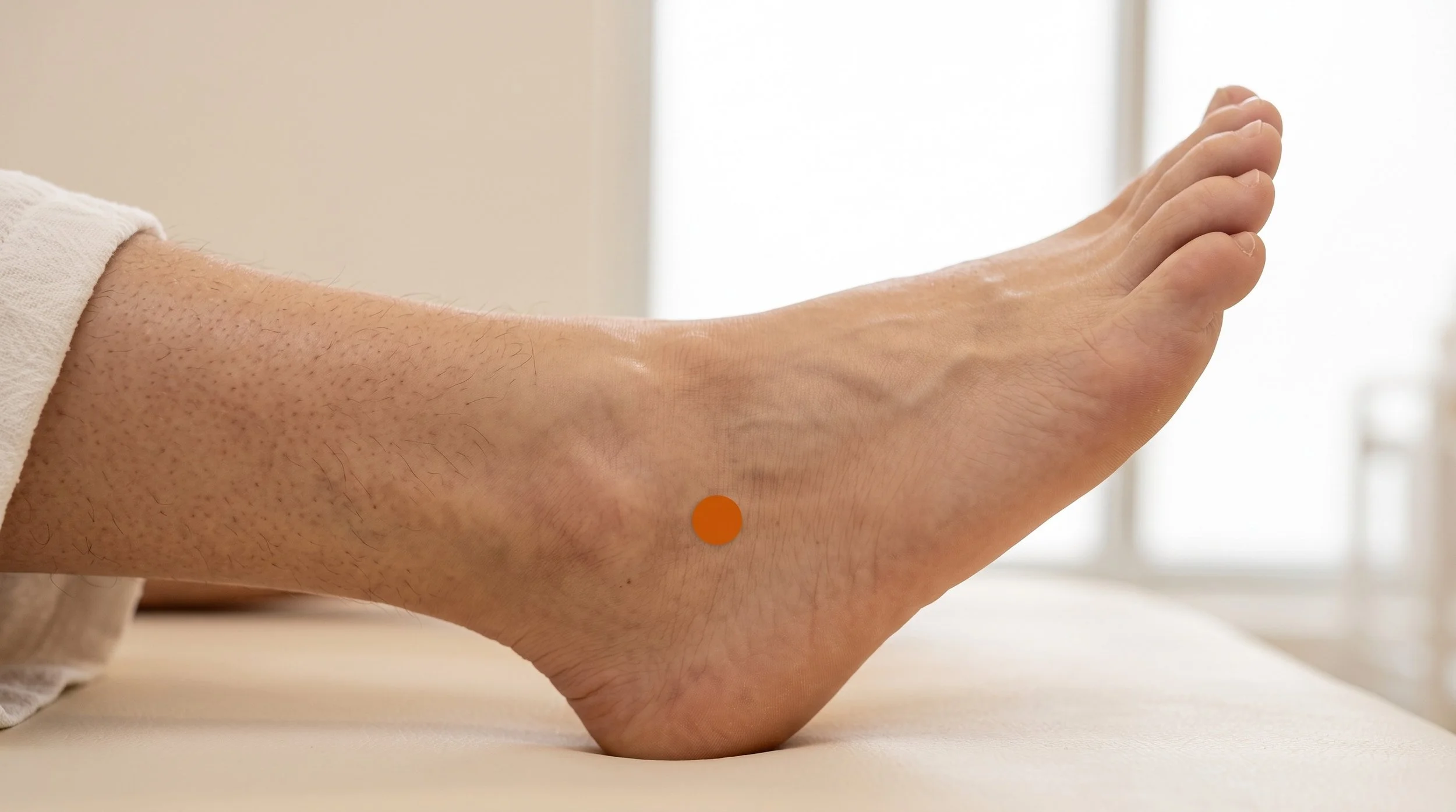
GB40 Acupuncture Point
The Mound of Ruins at the Lateral Ankle: Anatomy, Mechanism, and Why This Yuan-Source Point Anchors Ankle Sprain, Lateral Leg, and Neck Pain Treatment
GB40 (Qiuxu), translated as Mound of Ruins, is the yuan-source point of the Gallbladder channel and sits in the soft hollow you can feel just in front of and below the bony bump on the outside of your ankle. Anatomically it lands over the neck of the talus and the anterolateral capsule of the ankle joint, immediately lateral to the tendons of extensor digitorum longus, which makes it one of the few points that gives direct access to the tissue most people injure when they roll an ankle.
Classical texts list it for swelling and painful obstruction of the ankle, weakness and wasting of the leg, hip pain, neck and lateral rib complaints, and even wrist pain on the opposite side (Deadman et al., 2001). In a modern clinic, the gb40 acupuncture point is used mainly as a local and regional tool for lateral ankle sprain, chronic ankle instability, peroneal tendon irritation, and lateral leg pain, and as a distal point when the presenting problem sits along the lateral line of the body.
- Location and layers: the qiuxu point sits at the crossing of two lines drawn along the front and lower borders of the lateral malleolus, in a depression bounded by the extensor digitorum longus and peroneus tertius tendons, with the anterior talofibular ligament and ankle joint capsule immediately deep (Deadman et al., 2001).
- Traditional categories translated: the Gallbladder channel texts classify GB40 as the yuan-source point of the channel and describe it as spreading Liver qi, clearing Gallbladder heat, and regulating shaoyang (Deadman et al., 2001). In neurophysiological terms, we read those attributions as a low-threshold somatic input at the L5 to S1 segments that influences local nociception, muscle tone, and autonomic tone rather than as literal energy movement.
- Mechanism: needling here recruits A-delta and C fibers in the joint capsule, retinaculum, and periosteum, which drives segmental inhibition in the dorsal horn and engages descending pain control pathways involving endogenous opioids, serotonin, and noradrenaline (Zhao, 2008).
- Research picture: the Cochrane review of acupuncture for acute ankle sprain found the trial pool too heterogeneous and too poorly reported to support firm conclusions (Kim et al., 2014), while later meta-analyses reported signals favoring acupuncture added to standard care but with the same quality limits (Park et al., 2013; Liu et al., 2020). For persistent musculoskeletal pain more broadly, individual patient data pooling supports modest, durable effects over sham and no-acupuncture controls (Vickers et al., 2018).
- Clinical framing: we rarely use gallbladder 40 in isolation. It is typically combined with proximal channel points, with dry needling of the peroneals and anterior compartment, and with graded loading and balance work, since needling the fibularis muscles has been shown to improve self-reported function when added to proprioceptive exercise (Salom-Moreno et al., 2015).
- De qi: most patients report a dull, heavy ache that fills the front of the ankle joint and sometimes spreads up the outside of the leg toward the fibula. A brief tingle can occur if a superficial peroneal nerve branch is brushed, and the needle is redirected if that happens.
Still Guarding That Ankle Months After the Sprain?
Ankles that keep rolling, ache on uneven ground, or feel stiff at the front of the joint usually have a mix of scarred capsule, guarded peroneals, and altered balance reflexes. At Morningside Acupuncture we needle GB40 directly into that anterolateral hollow, add dry needling of peroneus longus, peroneus brevis, and the extensor group, and pair the session with loading and balance retraining you can do at home. Most patients notice a change in how confidently they push off within a few visits. Schedule an ankle-focused visit and let us assess the joint properly.
Schedule NowAnatomy of GB40: Why the Hollow in Front of the Lateral Malleolus Is Such an Important Location
The gb 40 location is a genuine anatomical depression rather than a soft tissue landmark. Under the skin and thin subcutaneous layer sits the inferior extensor retinaculum, with the tendons of extensor digitorum longus and peroneus tertius passing just medial to the point. Deep to that lies the sinus tarsi region, the neck of the talus, and the anterolateral capsule of the ankle joint, which is reinforced by the anterior talofibular ligament.
This is precisely the tissue that gets overstretched during an inversion sprain, and it is where chronic post-sprain thickening, capsular scarring, and a nagging pinch on dorsiflexion tend to settle (Deadman et al., 2001).
The point sits in cutaneous territory supplied by branches of the superficial peroneal nerve, with the sural nerve distribution just posterior and the deep peroneal nerve just medial, and its segmental input traces back to roughly L5 and S1. Because joint capsule, ligament, retinaculum, and skin from the same segments all converge on shared dorsal horn neurons, a needle stimulus at this location can modulate how the whole ankle region is processed, not just the spot under the needle.
That segmental convergence, layered with descending inhibition from the brainstem and with local vasodilation around the needle, is the plausible mechanism behind reduced pain and easier joint motion after treatment (Zhao, 2008). It also explains why patients often report a change in stiffness across the entire front of the ankle rather than a pinpoint effect.
The main structures to respect are the ankle joint capsule itself and the small vascular branches of the lateral malleolar network. Standard needling is perpendicular, 1 to 1.5 cun, and classical instruction is to angle the needle across the ankle toward KI6 on the inner side, effectively threading between the tarsal bones (Deadman et al., 2001). We modify depth in acute, swollen ankles, use shallower insertion when the joint is hot and reactive, and avoid needling over broken skin or any joint where infection or fracture has not been ruled out.
Related Peroneus Tertius Trigger Points Related Extensor Digitorum Longus Trigger PointsGB40 at a Glance: Classification, Location, and Clinical Use
| Category | Detail |
|---|---|
| Traditional Name | Qiuxu (Mound of Ruins), Gallbladder 40 |
| Channel Classification | Foot shaoyang Gallbladder channel, lower limb, ankle level |
| Point Categories | Yuan-source point of the Gallbladder channel; used in classical practice as the source point paired with the Liver channel in yuan-luo combinations |
| Precise Location | On the anterolateral ankle, in the depression anterior and inferior to the lateral malleolus, lateral to the tendon of extensor digitorum longus. Locate at the junction of a line along the front border of the lateral malleolus and a line along its lower border. |
| Tissue Stimulated | Skin and inferior extensor retinaculum, anterolateral ankle joint capsule and anterior talofibular ligament, talar neck periosteum, with the tendons of extensor digitorum longus and peroneus tertius immediately adjacent |
| Needle Depth / Direction | Perpendicular insertion 1 to 1.5 cun, classically directed transversely toward KI6 on the medial ankle; shallower insertion in acutely swollen or reactive joints |
| De Qi Sensation | Deep, heavy ache filling the front of the ankle joint, sometimes spreading up the lateral leg or into the top of the foot; a brief electric tingle indicates a superficial peroneal branch and calls for redirection |
| Primary Clinical Uses | Lateral ankle sprain and post-sprain instability, anterolateral ankle pain and stiffness, peroneal and extensor tendon irritation, lateral leg and hip pain, lower limb weakness or drop foot patterns, neck and lateral rib area discomfort as a distal point |
| Common Point Combinations |
|
In the Deadman, Al-Khafaji and Baker text, GB40 is presented as the yuan-source point where accumulated heat and stagnation along the Gallbladder channel can be addressed at a single place, with traditional actions given as spreading Liver qi, clearing heat and damp-heat from the Gallbladder, activating the channel to relieve pain and benefit the joints, and regulating shaoyang.
The classical indication lists cluster into a few recognizable groups: complaints of the head and sense organs such as one-sided headache, red or painful eyes and throat obstruction; complaints along the side of the trunk such as rib and chest distention with sighing, axillary swelling and lower abdominal hardness; digestive upset attributed to Gallbladder heat pressing on the Stomach, including vomiting and acid reflux; and a large block of lower limb problems covering hip pain, sciatica, leg cramping, wasting and painful obstruction, drop foot, and swelling or weakness of the ankle.
The commentary also records the cross-needling convention in which the ankle corresponds to the wrist, so several classical texts recommend this point for wrist pain on the opposite side, and it notes the long use of GB40 in intermittent fever patterns because shaoyang was understood as the hinge between exterior and interior (Deadman et al., 2001).
What is striking is how consistently the tradition treated one small hollow at the ankle as a lever for the entire lateral line of the body, an intuition that maps surprisingly well onto modern thinking about regional and segmental effects.
Why GB40 Is Used for Neck Pain and Opposite-Side Wrist Pain, Not Just Ankles
The obvious use of the qiuxu point is local: it sits on the injured tissue in a lateral ankle sprain, so needling there addresses the capsule, ligament, and retinaculum that are actually generating pain. The less obvious use is distal. Classical practice assigned neck pain, lateral rib discomfort, and contralateral wrist pain to this point, and modern pain science offers a workable explanation.
Needling produces a strong, well-localized afferent barrage that does not stay confined to one segment; it reaches brainstem structures that regulate pain across the body, so a distal stimulus can dampen sensitivity in a region far from the needle (Zhao, 2008). That is the same logic behind needling the hand for a headache or the leg for the low back.
There is a second, more practical reason for using GB40 in neck and shoulder-girdle presentations. Needling a distal point lets us reduce guarding and improve range of motion while the patient actively moves the painful area, without putting needles into tissue that is already inflamed and defensive. We often ask patients to rotate the neck or reach overhead while the ankle point is retained, then reassess.
This does not replace local treatment, and the Cochrane review of acupuncture for neck disorders found that benefits, while present in several comparisons, came from small and variable trials (Trinh et al., 2016). We present it as a useful adjunct rather than a stand-alone answer.
For the ankle itself, the interesting mechanism is neuromuscular rather than purely analgesic. Chronic ankle instability involves delayed peroneal reaction time and altered postural control, and needling the fibularis muscles has been shown to change muscle pre-activation and center of pressure behavior in athletes with instability (López-González et al., 2021). Combining a joint-level point such as GB40 with needling of those stabilizers, then loading the ankle immediately afterward, is how we try to convert a short-term sensory change into a lasting motor one.
What the Research Shows for GB40
Almost no clinical trial isolates a single acupuncture point, so there is no body of research testing GB40 by itself. What exists are reviews of multi-point protocols for ankle sprain and neck pain in which this point commonly appears, plus needling trials targeting the peroneal muscles that sit right beside it. The honest summary is that the ankle sprain literature is large but methodologically weak, the neck pain literature is moderate quality with modest short-term effects, and the strongest evidence for needling in general comes from chronic musculoskeletal pain pooling. Read the table below as context for a reasonable clinical choice, not as proof that one point does the work.
| Study | Type | Focus | Key Finding |
|---|---|---|---|
| Kim et al., 2014 | Cochrane systematic review | Acupuncture for acute ankle sprain in adults | The included trials were highly heterogeneous and poorly reported, so the reviewers could not draw firm conclusions about benefit or harm. |
| Park et al., 2013 | Systematic review and meta-analysis | Acupuncture for ankle sprain across 17 trials | More participants reported global symptom improvement with acupuncture, but trial quality was generally poor and the authors judged the evidence insufficient to recommend it as established care. |
| Liu et al., 2020 | Systematic review and meta-analysis | Acupuncture, alone or with standard care, for acute ankle sprain | Pooled results favored acupuncture combined with rest, ice, compression and elevation over standard care alone, with the same caveats about study quality. |
| Trinh et al., 2016 | Cochrane systematic review | Acupuncture for acute, subacute and chronic neck pain | Acupuncture showed short-term pain relief compared with sham or inactive controls in several comparisons, though the evidence was low to moderate quality. |
| Salom-Moreno et al., 2015 | Randomized clinical trial | Trigger point dry needling of the lateral peroneus added to proprioceptive and strengthening exercise in chronic ankle instability | The group receiving needling plus exercise reported greater improvement in function and pain at one month than exercise alone. |
| López-González et al., 2021 | Single-blinded randomized controlled trial | Dry needling of peroneus longus and tibialis anterior in basketball players with chronic ankle instability | Needling was associated with changes in muscle pre-activation and postural control measures compared with placebo needling, suggesting a neuromuscular as well as analgesic effect. |
| Vickers et al., 2018 | Individual patient data meta-analysis | Acupuncture for chronic musculoskeletal, headache and osteoarthritis pain | Acupuncture outperformed sham and no-acupuncture controls with effects that persisted over about a year, supporting more than a short-lived placebo response. |
Lateral Leg, Hip, and Neck Pain That Follow the Same Line?
Pain that runs along the outside of the leg, the side of the hip, or the side of the neck often responds better when treatment addresses the whole lateral chain instead of one sore spot. GB40 is our distal anchor for that pattern, frequently combined with GB34 at the knee and with local needling wherever the tissue is actually irritable. We explain what we find and why each needle is placed. Book a consultation and we will map the pattern with you.
Schedule NowGB40 in the Context of Trigger Point Work
GB40 is not a muscle belly point, so it is not itself a classic trigger point target. It is a joint and retinaculum point that we use alongside myofascial needling. The muscles that most often need attention in the same visit are peroneus longus and brevis, whose taut bands refer pain along the outer lower leg and around the lateral malleolus, and the anterior compartment group including tibialis anterior, extensor digitorum longus, and extensor hallucis longus, which refer into the ankle and forefoot (Simons et al., 1999).
When a patient points to the front of the lateral ankle, our job is to sort out how much of the pain is capsular, how much is tendon, and how much is referred from those bellies higher up.
A typical Morningside session for a stubborn ankle uses GB40 at the joint line, dry needling of the peroneals for reaction time and tone, needling of the extensor group if dorsiflexion loading reproduces symptoms, and often GB34 near the fibular head where the peroneal nerve and the proximal peroneal tissue meet. This mirrors what the trial literature has tested most directly: needling the fibularis muscles as an add-on to proprioceptive and strengthening work improved reported function more than exercise alone (Salom-Moreno et al., 2015).
Because acupuncture is defined by the use of an acupuncture needle across hundreds of styles, including dry needling, we treat these as one toolkit rather than two competing methods, and we always finish with active loading so the nervous system has a reason to keep the change.
GB40 Ankle Pain Treatment at NYC's Highest-Rated Acupuncture Clinic
Morningside Acupuncture is the highest-rated acupuncture and dry needling clinic in New York City with over 500 five-star Google reviews, and ankle and foot complaints are among the conditions we see most. Treatment is hands-on and specific: joint-level needling at GB40, trigger point work in the leg muscles that control the ankle, and clear guidance on returning to running, lifting, or dance. You will leave each session knowing what changed and what to do next. Schedule your visit in Midtown Manhattan today.
Schedule NowFrequently Asked Questions
What does GB40 feel like when needled?
Most people feel a firm pressure as the needle passes the retinaculum, then a deep, heavy, slightly achy fullness inside the front of the ankle joint. That sensation often spreads a short distance up the outside of the leg or forward into the top of the foot. If the needle is angled across toward the inner ankle, the ache can feel like it travels through the joint, which is expected. A brief zing or tingle means a small skin nerve branch has been contacted, and your practitioner will withdraw slightly and redirect.
Why would my practitioner needle my ankle for neck or rib pain?
Two reasons. Classically, GB40 is the source point of the Gallbladder channel, which runs the length of the lateral body from the head and neck through the ribs and hip to the ankle, and older texts list it for neck pain, rib and chest distention, and even opposite-side wrist pain (Deadman et al., 2001). Physiologically, a strong needle stimulus at a distal site engages brainstem-mediated descending pain control that is not limited to the segment being needled (Zhao, 2008). Practically, it also lets us reduce guarding while you actively move the painful region, which is hard to do when needles are sitting in the sore tissue itself.
Can I press GB40 myself between sessions?
Yes, and it is easy to find. Sit with the ankle relaxed, run a finger down the front edge of the outer ankle bone until it drops into the soft hollow just in front of and below it, then slide slightly toward the outside of the extensor tendons you can feel when you lift your toes. Press inward and slightly toward the inner ankle with your thumb using steady, moderate pressure, hold for 30 to 60 seconds, release, and repeat two or three times. Small circular pressure for one to two minutes works equally well. Do this once or twice a day, keep it firm but tolerable, and pair it with gentle ankle circles and calf stretching. Stop if pressure sharply increases pain, if the ankle is acutely swollen and hot, or if you have not had a recent injury properly assessed.
Is GB40 safe to needle?
In trained hands it is a low-risk point. The main considerations are that the needle sits close to the ankle joint capsule, so clean technique matters, and that small branches of the superficial peroneal nerve run nearby and can produce a brief tingle if contacted. Practitioners use shallower, gentler insertion in an acutely swollen or hot joint and avoid needling over broken skin, active infection, or an ankle where a fracture has not been ruled out. Bruising is the most common minor side effect because of the small vessels around the malleolus. Tell your practitioner if you take anticoagulants or have a history of joint infection or recent ankle surgery.
Where exactly is GB40 located?
On the anterolateral aspect of the ankle, in the depression anterior and inferior to the lateral malleolus, just lateral to the tendons of extensor digitorum longus. The classic way to confirm the gb 40 location is to draw one imaginary line down the front border of the outer ankle bone and another along its lower border; the point sits where those two lines meet, in the palpable hollow over the neck of the talus. Lifting the toes makes the extensor tendons stand out, which gives you a reliable medial boundary for the point.
References
- Deadman, P., Al-Khafaji, M., & Baker, K. (2009). A manual of acupuncture. Journal of Chinese Medicine Publications.
- Simons, D. G., Travell, J. G., & Simons, L. S. (1999). Travell & Simons' myofascial pain and dysfunction: The trigger point manual, Vol. 1: Upper half of body (2nd ed.). Williams & Wilkins.
- Kim, T. H., Lee, M. S., Kim, K. H., Kang, J. W., Choi, T. Y., & Ernst, E. (2014). Acupuncture for treating acute ankle sprains in adults. Cochrane Database of Systematic Reviews, 2014(6), CD009065. https://doi.org/10.1002/14651858.CD009065.pub2
- Park, J., Hahn, S., Park, J. Y., Park, H. J., & Lee, H. (2013). Acupuncture for ankle sprain: Systematic review and meta-analysis. BMC Complementary and Alternative Medicine, 13, 55. https://doi.org/10.1186/1472-6882-13-55
- Liu, A. F., Gong, S. W., Chen, J. X., & Zhai, J. B. (2020). Efficacy and safety of acupuncture therapy for patients with acute ankle sprain: A systematic review and meta-analysis of randomized controlled trials. Evidence-Based Complementary and Alternative Medicine, 2020, 9109531. https://doi.org/10.1155/2020/9109531
- Trinh, K., Graham, N., Irnich, D., Cameron, I. D., & Forget, M. (2016). Acupuncture for neck disorders. Cochrane Database of Systematic Reviews, 2016(5), CD004870. https://doi.org/10.1002/14651858.CD004870.pub4 [VERIFY BEFORE PUBLISHING]
- Salom-Moreno, J., Ayuso-Casado, B., Tamaral-Costa, B., Sánchez-Milá, Z., Fernández-de-las-Peñas, C., & Alburquerque-Sendín, F. (2015). Trigger point dry needling and proprioceptive exercises for the management of chronic ankle instability: A randomized clinical trial. Evidence-Based Complementary and Alternative Medicine, 2015, 790209. https://doi.org/10.1155/2015/790209
- López-González, L., Falla, D., Lázaro-Navas, I., Lorenzo-Sánchez-Aguilera, C., Rodríguez-Costa, I., Pecos-Martín, D., & Gallego-Izquierdo, T. (2021). Effects of dry needling on neuromuscular control of ankle stabilizer muscles and center of pressure displacement in basketball players with chronic ankle instability: A single-blinded randomized controlled trial. International Journal of Environmental Research and Public Health, 18(4), 2092. https://doi.org/10.3390/ijerph18042092
- Vickers, A. J., Vertosick, E. A., Lewith, G., MacPherson, H., Foster, N. E., Sherman, K. J., Irnich, D., Witt, C. M., & Linde, K. (2018). Acupuncture for chronic pain: Update of an individual patient data meta-analysis. Journal of Pain, 19(5), 455-474. https://doi.org/10.1016/j.jpain.2017.11.005
- Zhao, Z. Q. (2008). Neural mechanism underlying acupuncture analgesia. Progress in Neurobiology, 85(4), 355-375. https://doi.org/10.1016/j.pneurobio.2008.05.004
Disclaimer: This web site is intended for educational and informational purposes only. Reading this website does not constitute providing medical advice or any professional services. This information should not be used for diagnosing or treating any health issue or disease. Those seeking medical advice should consult with a licensed physician. Seek the advice of a medical doctor or other qualified health professional for any medical condition. If you think you have a medical emergency, call 911 or go to the emergency room. No acupuncturist-patient relationship is created by reading this website or using the information. Morningside Acupuncture PLLC and its employees and contributors do not make any express or implied representations with respect to the information on this site or its use. For any legal interpretation of scope of practice in your state, consult a licensed attorney or regulatory authority.
Read more from our blog