Dry Needling for Tension Headaches
How Dry Needling Targets the Neck and Shoulder Muscles That Generate Tension-Type Headache Pain
Tension-type headaches are the most common headache disorder worldwide, and the majority have an active muscular component. Trigger points in the suboccipitals, upper trapezius, SCM, and temporalis generate the characteristic band-like head pain and can be directly treated with dry needling.
- Research has demonstrated that patients with tension-type headaches have significantly more active myofascial trigger points in the head and neck musculature than headache-free controls, with the suboccipitals, upper trapezius, and SCM most commonly involved (Fernández-de-las-Peñas et al., 2007).
- Trigger points in the suboccipitals and upper SCM refer pain that closely matches the classic tension headache pattern: a bilateral, band-like pressure or tightness around the head that may extend behind the eye (Bron & Dommerholt, 2012).
- Dry needling is more effective than sham interventions for reducing musculoskeletal pain, with clinically meaningful effects on pain intensity and function (Gattie et al., 2017).
- The mechanism involves deactivating the motor endplate dysfunction at the trigger point site, mechanically disrupting contracted sarcomere segments, and reducing the local concentration of pain-sensitizing substances including substance P and CGRP (Shah et al., 2015).
- Tension headaches differ from migraines in their muscular profile: tension headaches are driven primarily by trigger points in postural muscles of the neck and subocciput, while migraines involve more complex central sensitization mechanisms including trigeminal pathway activation (Fernández-de-las-Peñas et al., 2007).
- Dry needling of the suboccipitals, upper trapezius, and SCM can reduce headache frequency, intensity, and duration in patients with tension-type headaches that have a clear myofascial component (Gerwin, 2014).
Tension headaches that medication only masks?
Pain medication manages the headache but does not address the trigger points in your neck and shoulder muscles that are generating it. At Morningside Acupuncture, we treat the muscular source of tension headaches with dry needling and acupuncture, targeting the specific trigger points that are producing your head pain pattern.
Schedule NowThe Muscular Source of Tension Headaches
Tension-type headache (TTH) is the most prevalent headache disorder globally, yet its underlying mechanisms are incompletely understood and its treatment remains primarily pharmaceutical. What research has clarified in the past two decades is that active myofascial trigger points in the head and neck musculature are consistently present in patients with tension-type headaches and absent or far less prevalent in headache-free controls.
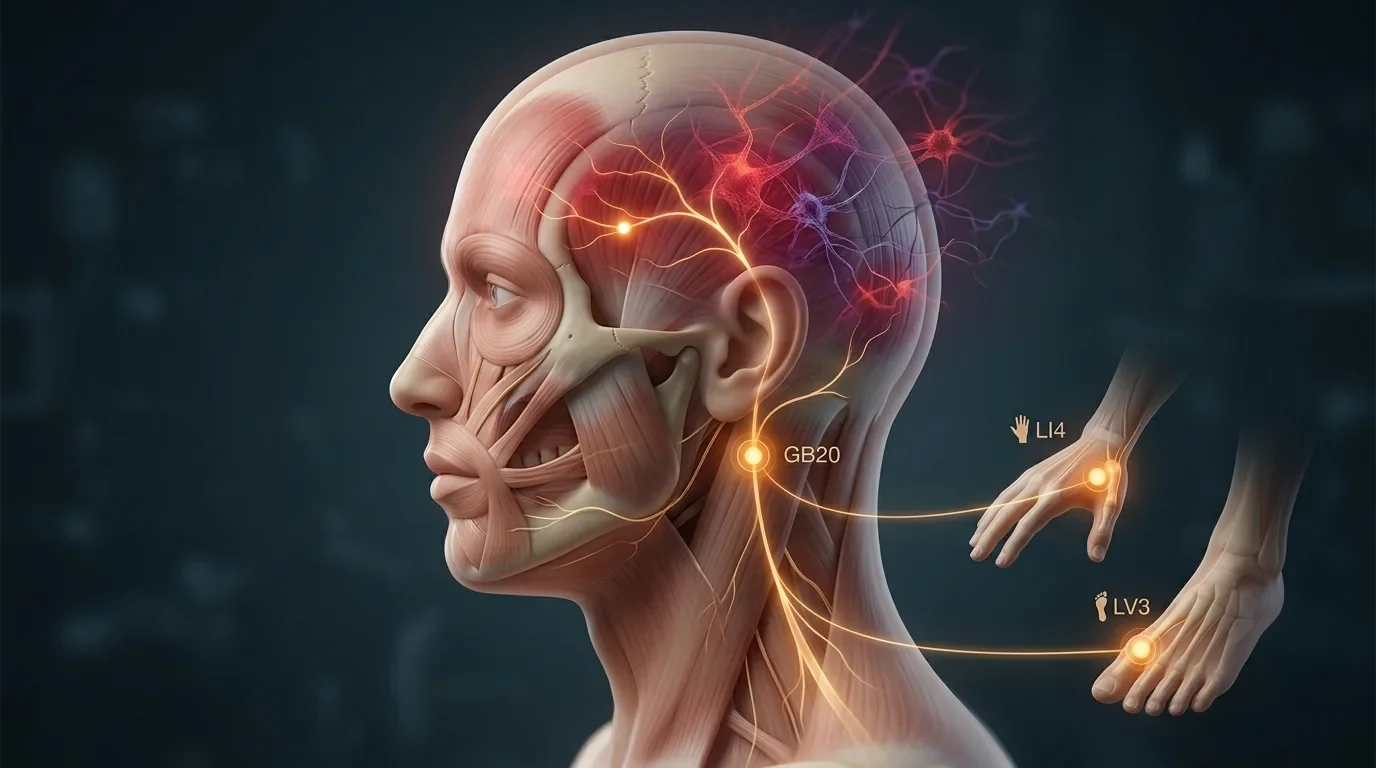
Fernández-de-las-Peñas et al. (2007) found that patients with episodic tension-type headaches had significantly more active trigger points in the suboccipitals, upper trapezius, SCM, and temporalis muscles than controls. Importantly, pressing on these trigger points reproduced the patients' headache pain, which is the clinical confirmation that the muscle is a generator rather than an incidental finding. This referred pain mechanism — in which sensitized nociceptors in neck muscles converge with trigeminal pain pathways in the brainstem — explains both why the headache is felt in the head and why treating the neck muscles reduces the head pain.
This is the foundation for using dry needling in tension headache treatment: if trigger points in the neck and shoulder musculature are generating the pain, deactivating those trigger points should reduce the headache. The clinical evidence supports this reasoning.
Pain Science Muscles That Cause Headaches — Which Muscles Refer Pain to the HeadKey Muscles Treated with Dry Needling for Tension Headaches
Suboccipital Muscles
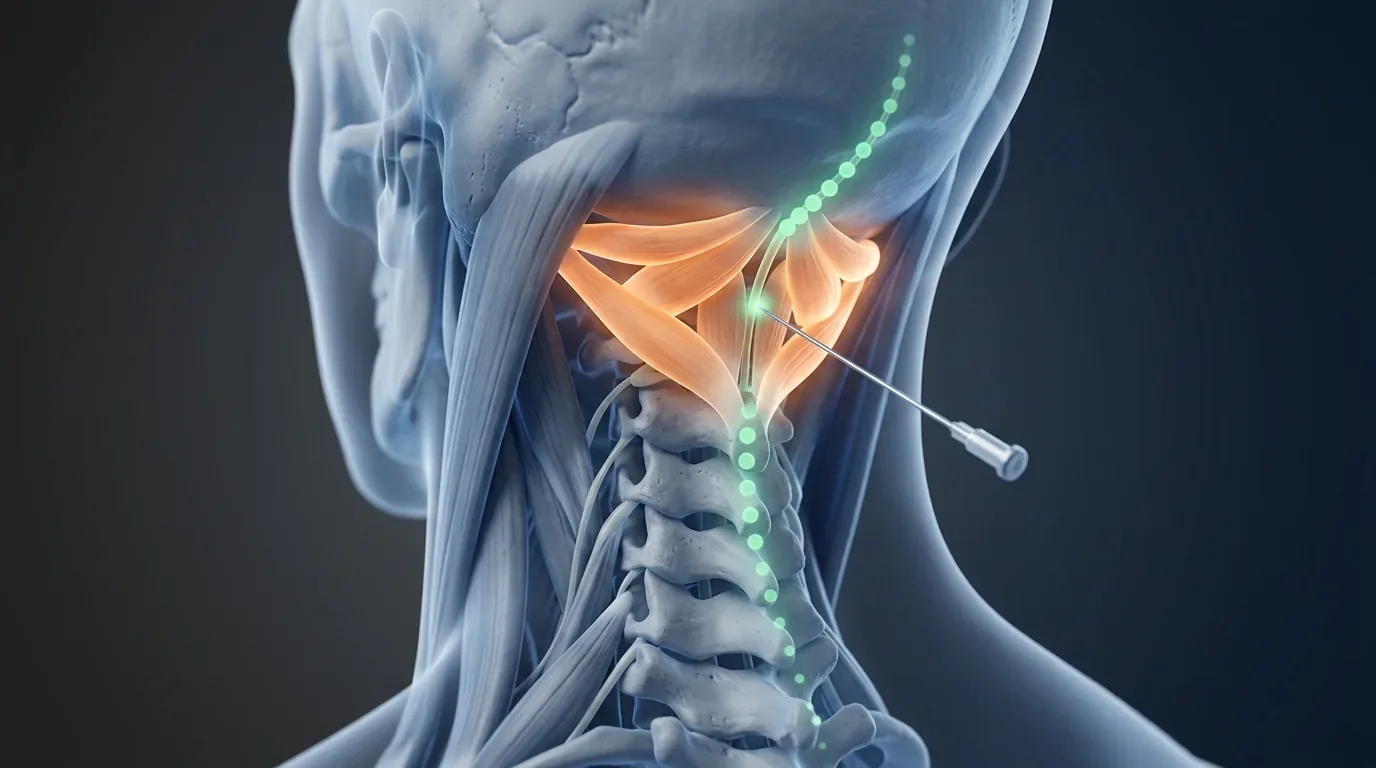
The four suboccipital muscles (rectus capitis posterior major and minor, obliquus capitis superior and inferior) form a deep muscular triangle at the base of the skull. They are the primary extensors and rotators of the atlantooccipital and atlantoaxial joints. Trigger points in the suboccipitals refer pain into the back of the head, spreading forward over the top and behind the eye in a pattern that precisely matches the distribution of tension-type headache. The suboccipitals are also anatomically adjacent to the greater occipital nerve, and hypertonia in these muscles can compress the nerve, adding a neurogenic component to the headache.
Because the suboccipitals are small, deep, and anatomically complex, they are rarely effectively treated by massage, which tends to compress the surrounding larger muscles rather than reaching the suboccipitals themselves. Dry needling with appropriate needle depth and angulation reaches the suboccipitals directly and is the most reliable way to deactivate trigger points within them.
Upper Trapezius
The upper trapezius is the most frequently involved muscle in tension-type headache and one of the most commonly needled muscles in clinical practice. Its trigger points refer pain up the lateral neck to the mastoid region and the temple. The temporal referral pattern is particularly common in patients who describe tension headaches as feeling like a band or a vice across the forehead and temples. Upper trapezius trigger points are perpetuated by forward head posture, sustained shoulder elevation (holding a phone between the ear and shoulder, carrying a bag on one shoulder), and psychological stress — all of which are ubiquitous in the typical office worker or urban professional.
Sternocleidomastoid
The SCM has two heads — sternal and clavicular — each with distinct referral patterns. The sternal head refers to the vertex and behind the eye, producing supraorbital pain and sometimes eye redness or tearing. The clavicular head refers across the forehead and behind the ear. Together, the SCM produces a complex, multifocal headache pattern that overlaps with both tension and cervicogenic headache presentations. SCM trigger points are activated by sustained head positions (looking at a screen, sleeping with the head twisted), whiplash injuries, and chronic upper chest breathing.
Temporalis
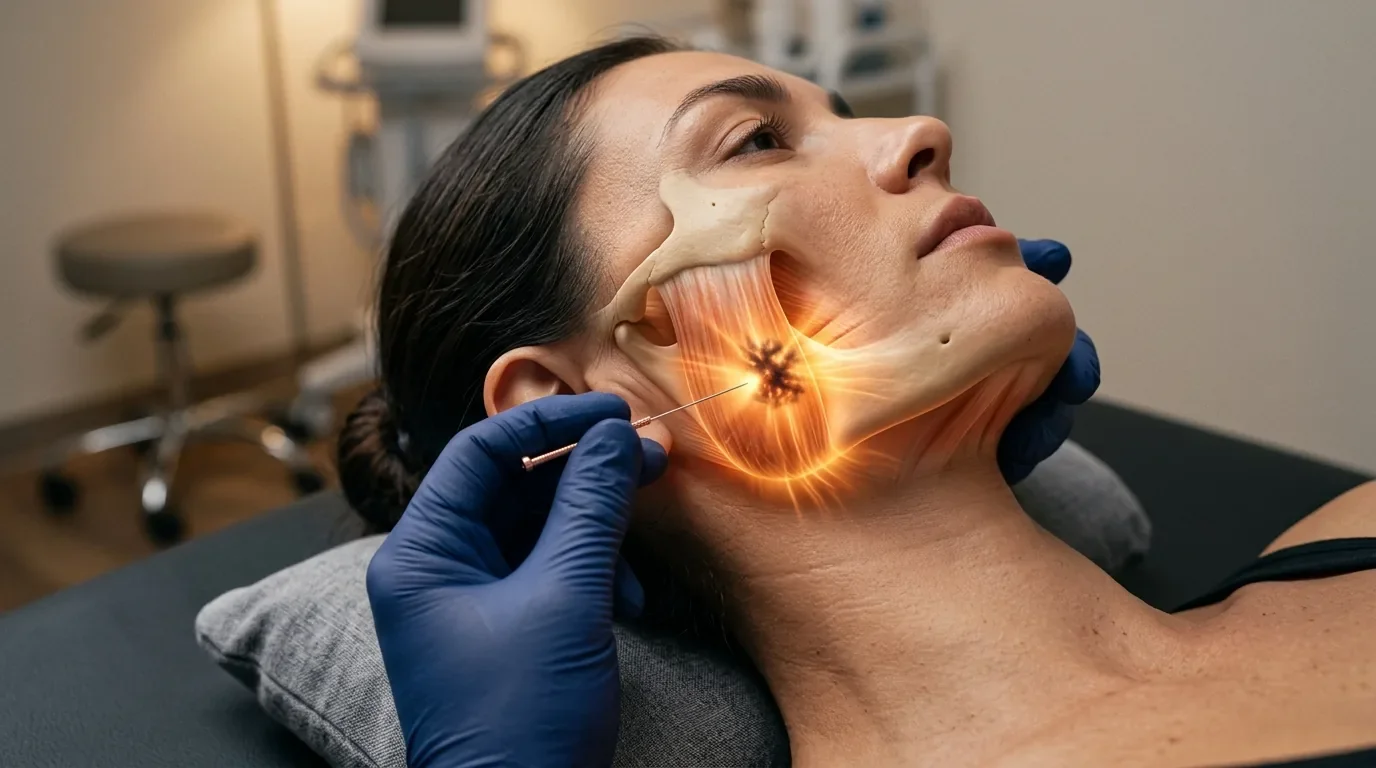
The temporalis is a large fan-shaped muscle that covers the temporal bone and is the primary jaw-closing muscle. Its trigger points refer pain across the temporal region and into the upper teeth. The temporal component is directly relevant to tension headache, as the sense of temporal tightness and pressure many patients describe corresponds to the temporalis referral zone. Temporalis trigger points are strongly associated with jaw clenching and bruxism, which makes them common in patients who carry stress in the jaw.
Splenius Capitis and Semispinalis Capitis
The splenius capitis refers pain to the top and back of the head, producing a "skullcap" pain pattern. The semispinalis capitis refers to the back of the head and occiput. Both muscles are significant contributors to posterior headache and neck pain and are commonly involved in cervicogenic headache, which has substantial overlap with tension-type headache in clinical presentation. Both respond well to dry needling given their moderate depth and consistent anatomical location.
Daily or frequent tension headaches affecting your productivity?
Frequent tension headaches in desk workers, screen users, and people carrying chronic stress are almost always accompanied by active trigger points in the neck and shoulder muscles. Dry needling these muscles directly — rather than only taking medication to mask the pain — can reduce headache frequency and intensity over a course of treatment. We see this pattern regularly at Morningside Acupuncture.
Schedule NowWhat the Evidence Shows
The evidence base for dry needling in tension-type headaches draws from both the trigger point literature and the broader musculoskeletal dry needling research. Gattie et al. (2017) systematically reviewed dry needling trials across musculoskeletal conditions and found it produced significantly greater pain reduction than sham, with medium effect sizes that were clinically meaningful. The head and neck region, including suboccipital and trapezius muscles, was among the areas showing consistent positive effects.
The mechanistic rationale is well supported. Shah et al. (2015) demonstrated that active trigger points in skeletal muscle accumulate substance P, CGRP, bradykinin, and pro-inflammatory cytokines at concentrations that are significantly higher than those in latent trigger points or normal muscle. CGRP in particular is a key neuropeptide in headache pathophysiology — it is elevated in migraine and has sensitizing effects on trigeminal nociceptors. When trigger points in the cervical musculature release CGRP into the local interstitial fluid, they may be contributing to the central sensitization that perpetuates recurring tension headaches. Dry needling reduces the local concentration of these substances, which is one mechanism by which it may reduce both headache intensity and frequency.
| Muscle | Headache Referral Zone | Common Triggers | DN Accessibility |
|---|---|---|---|
| Suboccipitals | Back of head, top of skull, behind the eye | Screen use, forward head posture, stress | Moderate depth; requires precise angulation |
| Upper Trapezius | Lateral neck to temple and mastoid | Sustained shoulder elevation, stress, poor posture | Superficial and accessible; high-yield target |
| Sternocleidomastoid | Vertex, behind eye, forehead, behind ear | Head-forward posture, whiplash, upper chest breathing | Superficial; requires care near carotid |
| Temporalis | Temporal region, upper teeth | Jaw clenching, bruxism, stress | Superficial; easily accessible |
| Splenius Capitis | Top of skull ("skullcap" pattern) | Sustained neck rotation, forward head posture | Moderate depth; accessible through cervical paraspinals |
| Semispinalis Capitis | Back of head and occiput | Prolonged neck extension or flexion | Moderate depth; treated alongside suboccipitals |
| Masseter | Cheek, ear, eyebrow, lower teeth | Jaw clenching, TMJ dysfunction, stress | Superficial; often treated with temporalis |
What to Expect During Treatment
Sessions for tension headache typically begin with palpation of the cervical, suboccipital, and shoulder musculature to identify which trigger points are active and to confirm that pressing on them reproduces the patient's familiar head pain pattern. This provocation step is clinically useful both diagnostically and prognostically: when pressing on a suboccipital trigger point reliably produces the patient's characteristic headache, dry needling of that trigger point is very likely to reduce it.
During needling of the head and neck, patients most commonly feel a deep pressure or ache at the needle site, and sometimes the reproduction of their familiar head pain during the insertion — which quickly passes. The local twitch response in smaller neck muscles is typically less dramatic than in larger muscles like the glutes, but the clinical effect is often profound. Post-treatment soreness in the cervical and suboccipital muscles for 24 to 48 hours is common, and most patients notice a reduction in headache frequency or intensity within one to three days of treatment.
Related Dry Needling for Migraines — Evidence and Treatment ApproachReady to treat the source of your tension headaches, not just the symptoms?
At Morningside Acupuncture, we are the highest-rated acupuncture and dry needling clinic in New York City with over 500 five-star Google reviews. We treat tension headaches by targeting the specific trigger points in the suboccipitals, upper trapezius, SCM, and temporalis that are generating your head pain — addressing the muscular source rather than masking symptoms. Many patients see a meaningful reduction in headache frequency and intensity over a course of treatment.
Schedule NowFrequently Asked Questions
How is dry needling for tension headaches different from acupuncture for headaches?
Both use the same type of solid filiform needle. Dry needling specifically targets myofascial trigger points based on a musculoskeletal assessment of which muscles are generating the headache pattern. Acupuncture also targets relevant points but may incorporate additional point selection based on the broader clinical presentation. At Morningside Acupuncture, both approaches are used and the selection is based on what is most appropriate for each patient's specific headache pattern and contributing factors.
Can dry needling prevent tension headaches from coming back?
Dry needling can deactivate the trigger points currently generating headaches, which reduces both frequency and intensity over a course of treatment. Whether headaches return depends largely on whether the perpetuating factors (posture, stress, jaw clenching, sustained muscle loading from screen use) are also addressed. Patients who receive effective dry needling treatment and make some modification of perpetuating factors tend to have the most durable results.
My headaches are at the base of my skull and behind my eyes. Can dry needling help?
Yes — this specific pattern (base of skull with referral behind the eye) is characteristic of suboccipital trigger points and upper SCM trigger points, both of which respond well to dry needling. The suboccipital muscles are among the most reliably effective targets in headache treatment: deactivating suboccipital trigger points frequently reduces or eliminates the posterior and retroorbital headache pattern within a few sessions.
How many sessions does dry needling take for tension headaches?
Most patients with tension-type headaches from a myofascial source see meaningful improvement within three to six sessions. Patients with daily or near-daily headaches, multiple contributing muscles, and significant central sensitization may require a longer course. Improvement in headache frequency is typically noticed before improvement in intensity, and both generally continue to improve across sessions.
Does Morningside Acupuncture treat both tension headaches and migraines?
Yes. Many patients have elements of both, and the muscular treatment for tension headaches often reduces the frequency of migraine triggers as well. Tension headache and migraine have overlapping muscular contributors — particularly the upper trapezius, suboccipitals, and SCM — and reducing the trigger point burden in these muscles benefits both headache types. The treatment emphasis differs, but both are addressed at our clinic.
References
- Bron, C., & Dommerholt, J. D. (2012). Etiology of myofascial trigger points. Current Pain and Headache Reports, 16(5), 439–444. https://doi.org/10.1007/s11916-012-0289-4
- Fernández-de-las-Peñas, C., Alonso-Blanco, C., Cuadrado, M. L., Gerwin, R. D., & Pareja, J. A. (2007). Trigger points in the suboccipital muscles and forward head posture in tension-type headache. Cephalalgia, 27(7), 757–765. https://doi.org/10.1111/j.1468-2982.2007.01295.x
- Gattie, E., Cleland, J. A., & Snodgrass, S. (2017). The effectiveness of trigger point dry needling for musculoskeletal conditions by physical therapists: a systematic review and meta-analysis. Journal of Orthopaedic & Sports Physical Therapy, 47(3), 133–149. https://doi.org/10.2519/jospt.2017.7096
- Gerwin, R. D. (2014). Diagnosing fibromyalgia and myofascial pain syndrome: a clinical primer. Physical Medicine and Rehabilitation Clinics of North America, 25(2), 415–437. https://doi.org/10.1016/j.pmr.2014.01.011
- Shah, J. P., Thaker, N., Heimur, J., Aredo, J. V., Sikdar, S., & Gerber, L. H. (2015). Myofascial trigger points then and now: a historical and scientific perspective. PM&R, 7(7), 746–761. https://doi.org/10.1016/j.pmrj.2015.01.024
Disclaimer: This web site is intended for educational and informational purposes only. Reading this website does not constitute providing medical advice or any professional services. This information should not be used for diagnosing or treating any health issue or disease. Those seeking medical advice should consult with a licensed physician. Seek the advice of a medical doctor or other qualified health professional for any medical condition. If you think you have a medical emergency, call 911 or go to the emergency room. No acupuncturist-patient relationship is created by reading this website or using the information. Morningside Acupuncture PLLC and its employees and contributors do not make any express or implied representations with respect to the information on this site or its use. For any legal interpretation of scope of practice in your state, consult a licensed attorney or regulatory authority.
Read more from our blog