LI20 Acupuncture Point (Yingxiang)
LI20 Acupuncture Point
Welcome Fragrance Beside the Nostril: Anatomy, Trigeminal Mechanism, and Why LI20 Anchors Treatment for Nasal Congestion, Sinus Pressure, and Allergy Symptoms
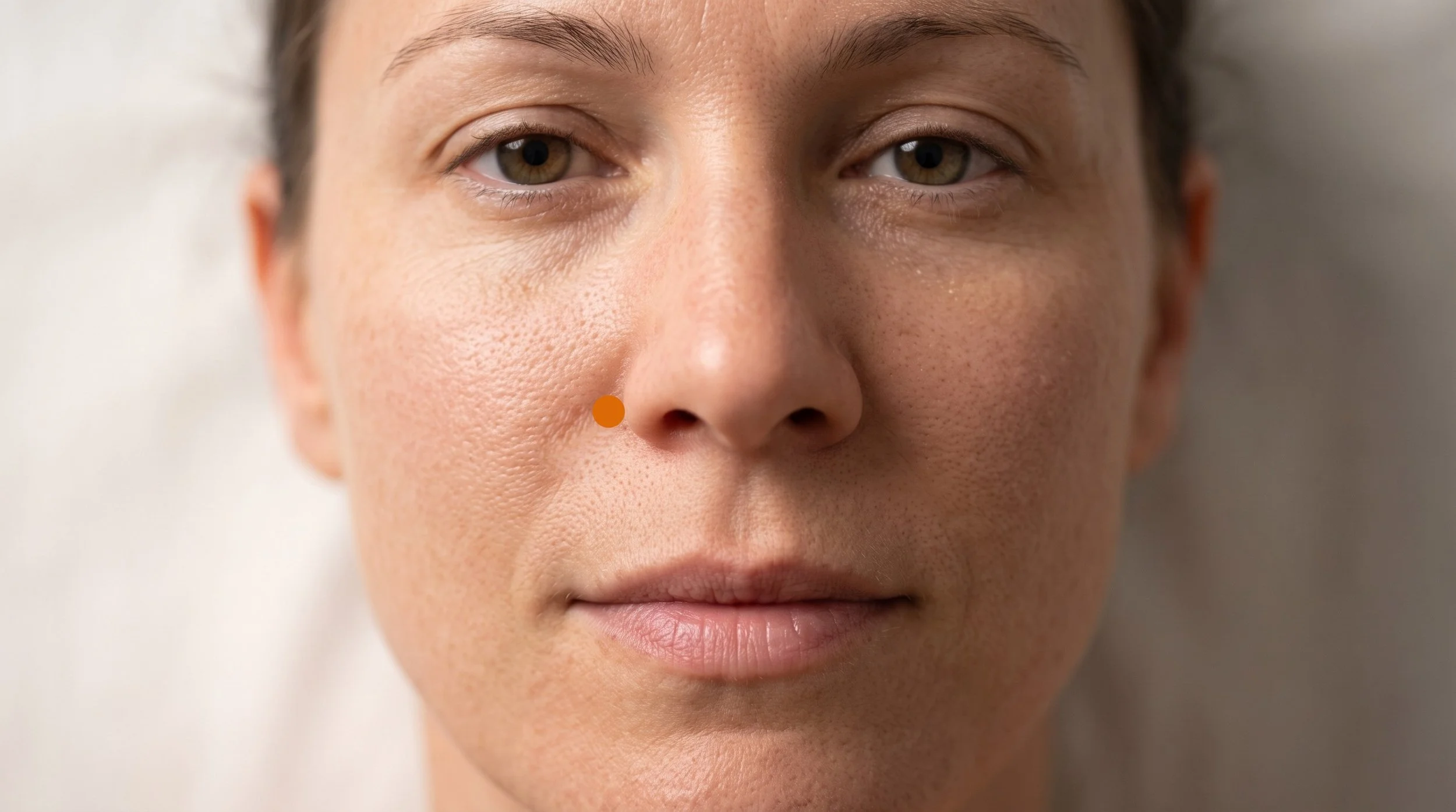
LI20 (Yingxiang, often translated as Welcome Fragrance) is the final point of the Large Intestine channel and one of the most heavily used facial points in modern practice. You can find it without measuring: slide a fingertip into the crease that runs from the outer edge of the nostril down toward the corner of the mouth, and stop level with the middle of the nostril's outer rim. That small groove sits over thin facial muscle, directly above dense trigeminal sensory territory and a few millimeters from the autonomic machinery that controls how swollen or open the nasal lining feels.
Classically the point was described as opening the nose and dispersing wind and heat from the face (Deadman et al., 2001). Clinically, it is the point we reach for when a patient's main complaint is a blocked nose, pressure across the cheeks and brow, allergy flares, or facial symptoms that track along the midface.
- The li20 acupuncture point sits in the nasolabial groove level with the midpoint of the lateral border of the ala nasi, over the levator labii superioris and just superficial to the maxilla, so needling stays shallow and transverse rather than deep (Deadman et al., 2001; Kim, 2010).
- Traditional texts classify large intestine 20 as a meeting point of the Large Intestine and Stomach channels, and as the exit point where Large Intestine qi passes into the Stomach channel on the face; these are traditional attributions, not anatomical claims (Deadman et al., 2001; Cunningham, 2010).
- Sensory input from this area travels through infraorbital branches of the maxillary division of the trigeminal nerve, whose second-order neurons converge in the trigeminal brainstem complex alongside afferents from the nasal mucosa, sinuses, and upper teeth, which is the most plausible route by which a needle beside the nostril changes how the nose and midface feel (Zhao, 2008).
- Needling also appears to recruit descending inhibitory pathways and endogenous opioid mechanisms rather than acting locally alone, which is consistent with the way acupuncture's effects on pain outlast the treatment session (Zhao, 2008; Vickers et al., 2018).
- Research on nose-related protocols is moderately encouraging and consistently multi-point: a large multicenter trial in seasonal allergic rhinitis used LI20 bilaterally as an obligatory point (Brinkhaus et al., 2013; Filshie et al., 2016), and pooled analyses suggest modest improvements in nasal symptom scores and quality of life, with sham comparisons narrowing the effect (He et al., 2022).
- De qi at Yingxiang is distinctive: a heavy, spreading ache around the nostril and cheek, often with reflex watering of the eye and sometimes a sense of one nostril opening within a minute or two. It is a sensitive spot, so gentle technique matters more than strong stimulation.
Stuffy Nose, Sinus Pressure, or Seasonal Allergies That Never Fully Clear?
At Morningside Acupuncture we treat congestion and sinus pressure as a nervous system and vascular problem as much as a mucus problem, and LI20 is one of the first points we use for it. We pair it with distal points such as LI4 and with gentle work around the brow and cheek so the whole midface calms down together. Most patients notice something change in the treatment room, and we build on that week to week. Schedule a visit and let's see how your nose responds.
Schedule NowAnatomy of LI20: Why the Nasolabial Groove Is Such an Important Location
The tissue at LI20 is thin and layered tightly. Under the skin of the nasolabial groove there is only a small amount of subcutaneous fat before the needle reaches the levator labii superioris, with the levator labii superioris alaeque nasi and the nasalis fibers close by, and the maxilla forming the hard floor beneath (Deadman et al., 2001). This is a high-traffic zone mechanically: it moves with every sneeze, sniff, smile, and yawn, and it takes repeated mechanical irritation from nose blowing, wiping, mask edges, and eyeglass frames during a congestion flare.
Chronic mouth breathing and habitual facial bracing add low-grade tension to the same small muscles, which is part of why the groove often feels tender before you even needle it.
The important anatomy here is neural, not muscular. Sensation in this region is carried by infraorbital branches of the maxillary division of the trigeminal nerve, while the facial nerve supplies the motor fibers of the surrounding expression muscles (Deadman et al., 2001). Those infraorbital afferents share second-order neurons in the trigeminal brainstem complex with afferents from the nasal mucosa, the maxillary sinus, and the upper teeth.
That shared wiring is the simplest explanation for two clinical observations: sinus and dental problems commonly refer pain to exactly this patch of face, and stimulating this patch of face can change nasal and sinus sensation. The same trigeminal input reaches brainstem autonomic nuclei that drive parasympathetic outflow through the pterygopalatine ganglion to the nasal mucosa and its venous sinusoids, offering a mechanism for shifts in perceived nasal patency without invoking energy flow.
Needling at any site also engages descending inhibitory control and endogenous opioid signaling, which helps explain why relief can outlast the session (Zhao, 2008; Vickers et al., 2018).
The structure that dictates technique is vascular. The angular branch of the facial artery runs close to LI20, so this point bruises easily if a needle is driven deep or angled carelessly (Deadman et al., 2001). Standard practice is a transverse or oblique insertion of roughly 0.3 to 0.5 cun directed medially or medio-superiorly, and some texts use an even shallower 0.2 to 0.3 cun oblique approach (Kim, 2010).
A common variation threads the needle up along the groove toward the extra point Bitong at the top of the nasolabial crease, and some classical and modern sources list this point as unsuitable for moxibustion, a caution worth respecting given how thin and cosmetically sensitive the facial skin is (Deadman et al., 2001).
Related Large Intestine Channel Related LI4 Acupuncture PointLI20 at a Glance: Classification, Location, and Clinical Use
| Category | Detail |
|---|---|
| Traditional Name | Yingxiang (Welcome Fragrance), Large Intestine 20 |
| Channel Classification | Large Intestine channel of Hand Yangming, final point of the channel on the face |
| Point Categories | Meeting (crossing) point of the Large Intestine and Stomach channels; also described as the exit point of the Large Intestine channel, where the channel connects with the Stomach channel beside the nose (Deadman et al., 2001; Cunningham, 2010) |
| Precise Location | In the nasolabial groove, level with the midpoint of the lateral border of the ala nasi (the outer rim of the nostril) |
| Tissue Stimulated | Skin and thin subcutaneous layer of the nasolabial groove, levator labii superioris and adjacent levator labii superioris alaeque nasi and nasalis fibers, with infraorbital (trigeminal V2) sensory branches and the angular branch of the facial artery nearby; frequently combined in clinic with dry needling of jaw muscles such as the lateral pterygoid |
| Needle Depth / Direction | Transverse or oblique insertion 0.3 to 0.5 cun directed medially or medio-superiorly, sometimes threaded along the groove toward Bitong; shallower 0.2 to 0.3 cun oblique technique is also described, and some texts consider the point unsuitable for moxibustion |
| De Qi Sensation | Local heaviness and a spreading dull ache around the nostril and cheek, often with reflex tearing of the eye, and sometimes a quick sense of one nasal passage opening |
| Primary Clinical Uses | Nasal congestion and discharge, sinus pressure, allergic rhinitis and hay fever symptoms, changes in sense of smell, facial pain, itching or swelling of the midface |
| Common Point Combinations |
|
In the point manual by Deadman and colleagues, Yingxiang is presented as the foremost local point for disorders of the nose, and the primary local point for the classical categories of bi yuan and bi qiu. Bi yuan, literally something like nose pool, is described as roughly overlapping with what we would call sinusitis: thin or thick discharge, a blocked and stuffy nose, pain, and dulled smell and taste. Bi qiu covers what modern clinicians would recognize as rhinitis, including allergic rhinitis, with sneezing, discharge, and itching.
The traditional actions attributed to the point are opening the nasal passages and expelling wind while clearing heat, and because Yangming was said to govern the face, this meeting point of the Large Intestine and Stomach channels was also used for facial itching and swelling, painful swollen lips, red hot eyes, and deviation of the mouth (Deadman et al., 2001).
What is striking is the precision of the classical pattern: the indication list maps almost exactly onto the sensory field of the maxillary trigeminal division and the mucosa it shares brainstem territory with, which is a remarkably accurate piece of clinical mapping for a text tradition with no concept of a trigeminal nucleus.
Why LI20 Is Used for More Than a Stuffy Nose: Sinus Pressure, Facial Pain, and Changes in Smell
Patients are often surprised that a needle placed beside the nostril can change pressure they feel across the cheekbones, behind the eyes, or in the upper teeth. The reason is convergence. Sensory fibers from the nasolabial region, the nasal lining, the maxillary sinus, and the upper dental arch all funnel into overlapping territory in the trigeminal brainstem complex, so the brain builds one blended map of the midface out of several inputs.
Stimulating one input can shift how the whole map is read, and the same convergence works in reverse, which is why sinus inflammation is felt as facial pain in the first place (Zhao, 2008).
There is a second, more mechanical layer. The swollen, congested feeling in a blocked nose comes largely from engorgement of venous sinusoids in the nasal lining, and that engorgement is under autonomic control by way of the pterygopalatine ganglion and its sympathetic counterpart. Trigeminal stimulation feeds into the brainstem circuits that regulate this outflow, which gives a plausible mechanism for the rapid, sometimes minute-to-minute changes in nasal airflow patients report during treatment.
Objective measurements support that something measurable happens, though not always as cleanly as the subjective reports suggest: rhinomanometry studies of needling at nose-related points have found significant improvement in airflow and symptom scores over time (Sertel et al., 2009), while an optical rhinometry study of mucosal swelling found sham needling performed better than expected and concluded that this particular instrument could not resolve the effect (Albrecht et al., 2015).
Finally, needling recruits general analgesic machinery that has nothing to do with the nose specifically. Descending inhibitory pathways and endogenous opioid signaling dampen how much of an ongoing nociceptive signal reaches conscious perception, which is one reason relief from facial and sinus pain often persists for hours or days after the needles come out and tends to accumulate across a series of treatments (Zhao, 2008; Vickers et al., 2018).
What the Research Shows for LI20
One caveat matters before reading any of the numbers below: almost no trial tests LI20 by itself. Studies of acupuncture for nasal symptoms use multi-point protocols in which Yingxiang is typically one obligatory local point alongside distal points such as LI4 and LI11, so the honest interpretation is that LI20 is a consistent component of protocols that have been tested, not an independently validated intervention (Filshie et al., 2016).
Sham comparisons in this field are also unusually difficult, since superficial needling near the face is not physiologically inert, and effect sizes shrink when trials are well blinded. With those limits in mind, the overall picture is modestly favorable for symptom scores and quality of life in allergic rhinitis, weaker and less consistent for objective airflow measures.
| Study | Type | Focus | Key Finding |
|---|---|---|---|
| Brinkhaus et al., 2013 | Multicenter randomized controlled trial (422 patients) | Acupuncture plus rescue antihistamine versus sham plus rescue medication versus rescue medication alone in seasonal allergic rhinitis, using LI20 bilaterally as an obligatory point | Quality of life improved more and rescue medication use fell further in the real acupuncture group at the end of the treatment period, though differences narrowed and lost statistical significance by 16 weeks. |
| He et al., 2022 | Systematic review and meta-analysis (30 trials, 4413 participants) | Acupuncture for allergic rhinitis, nasal symptom scores and rhinoconjunctivitis quality of life | Acupuncture was associated with improved nasal symptoms and quality of life compared with no intervention, and modestly outperformed sham acupuncture on quality of life measures. |
| Yin et al., 2020 | Systematic review with Bayesian network meta-analysis | Comparison of different acupuncture-related methods for allergic rhinitis | Several acupuncture approaches appeared more effective than control conditions, but the authors emphasized methodological limitations across the included trials. |
| Sertel et al., 2009 | Randomized, double-blind, placebo-controlled pilot study (24 patients) | Nasal airflow by rhinomanometry after needling verum versus control points in nasal congestion from turbinate hypertrophy or chronic sinusitis | Verum needling significantly improved measured nasal airflow and symptom scores over time, though the sample was small and exploratory. |
| Albrecht et al., 2015 | Prospective randomized controlled study (25 patients) | Optical rhinometry of inferior turbinate mucosal swelling after needling nose-related points versus sham points | Sham needling produced more response than anticipated, and the authors concluded that this imaging method could not detect a specific acupuncture effect. |
| Takeuchi et al., 1999 | Small randomized study (20 patients) | Thirty seconds of self-massage at Yingxiang for congestion during acute upper respiratory infection, with nasal airway resistance and airflow sensation as outcomes | Objective resistance and airflow scores did not differ significantly between groups, but more patients in the massage group reported that their congestion had improved. |
Facial Pressure, Post-Nasal Drip, and Allergy Season in New York City?
Spring pollen, radiator heat, subway dust, and late summer ragweed give Manhattan patients a nearly year-round congestion cycle. Our licensed acupuncturists combine LI20 with Yintang, LI4, and targeted dry needling of jaw and neck muscles that refer pain into the cheeks and sinuses. We also send you home with a simple acupressure routine so you are not waiting for your next appointment to breathe better. Book an appointment and get ahead of the next flare.
Schedule NowLI20 in the Context of Trigger Point Work
Acupuncture is defined by the tool, an acupuncture needle, and that same needle covers hundreds of styles including dry needling. At Morningside we routinely combine a channel-based point like LI20 with myofascial targets that refer symptoms into the same territory. This matters clinically because not every case of cheek pressure and sinus ache is coming from the sinuses.
Travell and Simons documented referral patterns in which masseter and sternocleidomastoid trigger points project pain into the maxillary and periorbital region, closely mimicking sinus pain, and jaw muscles such as the lateral pterygoid contribute to midface and ear pressure complaints (Simons et al., 1999). When a patient's imaging and ENT workup are unremarkable but the face still aches, those muscles deserve examination.
In practice, that means a session for congestion and facial pressure often looks like shallow needling at LI20 and Yintang, distal needling at LI4, and then dry needling of the masseter, temporalis, lateral pterygoid, or upper cervical muscles depending on what is tender and what reproduces the patient's symptom pattern. LI20 itself sits over the thin levator labii superioris rather than a large trigger point target, so it is treated with light, precise technique rather than the pistoning approach used in thicker muscle. Neck and jaw work also tends to reduce the guarding and clenching that keep midface symptoms simmering between visits.
LI20 Nasal Congestion and Sinus Treatment at NYC's Highest-Rated Acupuncture Clinic
Morningside Acupuncture is the highest-rated acupuncture and dry needling clinic in New York City with over 500 five-star Google reviews, and sinus and allergy complaints are among the most common reasons patients find us. Every treatment starts with an exam, so the points we choose (including whether LI20 is right for you) follow your presentation rather than a template. We keep needling at this point shallow, precise, and comfortable. Schedule your first session today.
Schedule NowFrequently Asked Questions
What does LI20 feel like when needled?
Most people feel a quick pinch as the needle passes the skin, then a heavy, slightly achy fullness that spreads across the nostril and cheek. Watering of the eye on that side is common and expected. Some patients notice one nasal passage seeming to open within a minute or two, and others feel the sensation travel toward the eye socket or upper lip. Because facial skin is sensitive, we keep insertion shallow and stimulation gentle; strong manipulation is not needed for the point to be effective.
Why needle beside my nose instead of somewhere closer to my sinuses?
The maxillary sinuses sit behind bone, so no needle reaches them directly, and none needs to. Sensory fibers from the skin beside the nostril, the nasal lining, and the sinus mucosa converge on overlapping neurons in the trigeminal brainstem complex, so accessible tissue at the surface shares neural real estate with the structures that hurt (Zhao, 2008). That same trigeminal input feeds brainstem circuits that regulate blood flow and secretion in the nasal lining. Needling LI20 works through that shared wiring, which is also why we add distal points such as LI4 rather than relying on local needling alone.
Can I press LI20 myself between sessions?
Yes, and it is one of the easiest points for self-care because you can find it by feel. Place your index fingertips in the creases on both sides of your nose, level with the middle of each nostril's outer rim. Press inward and slightly upward toward the nose with firm but comfortable pressure, then either hold steady for 30 to 60 seconds or make small circles for one to two minutes. Repeat two or three times a day, and during allergy season you can add a round any time congestion builds. A small randomized study of just 30 seconds of self-massage at this point found no significant change in measured nasal airway resistance, though more people in the massage group reported that their congestion felt better (Takeuchi et al., 1999), so treat it as comfort care rather than a substitute for treatment. Stop if the skin becomes irritated or sore, and skip the area entirely if you have a cold sore, active rash, or recent facial injury there.
Is LI20 safe to needle?
In trained hands, yes, with a few specific cautions. The angular branch of the facial artery runs close by and the tissue is thin, so deep or careless angling can cause a bruise; shallow transverse or oblique insertion of about 0.3 to 0.5 cun is the standard for this reason (Deadman et al., 2001; Kim, 2010). Some classical and modern texts also list this point as unsuitable for moxibustion. We take extra care with patients on blood thinners, avoid needling through active skin infections or lesions, and note that facial points can bruise more visibly than points on the trunk or limbs. Tell your acupuncturist about recent cosmetic facial procedures, fillers, or dental surgery so the plan can be adjusted.
Where exactly is LI20 located?
For li 20 location, find the nasolabial groove, the crease running from the outer edge of the nostril toward the corner of the mouth. LI20 is in that groove, level with the midpoint of the lateral border of the ala nasi, which is the outer rim of the nostril (Deadman et al., 2001). No proportional measuring is needed: it is where the fingertip naturally settles into the crease right beside the widest part of the nostril, and in patients with nasal symptoms it is usually noticeably tender. The point is needled bilaterally in most protocols.
References
- Deadman, P., Al-Khafaji, M., & Baker, K. (2009). A manual of acupuncture. Journal of Chinese Medicine Publications.
- Kim, H. (2008). Handbook of Oriental medicine (3rd ed.). Harmony & Balance Press.
- Cunningham, P. M. (2000). Acupuncture points: A practical guide to classical and modern usage. Odyssey Press.
- Maciocia, G. (2005). The foundations of Chinese medicine: A comprehensive text for acupuncturists and herbalists (2nd ed.). Elsevier Churchill Livingstone.
- Filshie, J., White, A., & Cummings, M. (Eds.). (2016). Medical acupuncture: A Western scientific approach (2nd ed.). Elsevier.
- Simons, D. G., Travell, J. G., & Simons, L. S. (1999). Travell & Simons' myofascial pain and dysfunction: The trigger point manual, Vol. 1: Upper half of body (2nd ed.). Williams & Wilkins.
- Zhao, Z. Q. (2008). Neural mechanism underlying acupuncture analgesia. Progress in Neurobiology, 85(4), 355-375. https://doi.org/10.1016/j.pneurobio.2008.05.004
- Vickers, A. J., Vertosick, E. A., Lewith, G., MacPherson, H., Foster, N. E., Sherman, K. J., Irnich, D., Witt, C. M., & Linde, K. (2018). Acupuncture for chronic pain: Update of an individual patient data meta-analysis. Journal of Pain, 19(5), 455-474. https://doi.org/10.1016/j.jpain.2017.11.005
- Brinkhaus, B., Ortiz, M., Witt, C. M., Roll, S., Linde, K., Pfab, F., Niggemann, B., Hummelsberger, J., Treszl, A., Ring, J., Zuberbier, T., Wegscheider, K., & Willich, S. N. (2013). Acupuncture in patients with seasonal allergic rhinitis: A randomized trial. Annals of Internal Medicine, 158(4), 225-234. https://doi.org/10.7326/0003-4819-158-4-201302190-00002
- He, M., Qin, W., Qin, Z., & Zhao, C. (2022). Acupuncture for allergic rhinitis: A systematic review and meta-analysis. European Journal of Medical Research, 27(1). https://doi.org/10.1186/s40001-022-00682-3
- Yin, Z., Geng, G., Xu, G., Zhao, L., & Liang, F. (2020). Acupuncture methods for allergic rhinitis: A systematic review and Bayesian meta-analysis of randomized controlled trials. Chinese Medicine, 15(1). https://doi.org/10.1186/s13020-020-00389-9
- Sertel, S., Bergmann, Z., Ratzlaff, K., Baumann, I., Greten, H. J., & Plinkert, P. K. (2009). Acupuncture for nasal congestion: A prospective, randomized, double-blind, placebo-controlled clinical pilot study. American Journal of Rhinology & Allergy, 23(6), e23-e28. https://doi.org/10.2500/ajra.2009.23.3380
- Albrecht, T., Wu, S., Baumann, I., Plinkert, P. K., & Sertel, S. (2015). Measurable impact of acupuncture on mucosal swelling of inferior turbinates: A prospective, randomized, controlled study. Acta Oto-Laryngologica, 135(2), 169-176. https://doi.org/10.3109/00016489.2014.973533
- Takeuchi, H., Jawad, M. S. M., & Eccles, R. (1999). The effects of nasal massage of the "yingxiang" acupuncture point on nasal airway resistance and sensation of nasal airflow in patients with nasal congestion associated with acute upper respiratory tract infection. American Journal of Rhinology, 13(2). https://doi.org/10.2500/105065899782106670
Disclaimer: This web site is intended for educational and informational purposes only. Reading this website does not constitute providing medical advice or any professional services. This information should not be used for diagnosing or treating any health issue or disease. Those seeking medical advice should consult with a licensed physician. Seek the advice of a medical doctor or other qualified health professional for any medical condition. If you think you have a medical emergency, call 911 or go to the emergency room. No acupuncturist-patient relationship is created by reading this website or using the information. Morningside Acupuncture PLLC and its employees and contributors do not make any express or implied representations with respect to the information on this site or its use. For any legal interpretation of scope of practice in your state, consult a licensed attorney or regulatory authority.
Read more from our blog