LI16 Acupuncture Point (Jugu)
LI16 Acupuncture Point (Jugu)
The Great Bone Above the Shoulder: Anatomy, Mechanism, and Why LI16 Belongs in Treatment for Shoulder Pain and Restricted Arm Elevation
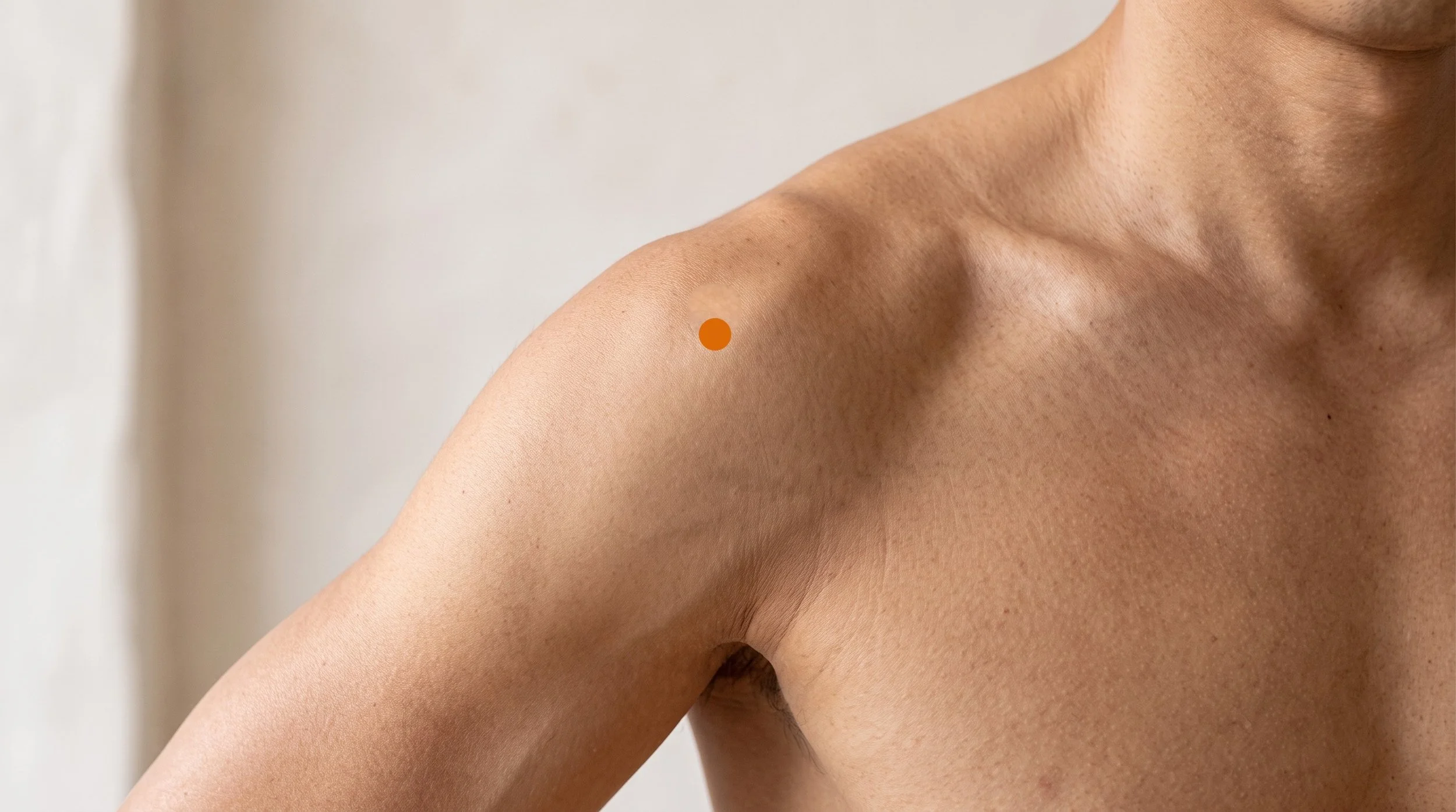
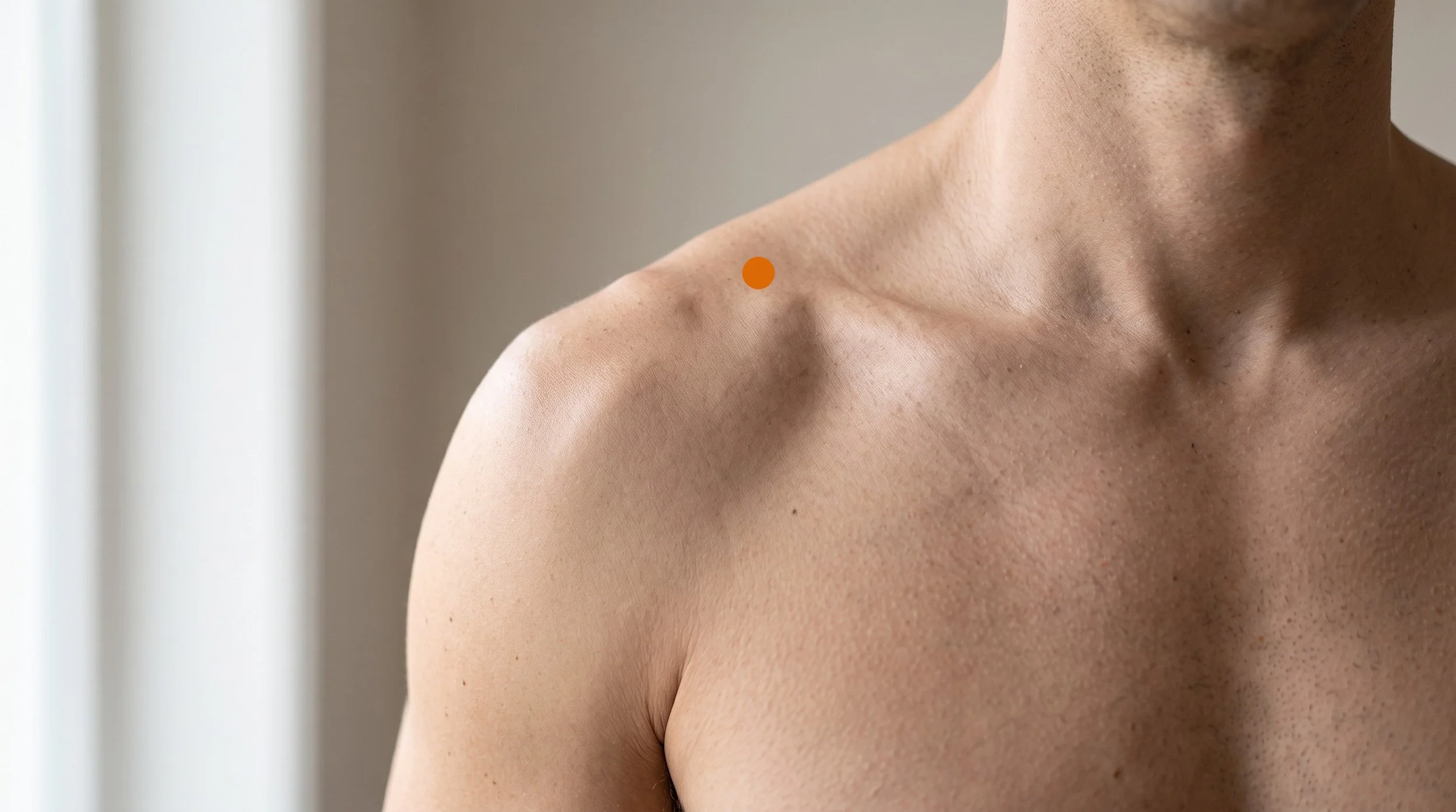
LI16, known in Chinese as Jugu and usually translated as Great Bone, sits in the small notch on top of the shoulder, just inside the bony point of the acromion, where the outer end of the collarbone meets the ridge of the shoulder blade. It's the sixteenth point of the Large Intestine channel and the last one on the shoulder before the channel climbs into the neck.
What makes the li16 acupuncture point clinically interesting is not the classical name but what sits underneath it: the upper trapezius superficially and the supraspinatus tendon and muscle belly deeper, in a corridor that also carries the suprascapular nerve. That places large intestine 16 directly over the tissue most often implicated when patients say their shoulder hurts and they can't lift their arm overhead.
- Location and layers: LI16 lies in the depression medial to the acromion, between the lateral end of the clavicle and the spine of the scapula (Deadman et al., 2001). The needle passes through skin, subcutaneous tissue, and upper trapezius toward the supraspinatus territory, which is why the jugu point is so often tender in people who carry, lift, or work overhead.
- Traditional attributions: classical texts describe LI16 as a meeting point of the Large Intestine channel with the Yang Motility (Yang Qiao) vessel and credit it with activating the channel, easing pain, benefiting the shoulder joint, and moving qi and blood (Deadman et al., 2001; Cunningham, 2019). We treat these as historical categories, not physiology.
- Mechanism: needling here recruits cutaneous branches of the supraclavicular nerves and deeper C4 to C6 input from the suprascapular nerve region, segments that also supply the glenohumeral joint and rotator cuff, so stimulation converges on the same dorsal horn territory as the painful structure (Zhao, 2008).
- Systemic effects: needling reliably engages descending inhibitory pathways and endogenous opioid signaling, and individual patient data from chronic pain trials suggest modest but persistent benefits over sham and usual care for musculoskeletal pain (Zhao, 2008; Vickers et al., 2018).
- Research picture for the shoulder specifically: the Cochrane review of acupuncture for shoulder pain found the literature too small and too varied to settle the question, with possible short term gains in pain and function (Green et al., 2005), while needling of shoulder girdle trigger points has since been examined in its own meta-analyses (Navarro-Santana et al., 2021; Griswold et al., 2023).
- De qi at LI16 tends to feel like a deep, dull, heavy ache that fills the top of the shoulder and can spread toward the deltoid or down the outer arm. Sharp, electric, or radiating sensation into the hand isn't the goal and tells the practitioner to redirect.
Shoulder Pain That Flares When You Reach Overhead?
Reaching, lifting a bag into an overhead bin, or putting on a jacket shouldn't feel like a negotiation. At Morningside Acupuncture we palpate the LI16 notch as part of a full shoulder exam, then combine it with nearby points and, where appropriate, dry needling of the supraspinatus and upper trapezius. Treatment is paired with simple loading and mobility work so gains carry over between visits. Schedule a shoulder assessment and let's find out what's actually driving the pain.
Schedule NowAnatomy of LI16: Why the Notch Between the Clavicle and Scapular Spine Is Such an Important Location
Run a finger along the top of your collarbone toward the shoulder and you'll reach a bony corner, then a small dip just before the hard shelf of the acromion. That dip is LI16. Under the skin sits the upper trapezius, and beneath that the supraspinatus muscle occupies the fossa above the scapular spine before its tendon runs laterally under the acromion. This region absorbs load every time you carry weight in one hand, hold a phone to your ear, sit at a desk with unsupported arms, or press something overhead.
Because the trapezius and supraspinatus work in different roles during the same movements, tenderness at the jugu point can reflect either layer, which is why palpation matters more than measurement here.
The sensory story is layered. Superficially, the skin over the point is supplied by supraclavicular branches from the cervical plexus, the trapezius receives motor supply from the accessory nerve, and deeper structures in this corridor fall within suprascapular nerve territory around C4 to C6 (Kim, 2013). Those same segments innervate the glenohumeral joint capsule, the rotator cuff, and the subacromial tissues, so afferent input from the needle arrives at spinal levels that already receive nociceptive traffic from the painful shoulder.
This segmental convergence is the most plausible reason local needling changes shoulder pain, and it sits alongside broader mechanisms including descending inhibition from brainstem centers and local release of vasoactive peptides that increase blood flow in needled muscle (Zhao, 2008; Sandberg et al., 2003).
The safety consideration is the same one that governs every point on top of the shoulder: the apex of the lung sits below and medial to this region. Classical texts specify perpendicular or oblique insertion of roughly 0.5 to 1 cun and caution that deep medial angulation risks pneumothorax, particularly in thin patients (Deadman et al., 2001).
In practice, angles are directed laterally toward the acromion rather than downward and inward, and some clinicians favor an oblique lateral approach when targeting supraspinatus tendon territory (Cunningham, 2019). Depth is dictated by body type, not by a number on a chart.
Related Best Acupuncture Points For Shoulder Pain Related Acupuncture For Rotator Cuff Pain ResearchLI16 at a Glance: Classification, Location, and Clinical Use
| Category | Detail |
|---|---|
| Traditional Name | Jugu (Great Bone) |
| Channel Classification | Sixteenth point of the Large Intestine channel (Hand Yang Ming) |
| Point Categories | Meeting point of the Large Intestine channel with the Yang Motility (Yang Qiao) vessel; listed among the intersection points of that vessel in the classical literature |
| Precise Location | On the upper shoulder, in the depression medial to the acromion process, between the lateral end of the clavicle and the spine of the scapula |
| Tissue Stimulated | Skin and supraclavicular nerve territory, upper trapezius, and deeper supraspinatus within the supraspinous fossa corridor |
| Needle Depth / Direction | Perpendicular or oblique insertion 0.5 to 1 cun, angled laterally toward the acromion; deep medial or downward angulation is avoided because of the lung apex |
| De Qi Sensation | Deep, heavy, dull ache filling the top of the shoulder, sometimes spreading into the deltoid or outer upper arm; sharp or electric sensation into the hand is not the target |
| Primary Clinical Uses | Shoulder pain with difficulty raising the arm, rotator cuff territory pain, upper back and shoulder blade discomfort, and arm pain along the Large Intestine channel |
| Common Point Combinations |
|
Deadman's Manual of Acupuncture presents LI16 mainly as an adjacent point for shoulder disorders and advises palpating it for tenderness before use, a practical instruction that says a great deal about how the point was actually applied. The text singles it out for shoulder problems that have become chronic and hard to shift, an emphasis it links to the classical idea of blood stasis and to the old saying that long standing disease often involves stagnation.
The same attributed action on blood extends the traditional indication list into territory that surprises modern readers, including stasis in the chest and vomiting of blood, and LI16 shares with its channel neighbors the historical use for scrofula and goiter. Presented as traditional attribution rather than physiology, the striking part is the pattern: a point chosen not for fresh, acute strains but for the shoulder that has been sore for months and hasn't budged.
Why LI16 Is Used for Stubborn Shoulder Pain That Hasn't Responded to Local Treatment
When a shoulder has hurt for months, the problem is rarely confined to one tendon. Input from the joint, the cuff, the bursa, and the surrounding muscles all arrives at the same mid cervical spinal segments, and with repeated bombardment those segments can become more responsive, so ordinary movement starts registering as pain. Needling at LI16 delivers strong, controlled afferent input into that same C4 to C6 neighborhood, and this segmental convergence is one of the better supported explanations for why local needling changes how a painful shoulder feels and moves (Zhao, 2008).
Beyond the segment, needle stimulation activates descending inhibitory pathways from the brainstem and engages endogenous opioid and monoamine systems that dampen pain signaling more broadly (Zhao, 2008). There's also a local vascular component: experimental work using photoplethysmography found that deeper needling into muscle produced greater increases in skin and muscle blood flow than superficial insertion, which may matter in a region where guarded, chronically loaded tissue is the complaint (Sandberg et al., 2003).
None of this requires a belief in energy flow, and none of it constitutes a cure. It describes a nervous system being given new, competing information.
Practically, this is why the jugu point earns its place in stubborn cases. If pressing the notch medial to the acromion reproduces the patient's familiar ache, that finding guides the treatment plan more than any textbook indication list does. If it doesn't, we look elsewhere: the neck, the scapular stabilizers, or the anterior shoulder.
What the Research Shows for LI16
It's worth being clear about what the evidence can and can't tell us. Almost no trial isolates a single point, and LI16 is essentially never studied on its own. What the literature evaluates is multi-point acupuncture protocols for shoulder conditions, or needling of specific shoulder girdle muscles, with LI16 appearing as one component among several.
The honest summary is that needling approaches show modest short and medium term benefits for shoulder pain and function in several reviews, that the quality of the underlying trials is often low, and that this point's contribution within a protocol has not been separately quantified.
| Study | Type | Focus | Key Finding |
|---|---|---|---|
| Green et al., 2005 | Cochrane systematic review | Acupuncture for shoulder pain in adults | The authors concluded there was little evidence either supporting or refuting acupuncture for shoulder pain, with possible short term benefit for pain and function over two to four weeks. |
| Vickers et al., 2018 | Individual patient data meta-analysis | Acupuncture for chronic musculoskeletal and other chronic pain | Pooled patient level data suggested acupuncture was superior to both sham and no acupuncture controls for chronic pain, with effects that persisted over time. |
| Navarro-Santana et al., 2021 | Systematic review with meta-analysis | Trigger point dry needling for nontraumatic shoulder pain of musculoskeletal origin | Needling of shoulder girdle trigger points was associated with reductions in pain and related disability, though the authors noted limitations in trial quality. |
| Griswold et al., 2023 | Systematic review with meta-analysis | Dry needling combined with other conservative care for subacromial pain syndrome | Adding dry needling to other conservative interventions produced more favorable pain and disability outcomes across the assessed time points. |
| Para-García et al., 2022 | Systematic review with meta-analysis | Dry needling alone or with exercise therapy in subacromial pain syndrome | Five randomized trials were pooled, with results suggesting possible benefit for pain and disability while certainty of evidence remained limited. |
| Ben-Arie et al., 2020 | Systematic review with meta-analysis | Acupuncture for frozen shoulder (adhesive capsulitis) | Acupuncture appeared safe and was associated with short and mid term improvements in pain, function, and flexion range, but the authors rated the level of evidence as very low. |
| Sandberg et al., 2003 | Experimental physiological study | Skin and muscle blood flow responses to needle stimulation in healthy subjects | Deep needle stimulation into muscle produced larger increases in local skin and muscle blood flow than subcutaneous insertion. |
Stubborn Rotator Cuff Pain That Hasn't Improved With Rest?
Rotator cuff territory pain often lingers because the irritated tissue keeps getting loaded and the surrounding muscles stay guarded. Our licensed acupuncturists use the li16 acupuncture point alongside local and distal points to reduce guarding and improve tolerance to movement. We coordinate with your physical therapist or trainer when you have one. Book a visit and start working the shoulder instead of avoiding it.
Schedule NowLI16 in the Context of Trigger Point Work
Acupuncture, as we define it, is the use of an acupuncture needle, and that includes the hundreds of styles practiced worldwide as well as dry needling. LI16 happens to sit where two clinically important myofascial targets overlap. The upper trapezius crosses the point superficially and is a well described source of referred pain into the neck, head, and shoulder region, while the supraspinatus lies deeper in the fossa and characteristically refers pain around the outer shoulder and down the arm, often with pain on abduction (Simons et al., 1999). Palpating LI16 frequently means palpating one or both of these muscles at the same time.
At Morningside, we use the point as a landmark rather than a formula. If the presenting complaint is difficulty raising the arm, we assess the supraspinatus and infraspinatus, the trapezius, and the deltoid, then decide whether the needle at LI16 should sit shallow in the trapezius layer or angle laterally toward supraspinatus territory. Local needling is typically combined with distal points and with active movement during retention, and we follow with loading exercises so the shoulder learns that the range it avoided is available again. Angles stay conservative and lateral for the reasons described above.
LI16 Shoulder Pain Treatment at NYC's Highest-Rated Acupuncture Clinic
Morningside Acupuncture is the highest-rated acupuncture and dry needling clinic in New York City with over 500 five-star Google reviews, and shoulder complaints are among the most common reasons patients come through our door. We treat li 16 shoulder presentations with careful palpation, conservative needle depth, and a plan that changes as your range of motion changes. Sessions are unhurried and explained as we go. Schedule your appointment at our Midtown Manhattan office.
Schedule NowFrequently Asked Questions
What does LI16 feel like when needled?
Most people describe a deep, heavy, spreading ache at the top of the shoulder, sometimes with a sense of pressure that travels toward the deltoid or outer upper arm. That dull, diffuse quality is the de qi practitioners look for. A brief pinch at insertion is normal. Sharp pain, burning, or an electric jolt shooting into the hand isn't expected, and you should say so immediately so the needle can be adjusted or removed. Some soreness at the site for a day afterward is common, particularly if the trapezius or supraspinatus was tender to begin with.
Why needle the top of the shoulder when my pain is on the outside of the arm?
Pain location and pain source are often different addresses. The supraspinatus and upper trapezius both refer pain away from where they sit, and referred patterns from the cuff commonly land on the outer shoulder and upper arm rather than in the fossa above the scapular spine (Simons et al., 1999). On top of that, the tissue under LI16 shares spinal segments with the shoulder joint and rotator cuff, so needling here feeds into the same neural territory that's processing your arm pain (Zhao, 2008). If pressing the notch medial to the acromion reproduces your familiar symptom, that's a strong argument for treating it.
Can I press LI16 myself between sessions?
Yes, and it's easy to find on yourself. Trace your collarbone outward toward the shoulder until you feel the bone end and a small dip appear just before the hard bony shelf of the acromion. Press straight down into that dip with the opposite index or middle finger using firm, steady pressure, enough to feel a satisfying ache but not enough to make you brace or hold your breath. Hold for 30 to 60 seconds, release, and repeat two or three times per side, once or twice a day. Slow circular pressure works equally well. Gentle shoulder rolls or a few pain free overhead reaches immediately afterward tend to help the effect stick. Skip it over broken skin, recent surgery, or a shoulder you've been told not to load, and stop if pressure sharpens the pain rather than easing it.
Is LI16 safe to needle?
In trained hands, yes, but it's a point that demands respect for depth and angle. The apex of the lung sits below and medial to this region, and classical texts explicitly caution that deep medial insertion risks pneumothorax, especially in thin patients (Deadman et al., 2001). Practitioners therefore keep insertion within roughly 0.5 to 1 cun and angle laterally toward the acromion rather than downward and inward. Licensed acupuncturists in New York are trained in clean needle technique and in the anatomy of the thoracic outlet region. Tell your practitioner if you're on blood thinners, have had shoulder or chest surgery, or have any implanted hardware in the area.
Where exactly is LI16 located?
On the upper aspect of the shoulder, in the depression just medial to the acromion process, between the lateral end of the clavicle and the spine of the scapula (Deadman et al., 2001). The simplest way to find large intestine 16 is to follow the collarbone laterally with a fingertip until it ends, then slide slightly backward into the soft notch before the acromion. In many people with shoulder complaints the spot announces itself as distinctly tender compared with the surrounding tissue.
References
- Deadman, P., Al-Khafaji, M., & Baker, K. (2009). A manual of acupuncture. Journal of Chinese Medicine Publications.
- Cunningham, P. M. (2000). Acupuncture points: A practical guide to classical and modern usage. Odyssey Press.
- Kim, H. (2008). Handbook of Oriental medicine (3rd ed.). Harmony & Balance Press.
- Simons, D. G., Travell, J. G., & Simons, L. S. (1999). Travell & Simons' myofascial pain and dysfunction: The trigger point manual, Vol. 1: Upper half of body (2nd ed.). Williams & Wilkins.
- Green, S., Buchbinder, R., & Hetrick, S. (2005). Acupuncture for shoulder pain. Cochrane Database of Systematic Reviews, 2005(2), CD005319. https://doi.org/10.1002/14651858.CD005319 [VERIFY BEFORE PUBLISHING]
- Vickers, A. J., Vertosick, E. A., Lewith, G., MacPherson, H., Foster, N. E., Sherman, K. J., Irnich, D., Witt, C. M., & Linde, K. (2018). Acupuncture for chronic pain: Update of an individual patient data meta-analysis. Journal of Pain, 19(5), 455-474. https://doi.org/10.1016/j.jpain.2017.11.005
- Zhao, Z. Q. (2008). Neural mechanism underlying acupuncture analgesia. Progress in Neurobiology, 85(4), 355-375. https://doi.org/10.1016/j.pneurobio.2008.05.004
- Navarro-Santana, M. J., Sanchez-Infante, J., Gómez-Chiguano, G. F., Cleland, J. A., Fernández-de-las-Peñas, C., & Plaza-Manzano, G. (2021). Effects of trigger point dry needling for nontraumatic shoulder pain of musculoskeletal origin: A systematic review and meta-analysis. Physical Therapy, 101(2), pzaa216. https://doi.org/10.1093/ptj/pzaa216 [VERIFY BEFORE PUBLISHING]
- Griswold, D., Learman, K., Ickert, E., Tapp, A., & Ross, O. (2023). Dry needling for subacromial pain syndrome: A systematic review with meta-analysis. Pain Medicine, 24(3), 285-299. https://doi.org/10.1093/pm/pnac131 [VERIFY BEFORE PUBLISHING]
- Para-García, G., García-Muñoz, A. M., López-Gil, J. F., Ruiz-Cárdenas, J. D., García-Guillén, A. I., López-Román, F. J., Pérez-Piñero, S., Abellán-Ruiz, M. S., Cánovas, F., & Victoria-Montesinos, D. (2022). Dry needling alone or in combination with exercise therapy versus other interventions for reducing pain and disability in subacromial pain syndrome: A systematic review and meta-analysis. International Journal of Environmental Research and Public Health, 19(17), 10961. https://doi.org/10.3390/ijerph191710961
- Ben-Arie, E., Kao, P. Y., Lee, Y. C., Ho, W. C., Chou, L. W., & Liu, H. P. (2020). The effectiveness of acupuncture in the treatment of frozen shoulder: A systematic review and meta-analysis. Evidence-Based Complementary and Alternative Medicine, 2020, 9790470. https://doi.org/10.1155/2020/9790470
- Sandberg, M., Lundeberg, T., Lindberg, L. G., & Gerdle, B. (2003). Effects of acupuncture on skin and muscle blood flow in healthy subjects. European Journal of Applied Physiology, 90(1-2), 114-119. https://doi.org/10.1007/s00421-003-0825-3
Disclaimer: This web site is intended for educational and informational purposes only. Reading this website does not constitute providing medical advice or any professional services. This information should not be used for diagnosing or treating any health issue or disease. Those seeking medical advice should consult with a licensed physician. Seek the advice of a medical doctor or other qualified health professional for any medical condition. If you think you have a medical emergency, call 911 or go to the emergency room. No acupuncturist-patient relationship is created by reading this website or using the information. Morningside Acupuncture PLLC and its employees and contributors do not make any express or implied representations with respect to the information on this site or its use. For any legal interpretation of scope of practice in your state, consult a licensed attorney or regulatory authority.
Read more from our blog