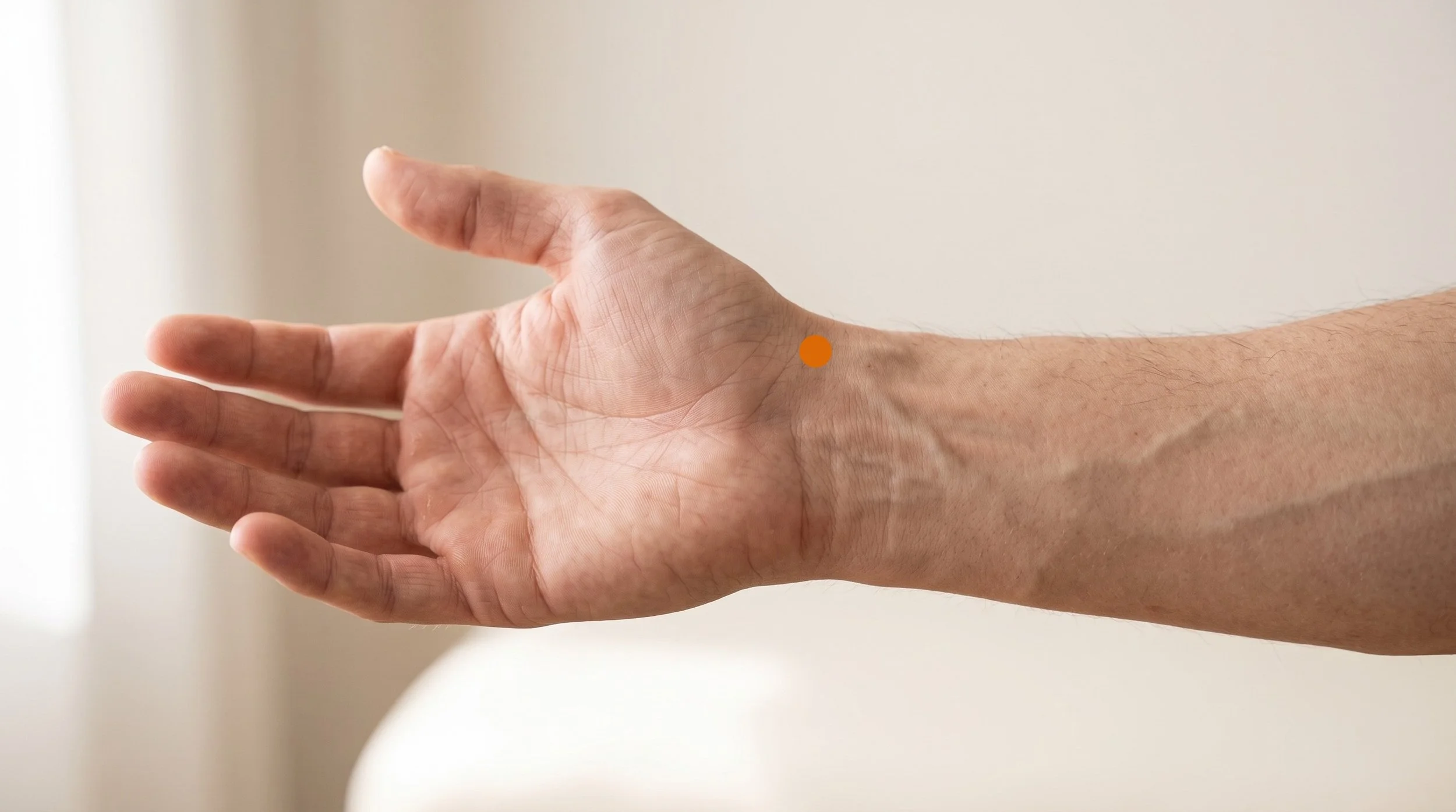
Bailao Acupuncture Point (M-HN-30)
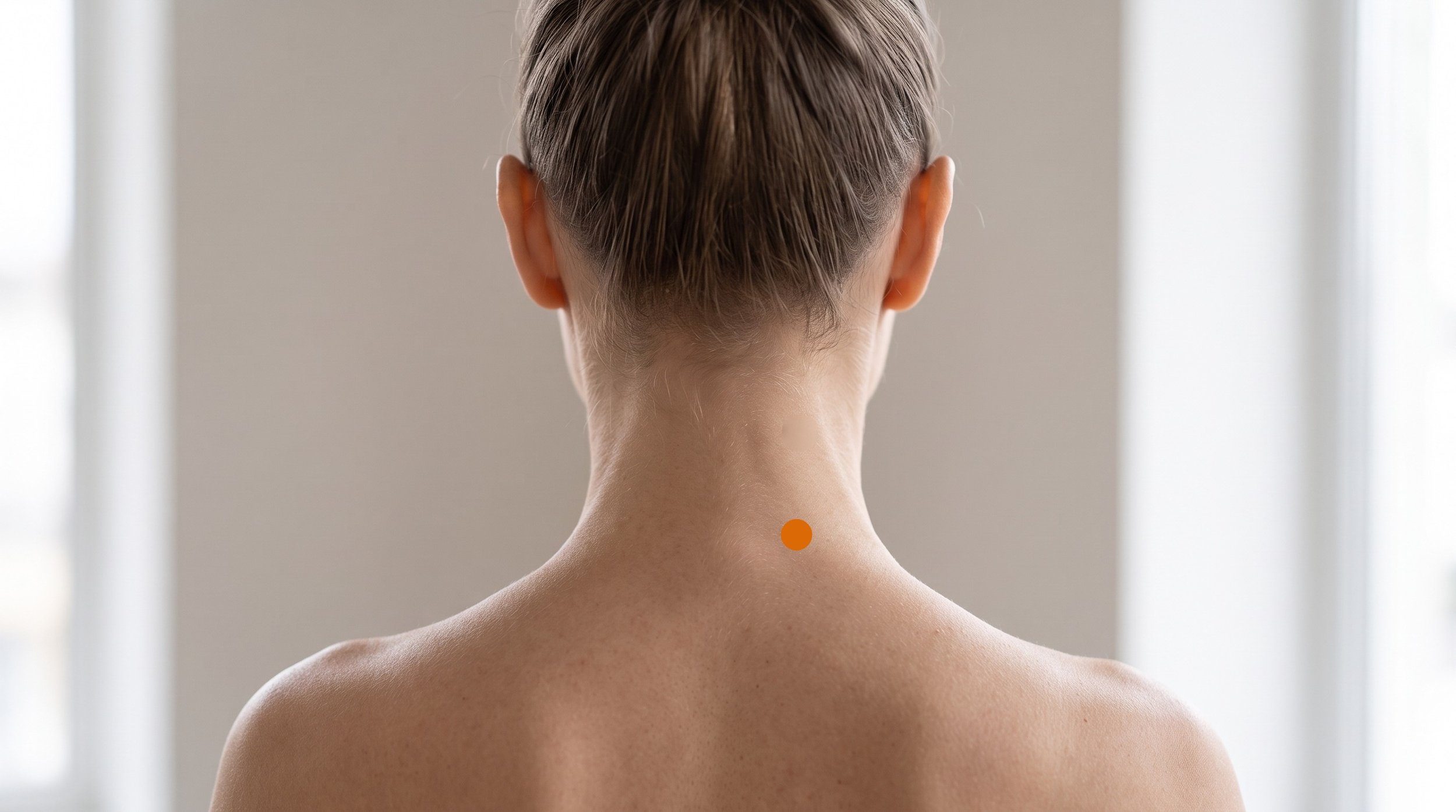
Bailao Acupuncture Point (M-HN-30)
Hundred Taxations Above the Great Vertebra: Anatomy, Mechanism, and Why This Extra Point Anchors Desk Posture Neck Care
BAILAO (M-HN-30), whose name is usually rendered as Hundred Taxations, is an extra point of the posterior neck rather than a point on one of the fourteen channels. You find it by locating the prominent spinous process of C7, dropping to GV14 just below it, then measuring 2 cun straight up the neck and 1 cun out to either side of the midline, which places it over the paraspinal muscle mass at roughly the C5 level.
Clinically it matters for two very different reasons: it sits in the exact tissue that gets loaded by screen posture, laptop use, and long commutes, and it carries an unusually broad classical reputation for depletion patterns such as chronic cough, night sweating, and long term fatigue. That combination makes the bailao acupuncture point a practical local target for stiff, guarded necks and a historically interesting site for moxibustion in run down patients.
- BAILAO (M-HN-30) lies 2 cun above GV14 and 1 cun lateral to the midline, over upper trapezius and, deeper, the splenius and semispinalis layer of the cervical extensors. The classical texts give a modest perpendicular insertion of roughly 0.5 to 0.8 cun, which keeps the needle in muscle rather than driving toward the spinal canal.
- Traditional sources attribute two main actions to this point: transforming phlegm with dissipation of neck nodules, and settling cough and wheezing. Translated into modern terms, these are pattern based attributions from the classical record, not verified physiological effects, and we present them as history rather than as mechanism.
- The tissue at M-HN-30 is supplied by cervical dorsal rami, so needling here delivers input to the same mid cervical dorsal horn segments that receive nociception from the facet joints, deep extensors, and ligaments patients describe as a stiff neck (Zhao, 2008). Segmental convergence is the most defensible explanation for why local needling changes local pain.
- Beyond the segment, needle stimulation recruits descending inhibitory pathways from the periaqueductal gray and rostral ventromedial medulla, plus local axon reflex vasodilation in the needled muscle (Zhao, 2008). This is why patients often report warmth and a loosening sensation that outlasts the session.
- The research picture is protocol level rather than point level: individual patient data meta-analysis supports acupuncture over sham and no acupuncture for chronic musculoskeletal pain including neck pain (Vickers et al., 2018), and needling of trigger points in the neck extensors and trapezius shows short term reductions in pain and disability (Navarro-Santana et al., 2020).
- De qi at the hundred taxations point is typically a deep, dull ache or heaviness that spreads across the upper trapezius toward the shoulder blade, sometimes with a brief muscle twitch when a taut band is engaged (Simons et al., 1999). Sharp, electric, or radiating arm sensation is not the goal and means the needle should be adjusted.
Is Your Neck Stiff Every Afternoon at Your Desk?
Most of the neck pain we treat in Midtown is not one injury but hundreds of small loading days stacked on the cervical extensors. At Morningside Acupuncture we use BAILAO alongside GB20, GV14, and trapezius dry needling to reduce guarding in the exact layer that stiffens with screen posture. Treatment is paired with practical ergonomic and movement advice so the change holds between visits. Schedule a session and let's map where your neck is actually loading.
Schedule NowAnatomy of BAILAO: Why the Mid Cervical Paraspinal Shelf Is Such an Important Location
Sliding a finger down the back of the neck, the first bump that stays prominent when you extend your head is C7, and GV14 sits just below it. From there, BAILAO is two thumb widths up and one thumb width out, which lands on the muscular shelf beside the spinous processes at about the C5 level. The needle passes through skin and thin subcutaneous tissue into upper trapezius, then into the splenius capitis and cervicis fibers, and deeper still toward semispinalis cervicis and multifidus.
These are the muscles that work isometrically all day to hold a forward head against gravity, which is precisely why this territory becomes tender, ropy, and stiff in desk workers, students, and anyone who reads on a phone.
The sensory and motor supply here comes from the dorsal rami of the mid cervical spinal nerves, the same nerves that carry information from the facet joints, deep interspinous ligaments, and paraspinal muscles of the neck. Because those afferents converge on shared dorsal horn neurons, a needle placed in muscle at this level delivers input to the very segments that are processing the ache a patient calls neck stiffness, and repeated stimulation of A delta and group III afferents engages spinal and supraspinal inhibitory circuits (Zhao, 2008).
Myofascial mapping adds a second layer of explanation: taut bands in the splenius and semispinalis group refer pain up into the head and across the shoulder in patterns patients recognize immediately (Simons et al., 1999). Needling into a taut band may provoke a local twitch response, which many clinicians use as a marker that the intended tissue was reached.
Depth discipline matters more than force at this location. The classical instruction is a perpendicular insertion of 0.5 to 0.8 cun, which keeps the needle within the extensor mass and well away from the vertebral canal, and clinicians generally avoid steep medial angling toward the interlaminar space or aggressive lateral angling toward the transverse processes, where the vertebral artery runs in the foramina.
The apex of the lung sits considerably lower and more lateral, so pneumothorax risk at M-HN-30 is low compared with points over the upper thoracic cage, but the same conservative principle applies: shallow, controlled, and anatomically informed.
In practice we use short needles, palpate the spinous process line first, and treat patients lying prone or seated with the head supported so the tissue is not moving mid technique.
Related Best Acupuncture Points For Neck Pain Related Acupuncture For Neck PainBAILAO at a Glance: Classification, Location, and Clinical Use
| Category | Detail |
|---|---|
| Traditional Name | Bailao, Hundred Taxations (also written Jing Bailao, neck hundred taxations) |
| Channel Classification | Extra point of the head and neck, M-HN-30, not assigned to one of the fourteen channels |
| Point Categories | Extraordinary (extra) point with no five-shu, meeting, or hui-gathering designation; traditional actions recorded as transforming phlegm and dissipating nodules, and stopping cough and calming dyspnea; the name Bailao is also used historically as an alternate name for GV14 and for BL11 |
| Precise Location | Posterior neck, 2 cun superior to GV14 (which lies below the C7 spinous process) and 1 cun lateral to the midline, bilateral |
| Tissue Stimulated | Upper trapezius, splenius capitis and splenius cervicis, with the semispinalis capitis and cervicis group deeper; innervated by cervical dorsal rami |
| Needle Depth / Direction | Perpendicular insertion 0.5 to 0.8 cun; avoid steep medial angling toward the spinal canal and deep lateral angling toward the transverse processes |
| De Qi Sensation | Deep heaviness, dull ache, or distension spreading across the upper trapezius and toward the shoulder blade; a brief twitch may occur when a taut band is engaged |
| Primary Clinical Uses | Neck stiffness and pain, restricted rotation, tension type headache from cervical extensor guarding; classically also listed for cough, wheezing, night and spontaneous sweating, tidal fever, and neck nodules |
| Common Point Combinations |
|
The Deadman text places the first discussion of this point in the Compilation of Acupuncture and Moxibustion and records a short but telling indication list: neck nodules, cough and wheezing, wasting lung disorders, night and spontaneous sweating, tidal fever, and stiffness and pain of the neck. Two traditional actions are given, transforming phlegm with dissipation of nodules, and settling cough with calming of labored breathing, and the recorded combination is a moxa formula pairing this point with the elbow tip point for neck nodules.
Deadman also flags a naming quirk worth remembering: Bailao is used elsewhere as an alternate name for GV14, and other authors apply it to BL11, so the same three syllables can point to different locations depending on the source. All of this is traditional attribution rather than tested physiology, but the pattern behind it is striking: a single spot on the back of the neck was asked to handle both the mechanical complaint of a stiff neck and the constitutional picture of a person worn down by a hundred labors.
Why BAILAO Is Used for Cough, Night Sweating, and Long Term Fatigue in the Classical Record
Patients are often surprised that a neck point carries indications for coughing, sweating, and exhaustion. Part of the answer is historical: in the classical system, points along the upper spine were understood to influence the chest and the body's overall reserve, and this site was a favored target for moxibustion in people described as depleted. We present that as a traditional framework, not as a physiological claim.
What we can say in modern terms is narrower and better supported: needling here reaches muscle and connective tissue innervated by mid cervical dorsal rami, which converge in the dorsal horn with input from cervical joints and ligaments, so stimulation at this segment plausibly modulates how the neck's nociceptive traffic is processed (Zhao, 2008).
The second half of the mechanism story is not local at all. Needle stimulation activates descending inhibitory control from brainstem structures including the periaqueductal gray and rostral ventromedial medulla, with endogenous opioid and monoaminergic signaling contributing to reduced pain transmission at the spinal level (Zhao, 2008). Locally, needling produces small vascular and inflammatory changes in the treated muscle that may explain the warmth and softening patients report.
Neither pathway is unique to BAILAO, which is honest and useful: the point is valuable because of where it sits, not because it does something no other point can do.
Clinically, we use M-HN-30 when palpation finds tenderness and stiffness in the mid cervical extensor shelf, when rotation or extension is guarded, or when headaches appear to be driven from the back of the neck. In patients who are simply exhausted and holding tension in the neck, the classical use of gentle moxibustion at this site remains a reasonable comfort measure, framed as a traditional practice with a pleasant thermal and autonomic effect rather than as a treatment for any internal disease.
What the Research Shows for BAILAO
There is no meaningful body of research on BAILAO in isolation. Like almost every point, it appears inside multi-point protocols, so the fair way to read the evidence is to ask whether needling protocols that include the posterior cervical extensors help neck pain, and then to note that this point is a standard member of those protocols. The trials below test acupuncture and dry needling as whole interventions, with effect sizes that are typically modest, mostly short term, and measured against sham, usual care, or no treatment. Nothing here should be read as evidence that a single point produces a specific outcome.
| Study | Type | Focus | Key Finding |
|---|---|---|---|
| Vickers et al., 2018 | Individual patient data meta-analysis | Acupuncture for chronic pain including neck and shoulder pain, roughly 20,000 patients | Acupuncture was associated with greater pain reduction than both sham and no acupuncture controls, with effects that persisted over time but were modest in size. |
| Trinh et al., 2016 | Cochrane systematic review (later withdrawn pending update) | Acupuncture for neck disorders across acute, subacute, and chronic presentations | Moderate quality evidence suggested pain relief compared with sham at the end of treatment and short term follow up, though the review was subsequently withdrawn for updating, so the conclusions should be treated cautiously. |
| Navarro-Santana et al., 2020 | Systematic review and meta-analysis | Dry needling of trigger points in patients with neck pain symptoms | Low to moderate quality evidence suggested short term improvements in pain intensity and related disability, without consistent effects on pressure pain sensitivity or cervical range of motion. |
| Fernández-de-las-Peñas et al., 2021 | Systematic review and meta-analysis | Dry needling combined with other physical therapy interventions for neck related trigger points | Combining needling with exercise and manual therapy appeared to add benefit over single interventions in the short term, supporting a multimodal rather than needle only approach. |
| Alhakami et al., 2025 | Systematic review of randomized clinical trials | Deep versus superficial dry needling of upper trapezius trigger points in neck pain | Both depths appeared to produce short term pain and function improvements without clear superiority of one technique, which supports the conservative depths used at this location. |
| Zhao, 2008 | Narrative review of mechanisms | Neural pathways underlying acupuncture analgesia | Analgesic effects are described through segmental spinal modulation and descending inhibitory control involving opioid and monoaminergic signaling, rather than through any channel specific mechanism. |
Headaches That Start in the Back of Your Neck?
Tension type headaches often track back to sensitized cervical extensors rather than to the head itself. We combine the bailao point with suboccipital and splenius work to settle the upper cervical input that feeds referral into the head. Our licensed acupuncturists needle conservatively, explain every step, and adjust the plan based on how you respond. Book an evaluation and we'll start with the tissue driving your symptoms.
Schedule NowBAILAO in the Context of Trigger Point Work
The location of M-HN-30 overlaps almost perfectly with common myofascial targets in the posterior neck. Depending on the angle and depth, a needle here engages upper trapezius fibers, the splenius capitis and cervicis, and the semispinalis group, all muscles that develop taut bands and refer pain into the head, the shoulder blade region, and occasionally toward the eye (Simons et al., 1999).
At Morningside we palpate first, mark the tender bands, then decide whether the session calls for a classical point prescription, focused trigger point needling, or both in the same visit.
In practice, a typical desk posture neck session might combine BAILAO and GB20 for the upper cervical shelf, GB21 and trapezius dry needling for the shoulder crest, and a distal point such as SI3 needled while the patient actively rotates and side bends. Reviews suggest that needling works best as part of a multimodal plan rather than on its own, so we pair it with loaded neck and scapular exercise and specific workstation changes (Fernández-de-las-Peñas et al., 2021). Soreness for a day after deeper trigger point work is common and usually settles quickly with movement and heat.
BAILAO Neck Pain Treatment at NYC's Highest-Rated Acupuncture Clinic
Morningside Acupuncture is the highest-rated acupuncture and dry needling clinic in New York City with over 500 five-star Google reviews. We use M-HN-30 as part of a full posterior neck strategy that blends classical point selection with modern trigger point needling of the trapezius, splenius, and semispinalis. Every visit is one on one with a licensed acupuncturist who explains what each needle is doing and why. Schedule your first appointment and get a clear plan for your neck.
Schedule NowFrequently Asked Questions
What does BAILAO feel like when needled?
Most people feel a dull, heavy ache or a spreading pressure that fans across the upper trapezius toward the shoulder blade, which is the classical de qi sensation. If the needle engages a taut band, there may be a brief involuntary twitch and a moment of sharper ache that fades within seconds. What you should not feel is an electric or radiating sensation down the arm; tell your acupuncturist right away if that happens, and the needle will be repositioned.
Why needle the neck itself instead of only using distal points for neck pain?
Local and distal needling do different jobs. A needle at BAILAO delivers input directly into the mid cervical segments that are processing your neck pain, and it also reaches the muscle tissue that is actually stiff and guarded (Zhao, 2008). Distal points such as SI3 give an additional, non-local analgesic contribution and let us treat while you actively move your neck. Most sessions use both, since the combination lets us address the tissue and the pain processing at the same time.
Can I press BAILAO myself between sessions?
Yes, this is one of the easier points for self acupressure. Find the bump at the base of your neck (C7), then walk your fingers about two thumb widths up the midline and one thumb width out to the side; you should land on a firm band of muscle beside the spine. Press with your thumb or two fingertips at a moderate, tolerable pressure and hold for 30 to 60 seconds per side, breathing slowly, then repeat two or three times. Doing this two or three times a day, or gently at your desk every hour or two, is reasonable. Keep it a dull ache rather than sharp, avoid pressing directly on bone, and stop if it produces tingling into the arm, dizziness, or a worsening headache.
Is BAILAO safe to needle?
In trained hands, yes. The classical guidance is a perpendicular insertion of 0.5 to 0.8 cun, which keeps the needle inside the neck extensor muscles and away from the vertebral canal, and clinicians avoid steep medial or deep lateral angulation for that reason. The most common effects are temporary local soreness or a small bruise. Tell your provider if you take blood thinners, have had cervical spine surgery or hardware placed, have significant osteoporosis, or have any implanted device in the area, since these change how we approach the point.
Where exactly is BAILAO located?
BAILAO (M-HN-30) sits on the back of the neck, 2 cun above GV14 and 1 cun lateral to the midline, on both sides. Practically: run a finger down the midline of your neck until you find the most prominent spinous process, which is usually C7, note the hollow just below it (GV14), then move two thumb widths straight up and one thumb width to the side. That places the point over the paraspinal muscle mass at roughly the C5 level, which is why the bailao neck point is such a natural target for posture related stiffness.
References
- Deadman, P., Al-Khafaji, M., & Baker, K. (2009). A manual of acupuncture. Journal of Chinese Medicine Publications.
- O'Connor, J., & Bensky, D. (Eds. & Trans.). (1981). Acupuncture: A comprehensive text. Shanghai College of Traditional Medicine. Eastland Press.
- Cheng, X. (Ed.). (1999). Chinese acupuncture and moxibustion (Rev. ed.). Foreign Languages Press.
- Maciocia, G. (2006). The channels of acupuncture: Clinical use of the secondary channels and eight extraordinary vessels. Churchill Livingstone Elsevier.
- Kim, H. (2008). Handbook of Oriental medicine (3rd ed.). Harmony & Balance Press.
- Simons, D. G., Travell, J. G., & Simons, L. S. (1999). Travell & Simons' myofascial pain and dysfunction: The trigger point manual, Vol. 1: Upper half of body (2nd ed.). Williams & Wilkins.
- Vickers, A. J., Vertosick, E. A., Lewith, G., MacPherson, H., Foster, N. E., Sherman, K. J., Irnich, D., Witt, C. M., & Linde, K. (2018). Acupuncture for chronic pain: Update of an individual patient data meta-analysis. Journal of Pain, 19(5), 455-474. https://doi.org/10.1016/j.jpain.2017.11.005
- Zhao, Z. Q. (2008). Neural mechanism underlying acupuncture analgesia. Progress in Neurobiology, 85(4), 355-375. https://doi.org/10.1016/j.pneurobio.2008.05.004
- Trinh, K., Graham, N., Irnich, D., Cameron, I. D., & Forget, M. (2016). Acupuncture for neck disorders. Cochrane Database of Systematic Reviews, 2016(5), CD004870. https://doi.org/10.1002/14651858.CD004870.pub4
- Navarro-Santana, M. J., Sanchez-Infante, J., Fernández-de-las-Peñas, C., Cleland, J. A., Martín-Casas, P., & Plaza-Manzano, G. (2020). Effectiveness of dry needling for myofascial trigger points associated with neck pain symptoms: An updated systematic review and meta-analysis. Journal of Clinical Medicine, 9(10), 3300. https://doi.org/10.3390/jcm9103300
- Fernández-de-las-Peñas, C., Plaza-Manzano, G., Sanchez-Infante, J., Gómez-Chiguano, G. F., Cleland, J. A., Arias-Buría, J. L., López-de-Uralde-Villanueva, I., & Navarro-Santana, M. J. (2021). Is dry needling effective when combined with other therapies for myofascial trigger points associated with neck pain symptoms? A systematic review and meta-analysis. Pain Research and Management, 2021, 8836427. https://doi.org/10.1155/2021/8836427
- Alhakami, A. M., Sahely, A., & Alshami, A. M. Y. (2025). Deep versus superficial dry needling for neck pain: A systematic review of randomised clinical trials. Medicina, 61(10), 1832. https://doi.org/10.3390/medicina61101832
Disclaimer: This web site is intended for educational and informational purposes only. Reading this website does not constitute providing medical advice or any professional services. This information should not be used for diagnosing or treating any health issue or disease. Those seeking medical advice should consult with a licensed physician. Seek the advice of a medical doctor or other qualified health professional for any medical condition. If you think you have a medical emergency, call 911 or go to the emergency room. No acupuncturist-patient relationship is created by reading this website or using the information. Morningside Acupuncture PLLC and its employees and contributors do not make any express or implied representations with respect to the information on this site or its use. For any legal interpretation of scope of practice in your state, consult a licensed attorney or regulatory authority.
Read more from our blog