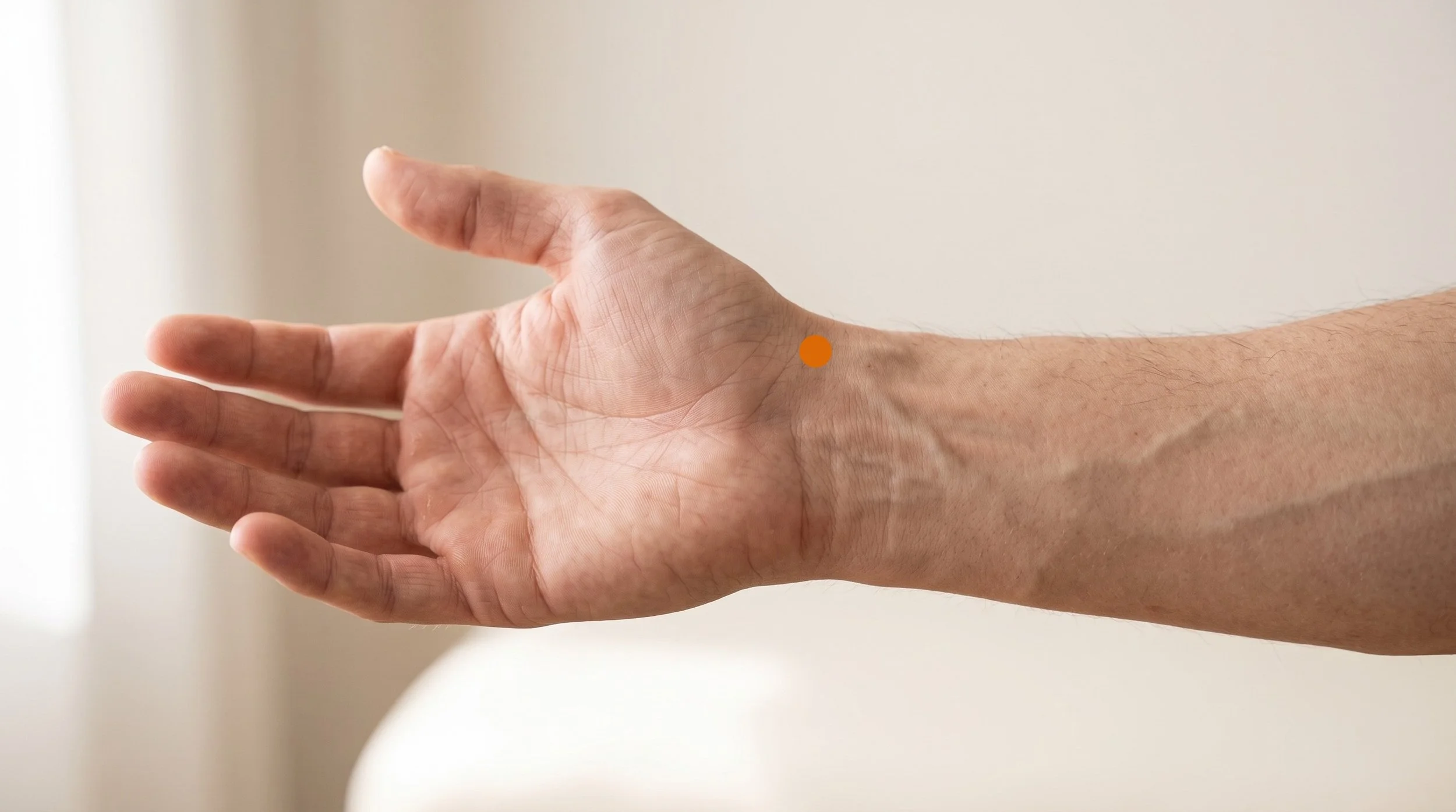
LU6 Acupuncture Point (Kongzui)
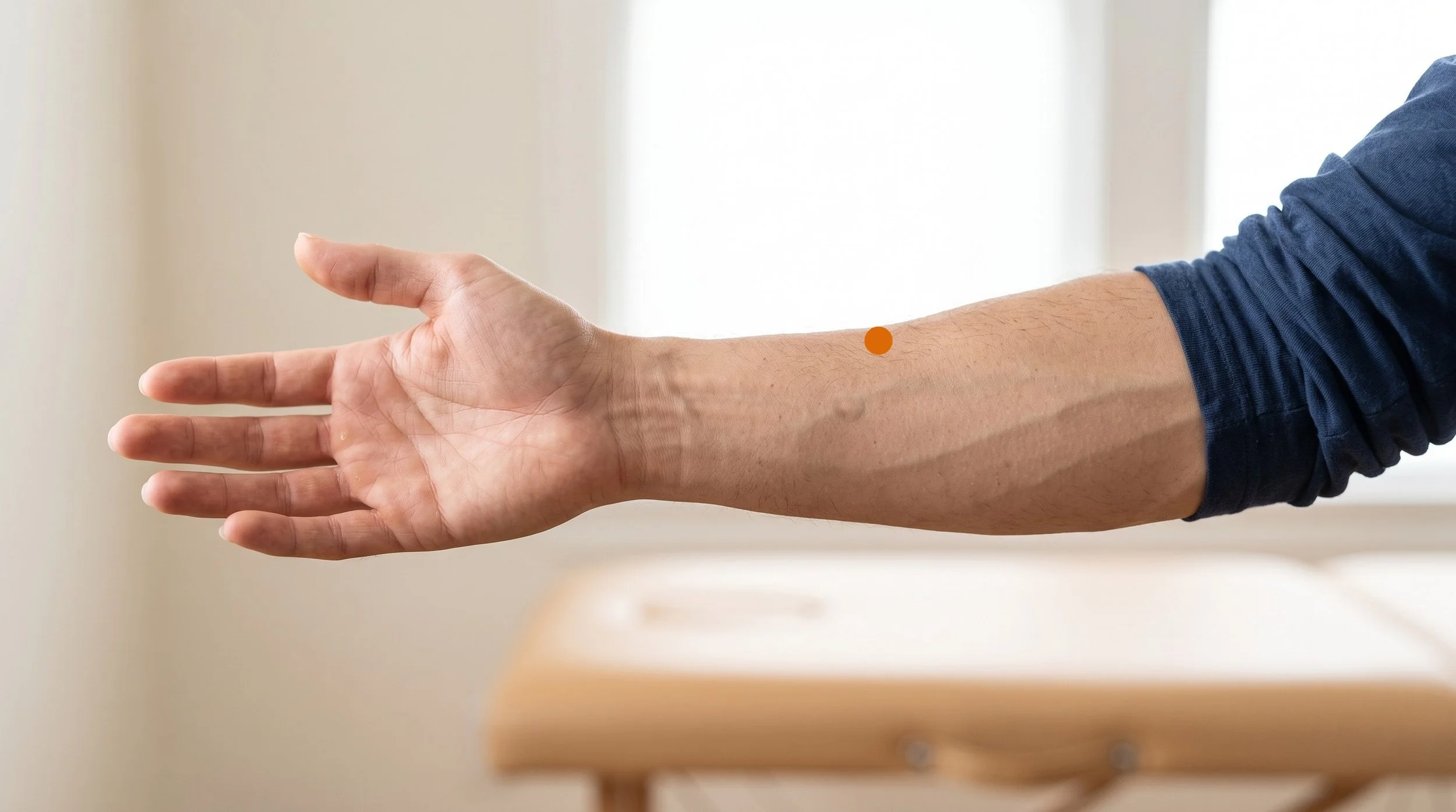
LU6 Acupuncture Point (Kongzui)
The Xi-Cleft Point of the Lung Channel: Anatomy, Mechanism, and Why a Mid-Forearm Point Was Reserved for Acute Cough, Voice Loss, and Radial Arm Pain
LU6 (Kongzui, often translated as Maximum Opening or Collection Hole) sits on the flexor side of the forearm, roughly halfway between the wrist and elbow creases on the thumb side, in a small depression along the line that connects LU9 at the wrist with LU5 at the elbow. In classical point theory it is the xi-cleft point of the Lung channel, a category traditionally reserved for sudden, intense, and acute presentations rather than slow chronic ones (Deadman et al., 2007).
That gives lung 6 an unusual double identity in modern practice: it is a well-mapped local point for radial-sided forearm and elbow pain, and it is one of the few forearm points that acupuncturists reach for when a patient walks in with a cough, a tight chest, or a voice that has gone hoarse overnight. This guide covers the lu6 acupuncture point in detail: the lu 6 location, the tissue and nerves under the needle, how the traditional indications translate into current pain and autonomic neuroscience, and what the research does and does not support.
- Location and layers: LU6 lies 7 cun proximal to LU9 on the LU9 to LU5 line, which in practice means finding the midpoint of the forearm and moving one cun toward the elbow into a palpable dip (Deadman et al., 2007). The needle passes through skin, subcutaneous tissue, and antebrachial fascia into the interval between brachioradialis and flexor carpi radialis, over flexor digitorum superficialis (Cheng, 1987).
- Point category, translated: xi cleft lung status is a traditional designation for a place where channel qi and blood were said to gather deeply, and the category was classically applied to acute pain and, on the yin channels, to bleeding presentations (Maciocia, 2015). Read neurophysiologically, this is a description of a point selected for sudden-onset, high-intensity complaints rather than a claim about fluid dynamics.
- Nerve story: the field around LU6 is supplied by the lateral antebrachial cutaneous nerve and the superficial radial nerve, with muscular innervation from the median nerve, placing the input broadly in the C6 to C7 range (Cheng, 1987). Needle stimulation recruits small-diameter afferents that engage spinal segmental inhibition and brainstem descending pain control (Zhao, 2008).
- Research picture: individual patient data meta-analysis supports modest, durable effects of acupuncture for chronic musculoskeletal pain (Vickers et al., 2018), while respiratory evidence is mixed, with a Cochrane review finding trial quality too inconsistent to support recommendations in asthma (McCarney et al., 2004) and a more recent systematic review reporting moderate-certainty improvement in cough severity when acupuncture is added to usual care (Lee et al., 2025).
- Clinical framing: in practice LU6 is rarely used alone. It is a distal partner in respiratory prescriptions and a segmental target in forearm pain protocols, where dry needling of the surrounding flexor and radial-side muscles may reduce pain and improve grip in conditions like lateral elbow pain (Navarro-Santana et al., 2020).
- De qi at LU6 is usually a deep, heavy, spreading ache rather than a sharp pinch, and patients often describe it traveling along the forearm toward the wrist or up toward the elbow. Brief and mild is normal; sharp electric sensation means the needle should be adjusted.
Struggling With a Cough That Will Not Settle or a Chest That Feels Tight?
At Morningside Acupuncture we use LU6 as part of a broader respiratory-support treatment that may include points on the upper back, neck, and chest along with breathing retraining. We are careful to work alongside your physician, not instead of one, and we screen for anything that needs medical workup first. Many patients come to us for the general nervous-system downshift that a session provides while their primary care follows the underlying condition. Schedule a visit and we will build a plan around what you are actually dealing with.
Schedule NowAnatomy of LU6: Why the Mid Radial Forearm Is Such an Important Location
Under LU6 the needle moves through thin skin and subcutaneous fat, then through the antebrachial fascia into the groove between brachioradialis on the radial side and flexor carpi radialis medially, with flexor digitorum superficialis and, deeper still, flexor pollicis longus and the radius beneath (Cheng, 1987). This is the working corridor of the hand. Every time you grip a subway pole, hold a phone for an hour, swing a racquet, or type through a long workday, these muscles co-contract to stabilize the wrist while the fingers move.
That repeated low-grade loading is exactly why the tissue around lu 6 location becomes tender, ropey, and reactive in people who have never injured the arm acutely.
The skin over LU6 is supplied by the lateral antebrachial cutaneous nerve (a continuation of the musculocutaneous nerve) with contributions from the superficial branch of the radial nerve nearby, while the deeper flexor muscles are innervated by the median nerve (Cheng, 1987). Functionally this places the input in the C6 and C7 range, the same cord segments that serve much of the radial forearm, thumb, and index finger.
Needling recruits A-delta and group III afferents whose signals converge in the dorsal horn with input from other tissues in the same segment, which is the basic substrate of segmental inhibition (Zhao, 2008). The same afferent barrage also activates brainstem structures that drive descending inhibitory control through serotonergic and noradrenergic pathways, alongside endogenous opioid release, which helps explain why effects are often felt beyond the needled area (Zhao, 2008).
The radial artery and the cephalic vein run in this region, so palpation before insertion matters more here than at many forearm points (Cheng, 1987). Standard practice is perpendicular or oblique insertion of about 0.5 to 1.5 cun, angled away from a palpable pulse, with gentle technique in anyone on anticoagulants or with a bleeding disorder (Deadman et al., 2007). Classical sources note that moxibustion is also applicable at this point (Kim, 2010). Bruising is the most common minor event and usually resolves within a few days with brief pressure after needle removal.
Related Flexor Carpi Radialis Trigger Points Related Pain Finder Forearm HandLU6 at a Glance: Classification, Location, and Clinical Use
| Category | Detail |
|---|---|
| Traditional Name | Kongzui, commonly rendered as Maximum Opening, Collection Hole, or Biggest Hole |
| Channel Classification | Sixth point of the Lung channel (Hand Taiyin) |
| Point Categories | Xi-cleft (accumulation) point of the Lung channel, the only category assigned to this point in the classical literature |
| Precise Location | Flexor aspect of the forearm, 7 cun proximal to LU9 on the line joining LU9 and LU5. A practical shortcut: find the midpoint between the wrist and elbow creases along that line, then move 1 cun proximally into a palpable depression |
| Tissue Stimulated | Skin and antebrachial fascia over the interval between brachioradialis and flexor carpi radialis, overlying flexor digitorum superficialis |
| Needle Depth / Direction | Perpendicular or oblique insertion 0.5 to 1.5 cun, angled clear of the radial pulse; moxibustion is traditionally applicable |
| De Qi Sensation | Deep local heaviness, distension, and dull ache, often spreading down the forearm toward the wrist or proximally toward the elbow |
| Primary Clinical Uses | Traditionally used for acute cough, wheezing, sore throat, and sudden loss of voice; in modern orthopedic practice used for radial-side forearm pain, elbow-to-wrist channel pain, and difficulty with gripping and finger movement |
| Common Point Combinations |
|
In the classical literature summarized by Deadman and colleagues, LU6 is presented as the xi-cleft point of the Lung channel, a category traditionally understood as a place where channel qi and blood gather and sink more deeply, and therefore a category applied to acute rather than lingering complaints (Deadman et al., 2007). The traditional actions attributed to the point cluster into four themes: sending lung qi downward when it is said to rebel upward as cough or wheeze, clearing heat and moistening dryness in the lung, stopping bleeding, and moderating acute conditions.
The classical indication lists follow the same logic and can be grouped into three families: sudden respiratory and throat problems (cough, wheezing, chest pain, painful swollen throat, loss of voice, fever without sweating), bleeding and upward-moving symptoms (coughing or spitting blood, vomiting, hiccup), and channel-region pain (severe elbow and upper arm pain, inability to raise the arm overhead, difficulty flexing and extending the fingers), with a handful of outliers such as headache and hemorrhoids (Deadman et al., 2007).
What makes the classical pattern striking is its timing rule: this is a point the old texts wanted used in the first hours or days of a problem, when symptoms are loud, not months later when they have gone quiet and chronic.
Why LU6 Is Used for Acute Cough and Sudden Hoarseness From a Point in the Middle of the Forearm
The forearm explanation is the straightforward one. LU6 sits in a C6 to C7 sensory and motor field, and the muscles beneath it move the wrist and fingers, so needling here delivers input into the same spinal segments that receive nociceptive traffic from an irritated radial forearm, wrist, or lateral elbow. Convergence in the dorsal horn means that stimulating one input in a segment can dampen the transmission of another, which is part of why a needle in the mid forearm can change pain felt closer to the elbow or wrist (Zhao, 2008).
Add the local effects of needle insertion into taut, overworked flexor tissue (a small mechanical and vascular response, plus a local twitch when a trigger point is engaged) and you have a plausible account of why patients often report immediate looseness in the forearm.
The respiratory use needs a more careful explanation, because the lungs are not innervated from C6. The honest mechanistic framing is that strong somatic afferent input from the limbs reaches brainstem and hypothalamic centers that regulate autonomic outflow, and that these somato-autonomic reflexes can shift the balance of sympathetic and parasympathetic activity, alter breathing pattern, and reduce the distress component of symptoms like breathlessness and cough (Zhao, 2008).
Descending inhibition, opioid and monoamine signaling, and reduced central sensitization all plausibly contribute. None of this is the same as saying a needle in the forearm opens the airway, and we do not make that claim.
Clinically, the practical value of the lu6 acupuncture point in respiratory care is as a distal partner rather than a primary driver. Prescriptions for cough and breathlessness are usually anchored on the upper back and chest, and lung 6 is added when the presentation is acute, when the throat and voice are involved, or when the patient also has arm-channel tension. That layered use is exactly how the point appears in the classical combinations and how it functions in modern clinic practice.
What the Research Shows for LU6
A fair reading of the evidence starts with a caveat: almost no trial isolates a single point. Studies test multi-point protocols delivered over a course of treatment, so the strongest claim anyone can make about LU6 specifically is that it appears within prescriptions that have been studied, and that its mechanism is consistent with what is known about needle-evoked analgesia and autonomic modulation.
The respiratory literature is genuinely mixed, with older Cochrane work finding the trial base too weak to support recommendations and more recent syntheses reporting moderate-certainty benefits when acupuncture is added to usual care. The musculoskeletal literature, which is where LU6 does much of its everyday work, is considerably more consistent.
| Study | Type | Focus | Key Finding |
|---|---|---|---|
| McCarney et al., 2004 | Cochrane systematic review | Acupuncture for chronic asthma | Trial quality varied and results were inconsistent, so the review concluded there was insufficient evidence to make recommendations. |
| Lee et al., 2025 | Systematic review and meta-analysis | Acupuncture-related therapy for chronic cough (30 RCTs, 2,835 participants) | Adding acupuncture-related therapy to conventional treatment was associated with improved cough severity and cough-related quality of life, with generally moderate certainty of evidence and no signal of increased adverse events. |
| Suzuki et al., 2012 | Randomized placebo-controlled trial | Acupuncture for dyspnea on exertion in COPD | Real acupuncture outperformed placebo needling on breathlessness scores in patients on standard medication, though the trial has been debated on blinding grounds. |
| Vickers et al., 2018 | Individual patient data meta-analysis | Acupuncture for chronic musculoskeletal, headache, and osteoarthritis pain | Acupuncture was superior to both sham and no-acupuncture controls, with effects that persisted over a year with modest decay. |
| Navarro-Santana et al., 2020 | Systematic review and meta-analysis | Trigger point dry needling for lateral epicondylalgia | Low to moderate evidence suggested short-term improvements in pain, disability, pressure pain sensitivity, and strength. |
| Zhao, 2008 | Narrative review of mechanism research | Neural mechanisms of acupuncture analgesia | Needle stimulation engages small-diameter afferents, spinal segmental inhibition, and descending control involving opioid and monoamine systems. |
Radial Forearm, Wrist, and Elbow Pain From Gripping, Typing, or Racquet Sports?
LU6 sits right in the muscular corridor that gets overloaded by repetitive gripping and wrist flexion, which makes it a natural anchor point for forearm treatment. We combine it with dry needling of the flexor and radial-side extensor muscles, plus manual therapy and loading advice so the tissue tolerates work again. Our clinicians assess the whole chain from neck to hand before needling anything. Book an appointment and get a clear read on why your forearm hurts.
Schedule NowLU6 in the Context of Trigger Point Work
The tissue under LU6 is prime dry needling territory. Flexor carpi radialis and flexor digitorum superficialis both harbor trigger points that refer pain toward the wrist, palm, and fingers, and brachioradialis, sitting just laterally, refers toward the lateral elbow and the web of the thumb (Simons et al., 1999). When a patient points to the radial forearm and says the ache runs down into the wrist, the classical point and the myofascial target frequently sit within a centimeter or two of each other.
In those cases we are not choosing between traditions: the same needle insertion satisfies both frameworks, and the deciding factor is what the palpating hand finds.
At Morningside we typically pair LU6 with dry needling of the forearm flexor group, brachioradialis, and the radial extensors when the complaint involves gripping, keyboard work, or racquet sports, since lateral elbow pain rarely lives in the elbow alone. Where a local twitch response is elicited in a taut band, that appears to matter for outcomes in lateral elbow pain protocols (Navarro-Santana et al., 2020). Treatment is then backed with loading progression and ergonomic adjustments, because needling reduces sensitivity while graded load is what rebuilds tolerance.
LU6 Cough and Forearm Pain Treatment at NYC's Highest-Rated Acupuncture Clinic
Morningside Acupuncture is the highest-rated acupuncture and dry needling clinic in New York City with over 500 five-star Google reviews, and our Kongzui work is always part of a full evaluation rather than a recipe. We treat respiratory support and radial forearm pain with the same evidence-informed approach, blending classical point selection with orthopedic assessment. Sessions are calm, precise, and built around your goals. Schedule your visit today and see what a thorough first appointment looks like.
Schedule NowFrequently Asked Questions
What does LU6 feel like when needled?
Most people feel a brief pinch at the skin, then a deep, heavy, distending ache that can spread along the forearm toward the wrist or up toward the elbow. That spreading heaviness is de qi, and it usually settles into a warm, dull sensation within a few seconds. If the tissue is loaded with taut bands, you may feel a quick involuntary twitch, which is normal and brief. Sharp, electric, or radiating zaps mean the needle is close to a nerve and should be repositioned, so tell your acupuncturist right away.
Why would an acupuncturist needle the forearm for a cough or a hoarse voice?
Classically, LU6 is the xi-cleft point of the Lung channel, a category traditionally reserved for sudden and intense presentations, and the old indication lists put acute cough, sore throat, and loss of voice at the top (Deadman et al., 2007). Neurophysiologically, we do not claim a needle in the forearm opens an airway. What is supported is that strong somatic input from the limbs can influence brainstem centers that regulate autonomic tone and the distress component of symptoms (Zhao, 2008), and that acupuncture added to conventional care has been associated with improved cough severity in recent systematic review data (Lee et al., 2025). It is a supporting point within a larger prescription, not a stand-alone treatment for respiratory illness.
Can I press LU6 myself between sessions?
Yes, and it is easy to reach. Rest your forearm palm-up, find the crease at the wrist and the crease at the elbow, then trace the line on the thumb side that connects them. Locate the midpoint, move about one thumb-width toward the elbow, and press gently until you find the tender dip. Use your opposite thumb with firm but comfortable pressure, hold for 30 to 60 seconds, release, and repeat three to five times per arm. You can do this two or three times a day, and small circular movements work as well as static pressure. Keep pressure off any spot where you can feel a pulse, stop if the sensation turns sharp or numb, and expect mild soreness rather than pain.
Is LU6 safe to needle?
It is a routinely used and generally low-risk point when needled by a licensed practitioner using sterile single-use needles at the conventional depth of about 0.5 to 1.5 cun (Deadman et al., 2007). The main anatomical consideration is vascular: the radial artery and cephalic vein run through this region, so the practitioner should palpate first and angle away from any pulse (Cheng, 1987). Bruising is the most common minor side effect, and people on blood thinners or with bleeding disorders should mention it so technique can be adjusted. Do not needle yourself at home, and if you are coughing up blood or have new breathlessness, seek medical care first.
Where exactly is LU6 located?
On the flexor (palm-side) surface of the forearm, 7 cun proximal to LU9 at the wrist crease, along the line that runs from LU9 up to LU5 at the elbow crease (Deadman et al., 2007). Because the wrist-to-elbow distance is measured as 12 cun, the easiest way to find it is to divide that span in half and then move 1 cun toward the elbow, where a small depression can usually be palpated. In surface terms, it lands on the radial side of the forearm in the interval between brachioradialis and flexor carpi radialis, and the spot is often distinctly tender to probing in people with forearm overuse.
References
- Deadman, P., Al-Khafaji, M., & Baker, K. (2009). A manual of acupuncture. Journal of Chinese Medicine Publications.
- Cheng, X. (Ed.). (1999). Chinese acupuncture and moxibustion (Rev. ed.). Foreign Languages Press.
- Maciocia, G. (2005). The foundations of Chinese medicine: A comprehensive text for acupuncturists and herbalists (2nd ed.). Elsevier Churchill Livingstone.
- Kim, H. (2008). Handbook of Oriental medicine (3rd ed.). Harmony & Balance Press.
- Simons, D. G., Travell, J. G., & Simons, L. S. (1999). Travell & Simons' myofascial pain and dysfunction: The trigger point manual, Vol. 1: Upper half of body (2nd ed.). Williams & Wilkins.
- Zhao, Z. Q. (2008). Neural mechanism underlying acupuncture analgesia. Progress in Neurobiology, 85(4), 355-375. https://doi.org/10.1016/j.pneurobio.2008.05.004
- Vickers, A. J., Vertosick, E. A., Lewith, G., MacPherson, H., Foster, N. E., Sherman, K. J., Irnich, D., Witt, C. M., & Linde, K. (2018). Acupuncture for chronic pain: Update of an individual patient data meta-analysis. Journal of Pain, 19(5), 455-474. https://doi.org/10.1016/j.jpain.2017.11.005
- McCarney, R. W., Brinkhaus, B., Lasserson, T. J., & Linde, K. (2004). Acupuncture for chronic asthma. Cochrane Database of Systematic Reviews, 2004(1), CD000008. https://doi.org/10.1002/14651858.CD000008.pub2 [VERIFY BEFORE PUBLISHING]
- Lee, B., Kwon, C. Y., Jeong, Y. K., Ha, N. Y., Kim, K. I., Lee, B. J., & Lee, J. H. (2025). Acupuncture-related therapy for chronic cough: A systematic review and meta-analysis. Integrative Medicine Research, 14(1), 101121. https://doi.org/10.1016/j.imr.2025.101121
- Suzuki, M., Muro, S., Ando, Y., Omori, T., Shiota, T., Endo, K., Sato, S., Aihara, K., Matsumoto, M., Suzuki, S., Itotani, R., Ishitoko, M., Hara, Y., Takemura, M., Ueda, T., Kagioka, H., Hirabayashi, M., Fukui, M., & Mishima, M. (2012). A randomized, placebo-controlled trial of acupuncture in patients with chronic obstructive pulmonary disease (COPD): The COPD-acupuncture trial (CAT). Archives of Internal Medicine, 172(11), 878-886. https://doi.org/10.1001/archinternmed.2012.1233
- Navarro-Santana, M. J., Sanchez-Infante, J., Gómez-Chiguano, G. F., Cleland, J. A., López-de-Uralde-Villanueva, I., Fernández-de-las-Peñas, C., & Plaza-Manzano, G. (2020). Effects of trigger point dry needling on lateral epicondylalgia of musculoskeletal origin: A systematic review and meta-analysis. Clinical Rehabilitation, 34(11), 1327-1340. https://doi.org/10.1177/0269215520937468
Disclaimer: This web site is intended for educational and informational purposes only. Reading this website does not constitute providing medical advice or any professional services. This information should not be used for diagnosing or treating any health issue or disease. Those seeking medical advice should consult with a licensed physician. Seek the advice of a medical doctor or other qualified health professional for any medical condition. If you think you have a medical emergency, call 911 or go to the emergency room. No acupuncturist-patient relationship is created by reading this website or using the information. Morningside Acupuncture PLLC and its employees and contributors do not make any express or implied representations with respect to the information on this site or its use. For any legal interpretation of scope of practice in your state, consult a licensed attorney or regulatory authority.
Read more from our blog