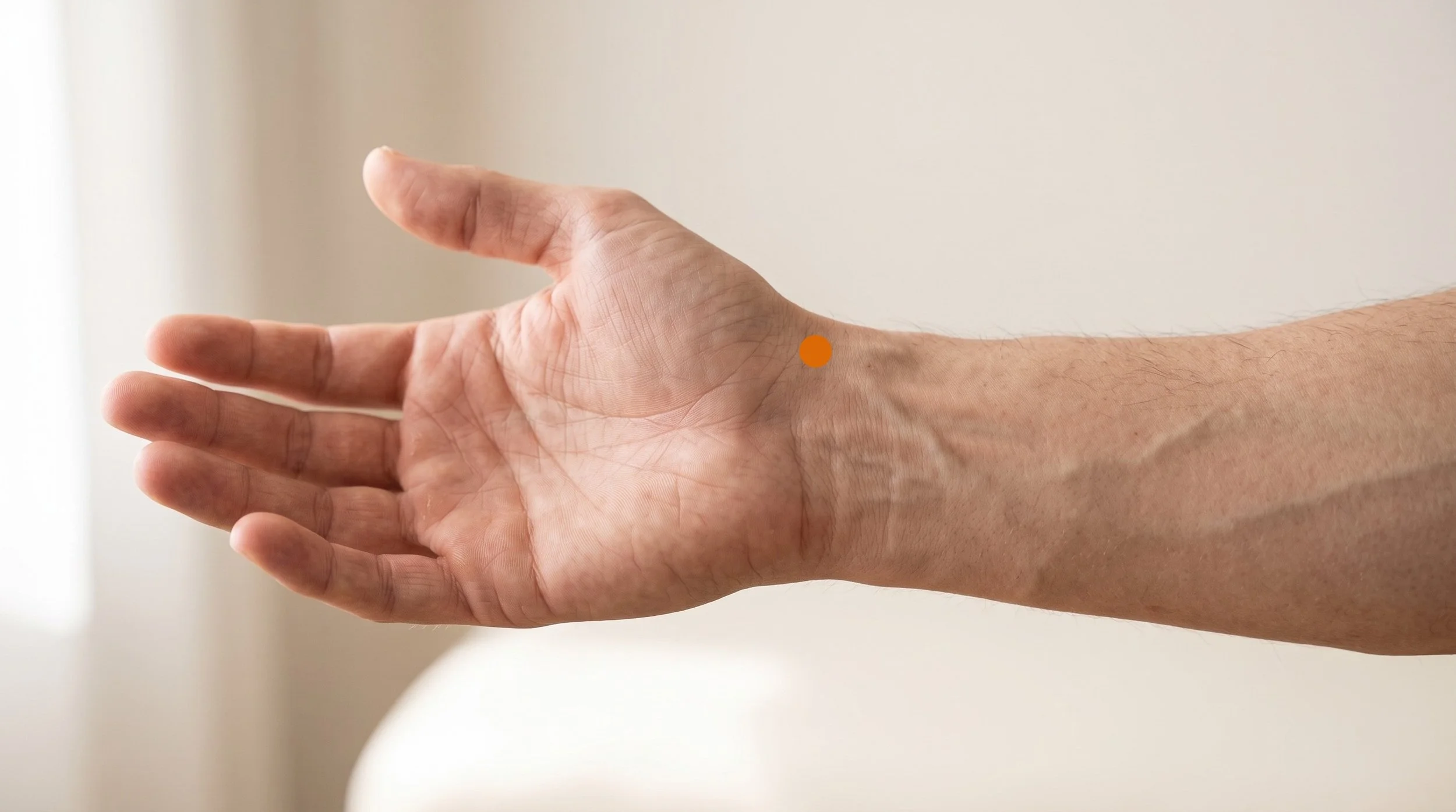
LU10 Acupuncture Point (Yuji)
LU10 Acupuncture Point
The Fish Border on the Palm of the Thumb: Anatomy, Mechanism, and Why This Thenar Point Bridges Throat Complaints and Thumb Pain
LU10 (Yuji, often translated as Fish Border) is the ying-spring and fire point of the Lung channel, and it sits in the fleshy pad at the base of the thumb, on the palmar side, at the midpoint of the first metacarpal shaft where the pale palm skin meets the darker skin of the back of the hand. The name is descriptive rather than mystical: the thenar eminence has the rounded shape of a fish belly, and the point sits along its border. Clinically, the lu10 acupuncture point occupies an unusual double role.
Classical texts placed it among the primary distal points for throat pain, dryness, and voice loss, while its physical location puts a needle directly into the thenar muscle group that phone use, keyboard work, gripping, and instrument playing overload every day. That combination makes lung 10 one of the more practical points on the hand for a modern clinic.
- LU10 lies on the palmar aspect of the thenar eminence, level with the midpoint of the first metacarpal, and needling passes through thick palmar skin into abductor pollicis brevis and opponens pollicis close to the bone (Deadman & Al-Khafaji, 2007).
- Traditional sources classify it as the ying-spring and fire point of the Lung channel and attribute to it actions of benefiting the throat, clearing Lung heat, and descending rebellious qi; in modern terms those categories describe a distal point used for upper airway irritation, cough, and irritable, heat-type presentations (Deadman & Al-Khafaji, 2007).
- The thenar muscles are supplied by the recurrent branch of the median nerve with cutaneous input from the superficial radial territory, roughly C6 to C8, so needling here recruits dense somatic afferent traffic from a highly represented region of the sensory cortex, the kind of input associated with descending pain modulation and endogenous opioid release (Zhao, 2008).
- The research picture is mixed and honest reporting matters: a meta-analysis of acupuncture for acute pharyngeal infection reported favorable symptom outcomes but with clear methodological limits (Zhang et al., 2023), while a sham-controlled trial in basal thumb arthritis found real and sham needling improved similarly (Barnard et al., 2020).
- In practice LU10 is rarely used alone. It functions as a distal adjunct for throat and voice complaints and as a local point for thumb, pinch, and grip pain, usually alongside forearm and hand release work (Vickers et al., 2018).
- De qi at LU10 is distinctly strong. Most people feel a deep, spreading ache or fullness through the thenar pad that can travel toward the thumb, since palmar tissue is richly innervated and far more sensitive than points on the forearm.
Sore Throat, Hoarseness, or a Voice That Keeps Giving Out?
Recurrent throat irritation and voice fatigue often involve more than the throat itself: jaw tension, neck muscles, breathing patterns, and stress load all contribute. At Morningside Acupuncture we use LU10 as a distal point within a broader treatment that may include neck, jaw, and upper chest work, and we always coordinate with your physician when infection or a structural cause is possible. Treatment is gentle, evidence informed, and tailored to what your exam actually shows. Schedule a visit and let's build a plan around your presentation.
Schedule NowAnatomy of LU10: Why the Thenar Eminence Is Such an Important Location
From the surface down, LU10 passes through thick, glabrous palmar skin and a dense subcutaneous fat pad before reaching the thenar muscle mass, mainly abductor pollicis brevis with opponens pollicis lying deeper against the first metacarpal. This group does the work of opposition and pinch: holding a phone, pressing a screen, pinching a pen, twisting a lid, gripping a barbell, fretting a guitar.
Because these muscles work in short, repetitive bursts hundreds of times a day, they are a classic site for taut bands and tender points, and they commonly become sore in people who spend hours on devices (Simons et al., 1999). The lu 10 location sits right in that overloaded tissue, which is one reason a point described in classical texts for throat symptoms turns out to be useful for very modern hand complaints.
Sensory innervation of the area comes from the superficial branch of the radial nerve and palmar cutaneous fibers, with motor supply to the thenar group from the recurrent branch of the median nerve, drawing on roughly the C6 to C8 segments. Needling here generates a robust afferent barrage from muscle and skin that converges in the dorsal horn with input from the same segmental levels, which is the standard explanation for why stimulating a hand point can influence sensitivity elsewhere in that segmental territory.
Beyond the segment, needle stimulation is thought to engage descending inhibitory pathways from the periaqueductal gray and rostral ventromedial medulla, along with endogenous opioid and monoamine mechanisms (Zhao, 2008). Imaging work stimulating this specific point has also reported changes in resting state brain activity and connectivity, which supports the idea that effects are not purely local (Wang et al., 2023).
The deep concern at LU10 is vascular and neural rather than visceral. The princeps pollicis artery and branches of the superficial palmar arch run in this region, and the recurrent motor branch of the median nerve supplies the thenar muscles, so needling is kept close to the border of the first metacarpal rather than driven blindly into the belly of the pad. Standard practice is perpendicular insertion of about 0.5 to 1 cun, with many practitioners staying shallower on sensitive hands.
Palmar skin is thick and sensitive, so a fine needle, a quick insertion, and moderate stimulation are usually more comfortable than aggressive technique. Bruising is the most common minor side effect here, and pressure after needle removal reduces it.
Related Opponens Pollicis Trigger Points Related Adductor Pollicis Trigger PointsLU10 at a Glance: Classification, Location, and Clinical Use
| Category | Detail |
|---|---|
| Traditional Name | Yuji (Fish Border), LU10, also written Lung 10 or LU-10 |
| Channel Classification | Lung channel of the hand taiyin; also described as lying along the course of the Lung connecting (luo) trajectory |
| Point Categories | Ying-spring point of the Lung channel; Fire point of the Lung channel. No meeting, hui-meeting, or extraordinary vessel intersection designations are recorded for this point in the classical sources consulted. |
| Precise Location | On the palmar side of the hand, on the thenar eminence, in the depression between the midpoint of the first metacarpal shaft and the thenar muscles, at the border of the red and white skin. Locate and needle close to the bone. |
| Tissue Stimulated | Palmar skin and fat pad, abductor pollicis brevis, and deeper opponens pollicis fibers along the first metacarpal, with functional overlap into adductor pollicis during pinch tasks |
| Needle Depth / Direction | Perpendicular insertion 0.5 to 1 cun, angled toward the border of the first metacarpal; many clinicians use 0.5 to 0.8 cun on sensitive hands |
| De Qi Sensation | A strong, deep ache or fullness through the thenar pad, often spreading toward the thumb; palmar tissue is sensitive, so sensation builds quickly |
| Primary Clinical Uses | Sore throat, dry throat, and voice loss in classical usage; cough and Lung heat presentations; thumb, thenar, and pinch or grip overuse pain in modern practice |
| Common Point Combinations |
|
In the classical literature summarized by Deadman and Al-Khafaji, LU10 is presented as the ying-spring and fire point of the Lung channel, and the Classic of Difficulties associated ying-spring points with heat in the body, which is the traditional rationale for using it in hot, dry, irritated presentations rather than cold or damp ones.
Because the internal Lung pathway was described as rising to the throat, distal Lung points were traditionally credited with treating the upper end of the channel, and LU10 appears repeatedly in classical throat indications: painful obstruction of the throat, dryness, swelling, and loss of voice, whether attributed to excess heat or to heat arising from deficiency.
The same sources distinguish it from points such as LU1 and LU5, which were traditionally preferred when phlegm rather than heat predominated, and they note a curious diagnostic detail: the presence or absence of sweating with cough was read as an index of how deeply heat had consumed the fluids. The traditional attributions extend further still, to bleeding presentations in all three jiao, to harmonizing relationships between Lung and Heart and between Lung and Stomach, and to agitation, fear, and mania when heat was thought to disturb the Heart.
Finally, and most concretely for a modern reader, the classical lists include heat and pain of the palm and thumb. What makes the pattern striking is that a single point on the fleshy base of the thumb was expected to serve throat, chest, digestive, emotional, and local hand complaints at once, a range that says as much about the organizing logic of channel theory as it does about the point itself.
Why LU10 Is Used for Sore Throat, Hoarseness, and Thumb Pain at the Same Time
The thumb-to-throat connection makes more sense through the lens of the nervous system than through anatomy alone. Sensory input from the hand enters the cervical spinal cord at roughly C6 to C8, and from there it feeds brainstem and cortical networks that also process input from the neck, jaw, and upper airway region. Strong stimulation from a densely innervated area such as the thenar eminence produces a large afferent signal, and that signal has been shown to engage descending inhibitory systems that dampen pain processing more broadly rather than only at the site needled (Zhao, 2008). This is why distal points on the hands and feet have remained standard in acupuncture protocols for complaints located far from the needle.
There is also point-specific work. A resting state fMRI study stimulating this exact point reported measurable changes in brain activity and functional connectivity, which is consistent with the idea that hand points recruit central rather than purely local mechanisms (Wang et al., 2023). That does not prove clinical benefit for any particular throat condition, and it should not be read that way, but it does support treating LU10 as a neurologically active site rather than a symbolic one.
For the thumb itself, the reasoning is straightforward. The needle enters muscle that is genuinely overworked in anyone who spends hours texting, typing, or gripping, and needling taut, tender muscle tissue is associated with reduced local sensitivity and improved comfort with pinch and grip tasks (Simons et al., 1999). Individual patient data from large acupuncture trials suggests modest but persistent benefits for chronic musculoskeletal pain overall, which is a reasonable expectation to set: helpful as part of a plan, not a standalone answer (Vickers et al., 2018).
What the Research Shows for LU10
Very little research isolates a single acupuncture point, and LU10 is no exception. Nearly all clinical trials test multi-point protocols in which this point may or may not be included, so the honest framing is that evidence supports acupuncture as a treatment approach for certain pain and throat complaints, while the specific contribution of LU10 within those protocols remains unquantified. The studies below are the most relevant to how this point is actually used, and they are presented with their limitations intact.
| Study | Type | Focus | Key Finding |
|---|---|---|---|
| Zhang et al., 2023 | Systematic review and meta-analysis | Acupuncture for acute pharyngeal infection, including sore throat severity and duration | Pooled results favored acupuncture on symptom measures with a low adverse event rate, though the authors urged caution given trial quality and heterogeneity. |
| Barnard et al., 2020 | Randomized sham-controlled trial | Real versus sham acupuncture for basal thumb joint arthritis | Both groups improved meaningfully in pain, with no significant difference between real and sham needling, suggesting nonspecific mechanisms contributed substantially. |
| Manyanga et al., 2014 | Systematic review and meta-analysis | Acupuncture for osteoarthritis pain, function, and quality of life | Acupuncture was associated with small but statistically significant reductions in pain intensity and improvements in function, smaller than earlier reviews had suggested. |
| Vickers et al., 2018 | Individual patient data meta-analysis | Acupuncture for chronic musculoskeletal, headache, and osteoarthritis pain | Acupuncture outperformed both sham and no-acupuncture controls, with effects persisting over roughly a year and only modest decay. |
| Wang et al., 2023 | Resting state fMRI study | Central effects of needling LU10 (Yuji) in participants with anxiety | Needling this point was associated with altered regional brain activity and functional connectivity, indicating central nervous system involvement rather than a purely local response. |
| Zhao, 2008 | Narrative review of mechanisms | Neural pathways underlying acupuncture analgesia | Analgesic effects are attributed to afferent stimulation engaging spinal, brainstem, and endogenous opioid mechanisms rather than to any single local action. |
Thumb Pain From Texting, Typing, or Gripping?
Thenar pain, weak pinch, and an aching thumb base are some of the most common hand complaints we see in New York City, and they rarely resolve with rest alone. LU10 sits directly in the thenar muscle group, which lets us combine classical point selection with precise dry needling of overworked opponens and adductor pollicis fibers. We pair that with load management, grip mechanics, and simple home strategies so the relief holds between sessions. Book an appointment to have your hand assessed properly.
Schedule NowLU10 in the Context of Trigger Point Work
Because acupuncture is defined by the use of an acupuncture needle, and dry needling is one of many needling styles, there is no conflict between using LU10 as a classical channel point and using the same needle to address taut bands in the thenar muscles.
At Morningside we frequently do both in one session. Thenar trigger points can refer pain into the thumb, the base of the thumb, and occasionally toward the wrist, patterns that overlap closely with what patients describe as texting thumb or grip strain (Simons et al., 1999). Needling at the LU10 location often reproduces a familiar ache, which is a useful confirmation that the tissue under the needle is part of the problem.
Treating the thenar group in isolation usually is not enough. Thumb pain is typically a chain problem, so we commonly add the forearm flexors and extensors, adductor pollicis in the first web space, and the thumb extensors, then check the neck and shoulder girdle when symptoms are stubborn or bilateral. Point selection follows the same logic: LU10 for the local tissue, LI4 or forearm points for the thumb-side chain, and neck points when cervical contribution is suspected. We finish with load and ergonomic guidance, since needling reduces sensitivity but does not change how many hours a day the thumb is working.
LU10 Sore Throat and Thumb Pain Treatment at NYC's Highest-Rated Acupuncture Clinic
Morningside Acupuncture is the highest-rated acupuncture and dry needling clinic in New York City with over 500 five-star Google reviews, and our approach blends classical point theory with modern pain science. We use LU10 within targeted treatment plans for throat and voice complaints, thumb and grip overuse, and hand pain that follows heavy device use. Every session begins with a hands-on assessment so needling addresses the tissues actually driving your symptoms. Schedule your appointment today.
Schedule NowFrequently Asked Questions
What does LU10 feel like when needled?
Expect a strong sensation. The thenar pad has thick palmar skin and dense innervation, so the initial insertion is noticeable and the de qi that follows is typically a deep, spreading ache or fullness that may travel toward the thumb or across the pad. Many people find it one of the more intense points on the hand, which is why we use fine needles, quick insertion, and moderate stimulation. The ache usually eases within a minute or two of the needle settling, and mild tenderness for a day afterward is normal.
Why use a point on the thumb for a throat problem?
Traditionally, the Lung channel was described as running internally to the throat, so distal Lung points were credited with treating the upper end of that pathway, and LU10 appears throughout classical throat indications (Deadman & Al-Khafaji, 2007). In neurophysiological terms, needling a densely innervated hand region produces a strong afferent signal that engages descending inhibitory systems and central networks rather than acting only where the needle sits (Zhao, 2008). Distal needling is also practical: it lets us treat without needling an inflamed, uncomfortable area directly. Sore throat with fever, difficulty swallowing, or symptoms lasting more than a few days should be evaluated medically first.
Can I press LU10 myself between sessions?
Yes, and it is one of the easier points to self-treat. Spread your thumb away from your palm, then find the fleshy pad at its base and slide your opposite thumb toward the bone at the midpoint of the first metacarpal, where the palm skin meets the back-of-hand skin. Press firmly enough to feel a clear ache but not a sharp pain, hold for 20 to 30 seconds, release, and repeat three to five times per hand. Small circular pressure for one to two minutes works equally well, and you can repeat two or three times a day. Stop if you notice numbness, tingling into the thumb, or increasing pain, and skip the area entirely if the skin is broken or bruised.
Is LU10 safe to needle?
In trained hands, yes. The relevant structures are vascular and neural rather than visceral: branches of the palmar arterial supply and the recurrent motor branch of the median nerve run in this region, which is why needling is kept close to the border of the first metacarpal at a depth of roughly 0.5 to 1 cun rather than driven deep into the muscle pad. Bruising is the most common minor side effect because the hand is well vascularized, and brief pressure after needle removal reduces it. Tell your practitioner if you take blood thinners, have had thumb surgery, or have any diagnosed nerve entrapment in the hand.
Where exactly is LU10 located?
The thenar eminence point sits on the palmar surface of the hand, on the fleshy pad at the base of the thumb, level with the midpoint of the first metacarpal shaft, in the depression between the bone and the thenar muscles, right at the border of the red and white skin. A simple way to find it: turn your palm up, spread the thumb, run a finger along the side of the first metacarpal to its midpoint, and settle into the groove where the paler palm skin transitions to the skin of the thumb's outer edge. That transition line is the border the classical name refers to, since the thenar pad was likened to the belly of a fish.
References
- Deadman, P., Al-Khafaji, M., & Baker, K. (2009). A manual of acupuncture. Journal of Chinese Medicine Publications.
- Kim, H. (2008). Handbook of Oriental medicine (3rd ed.). Harmony & Balance Press.
- Cunningham, P. M. (2000). Acupuncture points: A practical guide to classical and modern usage. Odyssey Press.
- Cecil-Sterman, A. (2012). Advanced acupuncture: A clinic manual. Classical Wellness Press.
- Simons, D. G., Travell, J. G., & Simons, L. S. (1999). Travell & Simons' myofascial pain and dysfunction: The trigger point manual, Vol. 1: Upper half of body (2nd ed.). Williams & Wilkins.
- Zhang, S., Cui, Y., Zhou, X., Wang, D., Yin, J., Meng, X., Cao, Y., Li, Q., & Yin, H. (2023). Efficacy of acupuncture on acute pharynx infections: A systematic review and meta-analysis. Medicine, 102(25), e34124. https://doi.org/10.1097/MD.0000000000034124
- Wang, Y., Li, C., & Qi, X. (2023). The effect of acupuncture at the Yuji point on resting-state brain function in anxiety. Medicine, 102(8), e33094. https://doi.org/10.1097/MD.0000000000033094
- Barnard, A., Jansen, V., Swindells, M. G., Arundell, M., & Burke, F. D. (2020). A randomized controlled trial of real versus sham acupuncture for basal thumb joint arthritis. Journal of Hand Surgery (European Volume), 45(6), 619-623. https://doi.org/10.1177/1753193420911326
- Manyanga, T., Froese, M., Zarychanski, R., Abou-Setta, A., Friesen, C., Tennenhouse, M., & Shay, B. L. (2014). Pain management with acupuncture in osteoarthritis: A systematic review and meta-analysis. BMC Complementary and Alternative Medicine, 14, 312. https://doi.org/10.1186/1472-6882-14-312
- Vickers, A. J., Vertosick, E. A., Lewith, G., MacPherson, H., Foster, N. E., Sherman, K. J., Irnich, D., Witt, C. M., & Linde, K. (2018). Acupuncture for chronic pain: Update of an individual patient data meta-analysis. Journal of Pain, 19(5), 455-474. https://doi.org/10.1016/j.jpain.2017.11.005
- Zhao, Z. Q. (2008). Neural mechanism underlying acupuncture analgesia. Progress in Neurobiology, 85(4), 355-375. https://doi.org/10.1016/j.pneurobio.2008.05.004
Disclaimer: This web site is intended for educational and informational purposes only. Reading this website does not constitute providing medical advice or any professional services. This information should not be used for diagnosing or treating any health issue or disease. Those seeking medical advice should consult with a licensed physician. Seek the advice of a medical doctor or other qualified health professional for any medical condition. If you think you have a medical emergency, call 911 or go to the emergency room. No acupuncturist-patient relationship is created by reading this website or using the information. Morningside Acupuncture PLLC and its employees and contributors do not make any express or implied representations with respect to the information on this site or its use. For any legal interpretation of scope of practice in your state, consult a licensed attorney or regulatory authority.
Read more from our blog