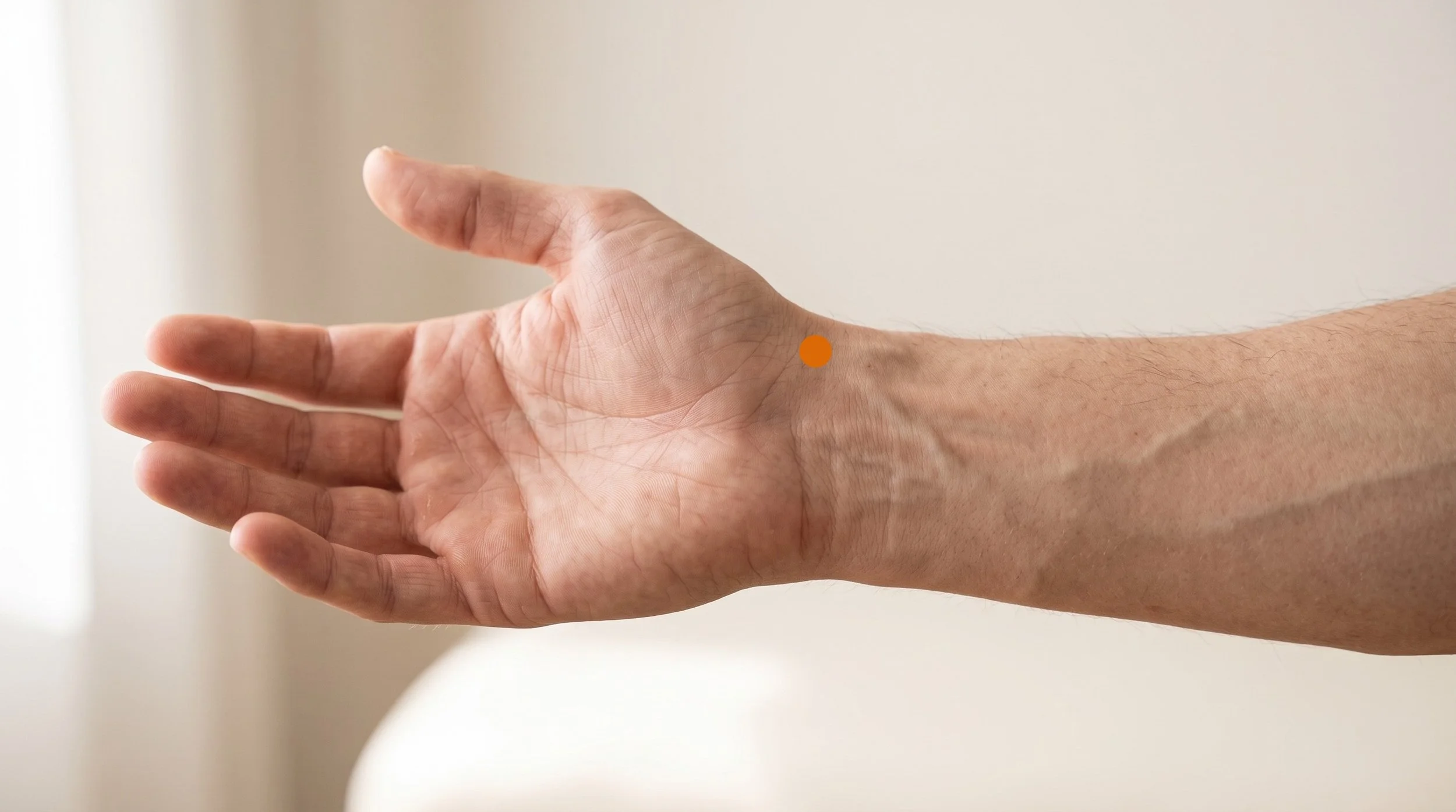
LU9 Acupuncture Point (Taiyuan)
LU9 Acupuncture Point
The Supreme Abyss Beside the Radial Pulse: Anatomy, Mechanism, and Why This Wrist Point Anchors Both Thumb-Side Wrist Pain and Breathing Complaints
LU9 (Taiyuan, often translated as Supreme Abyss or Great Pool) is the ninth and final wrist-level point of the Lung channel, and it sits in a spot almost every patient can find on themselves: the small hollow at the front of the wrist crease, just thumb-side of the radial pulse and immediately next to the tendon of abductor pollicis longus. That location is exactly why the lu9 acupuncture point earns so much clinical attention.
It overlies the radial side of the radiocarpal joint and the first extensor compartment tendons that get loaded by keyboards, phones, tool grips, and infant carrying, while classically it is the single most important tonifying point of the Lung channel, traditionally used for weak chronic cough, breathlessness, and what the classics called disorders of the hundred vessels. In modern practice, lung 9 is a small-target, high-precision point: useful, but needled with respect for the artery a few millimeters away.
- LU 9 location in plain terms: at the anterior wrist crease, radial to the radial artery, in the depression between that artery and the abductor pollicis longus tendon. Because wrist creases vary, the Manual of Acupuncture suggests cross-checking the level against HT7 at the lower border of the pisiform bone, which gives a far more reproducible landmark than skin folds alone.
- Traditionally, Taiyuan is designated the shu-stream, yuan-source, and earth point of the Lung channel and the hui-meeting point of the vessels, which in classical texts made it the primary choice for Lung deficiency patterns and for harmonizing the relationship between breath, circulation, and the pulse. These are traditional attributions, not physiological claims.
- Neurophysiologically, needling here recruits cutaneous afferents from the superficial radial and lateral antebrachial cutaneous nerves plus deeper joint and tendon-sheath afferents that share C6 and C7 segmental territory with the thumb, radial wrist, and forearm, so input converges on the same dorsal horn neurons that process wrist and thumb pain (Zhao, 2008).
- Needling also drives local vascular change: photoplethysmography studies show needle stimulation increases skin and muscle blood flow around the needled region, with stronger responses when a de qi sensation is elicited (Sandberg et al., 2003). That is the plausible reading of the classical circulation language, not literal energy flow.
- The research picture is mixed but not empty. A Cochrane review of acupuncture for carpal tunnel symptoms found trials too heterogeneous and too biased to pool confidently, though no serious adverse events were reported (Choi et al., 2018), while imaging trials at the wrist show real acupuncture improved median nerve conduction latency and primary somatosensory cortex organization more than sham (Maeda et al., 2017). Broader chronic pain data support modest, durable effects from multi-point protocols (Vickers et al., 2018).
- De qi at LU9 is usually a dull, spreading ache or heaviness that fans toward the thumb base and up the radial forearm. Sharp, electric, or pulsating sensations mean the needle should be adjusted or withdrawn, since the radial artery lies immediately ulnar to the point.
Thumb-Side Wrist Pain That Flares With Typing, Lifting, or Gripping?
Radial wrist pain rarely comes from one structure. At Morningside Acupuncture we assess the radiocarpal joint, the first extensor compartment tendons, and the thumb and forearm muscles that load them, then use LU9 as a precise local point alongside dry needling of the relevant muscles. Treatment is paired with grip, wrist, and workstation strategy so the change holds between sessions. Schedule an evaluation and let's map where your wrist pain is actually coming from.
Schedule NowAnatomy of LU9: Why the Radial Pulse Hollow Is Such an Important Location
Starting at the surface, LU9 sits under thin, mobile skin with very little subcutaneous fat, which is why the point feels tender in almost everyone. Just beneath lies the tendon of abductor pollicis longus, forming the radial wall of the small hollow, with the flexor carpi radialis tendon on the ulnar side of the artery and the radial styloid and scaphoid deeper still.
This is a high-traffic mechanical zone: repetitive thumb abduction and extension from mouse work, phone scrolling, hairdressing, racquet sports, and carrying loads with the thumb hooked all load the first compartment tendons and the radial side of the radiocarpal joint that this point overlies. Patients often arrive describing pain that lives right where their watch strap sits.
The nerve geography explains why a small wrist point can influence a broad area. Superficial input here comes from the superficial branch of the radial nerve and the lateral antebrachial cutaneous nerve, with contributions from the palmar cutaneous territory nearby, and deeper input arrives from joint capsule and tendon-sheath afferents. All of that traffic enters the cervical cord around C6 and C7, the same segments that serve the thumb, radial wrist, and radial forearm.
When these afferents are stimulated, dorsal horn neurons receiving convergent input can be modulated, and spinal and supraspinal pathways involving endogenous opioid and monoaminergic signaling are engaged (Zhao, 2008). Local needling also triggers axon-reflex vasodilation and measurable increases in skin and muscle blood flow, which may improve the mechanical and metabolic environment of loaded tendon and joint tissue (Sandberg et al., 2003).
The deep structure that defines needling technique at LU9 is the radial artery, which lies immediately ulnar to the point along with its accompanying venae comitantes. Standard practice is perpendicular insertion of roughly 0.3 to 0.5 cun, staying radial to the palpable pulse, with some texts advising an even shallower 0.2 to 0.3 cun. Practically, that means the clinician palpates the pulse first, fixes the needle path lateral to it, and uses gentle technique rather than vigorous lifting and thrusting.
If the pulse is felt through the needle or the patient reports a sharp throbbing sensation, the needle is withdrawn and repositioned. Minor bruising is the most common nuisance, and firm pressure after removal usually prevents it.
Related Extensor Pollicis Longus Brevis Trigger Points Related Flexor Pollicis Longus Trigger PointsLU9 at a Glance: Classification, Location, and Clinical Use
| Category | Detail |
|---|---|
| Traditional Name | Taiyuan (Supreme Abyss, also translated Great Pool or Greater Abyss) |
| Channel Classification | Ninth point of the Lung channel of Hand Taiyin |
| Point Categories | Shu-stream point, yuan-source point, and earth (tonification) point of the Lung channel; hui-meeting point of the vessels |
| Precise Location | At the anterior wrist crease, in the depression between the radial artery and the tendon of abductor pollicis longus, radial to the artery, level with HT7 at the proximal border of the pisiform bone |
| Tissue Stimulated | Thin radial wrist skin, abductor pollicis longus tendon and first compartment sheath, radiocarpal joint capsule, and by extension the thumb and forearm muscles addressed with Extensor Pollicis Longus Brevis Trigger Points and Flexor Pollicis Longus Trigger Points work |
| Needle Depth / Direction | Perpendicular insertion 0.3 to 0.5 cun (some texts 0.2 to 0.3 cun), directed radial to the palpated radial artery |
| De Qi Sensation | Dull ache, fullness, or heaviness spreading toward the thumb base and radial forearm; sharp or pulsating sensation calls for immediate repositioning |
| Primary Clinical Uses | Radial and thumb-side wrist pain, wrist weakness, thumb tendon irritation, carpal tunnel presentations as part of a wrist protocol, and traditional use for chronic weak cough, breathlessness, and dry throat |
| Common Point Combinations |
|
Deadman, Al-Khafaji, and Baker's A Manual of Acupuncture presents Taiyuan as the Lung channel's shu-stream, yuan-source, and earth point, and traditionally the first choice when Lung qi or Lung yin was judged deficient, drawing on the Spiritual Pivot's advice to use shu-stream and yuan-source points for disorders of the zang and the Classic of Difficulties' principle of reinforcing the mother in cases of deficiency.
In that framework the traditional indications cluster into four groups: weak chronic respiratory complaints (cough with thin or scanty phlegm, wheezing, breathlessness, frequent yawning, dry throat, chest oppression with inability to lie flat), bleeding and vessel disorders (coughing or vomiting blood, heart pain with a choppy pulse, pulseless syndrome, agitation and severe restlessness), upward-rebelling and heat symptoms borrowed from its middle-jiao origin (belching, toothache, red painful eyes, facial swelling, breast pain), and channel pain along the arm (wrist weakness or pain, inner arm pain, shoulder, back, and supraclavicular pain).
The classical texts also call it the hui-meeting point of the vessels, quoting the Classic of Difficulties that the vessels gather here. What makes the pattern striking is the location: of all the places early physicians could have chosen to name the meeting of the hundred vessels, they picked the exact spot where the pulse has been read for two thousand years.
Why LU9 Is Used for Cough and Breathlessness, Not Just Wrist Pain
The wrist logic is straightforward. Afferents from the skin, tendon sheath, and joint capsule at LU9 enter the cord in the C6 and C7 range, the same segments that carry sensation from the thumb and radial wrist. When a nociceptive input from an irritated tendon or joint has sensitized those dorsal horn neurons, adding a controlled, non-threatening afferent barrage from the same segment can change how that pool of neurons behaves, and the effect is amplified by descending pathways from the brainstem that use opioid, serotonergic, and noradrenergic signaling to dampen ascending pain traffic (Zhao, 2008).
This is the mechanism behind most local needling at the wrist, and it is why patients often notice a change in tenderness within the same visit even when the tendon itself needs weeks to remodel.
The wrist is also one of the few regions where acupuncture's central effects have been imaged directly. In a randomized trial of carpal tunnel syndrome, real needling at the wrist and at distal points both improved median nerve conduction latency and the separation of digit representations in the primary somatosensory cortex more than sham, and the degree of cortical change predicted symptom relief three months later (Maeda et al., 2017).
Earlier work from the same group had already found that acupuncture was associated with reorganization of somatosensory maps that had become blurred in carpal tunnel syndrome (Napadow et al., 2007). Those trials used wrist protocols rather than LU9 alone, but they make the case that needling in this small territory reaches beyond skin and tendon.
For breathing complaints, the honest framing is different. There is no LU9-specific respiratory trial. What exists is evidence that acupuncture protocols including Lung channel and upper back points may modestly improve symptoms in chronic cough and stable COPD, with the certainty of that evidence rated low (Lee et al., 2025; Li et al., 2025). Segmental reasoning does offer a plausible route: cervical and upper thoracic somatic input can influence autonomic outflow and vagally mediated airway reflexes, and needling can shift sympathetic tone and local vascular responses (Sandberg et al., 2003).
We use Taiyuan for respiratory support because the tradition points there and because patients often report easier, less guarded breathing, not because a single point controls the lungs.
What the Research Shows for LU9
One caveat frames everything below. Clinical trials almost never test a single point, so the studies here evaluate protocols that include LU9 or nearby wrist and Lung channel points among several needles. That means the evidence tells us whether the treatment approach may help, not how much any one point contributes. Wrist research is unusually informative because carpal tunnel syndrome gives objective outcomes like nerve conduction latency, while respiratory evidence remains low certainty and should be read as supportive rather than conclusive.
| Study | Type | Focus | Key Finding |
|---|---|---|---|
| Choi et al., 2018 | Cochrane systematic review | Acupuncture and related interventions for carpal tunnel syndrome symptoms (12 trials, 869 participants) | Effectiveness remained uncertain because most trials could not be pooled and carried unclear or high risk of bias, though reported adverse events were minor and non-serious. |
| Maeda et al., 2017 | Randomized controlled trial with neuroimaging | Local wrist versus distal versus sham acupuncture in carpal tunnel syndrome | Real acupuncture improved median nerve conduction latency and somatosensory cortex digit separation more than sham, and imaging change predicted longer-term symptom relief. |
| Napadow et al., 2007 | Longitudinal fMRI study | Somatosensory cortical organization before and after acupuncture in carpal tunnel syndrome | Acupuncture was associated with normalization of blurred digit representations, suggesting that wrist needling may act partly through cortical plasticity. |
| Vickers et al., 2018 | Individual patient data meta-analysis | Acupuncture across chronic musculoskeletal pain conditions | Acupuncture outperformed sham and no-acupuncture controls with modest effect sizes that persisted over roughly a year, supporting its use within multimodal care. |
| Sandberg et al., 2003 | Controlled physiological study | Skin and muscle blood flow responses to needle stimulation measured by photoplethysmography | Needling increased local skin and muscle blood flow, with the largest responses when de qi was elicited, offering a mechanism for local circulatory effects. |
| Lee et al., 2025 | Systematic review and meta-analysis | Acupuncture-related therapy for chronic cough | Pooled results suggested possible symptom benefit, but the authors noted methodological limitations that keep confidence in the estimates low. |
| Li et al., 2025 | Systematic review and meta-analysis | Acupuncture-based treatment in stable chronic obstructive pulmonary disease | Meta-analysis of stable-phase trials indicated possible improvements in function-related outcomes, though heterogeneity and reporting quality limited the conclusions. |
Lingering Cough or Shortness of Breath After an Illness?
Taiyuan is traditionally the Lung channel's main tonifying point, used for weak, dragging coughs and breathlessness that outlast an infection. We combine it with chest, upper back, and forearm points, plus needling of respiratory accessory muscles when breathing mechanics have become guarded. Acupuncture supports symptoms alongside your medical care and never replaces it. Book a visit to discuss whether this approach fits your history.
Schedule NowLU9 in the Context of Trigger Point Work
Acupuncture, defined by the use of an acupuncture needle, covers hundreds of styles, and dry needling is one of them. At Morningside we rarely treat LU9 in isolation for radial wrist pain. The point becomes the local anchor while we needle the muscles that actually generate load and referred pain in that territory: abductor pollicis longus and extensor pollicis brevis in the first compartment, extensor pollicis longus, flexor pollicis longus, brachioradialis in the proximal forearm, and the thenar group including adductor pollicis.
Travell and Simons documented that trigger points in thumb and forearm muscles refer pain into the radial wrist and thumb base, which is often exactly the area a patient circles when asked to point to the problem.
There is meaningful overlap between the point and the myofascial target. Because LU9 sits directly against the abductor pollicis longus tendon, needling there can address both the classical point and the tendon interface, though the tendon proper is treated by needling toward the muscle belly higher in the forearm rather than in the wrist hollow itself. Sequencing usually runs from proximal muscle to distal point: release the forearm drivers, then treat the wrist locally, then load the tissue with graded grip and thumb exercise.
Where the presentation includes median nerve symptoms, we add wrist and forearm points along with PC6 territory and coordinate with the patient's physician, since the imaging work in carpal tunnel syndrome suggests wrist needling may influence nerve function as well as pain (Maeda et al., 2017).
LU9 Wrist and Respiratory Support Treatment at NYC's Highest-Rated Acupuncture Clinic
Morningside Acupuncture is the highest-rated acupuncture and dry needling clinic in New York City with over 500 five-star Google reviews, and our approach blends classical point selection with orthopedic and pain-science reasoning. LU9 is one of the points we use most carefully, always with clean-needle technique, arterial awareness, and clear consent about sensation. Every session includes hands-on assessment, needling, and a plan you can actually follow. Schedule your appointment at our Upper West Side clinic today.
Schedule NowFrequently Asked Questions
What does LU9 feel like when needled?
Most patients feel a brief pinch at the skin, then a dull, spreading ache or fullness that may travel toward the thumb base or up the radial forearm. Because the skin here is thin and tightly bound, LU9 tends to be more sensitive than points on fleshier areas, so competent practitioners use fine needles and gentle stimulation. What you should not feel is a sharp, electric, or throbbing pulsating sensation. Those signal proximity to the artery or a cutaneous nerve branch and mean the needle should be adjusted right away, so speak up immediately.
Why would a wrist point be used for cough or breathlessness?
Traditionally, LU9 is designated the shu-stream, yuan-source, and earth point of the Lung channel, which made it the classical first choice for weak, chronic respiratory patterns rather than acute infections. Physiologically, distal points do not act on the lungs directly. What they can do is deliver strong, well-tolerated somatic input that influences autonomic outflow and engages descending inhibitory pathways, which may reduce guarding and discomfort around breathing (Zhao, 2008). Reviews of acupuncture for chronic cough and stable COPD suggest possible modest benefit within multi-point protocols, though the evidence is low certainty (Lee et al., 2025; Li et al., 2025). It is supportive care, not a substitute for pulmonary treatment.
Can I press LU9 myself between sessions?
Yes, with one specific precaution. Rest your forearm palm-up, find your radial pulse at the wrist crease, then move your fingertip slightly toward the thumb side until you are off the pulse and in the small hollow next to the thumb tendon. Press there, not on the pulse itself. Use firm, steady pressure or small circles for 30 to 60 seconds per side, breathing slowly, and repeat two or three times a day. Aim for pressure that registers as a dull ache around a 4 or 5 out of 10, never sharp. Stop if you feel tingling into the hand, if the pulse becomes uncomfortable, or if pressure increases your symptoms. People taking anticoagulants should keep pressure light to avoid bruising.
Is LU9 safe to needle?
In trained hands, yes, with the radial artery as the defining caution. Standard technique is perpendicular insertion of roughly 0.3 to 0.5 cun placed radial to the palpated pulse, which is why the pulse is always located before the needle goes in. The realistic risks are minor: local pain, small bruises, or brief tenderness, and Cochrane's review of wrist-area acupuncture for carpal tunnel symptoms reported only non-serious adverse events such as local pain and bruising (Choi et al., 2018). Tell your practitioner if you take blood thinners, have a bleeding disorder, or have had wrist surgery or a recent fracture in the area, since technique and pressure after needle removal are adjusted accordingly.
Where exactly is LU9 located?
Turn your palm up and find the crease at the front of the wrist. LU9 is at that crease, radial to the radial artery, in the depression between the artery and the tendon of abductor pollicis longus, which is the cord you can feel toward the thumb side. A more reliable cross-check, since wrist creases vary from person to person, is to locate HT7 at the lower border of the pisiform bone on the little-finger side of the wrist, then find LU9 at the same level on the thumb side. Practically, it is the hollow just past your pulse as you move toward the thumb, roughly where a watch strap crosses the wrist.
References
- Deadman, P., Al-Khafaji, M., & Baker, K. (2009). A manual of acupuncture. Journal of Chinese Medicine Publications.
- Kim, H. (2008). Handbook of Oriental medicine (3rd ed.). Harmony & Balance Press.
- Maciocia, G. (2006). The channels of acupuncture: Clinical use of the secondary channels and eight extraordinary vessels. Churchill Livingstone Elsevier.
- Cunningham, P. M. (2000). Acupuncture points: A practical guide to classical and modern usage. Odyssey Press.
- Cecil-Sterman, A. (2012). Advanced acupuncture: A clinic manual. Classical Wellness Press.
- Simons, D. G., Travell, J. G., & Simons, L. S. (1999). Travell & Simons' myofascial pain and dysfunction: The trigger point manual, Vol. 1: Upper half of body (2nd ed.). Williams & Wilkins.
- Choi, G. H., Wieland, L. S., Lee, H., Sim, H., Lee, M. S., & Shin, B. C. (2018). Acupuncture and related interventions for the treatment of symptoms associated with carpal tunnel syndrome. Cochrane Database of Systematic Reviews, 2018(12), CD011215. https://doi.org/10.1002/14651858.CD011215.pub2
- Maeda, Y., Kim, H., Kettner, N., Kim, J., Cina, S., Malatesta, C., Gerber, J., McManus, C., Ong-Sutherland, R., Mezzacappa, P., Libby, A., Mawla, I., Morse, L. R., Kaptchuk, T. J., Audette, J., & Napadow, V. (2017). Rewiring the primary somatosensory cortex in carpal tunnel syndrome with acupuncture. Brain, 140(4), 914-927. https://doi.org/10.1093/brain/awx015
- Napadow, V., Liu, J., Li, M., Kettner, N., Ryan, A., Kwong, K. K., Hui, K. K. S., & Audette, J. F. (2007). Somatosensory cortical plasticity in carpal tunnel syndrome treated by acupuncture. Human Brain Mapping, 28(3), 159-171. https://doi.org/10.1002/hbm.20261
- Sandberg, M., Lundeberg, T., Lindberg, L. G., & Gerdle, B. (2003). Effects of acupuncture on skin and muscle blood flow in healthy subjects. European Journal of Applied Physiology, 90(1-2), 114-119. https://doi.org/10.1007/s00421-003-0825-3
- Lee, B., Kwon, C. Y., Jeong, Y. K., Ha, N. Y., Kim, K. I., Lee, B. J., & Lee, J. H. (2025). Acupuncture-related therapy for chronic cough: A systematic review and meta-analysis. Integrative Medicine Research, 14(1), 101121. https://doi.org/10.1016/j.imr.2025.101121
- Li, M., Zheng, S., Lederer, A. K., & Huber, R. (2025). Efficacy of acupuncture-based treatment in chronic obstructive pulmonary disease: A systematic review and meta-analysis. Complementary Therapies in Medicine, 93, 103211. https://doi.org/10.1016/j.ctim.2025.103211
- Vickers, A. J., Vertosick, E. A., Lewith, G., MacPherson, H., Foster, N. E., Sherman, K. J., Irnich, D., Witt, C. M., & Linde, K. (2018). Acupuncture for chronic pain: Update of an individual patient data meta-analysis. Journal of Pain, 19(5), 455-474. https://doi.org/10.1016/j.jpain.2017.11.005
- Zhao, Z. Q. (2008). Neural mechanism underlying acupuncture analgesia. Progress in Neurobiology, 85(4), 355-375. https://doi.org/10.1016/j.pneurobio.2008.05.004
Disclaimer: This web site is intended for educational and informational purposes only. Reading this website does not constitute providing medical advice or any professional services. This information should not be used for diagnosing or treating any health issue or disease. Those seeking medical advice should consult with a licensed physician. Seek the advice of a medical doctor or other qualified health professional for any medical condition. If you think you have a medical emergency, call 911 or go to the emergency room. No acupuncturist-patient relationship is created by reading this website or using the information. Morningside Acupuncture PLLC and its employees and contributors do not make any express or implied representations with respect to the information on this site or its use. For any legal interpretation of scope of practice in your state, consult a licensed attorney or regulatory authority.
Read more from our blog