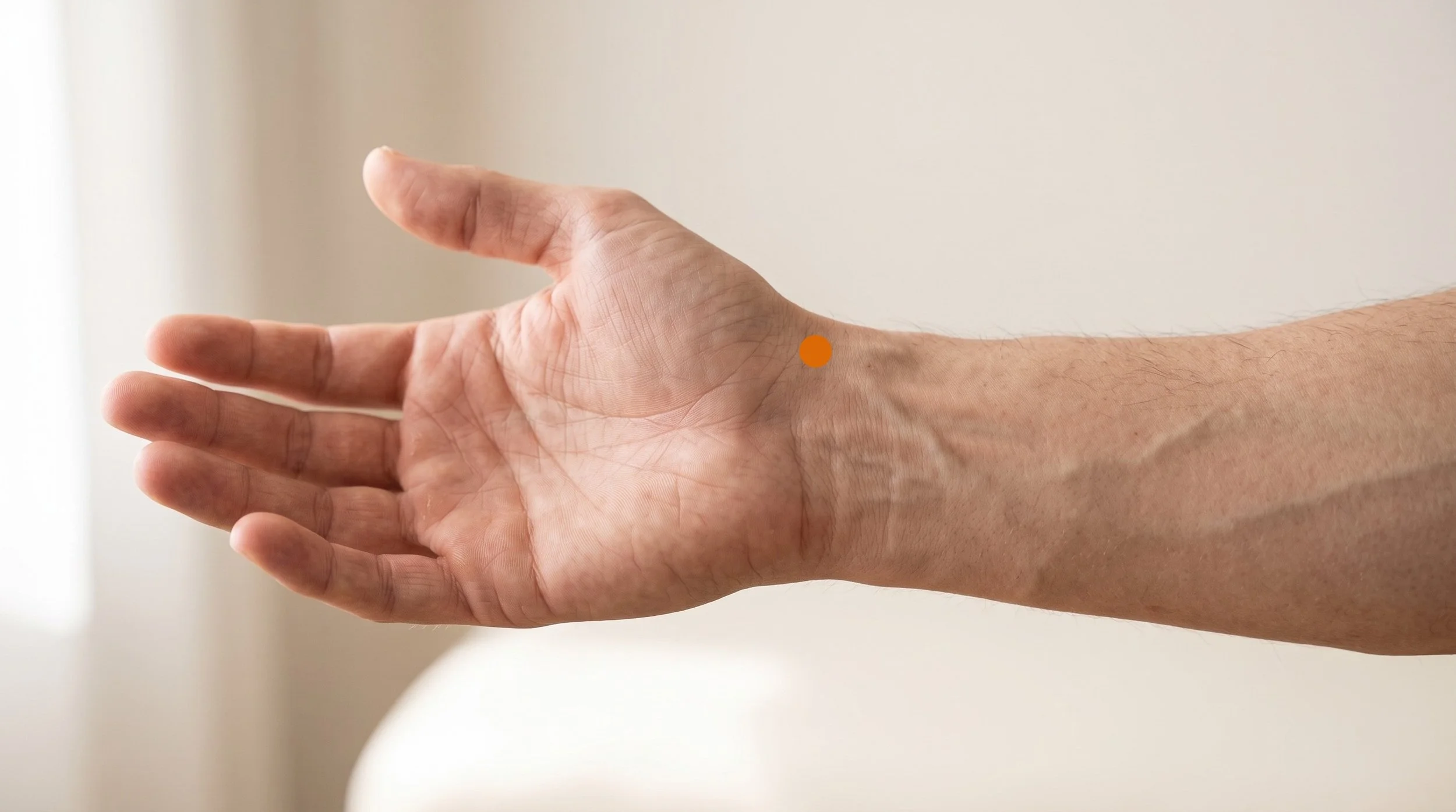
LU5 Acupuncture Point (Chize)
LU5 Acupuncture Point
The Cubit Marsh at the Elbow Crease: Anatomy, Mechanism, and Why the Lung Channel's He-Sea Point Serves Both Breathing and Elbow Pain
LU5 (Chize, often translated as Cubit Marsh) is the he-sea and water point of the Lung channel, and it sits in a spot almost anyone can find: bend the elbow slightly, feel the thick biceps tendon in the middle of the crease, then slide just to the thumb side of it into the soft hollow. That hollow is where the brachialis, the origin of brachioradialis, the lateral antebrachial cutaneous nerve, and the radial nerve's territory all crowd together, which is why one needle here can influence elbow pain, forearm tension, and grip mechanics at the same time.
Classically, LU5 was valued for a completely different reason, as the point that clears heat from the Lung and settles rebellious qi in coughing and wheezing, and modern clinics still use it for chest tightness alongside its musculoskeletal role.
The result is a point with two working identities, and understanding both makes the lu5 acupuncture point far more useful than a simple tennis elbow needle.
- Location and layers: LU5 lies on the cubital crease just lateral to the biceps brachii tendon, over the brachialis and the proximal brachioradialis, in a region loaded by repeated gripping, lifting, and end-range elbow extension (Deadman et al., 2001). Locating with the elbow slightly bent makes the tendon and the adjacent depression easier to identify.
- Traditional categories, read neurophysiologically: LU5 is described in the classical literature as the he-sea and water point of the Lung channel, with traditional actions of clearing Lung heat, descending rebellious qi, regulating the water passages, and relaxing the sinews (Deadman et al., 2001). In modern terms, the sinew-relaxing function maps neatly onto reduced motor tone and improved pressure pain thresholds around the elbow flexors and extensor origin.
- Nerve geography: the lateral antebrachial cutaneous nerve runs superficially at this level and the radial nerve lies deep in the groove between brachialis and brachioradialis, giving LU5 dense C5 to C6 segmental input that converges with the dorsal horn territory serving the lateral elbow (Zhao, 2008).
- Mechanism: needling here recruits group III and IV muscle afferents that engage segmental gating and descending inhibitory pathways involving endogenous opioid and monoaminergic systems, which is the best supported explanation for post-treatment pain relief (Zhao, 2008).
- Research picture: individual patient data pooling supports modest but persistent effects of acupuncture in chronic musculoskeletal pain (Vickers et al., 2018), reviews of acupuncture and of dry needling for lateral epicondylitis report short-term improvements in pain, disability, and grip strength while flagging small, heterogeneous trials (Zhou et al., 2020; Navarro-Santana et al., 2020; Ma et al., 2024). Respiratory evidence is much weaker, with a Cochrane review finding insufficient data to recommend acupuncture in chronic asthma (McCarney et al., 2004).
- De qi and practice framing: patients usually report a deep, heavy, spreading ache that travels toward the forearm rather than a sharp sting, and needling is typically 0.5 to 1 cun perpendicular with care to avoid the cubital vein (Deadman et al., 2001). If a sudden electric sensation shoots into the forearm or thumb, the needle is repositioned.
Elbow Pain That Flares Every Time You Grip Something?
Tennis elbow rarely stays in the elbow, and most of the people we see also have tight brachioradialis, brachialis, and forearm extensors driving the same complaint. At Morningside Acupuncture we use LU5 together with local needling of the extensor origin and the arm flexors, then pair it with loading advice so the tendon can tolerate work again. Treatment is graded, comfortable, and built around what your grip actually needs to do. Schedule a session and let's map out where your elbow pain is really coming from.
Schedule NowAnatomy of LU5: Why the Radial Side of the Biceps Tendon Is Such an Important Location
Start at the crease of the bent elbow and the first structure you meet is thin skin over a superficial venous network, which is exactly why this point is located and needled with the elbow slightly flexed and with attention to the cubital vein (Deadman et al., 2001). Just lateral to the biceps tendon, the needle passes into the lateral edge of brachialis and the upper fibers of brachioradialis.
These two muscles absorb an enormous amount of daily load: brachialis is the workhorse elbow flexor regardless of forearm position, and brachioradialis fires hard during gripping, carrying, and repetitive rotation, which is why office workers, climbers, racket players, and new parents so often present with tenderness right here.
The nerve geography is what makes LU5 interesting. The lateral antebrachial cutaneous nerve, the sensory continuation of the musculocutaneous nerve, emerges alongside the biceps tendon at this level, while the radial nerve trunk lies deeper in the interval between brachialis and brachioradialis before dividing. Both carry segmental input from roughly C5 to C6, the same segments that supply the lateral epicondyle, the extensor mass, and much of the shoulder girdle.
Stimulating them recruits group III and IV afferents that converge with nociceptive input in the dorsal horn and trigger descending inhibitory control through opioid and monoaminergic pathways, which is the mechanism most often invoked to explain why segmental needling reduces pain and pressure sensitivity beyond the needle site itself (Zhao, 2008). Local effects matter too: needling produces an axon reflex vasodilation and a small mechanical disruption of taut, tender tissue, which may reduce local sensitization.
Deeper and slightly medial to the point lie the brachial artery and its bifurcation, and the radial recurrent vessels run close to the brachioradialis interval, so conventional practice is a perpendicular insertion of 0.5 to 1 cun with unhurried angling and standard aspiration-style care (Deadman et al., 2001). Practically, this means the practitioner locates a little lateral to the tendon rather than pressing against it, avoids visible veins, and adjusts immediately if the patient reports a sharp electrical sensation traveling into the forearm or thumb. Done this way, LU5 is a comfortable and well-tolerated point for most people.
Related Lung Channel Related Brachialis Trigger PointsLU5 at a Glance: Classification, Location, and Clinical Use
| Category | Detail |
|---|---|
| Traditional Name | Chize (Cubit Marsh), LU5, also written Lung 5 |
| Channel Classification | Lung channel of Hand Taiyin |
| Point Categories | He-sea point and Water point of the Lung channel, one of the five-shu points; no meeting, crossing, or extraordinary vessel designations are recorded for this point in the classical sources used here |
| Precise Location | On the cubital crease with the elbow slightly flexed, in the depression on the radial (thumb) side of the biceps brachii tendon, located slightly lateral to the tendon rather than tight against it |
| Tissue Stimulated | Skin and subcutaneous tissue with superficial cubital veins, the lateral border of brachialis, the proximal fibers of brachioradialis, and the tendon margin of biceps brachii, with lateral antebrachial cutaneous and radial nerve territory nearby |
| Needle Depth / Direction | Perpendicular insertion 0.5 to 1 cun; some practitioners angle slightly toward the area of focal tenderness in lateral elbow presentations |
| De Qi Sensation | Deep, heavy, spreading ache or fullness at the elbow crease, often traveling into the forearm; a brief electrical flick toward the thumb means the needle should be repositioned |
| Primary Clinical Uses | Cough, wheezing, and chest tightness in traditional practice; elbow pain and restricted elbow motion; lateral elbow and forearm complaints including tennis-elbow-region pain; sore throat and heat patterns in classical listings |
| Common Point Combinations |
|
In the classical literature summarized by Deadman and colleagues, Chize is presented first as the point that clears heat from the Lung, whether that heat is described as excess or deficient, and settles qi that has rebelled upward, so its traditional indication list is dominated by cough, wheezing, breathlessness, chest fullness, dryness of the mouth and throat, tidal fevers, and throat pain (Deadman et al., 2001).
Because the same texts hold that heat in the Lung can disturb the vessels, LU5 also appears repeatedly for bleeding presentations such as coughing or spitting blood and nosebleed, and, through its he-sea association with descending function, for vomiting, diarrhea, and abdominal distention.
A second traditional theme is fluid regulation, with the point indicated for swelling of the limbs, urinary retention, enuresis, and frequent urination. The third theme is entirely musculoskeletal: shoulder, upper arm, elbow, and hand complaints, wandering joint pain, difficulty opening and extending the hand, and even knee swelling and lumbar pain treated through cross-body needling of the corresponding joint.
What is striking is that one small hollow at the elbow was asked to serve breathing, bleeding, fluids, and the whole upper limb, and that the modern anatomy of the site, dense C5 to C6 sensory territory over two heavily loaded muscles, explains at least the limb half of that list without any appeal to energy flow.
Why LU5 Is Used for Cough and Chest Tightness as Well as Tennis Elbow
For the elbow, the reasoning is straightforward. LU5 sits in tissue supplied by the same C5 to C6 spinal segments that serve the lateral epicondyle and the extensor origin, so afferent input from the needle arrives in the dorsal horn where the painful input is already being processed. That convergence lets the nervous system dampen the amplified signal, which is why patients often notice less tenderness to pressure and easier gripping after treatment rather than only a temporary numbing (Zhao, 2008).
Because a needle at LU5 can be angled toward the specific spot of focal tenderness, the point is often more adaptable in lateral elbow cases than a fixed landmark on the other side of the crease (Deadman et al., 2001).
For breathing, the story is less segmental and more systemic. The lungs and airways do not share C5 to C6 innervation, so any effect on cough or chest tightness is likely to come from broader mechanisms: descending inhibition, shifts in autonomic balance and sympathetic outflow, and reduced tone in the accessory breathing muscles of the neck, chest, and arms that make a breath feel restricted (Zhao, 2008). That is a real but limited claim, and the research reflects it.
A Cochrane review of acupuncture in chronic asthma found the trial evidence too sparse and too inconsistent to support recommendations (McCarney et al., 2004), and an animal study that directly compared electroacupuncture at LU5 with ST36 in a perinatal nicotine model found benefit at ST36 but no obvious protective effect at LU5 (Lu et al., 2020).
So the honest position is this: LU5 has strong anatomical logic and reasonable clinical evidence for elbow and forearm pain, and a long traditional record plus supportive but unproven reasoning for respiratory use. We use it confidently for the first and as adjunctive comfort-focused care for the second, always alongside appropriate medical management.
What the Research Shows for LU5
Almost no trial isolates a single point, so the evidence below tests protocols that included LU5 or that address the conditions LU5 is chosen for. Read it as context for a point within a treatment plan, not as proof that one needle produces a specific outcome. Trial quality in this area is mixed, sham comparisons are difficult, and effect sizes vary with the population studied, so cautious interpretation is warranted.
| Study | Type | Focus | Key Finding |
|---|---|---|---|
| Vickers et al., 2018 | Individual patient data meta-analysis | Acupuncture for chronic musculoskeletal, headache, and osteoarthritis pain | Acupuncture was associated with modestly better pain outcomes than sham and no-acupuncture controls, with effects that persisted over time. |
| Zhou et al., 2020 | Systematic review and meta-analysis | Acupuncture for lateral epicondylitis (tennis elbow) | Pooled results favored acupuncture over sham, medication, and injection comparators, though the authors judged the included trials to be of low quality. |
| Navarro-Santana et al., 2020 | Systematic review and meta-analysis | Trigger point dry needling for lateral epicondylalgia | Low to moderate evidence suggested short-term improvements in pain, disability, pressure pain sensitivity, and strength. |
| Ma et al., 2024 | Updated systematic review and meta-analysis | Dry needling for lateral epicondylitis | Dry needling improved elbow disability and grip strength, with pain benefits clearest in the first week and better results when a local twitch response was elicited. |
| McCarney et al., 2004 | Cochrane systematic review | Acupuncture for chronic asthma | The available trials were too few and too variable to support recommendations about acupuncture in asthma care. |
| Lu et al., 2020 | Controlled animal experiment | Electroacupuncture at LU5 compared with ST36 in perinatal nicotine-exposed rats | ST36 stimulation normalized lung and HPA axis changes while LU5 stimulation showed no obvious effect, suggesting point-specific mechanisms rather than a general channel effect. |
Chest Tightness, Lingering Cough, or Breathing That Feels Restricted?
Chize has been used for cough, wheezing, and fullness in the chest for centuries, and it still earns a place in treatments aimed at breathing comfort and upper body tension. We combine LU5 with points such as CV17, plus manual work for the accessory breathing muscles, as supportive care alongside your medical treatment rather than a replacement for it. Expect clear expectations and honest reporting of what acupuncture can and cannot do here. Book an appointment to talk through your goals.
Schedule NowLU5 in the Context of Trigger Point Work
The LU5 location overlaps directly with muscles that carry well-described referral patterns. Brachialis trigger points typically refer toward the base of the thumb and can mimic radial-sided forearm complaints, while brachioradialis refers toward the lateral epicondyle and the web space, which is precisely the pattern many patients describe as tennis elbow (Simons et al., 1999). Because a needle at LU5 enters brachialis and the proximal brachioradialis, the point does double duty: it satisfies the classical location and it lands in a common myofascial target.
In practice we palpate first, identify the taut, tender bands, and needle what actually reproduces the patient's familiar ache rather than assuming the textbook spot is the guilty one.
At Morningside Acupuncture, a typical lateral elbow session pairs LU5 with dry needling of brachialis, brachioradialis, the wrist extensor group, and often triceps or biceps brachii when the arm has been guarding for months. Dry needling is acupuncture performed with an acupuncture needle, so the two approaches are not rivals, and reviews of dry needling for lateral elbow pain report short-term gains in pain, disability, and grip strength, with better results when a local twitch response is obtained (Navarro-Santana et al., 2020; Ma et al., 2024). We then add loading work, since needling reduces sensitivity but tendon capacity is built through graded exercise.
LU5 Elbow and Breathing Support Treatment at NYC's Highest-Rated Acupuncture Clinic
Morningside Acupuncture is the highest-rated acupuncture and dry needling clinic in New York City with over 500 five-star Google reviews, and our approach blends classical point selection with modern pain science. LU5 is one of our regular choices for lateral elbow complaints, forearm tightness, and chest and breathing support, always within a plan that includes movement and load management. Every visit is one-on-one, unhurried, and explained in plain language. Schedule your visit and start with a proper assessment.
Schedule NowFrequently Asked Questions
What does LU5 feel like when needled?
Most people feel a dull, heavy, spreading ache or a sense of fullness at the elbow crease, sometimes traveling a few inches down the forearm. That sensation, called de qi, usually settles within seconds and often gives way to a pleasant heaviness in the whole arm. Sharp pain or an electric zing into the thumb is not the goal and means the needle should be adjusted, since the lateral antebrachial cutaneous nerve and the radial nerve run nearby. Mild tenderness the next day is common, especially if the brachialis was tight.
Why needle the elbow for a cough or chest tightness?
Traditionally, LU5 is the he-sea and water point of the Lung channel and was used to clear Lung heat and settle qi that had rebelled upward, which covers cough, wheezing, and chest fullness (Deadman et al., 2001). Neurophysiologically, the lungs are not supplied by the same spinal segments as the elbow, so any respiratory effect is best explained by broader mechanisms such as descending inhibition, autonomic modulation, and reduced tension in accessory breathing muscles rather than by a direct segmental link (Zhao, 2008). The clinical evidence for respiratory conditions is limited (McCarney et al., 2004), so we use LU5 here as supportive care alongside medical treatment, never in place of it.
Can I press LU5 myself between sessions?
Yes, and it is an easy point to self-treat. Bend your elbow to about 90 degrees, find the firm biceps tendon in the middle of the crease, then slide your thumb about a finger's width toward the thumb side into the soft hollow. Press with your thumb at a moderate pressure that feels like a satisfying ache, around a 4 or 5 out of 10, and hold for 30 to 60 seconds. Repeat two or three times on each arm, once or twice a day, and you can add slow elbow bending and straightening while you hold the pressure. Skip it if you bruise easily, take blood thinners, or feel any tingling into the hand, and never press hard over a visible vein.
Is LU5 safe to needle?
In trained hands it is a routine and well-tolerated point. The conventional technique is a perpendicular insertion of 0.5 to 1 cun with the elbow slightly flexed, staying lateral to the biceps tendon and avoiding the cubital vein (Deadman et al., 2001). The practical cautions are vascular and neural: the brachial artery and its branches sit deeper and slightly medial, the radial recurrent vessels run near the brachioradialis interval, and the radial and lateral antebrachial cutaneous nerves are close by, so practitioners insert slowly and reposition at once if a patient reports an electric sensation. People on anticoagulants, with bleeding disorders, or with local skin infection should tell their practitioner beforehand.
Where exactly is LU5 located?
For the standard lu 5 location, bend the elbow slightly so the biceps tendon stands out in the crease, then move from that tendon toward the thumb side and drop into the depression next to it. That hollow, on the cubital crease at the radial border of the biceps brachii tendon, is the chize point (Deadman et al., 2001). It helps to locate a little lateral to the tendon rather than jammed against it, and to check the area for surface veins before needling. On most adults it sits roughly in line with the thumb when the palm faces up.
References
- Deadman, P., Al-Khafaji, M., & Baker, K. (2009). A manual of acupuncture. Journal of Chinese Medicine Publications.
- Kim, H. (2008). Handbook of Oriental medicine (3rd ed.). Harmony & Balance Press.
- Simons, D. G., Travell, J. G., & Simons, L. S. (1999). Travell & Simons' myofascial pain and dysfunction: The trigger point manual, Vol. 1: Upper half of body (2nd ed.). Williams & Wilkins.
- Zhao, Z. Q. (2008). Neural mechanism underlying acupuncture analgesia. Progress in Neurobiology, 85(4), 355-375. https://doi.org/10.1016/j.pneurobio.2008.05.004
- Vickers, A. J., Vertosick, E. A., Lewith, G., MacPherson, H., Foster, N. E., Sherman, K. J., Irnich, D., Witt, C. M., & Linde, K. (2018). Acupuncture for chronic pain: Update of an individual patient data meta-analysis. Journal of Pain, 19(5), 455-474. https://doi.org/10.1016/j.jpain.2017.11.005
- Zhou, Y., Guo, Y., Zhou, R., Wu, P., Liang, F., & Yang, Z. (2020). Effectiveness of acupuncture for lateral epicondylitis: A systematic review and meta-analysis of randomized controlled trials. Pain Research and Management, 2020, 8506591. https://doi.org/10.1155/2020/8506591
- Navarro-Santana, M. J., Sanchez-Infante, J., Gomez-Chiguano, G. F., Cleland, J. A., Lopez-de-Uralde-Villanueva, I., Fernandez-de-las-Penas, C., & Plaza-Manzano, G. (2020). Effects of trigger point dry needling on lateral epicondylalgia of musculoskeletal origin: A systematic review and meta-analysis. Clinical Rehabilitation, 34(11), 1327-1340. https://doi.org/10.1177/0269215520937468
- Ma, X., Qiao, Y., Wang, J., Xu, A., & Rong, J. (2024). Therapeutic effects of dry needling on lateral epicondylitis: An updated systematic review and meta-analysis. Archives of Physical Medicine and Rehabilitation, 105(11), 2184-2197. https://doi.org/10.1016/j.apmr.2024.02.713
- McCarney, R. W., Brinkhaus, B., Lasserson, T. J., & Linde, K. (2004). Acupuncture for chronic asthma. Cochrane Database of Systematic Reviews, 2004(1), CD000008. https://doi.org/10.1002/14651858.CD000008.pub2 [VERIFY BEFORE PUBLISHING]
- Lu, Y., Ji, B., Zhao, G., Dai, J., Sakurai, R., Liu, Y., Mou, Q., Xie, Y., Zhang, Q., Xu, S., & Rehan, V. K. (2020). Comparison of protective effects of electroacupuncture at ST 36 and LU 5 on pulmonary and hypothalamic pituitary adrenal axis changes in perinatal nicotine-exposed rats. BioMed Research International, 2020, 3901528. https://doi.org/10.1155/2020/3901528
Disclaimer: This web site is intended for educational and informational purposes only. Reading this website does not constitute providing medical advice or any professional services. This information should not be used for diagnosing or treating any health issue or disease. Those seeking medical advice should consult with a licensed physician. Seek the advice of a medical doctor or other qualified health professional for any medical condition. If you think you have a medical emergency, call 911 or go to the emergency room. No acupuncturist-patient relationship is created by reading this website or using the information. Morningside Acupuncture PLLC and its employees and contributors do not make any express or implied representations with respect to the information on this site or its use. For any legal interpretation of scope of practice in your state, consult a licensed attorney or regulatory authority.
Read more from our blog