BL22 Acupuncture Point (Sanjiaoshu)
BL22 Acupuncture Point (Sanjiaoshu)
The Sanjiao Back-Shu Point at the Thoracolumbar Junction: Anatomy, Mechanism, and Why BL22 Sits Exactly Where Back Pain and Digestion Overlap
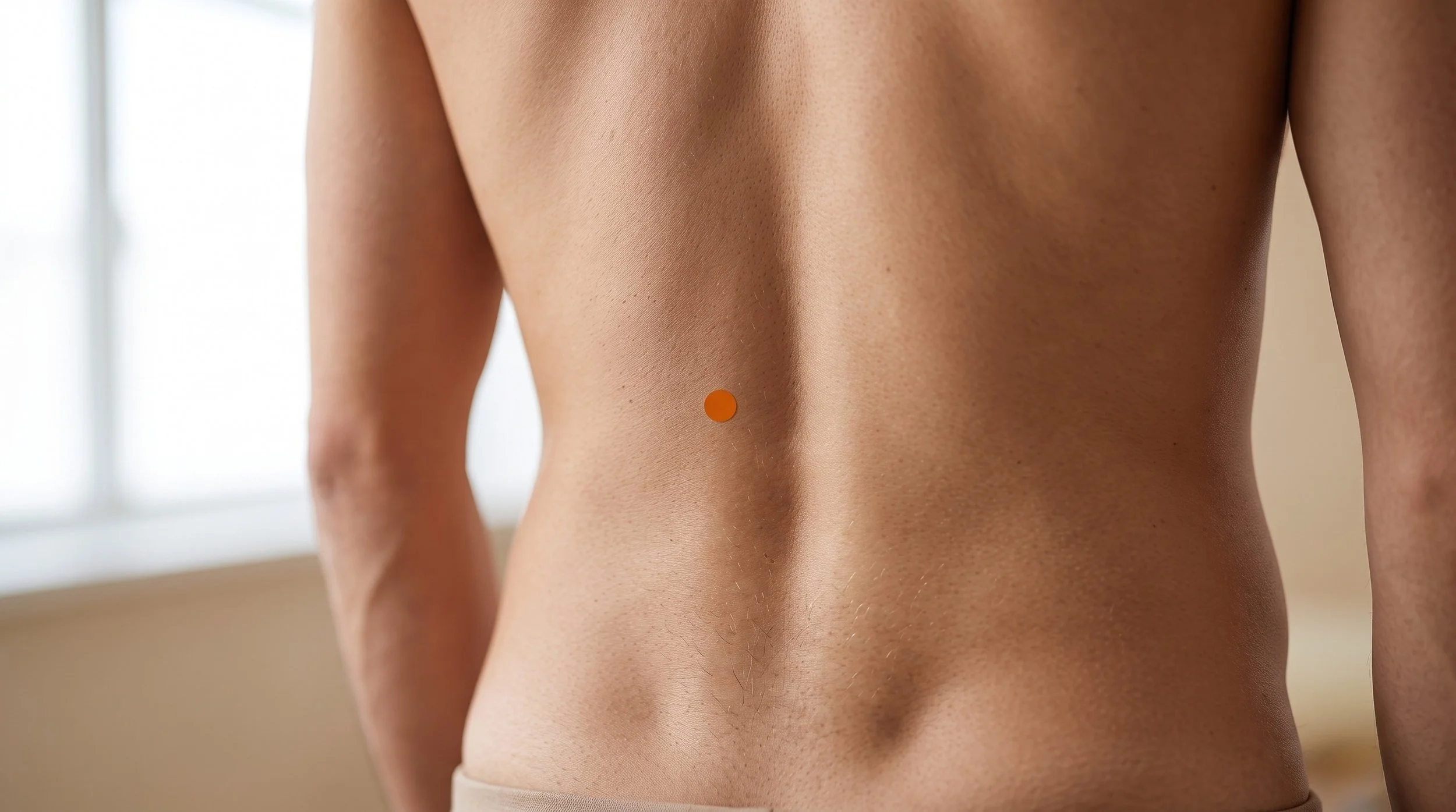
BL22 (Sanjiaoshu, sometimes written Sanjiao Shu or Bladder 22) is the back-shu point of the Sanjiao, and it sits low on the back at the level where the rib cage stops governing movement and the lumbar spine starts absorbing load. The bl 22 location is straightforward once you find the landmark: 1.5 cun lateral to the lower border of the L1 spinous process, in the thick band of paraspinal muscle that stands up on either side of the spine (Deadman et al., 2007).
Clinically the bl22 acupuncture point earns its place twice over: it is a practical local target for thoracolumbar stiffness and quadratus-adjacent tension, and it is one of the classical back-shu points traditionally chosen for digestive irregularity and fluid handling. Understanding why one small site carries both reputations means looking at the nerves that serve it rather than at anything mystical.
- BL22 lies on the inner Bladder line, 1.5 cun lateral to the lower border of the L1 spinous process, entering skin, thoracolumbar fascia, and the erector spinae mass, with the kidney sitting deep to the muscular layer (Deadman et al., 2007).
- Traditional sources classify BL22 as the back-shu point of the Sanjiao and attribute to it the regulation of the middle and lower burners, the resolution of dampness, and the movement of the water passages; in modern terms these are descriptions of digestion, bowel behavior, and fluid handling rather than statements about a physical substance moving through the body (Deadman et al., 2007).
- The point is innervated by the dorsal rami of roughly T12 to L1, the same segmental neighborhood that supplies deep paraspinal tissue and overlaps with visceral afferent input from the upper abdominal organs, which is the plausible route by which a back point may influence both muscular pain and autonomic tone (Uchida et al., 2017).
- Needling likely recruits A-delta and C fiber afferents that engage spinal gating and descending inhibitory pathways involving endogenous opioids, serotonin, and noradrenaline, a mechanism mapped in detail across decades of laboratory work (Zhao, 2008).
- The research picture is protocol-level rather than point-level: Cochrane work on chronic nonspecific low back pain found modest short-term benefit with uncertain certainty (Mu et al., 2020), while a 2025 Cochrane overview placed acupuncture among the better supported non-drug options (Rizzo et al., 2025), and individual patient data pooling supports durable effects for chronic pain generally (Vickers et al., 2018).
- De qi at BL22 usually reads as a deep, heavy ache with a spreading quality that may travel a hand's width sideways toward the flank; sharp or electric sensation is a signal to withdraw and change angle, and depth stays disciplined because of the kidney beneath (Deadman et al., 2007).
Stuck With Low Back Stiffness That Never Fully Releases?
Thoracolumbar tension is one of the most common patterns we see, and it often hides behind a diagnosis that only names the lumbar spine. At Morningside Acupuncture we use BL22 alongside segmental paraspinal needling and dry needling of the quadratus lumborum and erector spinae to address the whole load-sharing zone at once. Treatment is paired with movement and breathing strategies so the change holds between visits. Schedule a session and let's map where your back is actually working too hard.
Schedule NowAnatomy of BL22: Why the L1 Thoracolumbar Junction Is Such an Important Location
From the surface inward, a needle at BL22 passes through skin and subcutaneous tissue, then the posterior layer of the thoracolumbar fascia, then into the erector spinae column (mainly longissimus and iliocostalis fibers at this height), with the deeper multifidus and the lateral border of the quadratus lumborum nearby. This is the junction where rib-stabilized thoracic mechanics hand off to the mobile, load-bearing lumbar spine, so the tissue here absorbs rotation from above and compression from below.
That is why the site so often palpates as a dense, ropy band in people who sit long hours, lift asymmetrically, or train with a heavy hinge pattern. Deadman notes the practical landmark of locating the point at the visible high point of the paraspinal muscle mass, which is a useful reminder that BL22 is a muscular target as much as a coordinate (Deadman et al., 2007).
The nerve geography explains the point's dual reputation. BL22 sits in the territory of the dorsal rami of roughly T12 to L1, and those same spinal segments receive convergent input from deep somatic tissue and from visceral afferents serving upper abdominal and retroperitoneal structures. When two input streams share dorsal horn real estate, stimulation of one may modulate processing of the other, which is the standard convergence explanation for referred pain and for the back-shu concept in neurophysiological dress.
Needling at intensities sufficient to recruit small-diameter afferents engages spinal segmental inhibition and descending control from the periaqueductal gray and rostral ventromedial medulla, with opioid, serotonergic, and noradrenergic components (Zhao, 2008). Paraspinal stimulation has also been shown in laboratory work to influence autonomic outflow through somato-autonomic reflex pathways, with effects that depend on the body region stimulated and the intensity used (Uchida et al., 2017).
The safety consideration at this level is straightforward and non-negotiable. The kidney lies deep to the paraspinal muscles in this region, so deep perpendicular needling at BL22 carries real risk, and the conventional technique is oblique or perpendicular-oblique insertion angled toward the spine to a depth of about 1 to 1.5 cun (Deadman et al., 2007). Other modern texts describe a shallower perpendicular approach of roughly 0.5 to 1 cun (Kim, 2010).
In practice, angle discipline matters more than depth numbers: needling toward the midline keeps the trajectory pointed at bone and muscle rather than at the retroperitoneal space, and body habitus should always adjust the plan. Patients who are lean, who have had kidney surgery, or who have known anatomical variation deserve extra conservatism.
Related Muscles That Cause Low Back Pain Related Back Shu PointsBL22 at a Glance: Classification, Location, and Clinical Use
| Category | Detail |
|---|---|
| Traditional Name | Sanjiaoshu (Sanjiao Shu), the Sanjiao Transporting Point |
| Channel Classification | Bladder channel (BL22, Bladder 22), inner back line of the Bladder Channel |
| Point Categories | Back-shu (back transporting) point of the Sanjiao. No five-shu, hui-meeting, luo, xi-cleft, or extraordinary vessel designations are attributed to this point in the classical sources consulted. |
| Precise Location | On the lower back, 1.5 cun lateral to the lower border of the spinous process of the first lumbar vertebra (L1), level with DU5. Palpate at the visible crest of the paraspinal muscle mass. |
| Tissue Stimulated | Thoracolumbar fascia and erector spinae (longissimus, iliocostalis) with deeper multifidus; adjacent to the quadratus lumborum laterally. Innervation from dorsal rami of T12 to L1. |
| Needle Depth / Direction | Oblique or perpendicular-oblique toward the spine, approximately 1 to 1.5 cun; some texts describe 0.5 to 1 cun perpendicular. Deep perpendicular needling is avoided because of the kidney below. |
| De Qi Sensation | Deep heaviness and dull ache with a spreading quality toward the flank; occasional warmth. Sharp, burning, or electric sensations mean the needle should be withdrawn and redirected. |
| Primary Clinical Uses | Thoracolumbar back pain and lumbar stiffness; digestive irregularity and abdominal distention in classical listings; fluid metabolism and urinary patterns in traditional framing. |
| Common Point Combinations |
|
In the classical literature summarized by Deadman, Al-Khafaji, and Baker, BL22 is presented as the back-shu point where the qi of the Sanjiao is said to surface, and the Sanjiao itself is described as the system that coordinates the upper, middle, and lower regions of the trunk and keeps food and fluid moving through them. Because BL22 sits between the Stomach shu above and the Kidney shu below, the tradition assigns it influence over the middle and lower regions only, integrating stomach and spleen function with the intestines, kidneys, and bladder.
That assignment produced a long indication list: rumbling and loose stool, undigested food, vomiting and difficult swallowing, abdominal distention with wasting, palpable abdominal accumulations, oedema with difficult urination, cloudy or bloody urine, and stiffness of the lumbar spine and shoulders. Traditional sources also credit the point with treating alternating chills and fever, bitter taste, headache, and dizziness, on the reasoning that the Sanjiao belongs to the shaoyang division.
What is striking is not the length of the list but its internal logic: nearly every entry concerns something failing to move through or drain out of the trunk, which is a coherent clinical theme built around a single segmental level.
Why BL22 Is Used for Digestive Complaints and Not Just Low Back Pain
The first part of the answer is anatomical. Points along the inner Bladder line sit over the paraspinal muscles at specific spinal levels, and each level receives sensory input from both the deep back tissues and the internal organs served by that segment. In the dorsal horn those inputs converge, which is why organ trouble can produce a tender paraspinal band and why needling that band may alter how the nervous system is processing input from the whole segment.
At the L1 level, BL22 sits in the neighborhood that serves upper abdominal and retroperitoneal structures, which is a plausible reason the classical texts clustered digestive and fluid complaints around this exact height.
The second part concerns autonomic modulation. Laboratory work on somato-autonomic reflexes has shown that stimulating somatic tissue can shift autonomic outflow, and that the direction and size of the response depend on where the stimulus is applied and how strong it is, with trunk stimulation and limb stimulation producing different patterns (Uchida et al., 2017).
Reviews of acupuncture and electroacupuncture in functional dyspepsia describe changes in gastric motility and accommodation, gastrointestinal hormone levels, and central and autonomic measures, though the authors are appropriately cautious about study quality (Guo, Wei, & Chen, 2020). None of this proves that BL22 specifically drives digestion, and honest practice says so plainly.
The pain side of the story is more familiar. Needling the erector spinae at a symptomatic level recruits small-diameter afferents that engage spinal gating and descending inhibition from brainstem centers, with opioid and monoaminergic signaling involved (Zhao, 2008). Locally, needling a taut paraspinal band may reduce nociceptive input from the muscle itself. In a clinical setting these two mechanisms tend to arrive together: patients often report that the back loosens first and that the abdominal heaviness, if present, eases more gradually over a course of treatment.
What the Research Shows for BL22
A fair reading of the evidence starts with a caveat: almost no trial isolates BL22. Studies test multi-point protocols, so what the literature can tell us is whether acupuncture protocols that commonly include lumbar back-shu points outperform sham, usual care, or no treatment, not whether this single point carries the effect. With that framing, the low back pain evidence is the most directly relevant to how BL22 is used in a clinic, and the digestive evidence is suggestive but methodologically mixed.
| Study | Type | Focus | Key Finding |
|---|---|---|---|
| Mu et al., 2020 | Cochrane systematic review | Acupuncture for chronic nonspecific low back pain, 33 trials | Acupuncture showed benefit over no treatment for pain with moderate-certainty evidence, while comparisons with sham and usual care produced smaller and less certain differences. |
| Rizzo et al., 2025 | Cochrane overview of reviews | Non-pharmacological and non-surgical treatments for low back pain in adults | Acupuncture appeared among the better supported non-drug options for chronic low back pain, though the authors emphasize variable certainty across comparisons. |
| Vickers et al., 2018 | Individual patient data meta-analysis | Chronic pain conditions including back and neck pain, roughly 20,000 patients | Acupuncture outperformed both sham and no-acupuncture controls, with effects that persisted over twelve months rather than dissipating immediately. |
| Hu et al., 2018 | Systematic review and meta-analysis | Dry needling of myofascial trigger points for low back pain | Dry needling was associated with reduced pain intensity and improved function in the short term, with the authors noting methodological limitations across included trials. |
| Guo, Wei, & Chen, 2020 | Systematic review of mechanisms | Acupuncture and electroacupuncture in functional dyspepsia | Included studies reported changes in gastric motility, gastrointestinal hormones, and autonomic measures, but the authors call for higher-quality trials before firm conclusions. |
| Uchida et al., 2017 | Narrative physiological review | Somato-autonomic reflex pathways underlying acupuncture effects on visceral function | Somatic stimulation can modulate autonomic outflow in a site-dependent and intensity-dependent way, though most evidence comes from anesthetized animal models. |
Back Pain and Digestive Complaints Showing Up Together?
Patients often mention bloating, irregular bowels, or a heavy abdomen in the same breath as their back pain, and the overlap is not a coincidence given how densely the thoracolumbar segments are wired. BL22 is one of the points we reach for when both stories appear in the same person, usually combined with abdominal and lower limb points. We keep expectations realistic and track symptoms visit to visit. Book an evaluation and we'll build a plan around what is actually bothering you most.
Schedule NowBL22 in the Context of Trigger Point Work
The BL22 site overlaps closely with myofascial targets that any clinician treating low back pain already knows. The erector spinae at the thoracolumbar junction and the lateral fibers of the quadratus lumborum both refer pain into the low back, the iliac crest region, and sometimes the lateral hip, and taut bands in these muscles are frequently found at or just lateral to the point (Simons, Travell, & Simons, 1999).
At Morningside we treat the point and the muscle in the same session rather than choosing between frameworks: BL22 gives us a segmental anchor at L1, and dry needling of the surrounding erector spinae and quadratus lumborum addresses the contractile tissue generating local symptoms.
Practically, this means angling conservatively and treating what the palpation exam finds. Because the kidney sits deep to this region, quadratus lumborum needling is approached with the same care described for BL22 itself, with attention to angle, depth, and patient size. We generally follow needling with breathing work, hip hinge retraining, and loaded carries or side-plank progressions, since the thoracolumbar junction responds well to being taught how to share load rather than simply being released. Patients with recurrent stiffness often do best with a short course of treatment plus a home routine rather than isolated sessions.
BL22 Low Back Pain Treatment at NYC's Highest-Rated Acupuncture Clinic
Morningside Acupuncture is the highest-rated acupuncture and dry needling clinic in New York City with over 500 five-star Google reviews, and our approach blends classical point selection with trigger point and orthopedic needling. BL22 is a routine part of how we treat thoracolumbar pain, lumbar stiffness, and the digestive complaints that often accompany them. Every visit includes an assessment of movement, breathing, and load so the needling fits the person rather than the label. Schedule your appointment and start with a clear plan.
Schedule NowFrequently Asked Questions
What does BL22 feel like when needled?
Most people describe a deep, dull, heavy ache that builds over a few seconds and spreads outward toward the flank, sometimes with a sense of warmth or pressure. That sensation is de qi, and it usually means small-diameter afferents in muscle and fascia have been engaged (Zhao, 2008). If the muscle holds an active taut band, you may also feel a brief twitch or cramp that settles quickly. What you should not feel is a sharp, burning, or electric sensation, or anything radiating into the abdomen; those signal that the needle needs to be withdrawn and repositioned.
Why treat a back point for digestive symptoms instead of the abdomen?
Back-shu points sit at spinal levels where sensory input from deep back tissue and from internal organs converges in the same segments of the spinal cord, so stimulating one may influence processing of the other. Laboratory research on somato-autonomic reflexes shows that somatic stimulation can shift autonomic activity, with the pattern depending on where the stimulus is applied (Uchida et al., 2017). In practice we often use both: a back point like BL22 for the segmental input, and an abdominal or lower limb point such as ST25 or ST36 as part of the same protocol. It is a way of approaching the same nervous system from two directions.
Can I press BL22 myself between sessions?
Yes, and it is one of the easier back points to reach. Place your thumbs on either side of your spine at the level of the lowest rib, then slide slightly downward until you feel the crest of the muscle band about one and a half thumb-widths out from the midline. Press inward and slightly toward the spine with steady, firm pressure until you feel a dull ache rather than sharp pain, hold for 30 to 60 seconds, then release; repeat two or three times per side and do this once or twice a day. A tennis ball or massage ball against a wall works well if your hands tire, and slow nasal breathing during the hold tends to make the tissue give more readily. Stop if pressure produces flank pain, nausea, or any radiating sensation, and check with your clinician before doing this if you have kidney problems, osteoporosis, or a recent injury.
Is BL22 safe to needle?
In trained hands, yes, with one specific precaution. The kidney lies deep to the paraspinal muscles at this level, so deep perpendicular needling is avoided; the standard approach is an oblique or perpendicular-oblique angle directed toward the spine at a controlled depth (Deadman et al., 2007). A properly trained practitioner adjusts depth for body size and stays well within the muscular layer. Typical side effects are minor and local: brief soreness, occasional small bruising, and a short-lived heavy feeling in the low back. Tell your practitioner if you are pregnant, taking anticoagulants, or have a history of kidney disease or kidney surgery so the technique can be adapted.
Where exactly is BL22 located?
BL22 is on the lower back, 1.5 cun lateral to the lower border of the spinous process of the first lumbar vertebra (L1), level with DU5 on the midline. A useful way to find L1 is to locate the lowest palpable rib and follow it back to the spine, then confirm the level by counting. Cun measurements are proportional rather than fixed, so 1.5 cun is roughly the width of your own index and middle fingers together, which on most people places the point right on the visible ridge of the paraspinal muscle. BL21 sits one vertebral level above at T12 and BL23 sits one level below at L2, so the three form a vertical column that is easy to orient by.
References
- Deadman, P., Al-Khafaji, M., & Baker, K. (2009). A manual of acupuncture. Journal of Chinese Medicine Publications.
- Kim, H. (2008). Handbook of Oriental medicine (3rd ed.). Harmony & Balance Press.
- Simons, D. G., Travell, J. G., & Simons, L. S. (1999). Travell & Simons' myofascial pain and dysfunction: The trigger point manual, Vol. 1: Upper half of body (2nd ed.). Williams & Wilkins.
- Mu, J., Furlan, A. D., Lam, W. Y., Hsu, M. Y., Ning, Z., & Lao, L. (2020). Acupuncture for chronic nonspecific low back pain. Cochrane Database of Systematic Reviews, 2020(12), CD013814. https://doi.org/10.1002/14651858.CD013814
- Rizzo, R. R. N., Cashin, A. G., Wand, B. M., Ferraro, M. C., Sharma, S., Lee, H., O'Hagan, E., Maher, C. G., Furlan, A. D., van Tulder, M. W., & McAuley, J. H. (2025). Non-pharmacological and non-surgical treatments for low back pain in adults: An overview of Cochrane reviews. Cochrane Database of Systematic Reviews, 2025(3), CD014691. https://doi.org/10.1002/14651858.CD014691.pub2
- Vickers, A. J., Vertosick, E. A., Lewith, G., MacPherson, H., Foster, N. E., Sherman, K. J., Irnich, D., Witt, C. M., & Linde, K. (2018). Acupuncture for chronic pain: Update of an individual patient data meta-analysis. Journal of Pain, 19(5), 455-474. https://doi.org/10.1016/j.jpain.2017.11.005
- Zhao, Z. Q. (2008). Neural mechanism underlying acupuncture analgesia. Progress in Neurobiology, 85(4), 355-375. https://doi.org/10.1016/j.pneurobio.2008.05.004
- Uchida, S., Kagitani, F., & Sato-Suzuki, I. (2017). Somatoautonomic reflexes in acupuncture therapy: A review. Autonomic Neuroscience: Basic and Clinical, 203, 1-8. https://doi.org/10.1016/j.autneu.2016.11.001
- Guo, Y., Wei, W., & Chen, J. D. Z. (2020). Effects and mechanisms of acupuncture and electroacupuncture for functional dyspepsia: A systematic review. World Journal of Gastroenterology, 26(19), 2440-2457. https://doi.org/10.3748/wjg.v26.i19.2440
- Hu, H. T., Gao, H., Ma, R. J., Zhao, X. F., Tian, H. F., & Li, L. (2018). Is dry needling effective for low back pain? A systematic review and PRISMA-compliant meta-analysis. Medicine, 97(26), e11225. https://doi.org/10.1097/MD.0000000000011225 [VERIFY BEFORE PUBLISHING]
Disclaimer: This web site is intended for educational and informational purposes only. Reading this website does not constitute providing medical advice or any professional services. This information should not be used for diagnosing or treating any health issue or disease. Those seeking medical advice should consult with a licensed physician. Seek the advice of a medical doctor or other qualified health professional for any medical condition. If you think you have a medical emergency, call 911 or go to the emergency room. No acupuncturist-patient relationship is created by reading this website or using the information. Morningside Acupuncture PLLC and its employees and contributors do not make any express or implied representations with respect to the information on this site or its use. For any legal interpretation of scope of practice in your state, consult a licensed attorney or regulatory authority.
Read more from our blog