BL3 Acupuncture Point (Meichong)
BL3 Acupuncture Point (Meichong)
Eyebrows' Pouring at the Front Hairline: Anatomy, Mechanism, and Why This Small Scalp Point Earns Its Place in Frontal Headache and Congestion Treatment
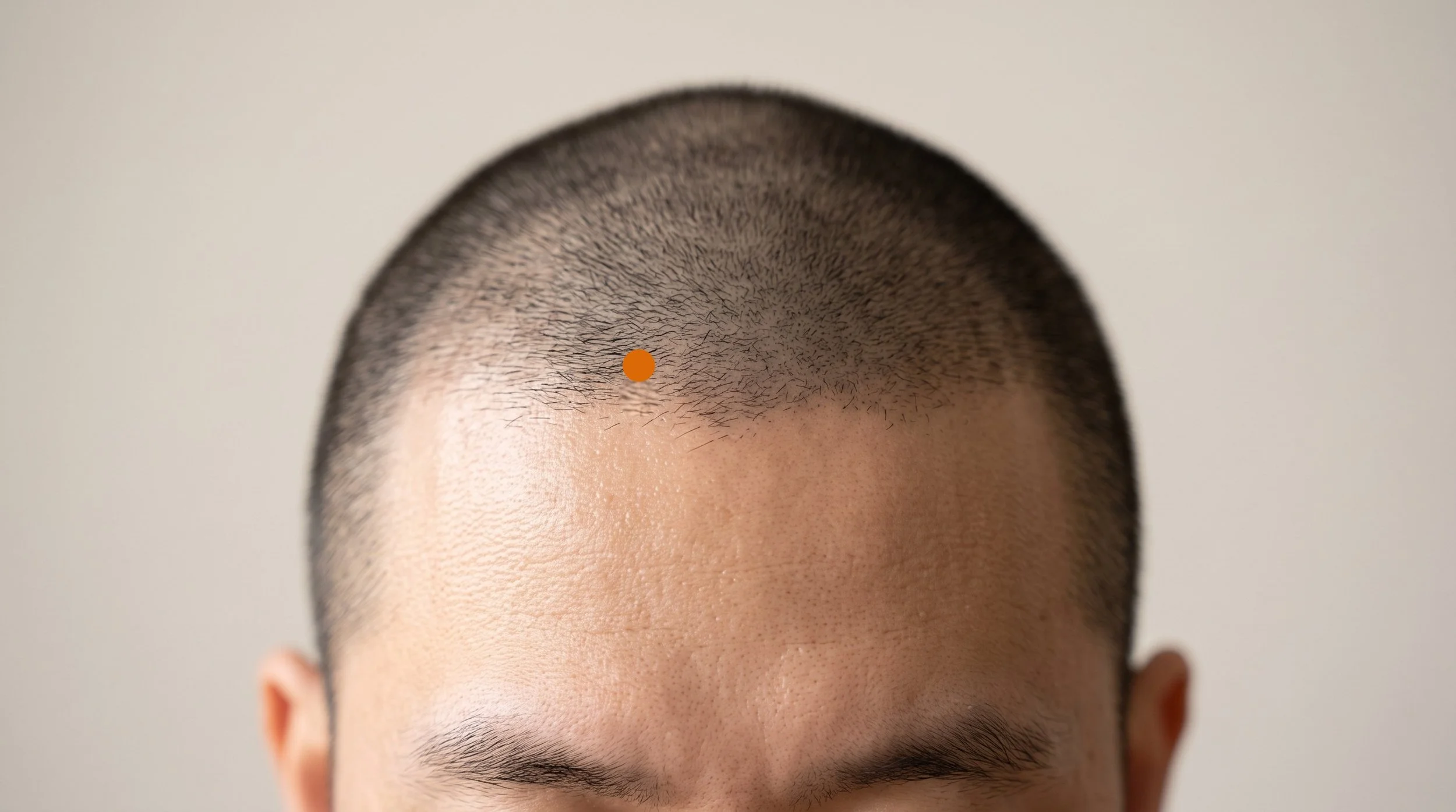
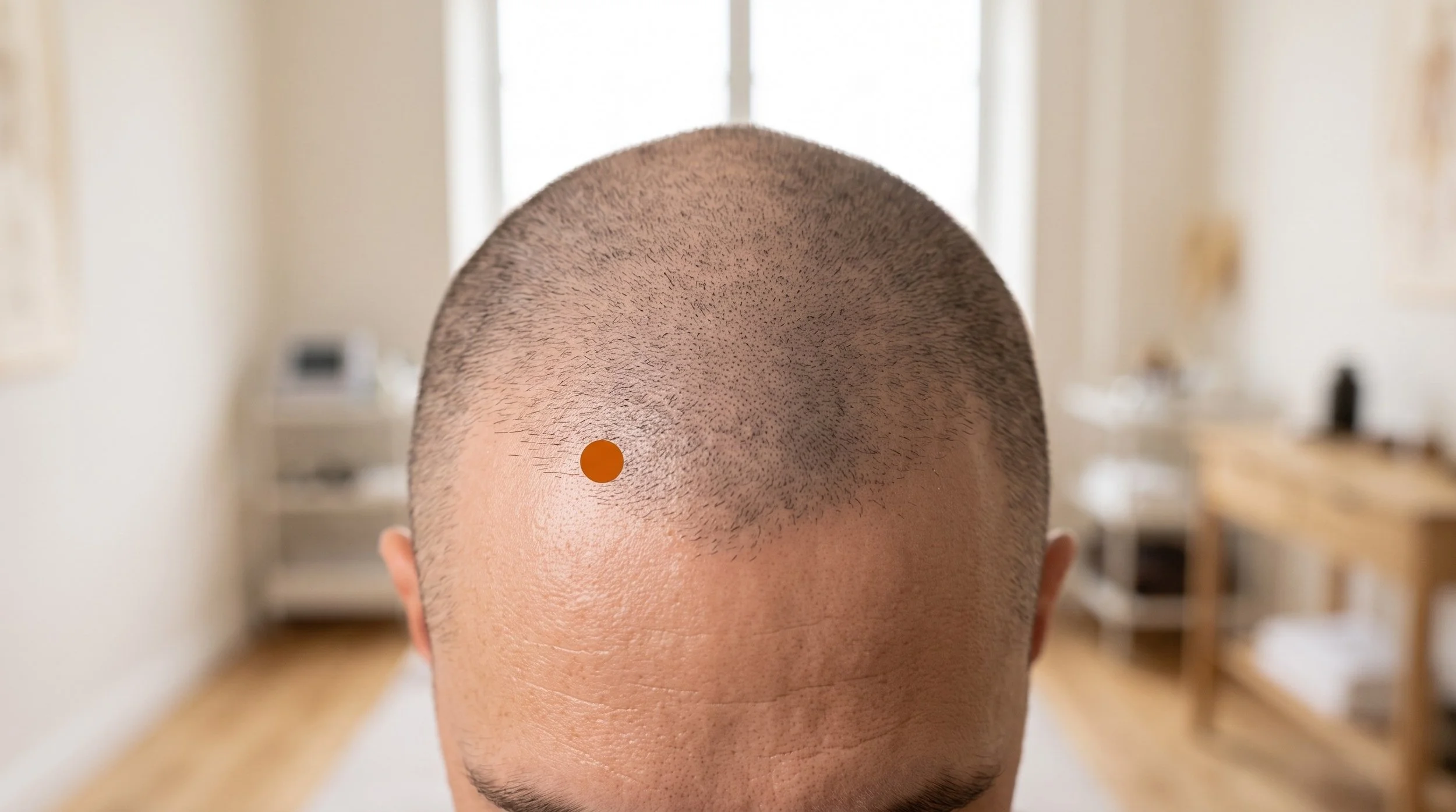
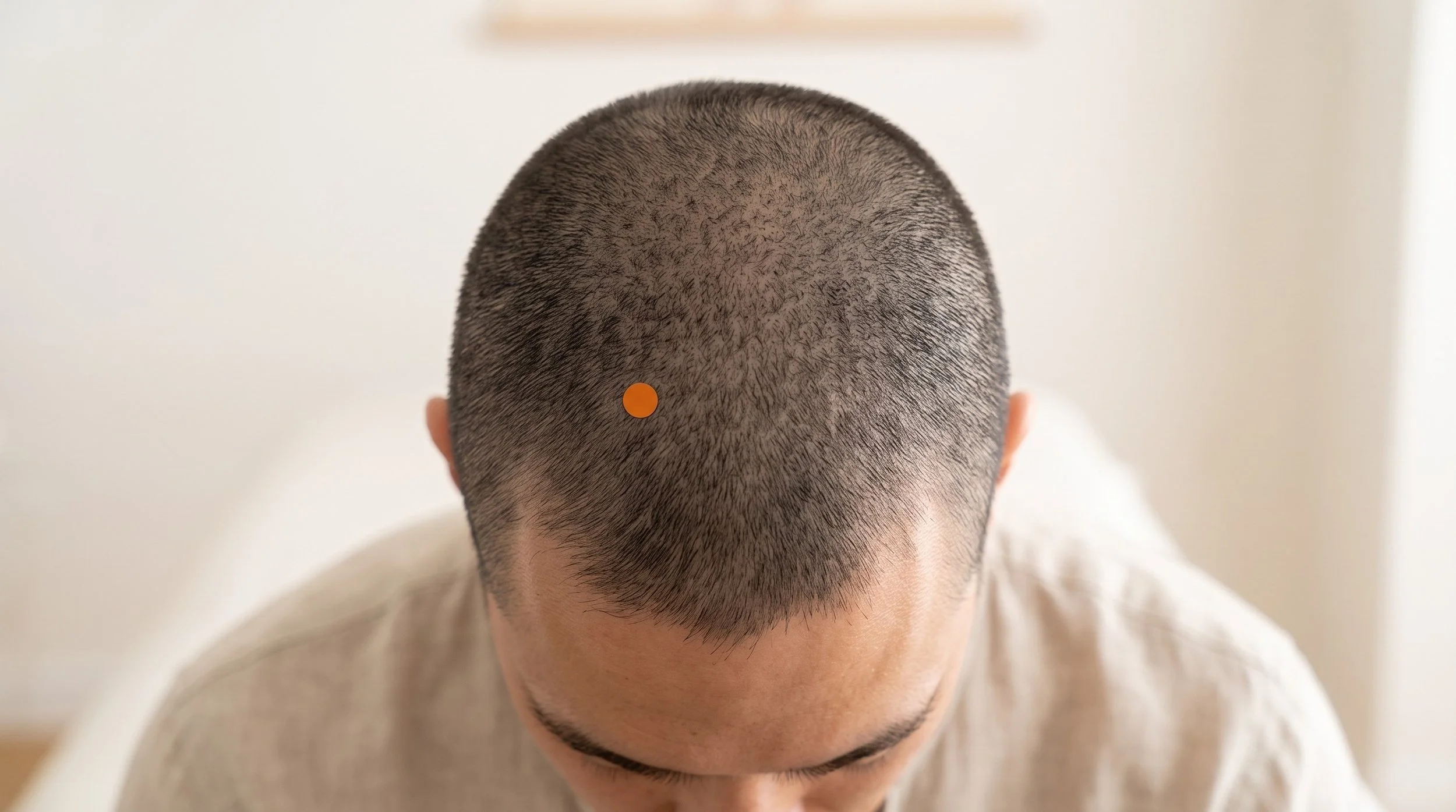
BL3 (Meichong, often translated as Eyebrows' Pouring) is the third point of the Bladder channel and the first one that sits on the scalp rather than the face. To find it, trace a line straight up from the inner end of the eyebrow, just above BL2, until you cross into the hairline, then stop about half a cun past the hairline edge, level with GV24 on the midline (Deadman et al., 2001). That places the bl3 acupuncture point in a narrow band of tissue where the frontalis muscle blends into the galea and where the terminal branches of the first trigeminal division fan upward over the forehead.
Classically the point was used for headache at the front and top of the head, blocked or sore nose, and dizziness, and in modern practice bladder 3 is most often chosen when a patient's headache sits behind or above the brow and travels back over the scalp, especially when sinus pressure and eye strain are part of the picture.
- Location and layers: bl 3 location is directly above BL2, 0.5 cun inside the anterior hairline and level with GV24 on the midline (Deadman et al., 2001). The needle passes through skin, a dense fibrofatty subcutaneous layer, and the frontalis and galea, so almost all of the sensory action happens within a few millimeters of the surface.
- Traditional framing: classical texts describe the meichong point as a place to expel wind, clear the head, ease pain, and benefit the eyes and nose (Deadman et al., 2001; Kim, 2007). Those categories are traditional attributions, and in modern language they map onto a superficial trigeminal field point used for anterior head pain and nasal symptoms.
- Nerve story: BL3 sits in territory supplied by the supratrochlear and supraorbital branches of the ophthalmic nerve, the first division of the trigeminal nerve. These fibers converge in the trigeminocervical complex alongside upper cervical afferents, which is the anatomical reason forehead points may influence pain that patients feel across the whole front of the head (Zhao, 2008).
- Mechanism beyond the local area: needling appears to recruit segmental inhibition plus descending pain control involving endogenous opioid and monoamine systems, rather than moving anything along the surface of the scalp (Zhao, 2008). Non-needle stimulation of the same supraorbital nerve territory has reduced monthly migraine days versus sham in a randomized trial, which supports the idea that this nerve field is modifiable (Schoenen et al., 2013).
- Research picture: no trial has isolated BL3 by itself, so its evidence is indirect. Cochrane reviews suggest acupuncture may reduce headache frequency in tension-type headache and episodic migraine (Linde et al., 2016a; Linde et al., 2016b), a large individual patient data meta-analysis found modest but persistent effects for chronic pain (Vickers et al., 2018), and a rhinitis meta-analysis reported symptom and medication score improvements with acupuncture (Feng et al., 2015).
- Practice notes: this is a transverse scalp insertion, 0.5 to 1 cun, usually angled backward or toward the tender zone, and classical sources record bladder 3 as a point not to moxa (Deadman et al., 2001). De qi here is usually a spreading dull pressure or heaviness under the scalp rather than a sharp jolt, and scalp points can bleed a little on withdrawal because of the vascular subcutaneous layer.
Frontal Headaches That Sit Right Above Your Eyebrows?
If your headaches start over the brow, press behind the eyes, and creep back over the top of your head, BL3 is one of the points we reach for first. At Morningside Acupuncture we combine it with BL2, GB20, and distal points like LI4, then add dry needling to the frontalis, temporalis, and upper neck muscles that feed the same pain pattern. Most patients notice a change in headache frequency over a short course of visits rather than in one session. Schedule a visit and we'll map your headache pattern before a single needle goes in.
Schedule NowAnatomy of BL3: Why the Frontal Hairline Is Such an Important Location
The scalp at BL3 is built in tight, adherent layers. Under thick skin sits a dense subcutaneous layer webbed with fibrous septa and small vessels, and beneath that lies the frontal belly of the occipitofrontalis muscle blending into the galea aponeurotica. Because the frontalis has no bony attachment of its own and pulls on this sheet every time you raise your eyebrows, squint at a screen, or hold a worried expression, the tissue here takes a surprising amount of low-grade mechanical load.
Patients who live with chronic eye strain often have a taut, tender band across this exact area, which is why the point is frequently sore on palpation before it's ever needled.
Sensory supply comes from the supratrochlear and supraorbital nerves, terminal branches of the frontal nerve within the ophthalmic division of the trigeminal nerve. These fibers climb from the orbital rim across the forehead and continue well back onto the scalp, so a stimulus at the hairline lands squarely in the same nerve territory as brow and eye pain.
Trigeminal afferents from this region synapse in the trigeminocervical complex, where they share second-order neurons with input from the upper cervical segments, and that convergence is the standard explanation for why forehead, eye, and upper neck symptoms so often travel together.
Needling in this field is thought to engage segmental inhibition and descending modulation through opioid and monoamine pathways rather than acting only where the needle sits (Zhao, 2008), and studies applying electrical stimulation to the supraorbital nerve have reported reduced migraine days compared with sham, which supports the responsiveness of this territory (Schoenen et al., 2013).
The deeper concern at BL3 is vascular rather than visceral. The subcutaneous layer carries branches of the supratrochlear and supraorbital vessels, and scalp tissue bleeds readily, so a small bead of blood or a transient bruise after needle removal isn't unusual. Below the galea is a loose areolar plane and then the periosteum of the frontal bone, which is why the accepted technique is transverse insertion along the scalp of roughly 0.5 to 1 cun rather than any perpendicular approach (Deadman et al., 2001).
Classical sources also record BL3 as contraindicated to moxibustion, a caution that makes practical sense on hair-bearing skin over a thin, well vascularized layer (Deadman et al., 2001).
Related Bladder Channel Related Pain Finder Head NeckBL3 at a Glance: Classification, Location, and Clinical Use
| Category | Detail |
|---|---|
| Traditional Name | Meichong (Eyebrows' Pouring), also rendered as Eyebrow's Rushing or Eyebrow Upward |
| Channel Classification | Bladder channel of Foot Taiyang, third point of the channel and its first scalp point |
| Point Categories | The reference sources list no five-shu, meeting, hui-meeting, or extraordinary vessel designation for BL3. It's classified simply as a point of the Bladder channel located at the anterior hairline, between GV24 on the midline and BL4 laterally. |
| Precise Location | On the head, directly superior to BL2 and above the medial end of the eyebrow, 0.5 cun within the anterior hairline, level with GV24. If the hairline is indistinct, classical measurement places the anterior hairline one fifth of the distance from the glabella to the posterior hairline. |
| Tissue Stimulated | Skin, fibrofatty subcutaneous layer, frontal belly of the occipitofrontalis and the galea aponeurotica, within the supratrochlear and supraorbital nerve field. Clinically related myofascial referral from the neck and shoulder girdle is often addressed alongside it, including Serratus Posterior Superior Trigger Points when upper back tension drives head symptoms. |
| Needle Depth / Direction | Transverse (subcutaneous) insertion along the scalp, 0.5 to 1 cun, usually directed posteriorly or toward the most tender segment. Some texts use a shallower 0.3 to 0.5 cun subcutaneous technique. Classical sources list the point as contraindicated to moxibustion. |
| De Qi Sensation | A dull, spreading pressure or heaviness under the scalp, sometimes with a mild tugging sensation as the needle threads along the galea. Sharpness is uncommon and usually means the angle needs adjusting. |
| Primary Clinical Uses | Frontal and vertex headache, nasal congestion and sinus pressure, eye strain and heaviness around the brow, and dizziness in classical listings |
| Common Point Combinations |
|
In A Manual of Acupuncture, Deadman and colleagues present BL3 under traditional actions that read as a short list: expel wind, clear the head, relieve pain, and benefit the eyes and nose. The indications recorded there gather into a few natural groups, namely head pain at the front and vertex, disturbances of balance and vision such as dizziness and blurred sight, nasal complaints including blockage and sores inside the nose, and a smaller cluster of chest and mind symptoms like breathing difficulty, restlessness, and fullness in the chest, along with epilepsy.
Those are traditional attributions rather than clinical claims, and they belong to a period when a single point was expected to carry a broad symptom list. What stands out is how tightly most of that list tracks one anatomical field: the brow, the eye, the nose, and the front of the head are all served by the ophthalmic and maxillary trigeminal territory or drain through structures immediately beneath. The classical pattern and the nerve map end up describing much the same region by different routes.
Why BL3 Is Used for Headaches That Feel Like Sinus Pressure
Patients often describe a headache that sits above the eyebrows, pushes behind the eyes, and feels heavier when they bend forward. Many assume it's purely sinus related, and sometimes it is, but a large share of that pattern is generated by nerve traffic rather than by blocked cavities alone. The supratrochlear and supraorbital nerves that cross BL3 belong to the ophthalmic division of the trigeminal nerve, and their central connections in the trigeminocervical complex sit alongside inputs from the sinuses, the eye, and the top of the neck.
When several of those inputs are irritated at once, the brain has limited ability to tell them apart, and the result is a diffuse frontal ache that feels like congestion even when imaging is unremarkable.
Needling at the hairline gives us a direct way to add competing, controlled input into that same convergence zone. Experimental work on acupuncture analgesia describes activation of A-delta and small myelinated afferents that trigger spinal and supraspinal inhibition, with endogenous opioids and monoamines involved in dampening onward pain signaling (Zhao, 2008). The supraorbital field specifically has been shown to be modifiable: a randomized sham-controlled trial of transcutaneous stimulation over this nerve territory reported fewer migraine days in the active group (Schoenen et al., 2013).
That doesn't prove anything about BL3 in isolation, but it does suggest the anatomical region acupuncturists have used for centuries is one the nervous system responds to.
There's a mechanical layer as well. The frontalis is a thin sheet that contracts every time the brows lift, and hours of screen work with a slightly furrowed expression leave it tender and tight along the very line BL3 occupies. Adding a superficial needle there, and often dry needling adjacent taut bands, may reduce that local nociceptive drive while the segmental effects work on the broader pattern.
Acupuncture for chronic pain has shown modest, durable effects across large pooled datasets, which is roughly what we tell patients to expect: meaningful improvement in frequency and intensity rather than a switch being flipped (Vickers et al., 2018).
What the Research Shows for BL3
It's worth being straightforward about the evidence base here. There are no clinical trials that test BL3 on its own, and there almost certainly never will be, because acupuncture is delivered as a prescription of several points chosen for the individual. What the literature offers instead is evidence about multi-point protocols for the conditions BL3 is traditionally used within, plus mechanistic work on the nerve territory the point occupies. The reasonable reading is that BL3 is one plausible contributor inside protocols that have shown modest benefit, not an independently validated intervention.
| Study | Type | Focus | Key Finding |
|---|---|---|---|
| Linde et al., 2016a | Cochrane systematic review | Acupuncture for prevention of tension-type headache | The review concluded that acupuncture may be a useful option for frequent tension-type headache, though comparisons with sham showed smaller differences. |
| Linde et al., 2016b | Cochrane systematic review | Acupuncture for prevention of episodic migraine | Moderate quality evidence suggested acupuncture may reduce migraine frequency at least as much as prophylactic drug treatment, with fewer dropouts for adverse effects. |
| Vickers et al., 2018 | Individual patient data meta-analysis | Acupuncture across chronic pain conditions including headache | Effects were modest but statistically significant versus both sham and no-acupuncture control, and persisted over roughly a year. |
| Feng et al., 2015 | Systematic review and meta-analysis | Acupuncture for allergic rhinitis symptoms | Pooled results favored acupuncture for nasal symptom and medication scores, though trial quality varied and findings should be read cautiously. |
| Schoenen et al., 2013 | Randomized sham-controlled trial | Transcutaneous stimulation of the supraorbital nerve territory for migraine prevention | Active stimulation over the same nerve field as BL3 reduced monthly migraine days more than sham, supporting the responsiveness of this region. |
| Zhao, 2008 | Narrative review of mechanisms | Neural mechanisms of acupuncture analgesia | Analgesic effects are attributed to afferent-driven segmental inhibition and descending modulation involving opioid and monoamine systems. |
Stuffy Nose, Sinus Pressure, and Head Fog?
Classical sources paired the meichong point with LI20 and GV23 for headache that comes bundled with nasal congestion, and that grouping still makes clinical sense today. We use BL3 alongside face and forehead points to address pressure and blockage, while checking the neck and jaw muscles that often amplify facial heaviness. Treatment is gentle, quick, and easy to fit into a workday. Book a session and see how your head feels afterward.
Schedule NowBL3 in the Context of Trigger Point Work
At Morningside we rarely needle BL3 as an isolated act. Frontal headache is frequently driven from below and behind, and the trigger point literature documents referral into the forehead and brow from the sternocleidomastoid, the semispinalis capitis, the upper trapezius, and the temporalis, along with local referral from the frontal belly of the occipitofrontalis itself (Simons et al., 1999).
A typical session might pair BL3 and BL2 at the brow line with dry needling of the suboccipital group and the clavicular division of the sternocleidomastoid, because treating only the place the patient points to often leaves the generator untouched.
The point location and the myofascial target actually overlap here, which isn't true everywhere on the body. A transverse needle at the frontal hairline runs directly through frontalis fibers and the galea, so the same insertion can serve as a channel point in a traditional prescription and as superficial work on a tender band of muscle. Acupuncture is defined by the use of an acupuncture needle, and the hundreds of styles that use one, dry needling included, are variations on that. We choose the framing that best explains the plan to the patient, then treat the tissue in front of us.
BL3 Headache Treatment at NYC's Highest-Rated Acupuncture Clinic
Morningside Acupuncture is the highest-rated acupuncture and dry needling clinic in New York City with over 500 five-star Google reviews, and headache care is one of the things we do most. We treat BL3 as part of a full plan that includes trigger point dry needling, cervical assessment, and practical advice on screens, sleep, and jaw tension. You'll always know why each point was selected and what we expect it to do. Schedule your appointment on the Upper West Side and let's get your head quieter.
Schedule NowFrequently Asked Questions
What does BL3 feel like when needled?
Most people feel a brief pinch as the needle enters the scalp, then a dull, spreading heaviness or pressure that can extend forward toward the brow or back over the top of the head. Because the insertion is transverse and shallow, there's often a mild tugging sensation as the needle threads along the tissue plane. Sharp or electric pain isn't the goal and usually means the angle should be adjusted. Some patients find scalp points slightly more sensitive on entry than points on the limbs, but the sensation typically settles within a few seconds.
Why needle the hairline instead of where my headache actually hurts?
In many cases BL3 is close to where it hurts, since frontal headaches concentrate in exactly this band. The more interesting answer is that the point sits in the supratrochlear and supraorbital nerve field, which feeds into the trigeminocervical complex where forehead, eye, sinus, and upper neck signals converge (Zhao, 2008). Adding controlled input into that shared zone may influence pain arising anywhere in the region, not just directly under the needle. That's also why we frequently combine BL3 with points at the base of the skull such as GB20, and with distal points, so that local and system-wide mechanisms are both engaged.
Can I press BL3 myself between sessions?
Yes, and it's an easy one to find. Place a fingertip on the inner end of your eyebrow, slide straight up past the brow and onto the forehead, and continue until you feel your hairline, then move about a finger's width past it. Use the pad of your index or middle finger and press with firm, comfortable pressure, holding for 30 to 60 seconds, or making small circles for the same duration. Do both sides, either together or one at a time, and repeat two or three times a day when you're symptomatic. If you find a tender band there, you can also stroke slowly from the brow up into the hairline for a minute or two. Stop if pressure sharply increases your headache, and don't press over broken skin or a recent injury.
Is BL3 safe to needle?
In trained hands it's a low-risk point. There's no organ or major vessel at depth, and the technique used is transverse insertion along the scalp of about 0.5 to 1 cun, so the needle stays in the superficial tissue plane (Deadman et al., 2001). The main practical issues are minor: scalp tissue is vascular and can produce a small bead of blood or a short-lived bruise on withdrawal, so practitioners typically apply pressure after removing the needle. Classical sources record BL3 as contraindicated to moxibustion, and we follow that convention. Tell your acupuncturist if you take blood thinners or bruise easily, and as with any point, needling should be done with sterile single-use needles by a licensed practitioner.
Where exactly is BL3 located?
BL3 sits on the head, directly superior to BL2 and above the medial end of the eyebrow, 0.5 cun inside the anterior hairline and level with GV24 on the midline (Deadman et al., 2001). It lies between GV24 medially and BL4 laterally, roughly a finger's width to either side of the midline depending on head size. If the hairline is receded or unclear, the classical solution is proportional measurement: the distance from the glabella to the posterior hairline is taken as 15 cun, and the anterior hairline falls at one fifth of that distance.
References
- Deadman, P., Al-Khafaji, M., & Baker, K. (2009). A manual of acupuncture. Journal of Chinese Medicine Publications.
- Kim, H. (2008). Handbook of Oriental medicine (3rd ed.). Harmony & Balance Press.
- Cunningham, P. M. (2000). Acupuncture points: A practical guide to classical and modern usage. Odyssey Press.
- Simons, D. G., Travell, J. G., & Simons, L. S. (1999). Travell & Simons' myofascial pain and dysfunction: The trigger point manual, Vol. 1: Upper half of body (2nd ed.). Williams & Wilkins.
- Linde, K., Allais, G., Brinkhaus, B., Fei, Y., Mehring, M., Shin, B. C., Vickers, A., & White, A. R. (2016a). Acupuncture for the prevention of tension-type headache. Cochrane Database of Systematic Reviews, 2016(4), CD007587. https://doi.org/10.1002/14651858.CD007587.pub2
- Linde, K., Allais, G., Brinkhaus, B., Fei, Y., Mehring, M., Vertosick, E. A., Vickers, A., & White, A. R. (2016b). Acupuncture for the prevention of episodic migraine. Cochrane Database of Systematic Reviews, 2016(6), CD001218. https://doi.org/10.1002/14651858.CD001218.pub3
- Vickers, A. J., Vertosick, E. A., Lewith, G., MacPherson, H., Foster, N. E., Sherman, K. J., Irnich, D., Witt, C. M., & Linde, K. (2018). Acupuncture for chronic pain: Update of an individual patient data meta-analysis. Journal of Pain, 19(5), 455-474. https://doi.org/10.1016/j.jpain.2017.11.005
- Feng, S., Han, M., Fan, Y., Yang, G., Liao, Z., Liao, W., & Li, H. (2015). Acupuncture for the treatment of allergic rhinitis: A systematic review and meta-analysis. American Journal of Rhinology & Allergy, 29(1), 57-62. https://doi.org/10.2500/ajra.2015.29.4116
- Schoenen, J., Vandersmissen, B., Jeangette, S., Herroelen, L., Vandenheede, M., Gérard, P., & Magis, D. (2013). Migraine prevention with a supraorbital transcutaneous stimulator: A randomized controlled trial. Neurology, 80(8), 697-704. https://doi.org/10.1212/WNL.0b013e3182825055
- Zhao, Z. Q. (2008). Neural mechanism underlying acupuncture analgesia. Progress in Neurobiology, 85(4), 355-375. https://doi.org/10.1016/j.pneurobio.2008.05.004
Disclaimer: This web site is intended for educational and informational purposes only. Reading this website does not constitute providing medical advice or any professional services. This information should not be used for diagnosing or treating any health issue or disease. Those seeking medical advice should consult with a licensed physician. Seek the advice of a medical doctor or other qualified health professional for any medical condition. If you think you have a medical emergency, call 911 or go to the emergency room. No acupuncturist-patient relationship is created by reading this website or using the information. Morningside Acupuncture PLLC and its employees and contributors do not make any express or implied representations with respect to the information on this site or its use. For any legal interpretation of scope of practice in your state, consult a licensed attorney or regulatory authority.
Read more from our blog