BL6 Acupuncture Point (Chengguang)
BL6 Acupuncture Point (Chengguang)
Receiving Light on the Parietal Scalp: Anatomy, Mechanism, and Why This Bladder Channel Point Belongs in Headache and Sinus Treatment
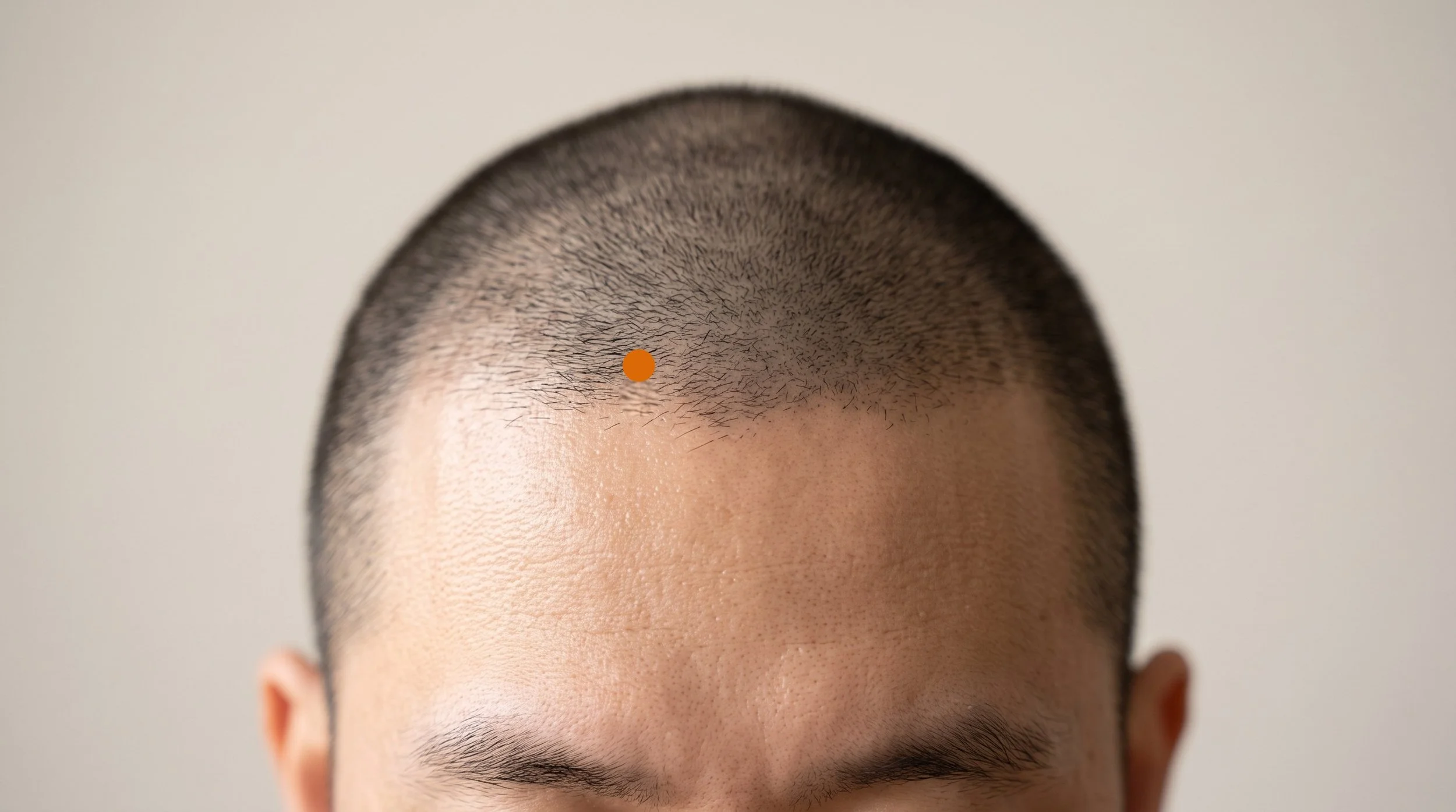
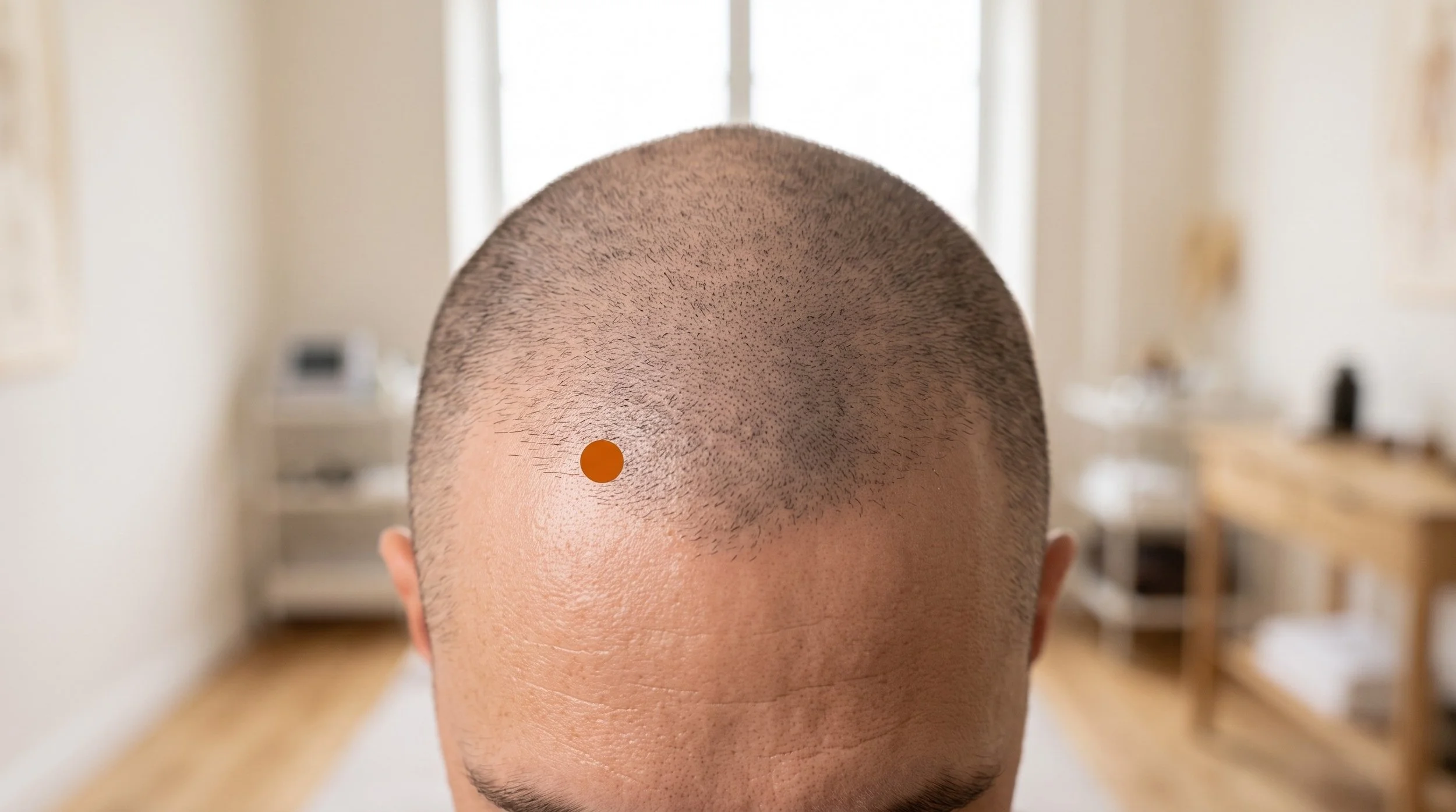
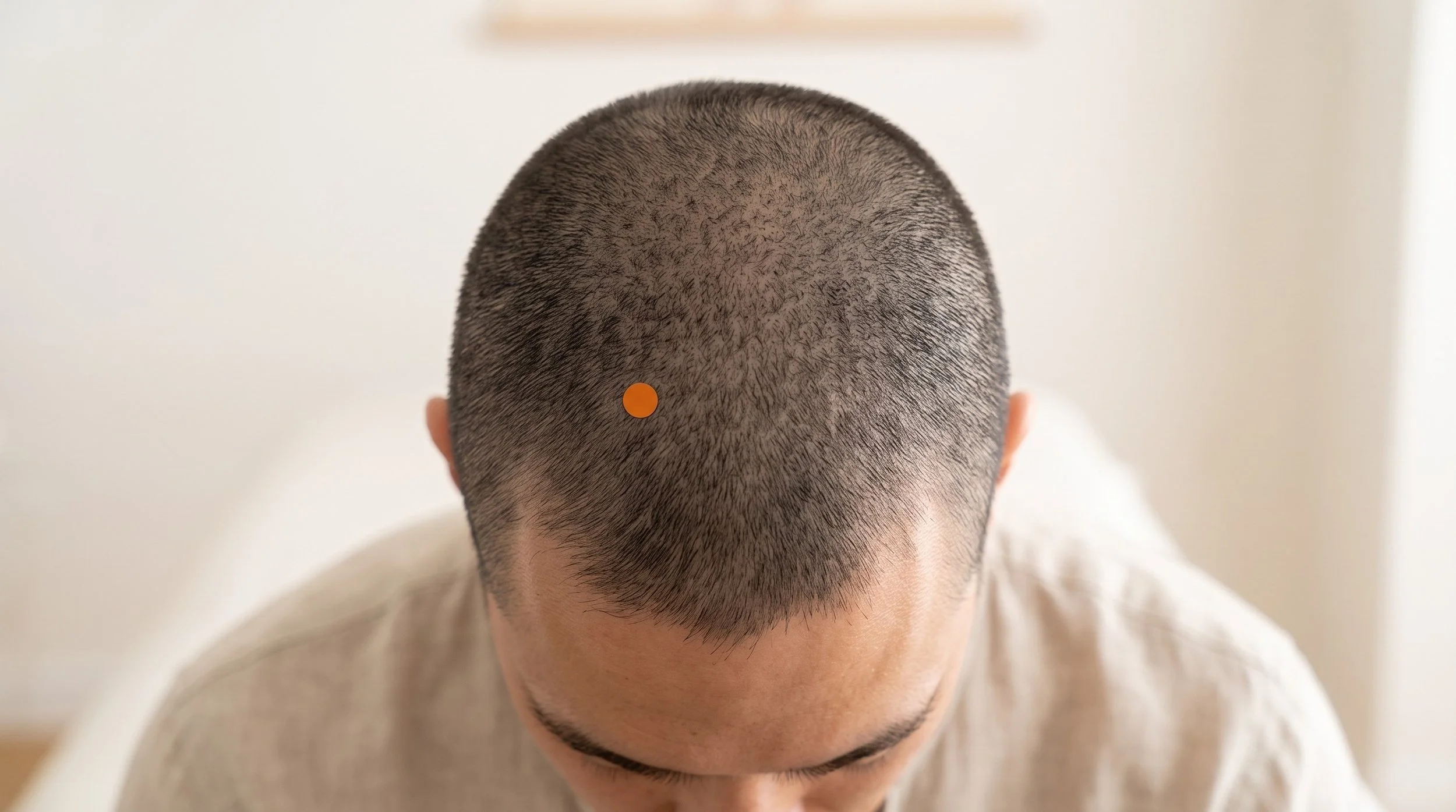
BL6 (Chengguang, translated as Receiving Light) is the sixth point of the Bladder channel and sits on the top of the head, roughly 2.5 cun behind the front hairline and 1.5 cun out from the midline, one and a half cun behind BL5.
In plain terms, if you draw a line from the inner edge of the eyebrow straight back over the skull, BL6 lands on that line about two finger widths behind the hairline, in the flat parietal region where the scalp glides over bone. It matters clinically because this small patch of tissue sits at the meeting ground of two sensory territories, the trigeminal supply that covers the front of the head and the upper cervical supply that covers the back, which is exactly the neural crossroads implicated in headaches that spread from the neck to the crown or forward toward the eyes and nose.
Classical sources also treat the bl6 acupuncture point as a head and sense organ point, listing it for vertex headache, dizziness, blurred vision, and a blocked nose with dulled sense of smell.
- The bl 6 location is straightforward once you find the hairline: 2.5 cun inside the anterior hairline and 1.5 cun lateral to the midline, which places it 1.5 cun behind BL5 on the same parasagittal line that continues to BL7 and BL8 (Deadman et al., 2007; Kim, 2013).
- Needling is transverse along the scalp, usually 0.5 to 1 cun, sliding the needle between the dense subcutaneous layer and the galea rather than aiming down at bone, and several classical and modern texts record this point as one to avoid with moxibustion (Deadman et al., 2007; O'Connor & Bensky, 1981).
- Traditional sources describe chengguang as a point that disperses wind and heat from the head and benefits the eyes and nose. Read neurophysiologically, that maps onto modulating sensitized head sensory pathways and influencing nasal and ocular autonomic tone rather than moving anything through the skull (Deadman et al., 2007; Kim, 2013).
- The mechanism story is largely trigeminocervical: scalp afferents converge with upper cervical input in the brainstem, needling recruits descending inhibitory control, and animal work suggests scalp points have anatomical relationships with trigeminal supply to the dura, while scalp needling has also been studied for its effects on cerebral blood flow regulation (Zhao, 2008; Wang et al., 2017; Jin et al., 2023).
- Research does not test chengguang point in isolation. Cochrane reviews of acupuncture for tension-type headache and episodic migraine, along with individual patient data meta-analysis for chronic pain, evaluate multi-point protocols in which scalp and head points like bladder 6 typically appear alongside distal points (Linde et al., 2016a; Linde et al., 2016b; Vickers et al., 2018).
- De qi at BL6 is usually modest and diffuse: a tight, spreading pressure or dull ache under the scalp that may travel a short distance along the needle's path, quite different from the heavy grabbing sensation patients notice in a limb muscle.
Headaches That Sit at the Top of Your Head?
Vertex headaches are frustrating because they rarely respond to the neck rub or the eye drops that patients try first. At Morningside Acupuncture we use BL6 as part of a scalp and suboccipital strategy, combining gentle transverse scalp needling with dry needling of the muscles that refer pain up over the skull. Treatment plans are built around your headache pattern, your triggers, and how your neck moves, not a fixed recipe. Schedule a visit and we'll map where your headaches actually start.
Schedule NowAnatomy of BL6: Why the Parietal Scalp Is Such an Important Location
The scalp is built in layers, and BL6 passes through all the shallow ones. Under the skin sits a dense, fibrous fat layer packed with small vessels and nerves, then the galea aponeurotica, the tough sheet that links the frontal and occipital bellies of the occipitofrontalis muscle across the top of the skull. Beneath the galea is a loose gliding layer, then periosteum and parietal bone.
Because the galea is continuous front to back, sustained tension in the forehead, the occipital region, or the temporal fascia can load this sheet from any direction, which is one reason patients describe scalp tenderness in a band rather than a spot. Chronic jaw clenching, prolonged forward head posture, and long screen sessions all tend to leave this tissue feeling tight and sensitive to light touch.
The nerve geography here is the clinically interesting part. The front of the scalp is supplied by branches of the ophthalmic division of the trigeminal nerve, while the back and vertex receive input from the greater occipital nerve arising from the upper cervical roots, with the two territories meeting in the parietal region where BL6 sits. Those trigeminal and upper cervical afferents converge onto shared second-order neurons in the trigeminocervical complex, which is why neck-driven pain can be felt at the crown or behind the eye.
Needling in this transition zone provides segmental input to that same convergence pool, and repeated stimulation may recruit descending inhibitory pathways involving endogenous opioid and monoamine systems that reduce how strongly those neurons respond (Zhao, 2008).
Experimental work in animals has also examined anatomical and functional relationships between scalp acupoints, trigeminal afferents, and the dura, offering one plausible route by which surface scalp stimulation could influence intracranial sensory processing (Wang et al., 2017), and reviews of scalp needling have proposed effects on cerebral blood flow regulation as an additional mechanism (Jin et al., 2023).
There is no dangerous deep structure at BL6, which is part of why it is a comfortable point to teach. The bone lies immediately beneath the loose areolar layer, and a transverse needle angled almost flat to the skin stays in the superficial tissue plane the whole way.
The practical caution is vascular: the scalp is richly supplied by branches of the superficial temporal and occipital arteries and their accompanying veins, and small vessels here bleed readily and can raise a visible bump if pressure is not applied on withdrawal. Standard technique is a shallow transverse insertion of about 0.5 to 1 cun directed forward or backward along the channel line, with clean technique and firm pressure after removal (Deadman et al., 2007). Several classical and modern texts also list this point as contraindicated to moxibustion, a note worth respecting in a hair-bearing region.
Related Best Acupuncture Points For Headaches Related Bladder ChannelBL6 at a Glance: Classification, Location, and Clinical Use
| Category | Detail |
|---|---|
| Traditional Name | Chengguang (Receiving Light), also translated as Support Light or Receive Light |
| Channel Classification | Sixth point of the Bladder channel of foot taiyang, on the vertex region of the scalp |
| Point Categories | No five-shu, yuan, luo, xi-cleft, hui-meeting, or extraordinary vessel intersection designations are recorded for this point in the standard references. It is an ordinary channel point of the Bladder taiyang line as it crosses the top of the head, grouped with BL5, BL7, and BL8. |
| Precise Location | On the head, 2.5 cun within the anterior hairline and 1.5 cun lateral to the anterior midline, which places it 1.5 cun posterior to BL5 (Wuchu) on the same line |
| Tissue Stimulated | Scalp skin, dense subcutaneous fibrofatty layer, and the galea aponeurotica overlying the occipitofrontalis system; clinically related myofascial targets include the Suboccipital Trigger Points that refer pain up over the side and top of the head |
| Needle Depth / Direction | Transverse (nearly flat) insertion along the scalp, anteriorly or posteriorly, about 0.5 to 1 cun; several classical and modern texts list the point as contraindicated to moxibustion |
| De Qi Sensation | Mild, diffuse tightness or pressure under the scalp, sometimes a dull spreading ache along the needle track; heaviness rather than sharpness, and usually less intense than limb points |
| Primary Clinical Uses | Vertex headache and diffuse head pressure; traditionally listed for dizziness, blurred or obstructed vision, nasal congestion with clear discharge, and reduced sense of smell |
| Common Point Combinations |
|
In the traditional literature summarized by Deadman, Al-Khafaji, and Baker, chengguang is credited with dispersing wind and clearing heat from the head while benefiting the eyes and nose. Its recorded indications cluster tightly around the sense organs and the top of the head: pain at the vertex, wind dizziness, visual obstruction and blurring, copious clear nasal discharge with congestion, and an inability to distinguish smells, along with a smaller set of odder entries such as vomiting, restlessness of the Heart with vomiting, and febrile illness without sweating.
The classical formula collections keep the same company. The Thousand Ducat Formulas group it with BL2 and points around the eye and ear for wind headache, while Supplementing Life pairs it with midline governing vessel points for a blocked nose with lost smell. What stands out is the consistency: nearly every entry concerns the head, the face, or the sense organs, exactly the region whose sensory supply converges in the brainstem, and that anatomical coherence is what makes the traditional attribution worth reading closely rather than dismissing.
Why BL6 Is Used for Vertex Headache and a Blocked, Dulled Nose
The link between a point on the crown of the head and pain that patients feel deep behind the eyes comes down to convergence. Sensory fibers from the forehead and scalp travel with the trigeminal nerve, fibers from the back of the head arrive through the greater occipital nerve from the upper cervical spine, and both funnel onto shared neurons in the trigeminocervical complex of the brainstem. When those neurons become sensitized, the brain loses precision about where the input is coming from, so a tight suboccipital region can be experienced as pressure at the top of the head or an ache behind the eye.
Needling at BL6 delivers input into the same convergent territory, and the aim is not to chase the pain but to change how readily that pool of neurons fires (Zhao, 2008).
Beyond the segmental story, needling recruits descending inhibitory pathways from the midbrain and brainstem that dampen incoming pain signals, with endogenous opioid and monoamine mechanisms among the best characterized effects (Zhao, 2008).
There is also point-adjacent physiological work worth knowing about. Animal experiments have examined how scalp acupoints relate anatomically to trigeminal afferents supplying the dura, one proposed route by which surface stimulation might reach intracranial structures (Wang et al., 2017), and a review of scalp acupuncture has argued that changes in cerebral blood flow regulation may contribute to its effects in brain-related conditions (Jin et al., 2023). Both lines of evidence remain preliminary and neither was conducted on BL6 specifically.
The nose and eye indications follow a similar logic. The nasal mucosa and the eye receive both trigeminal sensory supply and dense autonomic innervation that governs blood flow and secretion, so stimulation within trigeminal territory may plausibly shift local vascular and glandular tone. Clinical reviews of acupuncture for allergic rhinitis suggest modest improvements in nasal symptoms and quality of life compared with sham and no treatment, though the trials use full multi-point protocols and the certainty of evidence is limited (Yin et al., 2020). We frame BL6 here as a supporting local point rather than the driver of the result.
What the Research Shows for BL6
It is worth being direct about what the research can and cannot tell us. No trial has isolated BL6, and no study has compared a protocol with chengguang against the same protocol without it. What the literature evaluates is whole treatment courses in which head and scalp points sit alongside neck and distal points, so the honest framing is that BL6 is one component of protocols that have been tested, not an independently validated intervention.
Reviews of acupuncture for headache generally report modest benefits over usual care and smaller, less certain differences against sham needling, and effect sizes should be read with that context in mind.
| Study | Type | Focus | Key Finding |
|---|---|---|---|
| Linde et al., 2016a | Cochrane systematic review | Acupuncture for prevention of tension-type headache | The reviewers concluded that a course of at least six sessions may be a worthwhile option for people with frequent tension-type headache, with benefit over usual care and smaller differences versus sham. |
| Linde et al., 2016b | Cochrane systematic review | Acupuncture for prevention of episodic migraine | Adding acupuncture to usual care reduced headache frequency compared with usual care alone, with moderate certainty evidence and only small advantages over sham needling. |
| Vickers et al., 2018 | Individual patient data meta-analysis | Chronic pain conditions including chronic headache | Acupuncture was associated with greater pain reduction than sham and no-acupuncture controls, with effects that persisted over follow-up but were modest against sham. |
| Yin et al., 2020 | Systematic review and Bayesian network meta-analysis | Acupuncture methods for allergic rhinitis | Acupuncture approaches outperformed sham on nasal symptom and quality of life scores, though the analysis pooled varied protocols and cannot speak to any single point. |
| Wang et al., 2017 | Experimental animal study | Anatomical relationship between scalp acupoints, trigeminal afferents, and the dura | The authors proposed a trigeminal route linking scalp points to intracranial structures, a preliminary mechanistic finding rather than clinical evidence. |
| Jin et al., 2023 | Narrative mechanistic review | Scalp acupuncture and neural control of cerebral blood flow | The review argues that effects on cerebral blood flow regulation may help explain scalp acupuncture outcomes, while noting the hypothesis needs stronger validation. |
Stuffy Head, Dull Sense of Smell, Pressure Behind the Face?
Classical texts paired chengguang with points around the nose and forehead for congestion and a blunted sense of smell, and modern practice still works that region for sinus pressure and post-viral stuffiness. We combine scalp points with facial and distal needling, and we are careful to refer out when a medical workup is the right next step. Many patients notice their head feels lighter and clearer before the congestion itself fully settles. Book a consultation to see whether acupuncture fits your case.
Schedule NowBL6 in the Context of Trigger Point Work
Acupuncture, defined as the use of an acupuncture needle, covers hundreds of styles including dry needling, and at Morningside we move between those frames in a single session. BL6 itself is not a muscular trigger point target: it sits in the galea, and the tissue there does not contain taut bands in the way a limb muscle does. What it does sit within is the referral field of several muscles that commonly produce head pain.
The suboccipital group refers a deep ache that wraps from the back of the skull toward the eye and over the vertex, and the sternocleidomastoid and upper trapezius carry their own well-mapped head referral patterns (Simons et al., 1999). When a patient's scalp feels tender to light touch over the parietal region, that sensitivity is often downstream of these neck sources rather than a problem originating in the scalp.
A typical session therefore layers the two approaches. We treat the mechanical drivers first with dry needling of the [suboccipital muscles](https://www.morningsideacupuncturenyc.com/suboccipital-trigger-points), upper trapezius, and sometimes the temporalis or lateral pterygoid when clenching is part of the picture, then add scalp needling at BL6 and neighboring Bladder line points to provide input into the same convergent sensory territory the neck feeds.
Distal points such as [LI4](https://www.morningsideacupuncturenyc.com/blog/li4-acupuncture-point) and [LV3](https://www.morningsideacupuncturenyc.com/blog/lv3-acupuncture-point) round out the treatment. Patients often report that the pressure at the crown eases before the neck tightness fully resolves, which is a useful sign that the sensory picture is settling.
BL6 Headache Treatment at NYC's Highest-Rated Acupuncture Clinic
Morningside Acupuncture is the highest-rated acupuncture and dry needling clinic in New York City with over 500 five-star Google reviews, and headache care is one of the things we treat most. We integrate scalp points such as BL6, trigger point dry needling of the suboccipitals and upper trapezius, and practical guidance on posture, sleep, and screen habits. Every plan is explained clearly, so you know why each needle goes where it does. Schedule your appointment on the Upper West Side and let's get your head quiet again.
Schedule NowFrequently Asked Questions
What does BL6 feel like when needled?
Most people feel a brief pinch as the needle passes the skin, then a mild tight or full sensation under the scalp that may spread a short distance forward or backward. Because the insertion is transverse and shallow, it rarely produces the strong heavy grabbing feeling associated with deeper muscular points. Some patients notice a warm or slightly buzzing quality across the top of the head, and a few feel almost nothing, which is normal for scalp needling and does not mean the treatment is not working.
Why needle the top of the head for a headache I feel behind my eyes or in my neck?
Because the head does not have neat sensory borders. Nerves from the front of the scalp travel with the trigeminal system, nerves from the back arrive from the upper cervical spine, and both converge on shared neurons in the brainstem. That convergence is why a tight neck can be felt as pressure at the crown or behind the eye, and it is also why input at a vertex point like BL6 can influence pain experienced elsewhere in the head (Zhao, 2008). In practice we usually treat both ends, the scalp and the neck, rather than choosing between them.
Can I press BL6 myself between sessions?
Yes, and it is easy to reach. Find the top of your forehead where the hairline sits, move back about two finger widths, then slide out about one and a half finger widths from the midline so you are on a line running back from the inner edge of the eyebrow. Use a fingertip or thumb pad to press with steady, moderate pressure, or make small circles, for 30 to 60 seconds per side. Repeat two or three times, and feel free to run your fingertips backward along the same line toward BL7 and BL8. Two to three short rounds a day is plenty. Stop if pressure sharpens the headache rather than easing it, and skip the area entirely if the scalp is broken, sunburned, or inflamed.
Is BL6 safe to needle?
In trained hands, yes. There are no organs or major vessels at risk because the needle runs flat within the superficial scalp layers and never approaches depth. The realistic issue is bleeding: the scalp is well supplied with small vessels, so minor bleeding or a small lump under the skin can occur, which is why practitioners apply firm pressure on withdrawal. Tell your acupuncturist if you take blood thinners. Several classical and modern texts also list this point as contraindicated to moxibustion, so heat is not applied here.
Where exactly is BL6 located?
The bl 6 location is on the head, 2.5 cun inside the anterior hairline and 1.5 cun lateral to the midline, which is 1.5 cun directly behind BL5 on the same parasagittal line. A workable landmark is to trace straight back from the inner end of the eyebrow: that line carries the Bladder channel across the scalp through BL3, BL4, BL5, BL6, BL7, and BL8. If the hairline is receded or indistinct, practitioners use standard proportional measurements from the glabella and vertex rather than eyeballing the hair itself, since the distance from the midline hairline to GV20 is measured as 5 cun.
References
- Deadman, P., Al-Khafaji, M., & Baker, K. (2009). A manual of acupuncture. Journal of Chinese Medicine Publications.
- Kim, H. (2008). Handbook of Oriental medicine (3rd ed.). Harmony & Balance Press.
- O'Connor, J., & Bensky, D. (Eds. & Trans.). (1981). Acupuncture: A comprehensive text. Shanghai College of Traditional Medicine. Eastland Press.
- Simons, D. G., Travell, J. G., & Simons, L. S. (1999). Travell & Simons' myofascial pain and dysfunction: The trigger point manual, Vol. 1: Upper half of body (2nd ed.). Williams & Wilkins.
- Linde, K., Allais, G., Brinkhaus, B., Fei, Y., Mehring, M., Shin, B. C., Vickers, A., & White, A. R. (2016a). Acupuncture for the prevention of tension-type headache. Cochrane Database of Systematic Reviews, 2016(4), CD007587. https://doi.org/10.1002/14651858.CD007587.pub2
- Linde, K., Allais, G., Brinkhaus, B., Fei, Y., Mehring, M., Vertosick, E. A., Vickers, A., & White, A. R. (2016b). Acupuncture for the prevention of episodic migraine. Cochrane Database of Systematic Reviews, 2016(6), CD001218. https://doi.org/10.1002/14651858.CD001218.pub3
- Vickers, A. J., Vertosick, E. A., Lewith, G., MacPherson, H., Foster, N. E., Sherman, K. J., Irnich, D., Witt, C. M., & Linde, K. (2018). Acupuncture for chronic pain: Update of an individual patient data meta-analysis. Journal of Pain, 19(5), 455-474. https://doi.org/10.1016/j.jpain.2017.11.005
- Zhao, Z. Q. (2008). Neural mechanism underlying acupuncture analgesia. Progress in Neurobiology, 85(4), 355-375. https://doi.org/10.1016/j.pneurobio.2008.05.004
- Yin, Z., Geng, G., Xu, G., Zhao, L., & Liang, F. (2020). Acupuncture methods for allergic rhinitis: A systematic review and bayesian meta-analysis of randomized controlled trials. Chinese Medicine, 15, 109. https://doi.org/10.1186/s13020-020-00389-9
- Wang, S., Liu, K., Wang, Y., Wang, S., He, X., Cui, X., Gao, X., & Zhu, B. (2017). A proposed neurologic pathway for scalp acupuncture: Trigeminal nerve-meninges-cerebrospinal fluid-contacting neurons-brain. Medical Acupuncture, 29(5), 322-326. https://doi.org/10.1089/acu.2017.1231
- Jin, G. Y., Jin, L. L., Jin, B. X., Zheng, J., He, B. J., & Li, S. J. (2023). Neural control of cerebral blood flow: Scientific basis of scalp acupuncture in treating brain diseases. Frontiers in Neuroscience, 17, 1210537. https://doi.org/10.3389/fnins.2023.1210537
Disclaimer: This web site is intended for educational and informational purposes only. Reading this website does not constitute providing medical advice or any professional services. This information should not be used for diagnosing or treating any health issue or disease. Those seeking medical advice should consult with a licensed physician. Seek the advice of a medical doctor or other qualified health professional for any medical condition. If you think you have a medical emergency, call 911 or go to the emergency room. No acupuncturist-patient relationship is created by reading this website or using the information. Morningside Acupuncture PLLC and its employees and contributors do not make any express or implied representations with respect to the information on this site or its use. For any legal interpretation of scope of practice in your state, consult a licensed attorney or regulatory authority.
Read more from our blog