BL8 Acupuncture Point (Luoque)
BL8 Acupuncture Point (Luoque)
The Declining Connection Behind the Vertex: Anatomy, Mechanism, and Why This Posterior Scalp Point Is Used for Dizziness, Tinnitus, and Head Pressure
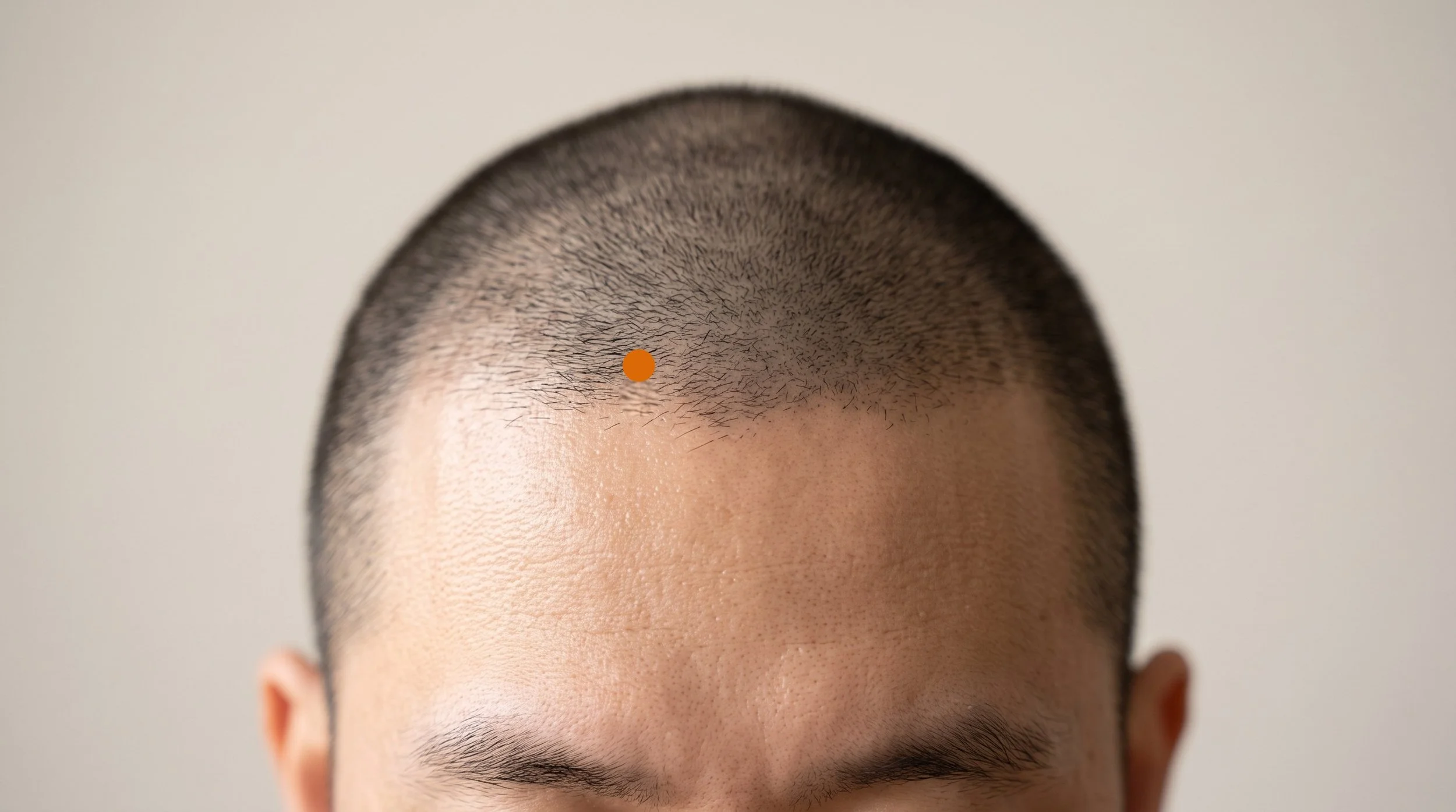
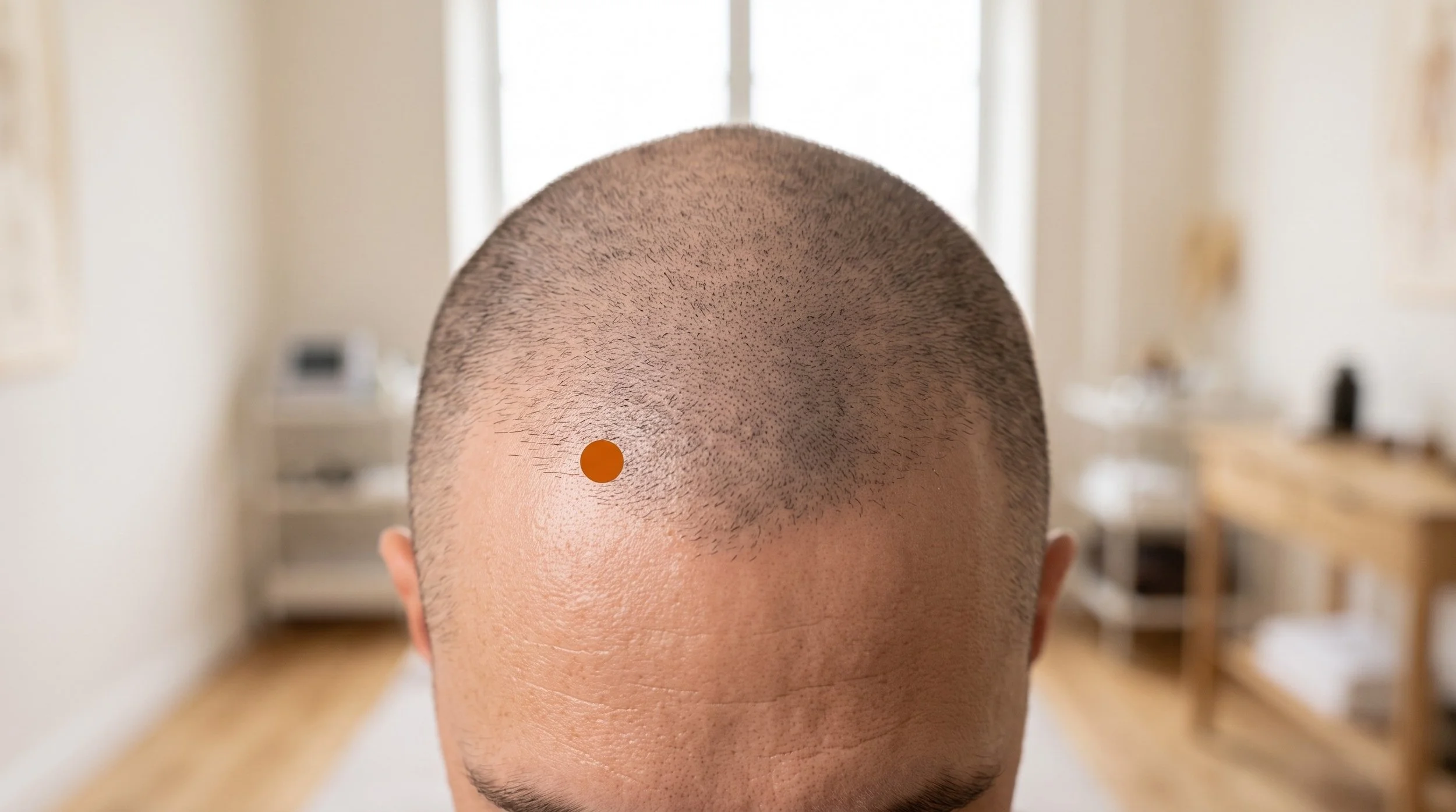
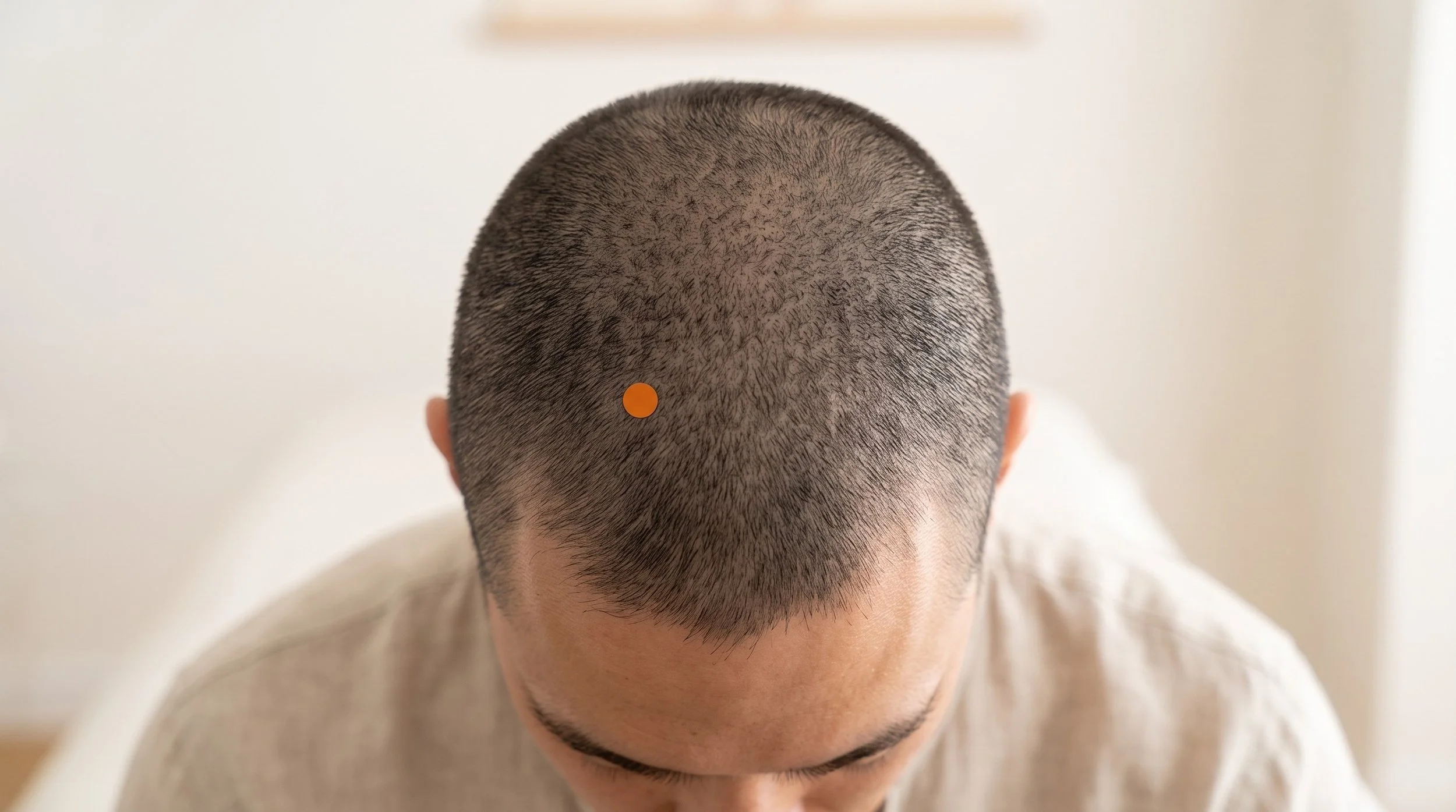
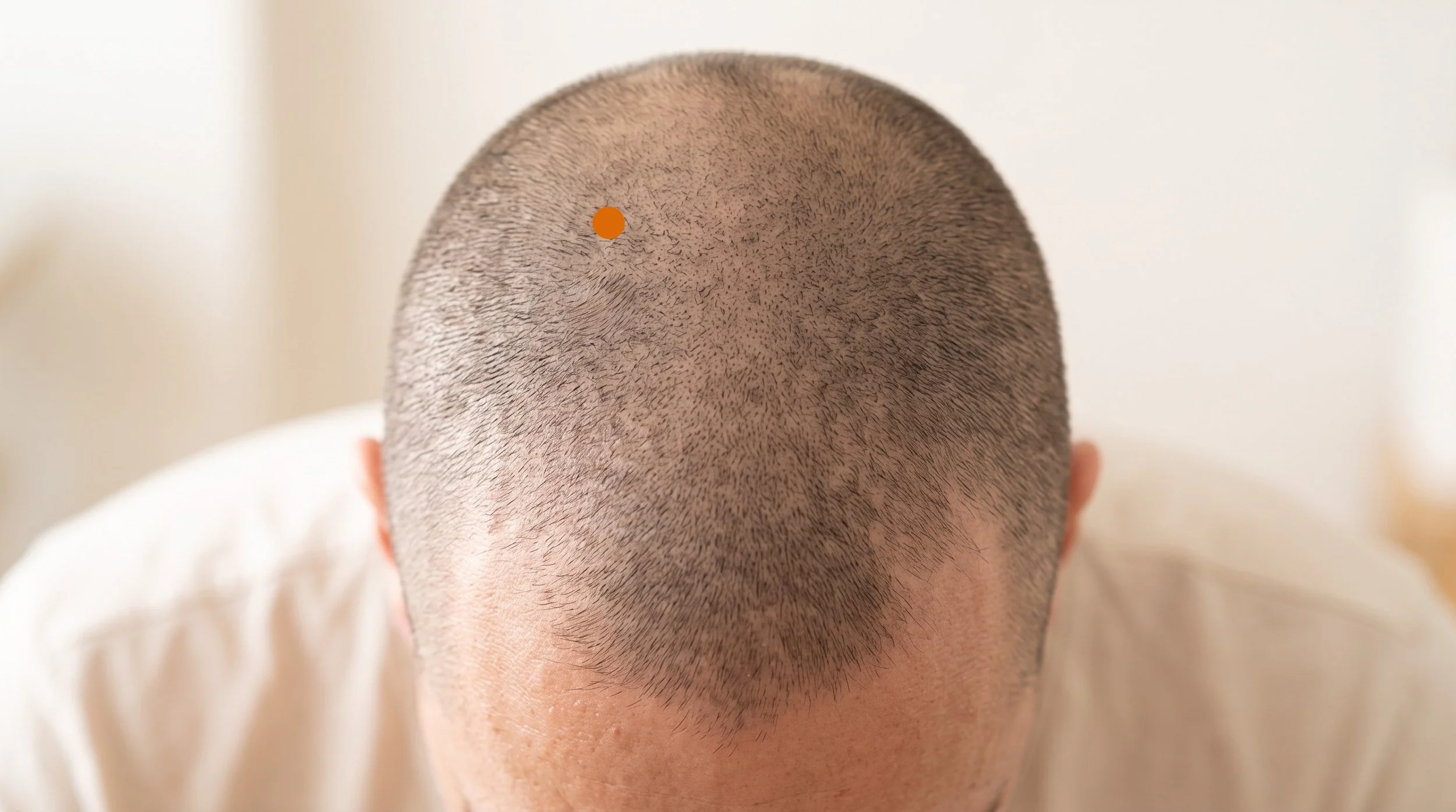
BL8 (Luoque), often translated as Declining Connection, sits on the posterior parietal scalp where the Bladder channel crests the top of the head and begins its descent toward the occiput. In plain terms, the bl 8 location is a fingertip's distance behind and to the side of the crown: 1.5 cun lateral to the midline and 5.5 cun back from the front hairline, which in practice puts it about 1.5 cun to the side of GV20 and roughly half a cun behind it.
Bladder 8 is a small, quiet point that rarely headlines a treatment plan, yet it earns its place in scalp work for patients whose main complaints are pressure at the back and top of the head, unsteadiness, visual fuzziness with head movement, and ringing in the ears. Because the tissue here is thin and firmly anchored, the bl8 acupuncture point is needled flat under the scalp rather than straight in, which makes it comfortable, easy to combine with neighbouring points, and simple to thread toward whichever direction the symptom pattern suggests.
- Location and layers: BL8 lies 1.5 cun posterior to BL7, 1.5 cun lateral to the midline and 5.5 cun inside the anterior hairline, with skin, dense fibro-fatty subcutaneous tissue, the galea aponeurotica, a loose areolar plane and pericranium stacked over the parietal bone. Needling is transverse (0.5 to 1 cun), so the needle travels within the subcutaneous and galeal layers rather than toward bone.
- Traditional attribution, restated: classical texts credit Luoque with benefiting the sense organs, settling wind, transforming phlegm and calming the spirit, and list dizziness, tinnitus, blurred vision, nasal congestion and agitated mental states among its indications. Modern language would describe the same territory as head-pressure, vestibular and sensory-sensitivity patterns rather than any literal movement of qi.
- Nerve geography: the posterior scalp here is supplied by branches of the greater occipital nerve (C2) blending toward vertex territory, and upper cervical afferents converge with trigeminal afferents in the trigeminocervical complex, which is the standard explanation for why occipital and vertex input can change frontal and retro-orbital head symptoms (Zhao, 2008).
- Mechanism beyond the local area: needling activates A-delta and C fibre input that engages descending inhibitory pathways from the periaqueductal grey and rostroventromedial medulla, alongside segmental modulation at the dorsal horn (Zhao, 2008). Autonomic and vascular effects have also been proposed, and vertigo trials commonly measure vertebrobasilar flow velocity as an outcome (Li et al., 2022).
- Research picture: no trial isolates BL8, but the point sits inside protocols tested for headache and dizziness. Cochrane reviews report that acupuncture reduces headache frequency in tension-type headache and episodic migraine (Linde et al., 2016a; Linde et al., 2016b), individual patient data support persisting effects in chronic pain (Vickers et al., 2018), and vertigo and tinnitus reviews are more mixed and lower in certainty (Hou et al., 2017; Huang et al., 2021).
- Clinical framing and sensation: BL8 is a supporting point, chosen when scalp tension, head heaviness or dizziness accompanies a neck-driven picture, and it pairs naturally with GV20, BL7, BL9 and GB20. Threaded needling under the scalp gives a dull spreading tightness or a mild warm ache rather than the heavy distension patients notice at limb points, and the sensation usually fades within a minute or two.
Dizzy, Foggy, or Feeling Pressure at the Back of Your Head?
Unsteadiness and head heaviness often travel together with tight suboccipital muscles, jaw clenching, and long hours at a screen. At Morningside Acupuncture we use BL8 alongside GV20, GB20, and dry needling of the upper cervical muscles to reduce scalp and neck tension and to calm an over-reactive head-neck system. Treatment is paired with simple posture and breathing work you can carry between visits. Schedule a session and let's map out where your symptoms are actually coming from.
Schedule NowAnatomy of BL8: Why the Posterior Parietal Scalp Is Such an Important Location
The scalp at BL8 is a compact, layered structure. Under the hair-bearing skin lies a dense subcutaneous layer packed with fibrous septa, small arteries and sensory nerve branches, and beneath that sits the galea aponeurotica, the tough sheet that links the frontal and occipital bellies of the occipitofrontalis muscle. Below the galea is a loose areolar plane that lets the scalp glide, and then the pericranium over the parietal bone.
What loads this region is not muscular effort at the point itself but sustained pull transmitted from below: chronically shortened suboccipital, semispinalis and splenius capitis muscles tug on the occipital attachment of the galea, and patients often describe the result as a tight cap, a band, or pressure sitting on top of the head.
Sensory supply to this part of the scalp comes largely from the greater occipital nerve, a cutaneous continuation of the C2 dorsal ramus that ascends across the occiput and fans forward toward the vertex, meeting territory served by the trigeminal system further front. That anatomical handshake matters clinically, because upper cervical afferents and trigeminal afferents converge on shared second-order neurons in the trigeminocervical complex, so input from the back of the head can influence how the front of the head and the face are perceived.
Needling activates small-diameter afferents that recruit segmental inhibition and descending control from brainstem structures, with endogenous opioid and monoamine systems involved (Zhao, 2008). This is also why patients sometimes report that a scalp point changes sensations well away from where the needle sits.
Vascularly, the area is served by branches of the occipital artery and vein, which anastomose freely with the superficial temporal and posterior auricular vessels. Scalp vessels are held open by the fibrous subcutaneous layer, so pinpoint bleeding or a small bruise is the most common minor event here, and pressure for thirty seconds after withdrawal usually settles it. Standard technique for BL8 is transverse insertion along the scalp, generally 0.5 to 1 cun, angled toward BL7, BL9, or GV20 depending on the pattern being treated.
There is no deep cavity or organ at risk under an adult parietal bone, but sensible caution applies with unfused fontanelles in infants, craniotomy sites, cranial hardware or shunts, and in patients on anticoagulants.
Related Bladder Channel Related Acupuncture For Suboccipital MusclesBL8 at a Glance: Classification, Location, and Clinical Use
| Category | Detail |
|---|---|
| Traditional Name | Luoque (Declining Connection), Bladder 8 |
| Channel Classification | Eighth point of the Bladder (Taiyang) channel of the foot, on the posterior scalp |
| Point Categories | No five-shu, luo-connecting, xi-cleft, hui-meeting or extraordinary vessel designation is recorded for this point in the standard manuals. It is classified simply as a Bladder channel point of the head, with traditional actions given as benefiting the sense organs, pacifying wind, transforming phlegm and calming the spirit. |
| Precise Location | On the head, 5.5 cun within the anterior hairline and 1.5 cun lateral to the midline, 1.5 cun posterior to BL7. Most easily found as the spot 1.5 cun lateral to and about 0.5 cun behind GV20. |
| Tissue Stimulated | Scalp skin, subcutaneous fibro-fatty layer and galea aponeurotica over the parietal bone, in greater occipital (C2) sensory territory. Functionally linked to tension in the suboccipital muscles below. |
| Needle Depth / Direction | Transverse (threaded) insertion along the scalp, 0.5 to 1 cun, angled posteriorly toward BL9, anteriorly toward BL7, or medially toward GV20 as the pattern suggests. Fine gauge needles are preferred. |
| De Qi Sensation | A dull spreading tightness, mild ache, or warm pressure under the scalp, sometimes travelling a short distance along the threaded direction. Brief sharpness on entry is common because scalp skin is richly innervated, and it should settle immediately. |
| Primary Clinical Uses | Traditionally listed for dizziness, tinnitus, blurred vision, nasal congestion and disorientation; used clinically today for posterior scalp tension, head heaviness and pressure, and as a supporting scalp point in headache and cervicogenic dizziness protocols. |
| Common Point Combinations |
|
In Deadman's A Manual of Acupuncture, Luoque is presented as a point that benefits the sense organs, settles wind, transforms phlegm and calms the spirit, with indications spanning dizziness, tinnitus, blurred vision, nasal congestion, deviation of the mouth, goitre, vomiting, abdominal fullness, disorientation and collapse.
Older sources add texture to that list: the Thousand Ducat Formulas pair BL8 with BL7 for collapse on standing up suddenly and fold it into a longer formula for disturbed mental states with vomiting, while the Great Compendium places it inside a broad tinnitus prescription combining ear-region points, vertex points, and distal points on the arm channels.
The name itself is instructive as traditional imagery: luo refers to the connecting relationship between the Bladder line and the vertex, and que to the point where the channel, having passed the highest part of the head, starts its decline toward the occiput and back.
What is striking is how consistently the classical indications cluster around head orientation and the special senses, hearing, vision, and balance, rather than around pain, which is exactly the niche this point still occupies in modern scalp work.
Why BL8 Is Used for Dizziness and Ringing in the Ears, Far From Either Organ
Patients are often puzzled that a point on the back of the scalp is chosen for symptoms they associate with the inner ear. The answer starts with convergence. Sensory fibres from the upper cervical segments, including the greater occipital nerve that supplies the skin around BL8, share second-order neurons in the brainstem with trigeminal fibres from the face and head, and upper cervical input also interacts with vestibular processing. When neck and scalp tissues are chronically irritated, that shared circuitry can be biased toward reporting pressure, unsteadiness, and heightened sensitivity to sound and light.
Needling in this territory feeds a competing, well-localized signal into the same pathways, and small-fibre activation recruits segmental inhibition plus descending control from the periaqueductal grey and medullary structures, using endogenous opioid and monoamine mechanisms (Zhao, 2008).
A second thread is vascular and autonomic. Reviews of acupuncture for cervical and posterior circulation vertigo have used vertebrobasilar blood flow velocity as an outcome, and pooled analyses report changes in these measures alongside symptom scores, though the certainty of the evidence is low and the trials are heterogeneous (Hou et al., 2017; Li et al., 2022). It is fair to say that plausible autonomic and vascular effects exist and are being measured, and unfair to claim they are settled.
For tinnitus, the picture is more restrained still: a meta-analysis found no significant advantage on the primary visual analogue outcome, with favourable results only on secondary handicap and severity indices (Huang et al., 2021).
In practice, that evidence base shapes how BL8 is used rather than whether it is used. It is a supporting point in a plan that usually includes upper cervical work, jaw assessment if relevant, and distal points, not a stand-alone answer to dizziness or tinnitus. When head pressure and unsteadiness clearly track with neck tension, screen posture, or clenching, patients often notice the scalp feels less tight and the head feels lighter within a session or two, and that change is a useful signal about whether the neck-driven hypothesis is right.
What the Research Shows for BL8
There is no clinical trial that tests BL8 by itself, and any honest account of the research has to start there. What exists are trials and reviews of multi-point protocols for headache, dizziness, and tinnitus, in which posterior scalp and vertex points appear as part of a larger prescription. The reasonable inference is that BL8 contributes to the local scalp and upper cervical component of these protocols rather than driving the result on its own, and the tables below are best read as evidence about the approach, not the point.
| Study | Type | Focus | Key Finding |
|---|---|---|---|
| Linde et al., 2016a | Cochrane systematic review | Acupuncture for the prevention of tension-type headache (12 trials, 2349 adults) | Adding acupuncture to routine care was associated with fewer headache days, with small additional benefit over sham in the pooled analysis. |
| Linde et al., 2016b | Cochrane systematic review | Acupuncture for the prevention of episodic migraine | Acupuncture reduced migraine frequency compared with usual care and sham, and appeared at least as effective as prophylactic drug treatment, though evidence quality varied. |
| Vickers et al., 2018 | Individual patient data meta-analysis | Chronic pain conditions including chronic headache, roughly 21,000 patients | Acupuncture outperformed both sham and no-acupuncture controls, with effects that persisted over time rather than fading quickly. |
| Hou et al., 2017 | Systematic review and meta-analysis | Acupuncture for cervical vertigo (10 trials, 914 participants) | Acupuncture appeared more effective than conventional drug therapy on vertigo outcomes, but the authors graded the evidence as low to very low certainty. |
| Li et al., 2022 | Systematic review and meta-analysis | Acupuncture for posterior circulation infarction vertigo (20 trials, 1541 participants) | Pooled data suggested changes in vertebrobasilar blood flow velocity and clinical response when acupuncture was added to medication, within a heterogeneous evidence base. |
| Huang et al., 2021 | Systematic review and meta-analysis | Acupuncture for tinnitus (8 trials, 504 participants) | No significant effect on the primary visual analogue outcome, with favourable results limited to secondary handicap and severity measures. |
| Zhao, 2008 | Narrative review of mechanism research | Neural mechanisms of acupuncture analgesia | Describes segmental modulation and descending inhibitory control with opioid and monoamine involvement, the framework used to explain scalp and neck point effects. |
Tinnitus, Ear Fullness, and Head Tension in One Picture?
Many patients with ringing or fullness in the ears also carry jaw, upper neck, and scalp tension that makes the sound feel louder. Traditional texts placed Luoque among the points said to benefit the sense organs, and we use it as part of a broader plan with local ear points, upper cervical needling, and stress-focused care. Results vary and research on tinnitus remains mixed, so we set expectations honestly and track your response session by session. Book a consultation to talk through what a realistic trial of care looks like.
Schedule NowBL8 in the Context of Trigger Point Work
Acupuncture at Morningside means the use of an acupuncture needle, which covers hundreds of styles including dry needling, so a session that includes BL8 rarely stops at the scalp. The muscles that most often reproduce the symptoms patients bring to this point sit below it: the suboccipitals (rectus capitis posterior major and minor, obliquus capitis superior and inferior), semispinalis capitis, splenius capitis, and upper trapezius.
Referral patterns from these muscles are well documented and include a deep, hard-to-localize ache spreading through the back of the head toward the eye, a band around the head, and pain climbing to the vertex and temple (Simons et al., 1999). When those patterns match what a patient describes, needling the muscle bellies addresses the driver while scalp points such as BL8, BL7, and GV20 address the tissue where the symptom is actually felt.
There is no muscle belly at BL8 itself, only the galea and the thin subcutaneous layer, so the point is not a trigger point target in the myofascial sense. What it offers is access to a sheet of tissue that is mechanically continuous with the occipital attachments below, plus a segmental entry into greater occipital nerve territory. A typical sequence is to treat the upper cervical and shoulder girdle muscles first, then add threaded scalp needles for the residual cap-like tightness, sometimes with gentle manual traction or breath work while the needles are retained.
Patients who describe pressure rather than sharp pain, and who feel worse after long screen sessions, tend to be the best responders to this combination.
BL8 Headache and Dizziness Treatment at NYC's Highest-Rated Acupuncture Clinic
Morningside Acupuncture is the highest-rated acupuncture and dry needling clinic in New York City with over 500 five-star Google reviews. Our licensed acupuncturists combine classical point selection, including posterior scalp points such as BL8 and BL7, with orthopedic assessment and trigger point needling of the neck and shoulder girdle. Every plan is built around your history, your imaging if you have it, and how your symptoms behave through the week. Schedule your first visit and start with a clear, structured assessment.
Schedule NowFrequently Asked Questions
What does BL8 feel like when needled?
Because BL8 is threaded flat under the scalp rather than inserted straight down, most people feel a brief sting as the needle passes the skin, then a dull spreading tightness, mild ache, or warmth that travels a short way along the direction of the needle. Some patients describe it as a small area of pressure, or as the scalp feeling snug and then loosening. The sharp part is over in a second or two, and the residual sensation typically fades to almost nothing while the needles are retained. Scalp points can feel more noticeable than limb points on entry simply because scalp skin is densely innervated, not because anything is wrong.
Why needle the back of the head for dizziness or ear symptoms rather than the ear itself?
Local ear points are often used too, but the posterior scalp gives access to a different part of the system. Sensory nerves from the upper neck, including the greater occipital nerve that supplies the skin around BL8, converge with trigeminal and vestibular pathways in the brainstem, so persistent irritation from tight upper cervical tissue can bias how the head reports pressure, balance, and sound sensitivity. Needling here provides a competing input into those shared circuits and engages descending inhibitory control (Zhao, 2008). Classical texts arrived at a similar clinical territory through different reasoning, listing Luoque for dizziness, tinnitus, and blurred vision.
Can I press BL8 myself between sessions?
Yes, and it is easy to find without a mirror. Place a fingertip on the crown of your head at the highest point roughly level with the tops of your ears (GV20), then move about two finger widths to one side and a little behind that spot. Press with the pad of your index or middle finger using firm, steady pressure, or make small circles, for 30 to 60 seconds per side, breathing slowly. Two or three rounds per session is plenty, and it can be repeated a few times a day. Many people find it more useful when combined with 30 seconds of pressure at the base of the skull just outside the midline (GB20 territory). Stop if pressure sharply worsens a headache, provokes nausea, or triggers dizziness, and do not press over any surgical site or skin lesion.
Is BL8 safe to needle?
In trained hands, yes. The point is needled transversely along the scalp to a depth of about 0.5 to 1 cun, so there is no deep structure at risk beneath an intact adult parietal bone. The main considerations are cosmetic and vascular: the scalp is well supplied by branches of the occipital artery and vein, so pinpoint bleeding or a small bruise can occur, and steady pressure after needle removal usually prevents it. Extra caution applies for patients on blood thinners, for anyone with cranial hardware, shunts, a craniotomy site, or a skull defect, and for infants with unfused fontanelles. Tell your acupuncturist about any of these before scalp needling.
Where exactly is BL8 located?
BL8 is on the posterior scalp, 1.5 cun lateral to the midline and 5.5 cun back from the anterior hairline, which places it 1.5 cun behind BL7 on the same line. The practical shortcut most clinicians use is to find GV20 at the crown, then measure about 1.5 cun to the side and roughly 0.5 cun behind it. If the front hairline is receded or indistinct, proportional measurement from the glabella is used instead of the visible hair edge. BL9 lies further back toward the occipital protuberance along the same channel line, so BL7, BL8, and BL9 form a short posterior arc over the top and back of the head.
References
- Deadman, P., Al-Khafaji, M., & Baker, K. (2009). A manual of acupuncture. Journal of Chinese Medicine Publications.
- Cheng, X. (Ed.). (1999). Chinese acupuncture and moxibustion (Rev. ed.). Foreign Languages Press.
- O'Connor, J., & Bensky, D. (Eds. & Trans.). (1981). Acupuncture: A comprehensive text. Shanghai College of Traditional Medicine. Eastland Press.
- Kim, H. (2008). Handbook of Oriental medicine (3rd ed.). Harmony & Balance Press.
- Cunningham, P. M. (2000). Acupuncture points: A practical guide to classical and modern usage. Odyssey Press.
- Simons, D. G., Travell, J. G., & Simons, L. S. (1999). Travell & Simons' myofascial pain and dysfunction: The trigger point manual, Vol. 1: Upper half of body (2nd ed.). Williams & Wilkins.
- Linde, K., Allais, G., Brinkhaus, B., Fei, Y., Mehring, M., Shin, B.-C., Vickers, A., & White, A. R. (2016a). Acupuncture for the prevention of tension-type headache. Cochrane Database of Systematic Reviews, 2016(4), CD007587. https://doi.org/10.1002/14651858.CD007587.pub2
- Linde, K., Allais, G., Brinkhaus, B., Fei, Y., Mehring, M., Vertosick, E. A., Vickers, A., & White, A. R. (2016b). Acupuncture for the prevention of episodic migraine. Cochrane Database of Systematic Reviews, 2016(6), CD001218. https://doi.org/10.1002/14651858.CD001218.pub3
- Vickers, A. J., Vertosick, E. A., Lewith, G., MacPherson, H., Foster, N. E., Sherman, K. J., Irnich, D., Witt, C. M., & Linde, K. (2018). Acupuncture for chronic pain: Update of an individual patient data meta-analysis. Journal of Pain, 19(5), 455-474. https://doi.org/10.1016/j.jpain.2017.11.005
- Hou, Z., Xu, S., Li, Q., Cai, L., Wu, W., Yu, H., & Chen, H. (2017). The efficacy of acupuncture for the treatment of cervical vertigo: A systematic review and meta-analysis. Evidence-Based Complementary and Alternative Medicine, 2017, 7597363. https://doi.org/10.1155/2017/7597363
- Li, B., Zhao, Q., Du, Y., Li, X., Li, Z., Meng, X., Li, C., Meng, Z., Chen, J., Liu, C., Cao, B., & Chi, S. (2022). Cerebral blood flow velocity modulation and clinical efficacy of acupuncture for posterior circulation infarction vertigo: A systematic review and meta-analysis. Evidence-Based Complementary and Alternative Medicine, 2022, 3740856. https://doi.org/10.1155/2022/3740856
- Huang, K., Liang, S., Chen, L., & Grellet, A. (2021). Acupuncture for tinnitus: A systematic review and meta-analysis of randomized controlled trials. Acupuncture in Medicine, 39(4), 264-271. https://doi.org/10.1177/0964528420938380 [VERIFY BEFORE PUBLISHING]
- Zhao, Z. Q. (2008). Neural mechanism underlying acupuncture analgesia. Progress in Neurobiology, 85(4), 355-375. https://doi.org/10.1016/j.pneurobio.2008.05.004
Disclaimer: This web site is intended for educational and informational purposes only. Reading this website does not constitute providing medical advice or any professional services. This information should not be used for diagnosing or treating any health issue or disease. Those seeking medical advice should consult with a licensed physician. Seek the advice of a medical doctor or other qualified health professional for any medical condition. If you think you have a medical emergency, call 911 or go to the emergency room. No acupuncturist-patient relationship is created by reading this website or using the information. Morningside Acupuncture PLLC and its employees and contributors do not make any express or implied representations with respect to the information on this site or its use. For any legal interpretation of scope of practice in your state, consult a licensed attorney or regulatory authority.
Read more from our blog