Acupuncture for Knee Arthritis
Knee Osteoarthritis Pain Management, Quadriceps Trigger Points, and the Evidence for Conservative Care
Knee osteoarthritis is the most prevalent joint condition in adults over 50 and one of the leading causes of disability worldwide. Acupuncture has more clinical trial evidence for knee OA than for almost any other musculoskeletal condition, and its effects on pain and function are both clinically meaningful and more durable than most pharmacological alternatives.
- Knee osteoarthritis involves cartilage degradation, subchondral bone remodeling, synovial inflammation, and periarticular soft tissue changes; the degree of radiographic OA correlates poorly with pain severity, and the periarticular muscles, particularly the quadriceps and gastrocnemius, are major contributors to daily pain through trigger point formation.
- A large individual patient data meta-analysis confirmed that acupuncture produces clinically meaningful and statistically significant reductions in knee pain and functional disability, with effects exceeding the minimum clinically important difference and persisting at 12 months (Vickers et al., 2018).
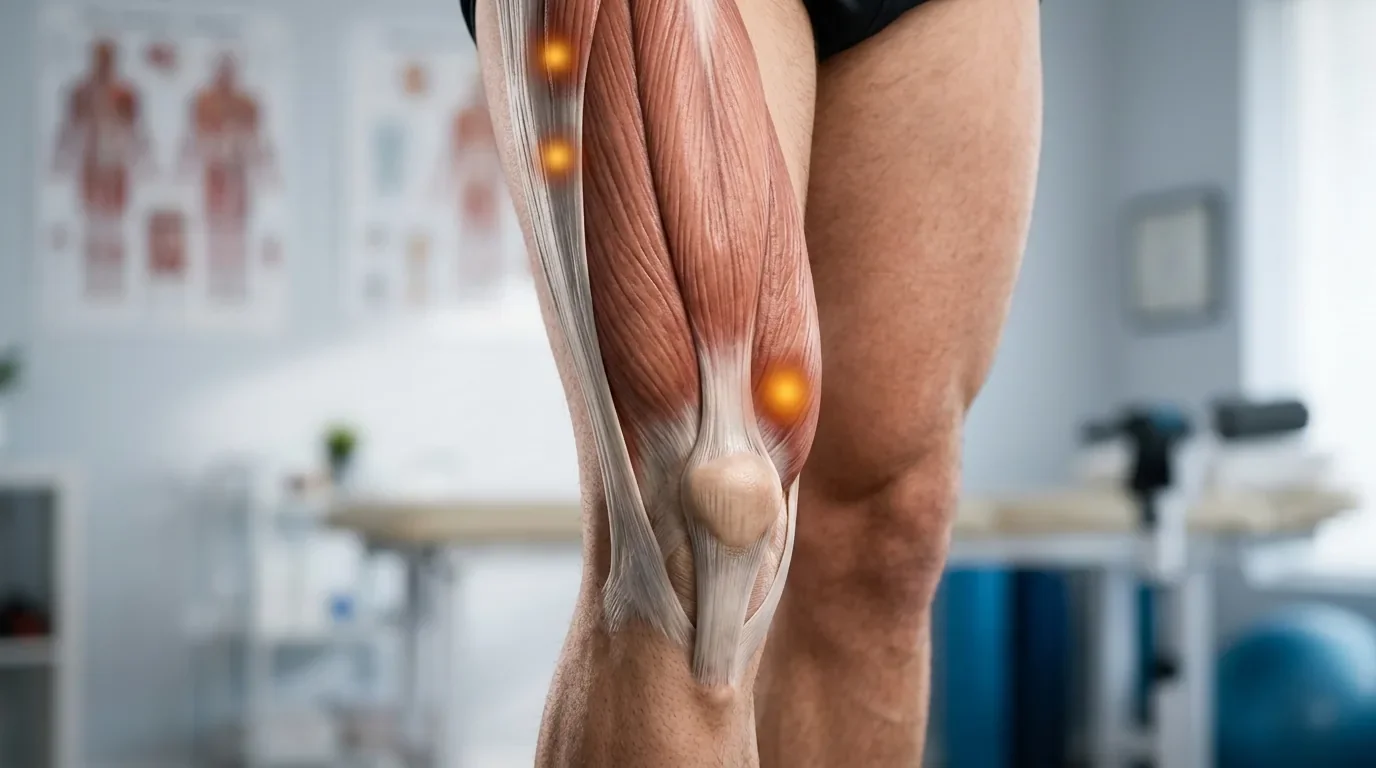
- The vastus medialis, with its distinctive trigger point referral to the medial knee and kneecap, is the most important single treatment target in knee OA and is frequently the muscle that explains why patients experience their worst pain with stair climbing and rising from chairs, the two activities that most challenge the quadriceps eccentric loading function.
- Acupuncture reduces intra-articular concentrations of pro-inflammatory cytokines and substance P in OA joints through local neuropeptide mechanisms, providing anti-inflammatory effects at the joint level that complement the systemic analgesic effects mediated by the periaqueductal gray (Zhao, 2008).
- The gastrocnemius and popliteus muscles produce posterior knee pain that most patients and clinicians attribute to the joint itself; these muscles are consistently trigger-pointed in knee OA and, when treated, often resolve what patients describe as their most limiting symptom.
- Hyaluronic acid injections, a common knee OA treatment, have been shown in meta-analyses to produce minimal clinically meaningful benefit beyond placebo for pain, while acupuncture demonstrates clinically significant effects above sham in well-controlled trials.
- Exercise and acupuncture are the two most evidence-supported non-surgical interventions for knee OA according to international guidelines, and combining them produces additive benefit when acupuncture is used to reduce pain sufficiently for patients to engage in the therapeutic exercise that drives long-term functional improvement.
Knee Arthritis Limiting Your Stairs and Activity?
Knee OA is one of the most well-studied conditions in acupuncture research, with a consistent evidence base showing clinically meaningful pain reduction that outlasts treatment. At Morningside, we combine quadriceps and gastrocnemius dry needling with systemic acupuncture to address the full pain picture of knee arthritis, helping patients stay active and functional at every stage of conservative management.
Schedule NowThe Knee OA Pain Picture: More Than Just the Joint
Knee osteoarthritis is typically presented to patients as a straightforward structural problem: cartilage has worn away, bone is contacting bone, and pain is the inevitable result. This framing is incomplete in ways that matter clinically. The cartilage changes in knee OA do not directly produce pain; cartilage is aneural and avascular and cannot itself generate nociceptive signals. Pain comes from the innervated periarticular structures: the subchondral bone, the synovial membrane, the joint capsule, the periosteum, and the surrounding ligaments and muscles.
Of these, the muscles are both the most painful and the most treatable. The quadriceps femoris group and the gastrocnemius-soleus complex develop trigger points in response to the altered joint mechanics, protective guarding, and reduced activity that accompany knee OA. These trigger points amplify the joint-origin nociception and add their own referred pain patterns to the total symptom picture, producing a knee pain experience that is substantially worse than what the intra-articular changes alone would generate.
Central sensitization adds the third layer. Chronic joint pain drives long-term potentiation at the lumbar dorsal horn, lowering the threshold for pain signal generation from all knee structures and expanding the territory of referred pain. This sensitized state explains why many knee OA patients have pain not just at the knee but in the thigh, calf, and occasionally even the hip and foot, and why their pain is exquisitely sensitive to weather, stress, and fatigue in ways that pure mechanical joint pain would not be.
The Quadriceps: Central to Knee OA Pain and Treatment
The quadriceps femoris, the four-muscle group that extends the knee and decelerates it during loading, is the most important treatment target in knee OA for two reasons. First, quadriceps weakness and atrophy are the most consistent findings in knee OA and correlate more strongly with pain severity and functional limitation than do radiographic changes. Second, the individual quadriceps muscles develop trigger points with referral patterns that are responsible for several of the most characteristic and limiting symptoms of knee OA.
The vastus medialis is the most clinically significant of the four. Its trigger points refer pain strongly to the medial knee, the patella, and the medial joint line, the area where most knee OA patients point when asked to localize their pain. Vastus medialis trigger points also produce quadriceps inhibition, reducing the protective co-contraction that stabilizes the medial compartment during loading, which mechanically accelerates medial compartment narrowing over time. Stair climbing and rising from a chair, the activities that most consistently provoke knee OA pain, both require eccentric quadriceps loading, and the vastus medialis with active trigger points cannot generate adequate force for these activities without pain.
The vastus lateralis refers to the lateral knee and lateral patellar border, where patients often describe a sharp, catching pain with knee flexion. The rectus femoris refers to the anterior knee and can produce the anterior knee pain and kneecap aching that is sometimes labeled as patellofemoral syndrome in OA patients. The vastus intermedius, lying deep beneath the rectus femoris, refers to the anterior mid-thigh and can produce a deep thigh aching that is sometimes mistaken for referred pain from the hip or lumbar spine.
Posterior Knee Pain: The Gastrocnemius and Popliteus
Posterior knee pain in OA patients is frequently attributed to a Baker's cyst (popliteal cyst) or to posterior compartment joint pathology, but the majority of cases involve gastrocnemius and popliteus trigger points that are generating referred posterior knee pain without any structural posterior knee damage.
The gastrocnemius trigger points, located in the proximal medial and lateral heads of the muscle, produce referred pain to the posterior knee and lower posterior thigh and occasionally into the plantar surface of the foot. This is particularly relevant in knee OA because the gastrocnemius contributes to posterior knee joint compression in standing, and when its trigger points reduce its extensibility, it also contributes to fixed knee flexion contracture that mechanically accelerates joint loading.
The popliteus, a small triangular muscle on the posterior aspect of the knee joint, produces the deep posterior knee pain and the sensation of something "catching" or being "blocked" in the posterior knee that is one of the most troubling symptoms in this patient population. Popliteus trigger points also refer pain to the posterior knee with weight-bearing (particularly going downstairs) and can produce a sensation that closely mimics mechanical posterior meniscus symptoms. Dry needling to the popliteus, performed with knowledge of the posterior knee neurovascular anatomy, reliably resolves this posterior pain pattern.
| Muscle | Trigger Point Referral | Clinical Role in Knee OA Pain |
|---|---|---|
| Vastus medialis | Medial knee; patella; medial joint line | Most common source of medial knee OA aching; worst with stairs and rising; inhibits knee stabilization |
| Vastus lateralis | Lateral knee; lateral patellar border; lateral thigh | Lateral knee pain; lateral patellar tracking abnormality; IT band tension contribution |
| Rectus femoris | Anterior knee; patella; anterior mid-thigh | Kneecap aching; anterior knee pain with knee bend; hip flexion contracture contribution |
| Gastrocnemius | Posterior knee; lower posterior thigh; heel and plantar foot | Posterior knee aching; stair descent pain; fixed flexion contracture contribution |
| Popliteus | Posterior knee; deep joint-line pain; catching sensation | Posterior catching and locking sensation; downstairs pain; mimics posterior meniscus symptoms |
| Gracilis | Medial knee and inner thigh; hot superficial medial knee burning | Superficial medial knee burning that feels different from deep OA aching; often the burning quality in medial knee pain |
The Evidence: Acupuncture Is One of the Best-Supported Treatments for Knee OA
Knee osteoarthritis is the musculoskeletal condition with the largest body of acupuncture RCT evidence, and the evidence is favorable. The individual patient data meta-analysis by Vickers and colleagues confirmed that acupuncture produces clinically meaningful pain and function improvements in knee OA, with effects exceeding the minimum clinically important difference and persisting at 12 months (Vickers et al., 2018). This is notable because most knee OA treatments, including widely used interventions such as hyaluronic acid injections and arthroscopic surgery for degenerative disease, have not consistently demonstrated clinically meaningful superiority over placebo in rigorous trials.
The neurophysiological mechanisms are well established. Zhao (2008) documented that acupuncture activates the PAG and its descending projections, producing serotonin and norepinephrine release that reduces dorsal horn hyperexcitability in the sensitized lumbosacral cord. At the joint level, experimental and some clinical evidence suggests that acupuncture reduces intra-articular concentrations of substance P and prostaglandin E2, providing local anti-inflammatory effects that complement the central analgesic mechanism.
The American College of Physicians' guidelines recommend non-pharmacological treatments, including acupuncture, as first-line options for chronic pain before pharmacological management is escalated (Qaseem et al., 2017). Major international rheumatology and orthopedic guidelines, including those from OARSI (Osteoarthritis Research Society International), include acupuncture as a conditionally recommended treatment for knee OA.
Related Acupuncture for Knee Pain at MorningsideNYC's Highest-Rated Clinic for Knee Arthritis Treatment
Morningside Acupuncture is the highest-rated acupuncture and dry needling clinic in New York City with over 500 five-star Google reviews. Knee arthritis is one of our most common presentations and one of the conditions where we consistently see patients achieve meaningful functional improvement: less pain on stairs, easier rising from chairs, and better tolerance of the walking and exercise that their health depends on.
Book Your VisitFrequently Asked Questions
How does acupuncture compare to cortisone and hyaluronic acid injections for knee arthritis?
For long-term outcomes, the evidence favors acupuncture. Corticosteroid injections provide short-term pain relief but studies show repeated injections may actually accelerate cartilage degradation over time. Hyaluronic acid injections (viscosupplementation) have failed to demonstrate clinically meaningful benefit over placebo in rigorous trials and are no longer recommended by many OA guidelines. Acupuncture, by contrast, demonstrates clinically significant pain reduction above sham in well-controlled trials and shows effects persisting at 12 months. It also has no cartilage-damaging effects. For patients who want sustained relief with a favorable risk profile, acupuncture offers a better evidence base than the injection options most commonly offered in primary care.
My knee OA is quite severe on X-ray. Is it too late for acupuncture to help?
No. The structural severity visible on X-ray does not determine how much of your pain is coming from the joint itself versus the surrounding muscles and central sensitization. Many patients with severe radiographic knee OA have a large myofascial component, particularly in the vastus medialis, gastrocnemius, and popliteus, that responds well to dry needling regardless of what the X-ray shows. We have treated patients who were told they need a knee replacement who achieved sufficient pain reduction from trigger point treatment and systemic acupuncture to delay or reconsider surgery. The treatment outcome depends on your pain mechanisms, not your imaging findings.
My worst pain is going up and down stairs. Why does this happen and can acupuncture help?
Stair climbing and descending are among the most demanding activities for the knee because they require substantial eccentric quadriceps loading at greater degrees of flexion than level walking. The vastus medialis, which is typically the most trigger-pointed quadriceps muscle in knee OA, is particularly challenged by this activity, and its active trigger points produce sharp medial knee and patellar pain with stair use. Dry needling to the vastus medialis, combined with the other periarticular muscles involved, typically produces one of the most rapid and satisfying improvements patients experience: the ability to take stairs with substantially less pain is usually one of the first changes they notice.
I'm scheduled for a knee replacement. Should I do acupuncture before or after surgery?
Both timings offer different benefits. Before surgery, acupuncture can reduce pre-surgical pain and improve functional capacity, which is associated with better post-surgical outcomes. It may also allow patients to reduce pre-surgical opioid use that complicates recovery. After surgery, once the surgical site has healed, acupuncture is useful for persistent soft tissue pain from the periarticular muscles (which the implant does not address), post-surgical central sensitization, and the rehabilitation period when patients need to build quadriceps strength without excessive pain. Many patients also find that the central sensitization that developed from longstanding pre-surgical pain takes several months to normalize after a successful replacement, and acupuncture can accelerate this process.
I have knee arthritis and have been told to exercise. The problem is exercise is too painful. Can acupuncture help with that?
Yes, and this is one of the most clinically important applications of acupuncture in knee OA. Exercise is the most evidence-supported treatment for knee OA progression and long-term outcomes, but the pain that limits exercise participation prevents many patients from benefiting from it. A course of acupuncture that reduces knee pain below the threshold where exercise is tolerable creates the window of opportunity for patients to begin and sustain the therapeutic exercise that produces long-term benefit. This sequencing, acupuncture first to reduce pain, exercise to build strength and slow progression, is explicitly recognized in the OA management literature and is the approach we take with patients who are caught in the pain-limiting-exercise cycle.
References
- Vickers, A. J., Vertosick, E. A., Lewith, G., MacPherson, H., Foster, N. E., Sherman, K. J., Irnich, D., Witt, C. M., & Linde, K. (2018). Acupuncture for chronic pain: Update of an individual patient data meta-analysis. Journal of Pain, 19(5), 455-474. https://doi.org/10.1016/j.jpain.2017.11.005
- Zhao, Z. Q. (2008). Neural mechanism underlying acupuncture analgesia. Progress in Neurobiology, 85(4), 355-375. https://doi.org/10.1016/j.pneurobio.2008.05.004
- Simons, D. G., Travell, J. G., & Simons, L. S. (1999). Travell & Simons' Myofascial Pain and Dysfunction: The Trigger Point Manual (2nd ed.). Lippincott Williams & Wilkins.
- Qaseem, A., Wilt, T. J., McLean, R. M., & Forciea, M. A. (2017). Noninvasive treatments for acute, subacute, and chronic low back pain: a clinical practice guideline from the American College of Physicians. Annals of Internal Medicine, 166(7), 514-530. https://doi.org/10.7326/M16-2367
- Kietrys, D. M., Palombaro, K. M., Azzaretto, E., Huber, R., Schaller, B., Schlussel, J. M., & Tucker, M. (2013). Effectiveness of dry needling for upper-quarter myofascial pain: a systematic review and meta-analysis. Journal of Orthopaedic & Sports Physical Therapy, 43(9), 620-634. https://doi.org/10.2519/jospt.2013.4668
- Manheimer, E., Cheng, K., Linde, K., Lao, L., Yoo, J., Wieland, S., van der Windt, D. A., Berman, B. M., & Bouter, L. M. (2010). Acupuncture for peripheral joint osteoarthritis. Cochrane Database of Systematic Reviews, 1, CD001977. https://doi.org/10.1002/14651858.CD001977.pub2
Disclaimer: This web site is intended for educational and informational purposes only. Reading this website does not constitute providing medical advice or any professional services. This information should not be used for diagnosing or treating any health issue or disease. Those seeking medical advice should consult with a licensed physician. Seek the advice of a medical doctor or other qualified health professional for any medical condition. If you think you have a medical emergency, call 911 or go to the emergency room. No acupuncturist-patient relationship is created by reading this website or using the information. Morningside Acupuncture PLLC and its employees and contributors do not make any express or implied representations with respect to the information on this site or its use. For any legal interpretation of scope of practice in your state, consult a licensed attorney or regulatory authority.
Read more from our blog