GB31 Acupuncture Point (Fengshi)
GB31 Acupuncture Point
The Wind Market on the Lateral Thigh: Anatomy, Mechanism, and Why This Gallbladder Point Anchors IT Band, Sciatica, and Lateral Leg Pain Treatment
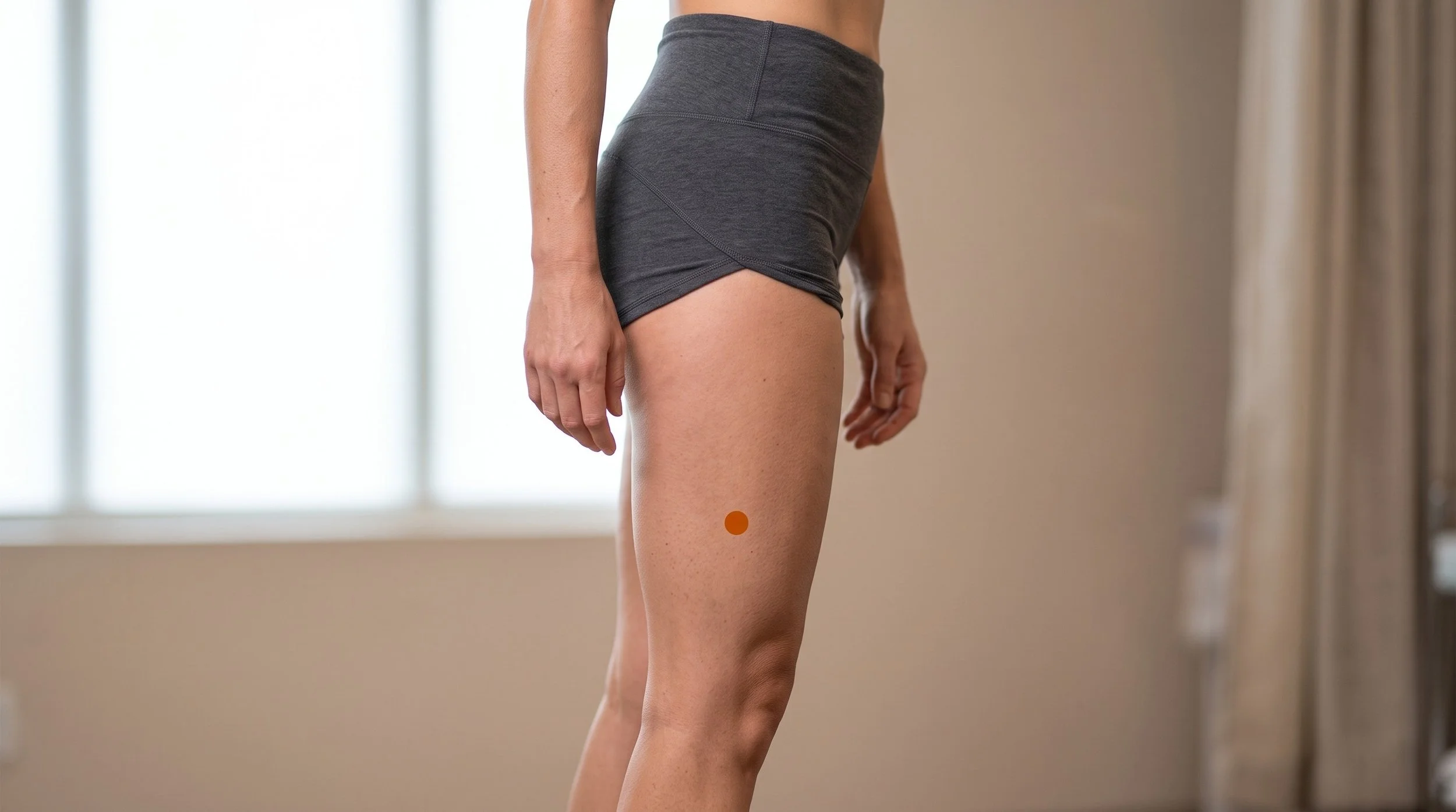
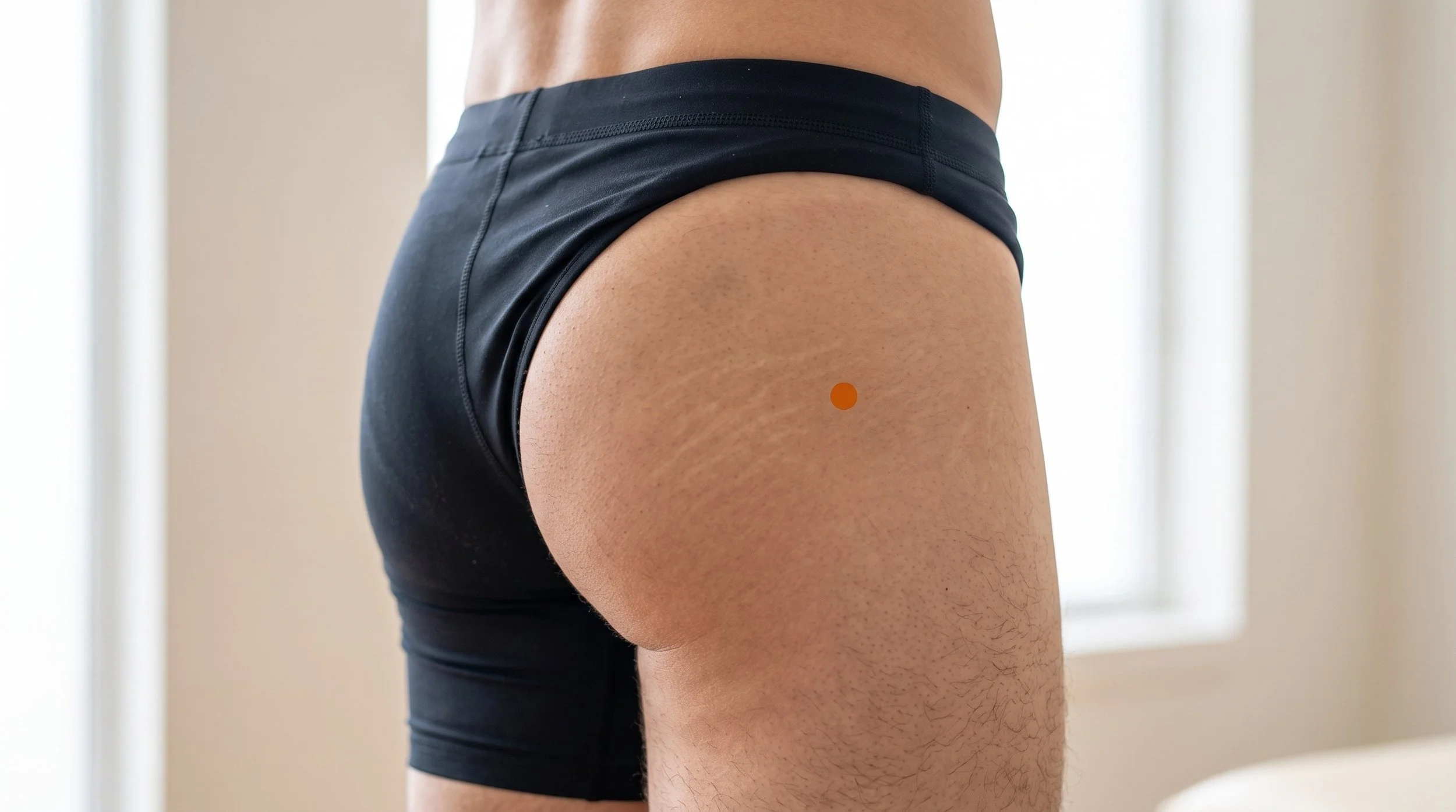
GB31 (Fengshi, translated as Wind Market) sits on the outer thigh, roughly where your middle fingertip lands when you stand tall with your arms hanging loosely at your sides. In modern anatomical terms it lies on the lateral midline of the thigh below the greater trochanter, about 7 cun above the crease behind the knee, directly over the iliotibial band and the vastus lateralis beneath it.
That single location explains most of its clinical value: it is one of the few classical points that lands squarely in the tissue runners, cyclists, and desk-bound hip-flexor-tight New Yorkers complain about, and it doubles as a reliable tender spot in lateral thigh numbness and sciatica-pattern leg pain. The gb31 acupuncture point is also a traditional wind point, which is why older texts list it for itching and hives alongside leg pain, and that combination of uses is more coherent than it first appears once you look at the nerve supply.
- Location and layers: GB31 is found on the lateral thigh below the greater trochanter, about 7 cun above the popliteal crease, and the needle passes through skin and subcutaneous fascia into the iliotibial band before reaching vastus lateralis (Deadman et al., 2007). Palpating a cun or so above and behind the textbook spot usually finds the tender point patients actually report (Cunningham, 2007).
- Traditional actions, translated: classical sources credit Fengshi with expelling wind, relieving itching, and freeing the channel to relieve pain (Deadman et al., 2007; Kim, 2008). In modern language those categories map onto a point that sits over a cutaneous nerve territory, a dense fascial band, and a common myofascial trigger point zone rather than onto any literal circulating substance.
- Nerve story: the skin over gallbladder 31 is supplied by branches related to the lateral femoral cutaneous nerve, carrying roughly L2 to L3 input, while the muscle beneath shares segmental territory with the femoral nerve. Needling here delivers strong A-delta and C-fiber afferent input into those spinal segments, which is the accepted starting point for acupuncture analgesia (Zhao, 2008).
- Point-specific clinical observation: in a small case series of meralgia paraesthetica treated with electroacupuncture, every patient was tender at GB31 before treatment, and pain scores improved substantially over four to five sessions (Alexander, 2013). It is a case series rather than a controlled trial, so it suggests a pattern rather than proving an effect.
- Research picture: individual patient data from chronic pain trials support acupuncture over sham and no-acupuncture controls for musculoskeletal pain (Vickers et al., 2018), and a 2024 multicenter randomized trial found meaningful leg pain and function gains in chronic sciatica from disk herniation (Tu et al., 2024). Neither study isolates GB31, so it should be understood as one component of a regional protocol.
- De qi and practice framing: patients usually describe a deep, dull, spreading ache or heaviness that may travel down toward the knee, sometimes with a brief cramp-like grab as the needle engages taut fibers in vastus lateralis (Simons et al., 1999). Sharp, electric sensation radiating into the skin means the needle is near a cutaneous nerve branch and should be redirected.
Struggling With Outer Thigh or IT Band Pain That Foam Rolling Will Not Touch?
Lateral thigh pain rarely comes from one structure, which is why we treat the whole lateral chain rather than one sore spot. At Morningside Acupuncture we use GB31 alongside dry needling of vastus lateralis and tensor fasciae latae, plus hip and gluteal points, to reduce guarding through the iliotibial band region. Most patients notice a change in how the thigh loads within the first two or three visits. Book a session and let's map out where your lateral leg pain is actually coming from.
Schedule NowAnatomy of GB31: Why the Lateral Thigh Below the Greater Trochanter Is Such an Important Location
From the surface down, GB31 passes through thin lateral thigh skin and subcutaneous fascia into the iliotibial band, a broad tendinous sheet formed by the tensor fasciae latae and gluteus maximus, and then into vastus lateralis underneath (Deadman et al., 2007; Cunningham, 2007). This is a high-load corridor. The IT band transmits force during every step, and vastus lateralis works hard in running, cycling, stair climbing, and prolonged sitting with the hip flexed.
Chronic loading here produces the taut bands and exquisitely tender nodules that Travell and Simons documented in vastus lateralis, which commonly refer pain along the outer thigh toward the knee (Simons et al., 1999). That referral pattern overlaps almost exactly with the classical indication list for Fengshi.
The nerve geography is what makes this point interesting rather than merely local. Skin over the region receives input from the lateral femoral cutaneous nerve, an L2 to L3 sensory nerve, while the underlying quadriceps tissue is innervated by femoral nerve branches sharing upper lumbar segments. Needling generates a barrage of afferent activity that converges in those dorsal horn segments, where it can reduce the excitability of neurons receiving input from other structures in the same segments, including deep fascia and joint tissue (Zhao, 2008).
At the same time, ascending signals recruit brainstem descending inhibitory pathways using serotonin, noradrenaline, and endogenous opioids, which is why patients often report relief beyond the needled area (Zhao, 2008). Local effects matter too: needle insertion into taut bands is associated with reduced local tenderness and improved tissue extensibility (Simons et al., 1999).
There are no major vessels or nerves at risk at the standard depth here, which makes GB31 a comparatively forgiving point, but depth still deserves respect. Sources describe perpendicular or slightly oblique insertion of roughly 1 to 2 cun, with oblique proximal or distal angling used when a longer needle is preferred, and shallower technique is also described in modern texts (Deadman et al., 2007; Kim, 2008). Because the IT band is dense, needle grab can be strong, and slow, patient insertion is more comfortable than fast advancement.
Sharp radiating sensation in the skin suggests proximity to a cutaneous nerve branch and calls for withdrawal and redirection rather than continued manipulation.
Related Acupuncture For IT Band Pain Related Vastus Lateralis Trigger PointsGB31 at a Glance: Classification, Location, and Clinical Use
| Category | Detail |
|---|---|
| Traditional Name | Fengshi (Wind Market), Gallbladder 31 |
| Channel Classification | Gallbladder channel of Foot Shaoyang, on the lateral thigh |
| Point Categories | No five-shu, hui-meeting, or extraordinary vessel designation is recorded for this point in the reference sources. It is classified by traditional action rather than by category: expelling wind, relieving itching, and activating the channel to relieve pain (Deadman et al., 2007; Kim, 2008; Cunningham, 2007). |
| Precise Location | On the lateral aspect of the thigh, directly below the greater trochanter, 7 cun above the popliteal crease, on the lateral midline. Classically identified where the middle fingertip lands when standing erect with arms at the sides, though body proportions make that landmark approximate. |
| Tissue Stimulated | Iliotibial band and underlying vastus lateralis; overlying skin supplied in the lateral femoral cutaneous nerve territory (L2 to L3) |
| Needle Depth / Direction | Perpendicular or slightly oblique insertion, approximately 1 to 2 cun; oblique proximal or distal angling up to 2.5 cun is also described. Shallower technique (under 1.5 cun) is common in modern practice. |
| De Qi Sensation | Deep, dull, heavy ache or spreading pressure that may travel toward the knee, sometimes with a brief muscular twitch or cramp sensation when taut bands in vastus lateralis are engaged |
| Primary Clinical Uses | Lateral thigh and IT band region pain, sciatica-pattern lateral leg pain, lateral thigh numbness and paresthesia, lower limb heaviness and weakness, and generalized itching or hives in classical listings |
| Common Point Combinations |
|
Deadman, Al-Khafaji, and Baker present Fengshi as the archetypal wind point of the lower limb, and their commentary organizes its traditional use into three streams. The first is wind-damp painful obstruction of the leg, particularly when pain wanders rather than staying fixed, a presentation for which the Complete Works of Jing-yue singled out this point as essential.
The second is skin disease of sudden onset with prominent itching, urticaria being the standard example, which is why classical indication lists move without apology from heavy, weak legs to whole-body itching. The third is hemiplegia following windstroke, where the point appears in Great Compendium protocols alongside GB34 and GB40.
These are traditional attributions rather than physiological claims, but the pattern is striking: a single lateral thigh location was asked to cover limb pain, limb weakness, and itchy skin, and every one of those categories has a plausible modern counterpart in the nerve and fascial territory the point occupies.
Why GB31 Is Used for Lateral Thigh Numbness, Tingling, and Itching
Patients are often surprised that a leg pain point is also a classical itching point, and the explanation is segmental rather than mystical. The lateral thigh skin at GB31 sits in the lateral femoral cutaneous nerve territory, carrying upper lumbar sensory input, and the same spinal segments receive input from deeper structures in the thigh and hip. When a needle produces sustained afferent activity in that territory, it enters a dorsal horn where cutaneous, muscular, and fascial inputs converge, and inhibitory interneurons in that segment can dampen the traffic arriving from neighboring sources (Zhao, 2008).
Itch and pain share substantial spinal machinery, which is one reason a point known for numbness and burning in the outer thigh also has a long classical history in skin complaints.
The clinical observation that patients with lateral femoral cutaneous nerve irritation are consistently tender at this exact spot is worth taking seriously. In a small case series of ten patients with meralgia paraesthetica treated with electroacupuncture, tenderness at GB31 was present in every case before treatment, and pain scores improved by at least half over an average of four to five sessions (Alexander, 2013).
The author explicitly notes that the reason for the universal tenderness is unclear and that controlled studies are needed, so this is a hypothesis-generating finding rather than evidence of efficacy. Still, it fits the anatomy: a dense fascial band overlying a superficial sensory nerve territory is exactly where sensitization would be palpable.
Beyond the segment, needling recruits descending inhibitory pathways from the periaqueductal gray and rostral ventromedial medulla that release serotonin, noradrenaline, and endogenous opioids at the spinal level, which broadens the effect beyond the treated limb (Zhao, 2008). This is why treatment for lateral leg symptoms may reduce overall pain sensitivity and improve sleep quality alongside the local complaint. It also explains why we combine local points like GB31 with distal points rather than relying on the tender spot alone.
What the Research Shows for GB31
No high-quality trial has tested GB31 by itself, and it would be misleading to suggest otherwise. What the literature offers is evidence for acupuncture protocols in which this point commonly appears, especially sciatica and lateral leg pain, plus a small point-specific case series and controlled data on dry needling of the tissue GB31 overlies. Read the table below as evidence about the treatment approach rather than about a single needle location, and note that several entries come from trials with modest sample sizes or high risk of bias.
| Study | Type | Focus | Key Finding |
|---|---|---|---|
| Tu et al., 2024 | Multicenter randomized clinical trial | Acupuncture versus sham acupuncture for chronic sciatica from herniated disk (216 patients, 10 sessions over 4 weeks) | Leg pain and disability improved more with acupuncture than sham at week 4, with benefits reported through 52 weeks, though sham design questions have been raised in subsequent correspondence. |
| Vickers et al., 2018 | Individual patient data meta-analysis | Acupuncture for chronic musculoskeletal, headache, and osteoarthritis pain | Acupuncture was associated with modestly greater pain reduction than both sham and no-acupuncture controls, with effects that persisted over time. |
| Qin et al., 2015 | Systematic review and meta-analysis | Acupuncture for sciatica across 11 randomized controlled trials | Acupuncture may outperform drug therapy and may add to drug effects, but the authors judged the evidence limited by the small number of rigorous trials. |
| Alexander, 2013 | Prospective case series | Electroacupuncture including GB31 for meralgia paraesthetica (10 patients) | All patients were tender at GB31 before treatment and pain scores improved by at least half, though the uncontrolled design cannot separate treatment effects from natural course. |
| Maghroori et al., 2021 | Randomized clinical trial | Dry needling versus extracorporeal shockwave therapy for iliotibial band syndrome (40 patients) | Both approaches improved pain and lower extremity function, with dry needling showing better pain scores at four weeks, in a small single-center sample. |
| Wei et al., 2025 | Systematic review and meta-analysis | Acupuncture for chronic spontaneous urticaria across 22 randomized trials | Acupuncture was associated with improved response rates and urticaria activity scores, though methodological quality across the included trials was variable. |
Sciatica-Pattern Pain Running Down the Side of Your Leg?
When leg pain tracks down the outside of the thigh rather than the back of it, the gallbladder channel points become the anchor of the treatment plan. We combine GB31 with GB30 at the hip and GB34 below the knee, a stack drawn from classical formulas and supported by modern sciatica trials. Treatment is paired with movement and loading advice so gains hold between visits. Schedule an evaluation and we'll build a plan around your specific pain pattern.
Schedule NowGB31 in the Context of Trigger Point Work
GB31 sits directly over one of the busiest myofascial regions in the lower body. Travell and Simons described vastus lateralis as harboring multiple trigger point zones along the lateral thigh, with referral running up toward the hip and down toward the lateral knee, a distribution that lines up neatly with the classical indications for Fengshi (Simons et al., 1999).
At Morningside we frequently treat this area from both directions in the same session: the point is needled at its traditional location for channel and segmental effect, and adjacent taut bands in vastus lateralis, tensor fasciae latae, and gluteus medius are needled where palpation reproduces the patient's familiar pain. Since acupuncture is defined by the use of an acupuncture needle, dry needling of these muscles is simply one style within that broader practice rather than a separate discipline.
Technique differs slightly between the two intentions. Needling GB31 as a point favors a steady perpendicular or slightly oblique insertion with gentle manipulation to develop a deep, spreading ache, while trigger point work in vastus lateralis is more exploratory, seeking twitch responses in specific bands. Patients with iliotibial band region pain often need the fascial layer addressed as well as the muscle, and a small randomized trial found dry needling produced better four-week pain scores than shockwave therapy in iliotibial band syndrome (Maghroori et al., 2021). We pair the needling with loading work for the hip abductors, because lateral thigh tissue that keeps getting overloaded will keep getting tender.
GB31 Lateral Thigh Pain Treatment at NYC's Highest-Rated Acupuncture Clinic
Morningside Acupuncture is the highest-rated acupuncture and dry needling clinic in New York City with over 500 five-star Google reviews, and lateral hip, thigh, and knee complaints are among the most common reasons patients find us. Every session blends point-based acupuncture with trigger point dry needling, orthopedic assessment, and clear home guidance. You get a treatment plan, not a mystery. Schedule your visit and let's get the outside of your leg working the way it should.
Schedule NowFrequently Asked Questions
What does GB31 feel like when needled?
Most patients describe a deep, dull ache or a heavy, spreading pressure in the outer thigh, sometimes traveling toward the knee. Because the needle passes through the dense iliotibial band, there can be a brief pinch at the fascial layer and a distinct sense of needle grab. If a taut band in vastus lateralis is engaged, you may feel a quick cramp-like twitch that settles within a second or two. Sharp, electric, or burning sensation in the skin is not the goal and means the needle should be adjusted.
Why needle the outer thigh when my pain is at the side of my knee or in my low back?
Two reasons. First, the lateral knee is often loaded by tissue further up the thigh, and treating the mid-thigh portion of the iliotibial band and vastus lateralis addresses the source rather than the site (Simons et al., 1999). Second, GB31 sits in an upper lumbar segmental territory, so afferent input from needling there converges in spinal segments that also receive signals from the hip, thigh, and back, allowing for inhibition beyond the immediate area (Zhao, 2008). Classical formulas took the same view, pairing this point with hip and calf points for lumbar pain radiating down the leg (Deadman et al., 2007).
Can I press GB31 myself between sessions?
Yes, and it's one of the easier points to self-treat. Stand up straight with your arms hanging at your sides and note where your middle fingertip touches the outer thigh, then feel around that area with your thumb or knuckle for the most tender spot, which is usually slightly higher and a bit toward the back of the thigh. Press with steady, firm pressure that registers as a strong but tolerable ache, roughly a 5 or 6 out of 10, and hold for 30 to 60 seconds. Repeat two or three times per side, once or twice a day, and follow it with gentle hip abductor and hip flexor movement rather than aggressive stretching. Stop if pressure produces numbness, tingling, or sharp radiating sensation.
Is GB31 safe to needle?
It's considered one of the more forgiving points on the lower limb, since there are no major vessels or deep nerves at the usual insertion depth, with sources describing perpendicular or oblique insertion of roughly 1 to 2 cun (Deadman et al., 2007). The main cautions are practical: the region has a rich subcutaneous blood supply, so minor bruising is possible, and deep needling into dense fascia can leave a day or two of soreness that feels like a workout ache. Tell your practitioner if you have a bleeding disorder, take anticoagulants, have had hip or thigh surgery, or have implanted hardware in the area. Treatment should always be performed by a licensed provider using sterile single-use needles.
Where exactly is GB31 located?
Locate the prominence of the greater trochanter at the side of the hip, then trace straight down the lateral midline of the thigh. GB31 lies below that landmark, approximately 7 cun above the crease behind the knee, which corresponds to roughly the junction of the upper two thirds and lower third of the thigh. The classical shortcut is the middle fingertip position when standing erect with arms at the sides, though individual proportions vary enough that the tender spot found by palpation is a better guide than the measurement alone (Deadman et al., 2007). Searching for gb 31 location often turns up diagrams showing the point squarely on the it band acupuncture point territory, which is accurate.
References
- Deadman, P., Al-Khafaji, M., & Baker, K. (2009). A manual of acupuncture. Journal of Chinese Medicine Publications.
- Cunningham, P. M. (2000). Acupuncture points: A practical guide to classical and modern usage. Odyssey Press.
- Kim, H. (2008). Handbook of Oriental medicine (3rd ed.). Harmony & Balance Press.
- Simons, D. G., Travell, J. G., & Simons, L. S. (1999). Travell & Simons' myofascial pain and dysfunction: The trigger point manual, Vol. 1: Upper half of body (2nd ed.). Williams & Wilkins.
- Zhao, Z. Q. (2008). Neural mechanism underlying acupuncture analgesia. Progress in Neurobiology, 85(4), 355-375. https://doi.org/10.1016/j.pneurobio.2008.05.004
- Vickers, A. J., Vertosick, E. A., Lewith, G., MacPherson, H., Foster, N. E., Sherman, K. J., Irnich, D., Witt, C. M., & Linde, K. (2018). Acupuncture for chronic pain: Update of an individual patient data meta-analysis. Journal of Pain, 19(5), 455-474. https://doi.org/10.1016/j.jpain.2017.11.005
- Tu, J. F., Shi, G. X., Yan, S. Y., Ni, G. X., Yu, F. T., Cai, G. W., Liu, Z. S., Ma, C. Y., Wang, L. Q., Yang, J. W., Zhou, X. Q., Meng, X. L., Fu, H. Y., Li, J., Wan, W. J., Sun, T. H., Wang, X. Z., & Liu, C. Z. (2024). Acupuncture vs sham acupuncture for chronic sciatica from herniated disk: A randomized clinical trial. JAMA Internal Medicine, 184(12), 1417-1424. https://doi.org/10.1001/jamainternmed.2024.5463
- Qin, Z., Liu, X., Wu, J., Zhai, Y., & Liu, Z. (2015). Effectiveness of acupuncture for treating sciatica: A systematic review and meta-analysis. Evidence-Based Complementary and Alternative Medicine, 2015, 425108. https://doi.org/10.1155/2015/425108
- Alexander, R. E. (2013). Clinical effectiveness of electroacupuncture in meralgia paraesthetica: A case series. Acupuncture in Medicine, 31(4), 435-439. https://doi.org/10.1136/acupmed-2013-010395
- Maghroori, R., Karshenas, L., & Khosrawi, S. (2021). Shockwave therapy versus dry needling for the management of iliotibial band syndrome: A randomized clinical trial. Galen Medical Journal, 10, 1-8. https://doi.org/10.31661/gmj.v10i0.2174
- Wei, W., Wu, Y., Zhang, S., Li, B., Cheng, Z., & Zhao, W. (2025). Clinical efficacy and safety of acupuncture in the treatment for chronic spontaneous urticaria: A systematic review and meta-analysis. Frontiers in Medicine, 12, 1498795. https://doi.org/10.3389/fmed.2025.1498795
Disclaimer: This web site is intended for educational and informational purposes only. Reading this website does not constitute providing medical advice or any professional services. This information should not be used for diagnosing or treating any health issue or disease. Those seeking medical advice should consult with a licensed physician. Seek the advice of a medical doctor or other qualified health professional for any medical condition. If you think you have a medical emergency, call 911 or go to the emergency room. No acupuncturist-patient relationship is created by reading this website or using the information. Morningside Acupuncture PLLC and its employees and contributors do not make any express or implied representations with respect to the information on this site or its use. For any legal interpretation of scope of practice in your state, consult a licensed attorney or regulatory authority.
Read more from our blog