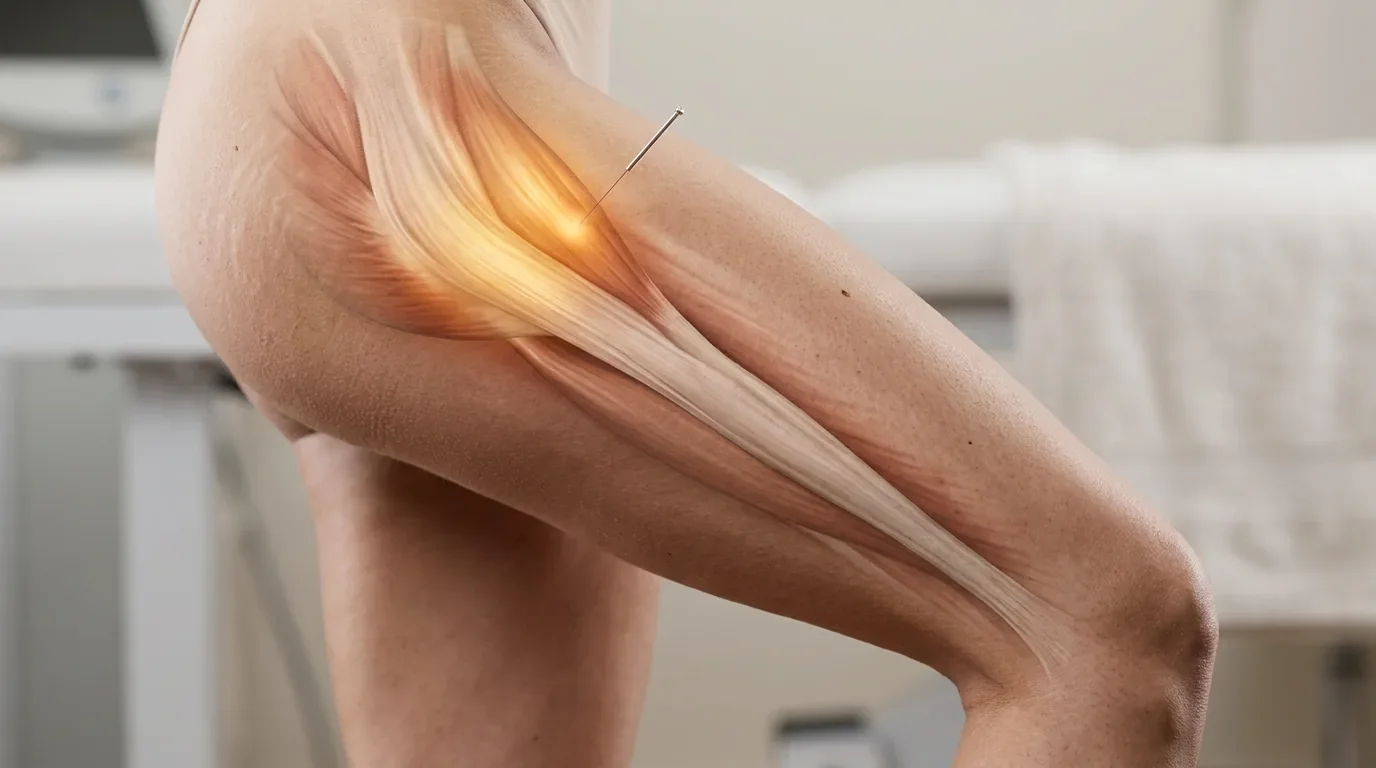
Dry Needling for IT Band Pain
How Trigger Point Dry Needling Treats the Muscles Behind Iliotibial Band Syndrome
IT band syndrome is one of the most frustrating overuse injuries for runners and cyclists. Foam rolling, stretching, and rest provide only temporary relief because the IT band itself is not the problem; the muscles generating tension along it are. Dry needling targets the trigger points in the tensor fasciae latae, gluteus medius, and lateral quadriceps that drive iliotibial band syndrome at its source.
- The iliotibial band is a thick band of fascia connecting the tensor fasciae latae (TFL) and gluteus maximus to the lateral knee; it cannot be effectively stretched because it is dense connective tissue with minimal elasticity, making trigger point treatment of its proximal muscles the most direct intervention (Simons et al., 1999).
- Trigger points in the TFL maintain sustained tension along the IT band, creating the compressive friction against the lateral femoral condyle that produces the characteristic sharp, lateral knee pain of IT band syndrome.
- Gluteus medius weakness and trigger points are consistently associated with IT band syndrome; the gluteus medius is the primary hip abductor and its dysfunction allows the femur to adduct excessively during the stance phase of running, increasing IT band compression at the knee (Fredericson et al., 2000).
- Dry needling elicits local twitch responses in the TFL, vastus lateralis, and gluteus medius that immediately reduce resting muscle tension, decreasing the mechanical tension transmitted through the IT band to the lateral knee (Shah et al., 2008).
- IT band syndrome has a high recurrence rate when only the symptom site (lateral knee) is treated; comprehensive trigger point treatment of the entire lateral hip and thigh chain produces more durable outcomes.
Lateral knee pain that comes on during or after running?
At Morningside Acupuncture in Morningside Heights, we treat IT band syndrome by targeting the TFL, gluteal, and lateral quadriceps trigger points that generate IT band tension. Many runners and cyclists achieve significant relief within four to six sessions when the proximal muscle chain is properly addressed.
Schedule NowWhy the IT Band Cannot Be Stretched
One of the most persistent misconceptions about IT band syndrome is that the IT band itself needs to be stretched. The iliotibial band is composed of dense, inelastic connective tissue that functions as a tension band transmitting forces from the hip muscles to the lateral knee. Research by Fairclough et al. (2006) demonstrated that the IT band does not actually slide over the lateral femoral condyle as previously thought; rather, it compresses the fatty tissues and bursa beneath it as the knee flexes and extends through the painful arc (approximately 30 degrees of flexion during running).
This means foam rolling and stretching the IT band directly, while providing temporary subjective relief, does not address the mechanical source of the problem: excessive tension from the TFL and gluteus maximus proximal to the IT band. Reducing trigger point activity in these muscles reduces the tension transmitted through the IT band and therefore the compressive force at the lateral femoral condyle. This is the mechanism by which dry needling produces more durable IT band syndrome relief than foam rolling alone.
Muscles Treated with Dry Needling for IT Band Pain
| Muscle | Trigger Point Location | Contribution to IT Band Pain | Referred Pain Pattern |
|---|---|---|---|
| Tensor Fasciae Latae (TFL) | Anterolateral hip, below the ASIS | Primary IT band tension generator; trigger points keep IT band under continuous load | Lateral hip, lateral thigh, lateral knee |
| Gluteus Medius | Posterior to the greater trochanter | Weakness allows excessive hip adduction during stance, increasing IT band compression | Lateral hip, posterior iliac crest, lateral thigh |
| Gluteus Maximus | Mid-buttock | Proximal IT band contributor; gluteus maximus fasciae merge with IT band at the iliac crest | Buttock, sacroiliac region |
| Vastus Lateralis | Mid-lateral thigh | Lateral knee compression from vastus lateralis trigger points adds to IT band impingement forces | Lateral thigh, lateral knee, outer patella |
| Biceps Femoris | Posterior lateral thigh | Lateral hamstring tightness alters tibial rotation, affecting IT band mechanics at the knee | Posterior knee, lateral knee, posterior thigh |
The Gluteus Medius Connection
Research by Fredericson et al. (2000) demonstrated that runners with IT band syndrome have significantly weaker hip abductors (primarily the gluteus medius) on the affected side compared to unaffected runners and to their own unaffected leg. This weakness creates a pattern during running where the pelvis drops contralaterally (Trendelenburg pattern) and the femur adducts, pulling the IT band laterally against the femoral condyle with each stride.
Dry needling of the gluteus medius addresses both the trigger points that generate lateral hip pain and the motor inhibition that allows excessive hip adduction. Following dry needling, progressive hip abductor strengthening is essential to consolidate the improved muscle function and prevent recurrence. Treatment of the TFL without addressing the gluteus medius typically produces incomplete and short-lived IT band syndrome relief.
"IT band syndrome is not a problem with the IT band. It is a problem with the muscles above it. Treating the lateral knee where the pain is located while ignoring the TFL and gluteus medius where the tension originates is why IT band syndrome has a reputation for being difficult to treat."
What to Expect During Dry Needling for IT Band Syndrome
Assessment begins with palpation of the TFL, gluteus medius, vastus lateralis, and biceps femoris for trigger points, combined with hip strength testing (particularly single-leg glute bridge and side-lying hip abduction) and gait or running assessment where relevant. The number and activity of trigger points in the lateral hip and thigh chain correlates closely with symptom severity.
Dry needling typically begins with the TFL, where local twitch responses produce an immediate reduction in the lateral hip tension many patients identify as their "IT band tightness." The gluteus medius and vastus lateralis are treated in subsequent needling passes. Most patients with IT band syndrome of less than three months notice significant improvement within three to five sessions. Running can usually be continued during treatment with modification of intensity and surface type.
IT band pain stopping your running in NYC? Let's find the source.
Morningside Acupuncture treats runners, cyclists, and active New Yorkers with IT band syndrome throughout Manhattan. Our dry needling approach targets the TFL and gluteal trigger points that foam rolling can't reach, producing more durable relief than stretching or rest alone.
Book a ConsultationFrequently Asked Questions
How is dry needling different from foam rolling for IT band syndrome?
Foam rolling applies compressive pressure to the lateral thigh, temporarily reducing fascial tension and providing subjective relief. However, foam rolling does not deactivate trigger points because it does not reproduce the local twitch response that is mechanistically important for trigger point resolution. Dry needling accesses the motor end plate dysfunction within the trigger point and resets it through the twitch mechanism, producing changes that persist well beyond the session. Most patients who have relied on foam rolling find that dry needling produces more durable and complete relief.
Can I keep running while receiving dry needling for IT band syndrome?
In most cases, yes, with modifications. Running on softer surfaces, reducing mileage, avoiding downhill running (which increases IT band compression), and temporarily avoiding the pain arc during runs can allow continued training during treatment. Most patients find that their pain-free running distance increases progressively over the course of treatment. Complete running cessation is rarely necessary and delays the development of the gluteal strength needed for lasting IT band syndrome resolution.
Why does my IT band syndrome keep coming back after I take time off?
Rest reduces inflammation and allows the lateral knee tissues to recover, but it does not deactivate the TFL and gluteus medius trigger points that create the IT band tension in the first place. When running is resumed, those trigger points recreate the same mechanical pattern, and symptoms return, often at the same mileage threshold where they first appeared. Treating the trigger points during the rest period, combined with gluteal strengthening before returning to running, is the approach most likely to prevent recurrence.
How many sessions does IT band syndrome typically take to resolve?
Most runners with IT band syndrome of less than three months achieve significant relief within four to six dry needling sessions. Chronic IT band syndrome present for more than a year, particularly in runners with established hip weakness patterns, may require eight to twelve sessions combined with a structured hip strengthening program. The timeline depends on the number of active trigger points, the degree of underlying hip abductor weakness, and whether contributing biomechanical factors (training load, footwear, running surface) are addressed.
References
- Simons, D. G., Travell, J. G., & Simons, L. S. (1999). Travell & Simons' Myofascial Pain and Dysfunction: The Trigger Point Manual (2nd ed., Vol. 2). Lippincott Williams & Wilkins.
- Fredericson, M., Cookingham, C. L., Chaudhari, A. M., Dowdell, B. C., Oestreicher, N., & Sahrmann, S. A. (2000). Hip abductor weakness in distance runners with iliotibial band syndrome. Clinical Journal of Sport Medicine, 10(3), 169–175. https://doi.org/10.1097/00042752-200007000-00004
- Shah, J. P., Danoff, J. V., Desai, M. J., Parikh, S., Nakamura, L. Y., Phillips, T. M., & Gerber, L. H. (2008). Biochemicals associated with pain and inflammation are elevated in sites near to and remote from active myofascial trigger points. Archives of Physical Medicine and Rehabilitation, 89(1), 16–23. https://doi.org/10.1016/j.apmr.2007.10.018
- Vickers, A. J., Vertosick, E. A., Lewith, G., MacPherson, H., Foster, N. E., Sherman, K. J., Irnich, D., Witt, C. M., & Linde, K. (2018). Acupuncture for chronic pain: Update of an individual patient data meta-analysis. Journal of Pain, 19(5), 455–474. https://doi.org/10.1016/j.jpain.2017.11.005
- Dommerholt, J., & Fernández-de-las-Peñas, C. (Eds.). (2013). Trigger Point Dry Needling: An Evidence and Clinical-Based Approach. Churchill Livingstone Elsevier.
Disclaimer: This web site is intended for educational and informational purposes only. Reading this website does not constitute providing medical advice or any professional services. This information should not be used for diagnosing or treating any health issue or disease. Those seeking medical advice should consult with a licensed physician. Seek the advice of a medical doctor or other qualified health professional for any medical condition. If you think you have a medical emergency, call 911 or go to the emergency room. No acupuncturist-patient relationship is created by reading this website or using the information. Morningside Acupuncture PLLC and its employees and contributors do not make any express or implied representations with respect to the information on this site or its use. For any legal interpretation of scope of practice in your state, consult a licensed attorney or regulatory authority.
Read more from our blog