GB30 Acupuncture Point (Huantiao)
GB30 Acupuncture Point
The Jumping Circle in the Deep Gluteal Space: Anatomy, Mechanism, and Why GB30 Anchors Sciatica, Hip, and Buttock Pain Treatment
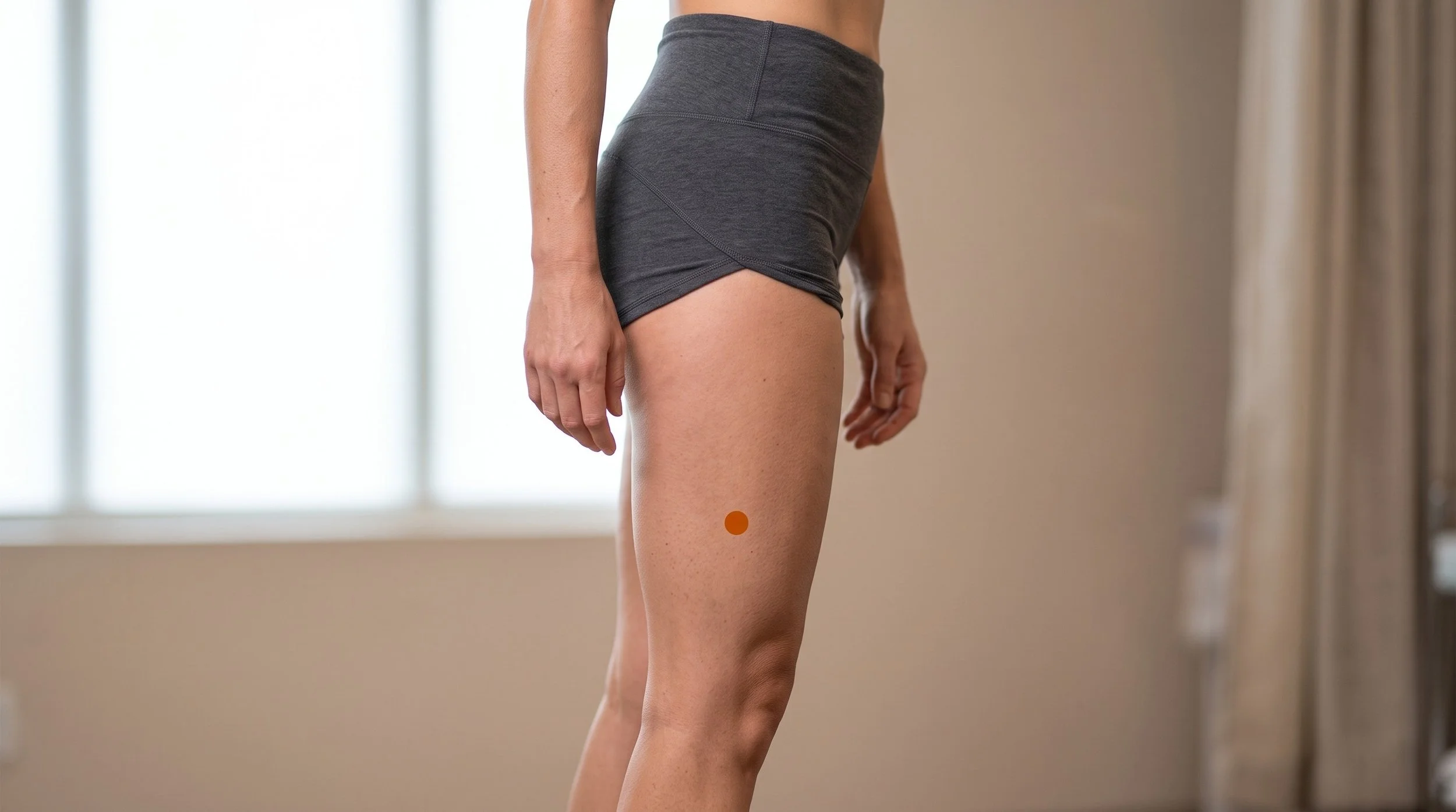
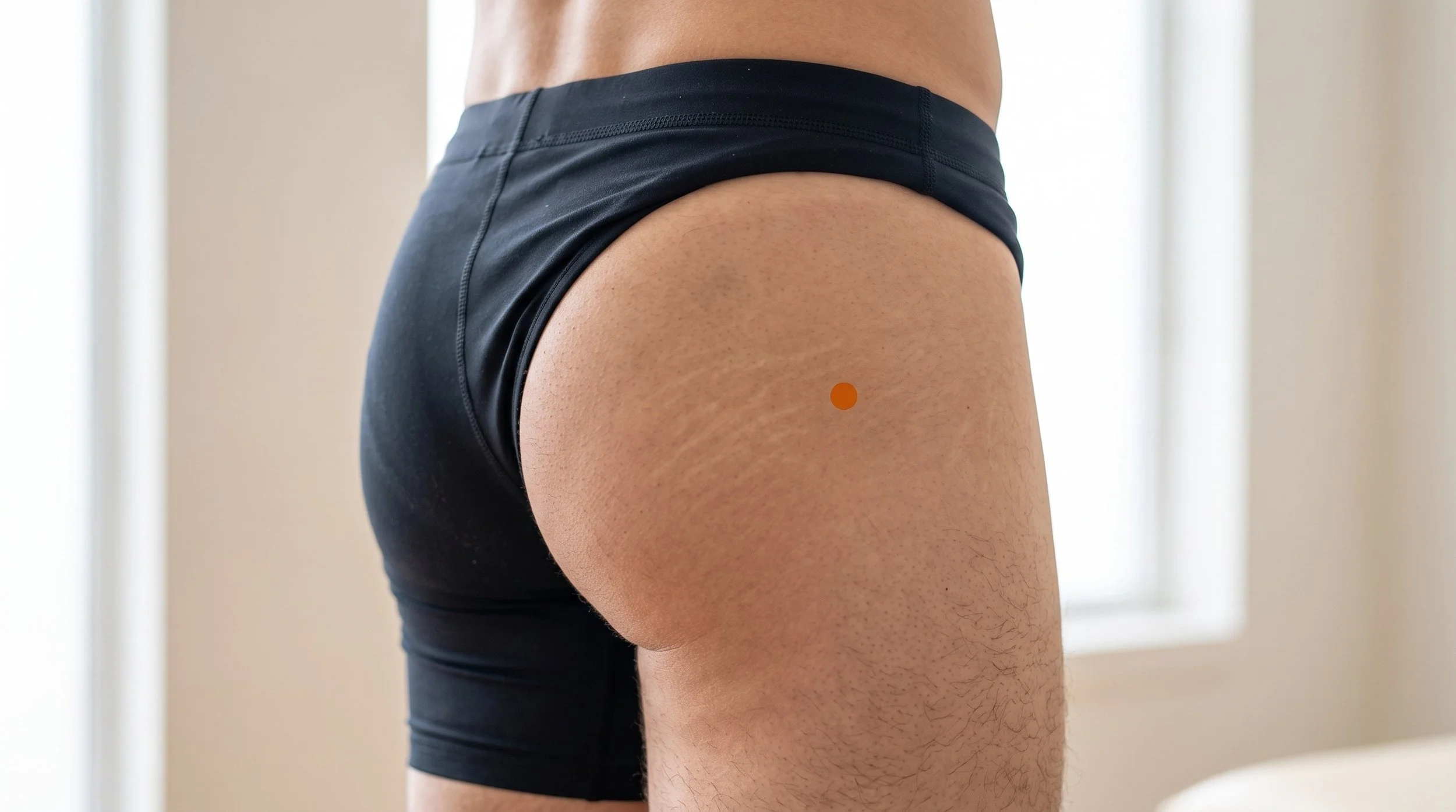
GB30, known in Chinese as Huantiao and usually translated as Jumping Circle, sits in the thick muscular wall of the buttock, roughly one third of the way along a line drawn from the bony bump on the outside of the hip (the greater trochanter) toward the base of the sacrum. In classical texts it is described as a meeting point of the Gallbladder and Bladder channels, and it is one of the very few points where a needle can reach the deep gluteal layer where the piriformis muscle and the sciatic nerve share tight quarters (Deadman et al., 2001). That combination of a broad superficial muscle, a deep rotator group, and a major peripheral nerve trunk is exactly why the gb30 acupuncture point has stayed near the top of nearly every point list written for sciatica, buttock pain, and hip pain for the better part of a thousand years.
- Location and layers: gallbladder 30 lies on the posterolateral hip, one third of the distance from the prominence of the greater trochanter to the sacral hiatus, with gluteus maximus superficially and the piriformis and sciatic nerve deep (Deadman et al., 2001; Kim, 2015).
- Traditional attributions: classical sources categorize GB30 as a crossing point of the Gallbladder and Bladder channels and describe its actions as moving the channel, easing pain, benefiting the hip and leg, and dispelling wind and damp (Deadman et al., 2001; Kim, 2015). Read neurophysiologically, those descriptions map onto strong somatic input from the lumbosacral segments that also carry buttock, thigh, and calf pain.
- Mechanism: needling here recruits deep muscle and periosteal afferents from segments L4 through S3, the same segments that supply the sciatic nerve and the deep gluteal muscles, so the stimulus converges on the dorsal horn neurons already sensitized in radiating leg pain and can engage descending inhibitory pathways (Zhao, 2008).
- Research picture: reviews of acupuncture for sciatica report favorable but low-certainty findings, largely because trials are small and methodologically uneven (Qin et al., 2015; Zhang et al., 2023), while individual patient data from chronic pain trials support modest, durable effects for acupuncture overall (Vickers et al., 2018).
- Point-specific physiology: animal work using Huantiao with other leg points has examined markers of nerve repair and motor recovery after experimental sciatic nerve crush injury, which is suggestive rather than conclusive for human sciatica (Ji et al., 2023).
- De qi and clinical framing: patients typically feel a deep, heavy, spreading ache in the buttock, and deeper insertion near the nerve trunk can produce a brief electric flick down the leg, a sensation that classical writers actively sought in sciatica but that we use sparingly and deliberately (Deadman et al., 2001).
Is Sciatica Pain Traveling From Your Buttock Down Your Leg?
Radiating leg pain rarely comes from one structure alone, which is why we assess the lumbar spine, the deep gluteal muscles, and nerve mechanosensitivity before we needle anything. GB30 is one of our anchor points for that presentation, often paired with distal points along the leg and with careful dry needling of the gluteal and rotator muscles. Treatment is graded, so you feel a therapeutic deep ache without leaving the session more irritated than you arrived. Schedule a visit and let's map where your pain is actually coming from.
Schedule NowAnatomy of GB30: Why the Deep Gluteal Space Is Such an Important Location
From the surface down, GB30 passes through skin and a variable layer of subcutaneous fat into gluteus maximus, the thick fan-shaped extensor that drives you up stairs and out of chairs. Beneath that lies the deep gluteal group, including piriformis and the other short external rotators, which control femoral rotation and help stabilize the hip during single-leg loading. This region gets loaded by prolonged sitting, hill and stair work, running with poor pelvic control, and long car or subway commutes, and it is a common site of tender taut bands that refer pain into the buttock and posterior thigh (Simons et al., 1999). Because the point sits at or just below the lower border of piriformis, the location is best understood as a small territory to be palpated rather than a single dot to be memorized (Cunningham, 1996).
The nerve geography is the reason this point behaves the way it does. The sciatic nerve, carrying fibers from L4 through S3, usually exits the pelvis just below piriformis and runs directly deep to GB30, while gluteus maximus receives the inferior gluteal nerve and the deeper abductors receive the superior gluteal nerve from the same segmental pool. Needling here therefore delivers a strong afferent barrage into precisely the spinal segments that are already processing pain from an irritated nerve root, a stiff hip, or sensitized gluteal muscle, and that convergence gives the nervous system new input to work with. Experimental work on acupuncture analgesia describes how such input recruits spinal and supraspinal inhibitory circuits and shifts the balance of endogenous opioid and monoamine mediated modulation (Zhao, 2008), which is a more useful frame for patients than talk of energy moving through the hip.
Deep to the same window run the superior and inferior gluteal vessels, and the sciatic nerve itself is the structure that defines safe practice here. Standard needling is perpendicular, generally 2 to 3 cun in adults, usually with the patient side-lying and the hip slightly flexed to open the gluteal contour, and depth is adjusted to body size rather than applied as a fixed number (Deadman et al., 2001; Kim, 2015). Ultrasound based measurements confirm that the skin to sciatic nerve distance in this region varies with weight, body mass index, and hip circumference, which is a good argument for choosing needle length by anatomy rather than habit (Valera-Calero et al., 2024). A brief electric sensation traveling toward the foot can occur; when it does, we withdraw slightly rather than repeatedly stimulating the nerve trunk.
Related Best Acupuncture Points For Sciatica Related Acupuncture For Piriformis Trigger PointsGB30 at a Glance: Classification, Location, and Clinical Use
| Category | Detail |
|---|---|
| Traditional Name | Huantiao (Jumping Circle), Gallbladder 30 |
| Channel Classification | Gallbladder channel (Foot Shaoyang), 30th point |
| Point Categories | Meeting or crossing point of the Gallbladder and Bladder channels; one of Ma Dan-yang's eleven Heavenly Star points, classically paired with GB34; listed as the opening point of the Gallbladder Divergent channel (Deadman et al., 2001; Maciocia, 2015; Sterman, 2015) |
| Precise Location | On the posterolateral hip, one third of the distance from the prominence of the greater trochanter to the sacral hiatus, best located side-lying with the hip flexed |
| Tissue Stimulated | Gluteus maximus superficially, then the deep external rotators including piriformis, with the sciatic nerve and superior gluteal vessels lying deeper still; the nearby gluteus medius is often treated in the same session |
| Needle Depth / Direction | Perpendicular insertion 2 to 3 cun, angled slightly medially toward the genitals in classical descriptions, depth scaled to body habitus |
| De Qi Sensation | Deep, heavy, dull ache spreading through the buttock; with deeper insertion near the nerve trunk a brief electric or radiating sensation may travel down the leg toward the foot |
| Primary Clinical Uses | Sciatica, hip pain, buttock pain, piriformis syndrome, low back pain radiating into the leg, leg heaviness and numbness |
| Common Point Combinations |
|
Deadman, Al-Khafaji, and Baker record GB30 as a meeting point of the Gallbladder and Bladder channels whose traditional actions are to open the channel and relieve pain, benefit the hip joint and leg, and disperse wind and damp, with an indication list that runs through buttock pain, hip and leg strain, sciatica, numbness and wasting of the lower limb, difficulty bending and straightening the knee, one-sided paralysis, and pain that links the low back to the flank. Ma Dan-yang, writing in the Jin dynasty, placed it among his short list of essential points and named it for pain running from the hip to the calf and the ache felt on turning over in bed, and later verse literature instructed practitioners to reach for it first in damp, cold obstruction of the lower limb before adding GB34. Its name, Jumping Circle, points to the hip as the hinge of the whole leg, and the classical writers argued that because the Bladder channel joins the Gallbladder channel here, one needle could address the low back, the buttock, and the flank at once. What is striking is how closely that classical claim tracks modern segmental anatomy: the region they singled out for pain that spans the lumbar spine and the entire lower limb happens to be the one spot where a needle can reach the confluence of the lumbosacral plexus.
Why GB30 Is Used for Leg Pain That Travels Well Below the Knee
Patients are often puzzled that a needle in the buttock changes symptoms in the calf or foot. The explanation is segmental. The nerve fibers supplying the deep gluteal muscles and the sciatic nerve trunk itself arise from the same L4 to S3 spinal segments that carry sensation from the back of the thigh, the calf, and much of the foot. When those segments are sensitized, whether by a disc-related nerve root irritation, hip joint pathology, or an irritable deep gluteal muscle, incoming signals from the leg are amplified at the dorsal horn. A strong, controlled stimulus delivered into the same segmental territory gives that circuit competing input and, in many patients, reduces the amplification (Zhao, 2008).
Beyond the segment, needling engages descending control. Brainstem structures including the periaqueductal gray and rostroventromedial medulla project back onto the spinal cord and can dampen nociceptive transmission through opioid, serotonergic, and noradrenergic mechanisms, which is one reason effects often outlast the session itself (Zhao, 2008). Pooled individual patient data from chronic pain trials suggest acupuncture produces modest benefits over both sham and usual care that persist over months rather than disappearing immediately (Vickers et al., 2018). Laboratory studies stimulating Huantiao alongside other leg points after experimental sciatic nerve injury have reported improved motor recovery and changes in markers associated with nerve repair, findings that are biologically interesting but should not be read as proof that needling repairs human nerves (Ji et al., 2023).
Clinically, this is why we treat GB30 as a regional anchor rather than a magic spot. If pain follows the lateral leg, we add points along that line; if it follows the back of the leg, we work the posterior chain; if the hip itself is stiff and irritable, we combine needling with loaded movement so the segment gets new, non-threatening input during the window when pain is lower.
What the Research Shows for GB30
A fair reading of the literature requires one caveat up front: clinical trials almost never test a single point. They test protocols, and GB30 happens to appear in most sciatica and hip pain protocols, so what the evidence really tells us is how needling programs that include this point perform, not what the point does on its own. With that in mind, the reviews are cautiously encouraging and consistently critical of trial quality, and the most directly point-relevant human data come from dry needling studies of the piriformis muscle, which occupies the same anatomical window.
| Study | Type | Focus | Key Finding |
|---|---|---|---|
| Zhang et al., 2023 | Systematic review and meta-analysis | Acupuncture therapy for sciatica versus medication treatment | Pooled results favored acupuncture protocols for effectiveness and pain intensity, though the authors caution that heterogeneity was high and methodological quality low. |
| Qin et al., 2015 | Systematic review and meta-analysis | Acupuncture for sciatica, effects and safety across 11 randomized trials | Acupuncture may be more effective than drug therapy and may add to it, but the authors describe the overall evidence as limited. |
| Vickers et al., 2018 | Individual patient data meta-analysis | Acupuncture across chronic musculoskeletal pain conditions including back and hip pain | Acupuncture was associated with modest benefits over sham and usual care that appeared to persist over time. |
| Tabatabaiee et al., 2019 | Randomized clinical trial | Ultrasound-guided dry needling of the piriformis muscle in piriformis syndrome | Three needling sessions produced a clinically meaningful short-term reduction in pain intensity compared with a wait-list group. |
| Valera-Calero et al., 2024 | Observational ultrasound imaging study | Skin to sciatic nerve distance and needle length selection for deep gluteal needling | Nerve depth varied with weight, body mass index, and hip circumference, supporting individualized needle length and careful landmarking. |
| Ji et al., 2023 | Preclinical animal study | Needling at Huantiao (GB30) and GB34 after experimental sciatic nerve crush injury | Treated animals showed better motor and electrophysiological recovery, which suggests plausible mechanisms without confirming clinical effects in people. |
| Zhao, 2008 | Narrative mechanistic review | Neural mechanisms of acupuncture analgesia | Describes segmental spinal modulation and descending inhibitory pathways as the principal explanatory framework for needling analgesia. |
Hip and Buttock Pain That Won't Settle With Stretching?
When stretching and foam rolling give you twenty minutes of relief and then the ache returns, the problem is usually a sensitized deep gluteal layer rather than short muscle. Needling at gb 30 point location reaches tissue that hands and rollers simply cannot load, and we combine it with lateral leg points and specific movement retraining. Most patients notice a change in how easily they can sit, walk, and roll over in bed. Book an evaluation and start working at the depth the problem lives at.
Schedule NowGB30 in the Context of Trigger Point Work
Very few classical points overlap with a myofascial target as neatly as this one. GB30 sits over gluteus maximus and at or just below the lower border of piriformis, and the surrounding area contains common trigger point zones in gluteus maximus, gluteus medius, gluteus minimus, and the deep rotators, all of which refer pain into the buttock, the lateral hip, and down the thigh in patterns that patients and clinicians alike mistake for nerve root pain (Simons et al., 1999). Older Western-language commentaries on this point made the same observation, recommending that practitioners treat GB30 as a local region to be palpated for tenderness rather than a fixed coordinate (Cunningham, 1996).
In practice at Morningside, a session for buttock and radiating leg pain often blends both frameworks: needling at GB30 with a classical distal partner such as GB34 or BL40, plus targeted dry needling of piriformis, gluteus medius, and gluteus minimus based on what reproduces the patient's familiar pain. Since acupuncture is defined by the use of an acupuncture needle, dry needling of these muscles is one style within that same practice rather than a separate technique. Needle length and angle are chosen for the individual, because skin to nerve depth in the gluteal region varies considerably between patients (Valera-Calero et al., 2024), and we follow needling with hip loading and gait work so the improvement has somewhere to go.
GB30 Sciatica and Hip Pain Treatment at NYC's Highest-Rated Acupuncture Clinic
Morningside Acupuncture is the highest-rated acupuncture and dry needling clinic in New York City with over 500 five-star Google reviews, and deep gluteal pain is one of the presentations we see most. Our licensed acupuncturists combine classical point selection with trigger point dry needling, electroacupuncture, and clear home programming so gains hold between visits. Every plan is built around your exam findings, not a template. Schedule your appointment today and let's get your leg working again.
Schedule NowFrequently Asked Questions
What does GB30 feel like when needled?
Most people describe a deep, heavy, spreading ache in the buttock that can feel surprisingly satisfying, sometimes with a brief cramp-like grab as the needle engages a taut band. Because the sciatic nerve lies deep to this point, a short electric or buzzing sensation may flick down the back or side of the leg. That is a recognized response rather than a sign of injury, and your acupuncturist will adjust the needle immediately if it happens. Soreness for a day afterward, similar to post-exercise ache, is common in this thick muscle.
Why treat the buttock when my pain is in my calf and foot?
Because the buttock is where the relevant neurology is accessible. The deep gluteal muscles and the sciatic nerve trunk share spinal segments (roughly L4 through S3) with the skin and muscles of the posterior thigh, calf, and foot, so stimulating this region feeds directly into the circuits producing your distal symptoms (Zhao, 2008). On top of that, deep gluteal trigger points can refer pain far down the leg on their own, and the deep rotators can mechanically irritate the nerve as it exits the pelvis. Treating the calf alone often misses the source, which is why gb30 sciatica protocols usually start proximally and then add distal points.
Can I press GB30 myself between sessions?
Yes, and it is one of the more practical self-care spots. Find the bony bump on the side of your hip, imagine a line from there to the base of your tailbone, and work the tender area about one third of the way along it, in the meat of the buttock. Lie on your side or sit and use a knuckle, a thumb, or a lacrosse ball against a wall (a wall gives you far better pressure control than the floor), applying steady pressure for 30 to 60 seconds per tender spot, two or three spots per side, once or twice daily. Aim for a pressure you would rate 4 or 5 out of 10, breathe slowly, and stop if you feel electrical, burning, or shooting sensations down the leg, since that suggests you are provoking the nerve rather than the muscle.
Is GB30 safe to needle?
In trained hands, yes. The main considerations are the sciatic nerve and the gluteal vessels lying deep to the point, so needle length and depth should be matched to the patient's build rather than applied uniformly, since nerve depth in this region varies with body size (Valera-Calero et al., 2024). Practitioners avoid repeated forceful stimulation of the nerve trunk, use clean technique, and take particular care with patients on anticoagulants, those with implanted devices in the region, or anyone with progressive neurological signs such as worsening weakness or changes in bowel or bladder control, which need medical evaluation first. Transient soreness or a small bruise are the usual side effects.
Where exactly is GB30 located?
GB30 is found on the posterolateral hip, one third of the distance along a line from the prominence of the greater trochanter to the sacral hiatus, which is the small depression between the horns of the sacrum and coccyx at the base of the sacrum (Deadman et al., 2001). The easiest way to locate it is side-lying with the top hip and knee flexed, which flattens the contour and makes the trochanter easier to identify; rotating the leg while your hand rests over the outer hip lets you feel the trochanter move. In practice, clinicians palpate a small territory around that landmark and needle the most tender, thickened band rather than a single fixed spot.
References
- Deadman, P., Al-Khafaji, M., & Baker, K. (2009). A manual of acupuncture. Journal of Chinese Medicine Publications.
- Cunningham, P. M. (2000). Acupuncture points: A practical guide to classical and modern usage. Odyssey Press.
- Kim, H. (2008). Handbook of Oriental medicine (3rd ed.). Harmony & Balance Press.
- Maciocia, G. (2005). The foundations of Chinese medicine: A comprehensive text for acupuncturists and herbalists (2nd ed.). Elsevier Churchill Livingstone.
- Cecil-Sterman, A. (2012). Advanced acupuncture: A clinic manual. Classical Wellness Press.
- Simons, D. G., Travell, J. G., & Simons, L. S. (1999). Travell & Simons' myofascial pain and dysfunction: The trigger point manual, Vol. 1: Upper half of body (2nd ed.). Williams & Wilkins.
- Zhang, Z., Hu, T., Huang, P., Yang, M., Huang, Z., Xia, Y., Zhang, X., Zhang, X., & Ni, G. (2023). The efficacy and safety of acupuncture therapy for sciatica: A systematic review and meta-analysis of randomized controlled trails. Frontiers in Neuroscience, 17, 1097830. https://doi.org/10.3389/fnins.2023.1097830
- Qin, Z., Liu, X., Wu, J., Zhai, Y., & Liu, Z. (2015). Effectiveness of acupuncture for treating sciatica: A systematic review and meta-analysis. Evidence-Based Complementary and Alternative Medicine, 2015, 425108. https://doi.org/10.1155/2015/425108
- Vickers, A. J., Vertosick, E. A., Lewith, G., MacPherson, H., Foster, N. E., Sherman, K. J., Irnich, D., Witt, C. M., & Linde, K. (2018). Acupuncture for chronic pain: Update of an individual patient data meta-analysis. Journal of Pain, 19(5), 455-474. https://doi.org/10.1016/j.jpain.2017.11.005
- Tabatabaiee, A., Ebrahimi Takamjani, I., Sarrafzadeh, J., Salehi, R., & Ahmadi, M. (2019). Ultrasound-guided dry needling decreases pain in patients with piriformis syndrome. Muscle & Nerve, 60(5), 558-565. https://doi.org/10.1002/mus.26671
- Valera-Calero, J. A., Varol, U., Plaza-Manzano, G., Fernandez-de-las-Penas, C., Belon-Perez, P., Lopez-Redondo, M., & Navarro-Santana, M. J. (2024). Testing the safety of piriformis dry needling interventions: An observational study evaluating the predictive value of anthropometric and demographic factors. Journal of Clinical Medicine, 13(22), 6674. https://doi.org/10.3390/jcm13226674
- Ji, Q., Shan, F., Zhang, B., Chen, Y., Yang, X., Gao, F., & Li, X. (2023). Acupuncture on Huantiao (GB30) and Yanglingquan (GB34) acupoints promotes nerve regeneration in mice model of peripheral nerve injury. IBRO Neuroscience Reports, 15, 179-186. https://doi.org/10.1016/j.ibneur.2023.08.004
- Zhao, Z. Q. (2008). Neural mechanism underlying acupuncture analgesia. Progress in Neurobiology, 85(4), 355-375. https://doi.org/10.1016/j.pneurobio.2008.05.004
Disclaimer: This web site is intended for educational and informational purposes only. Reading this website does not constitute providing medical advice or any professional services. This information should not be used for diagnosing or treating any health issue or disease. Those seeking medical advice should consult with a licensed physician. Seek the advice of a medical doctor or other qualified health professional for any medical condition. If you think you have a medical emergency, call 911 or go to the emergency room. No acupuncturist-patient relationship is created by reading this website or using the information. Morningside Acupuncture PLLC and its employees and contributors do not make any express or implied representations with respect to the information on this site or its use. For any legal interpretation of scope of practice in your state, consult a licensed attorney or regulatory authority.
Read more from our blog