GB14 Acupuncture Point (Yangbai)
GB14 Acupuncture Point
Yang White Above the Brow: Anatomy, Mechanism, and Why This Forehead Acupuncture Point Anchors Frontal Headache and Eye Strain Treatment
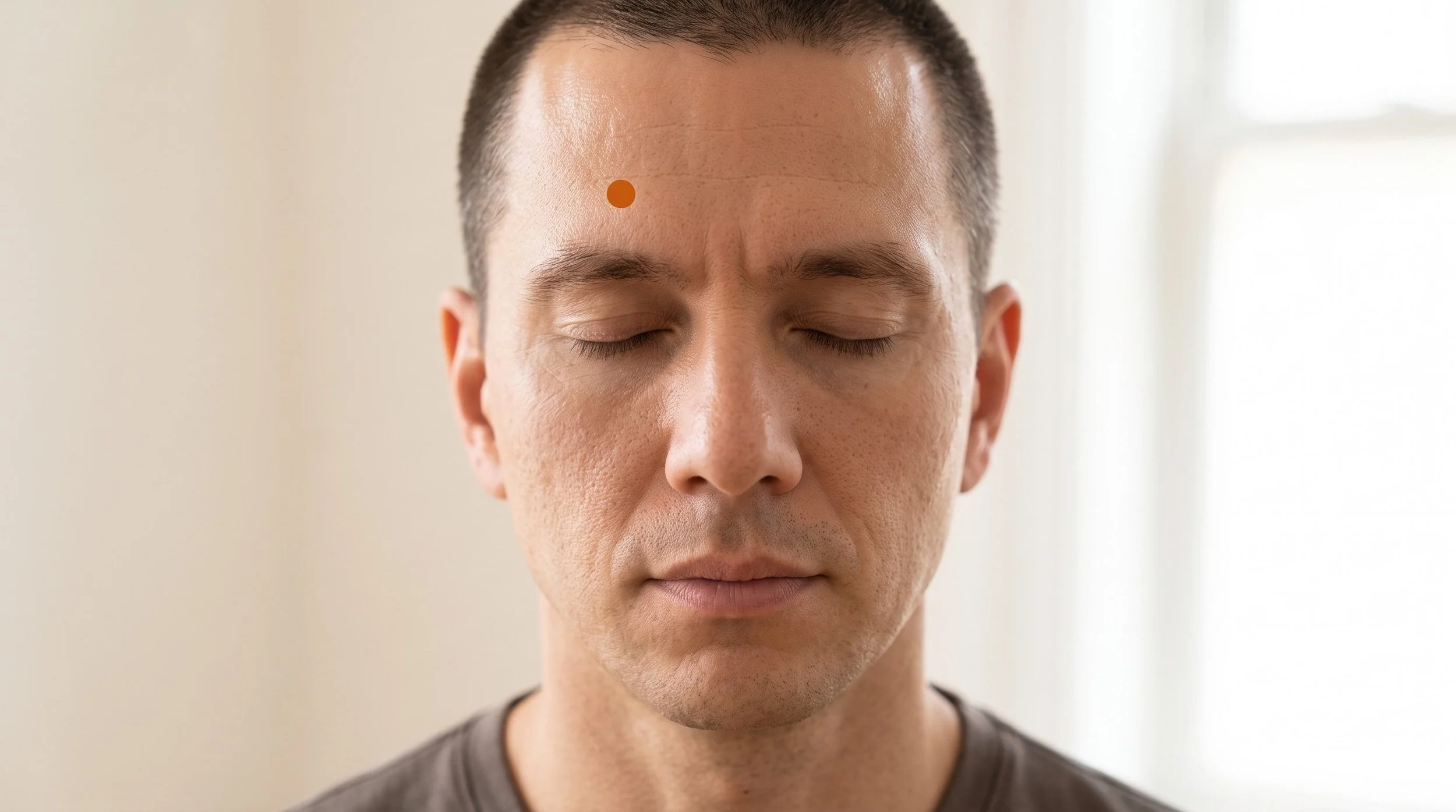
GB14 (Yangbai, translated as Yang White) is the gallbladder channel point on the forehead, sitting one cun (roughly one thumb width) above the midpoint of the eyebrow on the vertical line through the pupil when the eyes look straight ahead. It is one of the few points on the body where you can put a needle directly into first division trigeminal territory through skin only a few millimeters thick, which is exactly why the gb14 acupuncture point shows up so consistently in treatment for frontal headache, brow ridge pain, tired heavy eyelids, and facial nerve rehabilitation.
Classically it is listed as a meeting point of the gallbladder channel with the Yang Linking vessel and with the Sanjiao, Stomach, and Large Intestine channels (Deadman et al., 2007), a crossing status that matches the practical reality that forehead pain rarely respects a single channel map.
In the clinic, gallbladder 14 is a small, quick, superficially threaded needle that patients tend to feel as a spreading pressure across the brow, and it is often the difference between a headache treatment that helps the neck and one that also clears the front of the head.
- GB14 sits on the forehead, 1 cun above the eyebrow midpoint on the pupil line, with the glabella to anterior hairline distance measured as 3 cun, so the point falls about one third of the way up the forehead (Deadman et al., 2007). The tissue here is thin skin, subcutaneous fat, and frontalis muscle lying directly on the frontal bone.
- Traditional sources classify it as a crossing point of the gallbladder channel with the Yang Linking vessel and the Sanjiao, Stomach, and Large Intestine channels, and attribute to it the traditional actions of eliminating wind, benefiting the head, alleviating pain, and benefiting the eyes (Deadman et al., 2007; Kim, 2015). Read neurophysiologically, that crossing status simply reflects a location where several cranial sensory territories converge.
- The point lies in the distribution of the supraorbital nerve, a branch of the frontal nerve from the ophthalmic (V1) division of the trigeminal, and it overlaps the motor zone of frontalis, which is supplied by the temporal branch of the facial nerve (Cunningham, 2018). Histochemical work in rats at this exact location found sensory (CGRP positive), sympathetic, and parasympathetic fibers forming an intermingled network in the local tissue, which gives a plausible substrate for both sensory and vascular responses to needling (Wang et al., 2022).
- The mechanism story is convergence plus modulation: V1 afferents from the forehead terminate in the trigeminocervical complex alongside upper cervical input, and needle stimulation recruits descending inhibitory pathways using serotonergic, noradrenergic, and opioidergic signaling (Zhao, 2008). This is why a forehead point and an upper neck point often work better together than either alone.
- Research does not test GB14 in isolation. Cochrane reviews of acupuncture for tension-type headache and episodic migraine report modest benefit over sham and comparable or better results than routine care or prophylactic drugs, with GB14 appearing inside typical multi-point protocols (Linde et al., 2016a; Linde et al., 2016b), while individual patient data pooling in chronic pain shows effects that persist over time (Vickers et al., 2018).
- Needling is transverse, not perpendicular. The skin is pinched up and the needle is threaded inferiorly 0.5 to 0.8 cun, classically toward Yuyao at the mid-eyebrow (Deadman et al., 2007), and de qi is usually a spreading, distending fullness across the brow rather than a deep ache.
Frontal Headaches That Sit Right Behind the Brow?
Pain across the forehead and brow ridge often has both a local component (frontalis and supraorbital sensitivity) and an upstream component in the neck and jaw. At Morningside Acupuncture we use GB14 as a superficial threaded needle over frontalis, paired with upper cervical and distal points, so the treatment addresses the trigeminal input and the cervical contribution in the same session. Most patients feel the forehead soften within a few minutes of the needle being placed. Schedule a visit and let's map where your headache actually starts.
Schedule NowAnatomy of GB14: Why the Frontalis Above the Brow Ridge Is Such an Important Location
GB14 is one of the thinnest point locations on the body. Under the skin there is a shallow layer of subcutaneous fat, then the frontalis muscle (the anterior belly of occipitofrontalis), then the galea and periosteum sitting on the flat frontal bone. Frontalis is the muscle that raises the eyebrows and creates horizontal forehead lines, and it works far more than most people realize: squinting at screens, bracing against bright light, straining to read, and general facial guarding under stress all keep it low-level active.
Because there is no deep muscle bulk here, everything that happens at gb 14 location happens within a few millimeters of the surface, which shapes both the needling technique and the sensation.
The nerve geography is the clinically important part. The supraorbital nerve, a terminal branch of the frontal nerve from the ophthalmic (V1) division of the trigeminal, emerges at the supraorbital notch and fans upward across exactly this territory, with the supratrochlear nerve covering the medial forehead (Cunningham, 2018). Motor supply to frontalis comes from the temporal branch of the facial nerve, so a single small point overlies both a V1 sensory field and a facial nerve motor zone.
V1 afferents terminate in the trigeminocervical complex, where they converge with input from the upper cervical segments, which helps explain why forehead pain, neck tension, and eye symptoms so often travel together and why needling here can influence more than the patch of skin under the needle. Point-specific histochemical work in rats found sensory, sympathetic, and parasympathetic fibers distributed together in the tissue at GB14, targeting local vessels, follicles, and subcutaneous muscle, which supports both a sensory and an autonomic or vascular route of response (Wang et al., 2022).
Broader mechanism reviews describe needle stimulation engaging descending inhibitory control through serotonergic, noradrenergic, and endogenous opioid systems (Zhao, 2008).
The safety picture is straightforward but requires respect. The supraorbital artery and vein run with the nerve near the brow, and forehead skin bruises easily, so needling is done transversely with the skin pinched up rather than perpendicular toward bone. Classical technique threads the needle inferiorly 0.5 to 0.8 cun, sometimes connecting toward Yuyao at the mid-eyebrow (Deadman et al., 2007), while other texts describe a shallower subcutaneous insertion of 0.3 to 0.5 cun and note that moxibustion is applicable (Kim, 2015).
For facial paralysis work, practitioners may angle the threaded needle medially or laterally toward the affected side of the forehead. Firm post-needle pressure for a few seconds is standard practice here to minimize any small bruise.
Related Best Acupuncture Points For Headaches Related Frontalis Trigger PointsGB14 at a Glance: Classification, Location, and Clinical Use
| Category | Detail |
|---|---|
| Traditional Name | Yangbai (Yang White), GB14, also written gallbladder 14 |
| Channel Classification | Gallbladder channel of Foot Shaoyang, head and forehead region |
| Point Categories | Meeting point of the gallbladder channel with the Yang Linking vessel (Yang Wei mai) and with the Sanjiao, Stomach, and Large Intestine channels; listed among the Yang Linking vessel intersection points in classical channel theory |
| Precise Location | On the forehead, 1 cun superior to the midpoint of the eyebrow, directly above the pupil with the eyes looking straight ahead; the glabella to anterior hairline distance is measured as 3 cun, so the point sits about one third of the way up |
| Tissue Stimulated | Thin skin, subcutaneous fat, and the frontalis muscle over the frontal bone, in supraorbital nerve (V1) territory |
| Needle Depth / Direction | Transverse insertion directed inferiorly 0.5 to 0.8 cun with the skin pinched up, classically threaded toward Yuyao at the mid-eyebrow; some texts use a shallower subcutaneous 0.3 to 0.5 cun. Never perpendicular or deep |
| De Qi Sensation | A spreading, distending fullness across the forehead that may travel toward the brow or up toward the vertex, often with a mild stretch under the skin rather than a deep ache |
| Primary Clinical Uses | Frontal headache and brow ridge pain, supraorbital sensitivity, eye strain and heavy or twitching eyelids, facial paralysis rehabilitation, and head wind patterns in classical listings |
| Common Point Combinations |
|
Deadman's Manual of Acupuncture presents GB14 as the leading local point for forehead pain, and the commentary makes a distinction that still holds up in practice: forehead pain is theoretically yangming territory, but in the clinic it may follow either a yangming pattern (often with infraorbital pain, as in sinus complaints) or a shaoyang pattern (often with temporal, parietal, and eye involvement, as in migrainous headache).
Because this point is traditionally listed as a crossing of the gallbladder shaoyang channel with the Stomach and Large Intestine yangming channels, classical writers considered it suitable for either presentation, whether attributed to internal disharmony or to invasion of external wind. The same source records a second traditional role, that of a local point for a wide range of eye and eyelid complaints attributed to wind, including tearing on exposure to wind, drooping, twitching, or itching of the lids, deviation of the eye, and diminished night vision (Deadman et al., 2007).
What is striking is how tightly that classical list maps onto a single anatomical territory: nearly every indication falls within the supraorbital branch of V1 and the frontalis motor zone, which is not what you would expect from a system that had no concept of cranial nerve distribution.
Why GB14 Is Used for Eye Strain, Eyelid Twitching, and Facial Nerve Rehabilitation
The convergence story explains most of it. Sensation from the forehead, brow, upper eyelid, and front of the scalp all travels back through the supraorbital and supratrochlear branches of V1 to the trigeminal system, where those signals meet input from the upper cervical spine in the trigeminocervical complex. That shared relay is why a patient with a stiff, guarded neck often reports pressure across the brows, and why treating only the neck sometimes leaves the front of the head unaddressed.
Needling directly into that V1 field gives the nervous system a clear, competing, non-threatening sensory input at the same relay where the pain signal is being processed, which is a plausible mechanism for the rapid softening patients often notice.
Beyond the local segment, needle stimulation appears to engage descending pain control from the brainstem, with serotonergic, noradrenergic, and endogenous opioid systems all implicated in experimental work (Zhao, 2008). At this particular location there is also point-specific anatomical evidence: histochemical mapping in rats showed sensory, sympathetic, and parasympathetic fibers running together in the tissue at GB14 and supplying local blood vessels and subcutaneous muscle (Wang et al., 2022).
That combination of sensory and autonomic innervation offers a reasonable explanation for why patients frequently report warmth, flushing, or a sense of release across the forehead after needling, and it is consistent with traditional claims about local circulation without needing to invoke energy flow.
The facial paralysis application follows the motor anatomy rather than the sensory anatomy. GB14 overlies the region where the temporal branch of the facial nerve drives frontalis, so it functions as a local motor-zone point in rehabilitation protocols for Bell's palsy and related peripheral facial weakness (Cunningham, 2018).
Meta-analyses of acupuncture for Bell's palsy report higher effective response rates than comparison treatments but flag serious methodological limitations in the underlying trials, so the honest summary is that this is a reasonable adjunct within standard medical care rather than a proven stand-alone treatment (Li et al., 2015). Anyone with new facial weakness should be evaluated by a physician promptly, since corticosteroid timing matters.
What the Research Shows for GB14
It is worth being clear about what the evidence can and cannot say. No high-quality trial has isolated GB14 as a single intervention, and that is true for nearly every individual acupuncture point. What exists instead are reviews of multi-point protocols for headache, migraine, and facial paralysis in which this point commonly appears as a local selection, plus mechanistic work that describes what needling does to nerve and vascular tissue at this specific site.
Reading those together gives a fair picture: reasonable support for acupuncture as part of headache care, plausible physiology for why a forehead point contributes, and no basis for promising a specific result from one needle.
| Study | Type | Focus | Key Finding |
|---|---|---|---|
| Linde et al., 2016a | Cochrane systematic review | Acupuncture for prevention of tension-type headache | Pooled trials suggested acupuncture may reduce headache frequency compared with routine care and sham, though effect sizes were modest and trial quality varied. |
| Linde et al., 2016b | Cochrane systematic review | Acupuncture for prevention of episodic migraine | Moderate quality evidence indicated acupuncture was at least as effective as prophylactic drug treatment, with about 57 percent of acupuncture participants halving headache frequency at three months. |
| Vickers et al., 2018 | Individual patient data meta-analysis | Acupuncture for chronic pain including headache | Acupuncture outperformed both sham and no-acupuncture controls, with benefit that decayed only modestly over twelve months. |
| Li et al., 2015 | Systematic review and meta-analysis | Acupuncture for Bell's palsy (14 RCTs, 1541 participants) | Reported a higher effective response rate with acupuncture, but the authors cautioned that high risk of bias and heterogeneity limit confidence in the result. |
| Wang et al., 2022 | Experimental histochemical study (rat) | Sensory and autonomic innervation at GB14, ST2, and ST6 | Sensory, sympathetic, and parasympathetic fibers were shown forming a local network at the GB14 site, providing a neurochemical substrate that may respond to needling. |
| Zhao, 2008 | Narrative mechanism review | Neural mechanisms of acupuncture analgesia | Describes segmental spinal modulation and descending inhibitory pathways as the principal routes by which needle stimulation may reduce pain. |
Screen Fatigue, Heavy Eyelids, and Brow Tension?
Long hours at a monitor load the small muscles around the eyes and keep frontalis quietly working all day, which patients usually describe as heaviness, squinting, or a band of pressure above the brows. GB14 is one of the most useful forehead acupuncture point options for that pattern, and we combine it with periorbital and neck points to reduce the overall sensory load. Treatment is quick, comfortable, and easy to fit around a workday. Book a session and see how much lighter the front of your head can feel.
Schedule NowGB14 in the Context of Trigger Point Work
Frontalis is a genuine myofascial pain source, and its referral pattern stays close to home, spreading upward and across the forehead on the same side (Simons et al., 1999). GB14 sits squarely within that muscle, so in practical terms a needle placed at this point and a needle placed into a tender frontalis band are often the same needle described in two vocabularies.
At Morningside we treat that overlap as a feature rather than a contradiction: acupuncture is defined by the use of an acupuncture needle, and dry needling is one of the hundreds of styles that use it. What decides the technique is the exam, specifically whether palpation over the brow reproduces the patient's familiar headache.
In a typical headache session, GB14 rarely works alone. We commonly pair it with dry needling of the suboccipital group, upper trapezius, and temporalis when those muscles reproduce symptoms, because the upper cervical input converging in the trigeminocervical complex is frequently doing as much work as the forehead itself (Zhao, 2008). Because forehead tissue is thin and vascular, technique here stays gentle: shallow transverse insertion, minimal manipulation, and firm pressure afterward. Patients who arrive expecting aggressive needling on the face are usually surprised at how light this part of the treatment feels.
GB14 Headache Treatment at NYC's Highest-Rated Acupuncture Clinic
Morningside Acupuncture is the highest-rated acupuncture and dry needling clinic in New York City with over 500 five-star Google reviews, and headache care is one of the things we do most. Our licensed acupuncturists use GB14 alongside evidence-informed dry needling of frontalis, the suboccipitals, and the upper trapezius when the exam points that way. Every plan is built around your exam findings rather than a template. Schedule your first visit and start working on the headache pattern directly.
Schedule NowFrequently Asked Questions
What does GB14 feel like when needled?
Most people feel a brief pinch as the needle passes through the skin, then a spreading, slightly distending pressure across the forehead that can travel toward the brow or upward toward the top of the head. Because the needle is threaded flat under the skin rather than pushed toward bone, the sensation is usually a stretch or fullness rather than a deep ache. Some patients notice warmth or a sense of the forehead releasing within a minute or two. If it feels sharp, tell your acupuncturist, since the angle can be adjusted immediately.
Why needle the forehead when my headache seems to come from my neck?
Both can be true at the same time. Sensory nerves from the forehead (the supraorbital branch of the trigeminal nerve) and nerves from the upper neck feed into the same brainstem relay, the trigeminocervical complex, so tension in the neck can be felt across the brows and vice versa (Zhao, 2008). Treating only the neck sometimes leaves the frontal component untouched, which is why the classical pairing of GB14 with GB20 has such staying power. In practice, we choose based on what your exam and palpation findings show, not on where you point first.
Can I press GB14 myself between sessions?
Yes, and it is one of the easier points to self-treat. Look straight ahead, find the midpoint of your eyebrow, then move about one thumb width straight up onto the forehead, staying in line with your pupil. Use the pad of your index or middle finger and apply steady, moderate pressure, or small circles, for 30 to 60 seconds per side, breathing slowly. You can repeat this two or three times a day, and it pairs well with a light sweep along the brow ridge and a short screen break. Keep the pressure comfortable rather than forceful, since the skin here is thin, and stop if you have any skin irritation, an open lesion, or new or unexplained headache that has not been medically evaluated.
Is GB14 safe to needle?
In trained hands it is a low-risk point, but technique matters. Needling is transverse and shallow with the skin pinched up, typically 0.5 to 0.8 cun directed downward toward the mid-eyebrow (Deadman et al., 2007), and never perpendicular into the frontal bone or angled toward the orbit. The main practical consideration is bruising, since the supraorbital vessels run nearby and forehead skin marks easily, so practitioners apply firm pressure after removal. Tell your acupuncturist if you take blood thinners, bruise easily, have had cosmetic injectables in the area recently, or have any skin condition on the forehead.
Where exactly is GB14 located?
With your eyes looking straight ahead, GB14 is on the forehead, one cun (about one thumb width) directly above the midpoint of the eyebrow, on the vertical line running up from the pupil. Classical measurement treats the distance from the glabella (between the brows) to the front hairline as 3 cun, so gallbladder 14 falls roughly one third of the way up the forehead. Palpating downward from the hairline along the pupil line, it often sits in the slight hollow between the frontal eminence and the brow ridge, and it is frequently tender when there is forehead tension or eye fatigue.
References
- Deadman, P., Al-Khafaji, M., & Baker, K. (2009). A manual of acupuncture. Journal of Chinese Medicine Publications.
- Cunningham, P. M. (2000). Acupuncture points: A practical guide to classical and modern usage. Odyssey Press.
- Kim, H. (2008). Handbook of Oriental medicine (3rd ed.). Harmony & Balance Press.
- Simons, D. G., Travell, J. G., & Simons, L. S. (1999). Travell & Simons' myofascial pain and dysfunction: The trigger point manual, Vol. 1: Upper half of body (2nd ed.). Williams & Wilkins.
- Linde, K., Allais, G., Brinkhaus, B., Fei, Y., Mehring, M., Shin, B.-C., Vickers, A., & White, A. R. (2016a). Acupuncture for the prevention of tension-type headache. Cochrane Database of Systematic Reviews, 2016(4), CD007587. https://doi.org/10.1002/14651858.CD007587.pub2
- Linde, K., Allais, G., Brinkhaus, B., Fei, Y., Mehring, M., Vertosick, E. A., Vickers, A., & White, A. R. (2016b). Acupuncture for the prevention of episodic migraine. Cochrane Database of Systematic Reviews, 2016(6), CD001218. https://doi.org/10.1002/14651858.CD001218.pub3
- Vickers, A. J., Vertosick, E. A., Lewith, G., MacPherson, H., Foster, N. E., Sherman, K. J., Irnich, D., Witt, C. M., & Linde, K. (2018). Acupuncture for chronic pain: Update of an individual patient data meta-analysis. Journal of Pain, 19(5), 455-474. https://doi.org/10.1016/j.jpain.2017.11.005
- Li, P., Qiu, T., & Qin, C. (2015). Efficacy of acupuncture for Bell's palsy: A systematic review and meta-analysis of randomized controlled trials. PLoS ONE, 10(5), e0121880. https://doi.org/10.1371/journal.pone.0121880
- Wang, J., Cui, J.-J., Xu, D.-S., Su, Y.-X., Liao, J.-Y., Wu, S., Zou, L., Guo, Y.-T., Shen, Y., & Bai, W.-Z. (2022). Sensory and autonomic innervation of the local tissues at traditional acupuncture point locations GB14, ST2 and ST6. Acupuncture in Medicine, 40(6), 546-555. https://doi.org/10.1177/09645284221085579
- Zhao, Z. Q. (2008). Neural mechanism underlying acupuncture analgesia. Progress in Neurobiology, 85(4), 355-375. https://doi.org/10.1016/j.pneurobio.2008.05.004
Disclaimer: This web site is intended for educational and informational purposes only. Reading this website does not constitute providing medical advice or any professional services. This information should not be used for diagnosing or treating any health issue or disease. Those seeking medical advice should consult with a licensed physician. Seek the advice of a medical doctor or other qualified health professional for any medical condition. If you think you have a medical emergency, call 911 or go to the emergency room. No acupuncturist-patient relationship is created by reading this website or using the information. Morningside Acupuncture PLLC and its employees and contributors do not make any express or implied representations with respect to the information on this site or its use. For any legal interpretation of scope of practice in your state, consult a licensed attorney or regulatory authority.
Read more from our blog