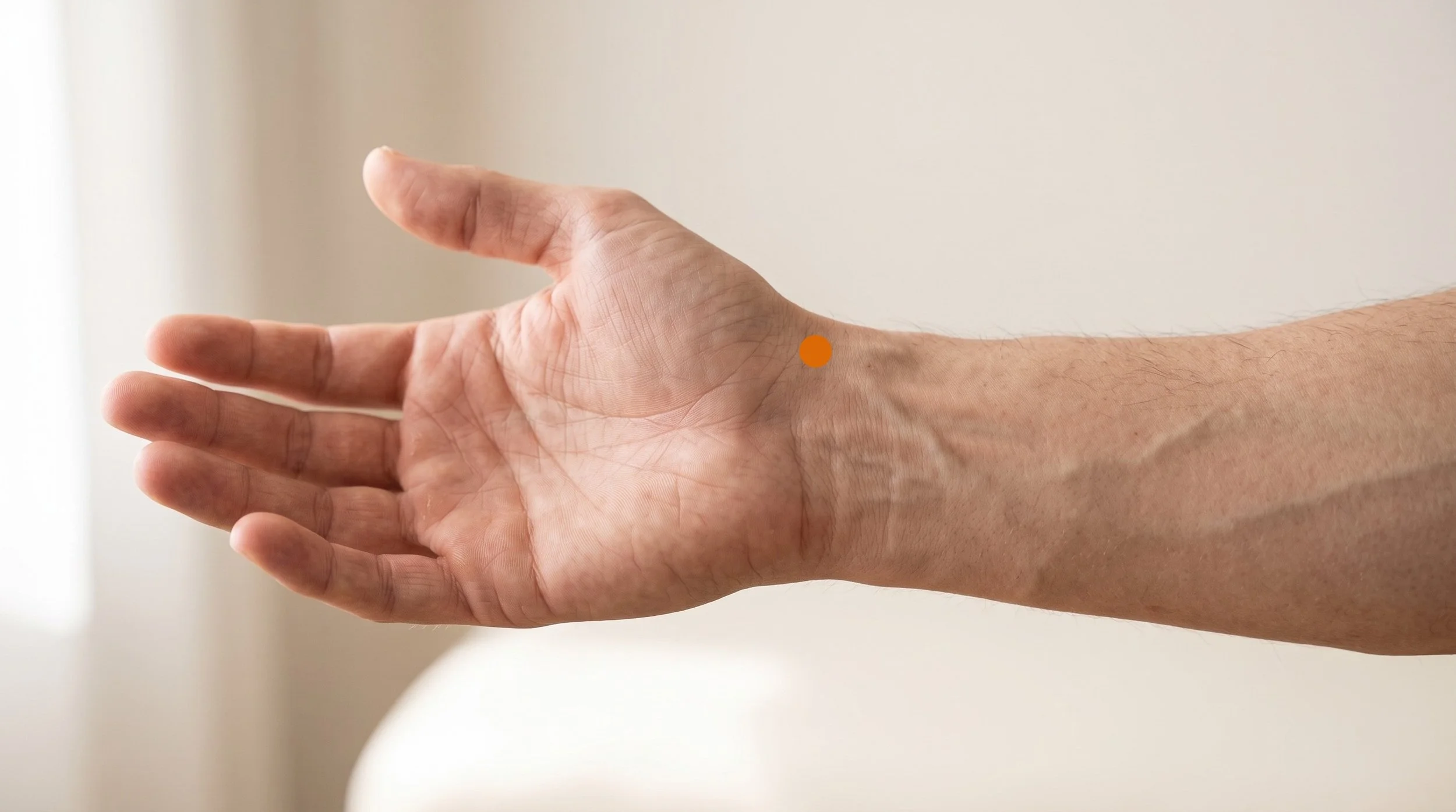
Zigong Acupuncture Point (M-CA-18)
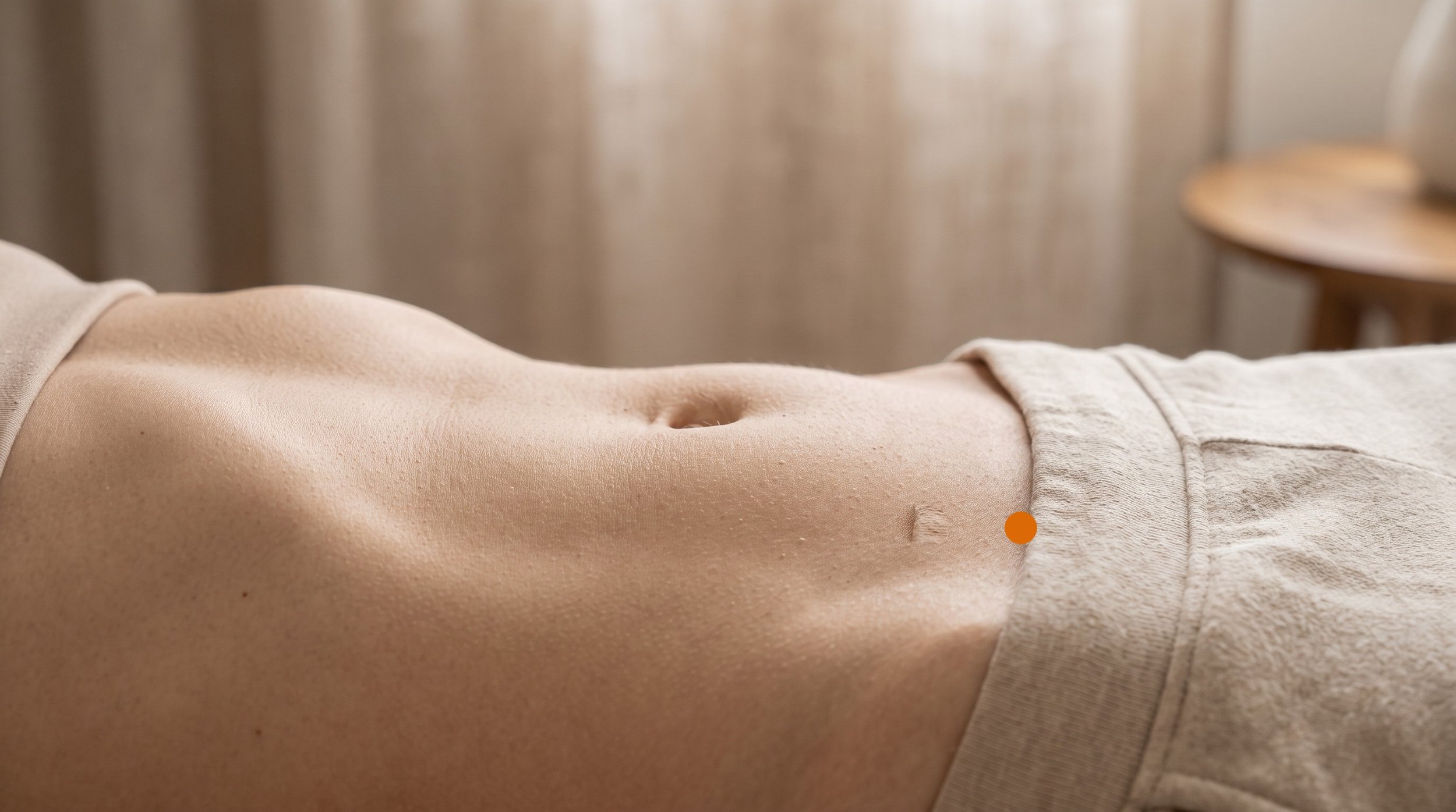
Zigong Acupuncture Point
The Palace of the Child Beside the Pubic Bone: Anatomy, Mechanism, and Why This Extra Point Anchors Menstrual and Fertility Protocols
Zigong, translated as Palace of the Child and coded M-CA-18 (also written EX-CA1 in modern lists), is an extra point of the lower abdomen named directly for the uterus. It sits 3 cun lateral to the midline, level with CV3 Zhongji, which places it about four finger-widths out from a spot roughly one cun above the top of the pubic bone. Unlike the fourteen-channel points, the zigong acupuncture point never belonged to a channel pathway; it entered the literature as a targeted local point for gynecological complaints and has stayed there.
Clinically it matters because it gives practitioners a paired, off-midline access to the same lower abdominal wall and pelvic segmental territory served by the CV-line points, and because it appears in a large share of modern menstrual and fertility protocols alongside CV3, CV4, and SP6.
- Location and layers: the zigong point lies 3 cun lateral to the anterior midline at the level of CV3, so the needle passes through skin, subcutaneous fat, and the lateral portion of rectus abdominis or its aponeurotic junction with the oblique layer before reaching the deeper abdominal wall.
- Traditional attribution: classical sources credit Zigong with raising and regulating qi and with regulating menstruation and relieving pain, and list it for uterine prolapse, infertility, irregular cycles, and uterine bleeding. In modern terms these categories map onto pelvic pain modulation and autonomic regulation rather than any literal movement of energy.
- Mechanism: needling here engages lower thoracic and upper lumbar somatic afferents (roughly T12 to L1) that share dorsal horn territory with visceral input from the uterus and adnexa, a convergence pattern that plausibly explains local and referred symptom change (Zhao, 2008).
- Descending control: needle stimulation also recruits supraspinal inhibitory pathways using opioid, serotonergic, and noradrenergic signalling, which is the best supported general mechanism for acupuncture analgesia (Zhao, 2008; Vickers et al., 2018).
- Research picture: a Cochrane review of acupuncture and acupressure for primary dysmenorrhoea found the evidence insufficient to draw firm conclusions (Smith et al., 2016), while fertility reviews disagree depending on the comparator used (Cheong et al., 2013; Smith et al., 2019).
- De qi and practice: patients usually report a heavy, distending ache that spreads toward the pubic bone or inward, and the bladder is emptied before treatment. Needling at Zigong is avoided once pregnancy is established or suspected.
Struggling With Period Pain That Takes Over Your Month?
At Morningside Acupuncture we use Zigong along with CV3, CV4, and SP6 as part of a cycle-aware plan rather than a one-off treatment. Sessions are timed around your cycle, and we often add gentle abdominal wall needling and heat to reduce cramping and guarding. Many patients also benefit from dry needling of the rectus abdominis and obliques when the abdominal wall itself is tender. Schedule a visit and we'll map a plan to your cycle.
Schedule NowAnatomy of ZIGONG: Why the Lower Abdominal Wall Beside CV3 Is Such an Important Location
Zigong sits low on the abdomen, three cun out from the midline at the level of CV3, which is four cun below the navel and one cun above the pubic symphysis. From the surface down, a needle crosses skin, a variable layer of subcutaneous fat, the superficial fascia, and then either the lateral fibers of rectus abdominis or the aponeurotic seam where the oblique and transversus layers meet the rectus sheath.
That tissue is loaded constantly by trunk flexion, coughing, breathing mechanics, and by the bracing patterns people adopt when the pelvis hurts, which is one reason the lower abdominal wall is often tender to palpation in patients with cramping or post-surgical scarring.
The innervation here comes from the lower intercostal, subcostal, and iliohypogastric branches, giving the point a segmental identity around the T12 to L1 levels. Uterine and adnexal afferents travel with hypogastric and ovarian plexus fibers into overlapping lower thoracic and upper lumbar cord segments, so somatic input from the abdominal wall and visceral input from the pelvis converge on shared dorsal horn neurons.
That convergence is the standard neurophysiological explanation for why a needle in the abdominal wall may change how pelvic symptoms are felt, and it works alongside recruitment of descending inhibitory pathways that use endogenous opioids, serotonin, and noradrenaline (Zhao, 2008). Pooled patient-level data for chronic pain conditions suggest effects that are modest but larger than sham and durable over months (Vickers et al., 2018).
Deep to the point lie the inferior epigastric vessels within the rectus sheath, the peritoneum, loops of bowel, the bladder when it's distended, and the ovary and adnexa in the deeper pelvic field. For that reason the standard convention is perpendicular insertion of 0.8 to 1.2 cun with the bladder emptied beforehand, with depth reduced in slim patients and with any lower abdominal needling avoided once pregnancy is established or suspected.
Classical texts also record a specialized lifting technique for uterine prolapse in which the needle is angled toward CV2 through the muscular layer, rotated to engage the fibers, then drawn up and taped in place for 20 to 30 minutes, a maneuver that belongs strictly in trained hands.
Related Rectus Abdominis Trigger Points Related Abdominal Obliques Trigger PointsZIGONG at a Glance: Classification, Location, and Clinical Use
| Category | Detail |
|---|---|
| Traditional Name | Zigong, Palace of the Child (uterus), extra point M-CA-18, also listed as EX-CA1 |
| Channel Classification | Extra (non-channel) point of the lower abdomen; not part of the fourteen-channel system |
| Point Categories | No five-shu, meeting, crossing, or hui-meeting designations are recorded for this point, since it's an extra point rather than a channel point; classical sources list it purely as a local uterus point of the lower abdomen |
| Precise Location | Lower abdomen, 3 cun lateral to the anterior midline, level with CV3 Zhongji, which is 4 cun below the umbilicus and 1 cun above the pubic symphysis |
| Tissue Stimulated | Skin and subcutaneous fat, then the lateral fibers of the rectus abdominis or the aponeurotic junction with the abdominal obliques, over the T12 to L1 segmental territory of the lower abdominal wall |
| Needle Depth / Direction | Perpendicular insertion 0.8 to 1.2 cun with the bladder emptied first; a classical prolapse technique directs the needle toward CV2 through the muscle layer, and lower abdominal needling is avoided once pregnancy is established or suspected |
| De Qi Sensation | A heavy, distending ache that often spreads medially toward the pubic bone or inward into the lower pelvis, sometimes with a mild drawing sensation |
| Primary Clinical Uses | Menstrual irregularity and cramping, fertility support protocols, uterine prolapse in classical listings, and general lower abdominal discomfort |
| Common Point Combinations |
|
Deadman and colleagues' point manual records that Zigong first appears in the Ming dynasty Great Compendium of Acupuncture and Moxibustion, and the traditional attributions given there are unusually narrow: raising and regulating qi, plus regulating menstruation and relieving pain. The classical indication list is similarly focused, covering uterine prolapse, infertility, irregular cycles, and uterine bleeding, with almost nothing outside the reproductive sphere.
The recorded combinations follow the same logic, pairing Zigong with CV3 for infertility and for bleeding, and expanding to CV3, CV5, and BL23 when bleeding is persistent. What's striking is the consistency: most points accumulate sprawling indication lists over the centuries, while this one stayed anchored to a single organ from its first appearance to modern protocol sheets, which is exactly what you'd expect from a point named after the structure that lies beneath it.
Why ZIGONG Is Used for Cramping That Radiates Into the Low Back and Inner Thighs
Patients are often surprised that a point on the front of the abdomen can change pain felt in the sacrum or down the inner thighs. The reason is segmental rather than mysterious. Sensory fibers from the uterus and adnexa enter the cord at lower thoracic and upper lumbar levels, the same levels that supply the skin and muscle of the lower abdominal wall, and pain referral from pelvic structures follows those shared segments outward.
Needling the abdominal wall in that territory feeds a strong, well-localized somatic signal into the same dorsal horn neurons that are processing the visceral input, which can dampen how that input is amplified (Zhao, 2008).
On top of the segmental effect, needle stimulation activates brainstem-based descending inhibition using opioid, serotonergic, and noradrenergic transmitters, and it engages autonomic reflexes that influence smooth muscle tone and regional blood flow (Zhao, 2008). A small early physiological study is often cited here: in ten infertile women with high uterine artery impedance, a course of electroacupuncture was followed by a reduction in the pulsatility index, with the authors proposing reduced sympathetic vasoconstrictor drive as the mechanism (Stener-Victorin et al., 1996). That study was small and not randomized, so it's best read as a plausible mechanism rather than proof of clinical benefit.
The practical takeaway is that Zigong isn't doing something exotic. It's a well-placed somatic input into the pelvic segments, usually combined with midline points and distal leg points so the treatment engages both local and systemic pathways. Pooled individual patient data across chronic pain conditions support real but moderate effects for acupuncture compared with sham and with no acupuncture, and that's a reasonable frame for what a course of treatment may offer (Vickers et al., 2018).
What the Research Shows for ZIGONG
Almost no trials isolate a single point, and Zigong is no exception. It typically appears inside multi-point protocols alongside CV3, CV4, SP6, BL32, or ST36, so the honest interpretation is that the evidence tests the protocol, not the point. The reviews below also disagree with each other in instructive ways, largely because results shift depending on whether acupuncture is compared with sham needling or with no adjunctive treatment at all. Read them as a picture of modest and uncertain benefit rather than as a settled answer.
| Study | Type | Focus | Key Finding |
|---|---|---|---|
| Smith et al., 2016 | Cochrane systematic review | Acupuncture and acupressure for primary dysmenorrhoea | The reviewers concluded there's insufficient evidence to determine whether these approaches help period pain, with risk of bias and poor reporting limiting the included trials. |
| Cheong et al., 2013 | Cochrane systematic review | Acupuncture as an adjunct to assisted reproductive technology | This review found no evidence that acupuncture improves live birth or pregnancy rates in assisted conception, and called for better designed trials. |
| Smith et al., 2019 | Systematic review and meta-analysis | Acupuncture performed around the time of embryo transfer | Across 20 trials and 5130 women, acupuncture was associated with higher clinical pregnancy and live birth rates compared with no adjunctive treatment, but showed no significant difference against sham controls, with substantial heterogeneity. |
| Xie et al., 2019 | Systematic review and meta-analysis | Acupuncture and IVF pregnancy outcomes across 27 trials | Pooled clinical pregnancy rates favored acupuncture while live birth rates did not, with the largest apparent benefit in trials where most participants had prior unsuccessful IVF cycles. |
| Stener-Victorin et al., 1996 | Small prospective physiological study | Electroacupuncture and uterine artery blood flow impedance | Ten infertile women with high uterine artery impedance showed reduced pulsatility index after a course of electroacupuncture, a suggestive but small and non-randomized finding. |
| Vickers et al., 2018 | Individual patient data meta-analysis | Acupuncture for chronic pain across roughly 21,000 patients | Effects were statistically significant versus both sham and no-acupuncture controls and persisted over a year, though the difference from sham was modest. |
| Zhao, 2008 | Mechanistic review | Neural mechanisms of acupuncture analgesia | Analgesic effects are attributed to segmental spinal inhibition and descending control involving opioid, serotonergic, and noradrenergic systems. |
Acupuncture Points for Fertility: How the Zigong Fertility Point Is Actually Used
Safety first, because this is the part that gets misreported online. Zigong is a lower abdominal point, and needling it belongs to a licensed practitioner working with an intake, not to self-treatment with needles at home. Lower abdominal needling including Zigong is set aside once pregnancy is established or suspected, and any fertility work should be coordinated with your reproductive endocrinologist or OB-GYN rather than substituted for their care. The bladder is emptied before treatment, depth is adjusted to body habitus, and treatment plans are timed to cycle phase or to the IVF calendar.
With that framing in place, the zigong fertility point is one of the most commonly selected acupuncture points for fertility in modern Chinese protocols, usually paired with CV3 or CV4 on the midline and SP6 on the medial leg. The classical rationale is straightforward: the point is named for the uterus and sits over it, and the Great Compendium already recorded a Zigong plus CV3 pairing for infertility.
The neurophysiological rationale is the segmental one, since the point feeds somatic input into the same lower thoracic and upper lumbar levels that carry uterine and ovarian afferents, with possible downstream effects on autonomic tone and pelvic blood flow (Zhao, 2008; Stener-Victorin et al., 1996).
What the evidence supports is narrower than most fertility marketing suggests. A Cochrane review of acupuncture in assisted reproduction found no clear benefit for live birth or pregnancy rates (Cheong et al., 2013), while a later meta-analysis of acupuncture around embryo transfer found higher pregnancy and live birth rates against no-treatment controls but not against sham needling (Smith et al., 2019). A separate pooled analysis found improved clinical pregnancy rates without a corresponding live birth effect, with the strongest signal in patients who'd already had failed cycles (Xie et al., 2019).
Our position is that uterus acupuncture point work may be a reasonable supportive measure for stress, sleep, cycle-related pain, and general wellbeing during treatment, and we say so plainly rather than promising outcomes.
Preparing for IVF or Trying to Conceive in NYC?
Our clinicians use the uterus point acupuncture approach as one component of a coordinated fertility support plan, always alongside your reproductive endocrinologist rather than in place of them. Treatment is adjusted at each phase of the cycle, and lower abdominal points including Zigong are set aside once pregnancy is established or suspected. We keep expectations realistic and explain what the research does and doesn't support. Book a consultation to talk through timing.
Schedule NowZIGONG in the Context of Trigger Point Work
The location of Zigong overlaps directly with myofascial territory that matters clinically. Trigger points in the lower rectus abdominis and in the lower fibers of the internal and external obliques can refer pain across the lower abdomen and into the groin, and the trigger point literature describes abdominal wall referral patterns that can convincingly imitate visceral complaints, as well as visceral problems that seed trigger points in the abdominal wall (Simons et al., 1999).
That two-way relationship is why we palpate the abdominal wall carefully before deciding whether a patient's lower abdominal pain is primarily myofascial, primarily visceral, or a mixture.
At Morningside we treat Zigong as an acupuncture point when the goal is segmental and autonomic regulation for menstrual or fertility-related concerns, and we treat the surrounding muscle as a dry needling target when palpation reproduces the patient's familiar pain.
In practice that may mean shallow, precise needling at Zigong and CV4 combined with careful dry needling of the rectus abdominis and obliques, plus more distal work at SP6 or ST36. Since acupuncture is defined by the use of an acupuncture needle, and dry needling is one of the many styles within that definition, both approaches are performed with the same sterile filiform needles by the same licensed clinician, with the same abdominal safety conventions applied throughout.
ZIGONG Menstrual and Fertility Treatment at NYC's Highest-Rated Acupuncture Clinic
Morningside Acupuncture is the highest-rated acupuncture and dry needling clinic in New York City with over 500 five-star Google reviews. Our licensed acupuncturists combine classical point selection like Zigong with modern trigger point and orthopedic needling, all delivered with thin sterile needles and careful abdominal technique. Whether your concern is cramping, cycle irregularity, or fertility support, we build the plan around your history and your care team. Schedule your appointment today.
Schedule NowFrequently Asked Questions
What does ZIGONG feel like when needled?
Most patients describe a heavy, full, or distending ache rather than a sharp sensation, often spreading medially toward the pubic bone or inward into the pelvis. Some feel a mild drawing or warming sensation across the lower abdomen. If the abdominal wall itself is holding tension, there may be a brief muscular grab or twitch as the needle passes through the rectus or oblique layer. Sharp, electric, or radiating pain isn't the goal, and you should tell your practitioner right away if you feel it so the needle can be adjusted.
Why needle the abdomen instead of just using points on the legs?
Both approaches are used, and most protocols combine them. Points like SP6 and ST36 work through distal and systemic pathways, while Zigong delivers input directly into the T12 to L1 segments that share spinal territory with uterine and adnexal afferents, which is the convergence mechanism behind local point selection (Zhao, 2008). Practically, abdominal points also let the practitioner palpate and treat a tender, guarded abdominal wall that often accompanies chronic pelvic complaints. The combination gives you a local segmental effect plus a broader descending inhibitory effect.
Can I press ZIGONG myself between sessions?
Yes, acupressure at this location is generally safe for most people outside of pregnancy. Find the top of your pubic bone, move about one thumb-width up to the CV3 level, then measure roughly four finger-widths out to either side. Use flat fingertip pressure, not a poking motion, at a firmness that feels like a satisfying ache rather than pain. Hold for 30 to 60 seconds per side, repeat two or three times, and combine it with slow breathing or a warm pack for cramping. Skip it if you're pregnant or think you might be, if you have an IUD-related or acute pelvic issue you haven't had assessed, if you've had recent abdominal surgery, or if the area is unusually tender, and see a clinician for pain that's new, severe, or accompanied by fever or abnormal bleeding.
Is ZIGONG safe to needle?
In trained hands, yes, with clear conventions. The bladder is emptied before treatment so a distended bladder isn't sitting under the needle, insertion is perpendicular at 0.8 to 1.2 cun, and depth is reduced in slim patients. The inferior epigastric vessels, peritoneum, and bowel lie deep to the point, so this isn't a location for aggressive or blind deep needling. Lower abdominal points including Zigong are avoided once pregnancy is established or suspected, and it's never a self-needling point. Common minor effects are the usual ones for any needling: brief soreness or a small bruise.
Where exactly is ZIGONG located?
It's on the lower abdomen, 3 cun lateral to the midline, level with CV3 Zhongji. To find CV3, locate the upper border of the pubic symphysis and measure one cun above it, which also corresponds to four cun below the navel. From there, measure one hand-breadth (three cun) straight out to each side. The point is bilateral, so there's one on each side, and practitioners usually confirm the spot by palpating for a tender or slightly firm area in the lower abdominal wall.
Should I get acupuncture at Zigong during an IVF cycle?
That's a conversation to have with both your acupuncturist and your fertility team. Many patients receive treatment during stimulation and around retrieval, and some clinics use protocols timed to embryo transfer, which is where most of the research sits (Smith et al., 2019). Once a transfer has occurred or pregnancy is suspected, we stop needling Zigong and other lower abdominal points and shift to points on the limbs and back. We always want to know your medication schedule and appointment dates so treatment fits around your cycle rather than complicating it.
References
- Deadman, P., Al-Khafaji, M., & Baker, K. (2009). A manual of acupuncture. Journal of Chinese Medicine Publications.
- O'Connor, J., & Bensky, D. (Eds. & Trans.). (1981). Acupuncture: A comprehensive text. Shanghai College of Traditional Medicine. Eastland Press.
- Maciocia, G. (2005). The foundations of Chinese medicine: A comprehensive text for acupuncturists and herbalists (2nd ed.). Elsevier Churchill Livingstone.
- Maciocia, G. (2006). The channels of acupuncture: Clinical use of the secondary channels and eight extraordinary vessels. Churchill Livingstone Elsevier.
- Kim, H. (2008). Handbook of Oriental medicine (3rd ed.). Harmony & Balance Press.
- Cheng, X. (Ed.). (1999). Chinese acupuncture and moxibustion (Rev. ed.). Foreign Languages Press.
- Simons, D. G., Travell, J. G., & Simons, L. S. (1999). Travell & Simons' myofascial pain and dysfunction: The trigger point manual, Vol. 1: Upper half of body (2nd ed.). Williams & Wilkins.
- Smith, C. A., Armour, M., Zhu, X., Li, X., Lu, Z. Y., & Song, J. (2016). Acupuncture for dysmenorrhoea. Cochrane Database of Systematic Reviews, 2016(4), CD007854. https://doi.org/10.1002/14651858.CD007854.pub3 [VERIFY BEFORE PUBLISHING]
- Cheong, Y. C., Dix, S., Hung Yu Ng, E., Ledger, W. L., & Farquhar, C. (2013). Acupuncture and assisted reproductive technology. Cochrane Database of Systematic Reviews, 2013(7), CD006920. https://doi.org/10.1002/14651858.CD006920.pub3
- Smith, C. A., Armour, M., Shewamene, Z., Tan, H. Y., Norman, R. J., & Johnson, N. P. (2019). Acupuncture performed around the time of embryo transfer: A systematic review and meta-analysis. Reproductive BioMedicine Online, 38(3), 364-379. https://doi.org/10.1016/j.rbmo.2018.12.038
- Xie, Z. Y., Peng, Z. H., Yao, B., Chen, L., Mu, Y. Y., Cheng, J., Li, Q., Luo, X., Yang, P. Y., & Xia, Y. B. (2019). The effects of acupuncture on pregnancy outcomes of in vitro fertilization: A systematic review and meta-analysis. BMC Complementary and Alternative Medicine, 19(1), 131. https://doi.org/10.1186/s12906-019-2523-7
- Stener-Victorin, E., Waldenström, U., Andersson, S. A., & Wikland, M. (1996). Reduction of blood flow impedance in the uterine arteries of infertile women with electro-acupuncture. Human Reproduction, 11(6), 1314-1317. https://doi.org/10.1093/oxfordjournals.humrep.a019378
- Zhao, Z. Q. (2008). Neural mechanism underlying acupuncture analgesia. Progress in Neurobiology, 85(4), 355-375. https://doi.org/10.1016/j.pneurobio.2008.05.004
- Vickers, A. J., Vertosick, E. A., Lewith, G., MacPherson, H., Foster, N. E., Sherman, K. J., Irnich, D., Witt, C. M., & Linde, K. (2018). Acupuncture for chronic pain: Update of an individual patient data meta-analysis. Journal of Pain, 19(5), 455-474. https://doi.org/10.1016/j.jpain.2017.11.005
Disclaimer: This web site is intended for educational and informational purposes only. Reading this website does not constitute providing medical advice or any professional services. This information should not be used for diagnosing or treating any health issue or disease. Those seeking medical advice should consult with a licensed physician. Seek the advice of a medical doctor or other qualified health professional for any medical condition. If you think you have a medical emergency, call 911 or go to the emergency room. No acupuncturist-patient relationship is created by reading this website or using the information. Morningside Acupuncture PLLC and its employees and contributors do not make any express or implied representations with respect to the information on this site or its use. For any legal interpretation of scope of practice in your state, consult a licensed attorney or regulatory authority.
Read more from our blog