Best Acupuncture Points for Neck Pain
GB20, BL10, GB21, GV14, and Distal Hand Points — Anatomical Locations, Neurophysiological Mechanisms, and How They Address Cervical Pain, Stiffness, and Occipital Headaches
Neck pain is one of the most common musculoskeletal complaints, and acupuncture has a well-documented evidence base for it. The point selection for neck pain is particularly instructive because it combines immediate local tissue effects at the cervical muscles with distal points on the hand that produce supraspinal modulation of the same pain pathways.
- A Cochrane systematic review on acupuncture for neck disorders found moderate evidence that acupuncture is more effective than sham for short-term pain relief and improved function, with evidence supporting both local cervical needling and distal point combinations (Trinh et al., 2007).
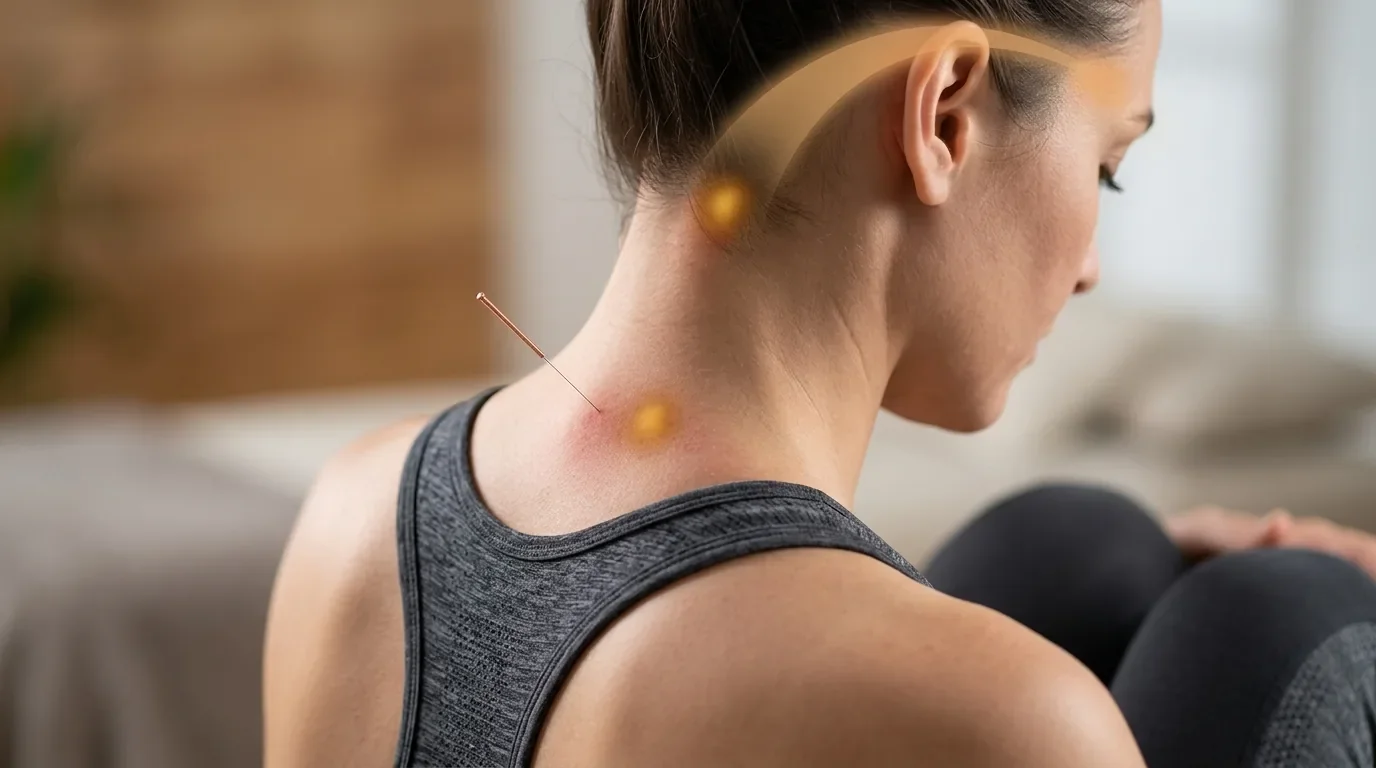
- GB20 (Fengchi), in the suboccipital depression between the upper trapezius and sternocleidomastoid, is the most consistently selected point for neck pain and occipital headaches, and its proximity to the greater occipital nerve explains both its local analgesic effect and its influence on headache patterns that arise from cervical muscle tension.
- The suboccipital region is a convergence zone: sensory afferents from the upper cervical muscles enter the trigeminal nucleus caudalis alongside signals from the face and head, which is why cervical muscle trigger points so commonly produce frontal headaches, eye pain, and even nausea (Zhao, 2008).
- SI3 (Houxi) on the ulnar border of the hand is a distal point classically used for cervical and spinal pain; its anatomical location over the abductor digiti minimi and its stimulation of the ulnar nerve creates afferent input that activates descending inhibition pathways relevant to C5–C8 spinal levels.
- GB21 (Jianjing) sits at the belly of the upper trapezius midway between the neck and the acromion, and needling here produces a local trigger point release in one of the most commonly overloaded muscles in desk workers, directly addressing the taut bands that generate referred headache and shoulder pain.
- For neck pain with arm radiation or tingling, point selection expands to include scalene-adjacent points and distal hand points, reflecting the involvement of the brachial plexus territory in cervical presentations with nerve root irritation (Vickers et al., 2018).
Has neck pain or stiffness been affecting your concentration or sleep?
Chronic neck tension and the headaches it causes are among the most common presentations we treat at Morningside. Acupuncture point selection for neck pain addresses both the local muscle tissue and the broader pain processing pathways that make cervical tension self-perpetuating. Our practitioners are experienced in identifying which muscles and spinal levels are involved in your specific pattern.
Schedule NowThe Cervical Spine as a Pain Generator and a Headache Source
Neck pain and headaches are inseparable complaints for a significant portion of patients. The anatomical reason is that the dorsal horn neurons of the upper cervical spinal cord (C1–C3) also receive input from the trigeminal nerve, which supplies sensation to the face, temples, and eyes. When the muscles of the upper neck, including the suboccipitals, semispinalis capitis, upper trapezius, and sternocleidomastoid, become chronically tight and develop active trigger points, the sensitized dorsal horn neurons at C1–C3 begin to relay some of that amplified signal through the trigeminal pathways, generating pain that is felt in the forehead, behind the eyes, or at the temples (Zhao, 2008).
This convergence mechanism explains why cervical acupuncture points, particularly those in the suboccipital region, are used for both neck stiffness and occipital or tension-type headaches. Reducing the afferent input from tense cervical muscles reduces the convergent trigeminal signals, and the headache component of the presentation typically improves alongside the neck itself.
Acupuncture point selection for neck pain therefore serves two targets simultaneously: the musculoskeletal tissue of the cervical spine and shoulder girdle, and the broader pain processing state that has become sensitized through persistent cervical muscle overload. Local points address the former; distal points on the hand address the latter through supraspinal descending inhibition pathways.
Related Trapezius Trigger Points: Upper Neck, Head, and Shoulder ReferralKey Acupuncture Points for Neck Pain
| Point | Anatomical Location | Tissue / Nerve | Clinical Use |
|---|---|---|---|
| GB20 (Fengchi) | Suboccipital depression between the upper trapezius and SCM insertions, below the occiput | Suboccipital musculature; greater occipital nerve adjacent; semispinalis capitis | Neck stiffness, occipital headache, dizziness; most commonly selected point for cervical presentations |
| BL10 (Tianzhu) | 1.3 cun lateral to GV15, over the upper trapezius at the base of the occiput at C1–C2 level | Trapezius origin at occiput; adjacent to greater occipital nerve | Occipital pain, cervical stiffness, eye and vision-related headaches from cervical muscle tension |
| GB21 (Jianjing) | Midpoint of the superior border of the trapezius, between the C7 spinous process and the acromion | Upper trapezius belly; trigger point location; accessory nerve territory | Neck and shoulder tension, upper trapezius trigger point release, referred headache; also useful for shoulder pain |
| GV14 (Dazhui) | Between the C7 and T1 spinous processes, midline | Supraspinous and interspinous ligaments; deep cervical extensors | Cervicothoracic junction stiffness, diffuse neck aching, febrile conditions; central segmental point for C7–T1 |
| SI3 (Houxi) | At the ulnar end of the proximal palmar crease, over the 5th metacarpal head when the hand is loosely fisted | Abductor digiti minimi; ulnar nerve branches | Distal point for cervical and spinal pain; opens the governing vessel pathway; activates supraspinal modulation relevant to C6–C8 levels |
| BL60 (Kunlun) | Between the posterior aspect of the lateral malleolus and the Achilles tendon | Superficial peroneal nerve; peroneal tendon sheath; deep to sural nerve | Distal point for cervical and lumbar spine; anti-inflammatory and analgesic via supraspinal pathways; particularly useful for cervical stiffness with restricted rotation |
| LI4 (Hegu) | Dorsum of the hand, between the 1st and 2nd metacarpals, at the midpoint of the 2nd metacarpal radial border | First dorsal interosseous muscle; deep branch of radial nerve | Distal analgesic point for head, face, and neck; activates descending inhibition; combined with LV3 as the "Four Gates" for widespread pain modulation |
| TE5 (Waiguan) | 2 cun proximal to the dorsal wrist crease, between radius and ulna | Extensor digitorum; posterior interosseous nerve; anterior interosseous nerve adjacent | Distal point for temporal headache, neck stiffness, and ear symptoms; opens the Yang Wei Mai in classical usage; neurologically activates C6–C7 segmental pathways |
GB20: The Suboccipital Point That Does Double Duty
GB20 (Fengchi) is arguably the most versatile point in the cervical region, and its location explains why. Situated in the depression between the trapezius and sternocleidomastoid at the base of the skull, the needle passes through the suboccipital muscles (obliquus capitis inferior and semispinalis capitis are nearby) and approaches the territory of the greater occipital nerve. This nerve, arising from the dorsal ramus of C2, provides sensation to the scalp from the suboccipital region to the vertex, and when the suboccipital muscles are tense and sensitized, its irritation produces the characteristic occipital headache that radiates from the base of the skull to the top of the head.
Needling GB20 produces several simultaneous effects. Locally, it stimulates the suboccipital musculature and the fascial structures in the posterior cervical region, reducing resting tone in muscles that are notoriously difficult to stretch effectively. The needle's proximity to the greater occipital nerve also reduces afferent input from this nerve's territory, quieting the sensitized pain pathways that generate occipital and vertex headaches. At the supraspinal level, strong de qi sensation at GB20 activates the periaqueductal gray via ascending pathways from the upper cervical cord, contributing to the broader analgesic state that makes acupuncture effective for chronic pain (Zhao, 2008).
For patients with both neck pain and headaches, which is the majority of those presenting with chronic cervical complaints, GB20 is typically needled bilaterally in every session, and it remains one of the most consistently effective points across the cervical condition spectrum from acute wry neck to chronic tension headache.
Related Levator Scapulae Trigger Points: Neck Stiffness and Restricted Rotation Related Sternocleidomastoid Trigger Points: Headaches, Dizziness, and Facial PainDistal Hand Points: Why SI3 and LI4 Appear in Neck Pain Protocols
The selection of hand points for neck pain reflects the supraspinal mechanism of acupuncture analgesia. SI3 (Houxi) and LI4 (Hegu) are the two most commonly used distal points for cervical presentations, and they work through different segmental pathways. LI4, at the first dorsal interosseous muscle, stimulates the deep branch of the radial nerve and generates afferent signals in the C6–C7 segmental territory that ascend to activate descending pain inhibition pathways in the brainstem. SI3, at the ulnar border of the hand, stimulates the ulnar nerve in the C8 territory, opening what classical practitioners describe as the "governing vessel" pathway that influences the entire spine from sacrum to vertex.
The clinical effect of these distal points is most apparent in patients with acute neck stiffness or restricted rotation, where the immediate muscle tension makes local needling at the cervical spine difficult or counterproductive. In these cases, needling SI3 and BL60 distally while the patient gently moves the neck through its available range can produce a more rapid reduction in protective muscle guarding than immediate local needling would achieve. This is the rationale behind the classical acupuncture technique of needling the limbs for acute spinal conditions before approaching the spine itself.
Is your neck pain affecting your ability to work, sleep, or drive comfortably?
Chronic neck pain and the headaches it generates are among the most common problems we see at Morningside. Our practitioners combine local cervical needling with distal point selection to address both the tight muscles and the sensitized pain pathways that make neck tension persistent. Most patients notice meaningful improvement within three to five sessions.
Schedule NowIntegrating Acupuncture with Trigger Point Work for Neck Pain
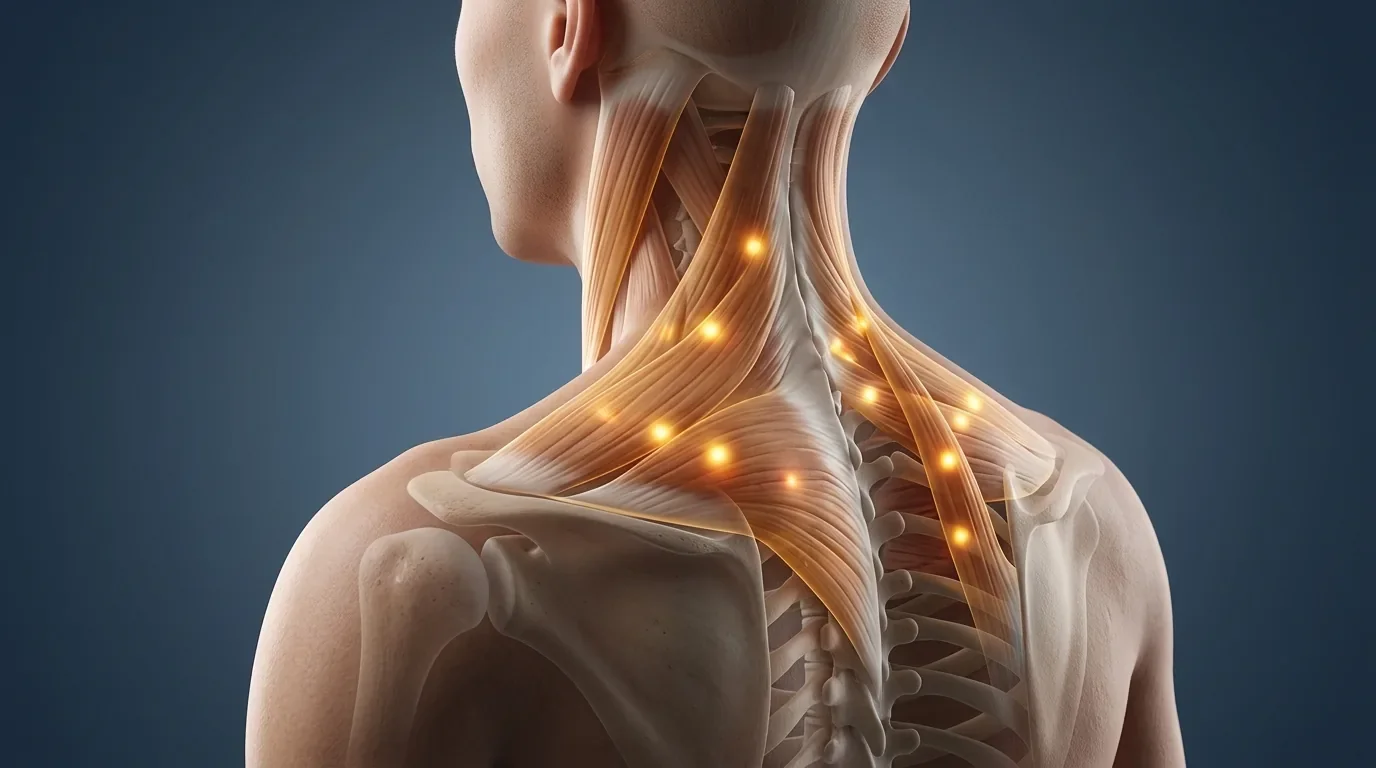
Neck pain almost always has a significant myofascial component. The upper trapezius, levator scapulae, scalenes, sternocleidomastoid, splenius cervicis, and semispinalis capitis and cervicis all develop active trigger points in response to sustained desk posture, forward head position, and emotional stress, and they all refer pain into the head, neck, and shoulder in patterns that overlap considerably with the distributions targeted by acupuncture points in the same region.
At Morningside, the distinction between acupuncture and dry needling for neck pain is mainly about selection rationale rather than technique. A dry needling approach uses palpation to find active trigger point bands in the target muscles and needles specifically into those bands to elicit a local twitch response. An acupuncture approach selects points based on their location, their neurological territory, and their clinical indications, with GB20, BL10, and GB21 often landing in or adjacent to the same myofascial structures that dry needling targets. The two approaches are complementary, and most neck pain patients benefit from the combination.
Ready to address your neck pain at the source?
At Morningside Acupuncture, we are the highest-rated acupuncture and dry needling clinic in New York City with over 500 five-star Google reviews. We treat cervical pain, stiffness, and tension headaches with a combination of evidence-based acupuncture point selection and myofascial trigger point work. Our team evaluates the full pattern of your presentation to select the points and techniques most likely to produce lasting improvement.
Schedule NowFrequently Asked Questions
Which acupuncture point is most effective for neck stiffness?
GB20 (Fengchi), in the suboccipital depression at the base of the skull, is the most consistently selected and broadly effective point for cervical stiffness and occipital headaches. For acute stiffness with restricted rotation, the combination of SI3 on the hand and BL60 at the ankle, used while the patient gently mobilizes the neck, can produce rapid reduction of protective muscle guarding. A practitioner will select the combination based on your specific presentation and the muscles most involved.
Can acupuncture help neck pain caused by forward head posture?
Yes. Forward head posture creates predictable overload in the levator scapulae, upper trapezius, and suboccipital muscles, all of which develop active trigger points that acupuncture and dry needling can address. The treatment effect is enhanced when postural retraining is incorporated alongside needling, as the needling creates a window of reduced muscle tension that makes postural correction exercises more accessible and effective.
How does acupuncture for neck pain differ from massage?
Massage works primarily through mechanical pressure on the superficial and mid-layer muscle tissue, which can provide temporary relief of muscle tension. Acupuncture works through neurological mechanisms, including segmental spinal cord modulation and supraspinal descending inhibition, that influence how the nervous system processes pain signals rather than just how the muscle tissue feels in the moment. For chronic or recurring neck pain, acupuncture tends to produce more durable changes than massage alone, though the two approaches are often used together with complementary benefits.
Will acupuncture needles hurt when placed in the neck?
Most patients are surprised by how little the cervical points hurt during insertion. GB20 and BL10 at the suboccipital region often produce a strong de qi sensation of spreading heaviness or warmth, which is distinct from sharp pain and is considered a sign of effective stimulation. GB21 at the upper trapezius occasionally produces a referred sensation into the arm or head as the trigger point responds. Practitioners adjust needle depth and angle based on your feedback throughout the session.
Does Morningside treat neck pain from car accidents or whiplash?
Yes. Whiplash-associated disorders are a common presentation at Morningside, involving the deep cervical flexors, multifidus, sternocleidomastoid, and scalenes alongside the more superficial cervical muscles. Acupuncture is included in several guidelines as a recommended conservative treatment for whiplash-associated neck pain. We work with patients at all stages of recovery and coordinate with referring physicians or physical therapists as needed.
References
- Trinh, K. V., Graham, N., Gross, A. R., Goldsmith, C. H., Wang, E., Cameron, I. D., & Kay, T. (2007). Acupuncture for neck disorders. Cochrane Database of Systematic Reviews, (3), CD004870. https://doi.org/10.1002/14651858.CD004870.pub3
- Zhao, Z. Q. (2008). Neural mechanism underlying acupuncture analgesia. Progress in Neurobiology, 85(4), 355–375. https://doi.org/10.1016/j.pneurobio.2008.05.004
- Vickers, A. J., Vertosick, E. A., Lewith, G., MacPherson, H., Foster, N. E., Sherman, K. J., ... & Acupuncture Trialists' Collaboration. (2018). Acupuncture for chronic pain: Update of an individual patient data meta-analysis. The Journal of Pain, 19(5), 455–474. https://doi.org/10.1016/j.jpain.2017.11.005
- Simons, D. G., Travell, J. G., & Simons, L. S. (1999). Travell & Simons' Myofascial Pain and Dysfunction: The Trigger Point Manual (2nd ed.). Williams & Wilkins.
- Yarnitsky, D. (2010). Conditioned pain modulation (the diffuse noxious inhibitory control-like effect): Its relevance for acute and chronic pain states. Current Opinion in Anaesthesiology, 23(5), 611–615. https://doi.org/10.1097/ACO.0b013e32833c348b
Disclaimer: This web site is intended for educational and informational purposes only. Reading this website does not constitute providing medical advice or any professional services. This information should not be used for diagnosing or treating any health issue or disease. Those seeking medical advice should consult with a licensed physician. Seek the advice of a medical doctor or other qualified health professional for any medical condition. If you think you have a medical emergency, call 911 or go to the emergency room. No acupuncturist-patient relationship is created by reading this website or using the information. Morningside Acupuncture PLLC and its employees and contributors do not make any express or implied representations with respect to the information on this site or its use. For any legal interpretation of scope of practice in your state, consult a licensed attorney or regulatory authority.
Read more from our blog