PC8 Acupuncture Point (Laogong)
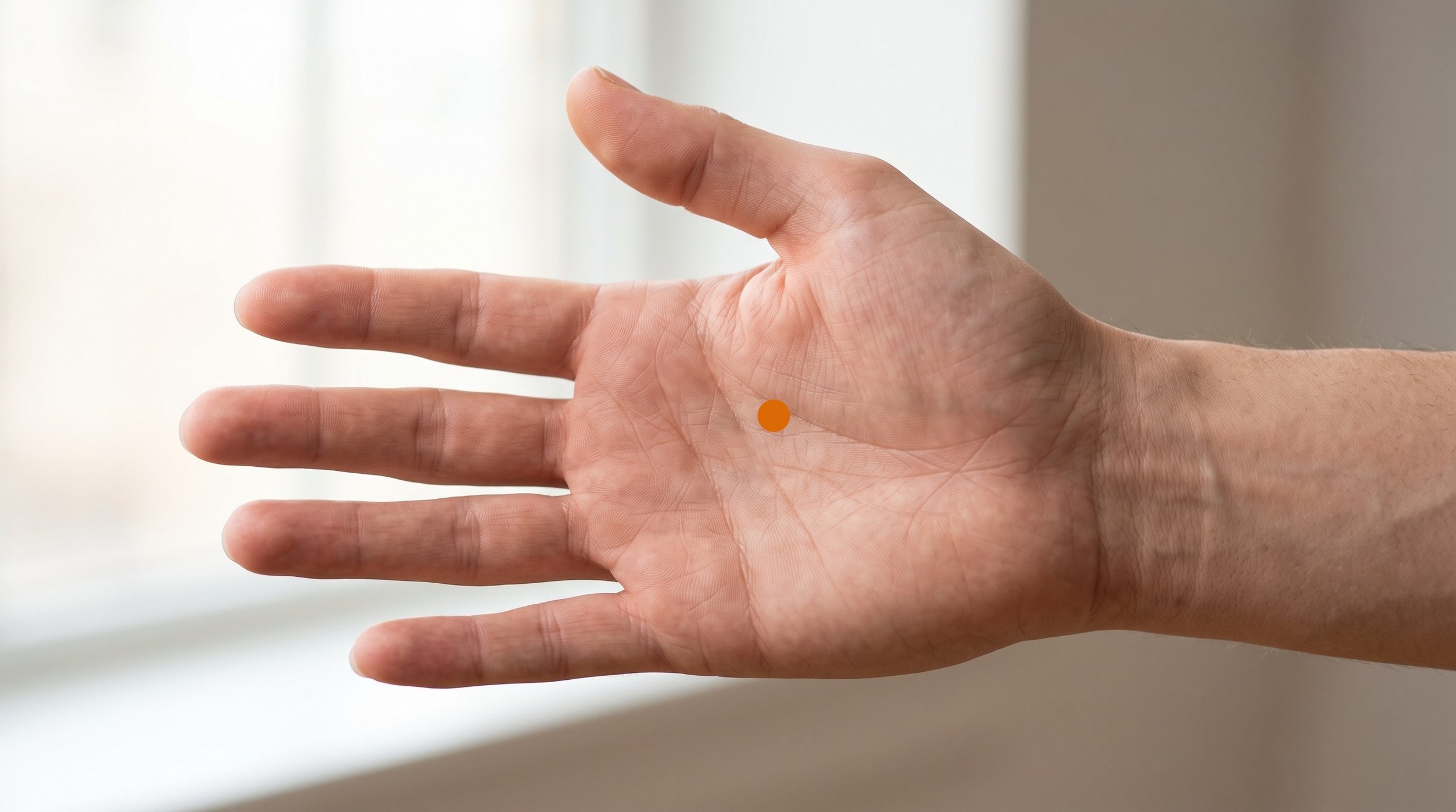
PC8 Acupuncture Point
The Palace of Toil in the Center of the Palm: Anatomy, Mechanism, and Why This Densely Innervated Hand Point Is Used for Agitation, Heat, and Hand Pain
PC8 (Laogong, often translated as Palace of Toil or Labor Palace) sits in the middle of the palm, in the small hollow between the second and third metacarpal bones where the tip of your middle finger lands when you curl your hand into a loose fist. It is the ying-spring and fire point of the Pericardium channel and one of Sun Si-miao's ghost points, a classical grouping reserved for severe agitation and disordered mental states (Deadman et al., 2007).
Clinically, the pc8 acupuncture point matters for two very different reasons: it is one of the most densely innervated pieces of skin on the body, which makes it a high-yield site for strong sensory input, and it sits directly over the working tissue of a hand that grips, types, lifts, and clenches all day. That combination is why pericardium 8 shows up in treatment plans for stress and agitation as often as it does for palm and hand complaints.
- Laogong point location is simple to find and hard to mistake: make a loose fist and mark where the middle fingertip touches the palm, then needle just radial to the third metacarpal bone, proximal to the knuckle joint (Deadman et al., 2007).
- Cadaveric dissection of the pc 8 palm point found palmar digital branches of the median nerve in the superficial layer and the deep branch of the ulnar nerve in the deeper layer, meaning a single needle here can recruit two major nerve territories at once (Kim et al., 2025).
- Neural tracing work in rats mapped the sensory neurons supplying PC8 to lower cervical and upper thoracic dorsal root ganglia, which places its input in the same segmental neighborhood that serves the chest, upper limb, and cardiac afferents (Cui et al., 2013).
- Traditionally, PC8 is classified as a fire point on a fire channel and is described as clearing heat, settling the spirit, and cooling the blood, language that maps in modern terms onto strong afferent drive, descending inhibition, and autonomic shifts rather than any literal movement of energy (Deadman et al., 2007; Zhao, 2008).
- The research picture is honest but modest: meta-analyses suggest acupuncture protocols may reduce anxiety symptoms and may shift heart rate variability toward parasympathetic dominance, though PC8 is almost always one point inside a larger prescription (Yang et al., 2021; Hamvas et al., 2023; Jang & Zheng, 2026).
- Expect the sensation to be memorable. The palm carries an unusually high density of mechanoreceptors and nociceptors, so de qi at PC8 tends to be sharp on insertion, then heavy and hot, sometimes radiating toward the middle and ring fingers, which is why many clinicians use a fine gauge needle and brief, controlled stimulation.
Wired, Restless, and Unable to Settle at the End of the Day?
At Morningside Acupuncture we use PC8 as part of a calming protocol for patients who describe a buzzing, keyed-up quality that will not switch off. It is typically paired with points at the wrist and forearm so that strong palmar input is balanced by gentler stimulation elsewhere, and treatment is built around breathing and autonomic downshifting rather than sedation. Most patients notice a distinct change in tension during the session itself. Schedule a visit and we will map out a plan for your specific stress pattern.
Schedule NowAnatomy of PC8: Why the Center of the Palm Is Such an Important Location
From the surface down, PC8 passes through thick, hairless palmar skin, then the palmar aponeurosis, then the second lumbrical muscle and the flexor digitorum tendons running toward the index and middle fingers, with the deep palmar arch lying deeper still. Palmar skin is anchored to the fascia below it, which is exactly what allows the hand to grip without shearing, and it is also why this tissue takes a beating in people who carry bags, swing kettlebells, climb, cook, or work with hand tools.
Repetitive gripping loads the flexor tendon sheaths and the aponeurosis in the same zone where the point sits, so palm tenderness at PC8 is often mechanical rather than mysterious.
The nerve geography is the real story. A cadaveric study specifically examining this acupoint found palmar digital branches of the median nerve in the superficial layer and the deep branch of the ulnar nerve deeper in the palm, so needling here may engage median and ulnar territories simultaneously (Kim et al., 2025). Neural tracing in animals traced PC8 afferents into dorsal root ganglia in the lower cervical and upper thoracic range (Cui et al., 2013).
That segmental address is clinically meaningful: input from the palm converges in the same spinal segments that receive afferents from the upper limb and chest wall, which is the standard convergence explanation for why a hand point can influence sensations felt well away from the hand. Strong afferent volleys from acupuncture needling also recruit descending inhibitory pathways from the brainstem and modulate endogenous opioid and monoamine systems, a mechanism reviewed in detail in the acupuncture analgesia literature (Zhao, 2008).
The deep palmar arch and its accompanying vessels are the structures to respect here, along with the digital neurovascular bundles running toward the fingers. Standard practice is perpendicular insertion to about 0.5 cun, which stays in the aponeurotic and lumbrical layer and well short of anything worth worrying about (Deadman et al., 2007). Because palmar tissue is so richly innervated, many practitioners use a thinner needle, a quick insertion technique, and shorter retention at PC8 than they would elsewhere.
Some also palpate for the common palmar digital arterial pulse in this region before needling, a habit borrowed from channel palpation traditions and a sensible safety check regardless (Maciocia, 2006).
Related Pericardium Channel Related PC6 Acupuncture PointPC8 at a Glance: Classification, Location, and Clinical Use
| Category | Detail |
|---|---|
| Traditional Name | Laogong (Palace of Toil, also translated Labor Palace); alternative classical name Guicu, Ghost Cave |
| Channel Classification | Pericardium channel (hand jueyin), point 8 of 9 |
| Point Categories | Ying-spring point of the Pericardium channel; Fire point of the Pericardium channel; one of Sun Si-miao's thirteen ghost points; historically listed as the ying-spring and fire point serving the Heart before the Heart channel had its own transport points |
| Precise Location | In the centre of the palm, between the second and third metacarpal bones, proximal to the metacarpophalangeal joint, in the depression on the radial side of the third metacarpal. Locate it by making a loose fist and marking where the tip of the middle finger lands. |
| Tissue Stimulated | Palmar skin and palmar aponeurosis, second lumbrical, and the flexor digitorum tendons passing beneath, with the deep palmar arch lying deeper. Related forearm targets often needled alongside it include flexor digitorum superficialis, flexor digitorum profundus, and flexor carpi radialis. |
| Needle Depth / Direction | Perpendicular insertion to approximately 0.5 cun. A fine gauge needle, brisk insertion, and moderate stimulation are usual given how sensitive the palm is. |
| De Qi Sensation | Distinctly sharp on entry, then a heavy, warm, aching fullness that may spread toward the middle and ring fingers or up the forearm. Among the more intense points on the body to needle. |
| Primary Clinical Uses | Stress, agitation, and emotional settling in modern practice; palm and hand pain; classically described excess heat presentations; mouth and tongue ulcers in traditional usage; sweaty or hot palms |
| Common Point Combinations |
|
In the classical literature summarized by Deadman and colleagues in A Manual of Acupuncture, Laogong is presented as a heat-clearing point of unusual reach. Traditional sources attribute to it the ability to clear heat from the Pericardium and revive consciousness, to clear Heart fire and calm the spirit, to harmonize the Stomach and cool the middle burner, and to cool the nutritive and blood levels.
The recorded indication lists therefore cover four broad territories: severe mental and emotional disturbance including mania, fright, sorrow, anger, and inappropriate laughter; febrile crises with clouded consciousness; mouth, tongue, and digestive complaints including ulceration, foul breath, and vomiting; and bleeding or blood-heat presentations alongside local hand problems such as tremor, skin eruption, heat, and sweating of the palm (Deadman et al., 2007).
Its inclusion among Sun Si-miao's thirteen ghost points, under the name Ghost Cave, places it firmly in the historical toolkit for what we would now call severe psychiatric agitation. What is striking is the coherence of the pattern: a point on the palm that traditional writers reached for whenever the presentation was hot, loud, and agitated, and that modern anatomy shows to be one of the most powerfully innervated targets available.
Why PC8 Is Used for Stress and Agitation, Not Just Hand Pain
The bridge between a palm point and a stress presentation runs through the spinal cord. Sensory fibers from PC8 enter the cord at roughly the C7 to T1 levels, the same segments that receive afferent traffic from the upper limb, the chest wall, and, importantly, cardiac and thoracic visceral structures (Cui et al., 2013). Because somatic and visceral afferents converge onto shared second-order neurons, strong input from the hand can alter how that whole segmental pool behaves.
Anatomically, the point also sits where median and ulnar territories are both accessible, which means a single needle may generate a broader afferent volley than its small footprint suggests (Kim et al., 2025).
Above the cord, needling recruits descending inhibitory systems that run from the periaqueductal gray and rostral ventromedial medulla back down to the dorsal horn, along with endogenous opioid and monoaminergic mechanisms that damp nociceptive transmission and shift arousal (Zhao, 2008). Autonomic effects have been measured directly: a meta-analysis of randomized trials using heart rate variability found that real needling shifted markers toward parasympathetic dominance in ways sham did not, although the authors emphasized the small number of trials and the heterogeneity involved (Hamvas et al., 2023). That is the physiological version of what classical texts described as settling agitation.
For patients, the practical translation is straightforward. PC8 is not a sedative and it is not a treatment for a diagnosis on its own. It is a strong, well-localized sensory input that may help interrupt a wound-up state, that gives the nervous system something concrete to attend to, and that is often paired with breathing work to encourage a parasympathetic shift. When the hand itself is the problem, the same point doubles as a local treatment for palmar fascia and flexor tendon loading.
What the Research Shows for PC8
A realistic framing matters here. There is no body of randomized trials testing PC8 in isolation, and the clinical literature that exists tests multi-point protocols in which this point may or may not appear. What we can say is that acupuncture protocols have been studied for anxiety, depression, and chronic pain with results ranging from modest benefit to uncertain, that the mechanistic literature for this specific point is anatomical rather than clinical, and that PC8's role is best understood as one contributing element within a larger prescription. The table below summarizes the most relevant work rather than claiming that any of it validates a single point.
| Study | Type | Focus | Key Finding |
|---|---|---|---|
| Kim et al., 2025 | Cadaveric anatomical study | Neuroanatomy of the PC8 acupoint in the palm | Dissection placed median nerve palmar digital branches superficially and the deep ulnar branch deeper at this site, suggesting needling may engage both nerve territories. |
| Cui et al., 2013 | Animal neural tracing study | Segmental innervation of PC8 in the rat | Tracer injected at the point labeled sensory neurons in lower cervical and upper thoracic ganglia, supporting a segmental convergence account of its effects. |
| Hamvas et al., 2023 | Systematic review and meta-analysis | Acupuncture and heart rate variability | Pooled data suggested real needling increased parasympathetic indices relative to sham, though the authors urged caution given study quality and heterogeneity. |
| Yang et al., 2021 | Systematic review and meta-analysis | Acupuncture for anxiety disorders | Across twenty randomized trials, acupuncture was associated with a small to moderate reduction in anxiety symptoms with good tolerability. |
| Jang & Zheng, 2026 | Systematic review and meta-analysis | Manual acupuncture versus sham or usual care for anxiety | An updated synthesis of randomized trials reported reductions in anxiety measures, with effect estimates that varied by comparator. |
| Smith et al., 2018 | Cochrane systematic review | Acupuncture for depression | Evidence was judged low quality overall, with small effects compared with control acupuncture and uncertainty about clinical significance. |
| Vickers et al., 2018 | Individual patient data meta-analysis | Acupuncture for chronic pain across conditions | Acupuncture outperformed both sham and no-acupuncture controls, with effects that persisted over twelve months. |
| Zhao, 2008 | Narrative mechanistic review | Neural mechanisms of acupuncture analgesia | Needling activates peripheral afferents that engage spinal and supraspinal inhibitory circuits and endogenous opioid pathways. |
Palm Pain, Grip Strain, or Hands That Ache From Overuse?
Hands that grip tools, instruments, weights, or a keyboard all day accumulate load through the palmar fascia and the long flexor tendons that pass right under PC8. We combine careful needling at this point with dry needling of the forearm flexors and thenar muscles, plus manual work and loading advice so the tissue tolerates more, not less. This is standard practice at our Midtown Manhattan clinic for hand and forearm complaints. Book an evaluation and we will assess grip, wrist mechanics, and the whole kinetic chain.
Schedule NowPC8 in the Context of Trigger Point Work
Acupuncture, in our definition, is the use of an acupuncture needle, and that includes the hundreds of stylistic variations practiced worldwide as well as dry needling. At Morningside we rarely treat PC8 in isolation for hand complaints. The palm is the end of a chain that starts in the forearm, so the point is usually combined with dry needling of flexor digitorum superficialis and profundus, flexor carpi radialis and ulnaris, and the thenar and hypothenar intrinsics when they are involved.
Referred pain from the long finger flexors can be felt in the fingers and palm, which means the tissue a patient points to is not always the tissue that needs treatment (Simons et al., 1999).
There is also genuine local overlap. PC8 lies over the lumbrical and flexor tendon layer of the palm, tissue that becomes tender and thickened in people with heavy gripping demands, and needling here may reduce that local sensitivity while the forearm work addresses the drivers. When stress and hand symptoms travel together, which is common in musicians, chefs, climbers, and desk-bound patients who clench, the same point serves both goals. Broad chronic pain evidence supports acupuncture as a reasonable component of a multimodal plan rather than a stand-alone answer (Vickers et al., 2018).
PC8 Stress and Hand Pain Treatment at NYC's Highest-Rated Acupuncture Clinic
Morningside Acupuncture is the highest-rated acupuncture and dry needling clinic in New York City with over 500 five-star Google reviews, and our approach blends classical point selection with modern pain science. PC8 is one of the tools we reach for when stress presentations and hand symptoms overlap, always inside an individualized plan rather than a fixed recipe. Every session includes assessment, treatment, and clear guidance on what to do between visits. Schedule your appointment today and start with a plan built around your presentation.
Schedule NowFrequently Asked Questions
What does PC8 feel like when needled?
Sharper than most points, and patients should be told that in advance. The palm has an unusually dense supply of mechanoreceptors and nociceptors, so insertion is briefly bright, followed by a heavy, warm, aching fullness that can spread toward the middle and ring fingers or up into the forearm. The initial sting settles within a few seconds. Practitioners typically use a fine needle and shorter retention here, and there is no requirement to chase a strong sensation for the treatment to be useful.
Why would a point in the palm be used for stress rather than something closer to the head or chest?
Because the effect is mediated by nerves, not by proximity. Afferents from PC8 enter the spinal cord at roughly the C7 to T1 levels, where they converge with input from the upper limb and thoracic structures (Cui et al., 2013), and anatomical work shows the site sits where median and ulnar nerve territories are both reachable (Kim et al., 2025). Strong peripheral input of this kind engages descending inhibitory and autonomic circuits that operate well above the level of the hand (Zhao, 2008). Distal points are also practical: patients can lie comfortably, breathe, and stay relaxed while the point is treated.
Can I press PC8 myself between sessions?
Yes, and it is one of the easier points to self-treat because you cannot really lose it. Make a loose fist, note where the middle fingertip touches the palm, then open the hand and press that spot with the opposite thumb. Use firm, steady pressure at an intensity you would rate about a 4 or 5 out of 10, hold for 30 to 60 seconds, release, and repeat two or three times per hand. Pair it with slow nasal breathing, roughly four seconds in and six seconds out, which tends to make the calming effect more noticeable. Two or three rounds a day is plenty. Stop if the area becomes bruised or genuinely painful, and skip it over broken skin, rashes, or recent injuries.
Is PC8 safe to needle?
In trained hands, yes. Standard practice is a perpendicular insertion to about 0.5 cun, which keeps the needle in the aponeurotic and lumbrical layer well above the deep palmar arch (Deadman et al., 2007). The main considerations are the vascularity of the palm and the sensitivity of the tissue, so a licensed practitioner will palpate first, use a fine needle, and avoid aggressive deep manipulation. Minor soreness or a small bruise afterward is the most common effect. People on anticoagulants, with hand infections, or with open skin over the palm should tell their practitioner, and this point is generally not one for aggressive self-needling at home.
Where exactly is PC8 located?
In the centre of the palm, between the second and third metacarpal bones, just proximal to the knuckle joints, in the depression along the radial side of the third metacarpal. The reliable way to find the laogong point location is to curl your hand into a loose fist and mark where the tip of the middle finger rests, then open the hand and needle or press that mark. Some classical sources placed the point slightly to the ulnar side of the third metacarpal, where the ring fingertip lands instead, so you may see both descriptions in older texts (Deadman et al., 2007).
References
- Deadman, P., Al-Khafaji, M., & Baker, K. (2009). A manual of acupuncture. Journal of Chinese Medicine Publications.
- Maciocia, G. (2006). The channels of acupuncture: Clinical use of the secondary channels and eight extraordinary vessels. Churchill Livingstone Elsevier.
- Simons, D. G., Travell, J. G., & Simons, L. S. (1999). Travell & Simons' myofascial pain and dysfunction: The trigger point manual, Vol. 1: Upper half of body (2nd ed.). Williams & Wilkins.
- Kim, S. H., Oh, H. M., Lee, Y. H., & Son, C. G. (2025). Anatomical exploration of the PC8 acupoint through cadaveric study: Implications for median and ulnar nerve stimulation. Complementary Therapies in Clinical Practice, 60, 101993. https://doi.org/10.1016/j.ctcp.2025.101993
- Cui, J. J., Ha, L. J., Zhu, X. L., Shi, H., Wang, F. C., Jing, X. H., & Bai, W. Z. (2013). Neuroanatomical basis for acupuncture point PC8 in the rat: Neural tracing study with cholera toxin subunit B. Acupuncture in Medicine, 31(4). https://doi.org/10.1136/acupmed-2013-010400
- Hamvas, S., Hegyi, P., Kiss, S., Lohner, S., McQueen, D., & Havasi, M. (2023). Acupuncture increases parasympathetic tone, modulating HRV: Systematic review and meta-analysis. Complementary Therapies in Medicine, 72, 102905. https://doi.org/10.1016/j.ctim.2022.102905
- Yang, X., Yang, N., Huang, F., Ren, S., & Li, Z. (2021). Effectiveness of acupuncture on anxiety disorder: A systematic review and meta-analysis of randomised controlled trials. Annals of General Psychiatry, 20, 9. https://doi.org/10.1186/s12991-021-00327-5
- Jang, S., & Zheng, S. (2026). Acupuncture for anxiety: A systematic review and meta-analysis of randomized controlled trials. Journal of Clinical Psychology, 82, 479-494. https://doi.org/10.1002/jclp.70079 [VERIFY BEFORE PUBLISHING]
- Smith, C. A., Armour, M., Lee, M. S., Wang, L. Q., & Hay, P. J. (2018). Acupuncture for depression. Cochrane Database of Systematic Reviews, 3, CD004046. https://doi.org/10.1002/14651858.CD004046.pub4 [VERIFY BEFORE PUBLISHING]
- Vickers, A. J., Vertosick, E. A., Lewith, G., MacPherson, H., Foster, N. E., Sherman, K. J., Irnich, D., Witt, C. M., & Linde, K. (2018). Acupuncture for chronic pain: Update of an individual patient data meta-analysis. Journal of Pain, 19(5), 455-474. https://doi.org/10.1016/j.jpain.2017.11.005
- Zhao, Z. Q. (2008). Neural mechanism underlying acupuncture analgesia. Progress in Neurobiology, 85(4), 355-375. https://doi.org/10.1016/j.pneurobio.2008.05.004
Disclaimer: This web site is intended for educational and informational purposes only. Reading this website does not constitute providing medical advice or any professional services. This information should not be used for diagnosing or treating any health issue or disease. Those seeking medical advice should consult with a licensed physician. Seek the advice of a medical doctor or other qualified health professional for any medical condition. If you think you have a medical emergency, call 911 or go to the emergency room. No acupuncturist-patient relationship is created by reading this website or using the information. Morningside Acupuncture PLLC and its employees and contributors do not make any express or implied representations with respect to the information on this site or its use. For any legal interpretation of scope of practice in your state, consult a licensed attorney or regulatory authority.
Read more from our blog