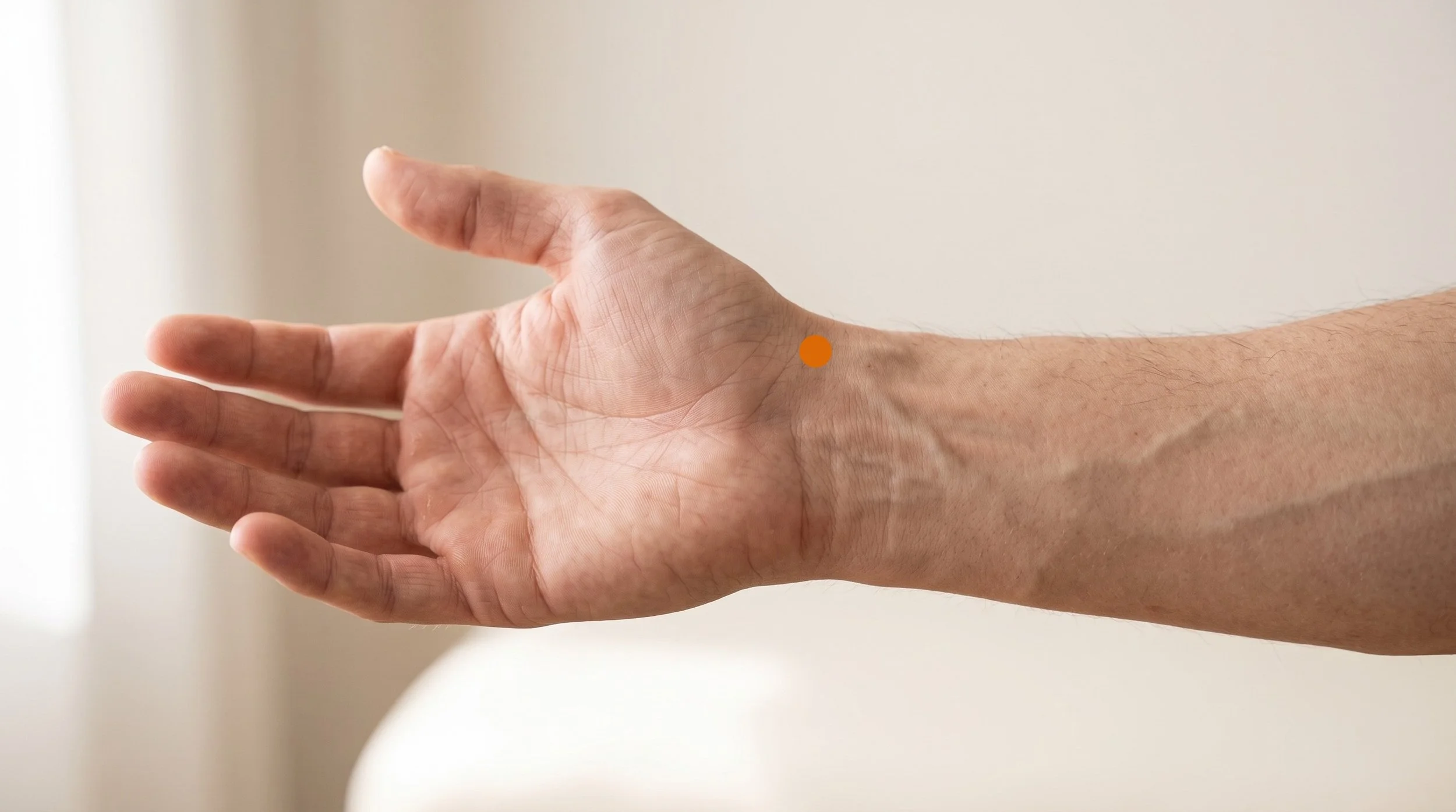
SI17 Acupuncture Point (Tianrong)
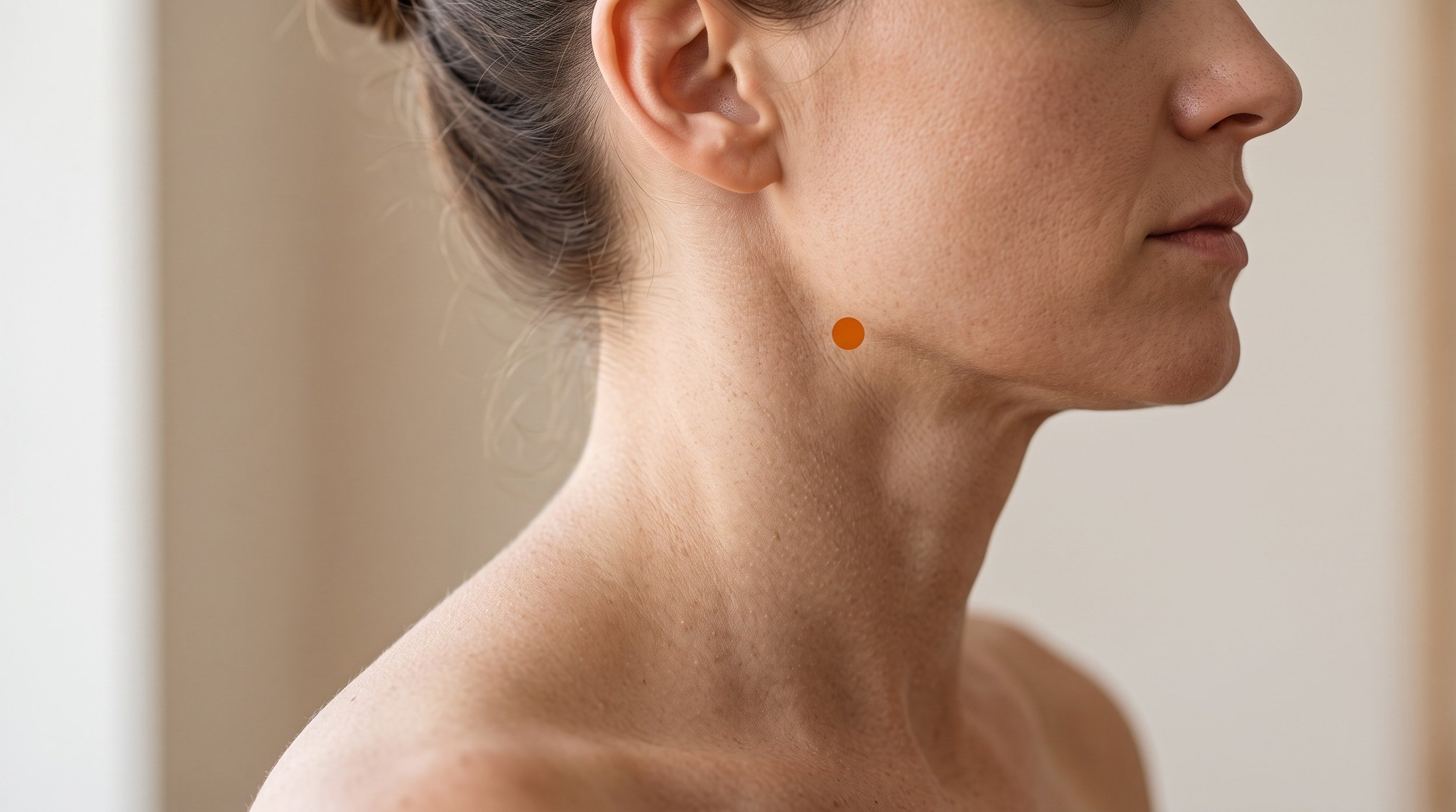
SI17 Acupuncture Point (Tianrong)
Heavenly Appearance Below the Jaw: Anatomy, Mechanism, and Why This Lateral Neck Point Belongs in Careful Hands
SI17 (Tianrong, often translated as Heavenly Appearance) sits in the soft hollow just behind the angle of the jaw, right at the front edge of the sternocleidomastoid muscle. It's the seventeenth point of the Small Intestine channel and one of the classical Window of Heaven points, a small group of neck points traditionally described as regulating the traffic of qi between the head and the body (Maciocia, 2015).
What makes the si17 acupuncture point clinically interesting is also what makes it demanding: this small depression sits over one of the busiest neurovascular corridors in the body, where sensory branches of the cervical plexus run superficially and the carotid sheath, vagus nerve, and cervical sympathetic chain lie deep. Traditionally used for throat obstruction, neck swelling, ear symptoms, and breathing difficulty, Tianrong is a point we treat with precise palpation, conservative depth, and a clear reason for choosing it.
- Location and layers: SI17 lies posterior to the mandibular angle in the depression along the anterior border of the sternocleidomastoid, above the posterior belly of digastric and the upper carotid triangle (Deadman et al., 2001; Shanghai College of Traditional Chinese Medicine, 1981).
- Traditional categories, translated: classical texts group Tianrong with the Window of Heaven points and describe it as benefiting the throat and neck, dispersing swelling, descending rebellious qi, and benefiting the ears (Deadman et al., 2001). In modern terms we read those attributions as effects on cervical sensory input, local muscle tone, and autonomic tone in a segment that also serves the pharynx and ear.
- Nerve geography: the great auricular and transverse cervical nerves (C2 to C3) cross this region superficially, while the vagus and the superior cervical sympathetic ganglion sit deep to the point, which explains why sensation can spread toward the ear, jaw, or root of the tongue (Shanghai College of Traditional Chinese Medicine, 1981).
- Mechanism: needling stimulates A-delta and C fibers that converge with visceral afferents in the upper cervical and brainstem relay zones, and acupuncture analgesia involves segmental spinal gating plus descending inhibitory pathways using opioid, serotonergic, and noradrenergic transmission (Zhao, 2008).
- Research picture: no trial has tested SI17 on its own. Meta-analytic data support acupuncture for chronic pain including neck pain (Vickers et al., 2018), a Cochrane review of neck disorders reported short-term benefit at low to moderate certainty before being withdrawn for updating (Trinh et al., 2016), and throat-focused work so far involves other points (Zhou et al., 2020).
- De qi and practice framing: patients usually describe a deep, spreading heaviness or fullness that travels toward the tongue base or throat rather than a sharp pain, and needle retention is typically brief with the head neutral and the practitioner's palpating hand stabilizing the vessels away from the needle path (Shanghai College of Traditional Chinese Medicine, 1981).
Struggling With Throat Tightness, Jaw Tension, or Neck Discomfort?
Persistent throat tightness and a full, banded feeling under the jaw often involve more than the throat itself, and a careful exam can sort out what's muscular, what's postural, and what needs a medical referral first.
At Morningside Acupuncture we use SI17 selectively, alongside distal points and hands-on work, as part of a plan built around your specific pattern. Every neck treatment starts with palpation, not assumption. Schedule a visit and we'll map out where your symptoms are actually coming from.
Schedule NowAnatomy of SI17: Why the Angle of the Mandible Is Such an Important Location
The si 17 location is easiest to find by feel. With the head neutral, trace the front edge of the sternocleidomastoid upward until it disappears behind the angle of the jaw, and the small hollow between those two landmarks is Tianrong (Deadman et al., 2001). Palpation becomes clearer if the patient turns the head away from the side being examined while you offer light resistance at the chin, which brings the muscle border forward.
Under the skin and platysma lie the upper attachment of the sternocleidomastoid, the posterior belly of digastric, and the fascia surrounding the submandibular region (Shanghai College of Traditional Chinese Medicine, 1981). These tissues load heavily with sustained forward head posture, clenching, prolonged talking or singing, and mouth breathing, which is one reason this area often feels tender in people who never think of themselves as having neck problems.
The nerve supply here is dense and superficial. Cutaneous branches of the cervical plexus, specifically the great auricular and transverse cervical nerves arising from C2 and C3, cross the region, and the cervical branch of the facial nerve runs nearby (Shanghai College of Traditional Chinese Medicine, 1981). Those upper cervical segments share second-order neurons in the trigeminocervical region with input from the ear, jaw, and pharynx, which gives a plausible anatomical account of why stimulation here can be felt as spreading toward the tongue base, ear, or jaw.
Needle stimulation of these fibers is thought to engage segmental inhibition at the dorsal horn and to recruit descending pain-modulating pathways involving endogenous opioids and monoamines (Zhao, 2008). This is a mechanistic framework, not a promise of results, and effects vary between patients.
The deep structures are the reason SI17 is a practitioner-level point. The carotid sheath, carrying the common and internal carotid arteries, internal jugular vein, and vagus nerve, sits immediately posterior to the needle path, and the superior cervical sympathetic ganglion lies deeper still (Shanghai College of Traditional Chinese Medicine, 1981). Classical needling convention is a shallow insertion of roughly 0.5 to 1 cun angled toward the root of the tongue and kept anterior to the carotid vessels (Deadman et al., 2001).
In practice that means constant landmark palpation, a fine needle, no aggressive lifting and thrusting, and immediate withdrawal if the patient reports pulsation, radiating shock, or lightheadedness. Serious acupuncture adverse events are uncommon overall, and the events that do occur are largely trauma-related, which is exactly why point-specific angle discipline matters in this corridor (White, 2004).
Related Small Intestine Channel Related Best Acupuncture Points For Neck PainSI17 at a Glance: Classification, Location, and Clinical Use
| Category | Detail |
|---|---|
| Traditional Name | Tianrong (Heavenly Appearance), Small Intestine 17 |
| Channel Classification | Small Intestine channel (Hand Taiyang); historically assigned to the Gall Bladder channel in the Spiritual Pivot and to the Sanjiao channel in the Systematic Classic before being placed on the Small Intestine channel in a 10th century text (Deadman et al., 2001). See the Small Intestine Channel overview. |
| Point Categories | Window of Heaven point (Deadman et al., 2001; Maciocia, 2015). Described in channel texts as a site where the Gall Bladder channel crosses the Small Intestine channel on the neck (Shanghai College of Traditional Chinese Medicine, 1981). No five-shu, luo, xi-cleft, or hui-meeting designation. |
| Precise Location | Lateral neck, posterior and slightly inferior to the angle of the mandible, in the depression at the anterior border of the sternocleidomastoid. |
| Tissue Stimulated | Skin and platysma, the upper anterior border of the sternocleidomastoid, the posterior belly of digastric, and cervical plexus cutaneous branches; the jaw region nearby includes the lateral pterygoid. |
| Needle Depth / Direction | 0.5 to 1 cun directed toward the root of the tongue, kept strictly anterior to the carotid vessels (Deadman et al., 2001); shallower insertion of about 0.5 to 0.7 cun is also described. Not a point for deep or vigorous manipulation. |
| De Qi Sensation | Deep, dull distension or fullness that may spread toward the root of the tongue, throat, jaw, or ear (Shanghai College of Traditional Chinese Medicine, 1981). Sharp pain, pulsation, or radiating shock means the needle should come out. |
| Primary Clinical Uses | Traditionally used for throat obstruction and painful throat, swelling and tension of the neck below the jaw, tinnitus and hearing complaints, voice and speech difficulty, and chest fullness with wheezing or cough (Deadman et al., 2001). |
| Common Point Combinations |
|
In Deadman's Manual of Acupuncture, Tianrong appears as a point with an unsettled history and a consistent clinical theme. Early sources placed it on the Gall Bladder channel and later ones on the Sanjiao channel, and it wasn't assigned to the Small Intestine channel until a 10th century text, which tells you something about how classical authors organized the crowded lateral neck.
Its traditional actions are given as benefiting the throat and neck and dispersing swelling, descending rebellious qi, and benefiting the ears, with classical indications spanning three loose groups: throat and neck problems (obstructed or painful throat, neck swellings, difficulty speaking, clenched jaw, cheek swelling), respiratory and digestive upward-rushing patterns (chest fullness, wheezing, cough, vomiting), and ear complaints such as tinnitus and hearing loss (Deadman et al., 2001).
Maciocia notes that the Window of Heaven group is best understood as points that regulate the movement of qi between the head and the trunk, all but two of them sitting on the neck (Maciocia, 2015). What's striking is how tightly that traditional cluster of throat, breathing, and ear indications maps onto a single anatomical corridor where pharyngeal, auricular, and autonomic pathways run within a few centimeters of one another.
Why SI17 Is Used for Throat Tightness, Globus Sensation, and Voice Strain
Patients who describe a lump-in-the-throat feeling, a sense of tightness when swallowing, or a voice that tires quickly are often surprised when a practitioner palpates the side of the neck rather than the throat itself. The anatomy explains the interest. The upper cervical segments that supply the skin and muscle around SI17 share central relay territory with afferents from the pharynx, larynx, ear, and jaw, so persistent input from tight sternocleidomastoid, digastric, and suprahyoid tissue can be experienced as throat rather than neck sensation.
Needling in this segment provides a competing stimulus that engages spinal gating and recruits descending inhibitory control from the brainstem, mechanisms that have been described in detail across decades of acupuncture analgesia research (Zhao, 2008).
There's a second, autonomic layer. The cervical sympathetic chain and the vagus nerve both travel deep to this point, and neck acupuncture is often associated with a settling, parasympathetic-leaning response during treatment. Research on throat symptoms is still preliminary and doesn't involve SI17 directly: a crossover trial of transcutaneous electroacupuncture in globus pharyngeus found symptom improvement with stimulation at CV22 and LU11, and the authors proposed parasympathetic and neuropeptide-related pathways as possible mediators (Zhou et al., 2020). That's suggestive rather than confirmatory, and it doesn't transfer automatically to needling Tianrong.
For voice strain and swallowing-related complaints, the practical rationale is more mechanical than mysterious. Reducing tone in the anterolateral neck musculature may make jaw opening, hyoid movement, and neck rotation feel easier, which patients often report as less throat effort. Acupuncture protocols that include anterior neck points are used in swallowing rehabilitation research, where reviews report possible benefit alongside standard therapy but with limited certainty due to trial quality (Li et al., 2024).
Any throat symptom that's new, one-sided, associated with weight loss, hoarseness lasting more than a few weeks, or a palpable neck mass belongs with an ENT physician first.
What the Research Shows for SI17
It's worth being direct about the evidence: there are no clinical trials isolating SI17. Acupuncture research almost always tests multi-point protocols, so what we can say is that treatments including lateral neck points may reduce neck pain and related disability in some patients, and that classical throat and ear indications for this point remain traditional attributions rather than tested claims.
The studies below describe the broader neighborhood of evidence that a Tianrong-containing treatment sits within, and most of them carry meaningful limitations around blinding, sham design, and heterogeneous point selection.
| Study | Type | Focus | Key Finding |
|---|---|---|---|
| Vickers et al., 2018 | Individual patient data meta-analysis | Acupuncture for chronic pain including neck and shoulder pain | Acupuncture was associated with modest but statistically significant benefit over sham and no-acupuncture controls, with effects that persisted over time. |
| Trinh et al., 2016 | Cochrane systematic review (later withdrawn for updating) | Acupuncture for neck disorders across 27 trials | Reported short-term improvement in pain and disability compared with sham or inactive controls, with evidence rated low to moderate certainty. |
| Fang et al., 2024 | Systematic review and meta-analysis | Durability of acupuncture effects in chronic neck pain | Acupuncture used as an adjunct was associated with sustained pain and function benefits at three to six months, though it didn't outperform sham for pain. |
| Zhou et al., 2020 | Randomized single-blind crossover trial | Transcutaneous electroacupuncture for globus pharyngeus | Stimulation at CV22 and LU11 improved globus symptom scores, with parasympathetic and neuropeptide changes proposed as mechanisms. |
| Li et al., 2024 | Systematic review and meta-analysis | Acupuncture for aspiration related to post-stroke dysphagia | Protocols including neck and throat points suggested improved swallowing outcomes when added to rehabilitation, limited by variable trial quality. |
| White, 2004 | Cumulative safety review | Range and incidence of significant adverse events with acupuncture | Serious events were rare and predominantly trauma-related, supporting strict anatomical technique at high-risk locations such as the anterior neck. |
Neck Tension That Keeps Coming Back After Long Screen Days?
Anterior neck and jaw tension is common in New Yorkers who spend hours in forward head posture, and it frequently travels into the ear, temple, and swallowing muscles. We combine gentle needling around the lateral neck with dry needling of the sternocleidomastoid, scalenes, and jaw muscles when they're relevant, plus simple home strategies you can actually keep up with. Most patients notice changes within a few sessions. Book an appointment to get started.
Schedule NowSI17 in the Context of Trigger Point Work
Acupuncture, in our definition, means treatment with an acupuncture needle, and that includes the hundreds of styles practiced worldwide as well as dry needling. At Morningside, SI17 rarely gets used alone. When a patient's complaint involves the front of the neck, jaw, or throat, we palpate the sternocleidomastoid first, since taut bands in its sternal and clavicular divisions are classically described as referring pain into the face, ear, and throat region and can also contribute to dizziness and altered head position sense (Simons et al., 1999).
The Tianrong point sits along the upper anterior border of that same muscle, so a needle placed there is engaging tissue that a myofascial assessment may already have flagged.
From there, treatment typically expands outward rather than deeper. Depending on findings we may needle the suprahyoid and digastric region, the masseter and lateral pterygoid when jaw mechanics are involved, and the scalenes and upper trapezius when the pattern extends into the shoulder girdle. Needling at the SI17 site itself is kept shallow and brief because of the carotid sheath, while the surrounding muscles tolerate more standard trigger point technique.
That combination, a conservative classical point plus targeted myofascial needling of muscles that reproduce the patient's symptoms on palpation, is how the tianrong point earns a place in a modern treatment rather than being included out of habit.
SI17 Neck and Throat Treatment at NYC's Highest-Rated Acupuncture Clinic
Morningside Acupuncture is the highest-rated acupuncture and dry needling clinic in New York City with over 500 five-star Google reviews, and precision around sensitive regions like the anterior neck is a large part of why. Our licensed acupuncturists integrate classical point selection with orthopedic assessment and myofascial needling, so points like Tianrong are used deliberately rather than reflexively. If throat tightness, neck stiffness, or jaw-related tension is limiting you, we can help you build a plan. Schedule your visit today.
Schedule NowFrequently Asked Questions
What does SI17 feel like when needled?
Most people feel a deep, heavy fullness or spreading distension under the jaw that can travel toward the root of the tongue, throat, ear, or jawline (Shanghai College of Traditional Chinese Medicine, 1981). It shouldn't be sharp, electric, or throbbing. Because of the structures nearby, we use a fine needle, a shallow angle toward the tongue base, and minimal manipulation, and we ask for immediate feedback. If you feel pulsation, a jolt down the neck, or any lightheadedness, the needle comes out right away.
Why needle the side of the neck for a throat symptom instead of the throat itself?
Because the throat, ear, and upper neck share sensory pathways. Afferents from the pharynx and ear converge with upper cervical input in the brainstem and upper spinal cord, so tension and sensitivity in the anterolateral neck can be experienced as throat tightness. Needling in that shared segment provides a competing input that engages spinal gating and descending inhibition (Zhao, 2008). Practically, the tissue that's actually restricted (sternocleidomastoid, digastric, suprahyoids) is on the side of the neck, not in the throat.
Can I press SI17 myself between sessions?
Only very gently, and with a clear caution. Do not press firmly on the pulsing carotid artery or use sustained pressure on the front of the neck, since carotid pressure can affect blood pressure and heart rate. If you want to work this area, use light fingertip contact just behind the angle of the jaw at the front edge of the sternocleidomastoid, hold gentle pressure for 20 to 30 seconds while breathing slowly, and repeat two or three times per side. Stop immediately with any dizziness, visual change, or pulsation under your fingers. A safer self-care option for most people is gentle massage along the muscle belly lower down, plus slow nasal breathing and chin-tuck mobility work. If you're on blood thinners, have carotid disease, or have any neck lump, skip self-pressure entirely and check with your physician.
Is SI17 safe to needle?
In trained hands, yes, but it's a practitioner-level point rather than a routine one. The carotid sheath with its artery, vein, and vagus nerve lies immediately deep and posterior, and the cervical sympathetic chain is deeper still (Shanghai College of Traditional Chinese Medicine, 1981), which is why classical technique specifies a shallow insertion angled toward the root of the tongue and kept anterior to the vessels (Deadman et al., 2001). Broad safety data indicate that serious acupuncture adverse events are rare and mostly related to trauma, which is precisely the argument for disciplined angle and depth in this region (White, 2004). We avoid the point in patients with known carotid disease, significant bleeding risk, or an undiagnosed neck mass, and we always assess before needling.
Where exactly is SI17 located?
Small Intestine 17 is on the lateral neck, just posterior and slightly below the angle of the mandible, in the depression along the anterior border of the sternocleidomastoid muscle (Deadman et al., 2001). To find it, place a fingertip on the bony corner of the jaw, slide back a short distance until you drop into a soft hollow, then confirm the muscle edge just behind your finger. Turning the head away from that side while lightly resisting at the chin makes the muscle border stand out. Locate the carotid pulse first so you know where it is and can stay in front of it.
References
- Deadman, P., Al-Khafaji, M., & Baker, K. (2009). A manual of acupuncture. Journal of Chinese Medicine Publications.
- O'Connor, J., & Bensky, D. (Eds. & Trans.). (1981). Acupuncture: A comprehensive text. Shanghai College of Traditional Medicine. Eastland Press.
- Maciocia, G. (2005). The foundations of Chinese medicine: A comprehensive text for acupuncturists and herbalists (2nd ed.). Elsevier Churchill Livingstone.
- Simons, D. G., Travell, J. G., & Simons, L. S. (1999). Travell & Simons' myofascial pain and dysfunction: The trigger point manual, Vol. 1: Upper half of body (2nd ed.). Williams & Wilkins.
- Zhao, Z. Q. (2008). Neural mechanism underlying acupuncture analgesia. Progress in Neurobiology, 85(4), 355-375. https://doi.org/10.1016/j.pneurobio.2008.05.004
- Vickers, A. J., Vertosick, E. A., Lewith, G., MacPherson, H., Foster, N. E., Sherman, K. J., Irnich, D., Witt, C. M., & Linde, K. (2018). Acupuncture for chronic pain: Update of an individual patient data meta-analysis. Journal of Pain, 19(5), 455-474. https://doi.org/10.1016/j.jpain.2017.11.005
- Trinh, K., Graham, N., Irnich, D., Cameron, I. D., & Forget, M. (2016). Acupuncture for neck disorders. Cochrane Database of Systematic Reviews, 2016(5), CD004870. https://doi.org/10.1002/14651858.CD004870.pub4 [VERIFY BEFORE PUBLISHING]
- Fang, J., Shi, H., Wang, W., Chen, H., Yang, M., Gao, S., Yao, H., Zhu, L., Yan, Y., & Liu, Z. (2024). Durable effect of acupuncture for chronic neck pain: A systematic review and meta-analysis. Current Pain and Headache Reports, 28(9), 957-969. https://doi.org/10.1007/s11916-024-01267-x
- Zhou, W., Deng, Q., Jia, L., Zhao, H., Yang, M., Dou, G., He, Z., & Guo, W. (2020). Acute effect of transcutaneous electroacupuncture on globus pharyngeus: A randomized, single-blind, crossover trial. Frontiers in Medicine, 7, 179. https://doi.org/10.3389/fmed.2020.00179
- Li, H., Li, J., Wang, X., & Zhang, Z. (2024). A systematic review and meta-analysis of acupuncture in aspiration caused by post-stroke dysphagia. Frontiers in Neurology, 15, 1305056. https://doi.org/10.3389/fneur.2024.1305056
- White, A. (2004). A cumulative review of the range and incidence of significant adverse events associated with acupuncture. Acupuncture in Medicine, 22(3), 122-133. https://doi.org/10.1136/aim.22.3.122
Disclaimer: This web site is intended for educational and informational purposes only. Reading this website does not constitute providing medical advice or any professional services. This information should not be used for diagnosing or treating any health issue or disease. Those seeking medical advice should consult with a licensed physician. Seek the advice of a medical doctor or other qualified health professional for any medical condition. If you think you have a medical emergency, call 911 or go to the emergency room. No acupuncturist-patient relationship is created by reading this website or using the information. Morningside Acupuncture PLLC and its employees and contributors do not make any express or implied representations with respect to the information on this site or its use. For any legal interpretation of scope of practice in your state, consult a licensed attorney or regulatory authority.
Read more from our blog