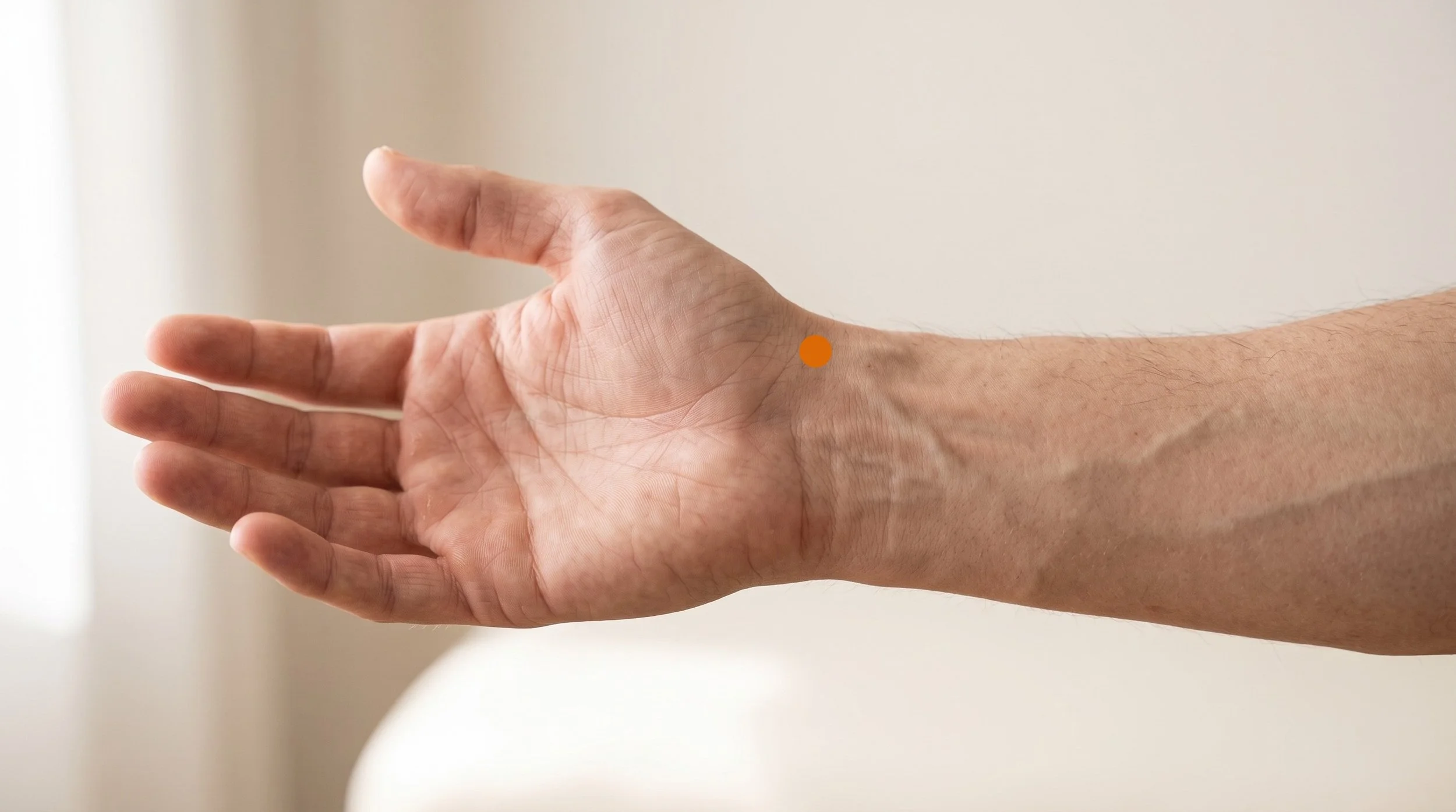
SI8 Acupuncture Point (Xiaohai)
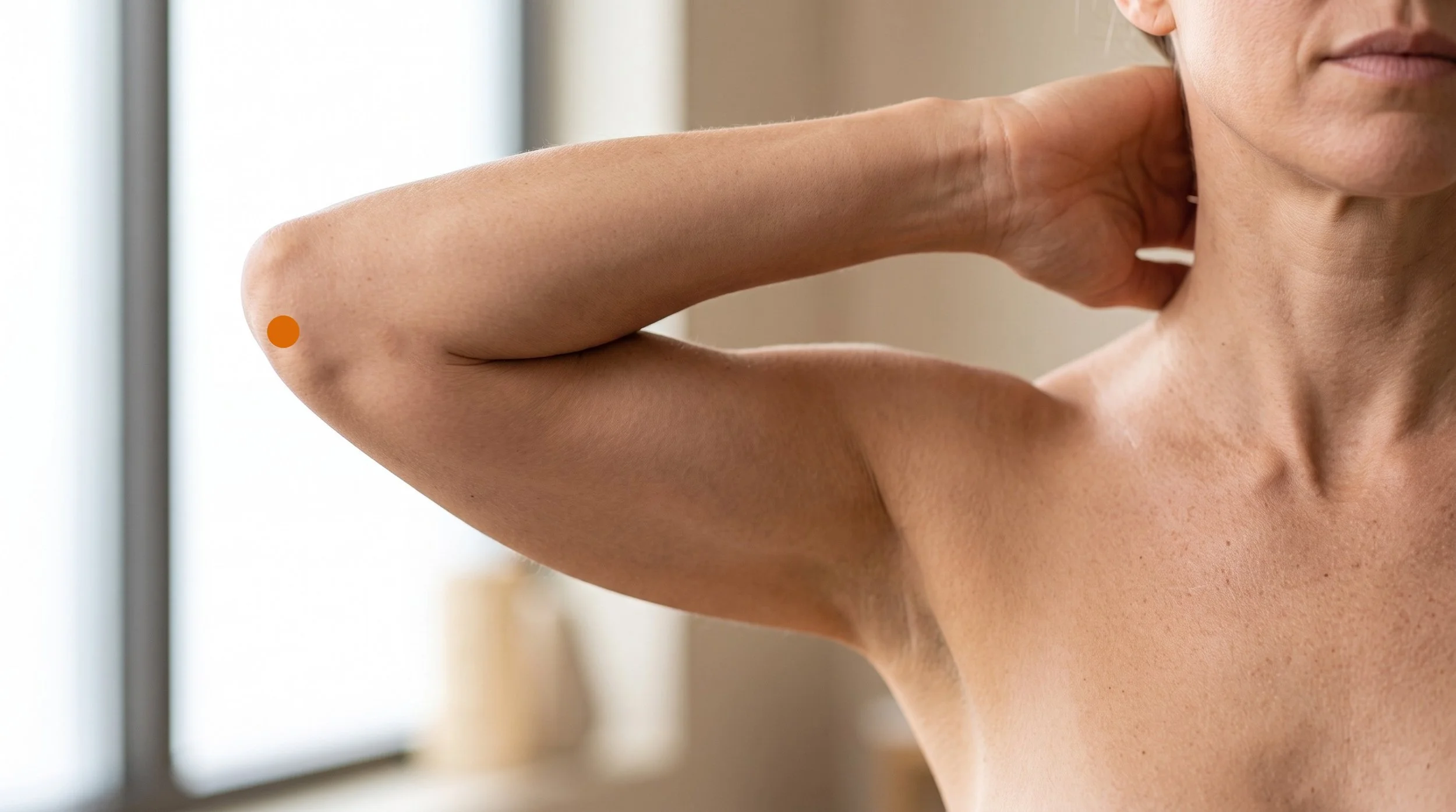
SI8 Acupuncture Point (Xiaohai)
The Small Sea at the Funny Bone: Anatomy, Mechanism, and Why SI8 Sits at the Center of Medial Elbow, Ulnar Forearm, and Scapular Pain Treatment
SI8, known in Chinese as Xiaohai and usually translated as Small Sea, is the he-sea and Earth point of the Small Intestine channel. You can find it by bending the elbow and sliding a finger into the groove between the bony tip of the olecranon and the knob of the medial epicondyle, which is the same spot most people know as the funny bone.
That anatomy is exactly why the si8 acupuncture point matters clinically: the needle sits over the cubital tunnel, in a region loaded by desk work, gripping, throwing and prolonged elbow flexion, and on a channel that continues up the back of the arm to the shoulder blade and neck. Practitioners use small intestine 8 for medial elbow pain, ulnar-side forearm and little-finger symptoms, and pain that tracks from the scapula down the arm.
- Location and layers: with the elbow flexed, the xiaohai point lies in the shallow depression between the olecranon tip and the medial epicondyle of the humerus (Deadman et al., 2007). The tissue here is thin, with skin and a small amount of subcutaneous fat over the joint capsule, the origin of the flexor carpi ulnaris and the retinaculum roofing the cubital tunnel.
- Classical category, modern reading: SI8 is described as the he-sea and Earth point of the Small Intestine channel, and classical texts group it with the upper sea points of the arm yang channels, which were used mainly for neck, shoulder, face and head complaints rather than for the bowel itself (Deadman et al., 2007; Maciocia, 2015). Read neurophysiologically, that means a point whose usefulness comes from its segmental and channel relationships along the arm, not from any digestive action.
- The nerve story: the ulnar nerve runs immediately deep to this point inside the cubital tunnel, and the region shares roughly C8 to T1 segmental input with the ulnar forearm, the little finger and parts of the medial scapular region. Needling that engages this segment may reduce pain through convergence at the dorsal horn and through descending inhibitory pathways involving endogenous opioid and monoaminergic systems (Zhao, 2008).
- The research picture: no trial has tested SI8 in isolation, so the evidence is indirect. Reviews of acupuncture for elbow pain found short-term benefit with limited data (Green et al., 2002), reviews of acupuncture for neck disorders reported moderate quality evidence of pain relief compared with sham (Trinh et al., 2016), and a large individual patient data meta-analysis found effects for chronic musculoskeletal pain that persisted over time (Vickers et al., 2018).
- Clinical practice framing: at Morningside Acupuncture, si 8 elbow needling is usually one element of a regional plan that also addresses the flexor and extensor origins, the triceps, the scapular stabilizers and the lower cervical segments, because medial elbow complaints often travel with neck and shoulder-blade findings.
- De qi and safety: correct needling here produces a local heavy, dull, spreading ache. A sharp electric jolt shooting into the ring and little fingers means the needle is too close to the ulnar nerve and it should be withdrawn and redirected immediately (Deadman et al., 2007).
Struggling With Medial Elbow Pain That Will Not Settle?
Golfer's-elbow-region pain, gripping pain and aching along the inner elbow rarely respond to rest alone. Our clinicians combine SI8 with careful needling of the common flexor origin, the pronator teres and the forearm flexors, then layer in loading strategies you can do at home. Sessions are unhurried, and we explain what we find at each visit. Schedule an appointment to get a clear plan for your elbow.
Schedule NowAnatomy of SI8: Why the Cubital Tunnel Is Such an Important Location
SI8 sits in the sulcus formed by two easily palpated landmarks: the olecranon process of the ulna behind and the medial epicondyle of the humerus in front. Skin here is thin and mobile, with very little fat, so the underlying structures are close to the surface. Just distal and anterior, the common flexor tendon anchors the wrist and finger flexors, including flexor carpi ulnaris, whose two heads bridge the groove itself.
Repeated gripping, keyboard and mouse work with the elbow bent, throwing, racket sports and long hours leaning on the inner elbow all load this small area, which is why patients often report tenderness right where the point is located.
The defining structure is the ulnar nerve, which passes directly beneath the point inside the cubital tunnel. That nerve carries sensation from the ulnar side of the hand and the little finger, and the whole region shares spinal segments in the C8 to T1 range with the medial forearm, the hypothenar muscles and parts of the medial scapular area. Because these inputs converge on the same dorsal horn neurons, stimulating tissue at the elbow can influence how the nervous system processes pain arriving from neighboring territory in the same segments.
Needling also recruits descending inhibitory control from the brainstem, with endogenous opioid, serotonergic and noradrenergic contributions described in mechanistic reviews of acupuncture analgesia (Zhao, 2008). Clinically this offers a plausible explanation for why a point at the elbow can influence complaints felt further along the arm and around the shoulder blade.
Vascular structures here are modest, mostly small collateral branches around the elbow, so bleeding risk is low. The nerve, not a vessel, is the safety consideration. Standard technique is oblique insertion of about 0.5 to 1 cun directed proximally or distally along the groove, or a shallow perpendicular insertion of roughly 0.3 to 0.5 cun (Deadman et al., 2007). Deep perpendicular needling straight into the tunnel is avoided.
If a patient reports an electric sensation running into the ring and little fingers, the needle is repositioned immediately rather than manipulated, and patients with known cubital tunnel syndrome are needled around the region rather than into it.
Related Small Intestine Channel Related Pain Finder Forearm HandSI8 at a Glance: Classification, Location, and Clinical Use
| Category | Detail |
|---|---|
| Traditional Name | Xiaohai (Small Sea), SI-8 |
| Channel Classification | Small Intestine channel of Hand Taiyang |
| Point Categories | He-sea point and Earth point of the Small Intestine channel; one of the upper sea points of the arm yang channels, traditionally paired conceptually with the lower he-sea point ST39 for Small Intestine disorders |
| Precise Location | At the elbow, in the depression between the tip of the olecranon of the ulna and the medial epicondyle of the humerus, most easily located with the elbow flexed |
| Tissue Stimulated | Skin and thin subcutaneous tissue over the cubital groove, the roof of the cubital tunnel, the ulnar collateral ligament region and the proximal attachment of flexor carpi ulnaris, with the ulnar nerve immediately deep. See our Pain Finder Forearm Hand guide for referral patterns in this territory. |
| Needle Depth / Direction | Oblique insertion 0.5 to 1 cun directed proximally or distally along the groove, or shallow perpendicular insertion 0.3 to 0.5 cun; deep perpendicular needling into the tunnel is avoided |
| De Qi Sensation | A local dull, heavy, spreading ache around the inner elbow, sometimes drifting along the ulnar forearm; a sharp electric zap into the little finger is nerve contact and calls for immediate repositioning |
| Primary Clinical Uses | Medial elbow pain and golfer's-elbow-region complaints, ulnar-side forearm and little-finger symptoms, scapular and posterolateral shoulder pain, neck pain that radiates toward the elbow |
| Common Point Combinations |
|
In A Manual of Acupuncture, Deadman and colleagues describe Xiaohai SI-8 as a point with impressive credentials that is nonetheless used less often than its status would suggest, appearing in only a handful of classical formulas.
The traditional indication lists group into a few themes: swellings and painful heat in the head and neck region (gums, throat, cheek, elbow and axilla, along with the neck lumps classical authors called scrofula), spirit and mind disturbances such as agitation, seizure disorders and disordered behavior, and channel pain running from the neck through the scapula, shoulder, upper arm and elbow. The traditional actions attributed to the point are clearing heat and reducing swelling, calming the spirit and freeing the channel to relieve pain.
What is striking about the classical pattern is how little the point was credited with acting on the Small Intestine organ itself, despite being its he-sea point, a contradiction the text explains by noting that the arm yang channels run far from the bowels they are named for.
Why SI8 Is Used for Shoulder Blade and Neck Pain, Not Just the Elbow
Patients are often surprised when a point at the inner elbow is chosen for pain felt between the shoulder blades or along the side of the neck. The reasoning is segmental rather than mystical. The tissues around the cubital tunnel share innervation in roughly the C8 to T1 range with the ulnar forearm, the little finger and parts of the medial scapular region, and sensory input from all of these areas converges on overlapping populations of dorsal horn neurons.
Stimulating one part of that shared territory can modulate how the whole segment behaves, which is one reason classical sources listed neck pain radiating to the elbow and scapular pain among the indications for this point.
A second mechanism operates above the spinal cord. Needling that produces the characteristic de qi ache activates ascending signals that recruit descending inhibitory control from the periaqueductal gray and rostral ventromedial medulla, with endogenous opioid, serotonergic and noradrenergic transmitters involved (Zhao, 2008). This system is not limited to one segment, which helps explain why patients frequently report a general easing of arm and neck discomfort after treatment rather than relief confined to the needle site.
Local effects matter too: needling changes blood flow and the chemical environment in the treated tissue, which may help irritable tendon attachments and taut muscle bands settle.
None of this makes SI8 a stand-alone answer for neck or scapular pain. It is a supporting point that fits naturally into a plan built around the cervical spine, the scapular stabilizers and the forearm. The best available evidence for acupuncture in chronic musculoskeletal pain comes from multi-point protocols, where effects were modest but durable across follow-up (Vickers et al., 2018), and that is the realistic expectation to hold.
What the Research Shows for SI8
There is no clinical trial dedicated to SI8 on its own, and it would be misleading to present one point as if it carried the effects of a whole treatment. What we can say is that acupuncture and dry needling protocols that include local elbow, forearm and cervical points have been studied in reviews of elbow pain, neck disorders and chronic pain generally. The findings below reflect multi-point protocols in which a point like small intestine 8 would typically be one component, and several of the reviews describe short-term benefit with meaningful limitations in study quality.
| Study | Type | Focus | Key Finding |
|---|---|---|---|
| Green et al., 2002 | Cochrane systematic review | Acupuncture for lateral elbow pain | The reviewers found some evidence of short-term pain relief but concluded that the small number and quality of trials made firm conclusions impossible. |
| Trinh et al., 2016 | Cochrane systematic review | Acupuncture for neck disorders | Moderate quality evidence suggested acupuncture reduced chronic neck pain more than sham immediately after treatment and at short-term follow-up. |
| Vickers et al., 2018 | Individual patient data meta-analysis | Acupuncture for chronic musculoskeletal, headache and osteoarthritis pain | Acupuncture was associated with modest but statistically significant improvements over both sham and no-acupuncture controls, with effects largely maintained over twelve months. |
| Navarro-Santana et al., 2020 | Systematic review and meta-analysis | Trigger point dry needling for lateral epicondylalgia | Low to moderate quality evidence suggested short-term improvements in pain, disability, pressure pain sensitivity and grip strength. |
| Ma et al., 2024 | Systematic review and meta-analysis | Dry needling for lateral epicondylitis | Pooled results favored dry needling for pain, elbow disability and grip strength, with better pain outcomes when a local twitch response was elicited. |
| Zhao, 2008 | Narrative review of mechanisms | Neural basis of acupuncture analgesia | Analgesic effects are attributed to segmental spinal modulation and descending inhibitory pathways involving opioid and monoamine systems rather than to any single point. |
Numbness or Tingling Along the Ulnar Side of Your Forearm?
Little-finger tingling, ulnar forearm heaviness and a cranky funny bone often trace back to a combination of local tissue irritation at the elbow and irritable segments in the lower neck. We use the xiaohai point cautiously alongside cervical and scapular work, always avoiding direct provocation of the ulnar nerve. If symptoms are worsening or you have weakness, we will tell you when a medical evaluation should come first. Book a visit to have your arm assessed properly.
Schedule NowSI8 in the Context of Trigger Point Work
Acupuncture at Morningside means the use of an acupuncture needle, and that includes the styles commonly labeled dry needling. When a patient presents with inner elbow pain, SI8 usually shares the treatment with muscles that refer into the same territory. Flexor carpi ulnaris and the deep finger flexors can refer along the ulnar forearm toward the little finger, triceps trigger points can project toward the medial epicondyle and down the back of the arm, and pronator teres often contributes to gripping pain near the common flexor origin (Simons et al., 1999).
Needling these bands with a local twitch response, then treating the point itself more gently, tends to give a more complete result than either approach alone.
The overlap between the point and myofascial targets is real but partial. SI8 sits over the groove, while the most productive taut bands usually lie slightly distal in the flexor mass or proximal in the medial triceps. Because the ulnar nerve is directly under the point, our clinicians work around the tunnel rather than through it, keeping needling shallow and oblique at SI8 and reserving deeper technique for the muscle bellies.
For patients whose elbow pain travels up to the shoulder blade, we frequently add the infraspinatus, rhomboids and levator scapulae, which is where the channel logic of the Small Intestine and the referral maps of trigger point work happen to agree.
SI8 Elbow and Arm Pain Treatment at NYC's Highest-Rated Acupuncture Clinic
Morningside Acupuncture is the highest-rated acupuncture and dry needling clinic in New York City with over 500 five-star Google reviews. Our licensed acupuncturists treat elbow, forearm, shoulder and neck pain every day, using points like SI8 within a full anatomical assessment rather than a fixed recipe. You get precise needling, clear reasoning and practical between-session advice. Schedule your appointment on the Upper West Side today.
Schedule NowFrequently Asked Questions
What does SI8 feel like when needled?
Most people feel a dull, heavy, slightly spreading ache right in the groove of the inner elbow, sometimes with a warm or full sensation that drifts a short way along the forearm. That achy quality is the de qi practitioners look for. What you should not feel is a sharp electric shock running into the ring and little fingers. That sensation means the needle is contacting the ulnar nerve, and your acupuncturist will withdraw and redirect it right away. Tell your clinician immediately if it happens, since it is easy to correct.
Why needle the elbow when my pain is in my neck or shoulder blade?
Because the tissues at SI8 share spinal segments with the ulnar forearm, the little finger and parts of the medial scapular region, so input from the elbow reaches the same dorsal horn neurons that process pain from those areas. Needling can also recruit descending inhibitory pathways that reduce pain more broadly (Zhao, 2008). Classical texts noticed the same clinical relationship centuries earlier and listed neck pain radiating to the elbow and scapular pain among the indications for this point. In practice, SI8 is used alongside local neck and shoulder treatment, not instead of it.
Can I press SI8 myself between sessions?
Yes, with a light touch. Bend your elbow to about 90 degrees, find the notch between the bony point of the elbow and the bump on the inner side, then press just at the edge of that groove with your thumb rather than digging into the center of it. Use steady, moderate pressure for 30 to 60 seconds, release, and repeat two or three times, once or twice a day. Small circles or gentle rubbing are fine. Stop immediately if you get tingling, buzzing or numbness into the little finger, and never sustain hard pressure directly over the nerve. Acupressure here may reduce local aching and is a reasonable complement to treatment, not a substitute for it.
Is SI8 safe to needle?
In trained hands it is safe, and it is used routinely. The one structure that dictates technique is the ulnar nerve, which lies directly deep to the point inside the cubital tunnel, so needling is kept shallow or oblique along the groove rather than deep and perpendicular (Deadman et al., 2007). Practitioners avoid aggressive manipulation at this location and reposition at once if an electric sensation appears. Patients with diagnosed cubital tunnel syndrome, prior ulnar nerve surgery or a nerve that subluxes over the epicondyle are usually treated around the area instead. Ordinary side effects are the same as elsewhere, mainly brief soreness or a small bruise.
Where exactly is SI8 located?
Bend your elbow and feel for two landmarks: the pointed tip of the olecranon at the back of the elbow and the rounded medial epicondyle on the inner side. SI8 lies in the depression between them, which is the same groove that produces the familiar funny bone sensation when knocked. Flexing the elbow opens the space and makes the two bony points easier to distinguish. If you tap lightly in that groove and feel a tingle toward the little finger, you have found the ulnar nerve, and the point sits right there, which is precisely why the needling technique is deliberately shallow.
References
- Deadman, P., Al-Khafaji, M., & Baker, K. (2009). A manual of acupuncture. Journal of Chinese Medicine Publications.
- Maciocia, G. (2005). The foundations of Chinese medicine: A comprehensive text for acupuncturists and herbalists (2nd ed.). Elsevier Churchill Livingstone.
- Cheng, X. (Ed.). (1999). Chinese acupuncture and moxibustion (Rev. ed.). Foreign Languages Press.
- Simons, D. G., Travell, J. G., & Simons, L. S. (1999). Travell & Simons' myofascial pain and dysfunction: The trigger point manual, Vol. 1: Upper half of body (2nd ed.). Williams & Wilkins.
- Green, S., Buchbinder, R., Barnsley, L., Hall, S., White, M., Smidt, N., & Assendelft, W. (2002). Acupuncture for lateral elbow pain. Cochrane Database of Systematic Reviews, 2002(1), CD003527. https://doi.org/10.1002/14651858.CD003527
- Trinh, K., Graham, N., Irnich, D., Cameron, I. D., & Forget, M. (2016). Acupuncture for neck disorders. Cochrane Database of Systematic Reviews, 2016(5), CD004870. https://doi.org/10.1002/14651858.CD004870.pub4 [VERIFY BEFORE PUBLISHING]
- Vickers, A. J., Vertosick, E. A., Lewith, G., MacPherson, H., Foster, N. E., Sherman, K. J., Irnich, D., Witt, C. M., & Linde, K. (2018). Acupuncture for chronic pain: Update of an individual patient data meta-analysis. Journal of Pain, 19(5), 455-474. https://doi.org/10.1016/j.jpain.2017.11.005
- Zhao, Z. Q. (2008). Neural mechanism underlying acupuncture analgesia. Progress in Neurobiology, 85(4), 355-375. https://doi.org/10.1016/j.pneurobio.2008.05.004
- Navarro-Santana, M. J., Sanchez-Infante, J., Gómez-Chiguano, G. F., Cleland, J. A., López-de-Uralde-Villanueva, I., Fernández-de-las-Peñas, C., & Plaza-Manzano, G. (2020). Effects of trigger point dry needling on lateral epicondylalgia of musculoskeletal origin: A systematic review and meta-analysis. Clinical Rehabilitation, 34(11), 1327-1340. https://doi.org/10.1177/0269215520937468
- Ma, X., Qiao, Y., Wang, J., Xu, A., & Rong, J. (2024). Therapeutic effects of dry needling on lateral epicondylitis: An updated systematic review and meta-analysis. Archives of Physical Medicine and Rehabilitation, 105(11), 2184-2197. https://doi.org/10.1016/j.apmr.2024.02.713
Disclaimer: This web site is intended for educational and informational purposes only. Reading this website does not constitute providing medical advice or any professional services. This information should not be used for diagnosing or treating any health issue or disease. Those seeking medical advice should consult with a licensed physician. Seek the advice of a medical doctor or other qualified health professional for any medical condition. If you think you have a medical emergency, call 911 or go to the emergency room. No acupuncturist-patient relationship is created by reading this website or using the information. Morningside Acupuncture PLLC and its employees and contributors do not make any express or implied representations with respect to the information on this site or its use. For any legal interpretation of scope of practice in your state, consult a licensed attorney or regulatory authority.
Read more from our blog