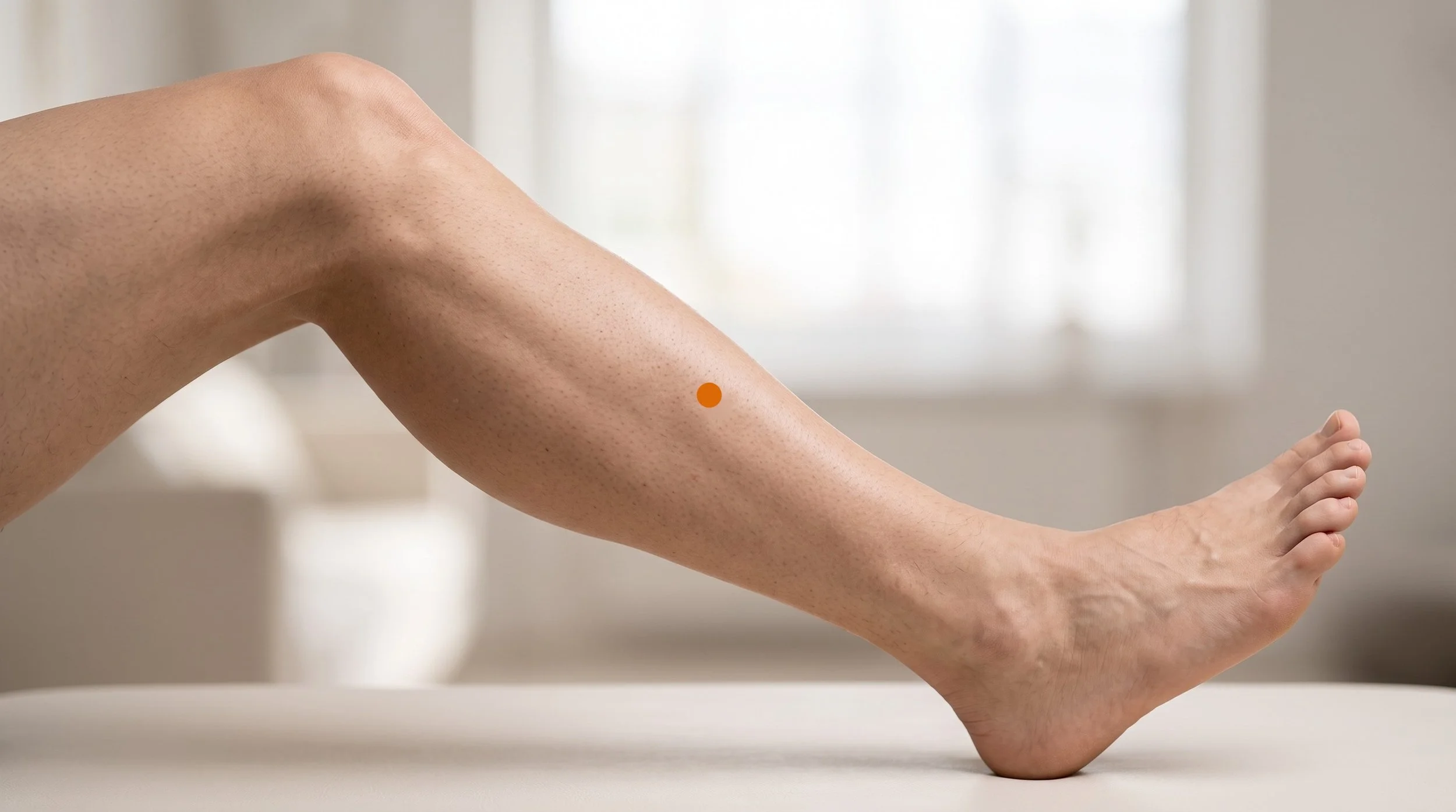
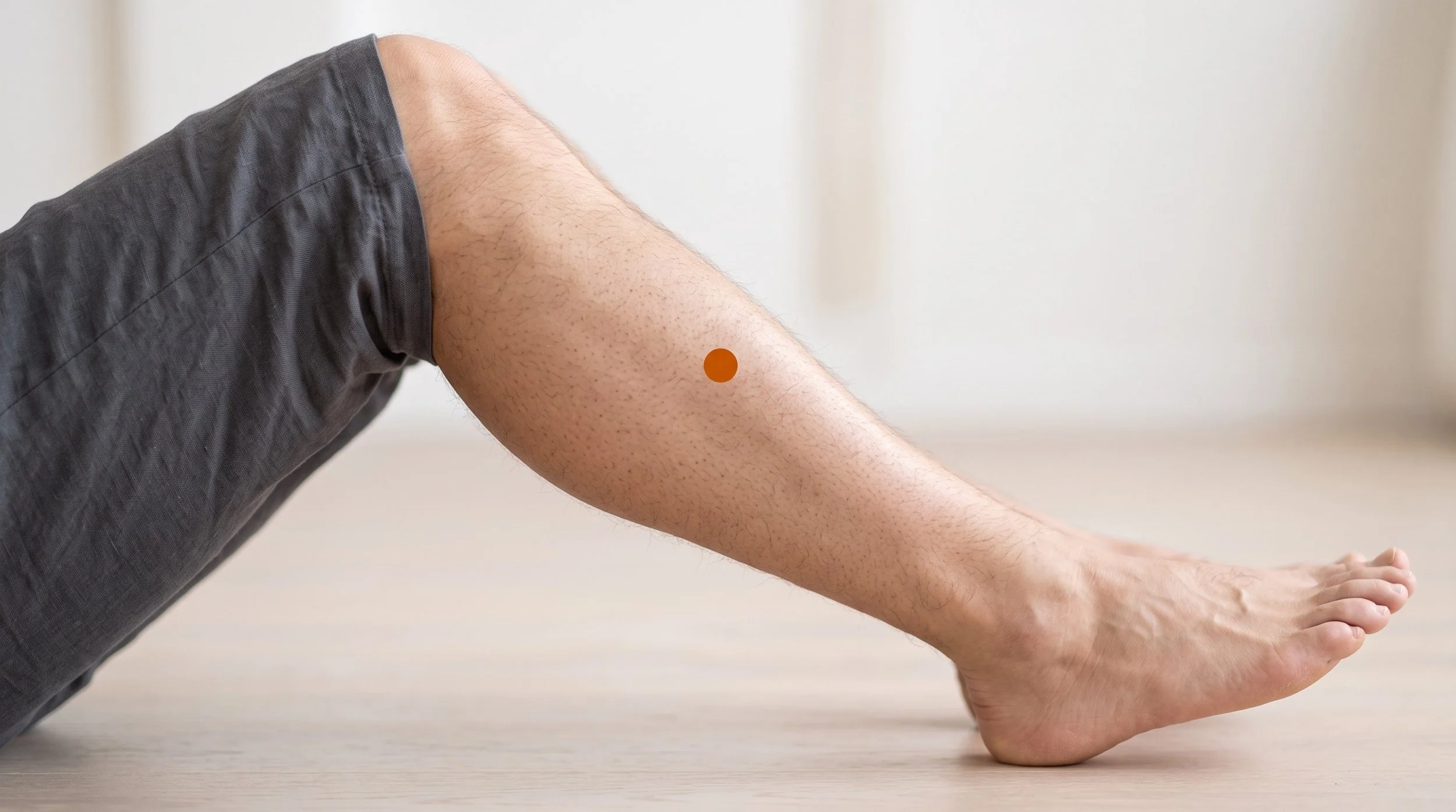
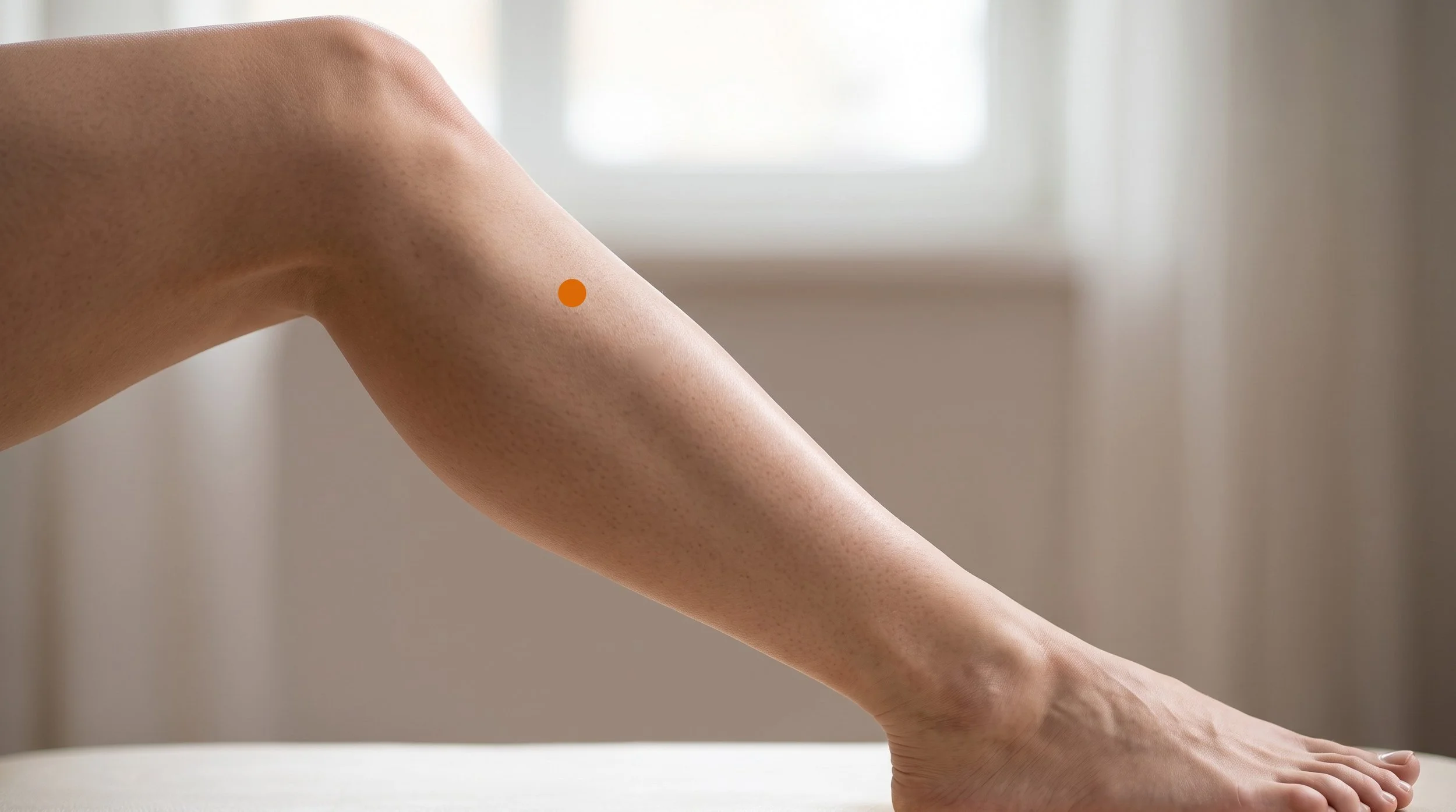
ST38 Acupuncture Point (Tiaokou)
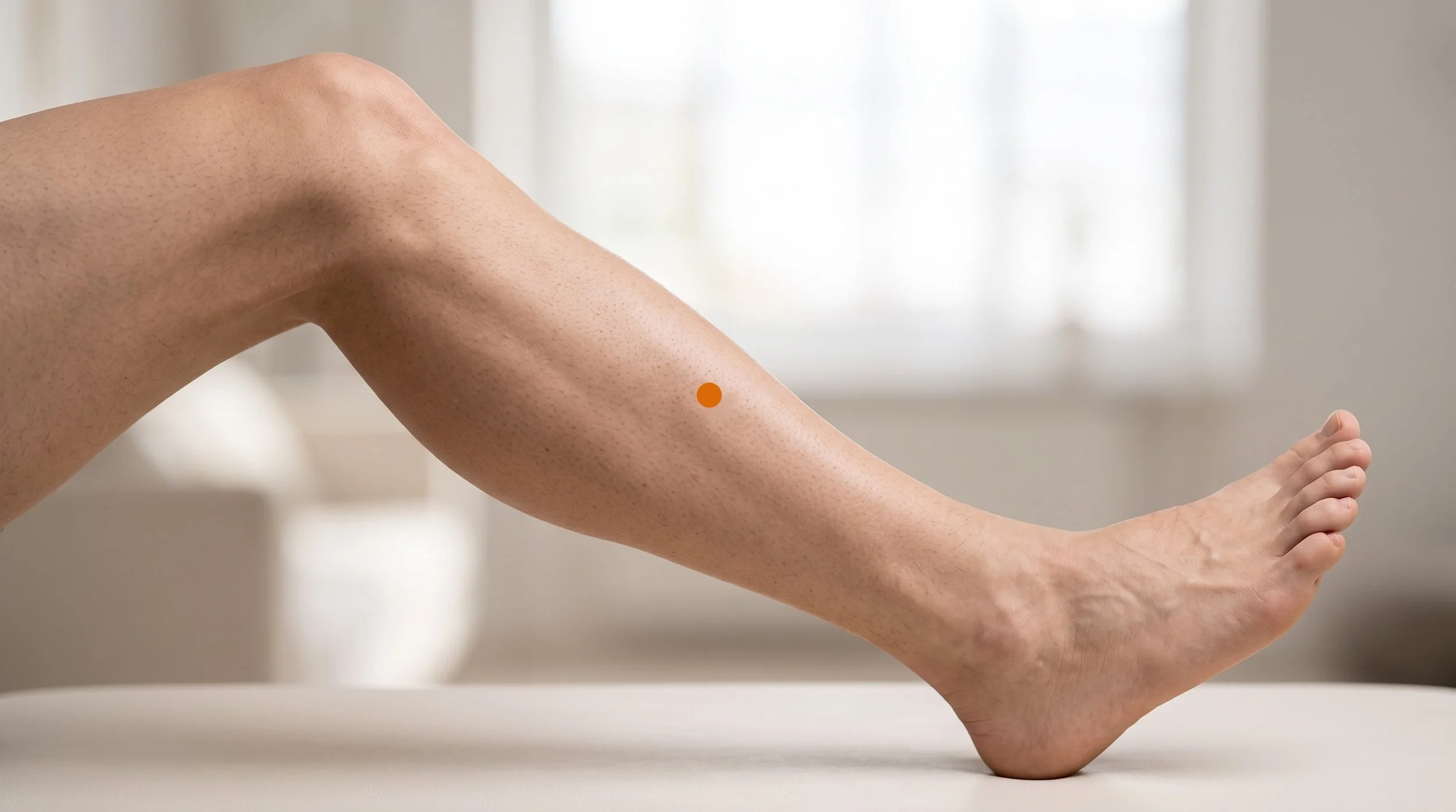
ST38 Acupuncture Point
Lines Opening on the Front of the Shin: Anatomy, Mechanism, and Why a Lower Leg Point Became the Classic Distal Choice for a Stuck Shoulder
ST38, known in Chinese as Tiaokou and usually translated as Lines Opening (some texts render it Narrow Opening), sits on the front of the lower leg, roughly halfway between the knee joint line and the bony bump on the outside of the ankle, a finger's width to the outside of the shin bone's sharp front edge. It is an ordinary looking point on the Stomach channel with an unusual reputation: alongside its local uses for shin pain, leg heaviness and lower limb weakness, the st38 acupuncture point is the point most classical and modern Chinese sources reach for when a shoulder will not move.
Practitioners needle stomach 38 in the leg, ask the patient to rotate the arm, and look for an immediate change in range of motion, which is why tiaokou frozen shoulder protocols show up in both old texts and contemporary trials.
- ST38 lies on the anterior lower leg midway between the tibiofemoral joint line and the prominence of the lateral malleolus, one finger-breadth lateral to the tibial crest and level with ST40; the needle passes through skin and crural fascia into tibialis anterior, angling toward the interosseous membrane, with extensor digitorum longus immediately lateral (Deadman et al., 1998; Cheng, 1987).
- Traditional sources attribute two actions to Tiaokou: expelling wind-damp with pain relief in the leg, and benefiting the shoulder (Deadman et al., 1998). Read neurophysiologically, the first describes local segmental input into an irritable anterior compartment and the second describes a heterosegmental analgesic effect produced far from the painful joint.
- Muscle and fascial afferents at this level travel with the deep peroneal nerve and enter the cord around L4 to L5, nowhere near the C5 to C6 segments that supply the shoulder, so any benefit at the shoulder has to be explained by supraspinal and descending pain-modulating pathways rather than local segmental convergence (Zhao, 2008).
- Imaging work supports that reading: needling ST38 in people with chronic shoulder pain produced measurable, and side-dependent, changes in brain network connectivity, with contralateral and ipsilateral needling associated with different patterns (Zhang et al., 2018; Yan et al., 2020).
- The point-specific clinical literature is encouraging but limited. A systematic review of 19 randomized trials with 1,944 participants reported favorable results for acupuncture at Tiaokou in shoulder adhesive capsulitis while judging most of the included trials low quality (Yang et al., 2018), and the older Cochrane review of acupuncture for shoulder pain found the evidence base too small and varied to be conclusive (Green et al., 2005).
- In clinic, ST38 is usually needled 1 to 1.5 cun with fairly strong stimulation while the patient actively moves the shoulder, then followed by local shoulder points (Maciocia, 2006). De qi here is typically a deep, heavy ache with distension that can travel up or down the shin, and it tends to be more intense than at softer points because the needle is engaging dense muscle.
Shoulder Stiff, Painful, and Not Improving?
Frozen shoulder and chronic shoulder restriction rarely respond to poking the sore spot alone. At Morningside Acupuncture, we often begin a shoulder session distally at ST38 while you gently move the arm, then add local needling around the joint and the muscles that have been guarding for months. Patients frequently notice a change in range of motion within the first visit, which gives us something concrete to build on. Schedule a shoulder evaluation and we will map out a plan.
Schedule NowAnatomy of ST38: Why the Mid-Shin on the Stomach Channel Is Such an Important Location
Find the joint line at the knee and the tip of the outer ankle bone, then split the difference. That midpoint, taken one finger-breadth lateral to the sharp front edge of the tibia, is ST38 (Deadman et al., 1998). Under the skin and crural fascia the needle enters the belly of tibialis anterior, the muscle that lifts the foot with every step and decelerates it on landing, with extensor digitorum longus sitting just lateral.
This compartment is loaded constantly during walking, running, hill climbing, and stair descent, and it is bounded by a relatively unforgiving fascial envelope, which is part of why it becomes tender and gritty in runners and in people who spend long days on hard surfaces. ST40 sits at the same level a finger further lateral, so the two points share a horizontal line and are easy to confuse if the tibial crest is not palpated first.
The sensory story here is straightforward. Skin over the point is supplied by branches related to the superficial peroneal nerve, while the deeper muscle afferents run with the deep peroneal nerve and enter the spinal cord in the region of the fourth and fifth lumbar segments (Cheng, 1987). Those inputs are perfectly matched to the leg itself, which explains the local indications for shin soreness, knee and lower leg pain, and impaired foot function. They are not matched to the shoulder at all.
When ST38 changes a shoulder, the effect has to travel upward: strong stimulation of small-diameter muscle afferents recruits brainstem and midbrain circuits that release serotonin, noradrenaline and endogenous opioids onto dorsal horn neurons far from the needle, a well described basis for heterosegmental acupuncture analgesia (Zhao, 2008). Studies of chronic shoulder pain that needled only ST38 reported measurable shifts in brain network connectivity, consistent with a centrally mediated rather than a local mechanism (Zhang et al., 2018; Yan et al., 2020).
Deep to the muscle lie the anterior tibial artery and vein and the deep peroneal nerve, running along the interosseous membrane. In practice this is not a high-risk site, because the standard perpendicular or oblique insertion of 1 to 1.5 cun stays within muscle well before those structures become a concern, and many textbooks describe an even shallower 0.5 to 1 inch depth (Deadman et al., 1998; Cheng, 1987). Angling slightly toward the tibia is common when a stronger sensation is wanted.
Sharp electric shooting down into the foot means the needle has approached neural tissue and should prompt withdrawal and redirection. As with any point on a limb, clean technique and single-use sterile needles are standard, and the leg should be supported so the patient does not move unexpectedly during manipulation.
Related Tibialis Anterior Trigger Points Related Acupuncture For Tibialis Anterior PainST38 at a Glance: Classification, Location, and Clinical Use
| Category | Detail |
|---|---|
| Traditional Name | Tiaokou (Lines Opening; also translated Narrow Opening) |
| Channel Classification | Stomach channel of the leg (Foot Yangming), lower leg segment |
| Point Categories | No five-shu, luo-connecting, xi-cleft, lower he-sea, hui-meeting or extraordinary vessel designations are recorded for ST38 in the reference texts. Its standing comes from empirical use rather than category status, and it is frequently cited as the textbook example of an empirical distal point for the shoulder (Deadman et al., 1998; Cunningham). |
| Precise Location | On the anterior lower leg, midway between the tibiofemoral joint line (level with the popliteal crease) and the prominence of the lateral malleolus, one finger-breadth lateral to the anterior crest of the tibia, level with ST40 and two cun below ST37. |
| Tissue Stimulated | Skin and crural fascia over the belly of tibialis anterior, directed toward the interosseous membrane, with extensor digitorum longus lying immediately lateral. |
| Needle Depth / Direction | Perpendicular or oblique insertion 1 to 1.5 cun, sometimes angled slightly toward the tibia; shallower insertion of 0.5 to 1 cun is also described. Moxibustion is traditionally permitted. For shoulder work the point is commonly stimulated strongly while the patient mobilises the arm. |
| De Qi Sensation | A deep, heavy ache with pressure or distension in the shin that may spread up toward the knee or down toward the ankle. Because the needle sits in dense working muscle, the sensation is often stronger than at fleshier or more superficial points, and a brief muscle twitch is common. |
| Primary Clinical Uses | Frozen shoulder and restricted, painful shoulder movement (distal use); shin and anterior lower leg pain; leg weakness, heaviness and impaired foot function; knee and lower limb soreness; abdominal discomfort in classical listings. |
| Common Point Combinations |
|
Deadman's Manual of Acupuncture presents Tiaokou in two registers. As a local point it belongs to the ordinary business of the Stomach channel in the leg, traditionally credited with expelling wind-damp and easing pain in cases described as atrophy disorder and painful obstruction of the lower limb, with numbness, coldness, swelling and aching of the shin, an inability to stand for long, swelling at the thigh and knee, and heat in the soles of the feet, along with abdominal pain in the older indication lists.
As a distal point it belongs to a much smaller and stranger category. The text describes needling ST38 on the affected side with the patient seated, obtaining a strong sensation, then having the patient move the shoulder through the painful range while the needle is manipulated, after which local and distal shoulder points are added; relief and improved mobility are often described as immediate.
Deadman notes that the link between the Stomach and Large Intestine channels may partly account for this, but frames the point primarily as empirical, meaning its reputation was earned by repeated clinical observation rather than derived from theory. Other authors make the same observation, listing ST38 for shoulder pain as the standard example of a point that works without fitting neatly into channel logic (Cunningham). That is what makes the classical pattern striking: the tradition recorded an effect it could not fully explain, and kept using it anyway.
Why ST38 Is Used for a Frozen Shoulder When the Point Is on the Shin
The first thing to say plainly is that ST38 does not work on the shoulder through local segmental convergence. Points that share spinal segments with a painful structure can quiet that structure through shared dorsal horn circuitry, but the lower leg reports to lumbar segments while the shoulder reports to the lower cervical cord. There is no shared switchboard.
So if needling the shin changes a shoulder, the signal has to go up and come back down, which is exactly the pattern that research on acupuncture analgesia describes: strong stimulation of muscle afferents activates brainstem and midbrain structures that send descending serotonergic, noradrenergic and opioid-mediated inhibition to distant spinal levels (Zhao, 2008).
Point-specific imaging work has looked at this directly in people with chronic shoulder pain. In a pilot functional MRI study, needling ST38 on the same side as the pain and on the opposite side produced different patterns of brain activity, suggesting the two approaches are not simply interchangeable (Zhang et al., 2018).
A later randomized imaging study found both approaches reduced pain and improved shoulder function, with the contralateral group showing greater functional improvement and a distinct pattern of connectivity change involving anterior and paracingulate regions, which correlated with the shoulder outcome measure (Yan et al., 2020). A small exploratory trial comparing immediate effects reported that contralateral needling at ST38 lowered pain scores more than ipsilateral needling in the twenty minutes after treatment (Hu et al., 2019). None of this is settled, and the sample sizes are small, but it is an unusually direct attempt to test a single classical claim.
The second half of the effect is probably not analgesic at all. When pain drops even briefly, the protective muscle guarding around a stiff shoulder relaxes, and the patient can move further than they expected. That new range is itself therapeutic input, because the nervous system updates its threat appraisal of the movement. This is why the traditional instruction to have the patient move the shoulder during needling makes so much sense: the needle opens a window, and the movement is what fills it.
Broader evidence suggests acupuncture produces modest but real effects over sham controls for chronic musculoskeletal pain including shoulder pain, and that those effects persist over time rather than dissipating immediately (Vickers et al., 2018).
What the Research Shows for ST38
A word of caution before the table. Most acupuncture trials test whole protocols rather than individual points, so it is usually impossible to say what any single needle contributed. ST38 is a rare exception, because a body of Chinese-language trials has tested it as the sole or primary intervention for shoulder adhesive capsulitis, which allows something closer to a point-specific read. That literature is generally positive, but it is also small, largely single-country, and methodologically weak by modern standards, so the honest summary is promising rather than established. The broader reviews of acupuncture for shoulder pain and for chronic pain provide the surrounding context.
| Study | Type | Focus | Key Finding |
|---|---|---|---|
| Yang et al., 2018 | Systematic review and meta-analysis | Acupuncture at Tiaokou (ST38) for shoulder adhesive capsulitis, 19 randomized trials with 1,944 participants | Reported favorable results for ST38 used alone or with shoulder points on effectiveness rates, Constant-Murley scores and pain scores, while noting that most included trials were of low methodological quality. |
| Green et al., 2005 | Cochrane systematic review | Acupuncture for shoulder pain in adults | Concluded there was little evidence to either support or refute acupuncture for shoulder pain, with possible short-term benefit for pain and function and a clear need for better trials. |
| Vickers et al., 2018 | Individual patient data meta-analysis | Acupuncture for chronic musculoskeletal pain, including shoulder pain | Found modest but statistically significant benefits over both sham and no-acupuncture controls, with effects largely sustained over twelve months. |
| Hu et al., 2019 | Randomized controlled exploratory trial | Immediate effect of contralateral versus ipsilateral ST38 needling in chronic shoulder pain (38 patients) | Both groups improved immediately after a single session, with a greater reduction in pain scores in the contralateral group in this small exploratory sample. |
| Yan et al., 2020 | Randomized clinical trial with resting-state fMRI | Brain network changes after contralateral or ipsilateral ST38 needling in unilateral chronic shoulder pain | Both approaches reduced pain, with greater functional improvement and distinct anterior/paracingulate connectivity changes in the contralateral group, suggesting different central mechanisms. |
| Zhang et al., 2018 | Pilot functional MRI study | Contralateral versus ipsilateral acupuncture at ST38 in unilateral chronic shoulder pain | Observed different patterns of brain activity between sides of needling, offering preliminary support for a centrally mediated distal effect. |
| Zhao, 2008 | Narrative review of mechanisms | Neural basis of acupuncture analgesia | Describes afferent-driven activation of descending inhibitory pathways and endogenous opioid release as a plausible route for analgesia at sites remote from the needle. |
Shin Pain, Heavy Legs, or Anterior Compartment Tightness?
ST38 sits directly in tibialis anterior, one of the muscles that takes a beating from running, hill work, and long days on New York City pavement. We combine needling at this point with dry needling of the anterior compartment and calf, plus loading advice so the tissue tolerates more work over time. If your shins ache with every mile or your legs feel heavy and unresponsive, that pattern is worth assessing properly. Book a session and let's look at the whole chain.
Schedule NowST38 in the Context of Trigger Point Work
ST38 sits in the belly of tibialis anterior, and that muscle carries well documented trigger points that refer pain down the front of the shin toward the ankle and big toe, a pattern that overlaps closely with what classical texts described as shin soreness with weakness of the foot (Simons et al., 1999). Extensor digitorum longus, immediately lateral, refers into the dorsum of the foot and toes. When we treat runners, walkers and anyone with anterior compartment complaints, needling at or near ST38 and needling tibialis anterior trigger points are often the same intervention described in two vocabularies.
Acupuncture, defined as the therapeutic use of an acupuncture needle, covers hundreds of styles, and dry needling of myofascial targets is one of them. The point map and the muscle map simply happen to converge here.
For shoulder cases the logic is different, because ST38 is being used far from the problem. In a typical Morningside shoulder session we might needle ST38 first with firm stimulation while the patient moves the arm through whatever range they have, then work locally with dry needling of the muscles that are actually restricting and guarding: infraspinatus, subscapularis, upper trapezius, levator scapulae and pectoralis minor, depending on the presentation. The distal point creates a temporary window of less pain and more motion; the local needling addresses the tissue that has adapted to months of disuse.
Neither piece does the whole job on its own, and treatment is paired with graded home movement so the range gained in the room does not disappear before the next visit.
ST38 Frozen Shoulder Treatment at NYC's Highest-Rated Acupuncture Clinic
Morningside Acupuncture is the highest-rated acupuncture and dry needling clinic in New York City with over 500 five-star Google reviews, and shoulder cases are among the most common reasons people find us. We use the st 38 shoulder point the way classical and modern sources describe it, as a distal opener paired with careful local work and movement, not as a standalone trick. Every treatment is delivered by a licensed acupuncturist who will explain what we are doing and why. Schedule your visit and start moving that shoulder again.
Schedule NowFrequently Asked Questions
What does ST38 feel like when needled?
Most people describe a deep, heavy, spreading ache with a sense of pressure or fullness in the shin, sometimes travelling toward the knee or ankle. Because the needle sits in dense working muscle rather than soft tissue, the sensation at ST38 is often stronger than at many other points, and a brief involuntary twitch of tibialis anterior is common and harmless. When the point is being used for a shoulder, the practitioner will usually stimulate it firmly, so expect a distinctly noticeable rather than a subtle sensation. It should feel intense but tolerable, and it typically eases within seconds. Sharp, electric pain shooting into the foot is not the goal and should be reported immediately so the needle can be adjusted.
Why needle a point on the shin for shoulder pain instead of the shoulder itself?
Partly because tradition says so, and partly because it is often more comfortable and more useful. Classical texts recorded ST38 as an empirical point for shoulder restriction, meaning the effect was observed repeatedly before anyone could explain it (Deadman et al., 1998). The modern explanation is that strong stimulation of leg muscle afferents recruits descending pain-inhibiting pathways from the brainstem that act on spinal levels far from the needle (Zhao, 2008), and imaging studies of ST38 in shoulder pain patients have shown corresponding changes in brain network activity (Zhang et al., 2018; Yan et al., 2020). Practically, it also leaves the shoulder free to move during treatment, which is the whole point of the technique. In most sessions the distal needle is the opener and local shoulder points follow.
Can I press ST38 myself between sessions?
Yes, acupressure at ST38 is straightforward and low risk. Sit with the knee bent, find the midpoint between the crease behind the knee and the tip of the outer ankle bone, then move about one finger-width to the outside of the sharp front ridge of the shin bone; you should feel muscle rather than bone under your thumb. Press with your thumb or a knuckle at a firm but comfortable pressure, aiming for a dull ache rather than sharp pain, and hold for 30 to 60 seconds, or use slow circular pressure for one to two minutes. For shoulder work, the useful trick is to press ST38 while slowly moving the shoulder through a comfortable range, repeating for two or three minutes per side, once or twice daily. Stop if the shin becomes bruised or increasingly sore, and remember that self-pressure supplements treatment rather than replacing it.
Is ST38 safe to needle?
In trained hands it is a safe point. The standard perpendicular or oblique insertion of 1 to 1.5 cun stays within tibialis anterior, well superficial to the anterior tibial vessels and deep peroneal nerve, which lie along the interosseous membrane (Deadman et al., 1998). Temporary shin soreness for a day or so is the most common after-effect, particularly when strong stimulation has been used, and minor bruising is possible as at any site. Sharp shooting pain into the foot means neural tissue is nearby and the needle should be withdrawn and redirected. People with peripheral neuropathy, poor circulation in the leg, cellulitis or other skin infection over the site, recent lower leg surgery, or a history of compartment syndrome should tell their acupuncturist so technique can be modified, and anyone on anticoagulants should mention it as well.
Where exactly is ST38 located?
ST38 is on the front of the lower leg, midway between the tibiofemoral joint line at the knee (level with the crease behind the knee) and the prominence of the lateral malleolus at the ankle, positioned one finger-breadth lateral to the anterior crest of the tibia. A common shortcut uses the sixteen cun measurement from the outer ankle bone to the centre of the kneecap and takes the halfway level. It sits two cun below ST37 and is level with ST40, which lies roughly one finger further lateral, so palpating the sharp front edge of the tibia first is the reliable way to keep the two apart. Under your finger you should feel the firm belly of tibialis anterior, which becomes obvious if you lift your foot toward your shin.
References
- Deadman, P., Al-Khafaji, M., & Baker, K. (2009). A manual of acupuncture. Journal of Chinese Medicine Publications.
- Cheng, X. (Ed.). (1999). Chinese acupuncture and moxibustion (Rev. ed.). Foreign Languages Press.
- Maciocia, G. (2006). The channels of acupuncture: Clinical use of the secondary channels and eight extraordinary vessels. Churchill Livingstone Elsevier.
- Cunningham, P. M. (2000). Acupuncture points: A practical guide to classical and modern usage. Odyssey Press.
- Simons, D. G., Travell, J. G., & Simons, L. S. (1999). Travell & Simons' myofascial pain and dysfunction: The trigger point manual, Vol. 1: Upper half of body (2nd ed.). Williams & Wilkins.
- Yang, C., Lv, T., Yu, T., Wong, S., Lu, M., & Li, Y. (2018). Acupuncture at Tiaokou (ST38) for shoulder adhesive capsulitis: What strengths does it have? A systematic review and meta-analysis of randomized controlled trials. Evidence-Based Complementary and Alternative Medicine, 2018, 4197659. https://doi.org/10.1155/2018/4197659
- Green, S., Buchbinder, R., & Hetrick, S. (2005). Acupuncture for shoulder pain. Cochrane Database of Systematic Reviews, 2005(2), CD005319. https://doi.org/10.1002/14651858.CD005319 [VERIFY BEFORE PUBLISHING]
- Hu, S., Zhang, S., Shi, G., Wang, Z., Wang, T., Yan, C., Zhou, P., & Liu, C. (2019). Immediate analgesia effect of contralateral needling at Tiaokou (ST38) in patients with chronic shoulder pain: A randomized controlled exploratory trial. Journal of Traditional Chinese Medical Sciences, 6(1), 95-100. https://doi.org/10.1016/j.jtcms.2019.01.007
- Yan, C. Q., Huo, J. W., Wang, X., Zhou, P., Zhang, Y. N., Li, J. L., Kim, M., Shao, J. K., Hu, S. Q., Wang, L. Q., & Liu, C. Z. (2020). Different degree centrality changes in the brain after acupuncture on contralateral or ipsilateral acupoint in patients with chronic shoulder pain: A resting-state fMRI study. Neural Plasticity, 2020, 5701042. https://doi.org/10.1155/2020/5701042
- Zhang, S., Wang, X., Yan, C. Q., Hu, S. Q., Huo, J. W., Wang, Z. Y., Zhou, P., Liu, C. H., & Liu, C. Z. (2018). Different mechanisms of contralateral- or ipsilateral-acupuncture to modulate the brain activity in patients with unilateral chronic shoulder pain: A pilot fMRI study. Journal of Pain Research, 11, 505-514. https://doi.org/10.2147/JPR.S152550
- Vickers, A. J., Vertosick, E. A., Lewith, G., MacPherson, H., Foster, N. E., Sherman, K. J., Irnich, D., Witt, C. M., & Linde, K. (2018). Acupuncture for chronic pain: Update of an individual patient data meta-analysis. Journal of Pain, 19(5), 455-474. https://doi.org/10.1016/j.jpain.2017.11.005
- Zhao, Z. Q. (2008). Neural mechanism underlying acupuncture analgesia. Progress in Neurobiology, 85(4), 355-375. https://doi.org/10.1016/j.pneurobio.2008.05.004
Disclaimer: This web site is intended for educational and informational purposes only. Reading this website does not constitute providing medical advice or any professional services. This information should not be used for diagnosing or treating any health issue or disease. Those seeking medical advice should consult with a licensed physician. Seek the advice of a medical doctor or other qualified health professional for any medical condition. If you think you have a medical emergency, call 911 or go to the emergency room. No acupuncturist-patient relationship is created by reading this website or using the information. Morningside Acupuncture PLLC and its employees and contributors do not make any express or implied representations with respect to the information on this site or its use. For any legal interpretation of scope of practice in your state, consult a licensed attorney or regulatory authority.
Read more from our blog