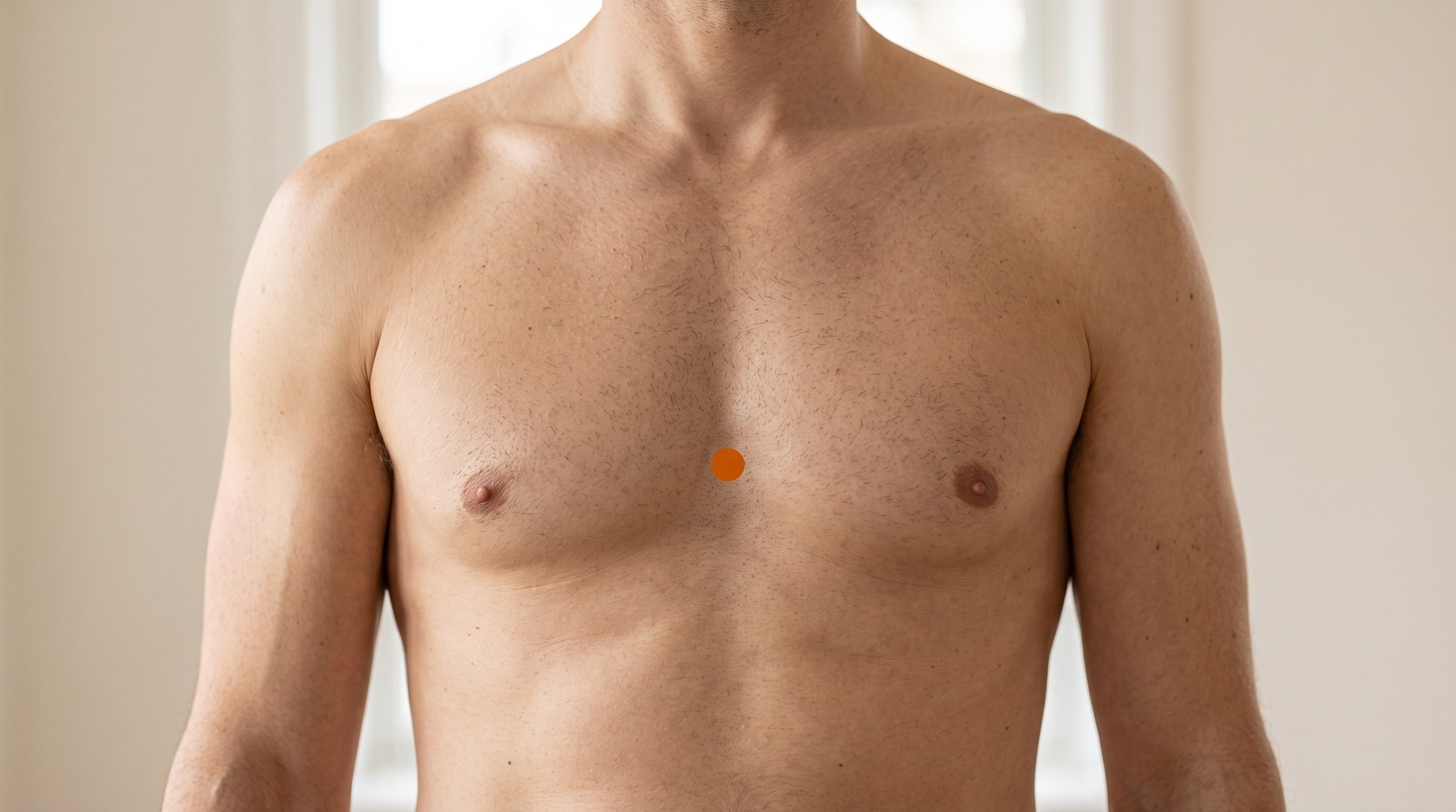
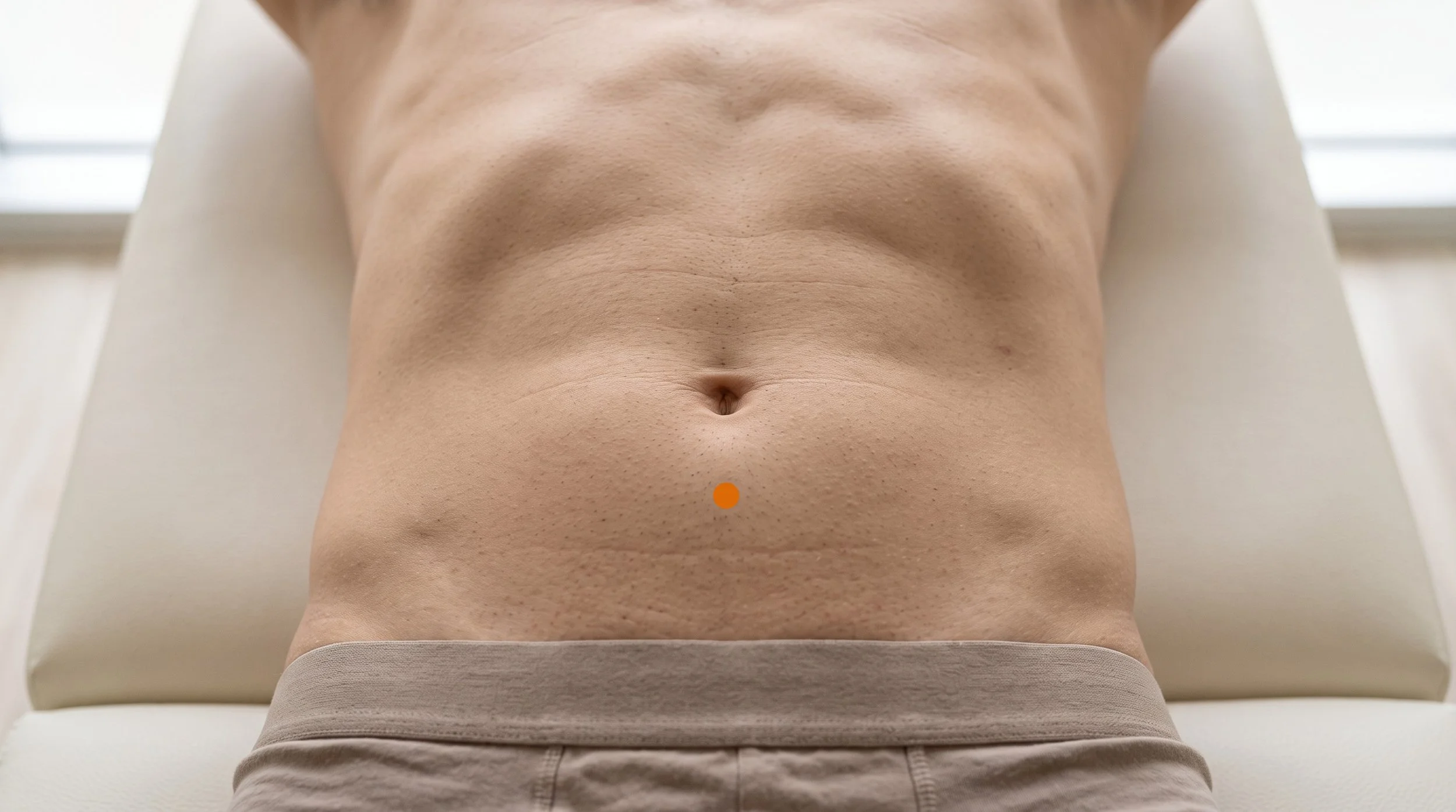
CV6 Acupuncture Point (Qihai)
CV6 Acupuncture Point
The Sea of Qi Below the Navel: Anatomy, Mechanism, and Why This Lower Abdominal Point Anchors Fatigue, Menstrual, and Digestive Treatment
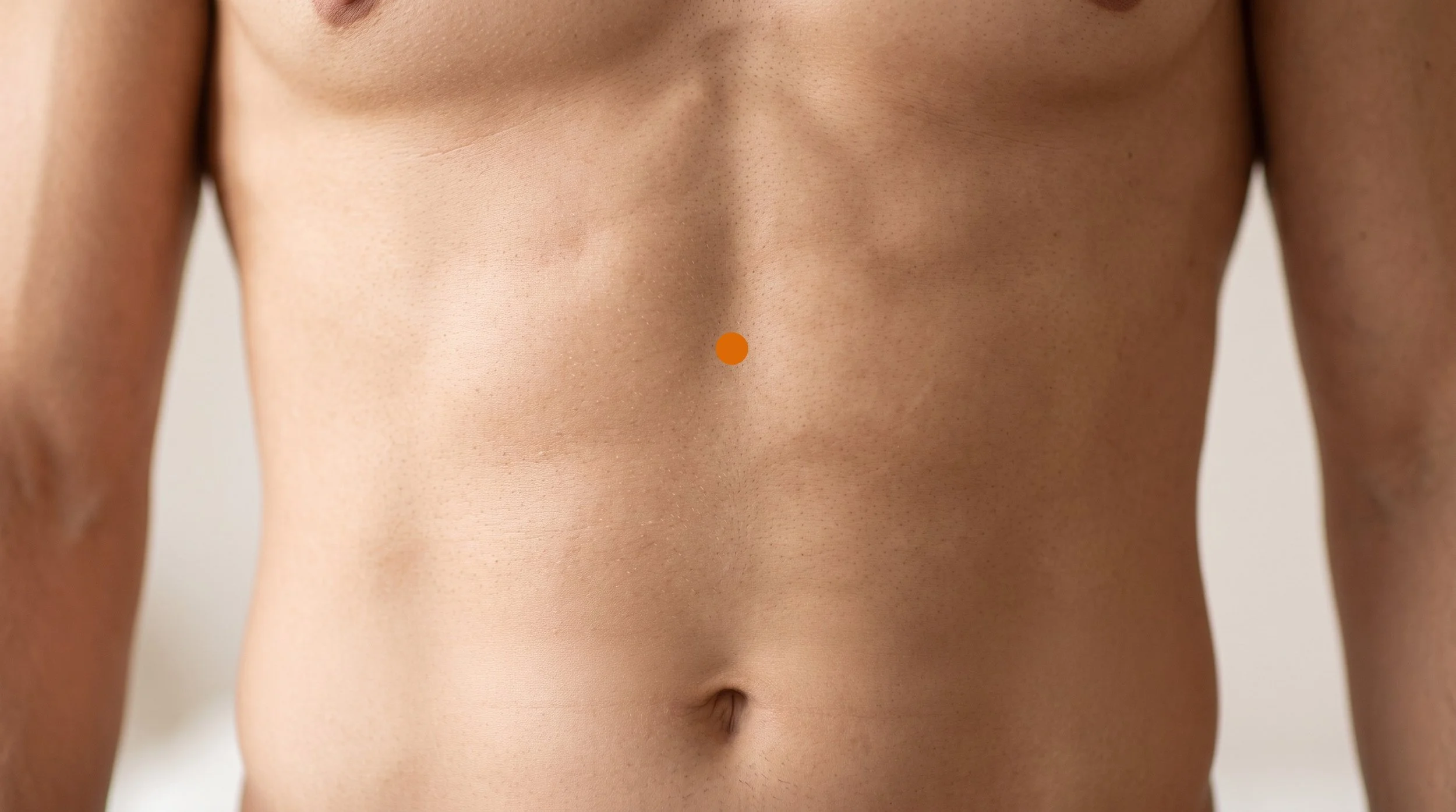
CV6 (Qihai), translated as Sea of Qi and also written as Ren 6 or Conception Vessel 6, sits on the front midline of the lower abdomen about 1.5 cun (roughly two finger widths) below the center of the navel, resting over the linea alba between the two bellies of the rectus abdominis. It's one of the most heavily used points in the entire acupuncture repertoire, partly because of where it lives: a thin, relatively bloodless midline seam that sits directly over the segmental territory of the lower thoracic nerves and, deeper still, over the autonomic plexuses that supply the intestines, bladder, and uterus. Clinically, the cv6 acupuncture point shows up in treatment plans for fatigue and low stamina, period cramps, lower abdominal bloating and sluggish digestion, and core and pelvic support work, and it's a mainstay in fertility-oriented protocols where practitioners want gentle, sustained input to the lower abdomen.
- CV6 is located on the midline of the lower abdomen, 1.5 cun below the umbilicus, and needles pass through skin, superficial fatty and membranous fascia, then the fibrous linea alba, with the preperitoneal fat and peritoneal cavity lying deeper. Because the linea alba is a tendon-like raphe rather than muscle, the needle sensation here tends to be dull and diffuse rather than sharp.
- The overlying skin and fascia are supplied by anterior cutaneous branches of the lower thoracoabdominal nerves, which enter the spinal cord around the same levels (roughly T10 to T12) as visceral afferents from the small intestine, bladder, and uterus, giving a plausible segmental basis for abdominal points influencing pelvic and gut symptoms (Yang et al., 2025).
- Classical texts assign CV6 the actions of fostering original qi, tonifying qi and yang, and regulating qi and blood in the lower abdomen. Read neurophysiologically, those traditional attributions describe a point used to modulate autonomic tone, local blood flow, and visceral sensitivity rather than to move any measurable substance.
- Needle-based stimulation is thought to recruit A-delta and C fiber afferents and engage descending inhibitory pathways involving endogenous opioids and monoamines, which is the best-supported general mechanism for acupuncture analgesia (Zhao, 2008; Vickers et al., 2018). Animal work indicates that abdominal points including CV6 alter gastrointestinal motility only when stimulation reaches those higher-threshold fibers, and that the direction of the effect depends on intensity and site (Yang et al., 2025).
- The research picture is mixed and protocol-dependent: a Cochrane review found the evidence for acupuncture and acupressure in primary period pain insufficient to draw firm conclusions (Smith et al., 2016), while a large meta-analysis of functional gut disorders reported symptom improvements with acupuncture but rated overall certainty as low (Wang et al., 2021).
- De qi at CV6 is usually described as a heavy, full, slightly warm sensation deep in the lower belly, sometimes spreading toward the pubic bone or low back. It should never be sharp, electric, or radiating down a leg, and needling depth is kept conservative because the peritoneal cavity lies below.
Tired of Fighting Through Period Cramps Every Month?
At Morningside Acupuncture, CV6 is one of the first points we consider for menstrual pain, especially when cramping sits low and central and comes with fatigue or bloating. We typically pair it with SP6 and lower back points, and we may add gentle heat over the lower abdomen during the session. Treatment is planned across a cycle or two so we can track what actually changes for you. Schedule a visit and let's build a plan around your cycle.
Schedule NowAnatomy of CV6: Why the Lower Linea Alba Is Such an Important Location
From the surface inward, a needle at CV6 passes through thin midline skin, then Camper's fatty layer and Scarpa's membranous layer of the superficial fascia, then the linea alba itself, the fibrous seam where the aponeuroses of both sides of the abdominal wall interlace. Just lateral to that seam lie the rectus abdominis muscles inside their sheath, with the obliques and transversus abdominis forming the wall beyond them. This is loaded tissue in everyday life: the linea alba transmits tension from breathing, bracing, twisting, and lifting, and in postpartum patients or those with long-standing anterior pelvic tilt the whole region can feel slack, guarded, or tender to light pressure.
Sensory supply to the skin and fascia here comes from anterior cutaneous branches of the lower thoracoabdominal (intercostal and subcostal) nerves. The umbilicus itself sits near the T10 dermatome, so CV6 usually falls in the T11 to T12 band. That matters because visceral afferents from the small intestine, bladder, uterus, and ovaries travel back to the cord through roughly the same lower thoracic and upper lumbar segments. Somatic and visceral inputs converging on shared dorsal horn neurons is the most straightforward explanation for why a needle in the abdominal wall can change how the pelvis feels, and reviews of acupuncture and gut motility describe exactly this kind of somatic-autonomic reflex arrangement, with effects depending on which segment is stimulated and how strongly (Yang et al., 2025). Broader mechanism work adds descending inhibition from the midbrain and brainstem, mediated in part by endogenous opioids, as a second layer of effect (Zhao, 2008).
Deep to the abdominal wall at this level sit the preperitoneal fat, the peritoneum, and then loops of small intestine, with a distended bladder able to rise into the field when someone hasn't voided recently. Below and behind, the aorta has already divided into the iliac vessels, and the superior hypogastric plexus lies along the lower spine. For that reason, standard needling is perpendicular to a depth of about 1 to 1.5 cun in an average adult, with reference manuals cautioning that deeper insertion can reach the peritoneal cavity and advising particular care with midline abdominal points during pregnancy. We ask patients to empty the bladder first, adjust depth to body habitus, and avoid the point entirely over hernias, surgical scars, or unexplained abdominal pain that hasn't been medically evaluated.
Related Conception Vessel Related Optimizing Menstrual HealthCV6 at a Glance: Classification, Location, and Clinical Use
| Category | Detail |
|---|---|
| Traditional Name | Qihai (Sea of Qi), also known classically as Dantian, the Cinnabar Field |
| Channel Classification | Conception Vessel (Ren Mai), point 6; an extraordinary vessel running up the anterior midline |
| Point Categories | Point of the Conception Vessel; not a five-shu or he-sea point. Classical sources designate it the shu point of the huang (the deep membranes), and Maciocia's channel text identifies Ren 6 as the source (yuan) point of the Membranes, a role tied to the Conception and Penetrating Vessels' influence over the abdominal membranes. Traditionally grouped with CV4 as a principal tonification point. |
| Precise Location | On the anterior midline of the lower abdomen, 1.5 cun inferior to the center of the umbilicus (about 3.5 cun above the pubic symphysis), over the linea alba |
| Tissue Stimulated | Midline skin and superficial fascia, linea alba, adjacent rectus abdominis sheath, with functional overlap into the abdominal obliques when the wall is guarded; anterior cutaneous branches of the lower thoracoabdominal nerves |
| Needle Depth / Direction | Perpendicular insertion 1 to 1.5 cun in an average adult, depth adjusted to body habitus; shallower oblique angling is often used in thin patients. Caution in pregnancy, and deep needling may enter the peritoneal cavity |
| De Qi Sensation | Deep, heavy fullness in the lower abdomen, often with a spreading warmth toward the pubic bone or low back; should not be sharp, burning, or radiating into the leg |
| Primary Clinical Uses | Fatigue and low energy, menstrual cramps and cycle irregularity, lower abdominal bloating and digestive sluggishness, core and pelvic support work, fertility-oriented treatment plans |
| Common Point Combinations |
|
Deadman's point manual, which compiles indications from the classical Chinese literature, presents Qihai as a point for profound depletion: exhaustion that doesn't respond to other treatment, wasting and weakness of the muscles, cold and diarrhea in the lower abdomen, sunken or prolapsed tissue, and gynecological bleeding traditionally explained as qi failing to hold blood in place. The Great Compendium of Acupuncture and Moxibustion lists it for deficiency of the original qi, and the Classic of Difficulties frames that original qi as the root of the organs and channels, which is why later authors treated this one spot on the midline as a lever on the whole system. Just as striking is the flip side of the same tradition: because the point was thought to govern qi movement in the lower abdomen, it was also prescribed for stagnation, meaning distention, cold cramping pain, constipation, and abdominal masses. A single location credited with both filling up what's empty and unsticking what's stuck is unusual in the classical record, and it tells you the old authors were describing regulation rather than a one-directional push.
Why CV6 Is Used for Fatigue and Low Energy, Not Just Period Pain
Patients are often surprised that a point on the belly gets used for tiredness. The physiological logic runs through segmental convergence: needling the lower abdominal wall stimulates lower thoracic somatic afferents that share dorsal horn territory with visceral inputs from the gut, bladder, and uterus, so input at this level can shift both how the abdomen feels and how the autonomic outflow to those organs is tuned. Reviews of acupuncture and gut motility describe abdominal and hindlimb points engaging distinct somatic-autonomic reflexes, with the direction of the response depending on which point is used and how intensely it's stimulated (Yang et al., 2025). In practice that means CV6 is chosen for quiet, low-intensity work when the goal is calming a reactive lower abdomen rather than driving anything hard.
The second layer is central. Needle stimulation activates descending pain-modulating pathways from the midbrain and brainstem and recruits endogenous opioid and monoamine systems, which is the best-characterized mechanism behind acupuncture's effects on pain (Zhao, 2008), and individual patient data from chronic pain trials show effects that are modest but larger than sham and durable over months (Vickers et al., 2018). Sessions that include abdominal points also tend to be profoundly relaxing, and that shift toward parasympathetic dominance is likely part of why patients report better sleep and steadier energy after a course of treatment. Vascular effects may matter too: an early study using electroacupuncture on abdominal and leg points found reduced uterine artery blood flow impedance in women with high baseline pulsatility, a small, non-randomized study but one that shaped how the lower abdomen has been treated ever since (Stener-Victorin et al., 1996).
It's worth being plain about the limits. Fatigue has many causes, from anemia and thyroid disease to sleep apnea and depression, and acupuncture is not a substitute for a medical workup. In cancer-related fatigue, where research is most concentrated, a Bayesian network meta-analysis found acupuncture-based therapies improved fatigue scores with acceptable safety, while noting that larger, better-designed trials are still needed (Tian et al., 2023). We treat that as encouraging rather than settled.
What the Research Shows for CV6
Almost no trial tests CV6 by itself. Studies of period pain, gut symptoms, fertility support, and fatigue use multi-point protocols in which Qihai is one of several needles, usually alongside SP6, ST36, CV4, and local sacral or lumbar points, so the honest framing is that this point sits inside protocols with mixed but partly encouraging evidence. Blinding is a real problem in this literature, sham comparisons rarely settle the question, and the reviews below disagree with each other in places. Reasonable expectations are modest symptom change over a course of treatment, not a single dramatic session.
| Study | Type | Focus | Key Finding |
|---|---|---|---|
| Smith et al., 2016 | Cochrane systematic review | Acupuncture and acupressure for primary dysmenorrhea | The reviewers concluded that the available evidence was insufficient to show whether acupuncture or acupressure reduce period pain, with adverse event data largely missing. |
| Wang et al., 2021 | Systematic review and meta-analysis (61 RCTs) | Acupuncture for functional gastrointestinal disorders including dyspepsia, IBS, and constipation | Pooled results favored acupuncture over medication, sham, and no treatment for symptom severity, though the authors rated overall certainty as low because of blinding problems and heterogeneity. |
| Yang et al., 2025 | Narrative mechanistic review | Autonomic pathways in acupuncture for gastrointestinal dysmotility, including abdominal points such as CV6 | Effects on gut motility appeared only when stimulation exceeded A-delta and C fiber thresholds, and the authors cautioned against assuming abdominal points act in a single fixed direction. |
| Smith et al., 2019 | Systematic review and meta-analysis (20 trials, 5130 women) | Acupuncture around the time of embryo transfer | Compared with no adjunctive treatment there were more clinical pregnancies and fewer miscarriages, but heterogeneity was substantial and no significant difference was seen against sham acupuncture. |
| Xie et al., 2019 | Systematic review with meta-regression (27 studies, 6116 participants) | Adjunctive acupuncture in IVF cycles | Clinical pregnancy rates were higher overall while live birth rates were not, with the clearest signal in women who had previously had unsuccessful IVF cycles. |
| Stener-Victorin et al., 1996 | Small prospective non-randomized study (10 women) | Electroacupuncture and uterine artery blood flow impedance | Pulsatility index fell after a course of eight treatments and remained lower 10 to 14 days later, suggesting a vascular effect that later work has only partly clarified. |
| Tian et al., 2023 | Bayesian network meta-analysis (34 RCTs, 2632 participants) | Acupuncture therapies for cancer-related fatigue | Acupuncture-based interventions combined with usual care improved fatigue scores with acceptable adverse event profiles, though the authors called for larger high-quality trials. |
| Vickers et al., 2018 | Individual patient data meta-analysis (about 21,000 patients) | Acupuncture for chronic pain conditions | Acupuncture outperformed both sham and no-acupuncture controls with modest effect sizes that persisted at 12 months, supporting a genuine but limited treatment effect. |
Acupuncture Points for Fertility: How the Qihai Point Fits Into Preconception and Energy Support
Safety comes first here. Lower abdominal points including Ren 6 carry a standard caution in pregnancy, and point manuals advise particular care with the whole midline abdominal series in pregnant patients, so this work belongs with a licensed acupuncturist who knows where you are in your cycle or treatment protocol. Once pregnancy is confirmed, most practitioners stop needling the lower abdomen altogether and shift to points on the limbs and back. If you're in an IVF or IUI cycle, treatment should be coordinated with your reproductive endocrinologist, and acupuncture is an adjunct to that care rather than an alternative to it.
With that framing in place, the qihai point earns its spot in preconception treatment for two reasons. Anatomically it gives access to the lower abdominal wall over the segments that share spinal cord territory with uterine and ovarian afferents, which is the same rationale behind the electroacupuncture protocols that reported reduced uterine artery blood flow impedance in women with high baseline pulsatility (Stener-Victorin et al., 1996). Traditionally, CV6 is described as fostering original qi and regulating qi and blood in the lower abdomen, and older texts list it for infertility, irregular cycles, and postpartum bleeding, which is why it appears so often on lists of acupuncture points for fertility alongside CV4, SP6, and ST36.
The clinical evidence is real but qualified. Meta-analyses of acupuncture around embryo transfer have found more clinical pregnancies compared with no adjunctive treatment, with reduced miscarriage in some pooled comparisons, though results against sham acupuncture were not significant and heterogeneity was high (Smith et al., 2019). A separate review with meta-regression found higher clinical pregnancy rates but no overall increase in live births, with the strongest effects among women who had already been through unsuccessful cycles (Xie et al., 2019). The fertility and energy conversation overlaps too: many patients come in exhausted, and the same treatments that support the cycle tend to improve sleep and daytime stamina, which is worth having as a goal in its own right.
Running on Empty Even After a Full Night's Sleep?
Persistent low energy usually has more than one driver, and acupuncture works best as part of a broader plan that includes sleep, nutrition, and load management. We use Qihai with ST36 in energy-support treatments because that combination gives calm, low-intensity input to the abdomen and lower leg, and most patients find the session itself deeply restful. We'll also screen for issues that belong with your physician. Book an initial consultation to get started.
Schedule NowCV6 in the Context of Trigger Point Work
Acupuncture and dry needling are both performed with an acupuncture needle, so at Morningside we don't treat them as separate services. When someone presents with lower abdominal pain, bloating, or a guarded core, we assess the abdominal wall directly. Trigger points in the rectus abdominis and the abdominal obliques can refer pain across the low belly and into the low back, and they can mimic or amplify visceral symptoms, which is one reason a careful screen matters before any needling happens. If the wall is the problem, needling the muscle bellies with a flat or tangential approach, well away from the midline, is the more direct intervention.
CV6 itself isn't a muscular trigger point. It sits over the linea alba, a fibrous seam, so it's better understood as a segmental input to the lower thoracic dermatomes than as a myofascial target. In practice we often use both in one session: CV6 with gentle stimulation for the segmental and autonomic effect, plus dry needling of the obliques, rectus abdominis, quadratus lumborum, or hip flexors depending on the exam. Patients dealing with postpartum core weakness, low back pain that worsens with sitting, or long-standing pelvic tilt frequently need that combination alongside loaded breathing and progressive core work, which we prescribe as part of the plan rather than as an afterthought.
CV6 Fatigue and Menstrual Pain Treatment at NYC's Highest-Rated Acupuncture Clinic
Morningside Acupuncture is the highest-rated acupuncture and dry needling clinic in New York City with over 500 five-star Google reviews, and our Midtown practice blends classical point selection with modern pain science. CV6 fits into treatments for cramps, lower abdominal discomfort, digestive sluggishness, fatigue, and core and pelvic support, always with clear safety screening first. Every session is one on one with a licensed acupuncturist. Schedule your appointment online today.
Schedule NowFrequently Asked Questions
What does CV6 feel like when needled?
Most people describe a deep, heavy fullness in the lower belly, sometimes with a warm sensation that spreads toward the pubic bone or wraps around to the low back. Because the needle passes through a fibrous midline seam rather than bulky muscle, the insertion is usually less noticeable than at a limb point, and the sensation builds a few seconds later. It should never feel sharp, burning, or electric, and it shouldn't shoot down a leg. Tell your acupuncturist right away if it does so the needle can be adjusted or removed.
Why needle the belly for fatigue or period pain instead of just treating where it hurts?
In this case we are treating close to where it hurts, which is part of the appeal. Menstrual cramping and lower abdominal discomfort arise from organs whose sensory nerves enter the spinal cord at roughly the same lower thoracic and upper lumbar levels as the skin and fascia at CV6, so needling the abdominal wall taps into the same segmental circuitry (Yang et al., 2025). For fatigue the reasoning is less local and more systemic: the point has a long traditional record for depletion, and abdominal needling reliably produces a settled, parasympathetic-leaning state during treatment. We still combine it with distal points like ST36 and SP6, because protocols that mix local and distal input are what the research has actually tested.
Can I press CV6 myself between sessions?
Yes, acupressure here is straightforward and safe for most people. Lie on your back with knees bent, find the center of your navel, and move down about two finger widths on the midline. Press straight in with the pad of your thumb or two fingers using firm but comfortable pressure, aiming for a dull fullness rather than pain, and hold for 30 to 60 seconds while breathing slowly into your lower abdomen. Repeat two or three times, once or twice a day, and for cramps a warm compress or heating pad over the same area for 10 to 15 minutes often helps more than pressure alone. Skip it if you're pregnant or might be, if you have a hernia or recent abdominal surgery, or if you have abdominal pain that hasn't been evaluated by a physician.
Is CV6 safe to needle?
In trained hands, yes. The main considerations are depth and patient screening: the peritoneal cavity lies below the abdominal wall, so needling is kept perpendicular at a moderate depth and adjusted to body size, with shallower insertion in thin patients. Point manuals specifically caution against deep needling here and advise care with midline abdominal points during pregnancy. We ask patients to empty the bladder beforehand, avoid the area over hernias, surgical scars, or an implanted device, and never needle into undiagnosed abdominal pain, fever, or suspected acute abdomen. Mild soreness or a small bruise are the most common side effects.
Where exactly is CV6 located?
CV6 sits on the anterior midline of the lower abdomen, 1.5 cun below the center of the umbilicus, which is roughly 3.5 cun above the top of the pubic bone. In practical terms, that's about two finger widths straight down from the navel along the midline groove, over the linea alba. For orientation among neighboring points, CV8 is at the navel itself, CV5 is 2 cun below the navel, and CV4 is 3 cun below, so the cv 6 location falls between CV8 and CV5 on the same line.
Is CV6 safe to use if I'm trying to conceive or already pregnant?
While you're trying to conceive, CV6 is commonly used and is a standard part of preconception protocols when performed by a licensed acupuncturist. Once pregnancy is confirmed or even suspected, we stop needling it, since reference texts caution against needling the lower abdominal midline points in pregnancy and there's no reason to take an avoidable risk. Tell your practitioner immediately if you might be pregnant, and we'll switch to points on the limbs, back, and ears that are appropriate for each trimester.
References
- Deadman, P., Al-Khafaji, M., & Baker, K. (2009). A manual of acupuncture. Journal of Chinese Medicine Publications.
- Kim, H. (2008). Handbook of Oriental medicine (3rd ed.). Harmony & Balance Press.
- Maciocia, G. (2006). The channels of acupuncture: Clinical use of the secondary channels and eight extraordinary vessels. Churchill Livingstone Elsevier.
- Smith, C. A., Armour, M., Zhu, X., Li, X., Lu, Z. Y., & Song, J. (2016). Acupuncture for dysmenorrhoea. Cochrane Database of Systematic Reviews, 2016(4), CD007854. https://doi.org/10.1002/14651858.CD007854.pub3
- Wang, X. Y., Wang, H., Guan, Y. Y., Cai, R. L., & Shen, G. M. (2021). Acupuncture for functional gastrointestinal disorders: A systematic review and meta-analysis. Journal of Gastroenterology and Hepatology, 36(11), 3015-3026. https://doi.org/10.1111/jgh.15645
- Yang, N. N., Xie, X. X., Yan, W. L., Liu, Y. D., Wang, H. X., Yang, L. X., & Liu, C. Z. (2025). The autonomic nervous system in acupuncture for gastrointestinal dysmotility: From anatomical insights to clinical medicine. International Journal of Medical Sciences, 22(11), 2620-2636. https://doi.org/10.7150/ijms.107643
- Smith, C. A., Armour, M., Shewamene, Z., Tan, H. Y., Norman, R. J., & Johnson, N. P. (2019). Acupuncture performed around the time of embryo transfer: A systematic review and meta-analysis. Reproductive BioMedicine Online, 38(3), 364-379. https://doi.org/10.1016/j.rbmo.2018.12.038
- Xie, Z. Y., Peng, Z. H., Yao, B., Chen, L., Mu, Y. Y., Cheng, J., Li, Q., Luo, X., Yang, P. Y., & Xia, Y. B. (2019). The effects of acupuncture on pregnancy outcomes of in vitro fertilization: A systematic review and meta-analysis. BMC Complementary and Alternative Medicine, 19(1), 131. https://doi.org/10.1186/s12906-019-2523-7
- Stener-Victorin, E., Waldenström, U., Andersson, S. A., & Wikland, M. (1996). Reduction of blood flow impedance in the uterine arteries of infertile women with electro-acupuncture. Human Reproduction, 11(6), 1314-1317. https://doi.org/10.1093/oxfordjournals.humrep.a019378
- Tian, H., Chen, Y., Sun, M., Huang, L., Xu, G., Yang, C., Luo, Q., Zhao, L., Wei, Z., & Liang, F. (2023). Acupuncture therapies for cancer-related fatigue: A Bayesian network meta-analysis and systematic review. Frontiers in Oncology, 13, 1071326. https://doi.org/10.3389/fonc.2023.1071326
- Zhao, Z. Q. (2008). Neural mechanism underlying acupuncture analgesia. Progress in Neurobiology, 85(4), 355-375. https://doi.org/10.1016/j.pneurobio.2008.05.004
- Vickers, A. J., Vertosick, E. A., Lewith, G., MacPherson, H., Foster, N. E., Sherman, K. J., Irnich, D., Witt, C. M., & Linde, K. (2018). Acupuncture for chronic pain: Update of an individual patient data meta-analysis. Journal of Pain, 19(5), 455-474. https://doi.org/10.1016/j.jpain.2017.11.005
Disclaimer: This web site is intended for educational and informational purposes only. Reading this website does not constitute providing medical advice or any professional services. This information should not be used for diagnosing or treating any health issue or disease. Those seeking medical advice should consult with a licensed physician. Seek the advice of a medical doctor or other qualified health professional for any medical condition. If you think you have a medical emergency, call 911 or go to the emergency room. No acupuncturist-patient relationship is created by reading this website or using the information. Morningside Acupuncture PLLC and its employees and contributors do not make any express or implied representations with respect to the information on this site or its use. For any legal interpretation of scope of practice in your state, consult a licensed attorney or regulatory authority.
Read more from our blog