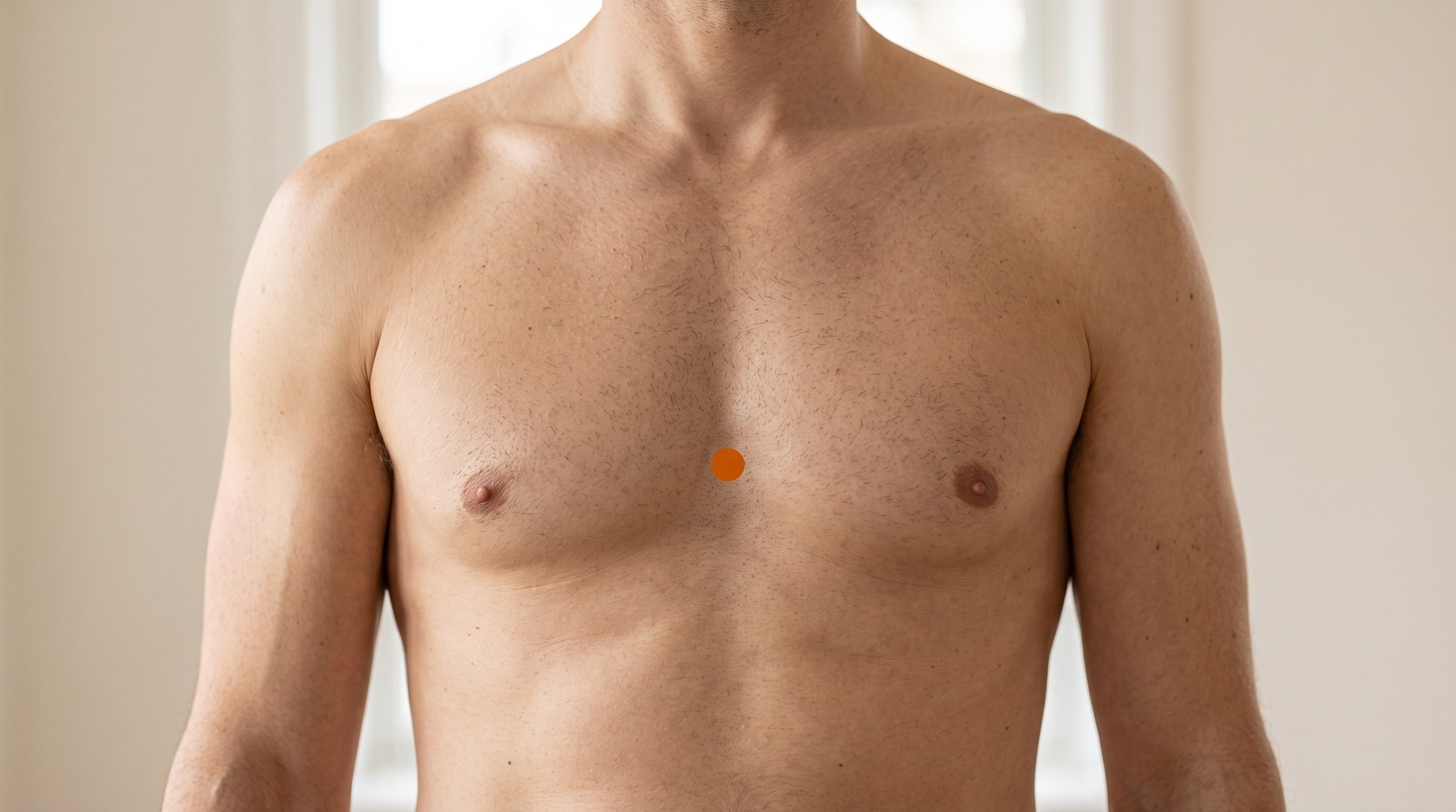
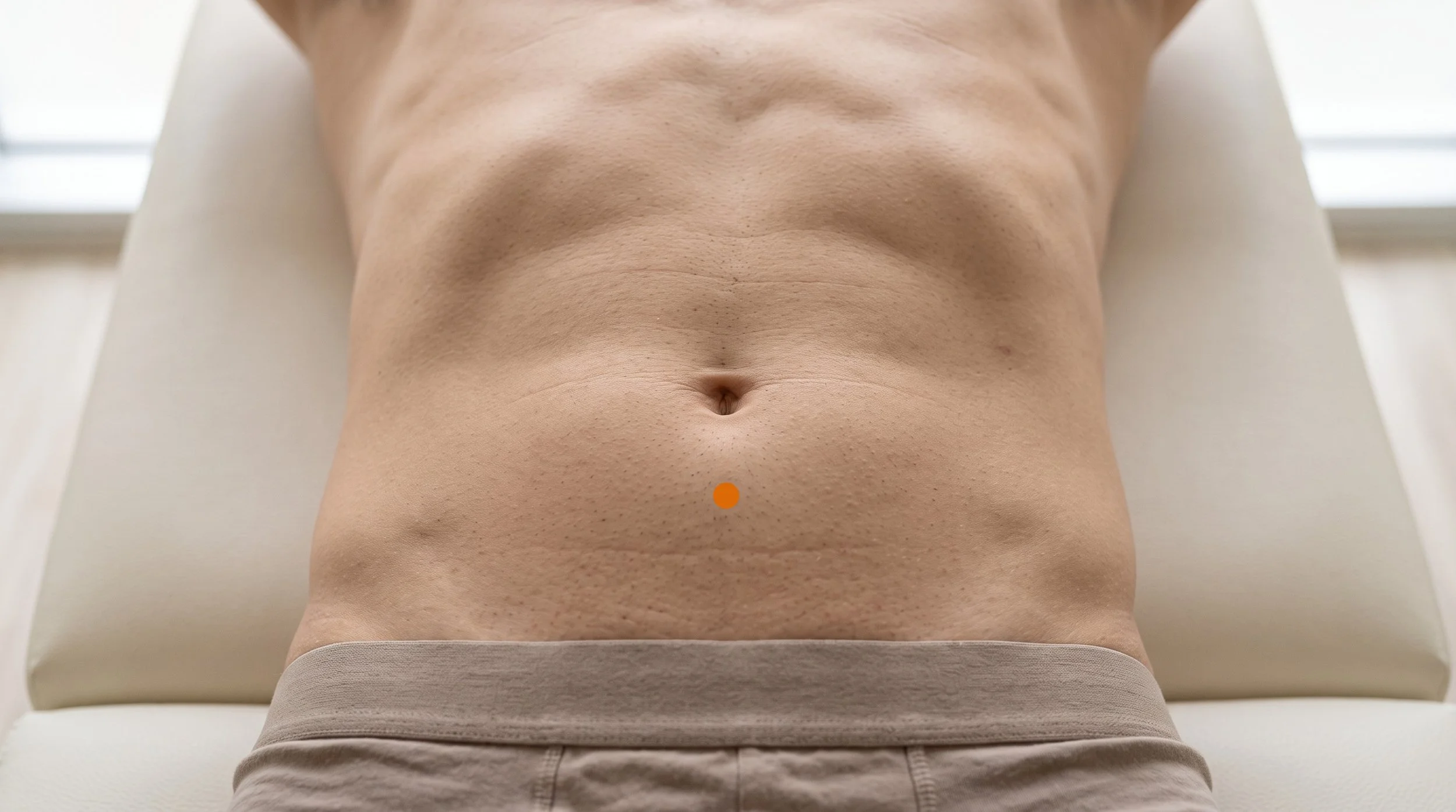
CV12 Acupuncture Point (Zhongwan)
CV12 Acupuncture Point
The Middle Cavity Above the Navel: Anatomy, Mechanism, and Why This Front-Mu Point Anchors Digestive Treatment
CV12 (Zhongwan, often translated as Middle Cavity or Middle of the Epigastrium) sits on the midline of the upper abdomen, four cun above the navel and roughly halfway between the belly button and the notch where the ribs meet the breastbone. Known in the classical literature as Ren 12 or Conception Vessel 12, it's the front-mu (gathering) point of the Stomach and the hui-meeting point of the fu organs, which is a traditional way of saying that it was considered the single most important surface location for influencing digestion (Deadman et al., 2001). In modern terms, the point lies over the linea alba in a mid-thoracic dermatome band that shares spinal segments with the stomach itself, which makes it a plausible site for stimulating somatic to autonomic reflexes that modulate gastric tone. Clinically, we use the cv12 acupuncture point for indigestion, epigastric discomfort, nausea, bloating, and as supportive care alongside medical management of acid reflux.
- CV12 is located on the anterior midline, 4 cun superior to the umbilicus, midway between the umbilicus and the sternocostal angle; the needle passes through skin, superficial fascia, and the fibrous linea alba, with the stomach lying deep to the point (Deadman et al., 2001).
- Traditionally, CV12 is the front-mu point of the Stomach and the hui-meeting point of the fu organs, and it's described as a meeting place of the Conception Vessel with the Stomach, Small Intestine, and Sanjiao channels; read neurophysiologically, these designations describe a viscerosomatic surface zone that shares segmental innervation with the upper digestive tract (Deadman et al., 2001; O'Connor & Bensky, 1981).
- Sensory innervation comes from anterior cutaneous branches of the lower intercostal nerves, so afferent input from CV12 enters roughly the same mid-thoracic spinal segments that receive visceral afferents from the stomach, a convergence pattern that helps explain segmental effects on gastric function (Ma, 2022).
- Animal work is unusually specific here: electroacupuncture at CV12 reduced gastric motility in an intensity-dependent way, with TRPV1 signaling partly involved (Yu et al., 2013), while stimulation of CV12 paired with the Stomach back-shu point influenced gastric activity through a hypothalamic, dorsal vagal complex, and vagal pathway (Wang et al., 2015).
- Clinical reviews of acupuncture for functional dyspepsia and reflux symptoms report symptom improvements but consistently flag small samples and methodological limits, so CV12 is best presented as supportive care within a multi-point protocol rather than a standalone answer (Pang et al., 2016; Zhu et al., 2017; Guo et al., 2020).
- De qi at CV12 is typically a dull, spreading fullness or heaviness under the ribs rather than a sharp sensation, and the feeling sometimes travels toward the costal margin, a transmission pattern the classical texts also noted (Deadman et al., 2001).
Tired of Bloating, Nausea, and Epigastric Discomfort After Meals?
At Morningside Acupuncture, CV12 is one of the first points we consider when digestive symptoms cluster around the upper abdomen. We combine gentle needling of Zhongwan with distal points like ST36 and PC6, breath work, and abdominal palpation to map where your symptoms actually live. Treatment is always coordinated with your gastroenterologist's plan, never in place of it. Schedule a visit and let's build a plan around your digestion.
Schedule NowAnatomy of CV12: Why the Midline Above the Navel Is Such an Important Location
CV12 sits on the linea alba, the tough vertical seam of connective tissue where the aponeuroses of the abdominal wall muscles interdigitate at the midline. A needle here passes through skin and a variable layer of subcutaneous fat, then meets dense fascia rather than bulky muscle, which is why the point often feels firm and slightly gripping rather than soft. The surrounding tissue is loaded by everything that raises intra-abdominal pressure: coughing, heavy lifting, bracing during exercise, prolonged sitting in flexion, and the postural habits that come with desk work. Just lateral to the midline, the rectus abdominis and oblique aponeuroses take up that load, and tenderness in this region frequently reflects wall tissue as much as viscera.
Cutaneous and deep sensation at CV12 travels through anterior cutaneous branches of the lower intercostal nerves, which arrive in the mid-thoracic dorsal horn. Visceral afferents from the stomach converge on overlapping segments, so needling the abdominal wall at this level feeds input into circuitry that also processes gastric signals. Reviews of somato-autonomic organization describe how abdominal stimulation preferentially drives segmental sympathetic reflexes to the gut, while limb stimulation is better at recruiting supraspinal vagal pathways (Ma, 2022). Needling also engages the broader analgesic machinery of the nervous system, including descending inhibitory control and endogenous opioid signaling, which is one reason abdominal points may reduce discomfort as well as change function (Zhao, 2008).
Deep to CV12 lies the stomach, and depending on body habitus and meal timing, the transverse colon and the lower edge of the liver may also sit nearby. There are no large vessels immediately at the midline, but the peritoneal cavity is genuinely close, and the classical texts already warned that deep needling in thin patients may penetrate it (Deadman et al., 2001). Standard convention is perpendicular insertion of roughly 0.8 to 1.5 cun, adjusted downward for slim patients, and we avoid deep or vigorous technique in anyone with abdominal surgical history, organomegaly, a very full stomach, or an undiagnosed abdominal mass. Careful palpation before insertion is not optional here; it's the safety step that determines depth.
Related Conception Vessel Related Stomach ChannelCV12 at a Glance: Classification, Location, and Clinical Use
| Category | Detail |
|---|---|
| Traditional Name | Zhongwan (Middle Cavity, also rendered Middle of the Epigastrium); an alternate classical name is Zhongguan, the Middle Controller |
| Channel Classification | Conception Vessel (Ren mai), point 12; also written Ren 12 or Conception Vessel 12 |
| Point Categories | Front-mu (gathering) point of the Stomach; hui-meeting point of the fu organs; traditional meeting point of the Conception Vessel with the Stomach, Small Intestine, and Sanjiao channels, with the Stomach and Small Intestine channels described as intersecting the Conception Vessel internally at CV13 and CV12 |
| Precise Location | On the anterior midline of the upper abdomen, 4 cun superior to the umbilicus, midway between the umbilicus and the sternocostal angle (the umbilicus to sternocostal angle distance is 8 cun) |
| Tissue Stimulated | Skin, superficial fascia, and the linea alba, with the rectus sheath and abdominal obliques aponeuroses immediately lateral and the lower intercostal muscles contributing the segmental nerve supply |
| Needle Depth / Direction | Perpendicular insertion, roughly 0.8 to 1.5 cun in an average adult; shallower in thin patients, since deep needling may reach the peritoneal cavity |
| De Qi Sensation | A dull, heavy, spreading fullness under the ribs, sometimes with a sense of warmth or audible gurgling; the sensation may travel toward the costal margin and rarely feels sharp |
| Primary Clinical Uses | Indigestion, epigastric discomfort and fullness, nausea, bloating and distension, poor appetite, and supportive care for acid reflux symptoms alongside medical management |
| Common Point Combinations |
|
In the classical Chinese literature, CV12 carries an unusually broad brief. Deadman, Al-Khafaji, and Baker note that one historical source credited Zhongwan with treating essentially all Stomach and Spleen disorders, and the traditional actions attributed to it (harmonising the middle burner, directing rebellious qi downward, tonifying the Stomach, fortifying the Spleen, and regulating qi to relieve pain) span both excess and deficiency presentations, which distinguished it from neighbouring points that were reserved mainly for excess patterns. The classical indication lists group loosely into four themes: upper digestive symptoms (epigastric pain and fullness, difficulty eating, early satiety, nausea, vomiting, reflux), lower digestive symptoms (loose stools with undigested food, dysenteric disorders, difficult defecation), depletion states (wasting, sallow complexion, post-partum dizziness), and, strikingly, mental and emotional presentations including agitation, seizure disorders, and loss of consciousness. Traditional health preservation writing also singled out worry, rumination, and eating while angry as direct causes of Stomach disharmony, with CV12 named as the primary point. What's remarkable about that pattern is how early it linked emotional state, appetite, and gastric function, an association that modern gut-brain research treats as unremarkable but that the classical authors reached from careful observation alone.
Why CV12 Is Used for Nausea, Appetite Changes, and Stress-Related Digestive Symptoms
The most useful way to understand CV12 is segmental. Needling the abdominal wall above the navel sends afferent signals into mid-thoracic spinal segments that also receive input from the stomach itself. When two sources of input converge on the same spinal neurons, stimulating one can change how the other is processed, which is the same principle that explains why visceral problems refer pain to predictable patches of body wall. That convergence gives a plausible route for a surface point to influence gastric sensation, wall tension, and discomfort thresholds (Ma, 2022).
Beyond the segment, needling recruits descending inhibitory pathways from the brainstem that damp nociceptive traffic body-wide and involve endogenous opioid and monoamine signaling (Zhao, 2008). CV12 also has point-specific physiological data behind it, which is rarer than most patients assume. Electroacupuncture at Zhongwan reduced gastric motility in a dose-related fashion in rodents, with TRPV1 receptors partly mediating the effect (Yu et al., 2013), and work combining CV12 with the Stomach back-shu point traced changes in gastric activity through hypothalamic and dorsal vagal complex circuitry and the vagus nerve (Wang et al., 2015). Notably, abdominal stimulation and limb stimulation appear to push gastric activity in different directions, which offers a neurophysiological rationale for the old habit of pairing CV12 with ST36 rather than using either alone (Ma, 2022).
That mechanism story also explains the emotional overlap the classical texts described. Autonomic tone shapes gastric accommodation, emptying, and visceral sensitivity, so stress and poor sleep can genuinely change how a meal feels. Systematic review work on functional dyspepsia reports that acupuncture protocols may influence gastric motility, gut hormone levels, and autonomic and central measures, though the authors are explicit that better-designed trials are needed (Guo et al., 2020). We frame CV12 accordingly: a well-supported tool for symptom modulation, not a replacement for diagnosis.
What the Research Shows for CV12
A caveat before the table: almost no clinical trial studies CV12 in isolation. Reviews evaluate multi-point protocols for conditions like functional dyspepsia and reflux, and CV12 is among the most frequently prescribed points inside those protocols, so the evidence tells us about the treatment package rather than the individual point. The mechanistic studies are more point-specific but were conducted in animals, which limits how directly they translate to a person on a treatment table. Read together, the literature supports acupuncture as a reasonable adjunct for functional upper-gut symptoms while leaving effect sizes and durability genuinely uncertain.
| Study | Type | Focus | Key Finding |
|---|---|---|---|
| Guo et al., 2020 | Systematic review of mechanistic RCTs | Acupuncture and electroacupuncture for functional dyspepsia | The authors report that treatment may improve gastric motility and accommodation and influence gut hormones and autonomic measures, while calling for higher-quality trials. |
| Pang et al., 2016 | Systematic review and meta-analysis | Acupuncture for functional dyspepsia symptom outcomes | Pooled results favored acupuncture on symptom measures, though the review notes that prior evidence had been inconsistent and methodological quality varied. |
| Zhu et al., 2017 | Systematic review and meta-analysis | Manual and electroacupuncture for gastro-oesophageal reflux disease | Adding acupuncture to conventional medication was associated with better global symptom improvement, but small samples and poor trial quality temper the conclusion. |
| Yu et al., 2013 | Controlled animal mechanistic study | Electroacupuncture specifically at CV12 and gastric motility | Stimulation at CV12 inhibited gastric motility in an intensity-dependent manner in wild-type mice, with TRPV1 signaling partly involved. |
| Wang et al., 2015 | Controlled animal neurophysiology study | CV12 with the Stomach back-shu point and central gastric control | The investigators traced motility changes to a hypothalamic to dorsal vagal complex to vagal pathway, supporting a central route for abdominal point effects. |
| Ma, 2022 | Narrative mechanism review | Somatotopic organization of acupuncture-driven autonomic reflexes | Abdominal points appear to preferentially drive segmental sympathetic gut reflexes while limb points recruit vagal pathways, suggesting the two are complementary. |
| Vickers et al., 2018 | Individual patient data meta-analysis | Acupuncture for chronic pain across conditions | Effects were superior to sham and no-acupuncture control with modest persistence over time, which supports the analgesic component of digestive treatments involving pain. |
Stress Sitting in Your Stomach? Let's Address Both at Once
Many of our Upper West Side patients notice that appetite, bloating, and reflux symptoms track closely with work stress and poor sleep. CV12 is often needled alongside points that support autonomic downshifting, so a session addresses the gut and the nervous system driving it. Sessions are unhurried, and we teach acupressure and breathing you can use between visits. Book an appointment and start with one focused evaluation.
Schedule NowCV12 in the Context of Trigger Point Work
Abdominal wall muscles can produce symptoms that convincingly imitate visceral disease. Trigger points in the rectus abdominis and the oblique group have been described as referring pain across the epigastrium and lower ribs and as contributing to nausea, belching, bloating sensations, and even heartburn-like burning (Simons et al., 1999). CV12 sits directly on the midline seam where those muscle layers meet, which means the point and the myofascial territory overlap almost completely. When a patient tells us their upper abdomen aches, and workup has been unremarkable, we palpate the wall carefully before assuming the stomach is the whole story.
In practice, that means CV12 is often needled in the same session as dry needling of the abdominal obliques and, when the referral pattern climbs toward the rib margin, the lower intercostal muscles. Dry needling is acupuncture in the sense that matters here: it uses an acupuncture needle, applied through a different reasoning framework, targeting taut bands and tender points rather than classical locations. Combining the two lets us address both the segmental input to the gut and the mechanical sensitivity of the wall itself, and we keep depth conservative throughout so that abdominal work stays comfortable and safe.
CV12 Digestive Treatment at NYC's Highest-Rated Acupuncture Clinic
Morningside Acupuncture is the highest-rated acupuncture and dry needling clinic in New York City with over 500 five-star Google reviews, and digestive complaints are among the most common reasons patients find us. Our licensed acupuncturists needle CV12 conservatively and precisely, pairing it with limb points and, when appropriate, dry needling of abdominal wall muscles that can mimic gastric pain. You'll leave each visit knowing what we treated and why. Schedule your first session today.
Schedule NowFrequently Asked Questions
What does CV12 feel like when needled?
Most patients describe a dull, heavy, spreading fullness beneath the ribs, sometimes with warmth, a mild pulling sensation, or audible stomach gurgling as the abdomen relaxes. The feeling can travel sideways toward the costal margin, which classical authors also observed. Sharp pain is not expected, and because the linea alba is fibrous, the needle may feel like it grips briefly on insertion before the sensation settles. If anything feels sharp or breath-limiting, tell your acupuncturist so depth or angle can be adjusted immediately.
Why needle the abdomen directly instead of only using distal points like ST36?
Because the two locations appear to work through different routes. Afferent input from the abdominal wall enters the same mid-thoracic spinal segments that receive signals from the stomach, giving CV12 a segmental, local influence, while limb points seem better at recruiting supraspinal vagal pathways (Ma, 2022). That difference is a plausible reason the classical texts kept pairing CV12 with ST36 and PC6 rather than relying on any single point. In the clinic, we usually use both a local abdominal point and distal limb points in the same treatment.
Can I press CV12 myself between sessions?
Yes, and it's one of the easier points to self-treat. Find the midline halfway between your navel and the soft notch where your ribs meet, then press straight in with the pad of your thumb or two fingertips using moderate, steady pressure. Hold for 30 to 60 seconds while breathing slowly through the nose, release, and repeat two or three times, for a total of two to four minutes. Slow circular pressure works equally well. Do this on a relatively empty stomach rather than right after eating, keep the pressure firm but never painful, and stop if it provokes nausea or cramping. Acupressure here is a reasonable between-session tool, not a substitute for evaluation of persistent or severe abdominal symptoms.
Is CV12 safe to needle?
In trained hands, yes, with sensible limits. The stomach lies directly deep to the point and the peritoneal cavity is close, so the classical caution against deep insertion in thin patients still governs practice (Deadman et al., 2001). Licensed acupuncturists palpate first, use perpendicular insertion at a conservative depth, and go shallower for slim patients. We modify or avoid needling here in pregnancy, with abdominal surgical history or hernia at the midline, with organomegaly, on a very full stomach, or when there's an undiagnosed abdominal mass, fever, or acute severe pain that needs medical assessment first. Anyone with new, worsening, or alarm-feature digestive symptoms should be evaluated by a physician; acupuncture is supportive care alongside that workup.
Where exactly is CV12 located?
On the front midline of the upper abdomen, 4 cun above the umbilicus, which is the midpoint between the navel and the sternocostal angle where the rib cartilages meet the lower sternum. The full navel-to-sternocostal-angle distance is treated as 8 cun, so halving that span is the quickest way to find cv 12 location on your own body. Practically, it's about a hand's width above the belly button on most adults, though proportional measurement is more reliable than finger widths. ST21 sits at the same level, 2 cun lateral to the midline, which is a useful cross-check.
References
- Deadman, P., Al-Khafaji, M., & Baker, K. (2009). A manual of acupuncture. Journal of Chinese Medicine Publications.
- O'Connor, J., & Bensky, D. (Eds. & Trans.). (1981). Acupuncture: A comprehensive text. Shanghai College of Traditional Medicine. Eastland Press.
- Cunningham, P. M. (2000). Acupuncture points: A practical guide to classical and modern usage. Odyssey Press.
- Simons, D. G., Travell, J. G., & Simons, L. S. (1999). Travell & Simons' myofascial pain and dysfunction: The trigger point manual, Vol. 1: Upper half of body (2nd ed.). Williams & Wilkins.
- Yu, Z., Zhang, N., Lu, C. X., Pang, T. T., Wang, K. Y., Jiang, J. F., Zhu, B., & Xu, B. (2013). Electroacupuncture stimulation at CV12 inhibits gastric motility via TRPV1 receptor. Evidence-Based Complementary and Alternative Medicine, 2013, 294789. https://doi.org/10.1155/2013/294789
- Wang, H., Liu, W. J., Shen, G. M., Zhang, M. T., Huang, S., & He, Y. (2015). Neural mechanism of gastric motility regulation by electroacupuncture at RN12 and BL21: A paraventricular hypothalamic nucleus-dorsal vagal complex-vagus nerve-gastric channel pathway. World Journal of Gastroenterology, 21(48), 13480-13489. https://doi.org/10.3748/wjg.v21.i48.13480
- Guo, Y., Wei, W., & Chen, J. D. Z. (2020). Effects and mechanisms of acupuncture and electroacupuncture for functional dyspepsia: A systematic review. World Journal of Gastroenterology, 26(19), 2440-2457. https://doi.org/10.3748/wjg.v26.i19.2440
- Pang, B., Jiang, T., Du, Y. H., Li, J., Li, B., Hu, Y. C., & Cai, Q. H. (2016). Acupuncture for functional dyspepsia: What strength does it have? A systematic review and meta-analysis of randomized controlled trials. Evidence-Based Complementary and Alternative Medicine, 2016, 3862916. https://doi.org/10.1155/2016/3862916
- Zhu, J., Guo, Y., Liu, S., Su, X., Li, Y., Yang, Y., Hou, L., Wang, G., Zhang, J., Chen, J. D. Z., Wang, Q., Wei, R., & Wei, W. (2017). Acupuncture for the treatment of gastro-oesophageal reflux disease: A systematic review and meta-analysis. Acupuncture in Medicine, 35(5), 316-323. https://doi.org/10.1136/acupmed-2016-011205
- Ma, Q. (2022). Somatotopic organization of autonomic reflexes by acupuncture. Current Opinion in Neurobiology, 76, 102602. https://doi.org/10.1016/j.conb.2022.102602
- Zhao, Z. Q. (2008). Neural mechanism underlying acupuncture analgesia. Progress in Neurobiology, 85(4), 355-375. https://doi.org/10.1016/j.pneurobio.2008.05.004
- Vickers, A. J., Vertosick, E. A., Lewith, G., MacPherson, H., Foster, N. E., Sherman, K. J., Irnich, D., Witt, C. M., & Linde, K. (2018). Acupuncture for chronic pain: Update of an individual patient data meta-analysis. Journal of Pain, 19(5), 455-474. https://doi.org/10.1016/j.jpain.2017.11.005
Disclaimer: This web site is intended for educational and informational purposes only. Reading this website does not constitute providing medical advice or any professional services. This information should not be used for diagnosing or treating any health issue or disease. Those seeking medical advice should consult with a licensed physician. Seek the advice of a medical doctor or other qualified health professional for any medical condition. If you think you have a medical emergency, call 911 or go to the emergency room. No acupuncturist-patient relationship is created by reading this website or using the information. Morningside Acupuncture PLLC and its employees and contributors do not make any express or implied representations with respect to the information on this site or its use. For any legal interpretation of scope of practice in your state, consult a licensed attorney or regulatory authority.
Read more from our blog