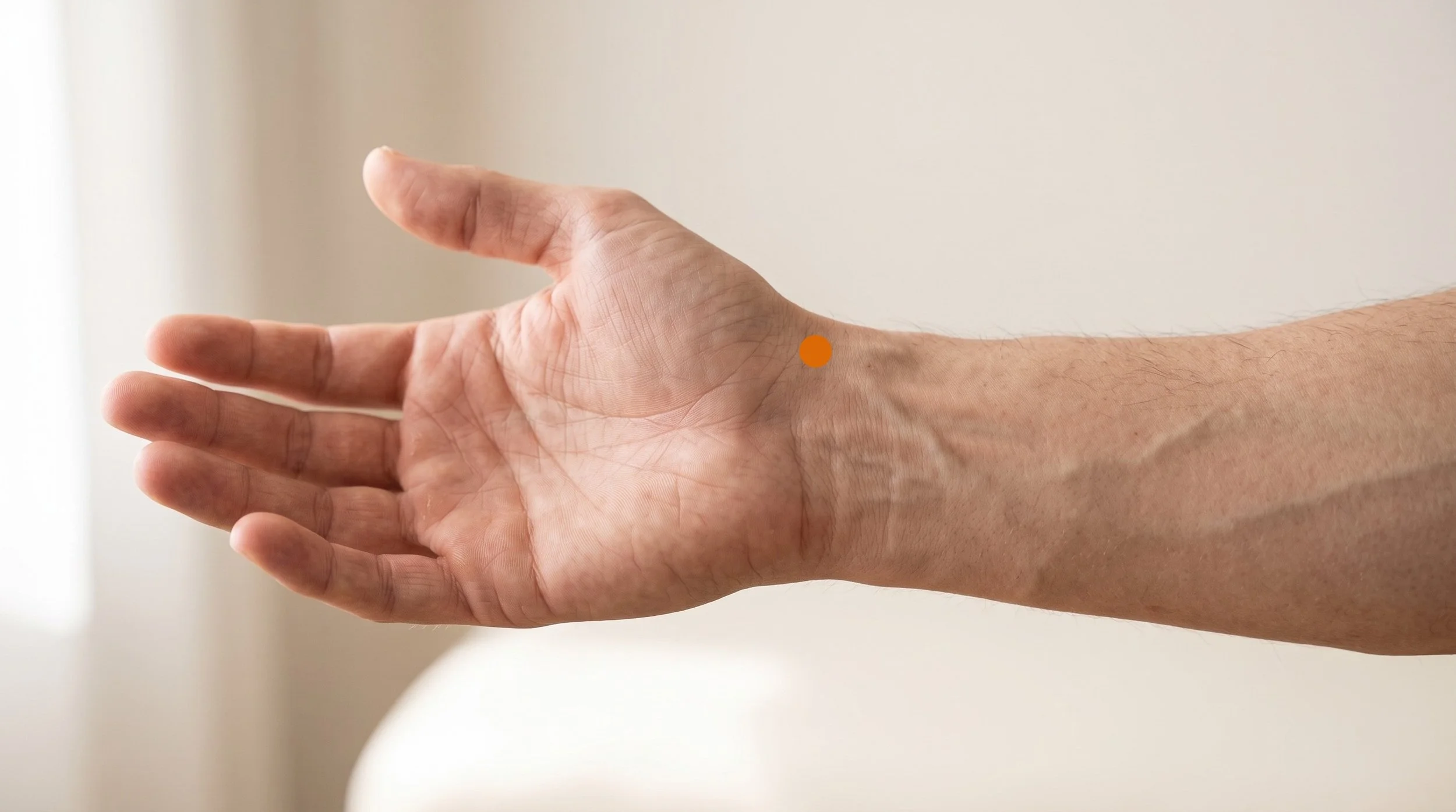
Anmian Acupuncture Point (N-HN-54)

Anmian Acupuncture Point
The Peaceful Sleep Point Behind the Ear: Anatomy, Upper Cervical Mechanism, and Why This Modern Extra Point Anchors Insomnia Treatment
Anmian (N-HN-54), whose name is usually rendered as Peaceful Sleep, is a modern extra point found behind the ear, in the soft depression behind the mastoid process, roughly halfway between GB20 at the base of the skull and TE17 in the hollow behind the earlobe. It isn't on any of the fourteen channels, and it doesn't appear in the early classics: it was added to the extra point catalog in the twentieth century and named for a single clinical purpose, which is helping people sleep.
That makes the anmian acupuncture point unusual in this series. Most points carry centuries of layered indications, while this one carries a job description. Anatomically it sits over the mastoid attachment of the sternocleidomastoid, in territory supplied by the lesser occipital and great auricular nerves at the C2 to C3 level, which is the same upper cervical input involved in tension-type headache, neck-driven head pain, and the muscular tightness that so often accompanies poor sleep. That overlap is why we use it for more than insomnia alone.
- Anmian lies behind the ear, midway between GB20 and TE17, in the depression behind the mastoid process, close to GB12 but slightly posterior and superior to it, and it's needled perpendicularly 0.5 to 1 cun (Deadman et al., 2007). The needle passes through skin and subcutaneous tissue into the mastoid attachment of the sternocleidomastoid, with splenius capitis lying deeper.
- Traditional sources attribute to Anmian the actions of calming the spirit and pacifying the Liver, with classical listings covering insomnia, agitation and restlessness, palpitations, dizziness, headache, tinnitus, seizure disorders, and hypertension (Deadman et al., 2007). Read neurophysiologically, that cluster describes an arousal and upper cervical picture rather than an organ pathology.
- The point sits in the cutaneous field of the lesser occipital and great auricular nerves, both branches of the cervical plexus carrying C2 to C3 input, and these segments converge in the trigeminocervical complex with input from the head and face. Needling here recruits segmental and descending inhibitory pathways that are among the best characterized effects of acupuncture stimulation (Zhao, 2008).
- Anmian is one of the most consistently included points in modern insomnia trial protocols, appearing alongside HT7, SP6, GV20, and Yintang in sham-controlled studies of primary insomnia (Yin et al., 2017) and in perimenopausal insomnia work (Fu et al., 2017). One trial compared standard meridian point prescriptions against a protocol built around three Anmian-area points and reported improvements in sleep and in associated mood scores (Huo et al., 2013).
- The overall evidence picture is honest but unsettled: the Cochrane review of acupuncture for insomnia found the trial literature too heterogeneous and too high in risk of bias to support or refute the intervention (Cheuk et al., 2012), while later network meta-analysis suggests benefit across several acupuncture modalities with quality caveats (Lu et al., 2022). We frame Anmian as one useful component of a sleep plan, not as a switch.
- De qi at Anmian is usually a dull, heavy, spreading ache or pressure behind the ear that may radiate up the side of the head or forward toward the jaw. Sharp, electric, or shooting sensation means the needle is too close to a superficial nerve branch and should be repositioned.
Struggling to Fall Asleep or Stay Asleep in New York City?
Poor sleep rarely has one cause, so we treat it as a system: stress load, neck and jaw tension, breathing, caffeine timing, and screen habits all get discussed alongside the needles. Anmian is one of the points we reach for most often in these treatments, usually paired with HT7, PC6, and SP6, and combined with hands-on work when the upper neck is clearly involved. We'll also flag when your history suggests sleep apnea or another sleep disorder that needs medical evaluation first. Schedule a visit and let's build a plan around how you actually sleep.
Schedule NowAnatomy of ANMIAN: Why the Hollow Behind the Mastoid Process Is Such an Important Location
Slide a fingertip behind your ear and you'll find the mastoid process, the hard bony knob behind the earlobe. Just behind and slightly above it there's a soft depression, and that's where Anmian sits, roughly halfway along a line from GB20 in the hollow beside the trapezius attachment to TE17 tucked behind the ear lobe. Under the skin and thin subcutaneous layer the needle meets the tendinous mastoid attachment of the sternocleidomastoid, with splenius capitis and the upper fibers of the cervical extensors lying deeper.
This is a high-load corner of the body. Every hour spent with the head carried forward over a laptop, every night on a pillow that's too high or too flat, and every clenched jaw loads the tissues that converge here, which is one reason the area so often feels tender before a patient even mentions it.
The nerve geography is what makes this point interesting for sleep and headache alike. Anmian lies in the distribution of the lesser occipital and great auricular nerves, cutaneous branches of the cervical plexus carrying C2 and C3 fibers, with the occipital artery and vein running nearby. Those upper cervical segments don't stay in the neck: second-order neurons in the upper cervical cord receive convergent input from cervical structures and from the trigeminal system, which is the anatomical basis for pain that starts in the neck and is felt around the ear, temple, and eye.
Needling into this field generates a barrage of small-fiber afferent input that engages segmental inhibition and descending pain-modulating pathways from the brainstem, mechanisms that have been mapped in detail in acupuncture analgesia research (Zhao, 2008). The same brainstem territory participates in autonomic regulation, which is part of why a point in the neck can plausibly influence arousal rather than just local soreness (Huang et al., 2011).
Depth and angle matter here more than at most points. The standard convention is perpendicular insertion of 0.5 to 1 cun, with some texts using slightly deeper insertion in larger patients (Deadman et al., 2007). What should never happen is deep needling angled medially or inferiorly toward the midline, because the suboccipital region gives access to structures that must be respected, including the vertebral artery deep and medial to the point and the contents of the posterior fossa beyond it.
Reviews of serious adverse events in acupuncture attribute the rare catastrophic cases in this region to improper technique with excessively deep needling, and one case report describes a cardiac conduction disturbance during electroacupuncture applied at Anmian (Filshie et al., 2016).
In practice, a trained clinician using conventional depth and a straight-in angle treats this as a safe point, and the caution is a reason to see someone properly trained rather than a reason to avoid the area.
Related Best Acupuncture Points For Sleep Related Acupuncture And Chinese Medicine For InsomniaANMIAN at a Glance: Classification, Location, and Clinical Use
| Category | Detail |
|---|---|
| Traditional Name | Anmian (安眠), Peaceful Sleep |
| Channel Classification | Extra point (non-channel), coded N-HN-54; also listed as M-HN-34, EX-HN22, and simply Extra 13 in various point systems |
| Point Categories | No channel affiliation and therefore no five-shu, yuan-source, luo-connecting, xi-cleft, front-mu, back-shu, hui-meeting, or extraordinary vessel confluent designations. It's a modern addition to the extraordinary (extra) point catalog, grouped with the head and neck extra points and located near Wangu GB12, which carries overlapping traditional indications for insomnia and agitation. |
| Precise Location | Behind the ear, midway between Fengchi GB20 and Yifeng TE17, in the depression behind the mastoid process; posterior and slightly superior to Wangu GB12 |
| Tissue Stimulated | Skin and subcutaneous tissue over the mastoid region, the mastoid attachment of the sternocleidomastoid, and the superficial fibers of splenius capitis, with the suboccipital group in the adjacent segment; innervation from the lesser occipital and great auricular nerves (C2 to C3) |
| Needle Depth / Direction | Perpendicular insertion 0.5 to 1 cun; keep the angle straight in or slightly toward the mastoid bone and never deep or medially angled toward the midline |
| De Qi Sensation | Local heaviness, distension, and dull soreness behind the ear that may spread across the side of the head or forward toward the face; sharp or electric sensation calls for repositioning |
| Primary Clinical Uses | Insomnia and restless, fragmented sleep; agitation and palpitations with restlessness; dizziness in classical listings; tension headache and neck tightness around the ear and occiput; supportive use in stress and anxiety presentations |
| Common Point Combinations |
|
Deadman, Al-Khafaji, and Baker's manual treats Anmian as a recent arrival rather than an inherited classic, noting in its commentary that this is a modern addition to the extra point catalog whose main clinical role is the treatment of insomnia, and that it sits close to Wangu GB12, a channel point traditionally credited with similar effects on sleep, agitation, and disturbances of the Heart.
The traditional actions attributed to the point are calming the spirit and pacifying the Liver, and the indication list given there gathers insomnia, restlessness and agitation, palpitations, seizure disorders, dizziness, headache, tinnitus, and hypertension. What's striking is how coherent that list looks through a modern lens: it's essentially a catalog of hyperarousal states plus upper cervical symptoms, assembled by clinicians who had no access to the concept of autonomic tone.
A point named for sleep, placed over the mastoid attachment of the sternocleidomastoid in C2 to C3 territory, ended up carrying exactly the symptom set that segment tends to produce and respond to.
Why ANMIAN Is Used for Sleep When the Problem Doesn't Feel Like a Neck Problem
Patients often ask why a point behind the ear would matter for insomnia. The short answer is that insomnia is largely a disorder of arousal, and the tissues around Anmian sit in a segment with unusually direct access to arousal-related circuitry. The lesser occipital and great auricular nerves feed C2 and C3, and those upper cervical segments converge with trigeminal input in the brainstem before that traffic reaches the thalamus and cortex.
Stimulating this field with a needle produces a sustained volley of small-fiber input that recruits segmental inhibition and descending modulation from brainstem nuclei, the same pathways characterized in acupuncture analgesia research (Zhao, 2008). Those nuclei don't only handle pain: they sit alongside the structures that regulate sympathetic and parasympathetic balance.
That autonomic angle is the most plausible mechanism for sleep effects. Current models of insomnia describe a state of central and autonomic hyperarousal rather than a simple sleep deficit, and reviews of acupuncture physiology argue that needling can shift autonomic tone through its direct effects on peripheral nerves and muscle, with downstream consequences for sleep and wakefulness (Huang et al., 2011).
Add in the mechanical layer: chronic tightness in the sternocleidomastoid, splenius capitis, and suboccipital muscles produces a low-grade nociceptive input that keeps the system on alert and makes it hard to settle into a pillow. Reducing that input may lower the background noise the nervous system has to sleep through.
There's also a point-specific literature, which is rare for extra points. A controlled study comparing conventional meridian point prescriptions with a protocol organized around Anmian-area points reported improvements in insomnia severity along with associated anxiety and depressive scores (Huo et al., 2013). That's a single trial in a field with real methodological limitations, so it belongs in the plausible-and-encouraging column rather than the settled column.
Still, it's consistent with what we observe: patients whose sleep is tangled up with neck tension and daytime stress tend to be the ones who respond best when Anmian is part of the prescription.
What the Research Shows for ANMIAN
A note on how to read the evidence below. Almost no trial tests Anmian by itself, because that isn't how acupuncture is practiced. What the studies test are multi-point protocols in which Anmian appears alongside HT7, SP6, PC6, GV20, and Yintang, so the honest claim is that this point is a consistent component of protocols that have been studied, not that it independently causes the results. The insomnia literature also has well-documented problems: heterogeneous diagnostic criteria, variable protocols, small samples, and high risk of bias in many trials. Reviews therefore range from cautiously positive to explicitly inconclusive, and we think patients deserve to see both.
| Study | Type | Focus | Key Finding |
|---|---|---|---|
| Cheuk et al., 2012 | Cochrane systematic review | Acupuncture in any form for insomnia across 33 randomized trials and 2,293 participants | The authors judged all included trials to be at high risk of bias and concluded the evidence was insufficient to support or refute acupuncture for insomnia. |
| Lu et al., 2022 | Systematic review and network meta-analysis | Comparative effectiveness of manual acupuncture, electroacupuncture, and related modalities for primary insomnia | Several acupuncture modalities outperformed control conditions on sleep quality measures, though the certainty of evidence remains limited by trial quality. |
| Yin et al., 2017 | Randomized sham-controlled trial | Primary insomnia treated three times weekly for four weeks with a protocol including bilateral Anmian, HT7, SP6, GV20, GV24, and Yintang | The acupuncture group showed greater improvement than sham on insomnia severity and actigraphy-based sleep measures, with good tolerability. |
| Huo et al., 2013 | Controlled clinical trial (point-specific) | Standard meridian point prescription compared with a protocol centered on three Anmian-area points in insomnia with mood symptoms | Both approaches improved sleep, with the Anmian-centered protocol also associated with improvement in anxiety and depression ratings in this single, modest trial. |
| Fu et al., 2017 | Randomized controlled trial | Perimenopausal insomnia treated with an acupuncture protocol including Anmian | Acupuncture was associated with improved sleep quality compared with sham in this population, supporting its use as an adjunct rather than a replacement for standard care. |
| Huang et al., 2011 | Narrative mechanistic review | Autonomic arousal in insomnia and the plausibility of acupuncture as a modulating intervention | The authors argue that acupuncture may influence sleep through effects on peripheral nerves and autonomic tone, while calling for further mechanistic research. |
| Linde et al., 2016 | Cochrane systematic review | Acupuncture for the prevention of tension-type headache across 12 trials and 2,349 adults | A course of at least six sessions may be a worthwhile option for people with frequent tension-type headache, relevant here because Anmian sits in the upper cervical field these protocols target. |
| Vickers et al., 2018 | Individual patient data meta-analysis | Acupuncture for chronic pain conditions including chronic headache and neck pain | Acupuncture was superior to both sham and no-acupuncture controls for chronic pain, with effects that persisted over time though the sham difference was modest. |
Anmian for Insomnia: Why the Peaceful Sleep Point Became the Best Known Pressure Point for Sleep
Search for a pressure point for sleep and Anmian comes up almost immediately, and for once the internet is pointing at something real. This is a modern point that was named, catalogued, and adopted specifically for sleep, and it appears in the majority of published acupuncture insomnia protocols, usually with HT7, SP6, PC6, and points on the forehead and vertex (Yin et al., 2017). Its popularity isn't mystical: it's accessible, easy to locate behind the ear, comfortable to needle, and it sits in a nerve field with credible links to arousal regulation (Huang et al., 2011).
What should you expect from anmian insomnia treatment? Realistically, gradual change over a course of visits rather than an immediate switch into deep sleep. Trials that show benefit typically use two or three sessions per week for four weeks or more, which is a useful benchmark for what a fair trial of treatment looks like. Some patients notice they fall asleep faster; others report fewer 3 a.m. wake-ups or less of the wired, tense feeling at bedtime. The Cochrane review of this literature remains cautious, and we hold the same posture in clinic (Cheuk et al., 2012).
The most important framing is this: the peaceful sleep point works best as part of a plan, not as a standalone fix. That plan should include the basics of sleep hygiene (consistent wake time, light exposure in the morning, caffeine and alcohol timing, screens out of the bedroom), an honest look at stress load and daytime activity, and appropriate medical screening. Loud snoring, witnessed breathing pauses, restless legs, or unrelenting daytime sleepiness point toward sleep disorders that need diagnosis, not needles. Cognitive behavioral therapy for insomnia remains the first-line treatment for chronic insomnia, and acupuncture sits comfortably alongside it.
Tension Headaches That Wrap Around the Ear and Base of the Skull?
The area around Anmian is where the sternocleidomastoid anchors to the mastoid and where the suboccipital muscles feed into the same upper cervical segments that carry tension headache pain. Needling here, often together with GB20 and targeted dry needling of the neck extensors, may reduce the muscular contribution to those headaches. Patients frequently notice that headache relief and better sleep arrive in the same few weeks. Book an evaluation and we'll map which structures are driving your pattern.
Schedule NowANMIAN in the Context of Trigger Point Work
Anmian sits directly over territory that matters in myofascial practice. The mastoid attachment of the sternocleidomastoid is right there under the needle, splenius capitis runs deeper, and the suboccipital group occupies the adjacent segment just medial and inferior. Trigger points in the sternocleidomastoid are classically described as referring pain into the ear, behind the ear, into the temple and forehead, and sometimes producing dizziness and disturbed balance, while suboccipital trigger points tend to project a deep, diffuse ache through the back and side of the head (Simons et al., 1999).
Compare that with the traditional indication list for Anmian, which includes headache, dizziness, and tinnitus, and the overlap is difficult to ignore. Two different traditions, working several centuries apart with completely different vocabularies, mapped roughly the same referral territory to roughly the same anatomy.
At Morningside we don't treat this as an either/or decision. In a patient whose insomnia is tangled up with neck tension and headaches, a session may include Anmian needled at conventional depth for its upper cervical and calming effects, dry needling of taut bands in the sternocleidomastoid and suboccipital muscles when palpation reproduces the familiar head or ear symptoms, and points like GB20, HT7, or SP6 to round out the protocol. Because acupuncture and dry needling are both the therapeutic use of an acupuncture needle, the distinction is one of reasoning and target rather than tool.
The palpation findings guide the plan: if the mastoid region is tender and pressing it reproduces the headache, that tissue gets attention, and sleep is often the outcome that improves alongside the pain.
ANMIAN Insomnia Treatment at NYC's Highest-Rated Acupuncture Clinic
Morningside Acupuncture is the highest-rated acupuncture and dry needling clinic in New York City with over 500 five-star Google reviews, and sleep complaints are among the most common reasons patients come through our door. We use the peaceful sleep point within individualized protocols that account for your stress physiology, neck mechanics, and daytime function, not as a one-size prescription. Treatment is calm, evidence-informed, and paced over a realistic course of visits rather than promised in a single session. Schedule your first appointment and start working on sleep from the nervous system side.
Schedule NowFrequently Asked Questions
What does ANMIAN feel like when needled?
Most patients report a dull, heavy, spreading pressure behind the ear rather than a sharp sensation. That fullness sometimes travels up the side of the head, forward toward the jaw and face, or down into the upper neck, which is the classic description in the point literature. Many people find this a distinctly relaxing point and it isn't unusual to feel drowsy while the needles are retained. A sharp, stinging, or electric sensation isn't the goal here: it usually means the needle is sitting on a superficial branch of the lesser occipital or great auricular nerve, and the clinician should adjust it.
Why needle behind the ear for a problem that feels like it's in my brain?
Because sleep is regulated by brainstem and hypothalamic circuitry that receives heavy input from the upper cervical segments, and Anmian sits squarely in that C2 to C3 field. Needling here generates afferent input that engages segmental and descending modulatory pathways in the same brainstem territory that participates in autonomic regulation (Zhao, 2008; Huang et al., 2011). There's also a simpler mechanical layer: chronic tightness in the sternocleidomastoid and suboccipital muscles creates a steady low-level nociceptive signal that keeps the system alert, and reducing that input may make it easier to settle. It isn't a point on the brain, but it's a point with unusually direct access to the systems that decide how aroused you are.
Can I press ANMIAN myself between sessions?
Yes, and it's one of the easier points to self-treat because you can reach it comfortably with both hands. Find the mastoid process, the bony bump behind your earlobe, then slide your fingertip back and slightly up into the soft hollow behind it, roughly halfway between that bump and the muscular groove at the base of your skull. Use your middle or index finger to apply steady, moderate pressure angled gently toward the bone, hold for 30 to 60 seconds, and release. Repeat two or three times per side, working both sides, with slow nasal breathing and a longer exhale. Doing this for a few minutes as part of a wind-down routine, 20 to 30 minutes before bed with the lights low, tends to be more useful than doing it once in a panic at 2 a.m. Pressure should feel like a satisfying ache, never sharp, and you should stop if you feel dizzy, get pins and needles, or notice any visual change.
Is ANMIAN safe to needle?
In trained hands, yes. The convention is perpendicular insertion of 0.5 to 1 cun, which keeps the needle in muscle and connective tissue over the mastoid region (Deadman et al., 2007). The cautions concern technique rather than the point itself: deep needling angled medially or inferiorly in the suboccipital area can approach structures that must be avoided, and reviews of serious acupuncture adverse events trace the rare severe cases in this region to improperly deep insertion, including one report of a cardiac conduction disturbance during electroacupuncture at Anmian (Filshie et al., 2016). Minor bruising is the most common real-world side effect, since the occipital vessels run nearby. Tell your clinician if you're on anticoagulants, and choose a licensed acupuncturist who knows the regional anatomy.
Where exactly is ANMIAN located?
Behind the ear, midway between GB20 and TE17. To find it, place one finger at TE17, in the hollow directly behind the earlobe, and another at GB20, in the depression at the base of the skull between the two large neck muscle attachments. Anmian sits halfway along that line, in the soft depression just behind the mastoid process. It lies very close to GB12, but slightly posterior and a little higher (Deadman et al., 2007). It's needled and treated bilaterally in most protocols, and in patients with chronic sleep problems the spot is frequently tender to palpation, which helps confirm you're in the right place.
Is the Anmian point insomnia effect strong enough to replace my sleep medication?
No, and you shouldn't change or stop any prescription based on a blog post or on how a treatment feels. Acupuncture protocols including Anmian have shown improvements in sleep quality in controlled trials, but the evidence base is mixed and the effects are generally gradual and moderate rather than dramatic (Cheuk et al., 2012; Yin et al., 2017). Some patients do eventually taper sleep medication, and when that happens it should be planned with the prescribing physician. Think of Anmian as support for the sleep system while other pieces (behavioral treatment, stress management, medical workup) do their part.
References
- Deadman, P., Al-Khafaji, M., & Baker, K. (2009). A manual of acupuncture. Journal of Chinese Medicine Publications.
- O'Connor, J., & Bensky, D. (Eds. & Trans.). (1981). Acupuncture: A comprehensive text. Shanghai College of Traditional Medicine. Eastland Press.
- Cheng, X. (Ed.). (1999). Chinese acupuncture and moxibustion (Rev. ed.). Foreign Languages Press.
- Kim, H. (2008). Handbook of Oriental medicine (3rd ed.). Harmony & Balance Press.
- Cunningham, P. M. (2000). Acupuncture points: A practical guide to classical and modern usage. Odyssey Press.
- Filshie, J., White, A., & Cummings, M. (Eds.). (2016). Medical acupuncture: A Western scientific approach (2nd ed.). Elsevier.
- Simons, D. G., Travell, J. G., & Simons, L. S. (1999). Travell & Simons' myofascial pain and dysfunction: The trigger point manual, Vol. 1: Upper half of body (2nd ed.). Williams & Wilkins.
- Cheuk, D. K. L., Yeung, W. F., Chung, K. F., & Wong, V. (2012). Acupuncture for insomnia. Cochrane Database of Systematic Reviews, 2012(9), CD005472. https://doi.org/10.1002/14651858.CD005472.pub3
- Linde, K., Allais, G., Brinkhaus, B., Fei, Y., Mehring, M., Shin, B.-C., Vickers, A., & White, A. R. (2016). Acupuncture for the prevention of tension-type headache. Cochrane Database of Systematic Reviews, 2016(4), CD007587. https://doi.org/10.1002/14651858.CD007587.pub2
- Yin, X., Gou, M., Xu, J., Dong, B., Yin, P., Masquelin, F., Wu, J., Lao, L., & Xu, S. (2017). Efficacy and safety of acupuncture treatment on primary insomnia: A randomized controlled trial. Sleep Medicine, 37, 193-200. https://doi.org/10.1016/j.sleep.2017.02.012
- Huo, Z. J., Guo, J., & Li, D. (2013). Effects of acupuncture with meridian acupoints and three Anmian acupoints on insomnia and related depression and anxiety state. Chinese Journal of Integrative Medicine, 19(3), 187-191. https://doi.org/10.1007/s11655-012-1240-6
- Fu, C., Zhao, N., Liu, Z., Yuan, L.-H., Xie, C., Yang, W.-J., et al. (2017). Acupuncture improves peri-menopausal insomnia: A randomized controlled trial. Sleep, 40(11), zsx153. https://doi.org/10.1093/sleep/zsx153
- Lu, Y., Zhu, H., Wang, Q., Tian, C., Lai, H., Hou, L., et al. (2022). Comparative effectiveness of multiple acupuncture therapies for primary insomnia: A systematic review and network meta-analysis of randomized trials. Sleep Medicine, 93, 39-48. https://doi.org/10.1016/j.sleep.2022.03.012
- Huang, W., Kutner, N., & Bliwise, D. L. (2011). Autonomic activation in insomnia: The case for acupuncture. Journal of Clinical Sleep Medicine, 7(1), 95-102. https://doi.org/10.5664/jcsm.28048
- Zhao, Z. Q. (2008). Neural mechanism underlying acupuncture analgesia. Progress in Neurobiology, 85(4), 355-375. https://doi.org/10.1016/j.pneurobio.2008.05.004
- Vickers, A. J., Vertosick, E. A., Lewith, G., MacPherson, H., Foster, N. E., Sherman, K. J., Irnich, D., Witt, C. M., & Linde, K. (2018). Acupuncture for chronic pain: Update of an individual patient data meta-analysis. Journal of Pain, 19(5), 455-474. https://doi.org/10.1016/j.jpain.2017.11.005
Disclaimer: This web site is intended for educational and informational purposes only. Reading this website does not constitute providing medical advice or any professional services. This information should not be used for diagnosing or treating any health issue or disease. Those seeking medical advice should consult with a licensed physician. Seek the advice of a medical doctor or other qualified health professional for any medical condition. If you think you have a medical emergency, call 911 or go to the emergency room. No acupuncturist-patient relationship is created by reading this website or using the information. Morningside Acupuncture PLLC and its employees and contributors do not make any express or implied representations with respect to the information on this site or its use. For any legal interpretation of scope of practice in your state, consult a licensed attorney or regulatory authority.
Read more from our blog