BL17 Acupuncture Point (Geshu)
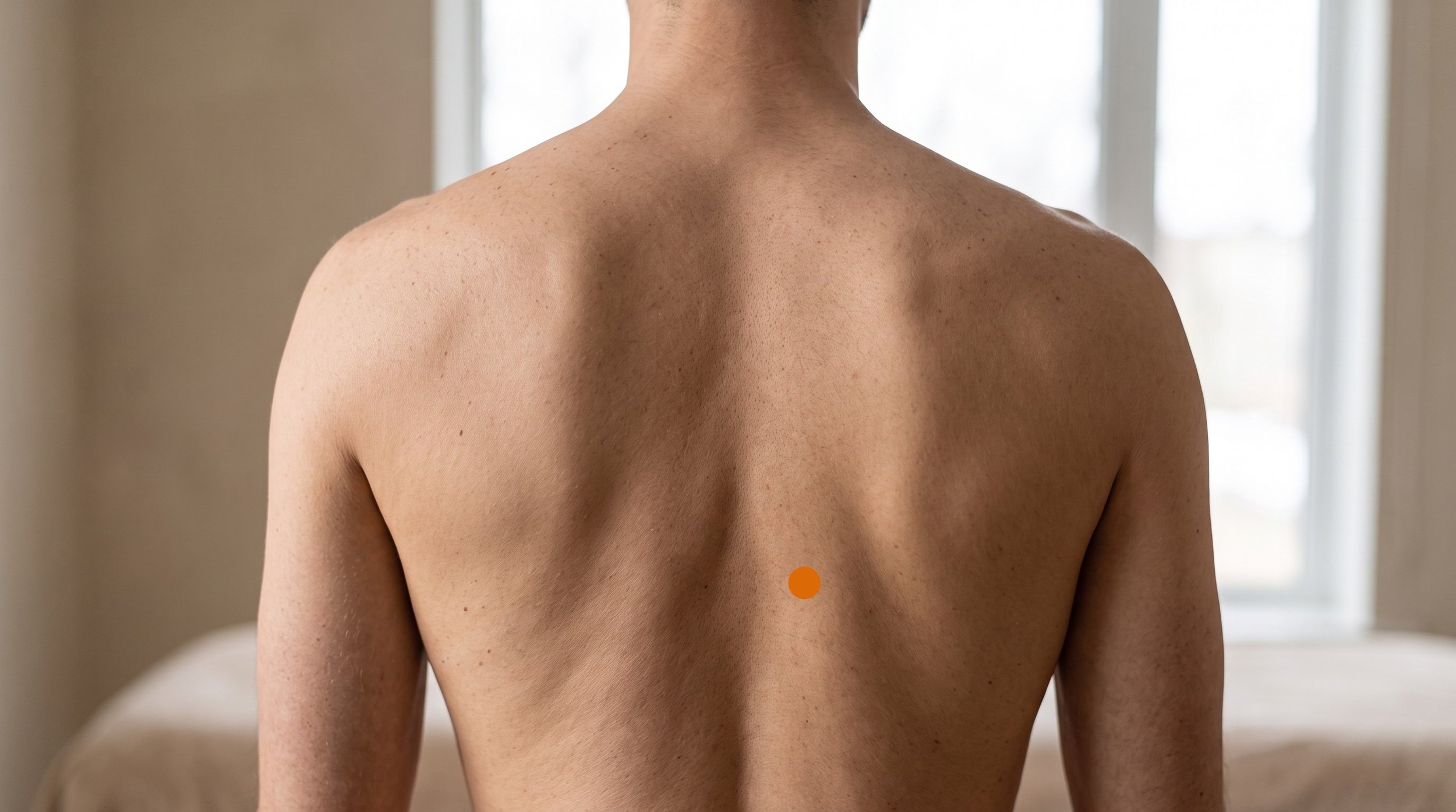
BL17 Acupuncture Point
Geshu at the Level of the Shoulder Blade Tip: Anatomy, Mechanism, and Why This Mid-Thoracic Point Sits at the Crossroads of Back Pain, Breathing, and Blood
BL17 (Geshu, often translated as Diaphragm Shu) is the seventeenth point of the Bladder channel, sitting 1.5 cun lateral to the lower border of the T7 spinous process, roughly level with the bottom tip of the shoulder blade when the arms hang relaxed at the sides. In classical texts it carries two designations that make it unusual among the back points: it's treated as the back-shu point of the diaphragm, and it's the hui-meeting point of Blood, one of the eight influential points first catalogued in the Classic on Medical Problems.
For a modern clinic, the practical value is simpler than the classical language suggests. This is a densely innervated mid-thoracic paraspinal site that sits over erector spinae fibers at the level where interscapular pain, rib cage stiffness, breathing restriction, and referred sensation from the upper digestive tract all share segmental territory, which is why the bl17 acupuncture point shows up in so many upper back and thoracic treatment plans.
- Bladder 17 sits 1.5 cun (about two finger widths) lateral to the midline at the lower edge of the T7 spinous process, level with the inferior angle of the scapula. The needle passes through skin and subcutaneous tissue into lower trapezius fibers and then into the erector spinae mass, with the rib cage lying immediately deep, which is why insertion angle matters more here than at almost any other back-shu point.
- The classical categories translate cleanly into anatomy. Calling it the diaphragm's shu point reflects a real segmental relationship, since the peripheral and costal portions of the diaphragm receive sensory supply from the lower intercostal nerves rather than from the phrenic nerve alone, so mid-thoracic input and diaphragm input converge in the same spinal segments.
- Needling here recruits A-delta and C fiber afferents in the dorsal rami territory of the mid-thoracic nerves, which engages both segmental dorsal horn inhibition and supraspinal descending control involving serotonergic, noradrenergic, and endogenous opioid pathways (Zhao, 2008).
- The research picture is reasonable but indirect. Systematic reviews of acupuncture for chronic spinal pain report meaningful pain and disability improvements compared with sham, usual care, and no treatment (Huang et al., 2021), and individual patient data meta-analysis in chronic pain shows effects modestly but consistently larger than sham and durable over about a year (Vickers et al., 2018). Almost none of these trials isolate BL17.
- Traditionally, BL17 was used for a very wide list: chest oppression, hiccup and vomiting, coughing or vomiting of blood, night sweating and tidal fever, and widespread body pain. These are traditional attributions from classical sources and should be read as historical pattern categories, not as claims that a single needle treats bleeding disorders.
- De qi at BL17 is usually a deep, dull, spreading ache under the shoulder blade, sometimes with a heavy sensation that follows the rib line laterally or a subtle sense of the mid-back releasing on the next breath. Sharp, electric, or radiating sensation isn't the target and should prompt the needle to be repositioned.
Stuck With Mid-Back Pain Between the Shoulder Blades?
Interscapular pain that flares at a desk, on long flights, or after heavy lifting rarely comes from one structure. At Morningside Acupuncture we use BL17 alongside dry needling of the lower trapezius, rhomboids, and thoracic erector spinae, plus breathing and postural work you can carry between sessions. Most patients notice looser rib motion and easier deep breaths within the first few visits. Schedule a session and let's map where your mid-back pain is actually coming from.
Schedule NowAnatomy of BL17: Why the T7 Paraspinal Level Is Such an Important Location
Find the inferior angle of the scapula with the arms hanging relaxed, drop to the midline, and you're close to the T7 spinous process. BL17 is 1.5 cun lateral to the lower border of that spinous process, which in most adults lands on the visible ridge of the paraspinal muscles rather than in the groove beside the spine. From the surface inward, the needle passes skin, subcutaneous fascia, the thin lower fibers of trapezius, and then the erector spinae column (longissimus and iliocostalis thoracis at this level), with rhomboid and serratus posterior superior fibers nearby in the broader region.
What loads this tissue is unglamorous: sustained forward-head and rounded-shoulder desk postures, carrying bags on one side, overhead lifting, and shallow upper chest breathing patterns that keep the thoracic extensors working as accessory stabilizers all day.
The nerve geography explains why a point named for the diaphragm sits on the back. BL17 lies in the cutaneous and muscular territory of the dorsal rami of the mid-thoracic spinal nerves, and those same spinal segments receive afferent traffic from the costal diaphragm through the lower intercostal nerves, from the lower esophagus and stomach through visceral afferents, and from the thoracic facet joints and costovertebral articulations.
When several inputs converge on shared dorsal horn neurons, sensitization in one input can lower the threshold of the others, which is one plausible reason mid-back tenderness so often accompanies reflux, breathing restriction, or post-surgical thoracic pain. Needling in this territory produces local axon reflex vasodilation, alters dorsal horn processing segmentally, and recruits descending inhibitory systems from the brainstem (Zhao, 2008).
Autonomic changes have also been studied using heart rate variability, though the findings across acupuncture trials are inconsistent enough that no single effect should be promised (Lee et al., 2010).
Immediately deep to the erector spinae at this level are the ribs and intercostal spaces, and deep to those is the pleura. This is the defining safety consideration at BL17. Standard texts specify oblique insertion angled toward the spine, 0.5 to 1 cun, or a transverse-oblique insertion of 1 to 1.5 cun along the muscle belly, and they warn explicitly that perpendicular needling, or oblique needling directed away from the spine, carries a real risk of pneumothorax.
Vascular structures here are small (medial branches of the posterior intercostal vessels), so bleeding risk is minor compared with the pleural consideration. In practice, a clinician who angles medially, controls depth, and knows the patient's body habitus and breathing pattern is working well within safe margins.
Related Pain Finder Upper Back Shoulder Arm Related Diaphragm Trigger PointsBL17 at a Glance: Classification, Location, and Clinical Use
| Category | Detail |
|---|---|
| Traditional Name | Geshu (Diaphragm Shu), Bladder 17, BL-17, UB17 |
| Channel Classification | Seventeenth point of the Bladder (Taiyang) channel of the foot, upper back group |
| Point Categories | Back-shu point of the diaphragm (treated as an honorary back-shu in the classical literature rather than a standard organ shu); hui-meeting (influential) point of Blood among the eight influential points; with BL19 forms the classical four flowers moxibustion pairing |
| Precise Location | On the upper back, 1.5 cun lateral to the lower border of the T7 spinous process, level with the inferior angle of the scapula, on the highest visible point of the paraspinal muscle mass |
| Tissue Stimulated | Skin and subcutaneous fascia, lower trapezius fibers, thoracic erector spinae (longissimus and iliocostalis), with segmental overlap into diaphragm referral territory; dorsal rami of the mid-thoracic nerves |
| Needle Depth / Direction | Oblique insertion angled toward the spine, 0.5 to 1 cun, or transverse-oblique along the muscle 1 to 1.5 cun. Never perpendicular and never angled laterally over the rib cage, because of pneumothorax risk. Moxibustion is commonly applied here in classical practice |
| De Qi Sensation | Deep, dull, spreading ache beneath the shoulder blade, sometimes heavy or warm, occasionally tracking along the rib line. Sharp or electric sensation means reposition |
| Primary Clinical Uses | Mid-back and interscapular pain, thoracic paraspinal tension and rib cage stiffness, breathing restriction, hiccup and diaphragm-pattern complaints in classical usage, chest oppression in classical listings, blood-deficiency patterns in traditional language |
| Common Point Combinations |
|
In Deadman's A Manual of Acupuncture, Geshu is presented as a point with two overlapping identities that drive everything else attributed to it: the hui-meeting point of Blood, and an informal back-shu point for the diaphragm. Traditional actions listed there include invigorating blood and dispersing stasis, cooling heat in the blood and stopping bleeding, nourishing and harmonizing blood, and settling rebellious qi at the diaphragm.
Classical authors grouped blood disorders into three broad families (stasis, heat, and deficiency) and considered BL17 relevant to all of them, with sources going so far as to say the point governs blood conditions generally. Fixed, stabbing pain was read as a marker of stasis, while moving pain suggested qi stagnation, and because of the point's position at the diaphragm the classical texts favored it for upper and middle body presentations rather than lower abdominal ones.
The traditional indication lists also cover chest oppression, hiccup and difficulty swallowing, vomiting, night sweating and tidal fever, and generalized aching of the whole body. What's striking about the classical pattern isn't any single claim but the internal logic: one anatomical level, the diaphragm, became the organizing metaphor for a whole category of circulation and nourishment, and the point sitting over that level inherited the entire category.
Why BL17 Is Used for Hiccup, Rib Cage Restriction, and Mid-Back Pain That Feels Like a Band Under the Shoulder Blades
Patients often describe the T7 region as a tight strap running under the shoulder blades that gets worse with prolonged sitting and eases briefly with a big stretch. The reason a single paraspinal point can influence something that feels so widespread comes down to convergence. Mid-thoracic dorsal horn neurons receive input from the thoracic facet joints, the costovertebral joints, the paraspinal and scapular muscles, the costal part of the diaphragm via the lower intercostal nerves, and visceral afferents from the lower esophagus and stomach.
When one of those inputs stays irritated, neighboring inputs in the same segments become easier to provoke, so the perceived problem spreads well beyond the tissue that started it. Needling at BL17 delivers a strong, well-localized afferent signal into exactly those segments, which is the segmental rationale for choosing it.
Beyond the segmental level, needle stimulation activates descending inhibitory pathways from the periaqueductal gray and rostral ventromedial medulla, releasing endogenous opioids, serotonin, and noradrenaline at the spinal cord and reducing the gain of nociceptive transmission (Zhao, 2008). That mechanism is not point-specific, which is exactly why point selection matters less than clinicians once assumed and why segmental accuracy and adequate stimulation matter more.
For the hiccup indications that fill BL17's classical record, reviews of acupuncture for persistent hiccup after stroke and for cancer-related hiccup report encouraging results, though both sets of authors flag substantial methodological weakness in the underlying trials (Yue et al., 2017; Guo et al., 2024). We treat that as a reasonable, low-risk adjunct rather than an established therapy.
The honest summary for patients: BL17 is well placed to help with mid-thoracic musculoskeletal pain and the breathing and postural patterns that accompany it, and it has a long traditional history in diaphragm-related complaints that modern evidence has only partly explored. It isn't a treatment for bleeding disorders or anemia, and any classical language in that direction belongs to a historical framework rather than to modern hematology.
What the Research Shows for BL17
Almost no clinical trial has studied BL17 on its own. Acupuncture research nearly always tests multi-point protocols delivered over a course of sessions, so the fairest way to read the evidence is that BL17 is one component within protocols for spinal pain, thoracic complaints, and specific symptoms like hiccup, and that the overall body of evidence supports acupuncture as a reasonable option for chronic musculoskeletal pain while leaving individual point contributions unresolved.
Effect sizes in well-conducted trials tend to be modest, certainty of evidence is often low to moderate, and results for non-pain indications are considerably weaker. That's the context for the table below.
| Study | Type | Focus | Key Finding |
|---|---|---|---|
| Vickers et al., 2018 | Individual patient data meta-analysis | Chronic musculoskeletal pain, headache, and osteoarthritis across nearly 21,000 patients | Acupuncture outperformed both sham and no-acupuncture controls, with benefits persisting over about twelve months, though the difference from sham was modest. |
| Huang et al., 2021 | Systematic review and meta-analysis | Chronic spinal pain including neck and back presentations | Pooled data from 22 randomized trials favored acupuncture over sham, usual care, and no treatment for pain and function, with a favorable safety profile. |
| Mu et al., 2020 | Cochrane systematic review | Chronic nonspecific low back pain | Acupuncture produced small improvements in pain and function versus sham and larger gains versus no treatment, but the certainty of evidence was generally low to moderate. |
| Yue et al., 2017 | Systematic review and meta-analysis | Hiccup following stroke | Included trials reported benefit from acupuncture, though the authors judged trial quality too limited to draw firm conclusions. |
| Guo et al., 2024 | Systematic review and meta-analysis | Cancer-related hiccup | Acupuncture-based interventions appeared helpful and well tolerated, with the same caveat that the underlying studies were methodologically weak. |
| Lee et al., 2010 | Systematic review | Acupuncture and heart rate variability as a measure of autonomic response | Reported effects on autonomic markers were inconsistent across studies, so autonomic claims for any single point should stay cautious. |
| Zhao, 2008 | Mechanistic review | Neural mechanisms of acupuncture analgesia | Analgesic effects are attributed to peripheral afferent activation, segmental spinal modulation, and descending opioid and monoaminergic inhibition. |
Rib Cage Tightness, Shallow Breathing, or Hiccup That Won't Settle?
The T7 level is where thoracic muscle tension, rib mechanics, and diaphragm-related complaints overlap, and BL17 sits right in that neighborhood. Our practitioners combine gentle oblique needling at Geshu with points that traditionally descend rebellious qi, including PC6 and CV12, and with hands-on release of the costal margin. We work conservatively and explain every step. Book an appointment to see whether this approach suits your case.
Schedule NowBL17 in the Context of Trigger Point Work
Acupuncture, as we define it, is treatment with an acupuncture needle, and that includes the hundreds of styles practiced worldwide as well as dry needling. At the T7 level, the classical point and the myofascial map overlap almost completely. Trigger points in the thoracic iliocostalis and longissimus refer pain up and down the back and sometimes forward around the rib cage, lower trapezius trigger points produce that familiar deep ache near the medial scapular border, and rhomboid and serratus posterior superior involvement adds a heavier interscapular quality (Simons et al., 1999).
Palpating BL17 in a symptomatic patient frequently reveals a taut band or an exquisitely tender spot rather than a neutral point, which is exactly what the Shanghai text describes when it discusses back points becoming reactive in disease.
At Morningside, a typical mid-back session might combine oblique needling at BL17 with dry needling of the thoracic erector spinae, lower trapezius, and rhomboids, plus attention to serratus anterior and the costal margin when breathing mechanics are involved. Distal points such as LI4 or SP6 may be added depending on the presentation, and we often finish with cupping over the paraspinals and specific loading exercises for thoracic extension and scapular control. The needling itself is only part of it.
Patients who change how they sit, breathe, and load their upper back between visits tend to hold their gains far longer than those who rely on treatment alone.
BL17 Mid-Back and Thoracic Pain Treatment at NYC's Highest-Rated Acupuncture Clinic
Morningside Acupuncture is the highest-rated acupuncture and dry needling clinic in New York City with over 500 five-star Google reviews, and thoracic and interscapular pain is one of the complaints we see most. Treatment plans built around BL17 pair classical point selection with sports medicine style needling and clear, evidence-informed expectations. You'll always know why a point was chosen and what we're aiming to change. Schedule your visit and start with a proper assessment.
Schedule NowFrequently Asked Questions
What does BL17 feel like when needled?
Most people feel a deep, dull, spreading ache beneath the shoulder blade, sometimes described as heavy, warm, or pressure-like, occasionally tracking a short distance along the rib line. That sensation is de qi, and it's the signal the practitioner is looking for. Because the erector spinae here is often tender, you may also feel a brief twitch or a familiar ache reproduced when the needle reaches a taut band. Sharp, burning, or electric sensations aren't expected, and you should say so immediately if you feel them so the needle can be repositioned.
Why needle a point on the back for hiccup or breathing restriction rather than something closer to the diaphragm?
Because the neurology already connects them. The costal portion of the diaphragm and the mid-thoracic paraspinal tissues share spinal segments through the lower intercostal nerves, so afferent input at the T7 level reaches the same dorsal horn territory that processes diaphragm and upper digestive sensation. Classical medicine reached a similar conclusion by observation and named the point Diaphragm Shu. Practically, the back offers safe, well-defined muscular tissue to needle, while the diaphragm itself is largely inaccessible. Evidence for hiccup specifically is encouraging but limited by weak trial quality (Yue et al., 2017; Guo et al., 2024).
Can I press BL17 myself between sessions?
You can, with reasonable caution and no needles. Reaching BL17 on yourself is awkward, so most people use a tennis or lacrosse ball against a wall rather than fingers. Locate the bottom tip of a shoulder blade, move about two finger widths toward the spine, and place the ball there against a wall with your feet slightly forward so you control the pressure. Lean in until you feel a firm, tolerable ache at roughly four to six out of ten, hold for 30 to 60 seconds, then breathe slowly and let the tissue soften for another 30 seconds before moving on. Two to three rounds per side, once or twice a day, is plenty. Skip it entirely over bruised or inflamed skin, if you're on blood thinners without clearance, or if pressure produces sharp pain, breathlessness, or any radiating symptom.
Is BL17 safe to needle?
In trained hands, yes, but it's a point where technique genuinely matters. The rib cage and pleura lie deep to the muscle at this level, so the convention is oblique insertion angled toward the spine at 0.5 to 1 cun, or a shallow transverse-oblique insertion along the muscle. Perpendicular needling and any angle directed away from the spine are avoided because of pneumothorax risk. Licensed acupuncturists are trained specifically in these thoracic safety margins, and serious adverse events with competent practice are rare. Tell your practitioner if you're on anticoagulants, have had thoracic surgery, have a lung condition, or are very thin, since all of these change how the point is approached.
Where exactly is BL17 located?
BL17 is on the upper back, 1.5 cun lateral to the lower border of the seventh thoracic vertebra's spinous process, which puts it level with the inferior angle of the scapula when your arms hang relaxed. For a bl 17 location shortcut, drop a horizontal line from the bottom tip of your shoulder blade to the spine and move about two finger widths out to the side, landing on the crest of the paraspinal muscle rather than the groove beside the bone. The governing vessel point GV9 (Zhiyang) sits at the midline on the same horizontal level, and BL17 is bilateral, so there's one on each side.
References
- Deadman, P., Al-Khafaji, M., & Baker, K. (2009). A manual of acupuncture. Journal of Chinese Medicine Publications.
- Cheng, X. (Ed.). (1999). Chinese acupuncture and moxibustion (Rev. ed.). Foreign Languages Press.
- Kim, H. (2008). Handbook of Oriental medicine (3rd ed.). Harmony & Balance Press.
- O'Connor, J., & Bensky, D. (Eds. & Trans.). (1981). Acupuncture: A comprehensive text. Shanghai College of Traditional Medicine. Eastland Press.
- Maciocia, G. (2005). The foundations of Chinese medicine: A comprehensive text for acupuncturists and herbalists (2nd ed.). Elsevier Churchill Livingstone.
- Simons, D. G., Travell, J. G., & Simons, L. S. (1999). Travell & Simons' myofascial pain and dysfunction: The trigger point manual, Vol. 1: Upper half of body (2nd ed.). Williams & Wilkins.
- Vickers, A. J., Vertosick, E. A., Lewith, G., MacPherson, H., Foster, N. E., Sherman, K. J., Irnich, D., Witt, C. M., & Linde, K. (2018). Acupuncture for chronic pain: Update of an individual patient data meta-analysis. Journal of Pain, 19(5), 455-474. https://doi.org/10.1016/j.jpain.2017.11.005
- Zhao, Z. Q. (2008). Neural mechanism underlying acupuncture analgesia. Progress in Neurobiology, 85(4), 355-375. https://doi.org/10.1016/j.pneurobio.2008.05.004
- Huang, J. F., Zheng, X. Q., Chen, D., Lin, J. L., Zhou, W. X., Wang, H., Qin, Z., & Wu, A. M. (2021). Can acupuncture improve chronic spinal pain? A systematic review and meta-analysis. Global Spine Journal, 11(8), 1248-1265. https://doi.org/10.1177/2192568220962440 [VERIFY BEFORE PUBLISHING]
- Mu, J., Furlan, A. D., Lam, W. Y., Hsu, M. Y., Ning, Z., & Lao, L. (2020). Acupuncture for chronic nonspecific low back pain. Cochrane Database of Systematic Reviews, 2020(12), CD013814. https://doi.org/10.1002/14651858.CD013814
- Yue, J., Liu, M., Li, J., Wang, Y., Hung, E. S., Tong, X., Sun, Z., Zhang, Q., & Golianu, B. (2017). Acupuncture for the treatment of hiccups following stroke: A systematic review and meta-analysis. Acupuncture in Medicine, 35(1), 2-8. https://doi.org/10.1136/acupmed-2015-011024
- Guo, Z., Liang, Y., Liu, W., Huang, B., Zheng, H., Cui, S., & Xu, N. (2024). Effectiveness and safety of acupuncture for cancer-related hiccups: A systematic review and meta-analysis. Frontiers in Neurology, 15, 1480656. https://doi.org/10.3389/fneur.2024.1480656
- Lee, S., Lee, M. S., Choi, J. Y., Lee, S. W., Jeong, S. Y., & Ernst, E. (2010). Acupuncture and heart rate variability: A systematic review. Autonomic Neuroscience, 155(1-2), 5-13. https://doi.org/10.1016/j.autneu.2010.02.003
Disclaimer: This web site is intended for educational and informational purposes only. Reading this website does not constitute providing medical advice or any professional services. This information should not be used for diagnosing or treating any health issue or disease. Those seeking medical advice should consult with a licensed physician. Seek the advice of a medical doctor or other qualified health professional for any medical condition. If you think you have a medical emergency, call 911 or go to the emergency room. No acupuncturist-patient relationship is created by reading this website or using the information. Morningside Acupuncture PLLC and its employees and contributors do not make any express or implied representations with respect to the information on this site or its use. For any legal interpretation of scope of practice in your state, consult a licensed attorney or regulatory authority.
Read more from our blog