BL40 Acupuncture Point
BL40 Acupuncture Point
The Middle of the Crook: Anatomy, Mechanism, and Why the Command Point of the Lower Back Anchors Lumbar and Sciatic Pain Treatment
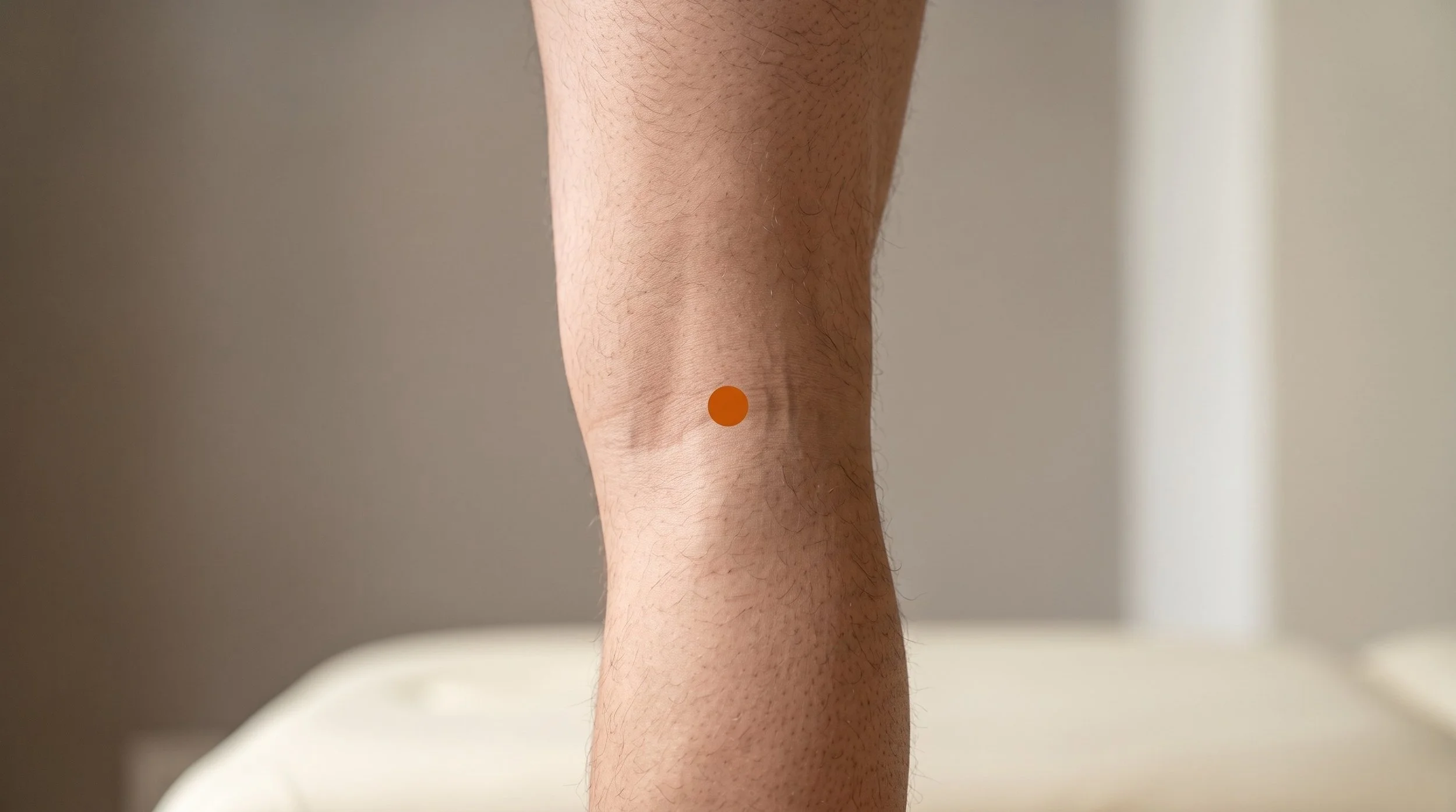
BL40 (Weizhong, often translated as Middle of the Crook, and written as Bladder 40 or UB40) sits in the soft hollow behind the knee, at the midpoint of the popliteal crease between the two hamstring tendons you can feel on either side. It's one of the most heavily used points in the entire acupuncture repertoire, and the reason is almost entirely about the low back rather than the knee: classical texts assign it command of the lumbar region, and modern clinicians reach for it when back pain, sciatic-pattern leg pain, hamstring tightness, and posterior knee complaints show up in the same body.
The BL40 acupoint is anatomically rich territory, which is what makes it both useful and a point that demands precise, conservative needling.
- Location and layers: BL40 lies at the middle of the popliteal crease, bordered laterally by the biceps femoris tendon and medially by the semitendinosus tendon, with skin, subcutaneous tissue, and popliteal fascia above a neurovascular bundle that includes the tibial nerve and popliteal vessels (Deadman et al., 2007).
- Traditional categories, read physiologically: it's traditionally described as the he-sea and Earth point of the Bladder channel and as a command point for the lumbar region, which in modern terms simply flags a distal site whose nerve supply shares spinal segments with the low back (Deadman et al., 2007).
- Mechanism: needling here recruits tibial nerve and posterior femoral cutaneous nerve afferents carrying L4 to S3 input, and afferent stimulation of this kind is understood to engage segmental gating and descending inhibitory pathways involving the periaqueductal gray and endogenous opioid systems (Zhao, 2008).
- Research picture: reviews of acupuncture for chronic low back pain and sciatica report modest to moderate short-term benefit with variable certainty (Mu et al., 2020; Zhang et al., 2023), and individual patient data pooling shows effects that persist beyond a single visit (Vickers et al., 2018).
- Point-specific findings: a randomized trial using infrared thermography reported that needling BL40 raised mean lumbar surface temperature more than the comparison conditions, a possible marker of regional microcirculatory change (Zheng et al., 2025), while animal work suggests depth matters and that tibial nerve involvement may mediate some autonomic effects (Liu et al., 2025).
- De qi and practice framing: patients usually describe a heavy, spreading ache that travels up the hamstrings or down the calf, not a sharp electric jolt; a shock-like sensation means the needle is too close to the tibial nerve and should be withdrawn and redirected.
Is Your Low Back Pain Keeping You From Standing Up Straight?
Morningside Acupuncture uses BL40 as a distal anchor for lumbar pain, pairing it with local needling of the erector spinae, quadratus lumborum, and gluteal muscles. Because the point is far from the painful area, it lets us start treatment even when the low back is too irritable to touch. We combine acupuncture and dry needling with movement advice so gains hold between visits. Schedule an appointment and let's map your pattern.
Schedule NowAnatomy of BL40: Why the Popliteal Crease Is Such an Important Location
BL40 sits in the middle of the popliteal fossa, the diamond-shaped hollow behind the knee. Its borders are easy to find with the knee slightly bent: the biceps femoris tendon forms the lateral wall, and the semitendinosus and semimembranosus tendons form the medial wall, with the two heads of gastrocnemius closing the space below. Under the skin lies loose subcutaneous fat and then the popliteal fascia, a firm sheet that tents across the fossa. This region takes load in a specific way.
Prolonged sitting compresses it, hamstring-dominant activity such as sprinting, cycling, and deadlifting loads the tendons that bound it, and chronic lumbar guarding tends to leave the hamstrings tonically short, so patients with long-standing back pain often have tender, ropey tissue right here.
The nerve geography explains most of what BL40 does clinically. Skin over the fossa is supplied by the posterior femoral cutaneous nerve, and deeper structures are served by the tibial nerve, which carries fibers from the L4 through S3 roots, the same segments that supply the lower lumbar spine, sacroiliac region, gluteals, and posterior leg. Needling BL40 therefore delivers afferent input into spinal segments that already receive input from the painful low back.
Convergence of this kind is a standard explanation for why a distal point can influence a proximal complaint, and the broader analgesic story adds descending modulation from the periaqueductal gray and rostral ventromedial medulla, along with endogenous opioid and monoamine involvement (Zhao, 2008). Practically, this means BL40 gives us a way to influence the lumbar segments through a route the patient can tolerate on a bad day.
Deep to the point runs the neurovascular bundle: the tibial nerve most superficially, then the popliteal vein, then the popliteal artery closest to the bone. Classical needling depth is generally given as perpendicular insertion of about 1 to 1.5 cun, though many modern practitioners work shallower, around 0.5 to 1 cun, and angle slightly away from the midline (Deadman et al., 2007). We locate the point with the knee slightly flexed and the patient prone, palpate for the tendon borders first, and avoid heavy lifting and thrusting at depth.
A sharp radiating shock means the needle has approached the tibial nerve and should be withdrawn. Patients with a Baker's cyst, known popliteal aneurysm, varicosities, deep vein thrombosis risk, or anticoagulant use need modified or shallower technique.
Related Acupuncture For Low Back Pain Related Best Acupuncture Points For SciaticaBL40 at a Glance: Classification, Location, and Clinical Use
| Category | Detail |
|---|---|
| Traditional Name | Weizhong (Middle of the Crook); classical alternative name Xue Xi, Blood Cleft |
| Channel Classification | Bladder channel (foot taiyang), point 40 of 67; also written Bladder 40 or UB40 |
| Point Categories | He-sea point and Earth point of the Bladder channel; the lower he-sea point of the Bladder; one of Gao Wu's four command points, assigned to the lumbar region; a Ma Dan-yang Heavenly Star point; listed in the Essential Questions among the points used to drain heat from the extremities |
| Precise Location | At the midpoint of the popliteal crease, in the depression between the tendons of biceps femoris (lateral) and semitendinosus (medial). Locate with the knee slightly flexed. |
| Tissue Stimulated | Skin and subcutaneous tissue of the popliteal fossa, popliteal fascia, and the tendinous borders formed by biceps femoris and semitendinosus, with the proximal gastrocnemius heads just below |
| Needle Depth / Direction | Perpendicular insertion, commonly 0.5 to 1.5 cun depending on style and body size, angled slightly off the midline to respect the neurovascular bundle; classical sources also describe pricking superficial veins in the region to bleed |
| De Qi Sensation | A deep, heavy, distending ache that often spreads upward into the hamstrings or downward into the calf; a sharp electric shock is not de qi and signals proximity to the tibial nerve |
| Primary Clinical Uses | Acute and chronic low back pain, sciatic-pattern leg pain, hamstring tightness and posterior thigh pain, knee pain including posterior knee stiffness, and general lower limb heaviness or weakness |
| Common Point Combinations |
|
Deadman's A Manual of Acupuncture presents BL40 as one of the most important points in the classical repertoire, and the traditional attributions cluster around three ideas. First, lumbar authority: Gao Wu placed it among his four command points with responsibility for the low back, Ma Dan-yang listed it among his Heavenly Star points for back pain that prevents straightening up and for knees that won't bend or extend easily, and Sun Simiao recommended bleeding it for heavy, painful backs and legs.
Second, blood: an older name for the point is Blood Cleft, and the Spiritual Pivot's description of taiyang as a channel rich in blood underpins the traditional practice of bleeding engorged vessels here, both for acute lumbar sprain and for heat-in-the-blood presentations such as nosebleed, eczema, urticaria, and erysipelas.
Third, breadth: classical indication lists extend well past the musculoskeletal into summer-heat patterns with vomiting and diarrhea, febrile presentations, urinary complaints including enuresis and difficult urination, and hemorrhoids, the last linked to the Bladder divergent channel's described route around the anus. What's striking is that a point sitting quietly behind the knee was assigned this much territory, and that the one indication every source agrees on, the low back, is exactly the one modern segmental anatomy makes easiest to explain.
Why BL40 Is Used for Back Pain That Sits Nowhere Near the Knee
The most common question patients ask is why we'd needle behind the knee for pain in the low back. The short answer is that the two areas share a spinal address. The tibial nerve, which runs deep to BL40, is built from fibers originating in the L4 to S3 nerve roots, and those same roots supply the lower lumbar joints, the sacroiliac region, the gluteal muscles, and the posterior thigh. When a sensitized segment is receiving a constant stream of nociceptive input from the back, adding strong, controlled input from the leg into that same segment changes how the dorsal horn processes the whole picture. That's segmental convergence, and it's the standard neurophysiological reading of what classical sources called a command point relationship.
Beyond the segment, needling recruits systems that run top-down. Afferent stimulation of this intensity engages descending inhibitory circuits through the periaqueductal gray and rostral ventromedial medulla, with endogenous opioid, serotonergic, and noradrenergic contributions (Zhao, 2008). This is why the analgesic effect isn't confined to one dermatome and why patients often report the whole posterior chain feeling looser rather than just the spot that was needled.
There's also point-specific evidence, though it's early. A randomized controlled trial in healthy adults used infrared thermography and reported that acupuncture at BL40 produced a greater increase in average lumbar surface temperature than the comparison interventions, which the authors interpreted as reflecting regional microcirculatory change linked to the traditional BL40 and low back association (Zheng et al., 2025).
Separately, animal work at BL40 found that deeper needling near the tibial nerve altered bladder function and brain activity in ways that shallower needling did not, with mast cell and tibial nerve involvement proposed as mediators (Liu et al., 2025). Neither finding proves clinical superiority, but both suggest that where and how deep the needle goes at this point is not incidental.
What the Research Shows for BL40
A fair reading of the evidence starts with a caveat: almost no trial isolates BL40. Clinical studies test multi-point protocols, and BL40 typically appears alongside local lumbar points such as BL23 and BL25, so any benefit reported belongs to the protocol rather than to this point alone.
What we can say is that BL40 is one of the most consistently included points in low back pain and sciatica protocols, that the pooled evidence for acupuncture in these conditions suggests modest short-term benefit with meaningful uncertainty, and that a small number of studies have looked at BL40 specifically for physiological effects. The sections below summarize that picture without overstating it.
| Study | Type | Focus | Key Finding |
|---|---|---|---|
| Mu et al., 2020 | Cochrane systematic review | Acupuncture for chronic nonspecific low back pain, 33 trials and 8,270 participants | Acupuncture appeared to reduce pain and improve function in the short term compared with sham, no treatment, or usual care, though certainty of evidence ranged from very low to moderate. |
| Vickers et al., 2018 | Individual patient data meta-analysis | Chronic pain conditions including musculoskeletal and back pain, roughly 21,000 patients | Acupuncture outperformed both sham and no-acupuncture controls, with effects that were only modestly reduced at one-year follow-up. |
| Zhang et al., 2023 | Systematic review and meta-analysis | Acupuncture therapy for sciatica, 30 randomized trials with 2,662 participants | Acupuncture was reported as effective and well tolerated relative to medication, but the authors noted high heterogeneity and low methodological quality across included trials. |
| Zheng et al., 2025 | Randomized controlled trial | Infrared thermography of lumbar temperature after acupuncture or moxibustion at BL40 or LU5 in 140 healthy adults | Acupuncture at BL40 produced a greater rise in mean lumbar surface temperature than comparison groups, suggesting a measurable regional effect that may reflect microcirculatory change. |
| Liu et al., 2025 | Controlled animal experiment | Deep versus shallow needling at BL40 in a rat model of overactive bladder, with urodynamics and functional MRI | Deeper needling near the tibial nerve altered bladder contraction intervals and brain activity patterns, with mast cell and tibial nerve signaling proposed as mechanisms; findings are preclinical and don't translate directly to patients. |
| Zhao, 2008 | Narrative review of mechanisms | Neural pathways underlying acupuncture analgesia | Describes segmental spinal inhibition and supraspinal descending control involving opioid and monoamine systems as the principal explanatory framework for needling-induced analgesia. |
Sciatic Pain Running Down the Back of Your Leg?
When pain travels from the buttock into the hamstring and calf, BL40 sits directly along that route and gives us a way to treat the whole posterior chain. Our practitioners combine it with GB30, gluteal and hamstring dry needling, and nerve-friendly loading to calm irritability without flaring symptoms. Sessions may reduce pain intensity and improve how far you can bend, sit, and walk. Book a visit to get assessed.
Schedule NowBL40 in the Context of Trigger Point Work
BL40 sits at a genuine crossroads for myofascial work. Its lateral border is the biceps femoris tendon and its medial border is the semitendinosus tendon, and both hamstring groups carry referral patterns that reach into the buttock and down the back of the thigh toward the knee, patterns that can convincingly mimic or overlap sciatic complaints (Simons et al., 1999). Just below the point, the medial and lateral heads of gastrocnemius refer into the posterior knee and calf.
So when a patient's posterior leg pain doesn't match a clean radicular pattern, the tissue around BL40 is often part of the story rather than a bystander.
In practice we rarely treat BL40 in isolation. A typical session might combine BL40 with dry needling of the biceps femoris and semitendinosus in the mid-thigh, the gluteus medius and piriformis at the hip, and the gastrocnemius or soleus if calf tension is limiting ankle dorsiflexion. The needling at BL40 itself stays conservative and shallow relative to the tendon borders, while the taut bands are addressed where they're actually palpable, well away from the popliteal neurovascular bundle.
Acupuncture, in the sense of using an acupuncture needle, covers both approaches, and combining a classical distal point with segmental trigger point work often gives more durable change than either alone.
BL40 Low Back and Sciatica Treatment at NYC's Highest-Rated Acupuncture Clinic
Morningside Acupuncture is the highest-rated acupuncture and dry needling clinic in New York City with over 500 five-star Google reviews. We treat BL40 as a precision point, using careful palpation and conservative depth to work the popliteal region safely. Every plan blends point-based acupuncture, trigger point dry needling, and rehab-minded guidance for your specific back or leg pattern. Schedule your first session today.
Schedule NowFrequently Asked Questions
What does BL40 feel like when needled?
Most people describe a deep, heavy, slightly spreading ache in the back of the knee, sometimes traveling up into the hamstrings or down into the calf. That sensation is de qi, and it usually fades within seconds while the needle stays in. What you should not feel is a sharp electric jolt shooting into the foot. That indicates the needle is near the tibial nerve, and your practitioner will withdraw and redirect immediately. Mild soreness in the fossa for a day afterward is common and typically settles on its own.
Why needle behind the knee for pain in my low back?
Because the two regions share nerve supply. The tibial nerve under BL40 draws fibers from the L4 to S3 spinal levels, the same levels that supply the lower lumbar spine, sacroiliac joints, and gluteal muscles. Stimulating that shared segment can change how the spinal cord processes pain coming from the back, and the input also recruits descending inhibitory systems in the brainstem (Zhao, 2008). There's a practical advantage too: when the low back is too irritable to needle directly, a distal point lets us begin treatment without provoking symptoms.
Can I press BL40 myself between sessions?
Yes, with a light touch. Sit with your knee bent to about 90 degrees, run your fingers into the crease behind the knee, and find the soft hollow midway between the two tendons you can feel on either side. Use the pads of two fingers, not a knuckle or a tool, and apply gentle, steady pressure for 20 to 30 seconds at a time. Repeat for two to three minutes per leg, once or twice a day. Keep the pressure moderate and stop immediately if you feel any tingling, numbness, or pulsing, since blood vessels and a major nerve run under this area. Combining it with an easy hamstring stretch or a few slow knee bends usually feels better than pressure alone.
Is BL40 safe to needle?
It's safe when needled by a trained practitioner who respects the anatomy. The tibial nerve and the popliteal vein and artery lie deep to the point, so the technique involves conservative depth, a slight angle away from the midline, and no aggressive deep manipulation. We modify or avoid the point in patients with a Baker's cyst, known popliteal aneurysm, prominent varicosities, active deep vein thrombosis or high DVT risk, local infection or skin breakdown, or those on anticoagulant therapy. This is a point where self-needling is not appropriate.
Where exactly is BL40 located?
BL40, or Weizhong, is at the midpoint of the popliteal crease, the transverse line behind the knee, in the depression between the biceps femoris tendon on the outer side and the semitendinosus tendon on the inner side. The easiest way to confirm the bl 40 point location is to bend the knee slightly, which makes both tendons stand out, then settle into the hollow exactly between them. It's the same landmark whether the point is written as BL40, Bladder 40, or UB40.
References
- Deadman, P., Al-Khafaji, M., & Baker, K. (2009). A manual of acupuncture. Journal of Chinese Medicine Publications.
- Kim, H. (2008). Handbook of Oriental medicine (3rd ed.). Harmony & Balance Press.
- Maciocia, G. (2006). The channels of acupuncture: Clinical use of the secondary channels and eight extraordinary vessels. Churchill Livingstone Elsevier.
- Simons, D. G., Travell, J. G., & Simons, L. S. (1999). Travell & Simons' myofascial pain and dysfunction: The trigger point manual, Vol. 1: Upper half of body (2nd ed.). Williams & Wilkins.
- Mu, J., Furlan, A. D., Lam, W. Y., Hsu, M. Y., Ning, Z., & Lao, L. (2020). Acupuncture for chronic nonspecific low back pain. Cochrane Database of Systematic Reviews, 2020(12), CD013814. https://doi.org/10.1002/14651858.CD013814
- Vickers, A. J., Vertosick, E. A., Lewith, G., MacPherson, H., Foster, N. E., Sherman, K. J., Irnich, D., Witt, C. M., & Linde, K. (2018). Acupuncture for chronic pain: Update of an individual patient data meta-analysis. Journal of Pain, 19(5), 455-474. https://doi.org/10.1016/j.jpain.2017.11.005
- Zhang, Z., Hu, T., Huang, P., Yang, M., Huang, Z., Xia, Y., Zhang, X., Zhang, X., & Ni, G. (2023). The efficacy and safety of acupuncture therapy for sciatica: A systematic review and meta-analysis of randomized controlled trials. Frontiers in Neuroscience, 17, 1097830. https://doi.org/10.3389/fnins.2023.1097830
- Zheng, S. Y., Wang, X. Y., Lin, L. N., Liu, S., Huang, X. X., Liu, Y. Y., Yu, X. S., Pan, W., Fang, J. Q., & Liang, Y. (2025). Lumbar temperature change after acupuncture or moxibustion at Weizhong (BL40) or Chize (LU5) in healthy adults: A randomized controlled trial. Journal of Integrative Medicine, 23(2), 145-151. https://doi.org/10.1016/j.joim.2025.01.004
- Liu, X., Zhang, C. Y., Du, X. Y., Li, S. S., Wang, Y. Q., Zheng, Y., Deng, H. Z., Fang, X. Q., Li, J. Y., Wang, Z. Q., Xu, S. F., & Mi, Y. Q. (2025). Acupuncture at Weizhong (BL40) attenuates acetic acid-induced overactive bladder in rats by regulating brain neural activity through the modulation of mast cells and tibial nerves. Journal of Integrative Medicine, 23(1), 46-55. https://doi.org/10.1016/j.joim.2024.11.006
- Zhao, Z. Q. (2008). Neural mechanism underlying acupuncture analgesia. Progress in Neurobiology, 85(4), 355-375. https://doi.org/10.1016/j.pneurobio.2008.05.004
Disclaimer: This web site is intended for educational and informational purposes only. Reading this website does not constitute providing medical advice or any professional services. This information should not be used for diagnosing or treating any health issue or disease. Those seeking medical advice should consult with a licensed physician. Seek the advice of a medical doctor or other qualified health professional for any medical condition. If you think you have a medical emergency, call 911 or go to the emergency room. No acupuncturist-patient relationship is created by reading this website or using the information. Morningside Acupuncture PLLC and its employees and contributors do not make any express or implied representations with respect to the information on this site or its use. For any legal interpretation of scope of practice in your state, consult a licensed attorney or regulatory authority.
Read more from our blog