Spinal Stenosis Treatment NYC
Acupuncture and Dry Needling to Reduce Stenosis-Related Back Pain, Leg Symptoms, and Neurogenic Claudication
Spinal stenosis, the narrowing of the spinal canal or neural foramina, is a common cause of low back pain and leg symptoms in older adults. While the structural narrowing cannot be reversed without surgery, the muscle trigger points, nerve sensitization, and central pain amplification that account for much of the symptom burden are highly treatable with acupuncture and dry needling.
- Spinal stenosis severity on MRI correlates poorly with symptom intensity: many patients with severe stenosis on imaging have mild symptoms, while those with moderate stenosis may be severely disabled; the modifiable factors of muscle trigger points and central sensitization largely account for this discrepancy (Brinjikji et al., 2015).
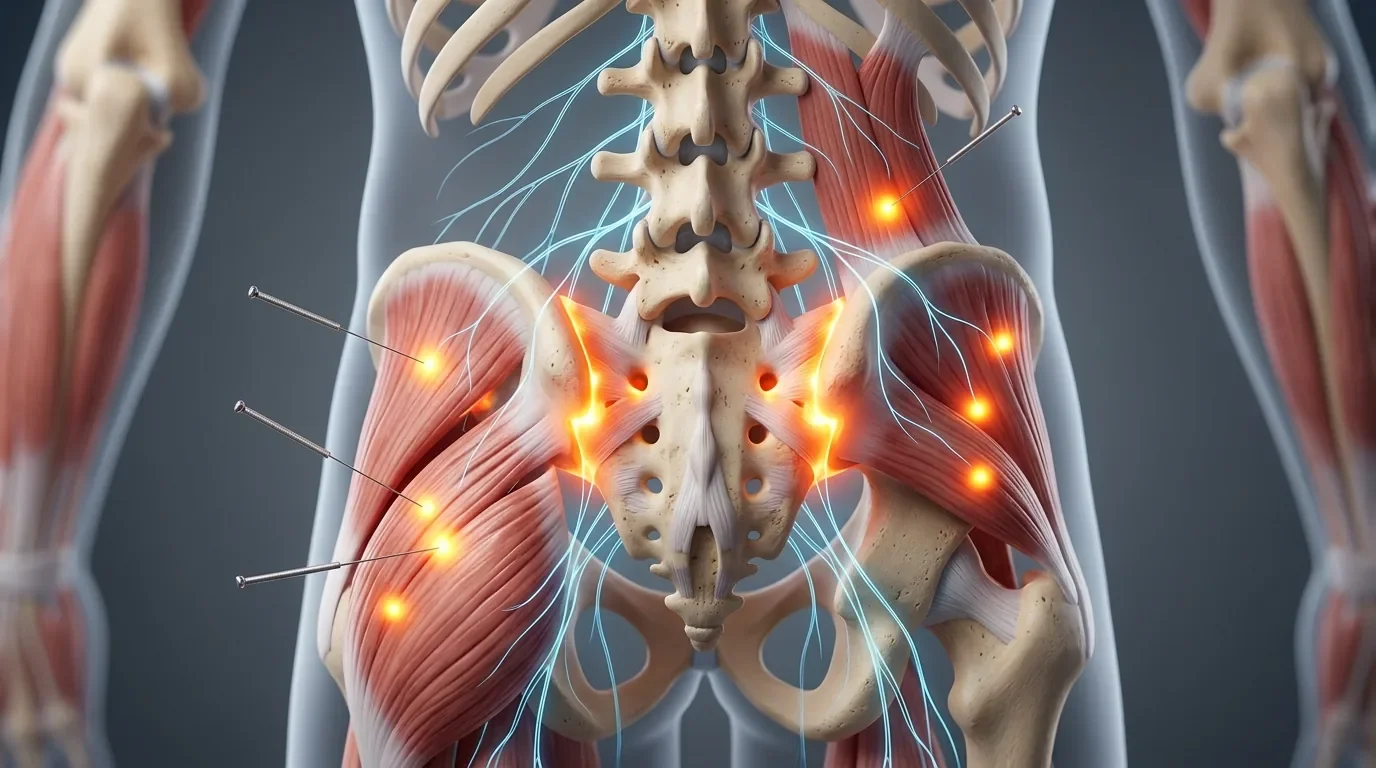
- The muscles most affected by spinal stenosis-driven adaptive changes, including the multifidus, quadratus lumborum, and iliopsoas, develop trigger points that generate significant independent pain signals, often amplifying stenosis symptoms substantially (Simons et al., 1999).
- A large individual patient data meta-analysis found acupuncture significantly superior to usual care for back pain, which encompasses many patients with stenosis-related symptoms (Vickers et al., 2018).
- Hip flexor tightness from iliopsoas trigger points increases lumbar lordosis and reduces the effective canal diameter in extension; treating the iliopsoas can improve functional walking tolerance in neurogenic claudication without any change in the structural stenosis (Simons et al., 1999).
- Neurogenic claudication, the leg heaviness, aching, and weakness that develops with walking and resolves with sitting or forward flexion, may be substantially reduced by decreasing the paraspinal muscle tension that contributes to canal narrowing with extension loading.
- Acupuncture's effects on descending pain inhibition and central sensitization address the nervous system amplification that makes mild stenosis produce severe symptoms in some patients, independent of any mechanical change to the spine.
Leg heaviness with walking, or back and leg pain from stenosis?
At Morningside Acupuncture in Morningside Heights, we address the treatable components of spinal stenosis symptoms: trigger points in the surrounding muscles, nerve sensitization, and central pain amplification. Many patients with confirmed stenosis achieve significant functional improvement without surgery through comprehensive conservative management.
Schedule NowUnderstanding Spinal Stenosis and Its Symptoms
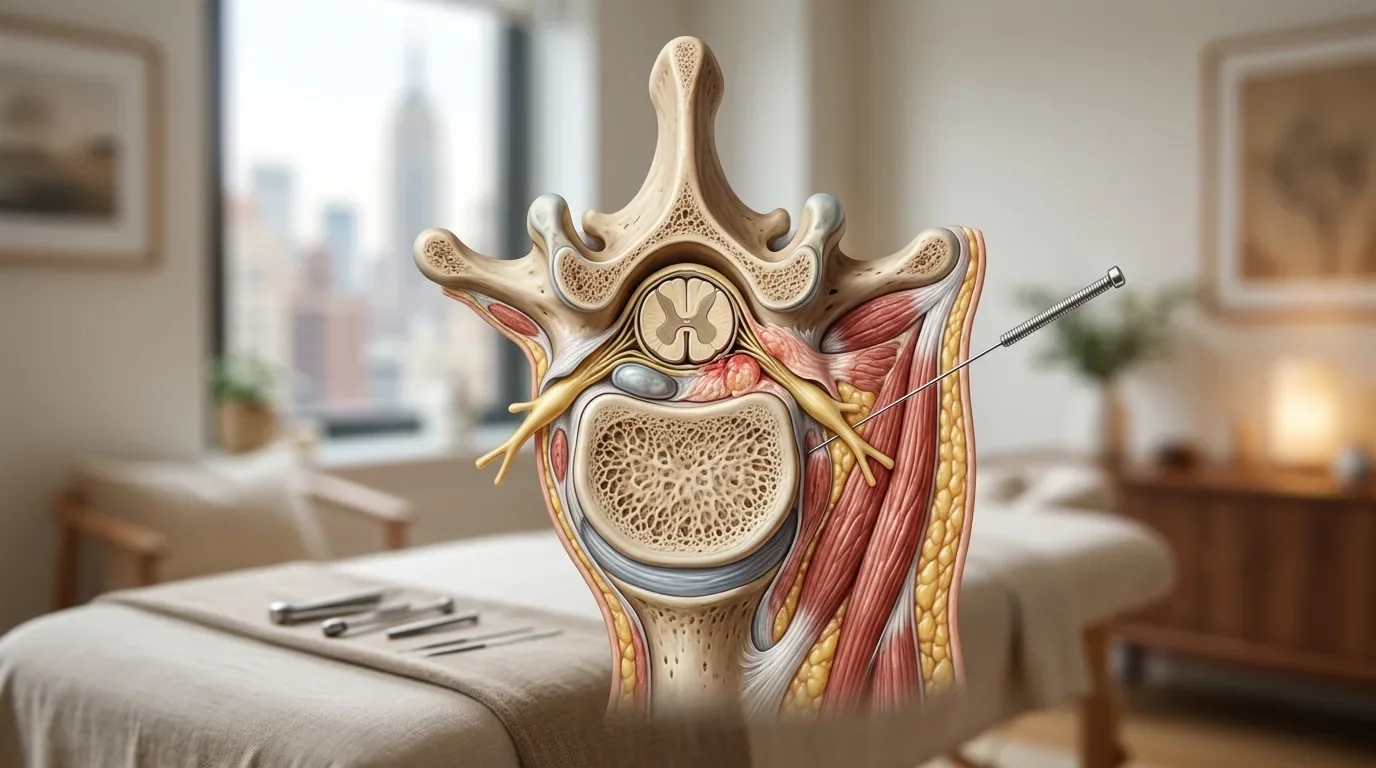
The spinal canal is the bony corridor through which the spinal cord and cauda equina pass. Spinal stenosis is narrowing of this corridor that can compress the neural structures within it. In the lumbar spine, the most common type, stenosis most often results from a combination of disc bulging, facet joint hypertrophy, and ligamentum flavum thickening, all of which are degenerative changes that accumulate over decades. Cervical stenosis follows the same degenerative process at the neck level.
The characteristic symptom of lumbar spinal stenosis is neurogenic claudication: leg heaviness, aching, cramping, or weakness that develops after walking a certain distance and is relieved by sitting, crouching forward, or leaning on a shopping cart (the "shopping cart sign"). This symptom pattern reflects the fact that lumbar extension reduces canal diameter while lumbar flexion increases it, so positions that flex the lumbar spine temporarily relieve neural compression.
However, as with disc disease, MRI findings of stenosis correlate poorly with symptom severity. Brinjikji et al. (2015) demonstrated in asymptomatic adults that spinal canal narrowing, disc degeneration, and neural foraminal narrowing are common incidental findings. This means that the muscle trigger points, paraspinal tension, and central sensitization surrounding the stenotic segment are critical determinants of who suffers from their stenosis and how much.
Muscles Contributing to Stenosis-Related Symptoms
| Muscle | Contribution to Stenosis Symptoms | Trigger Point Referred Pain | Treatment Priority |
|---|---|---|---|
| Iliopsoas | Hip flexor tightness increases lumbar lordosis and canal narrowing in extension | Low back, anterior thigh, groin | High: treating iliopsoas may improve walking tolerance |
| Quadratus Lumborum | Lateral tension increases segmental compressive load and can reduce canal dimensions | Low back, hip crest, lateral hip | High: QL trigger points generate significant stenosis-like symptoms |
| Multifidus | Atrophies after spinal injury; paraspinal tension from trigger points increases axial load | Deep local back pain, medial buttock | Medium: rehabilitation of multifidus reduces segmental instability |
| Piriformis | Piriformis trigger points generate leg symptoms mimicking or adding to stenotic radiculopathy | Buttock, posterior thigh, lateral leg | Medium: often responsible for the leg symptoms attributed entirely to stenosis |
| Gluteus Medius | Weakness from chronic pain avoidance alters gait and increases lumbar loading | Low back, lateral hip, posterior iliac crest | Medium: restoring gluteal function reduces lumbar compensatory loading |
The Iliopsoas and Walking Distance: A Critical Connection
One of the most practically important contributions of trigger point therapy to spinal stenosis management involves the iliopsoas. When the iliopsoas is shortened and hypertonic, it creates an anterior pull on the lumbar spine, maintaining lumbar hyperlordosis even during walking. Because lumbar extension reduces canal diameter in stenosis, a persistently lordotic lumbar posture during gait means the patient is walking with the spinal canal at its narrowest throughout their ambulatory activity. The neurogenic claudication develops faster than it would with neutral lumbar alignment.
Dry needling of iliopsoas trigger points, combined with hip flexor stretching guidance, can reduce the resting lordosis during gait and effectively increase the functional canal space available for neural structures during walking. Many patients report an increase in their pain-free walking distance within weeks of beginning iliopsoas treatment, a change that is mechanistically independent of any structural change in the stenosis itself.
"Neurogenic claudication is not solely determined by how narrow the canal is on MRI. It is also determined by how much the surrounding muscles amplify spinal loading, how sensitized the neural structures have become, and how much the central nervous system is amplifying the signals it receives. All of these are treatable."
Leg Symptoms: Stenosis or Piriformis?
The buttock, thigh, and leg symptoms attributed to lumbar spinal stenosis overlap substantially with the referred pain patterns of piriformis and gluteal trigger points. Piriformis trigger points compress the sciatic nerve, producing buttock and posterior thigh pain. Gluteus medius trigger points refer to the lateral hip and thigh. These myofascial contributions to "stenosis leg symptoms" are frequently untreated because the MRI finding of stenosis is assumed to explain all lower extremity symptoms.
Systematically treating the gluteal and piriformis trigger points in stenosis patients often produces meaningful reduction in leg symptoms even when the canal itself has not changed. The remaining symptoms after trigger point treatment more accurately reflect the true neural compression component, and can be addressed through epidural management or, when necessary, surgical decompression.
What to Expect at Morningside Acupuncture for Spinal Stenosis
Your assessment includes review of any imaging you have, a functional walking test if relevant, assessment of lumbar range of motion and the lumbar flexion response (does flexion relieve your leg symptoms?), and systematic trigger point palpation of the iliopsoas, quadratus lumborum, multifidus, piriformis, and gluteal muscles. We also screen for cervical stenosis myelopathy signs in patients with neck symptoms.
Treatment is conservative and begins with the most symptom-generating trigger points. Acupuncture is used throughout the treatment course for both pain modulation and to address the central sensitization that amplifies stenosis symptoms. Most patients with spinal stenosis are seen weekly for four to eight weeks, then monthly for maintenance. We work collaboratively with orthopedic and neurological specialists for patients with progressive neurological deficits or symptoms unresponsive to conservative care.
Over 500 five-star reviews from Manhattan patients managing spinal conditions
Morningside Acupuncture has helped many older adults throughout Manhattan and the Upper West Side manage spinal stenosis symptoms with acupuncture and dry needling. Our conservative approach is appropriate for patients who want to delay surgery, avoid surgery entirely, or manage residual symptoms after surgical decompression.
Read Our ReviewsFrequently Asked Questions
Can acupuncture fix spinal stenosis?
Acupuncture cannot structurally widen a narrowed spinal canal. However, it can significantly reduce the symptom burden associated with stenosis by addressing the muscle trigger points, nerve sensitization, and central pain amplification that account for much of the pain and functional limitation. Many patients with confirmed stenosis achieve meaningful functional improvement without any structural change to the spine.
How does this differ from an epidural steroid injection for stenosis?
Epidural steroid injections reduce the inflammatory component of nerve root irritation from stenosis and can provide significant temporary relief, particularly for the radicular leg symptoms. They do not address the muscle trigger points or the central sensitization component of stenosis symptoms. Acupuncture and dry needling complement epidurals by treating the layers the injection does not reach. Many patients find that combining the two approaches produces better outcomes than either alone.
I have stenosis at L3-L4 and L4-L5. Will acupuncture help?
Multi-level stenosis is common and does not preclude meaningful improvement with conservative management. In fact, because the trigger point and central sensitization components of pain are independent of stenosis level or severity, treating these components can produce significant relief even in patients with multi-level structural disease. The key clinical question is whether the symptoms are primarily mechanical (related to position and activity) or include progressive neurological deficits, which warrant prompt specialist evaluation.
Should I still consider surgery if acupuncture helps?
This is a conversation to have with your spine surgeon and primary care physician. Acupuncture and conservative management are appropriate first-line approaches for stenosis without progressive neurological deficit. If symptoms remain inadequately controlled after a comprehensive conservative course including acupuncture, physical therapy, and appropriate medication, surgical decompression may offer significant benefits, particularly for patients with significant neurogenic claudication. Improved conservative management does not rule out eventual surgery; it simply ensures you have explored all non-surgical options first.
References
- Brinjikji, W., Luetmer, P. H., Comstock, B., Bresnahan, B. W., Chen, L. E., Deyo, R. A., Halabi, S., Turner, J. A., Avins, A. L., James, K., Wald, J. T., Kallmes, D. F., & Jarvik, J. G. (2015). Systematic literature review of imaging features of spinal degeneration in asymptomatic populations. American Journal of Neuroradiology, 36(4), 811–816. https://doi.org/10.3174/ajnr.A4173
- Vickers, A. J., Vertosick, E. A., Lewith, G., MacPherson, H., Foster, N. E., Sherman, K. J., Irnich, D., Witt, C. M., & Linde, K. (2018). Acupuncture for chronic pain: Update of an individual patient data meta-analysis. Journal of Pain, 19(5), 455–474. https://doi.org/10.1016/j.jpain.2017.11.005
- Simons, D. G., Travell, J. G., & Simons, L. S. (1999). Travell & Simons' Myofascial Pain and Dysfunction: The Trigger Point Manual (2nd ed., Vol. 1). Lippincott Williams & Wilkins.
- Shah, J. P., Danoff, J. V., Desai, M. J., Parikh, S., Nakamura, L. Y., Phillips, T. M., & Gerber, L. H. (2008). Biochemicals associated with pain and inflammation are elevated in sites near to and remote from active myofascial trigger points. Archives of Physical Medicine and Rehabilitation, 89(1), 16–23. https://doi.org/10.1016/j.apmr.2007.10.018
- Dommerholt, J., & Fernández-de-las-Peñas, C. (Eds.). (2013). Trigger Point Dry Needling: An Evidence and Clinical-Based Approach. Churchill Livingstone Elsevier.
Disclaimer: This web site is intended for educational and informational purposes only. Reading this website does not constitute providing medical advice or any professional services. This information should not be used for diagnosing or treating any health issue or disease. Those seeking medical advice should consult with a licensed physician. Seek the advice of a medical doctor or other qualified health professional for any medical condition. If you think you have a medical emergency, call 911 or go to the emergency room. No acupuncturist-patient relationship is created by reading this website or using the information. Morningside Acupuncture PLLC and its employees and contributors do not make any express or implied representations with respect to the information on this site or its use. For any legal interpretation of scope of practice in your state, consult a licensed attorney or regulatory authority.
Read more from our blog