Psoas Major Trigger Points
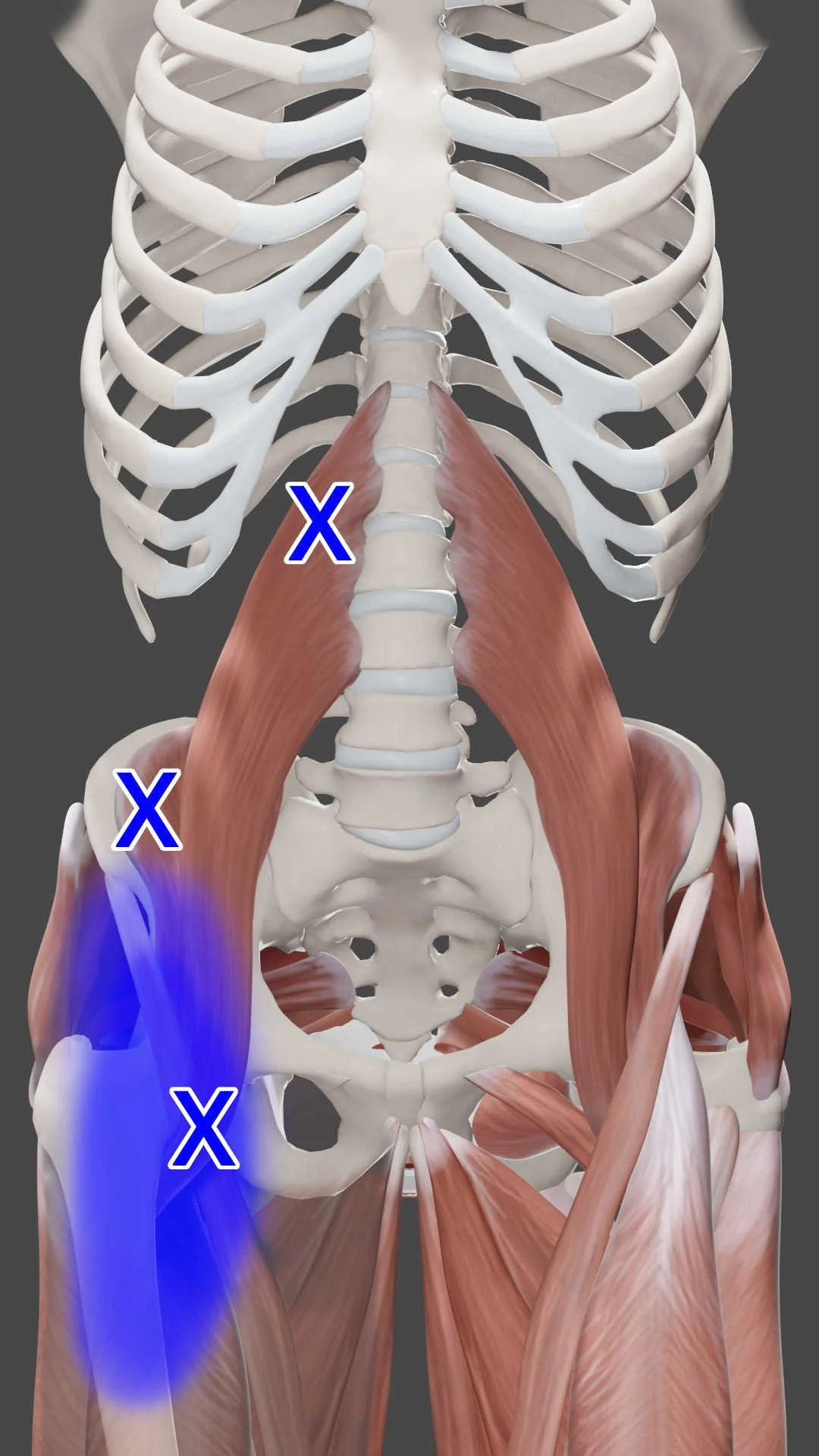
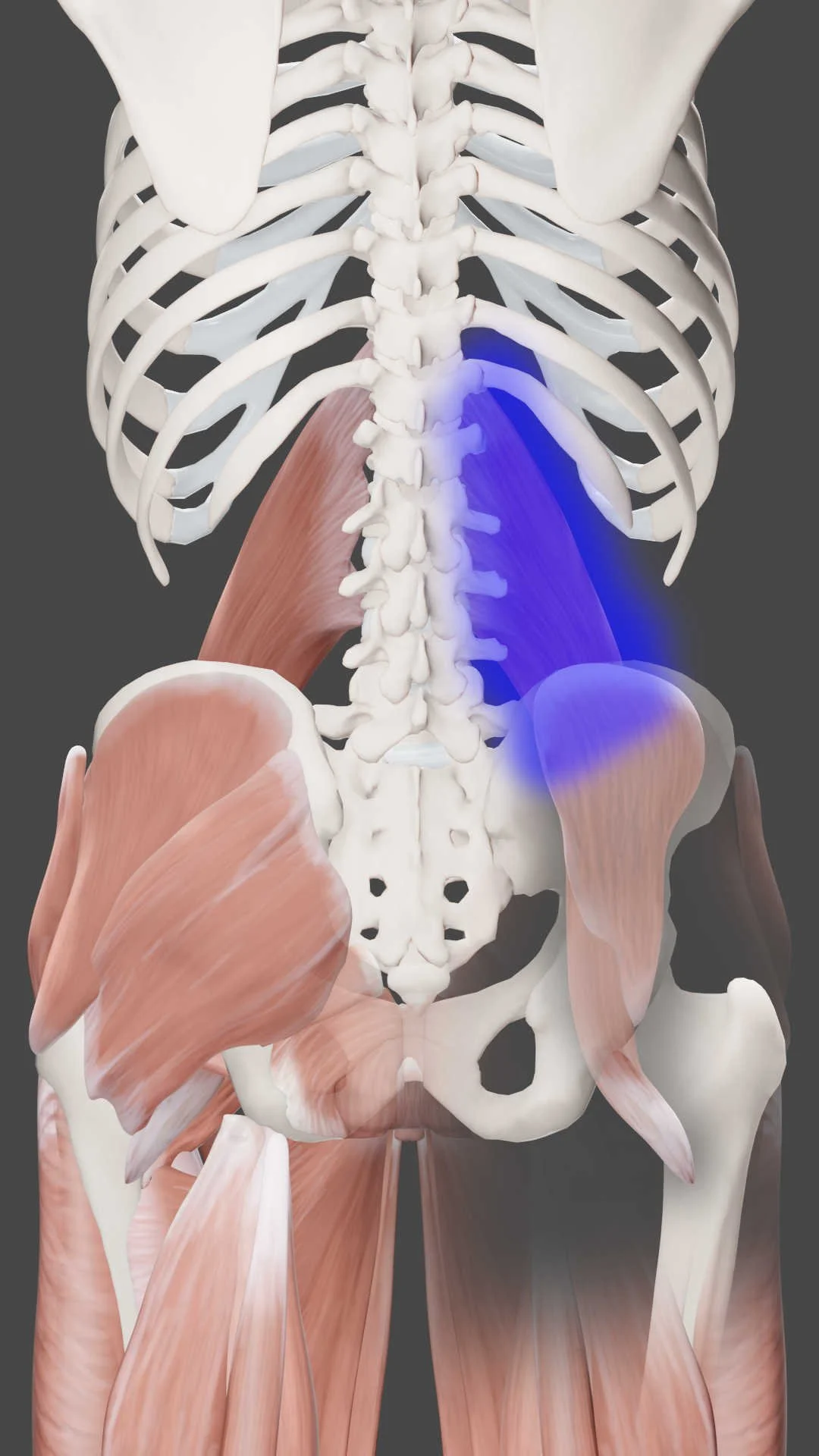
Trigger points in the psoas major can refer pain to the lower back and lumbar spine, the front of the hip and groin, and the upper thigh.
Reviewed by Teddy Levarda, L.Ac. Updated November 2026.
On this page
Key points
- Where it hurts: the lower back and lumbar spine, the front of the hip and groin, and the upper thigh.
- Common contributors: prolonged sitting, repetitive hip flexion movements, and weak glutes or core muscles.
- Often mistaken for: lumbar disc herniation, SI joint dysfunction, or hip impingement.
- What may help: dry needling, manual therapy, stretching and strengthening.
Introduction
The psoas major is a deep hip flexor muscle responsible for hip flexion, spinal stability, and postural alignment. When trigger points develop in this muscle, they can cause lower back pain, hip tightness, and difficulty standing upright, often mimicking lumbar disc issues, hip impingement, or SI joint dysfunction.
Name and Area
- Name: Psoas Major
- Area: Located deep in the abdomen and pelvis, running from the lumbar vertebrae (L1–L5) to the lesser trochanter of the femur.
Indications
Psoas major trigger points may contribute to:
- Pain in the Lower Back and Hip (Mistaken for Lumbar Disc Herniation or SI Joint Dysfunction)
- Pain That Extends to the Groin or Thigh (Can Mimic Hip Flexor Strain or Nerve Compression)
- Tightness in the Hip That Restricts Mobility (Difficulty Standing Fully Upright or Performing Deep Squats)
- Pain or Stiffness That Increases with Prolonged Sitting (Common in Desk Workers and Long-Distance Drivers)
- Pain When Lifting the Knee Toward the Chest (Can Affect Running, Climbing Stairs, or Getting Out of a Car)
- Lower Back Arching and Postural Imbalances (Can Cause Anterior Pelvic Tilt or Core Weakness)
Pain from this muscle is often mistaken for lumbar spine issues, SI joint dysfunction, or hip joint disorders.
Muscle Action
- Flexes the Hip: Brings the thigh toward the torso, essential for walking, running, and climbing stairs.
- Stabilizes the Lumbar Spine: Works with the deep core muscles to support posture.
- Assists in Trunk Flexion: Helps bend the torso forward when the legs are stationary.
The psoas major is crucial for functional movement, postural alignment, and lower body coordination.
Signs and Symptoms
Individuals with psoas major trigger points often report:
- Pain in the Lower Back That Feels Deep and Persistent (Common in Those with Prolonged Sitting Habits)
- Pain That Radiates to the Groin or Upper Thigh (Can Resemble Hip Flexor or Adductor Pain)
- Difficulty Standing Fully Upright (Feels Like the Hip Is "Locked")
- Pain When Transitioning from Sitting to Standing (Common in Office Workers and Athletes)
- Tightness That Worsens with Running, Sprinting, or High-Impact Activities
- Postural Imbalances, Such as an Anterior Pelvic Tilt or Lumbar Hyperlordosis
Pain worsens with prolonged sitting, excessive hip flexion, or rapid movements.
Perpetuating Factors
Common causes of psoas major trigger points include:
- Prolonged Sitting (Shortens the Psoas and Leads to Chronic Tightness and Imbalance)
- Repetitive Hip Flexion Movements (Running, Cycling, Sprinting, Martial Arts, or High-Knee Exercises)
- Weak Glutes or Core Muscles (Leads to Overcompensation by the Psoas for Stability and Posture Control)
- Pelvic Imbalances or Leg Length Discrepancy (Causes Asymmetrical Hip Loading and Dysfunction)
- Chronic Stress or Emotional Tension (Can Increase Psoas Tightness Due to Its Connection with the Autonomic Nervous System)
Trigger Point Referral Pattern
Trigger points in the psoas major refer pain to:
- The lower back and lumbar spine (Can Mimic Disc Herniation or Facet Joint Pain)
- The front of the hip and groin (Mistaken for Hip Flexor Strain or Inguinal Hernia)
- The upper thigh (Can Resemble Nerve Compression or Adductor Dysfunction)
Pain from this muscle is often confused with lumbar disc issues, hip joint dysfunction, or SI joint pain.
Differential Diagnosis
Psoas major trigger points may be mistaken for:
- Lumbar Disc Herniation (Lower Back Pain That Radiates Down the Leg, Worsens with Sitting or Bending Forward)
- SI Joint Dysfunction (Pain in the Lower Back and Buttocks, Worsens with Sitting or Standing on One Leg)
- Hip Impingement (Deep Hip Pain That Increases with Hip Flexion or Squatting)
- Hip Flexor Strain (Pain in the Front of the Hip, Worsens with Running or Sprinting)
- Kidney Pain or Digestive Issues (Deep Abdominal Pain That Can Overlap with Psoas Dysfunction)
A thorough hip, lumbar spine, and postural assessment is necessary to rule out these conditions.
Associated Trigger Points
Psoas major trigger points often co-exist with:
- Iliacus (Deep Hip and Lower Back Pain, Affects Hip Flexion and Pelvic Stability)
- Quadratus Lumborum (Lower Back and Pelvic Pain, Contributes to Postural Imbalances)
- Gluteus Medius and Minimus (Outer Hip and Buttock Pain, Affects Pelvic Stability and Walking Mechanics)
- Adductor Muscles (Groin and Inner Thigh Pain, Common in Runners and Athletes)
Anatomy and Innervation
| Muscle | Origin | Insertion | Innervation |
|---|---|---|---|
| Psoas Major | Transverse processes and bodies of L1–L5 vertebrae | Lesser trochanter of the femur | Lumbar plexus (L1–L3) |
The psoas major is innervated by the lumbar plexus, which also controls hip flexion, spinal stability, and core support.
Patient Examination
A comprehensive examination should include:
- Palpation: Identify tender nodules deep in the abdomen and hip crease.
- Resisted Hip Flexion Testing: Assess pain and weakness when lifting the knee toward the chest against resistance.
- Gait and Postural Analysis: Look for hip instability, anterior pelvic tilt, or excessive lumbar lordosis.
- SI Joint and Lumbar Spine Testing: Rule out joint dysfunction or lower back involvement.
Corrective Actions
Dry Needling
- Dry needling, a needling technique that uses acupuncture needles, may release trigger points in the psoas major, which may reduce deep hip tightness and improve spinal mobility.
We treat psoas major trigger points with dry needling at our Upper West Side clinic.
Manual Therapy
- Trigger Point Release: Apply deep sustained pressure to tight spots in the lower abdomen and hip flexors.
- Myofascial Release: May help improve circulation and reduce deep core tension.
Stretching
- Lunge Stretch for Hip Flexors: Helps lengthen the psoas and reduce chronic tightness.
- Supine Psoas Release Stretch: Lying on the back, let one leg dangle off a surface to decompress the psoas.
Strengthening Exercises
- Glute Bridges: Strengthens the posterior chain to counterbalance tight hip flexors.
- Dead Bugs (Core Stability Exercise): Improves deep core activation and spinal support.
- Single-Leg Balance Drills: Enhances pelvic alignment and hip control.
Postural and Movement Adjustments
- Avoid Prolonged Sitting Without Hip Extension (Take Standing Breaks Every 30–60 Minutes)
- Ensure Proper Walking Mechanics (Engage the Glutes to Reduce Psoas Overuse)
- Incorporate Dynamic Hip Mobility Drills (Prevents Hip Tightness and Improves Range of Motion)
What the Research Shows
- A randomized controlled study in people with chronic low back pain found that myofascial release of the diaphragm and iliopsoas was followed by improvements in pain, lumbar range of motion, flexibility, and chest wall mobility compared with a control group (Sığlan & Çolak, 2023).
- A randomized trial of 40 people with nonspecific chronic low back pain added psoas myofascial release to physiotherapy. Disability improved more in the myofascial release group, and pain reduction was no different between the groups (Iranpour et al., 2025).
- A double-blind randomized trial of 45 people with hip osteoarthritis compared dry needling of active trigger points in the iliopsoas, rectus femoris, tensor fasciae latae, and gluteus minimus with sham needling and with no treatment. The dry needling group had larger short-term improvements in pain, hip muscle strength, and physical function (Ceballos-Laita et al., 2021).
Conclusion
The psoas major plays a crucial role in hip flexion, postural stability, and core function, but trigger points in this muscle can cause significant lower back, hip, and groin pain. By incorporating dry needling, manual therapy, stretching, and strengthening exercises, individuals may reduce pain, improve mobility, and help prevent chronic hip dysfunction.
Struggling with low back or hip pain? Let's take a look together.
Acupuncture and dry needling on the Upper West Side. Sessions run 45 to 60 minutes.
Book your first visitReferences
- Travell JG, Simons DG. (1992). Myofascial Pain and Dysfunction: The Trigger Point Manual. Volume 2: The Lower Extremities. Williams & Wilkins.
- Sığlan Ü, Çolak S. (2023). Effects of diaphragmatic and iliopsoas myofascial release in patients with chronic low back pain: A randomized controlled study. Journal of Bodywork and Movement Therapies, 33, 120–127. https://doi.org/10.1016/j.jbmt.2022.09.029
- Iranpour K, Taheri N, Tarrahi MJ, Mohammadi HK. (2025). Effect of Psoas Muscle Myofascial Release on Pain and Disability Index in People With Nonspecific Chronic Low Back Pain: A Randomized Clinical Trial. Journal of Chiropractic Medicine, 24(1-4), 172–178. https://doi.org/10.1016/j.jcm.2025.09.002
- Ceballos-Laita L, Jiménez-Del-Barrio S, Marín-Zurdo J, Moreno-Calvo A, Marín-Boné J, Albarova-Corral MI, Estébanez-de-Miguel E. (2021). Effectiveness of Dry Needling Therapy on Pain, Hip Muscle Strength, and Physical Function in Patients With Hip Osteoarthritis: A Randomized Controlled Trial. Archives of Physical Medicine and Rehabilitation, 102(5), 959–966. https://doi.org/10.1016/j.apmr.2021.01.077