BL2 Acupuncture Point (Zanzhu)
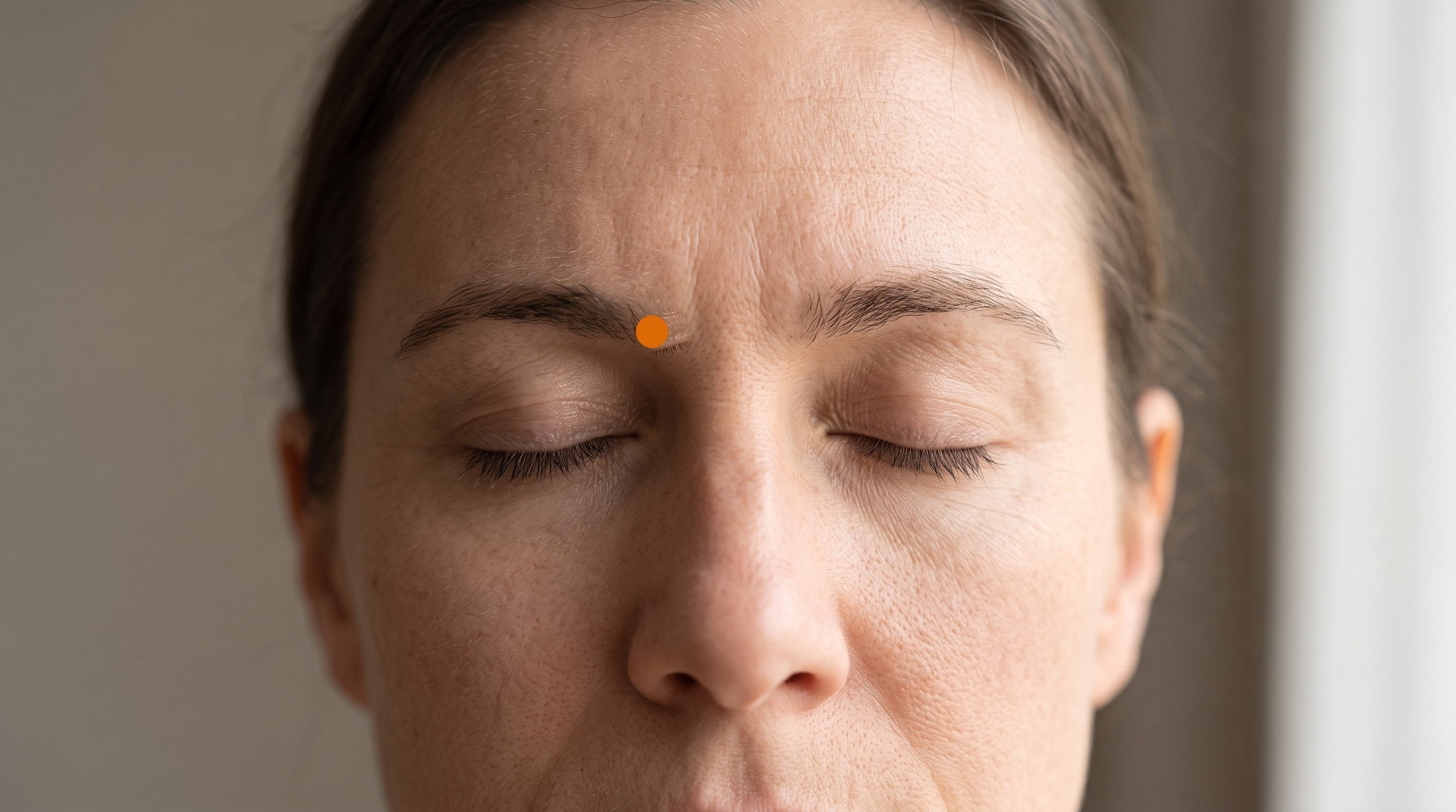
BL2 Acupuncture Point
Gathered Bamboo at the Medial Eyebrow: Anatomy, Mechanism, and Why This Small Notch Point Anchors Frontal Headache and Eye Strain Treatment
BL2, known in Chinese as Zanzhu and usually translated as Gathered Bamboo (a reference to the way eyebrow hairs bundle together at the inner brow), sits at the medial end of the eyebrow in the small depression of the frontal notch, directly above the inner corner of the eye. It is one of the most reachable points on the body: you can find your own bl 2 location in a few seconds by walking a fingertip along the underside of the brow toward the nose until it drops into a tender hollow against bone.
Clinically, bladder 2 matters because that hollow is where a superficial branch of the trigeminal nerve exits the skull and where the corrugator supercilii, the muscle of squinting and scowling, anchors. That combination of an accessible nerve trunk and a chronically loaded facial muscle is why the BL2 acupuncture point shows up so often in treatment plans for frontal headache, brow tension, sinus pressure, and screen related eye fatigue.
- BL2 lies at the medial end of the eyebrow over the frontal notch, and the needle passes only through thin skin, superficial fascia, and the medial fibers of corrugator supercilii and frontalis before reaching bone, which is why insertion is transverse rather than deep (Deadman et al., 2007).
- Classical texts traditionally credit Zanzhu with eliminating wind, clearing heat, benefiting the eyes, and clearing the head to relieve pain, a description that maps in modern terms onto local trigeminal input, altered muscle tone at the brow, and changes in periorbital blood flow (Deadman et al., 2007).
- The functional story is nerve driven: the supratrochlear branch of the frontal nerve (first division of the trigeminal) emerges at this notch, and its afferents converge with upper cervical input in the trigeminocervical complex, the same convergence that lets brow, forehead, and eye symptoms travel together (Zhao, 2008).
- Stimulating this supraorbital territory has measurable effects beyond the skin: a sham controlled trial of transcutaneous supraorbital nerve stimulation reported fewer monthly migraine days in the active group, which supports the plausibility of needling the same nerve field (Schoenen et al., 2013).
- The trial evidence for headache is protocol level rather than point level: Cochrane reviews found acupuncture reduced headache frequency in tension type headache and episodic migraine, and a large individual patient data meta-analysis found modest but persisting effects for chronic pain overall (Linde et al., 2016a; Linde et al., 2016b; Vickers et al., 2018).
- BL2 is also embedded in eye focused protocols: a multicenter randomized trial for moderate to severe dry eye used bilateral BL2 within its point prescription, and a meta-analysis of acupoint selection for dry eye found periocular points to be a consistent feature of effective formulas (Kim et al., 2012; Wei et al., 2020).
- De qi here is distinctive: patients usually report a brief pinch at the skin, then a dull spreading ache across the brow and into the eye socket, sometimes with watering of the eye and a sensation of the forehead softening or opening.
Frontal Headaches and Brow Tension That Never Fully Let Go?
Headaches that sit across the forehead and press behind the eyes rarely come from one tissue, so we treat the whole region rather than a single spot. At Morningside Acupuncture, BL2 is often paired with Yintang, GB20, and precise dry needling of the corrugator supercilii and frontalis when squinting, glare, and jaw clenching keep the brow loaded. Your practitioner will also review screen setup, sleep, and neck mechanics, because local needling works better when the daily drivers change too. Schedule an evaluation and we will map your headache pattern before we needle anything.
Schedule NowAnatomy of BL2: Why the Frontal Notch at the Medial Eyebrow Is Such an Important Location
From the surface inward, BL2 is a remarkably shallow point. Under the skin and a thin layer of superficial fascia sit the medial fibers of corrugator supercilii, the small oblique muscle that pulls the brow down and inward, along with the medial edge of frontalis and some fibers of orbicularis oculi. A few millimeters deeper the needle meets the rim of the frontal bone and the palpable dip of the frontal notch, which is exactly why texts describe transverse insertion of roughly 0.3 to 0.5 cun rather than any perpendicular technique (Deadman et al., 2007).
What loads this tiny area is unglamorous and constant: squinting at bright screens, reading in low light, uncorrected refractive error, allergy driven eye rubbing, jaw clenching, and the reflexive scowl that accompanies concentration and pain.
The nerve geography is the reason this point punches above its size. The supratrochlear nerve, a branch of the frontal nerve from the ophthalmic division of the trigeminal nerve, surfaces at or near the frontal notch to supply the medial forehead, the upper eyelid, and the inner brow. Trigeminal first division afferents from this territory synapse in the trigeminocervical complex, where they share second order neurons with input from the upper cervical segments, which explains why forehead pain, eye discomfort, and neck tightness so often behave as one problem rather than three.
Needle stimulation of somatic afferents in this field feeds into segmental inhibition and into brainstem descending pain control involving endogenous opioid and monoamine pathways (Zhao, 2008). Independent evidence that this specific nerve field is worth targeting comes from neuromodulation research: transcutaneous stimulation over the supraorbital nerves reduced monthly migraine days compared with sham in a randomized trial (Schoenen et al., 2013).
The safety considerations at BL2 are vascular and orbital rather than visceral. Small branches of the supratrochlear and supraorbital vessels run in this thin tissue, so bruising and a visible black eye are the most common nuisance events, and brief pressure over the site after withdrawal is standard practice. Because the orbit lies immediately below the brow, needles are directed along the brow line (inferiorly toward BL1 for eye complaints, laterally toward Yuyao for supraorbital pain) and kept superficial, never angled down into the orbital contents (Deadman et al., 2007).
Several classical sources also list BL2 as contraindicated to moxibustion, a caution that modern manuals continue to repeat, and pricking to bleed is described historically for heat patterns rather than as routine practice.
Related Corrugator Supercilii Trigger Points Related Frontalis Trigger PointsBL2 at a Glance: Classification, Location, and Clinical Use
| Category | Detail |
|---|---|
| Traditional Name | Zanzhu (Gathered Bamboo), also transliterated Cuanzhu |
| Channel Classification | Second point of the Bladder channel of Foot Taiyang |
| Point Categories | Point of the Bladder channel with no five-shu, hui-meeting, or extraordinary vessel designation in the reference sources; notable instead for two classical technique notes, that several classical texts contraindicate moxibustion here and that pricking to bleed was described for heat patterns (Deadman et al., 2007) |
| Precise Location | At the medial end of the eyebrow, in the depression over the frontal notch, directly superior to BL1 at the inner canthus; the spot is frequently tender to palpation |
| Tissue Stimulated | Thin skin and superficial fascia over the medial corrugator supercilii and the medial border of frontalis, with adjacent orbicularis oculi fibers, overlying the frontal notch and the supratrochlear nerve |
| Needle Depth / Direction | Transverse or transverse oblique insertion of 0.3 to 0.5 cun, directed inferiorly toward BL1 for eye complaints or laterally along the brow toward Yuyao for supraorbital pain; kept superficial and never angled into the orbit |
| De Qi Sensation | A brief sharp pinch at the skin followed by a dull, spreading ache across the brow and into the eye socket, occasionally with mild watering of the eye and a sense of the forehead releasing |
| Primary Clinical Uses | Frontal headache, pain and tension of the eyebrow region, eye strain and screen related visual fatigue, sinus and frontal pressure, allergic eye and nose symptoms, eyelid twitching |
| Common Point Combinations |
|
In A Manual of Acupuncture, Deadman and colleagues present Zanzhu as a frequently used local point whose traditional actions are to eliminate wind and clear heat, benefit the eyes, and clear the head to relieve pain.
The classical indication lists gather into a few recognizable clusters: pain of the brow and forehead with wind type headache and dizziness; a long catalogue of eye complaints ranging from blurred and dim vision to redness, swelling, itching, tearing in wind, and twitching eyelids; nasal and facial symptoms including sneezing, rhinitis, nosebleed, and facial pain; and a scattering of systemic entries such as neck stiffness, disturbed mental states, and hemorrhoid pain.
The commentary notes that BL2 was often substituted for BL1 when a practitioner preferred not to needle close to the eyeball, and that its combined reputation for itchy red eyes and sneezing made it a natural choice for what we would now call hay fever. All of this is traditional attribution rather than physiology, but one detail is genuinely striking: because the Bladder divergent channel was described as winding around the anus, a point at the eyebrow was classically indicated for hemorrhoid pain, an unusually clear illustration of the old principle of treating below by needling above.
Why BL2 Is Used for Sinus Pressure and Screen Fatigue, Not Just Brow Pain
The short answer is convergence. Sensory nerves from the medial forehead, the upper eyelid, the frontal sinus region, and the front of the scalp all belong to the ophthalmic division of the trigeminal nerve, and their signals arrive at the same pool of second order neurons in the brainstem that receives input from the upper neck. When that pool becomes sensitized by a week of poor sleep, allergy, glare, and forward head posture, patients do not experience four separate problems: they experience a heavy brow, gritty eyes, a full feeling behind the bridge of the nose, and a band of pressure across the forehead.
Needling at the frontal notch delivers strong, well localized input into that convergent territory, which is precisely why a point at the eyebrow can change how the eyes and sinuses feel (Zhao, 2008).
Beyond the segmental level, needle stimulation recruits descending inhibitory pathways from the brainstem that damp nociceptive transmission more broadly, along with local changes in blood flow and muscle tone at the treated site (Zhao, 2008). Corrugator supercilii is nearly always part of the picture, since it is the muscle that holds a squint in place, and reducing its resting tone tends to reduce the pulling sensation patients describe at the inner brow.
There is also indirect support that this nerve field responds to sustained stimulation: in a randomized sham controlled trial, daily transcutaneous stimulation over the supraorbital nerves reduced monthly migraine days in the active group but not in the sham group (Schoenen et al., 2013). Needling and electrical stimulation are not the same intervention, so this is plausibility rather than proof, but it points at the same anatomy.
For eye symptoms specifically, the clinical literature has usually tested BL2 inside periocular protocols rather than on its own. A multicenter randomized trial in moderate to severe dry eye used bilateral BL2 alongside GB14, TE23, ST1, GB20, and other points, and found improvements comparable to artificial tears, with some measures favoring acupuncture at follow up (Kim et al., 2012).
A later meta-analysis focused on acupoint selection reported that formulas built around periocular points, with or without added body points, outperformed artificial tears on tear film measures, though the included trials were mostly small and methodologically mixed (Wei et al., 2020).
What the Research Shows for BL2
It helps to be clear about what the research can and cannot say. Almost no trial isolates a single acupuncture point, so the evidence relevant to BL2 comes from studies of multi-point protocols in which this point is one component, plus mechanistic work on the nerve territory it occupies. That means the honest claim is about the treatment approach rather than about the point: reviews suggest acupuncture may reduce headache frequency and may help eye surface symptoms, and BL2 is a commonly chosen local point within those protocols.
Trial quality varies, blinding in needling research is difficult, and effect sizes for chronic pain are modest, so expectations should be set accordingly.
| Study | Type | Focus | Key Finding |
|---|---|---|---|
| Linde et al., 2016a | Cochrane systematic review | Acupuncture for prevention of tension type headache (12 trials, 2349 adults) | Reviewers concluded acupuncture appears effective for frequent episodic or chronic tension type headache, while calling for more comparisons with other treatments. |
| Linde et al., 2016b | Cochrane systematic review | Acupuncture for prevention of episodic migraine | Acupuncture was associated with reduced migraine frequency compared with no prophylaxis, sham needling, and prophylactic drugs, with effects over sham described as small. |
| Vickers et al., 2018 | Individual patient data meta-analysis | Chronic pain conditions including headache, about 20,000 patients | Acupuncture showed statistically significant effects over both sham and no acupuncture controls, with benefit that persisted over twelve months but was modest in size. |
| Schoenen et al., 2013 | Randomized sham controlled trial | Transcutaneous supraorbital nerve stimulation for migraine prevention | Monthly migraine days fell significantly in the active stimulation group but not in the sham group, supporting the responsiveness of this nerve field. |
| Kim et al., 2012 | Multicenter randomized controlled trial | Acupuncture including bilateral BL2 versus artificial tears in moderate to severe dry eye (150 patients) | Symptom improvement was broadly similar between groups immediately after treatment, suggesting acupuncture protocols containing BL2 may be a reasonable option rather than a superior one. |
| Wei et al., 2020 | Systematic review and meta-analysis | Acupoint selection in randomized trials of acupuncture for dry eye | Protocols centered on periocular points were associated with better tear film measures than artificial tears alone, though included trials were small and of variable quality. |
| Zhao, 2008 | Narrative review of mechanisms | Neural mechanisms of acupuncture analgesia | Needle stimulation of somatic afferents engages segmental spinal inhibition and descending brainstem pain control involving opioid and monoamine systems. |
Eye Strain, Screen Fatigue, and Sinus Pressure After Long Workdays?
Long hours at a monitor leave many New Yorkers with gritty eyes, a heavy brow, and pressure at the bridge of the nose by mid afternoon. We use bladder 2 as a local point in that exact territory, often alongside GB20 for the upper neck and distal points to support the whole pattern. Treatment is gentle, shallow, and adjusted session to session based on what actually changes for you. Book a visit and let us build a plan around your specific eye and headache pattern.
Schedule NowBL2 in the Context of Trigger Point Work
BL2 sits directly over tissue that trigger point clinicians treat by name. The corrugator supercilii lies underneath the medial brow, and taut bands there can refer discomfort up into the forehead and across the brow ridge, while frontalis tension contributes to the band like pressure many patients describe above the eyes (Simons et al., 1999). Because the classical point and the myofascial target occupy the same few square centimeters, needling at the frontal notch is often doing both jobs at once: providing input to the supratrochlear nerve field and reducing tone in a muscle that has been squinting all day.
Acupuncture and dry needling are not separate therapies in this sense, since both use an acupuncture needle and both are shaped by where the clinician chooses to place it.
At Morningside Acupuncture we usually treat BL2 as one element of a regional plan rather than as a standalone technique. A typical session for frontal headache might combine BL2 and Yintang at the brow with careful needling of corrugator supercilii and frontalis, then move to the suboccipital and upper cervical region around GB20 because of the trigeminocervical convergence described above. When clenching or dental habits are part of the pattern, we assess the jaw muscles too, including deeper targets such as the medial pterygoid, since sustained jaw load often travels upward into the brow. Needle technique at the face stays shallow and thin gauge, and we apply pressure after withdrawal to limit bruising in this vascular area.
BL2 Headache Treatment at NYC's Highest-Rated Acupuncture Clinic
Morningside Acupuncture is the highest-rated acupuncture and dry needling clinic in New York City with over 500 five-star Google reviews, and headache care is one of the things we do most. We combine classical point selection like BL2 and Yintang with orthopedic dry needling of the muscles that keep the brow, temples, and neck under load. Every plan is built around measurable goals: fewer headache days, less brow tension, easier screen tolerance. Schedule your first session and start tracking real change.
Schedule NowFrequently Asked Questions
What does BL2 feel like when needled?
Most people notice a quick pinch as the needle passes the skin, since the medial brow is thin and richly innervated, followed within a second or two by a dull ache that spreads across the eyebrow and into the eye socket. Some patients feel the forehead soften or a mild pulling toward the inner corner of the eye, and watering of the eye on that side is common and harmless. The point is often tender before needling, which is one reason practitioners palpate for the frontal notch rather than measuring. The ache generally fades within a minute of the needle being placed and is not meant to be sharp or lasting.
Why needle the eyebrow for headaches that feel like they are behind the eyes or in the sinuses?
Because the brow, forehead, upper eyelid, and frontal sinus region are all supplied by the same first division of the trigeminal nerve, and those signals converge in the brainstem with input from the upper neck. Needling at the frontal notch delivers strong local input into that shared territory, which can change how the whole region feels rather than just the skin at the brow (Zhao, 2008). It also reduces tone in the corrugator supercilii, the muscle that holds a squint, which is frequently part of the pressure patients describe above and behind the eyes (Simons et al., 1999). Traditionally, the same point was described as clearing the head and benefiting the eyes, which is the classical language for the same clinical observation (Deadman et al., 2007).
Can I press BL2 myself between sessions?
Yes, and this is one of the easiest points to self treat. Find the medial end of your eyebrow, walk a fingertip toward the nose until it settles into the small hollow against the bone just above the inner corner of the eye, then press upward and slightly outward against the brow ridge with your thumb or index finger. Use firm but comfortable pressure, hold for 30 to 60 seconds, release, and repeat two or three times per side, working both sides together if that feels better. Two to four rounds a day is plenty, and a good habit is to do it during screen breaks, ideally paired with looking at something 20 feet away for 20 seconds. Skip it if the skin is broken, infected, or bruised, if you have had recent facial or orbital surgery, or if pressure reproduces sharp shooting pain, and see a clinician for any headache that is new, severe, or accompanied by vision changes.
Is BL2 safe to needle?
In trained hands it is a low risk point, but it has specific cautions. Needling is kept transverse and shallow, typically 0.3 to 0.5 cun along the brow, so the needle never travels toward the orbit (Deadman et al., 2007). The main adverse event is cosmetic: small vessels run through this thin tissue, so bruising or a temporary black eye can occur, which is why practitioners press the site briefly after withdrawal. Several classical texts also list BL2 as contraindicated to moxibustion. Tell your practitioner if you take blood thinners, bruise easily, have had recent eye or facial surgery, or have any orbital or dermatologic condition in the area.
Where exactly is BL2 located?
BL2 is at the medial end of the eyebrow, in the depression over the frontal notch of the frontal bone, directly above BL1 at the inner canthus of the eye. To locate it, place a fingertip on the underside of the brow at its inner end and slide gently along the bone until it drops into a small hollow; that hollow is the bl 2 location, and it is usually tender when the brow and forehead are under load. Because the landmark is bony and palpable, it is found by feel rather than by measurement, and it is needled bilaterally in most protocols.
References
- Deadman, P., Al-Khafaji, M., & Baker, K. (2009). A manual of acupuncture. Journal of Chinese Medicine Publications.
- Kim, H. (2008). Handbook of Oriental medicine (3rd ed.). Harmony & Balance Press.
- Simons, D. G., Travell, J. G., & Simons, L. S. (1999). Travell & Simons' myofascial pain and dysfunction: The trigger point manual, Vol. 1: Upper half of body (2nd ed.). Williams & Wilkins.
- Linde, K., Allais, G., Brinkhaus, B., Fei, Y., Mehring, M., Shin, B.-C., Vickers, A., & White, A. R. (2016a). Acupuncture for the prevention of tension-type headache. Cochrane Database of Systematic Reviews, 2016(4), CD007587. https://doi.org/10.1002/14651858.CD007587.pub2
- Linde, K., Allais, G., Brinkhaus, B., Fei, Y., Mehring, M., Vertosick, E. A., Vickers, A., & White, A. R. (2016b). Acupuncture for the prevention of episodic migraine. Cochrane Database of Systematic Reviews, 2016(6), CD001218. https://doi.org/10.1002/14651858.CD001218.pub3
- Vickers, A. J., Vertosick, E. A., Lewith, G., MacPherson, H., Foster, N. E., Sherman, K. J., Irnich, D., Witt, C. M., & Linde, K. (2018). Acupuncture for chronic pain: Update of an individual patient data meta-analysis. Journal of Pain, 19(5), 455-474. https://doi.org/10.1016/j.jpain.2017.11.005
- Zhao, Z. Q. (2008). Neural mechanism underlying acupuncture analgesia. Progress in Neurobiology, 85(4), 355-375. https://doi.org/10.1016/j.pneurobio.2008.05.004
- Schoenen, J., Vandersmissen, B., Jeangette, S., Herroelen, L., Vandenheede, M., Gerard, P., & Magis, D. (2013). Migraine prevention with a supraorbital transcutaneous stimulator: A randomized controlled trial. Neurology, 80(8), 697-704. https://doi.org/10.1212/WNL.0b013e3182825055
- Kim, T.-H., Kang, J. W., Kim, K. H., Kang, K.-W., Shin, M.-S., Jung, S.-Y., Kim, A.-R., Jung, H.-J., Choi, J.-B., Hong, K. E., Lee, S.-D., & Choi, S.-M. (2012). Acupuncture for the treatment of dry eye: A multicenter randomised controlled trial with active comparison intervention (artificial teardrops). PLoS ONE, 7(5), e36638. https://doi.org/10.1371/journal.pone.0036638
- Wei, Q. B., Ding, N., Wang, J. J., Wang, W., & Gao, W. P. (2020). Acupoint selection for the treatment of dry eye: A systematic review and meta-analysis of randomized controlled trials. Experimental and Therapeutic Medicine, 19(4), 2851-2860. https://doi.org/10.3892/etm.2020.8561
Disclaimer: This web site is intended for educational and informational purposes only. Reading this website does not constitute providing medical advice or any professional services. This information should not be used for diagnosing or treating any health issue or disease. Those seeking medical advice should consult with a licensed physician. Seek the advice of a medical doctor or other qualified health professional for any medical condition. If you think you have a medical emergency, call 911 or go to the emergency room. No acupuncturist-patient relationship is created by reading this website or using the information. Morningside Acupuncture PLLC and its employees and contributors do not make any express or implied representations with respect to the information on this site or its use. For any legal interpretation of scope of practice in your state, consult a licensed attorney or regulatory authority.
Read more from our blog