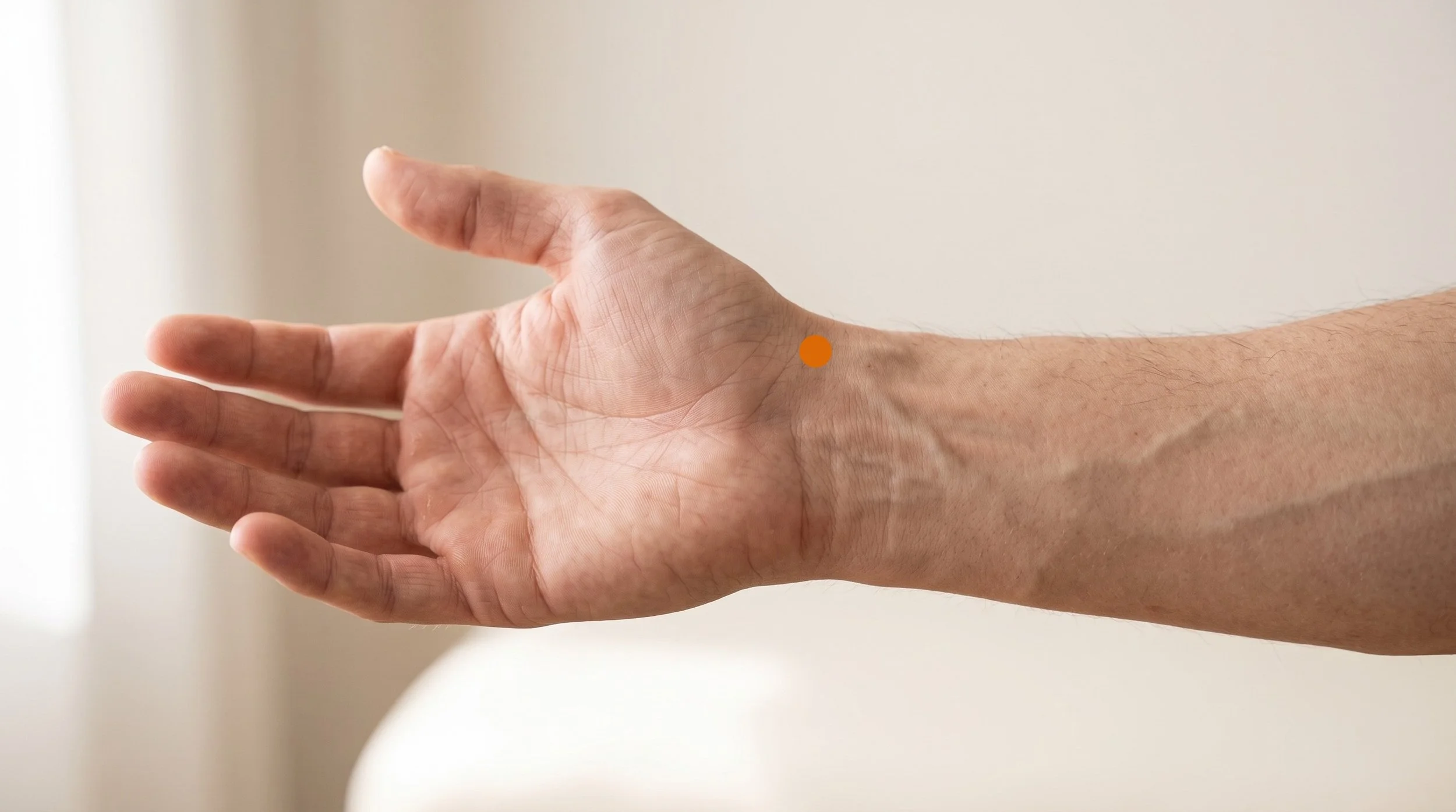
LU1 Acupuncture Point (Zhongfu)

LU1 Acupuncture Point
The Middle Palace Below the Collarbone: Anatomy, Mechanism, and Why This Front-Mu Point Anchors Chest, Breathing, and Front-Shoulder Treatment
LU1 (Zhongfu, often translated as Middle Palace) is the first point of the Lung channel and the front-mu point of the Lung, sitting high on the outer chest in the first intercostal space, roughly 6 cun lateral to the midline and about a thumb's width below LU2 near the hollow under the outer end of the collarbone. It is one of the few classical points located directly over the tissue it is named for, which is exactly why it matters clinically and why it demands respect: the needle is angled and kept shallow, never driven perpendicular.
In practice the lu1 acupuncture point is used where breathing complaints and musculoskeletal complaints overlap, for cough and a tight, oppressed chest, for front-of-shoulder and upper chest pain, and for the guarded, upper-chest breathing pattern that so often accompanies stress, desk posture, and chronic respiratory conditions.
- Location and layers: lung 1 sits in the first intercostal space below the outer clavicle, with skin and fascia over pectoralis major, pectoralis minor deeper and slightly lateral, and the intercostal muscles beneath that. This is dense, frequently overloaded tissue in people who round forward at a keyboard, and pectoral muscles are well described sources of referred chest and arm pain (Simons et al., 1999).
- Traditional categories, read modern: classical texts list LU1 as the front-mu (gathering) point of the Lung and a meeting point of the Lung and Spleen channels (Deadman et al.). A neurophysiological reading is simpler: the point overlies segments (roughly T1 to T2) that share spinal entry with afferents from the chest wall and lung, so tenderness here often reflects the state of the chest, not an abstract flow.
- Mechanism: needling recruits A-delta and C-fiber input that converges segmentally in the dorsal horn and engages descending inhibitory pathways involving serotonin, noradrenaline, and endogenous opioids, mechanisms mapped in detail in animal and human work (Zhao, 2008). Locally, needling taut pectoral tissue can reduce resting tone and ease the mechanical work of breathing.
- Research picture: reviews of acupuncture for asthma have been inconclusive because of small, variable trials (McCarney et al., 2004), while a placebo-needle trial in COPD reported improvements in dyspnea on exertion using protocols that included chest and Lung channel points (Suzuki et al., 2012), and a meta-analysis found reduced breathlessness severity in advanced disease with high heterogeneity (von Trott et al., 2020).
- Safety framing: acupuncture is broadly safe in large prospective cohorts, with mild bruising and needling pain as the usual events (Witt et al., 2009), but the chest is the exception. A documented tension pneumothorax case involved needling at LU1 and BL13, and the authors' conclusion was that anatomy, not acupuncture itself, was the failure point (Peuker, 2004).
- De qi at LU1 is typically a heavy, spreading fullness under the collarbone, sometimes drifting toward the front of the shoulder or the inner upper arm. Sharp chest pain, sudden coughing, or breathlessness are not de qi and are a signal for the practitioner to withdraw the needle.
Tight Chest, Shallow Breathing, or Front Shoulder Pain?
At Morningside Acupuncture we treat LU1 as a chest-wall and breathing point, not just a textbook Lung point. We palpate the first intercostal space and the pectoral fibers below the clavicle, then needle shallow and angled, usually alongside dry needling of pectoralis major and minor when those muscles are guarding. If your breathing feels high and effortful, or your chest feels braced by the end of a workday, schedule a visit and let's assess it properly.
Schedule NowAnatomy of LU1: Why the First Intercostal Space Below the Clavicle Is Such an Important Location
From the surface inward, LU1 passes through skin and superficial fascia into the upper fibers of pectoralis major, with pectoralis minor lying deeper and slightly lateral toward the coracoid process, and the first intercostal space and its intercostal muscles beneath. This is a busy mechanical corner. Pectoralis major and minor pull the shoulder forward and down, pectoralis minor tilts the scapula anteriorly and, when short, acts as an accessory breathing muscle by hauling on the upper ribs.
Anyone who spends hours reaching forward at a desk, drives a lot, carries a bag on one shoulder, or has coughed hard for weeks tends to build up tenderness right here, which is one reason palpation at LU1 so often reproduces a familiar tightness rather than a novel sensation.
The nerve geography explains why a point on the chest wall behaves the way it does. Innervation in this region comes from upper intercostal nerves and supraclavicular branches around the T1 to T2 segments, with pectoral nerves supplying the muscles. Those same segments receive visceral afferent traffic from the airways and lung, so somatic and visceral inputs converge on shared dorsal horn neurons. That convergence is the modern reading of the classical front-mu relationship: the front of the chest becomes a reflex window on the organ behind it.
Needling this territory generates afferent input that is processed segmentally and that also recruits descending inhibitory control from the brainstem, a mechanism supported by decades of neurophysiological research on acupuncture analgesia (Zhao, 2008). Trigger points in pectoralis major and minor add a second, purely musculoskeletal layer, since both muscles refer pain across the front of the chest and down the inner arm (Simons et al., 1999).
Deep to all of this sits the pleura and the apex of the lung, along with the axillary vessels laterally, and that anatomy dictates technique rather than being a footnote to it. Standard practice is a transverse-oblique insertion of roughly 0.5 to 1 cun directed along the intercostal space, laterally or medially depending on the text and the clinician's training, with deep perpendicular or steeply oblique needling explicitly cautioned against because of pneumothorax risk (Deadman et al.).
Depth to pleura varies considerably with body composition, and thin patients have far less margin. A reported tension pneumothorax after needling at LU1 and BL13 in a slender patient underscores that the risk is real and, in most published cases, tied to inadequate attention to basic anatomy (Peuker, 2004).
Related Pectoralis Major Trigger Points Related Pectoralis Minor Trigger PointsLU1 at a Glance: Classification, Location, and Clinical Use
| Category | Detail |
|---|---|
| Traditional Name | Zhongfu (Middle Palace, also translated Central Palace or Central Residence), Lung 1, LU-1 |
| Channel Classification | First point of the Lung channel of Hand Taiyin |
| Point Categories | Front-mu (front-collecting) point of the Lung; meeting/crossing point of the Lung and Spleen channels (hand and foot taiyin); described as the entry point of the Lung channel; classically counted among a small group of points used to clear heat from the chest |
| Precise Location | Lateral aspect of the upper chest in the first intercostal space, about 6 cun lateral to the anterior midline and roughly 1 cun inferior to LU2, below the lateral end of the clavicle. A practical method: find the delto-pectoral hollow below the outer clavicle (LU2), then drop about one thumb-width inferior and slightly lateral into the first intercostal space, which lies just above the second rib at the level of the sternal angle. |
| Tissue Stimulated | Upper fibers of pectoralis major, with pectoralis minor deeper and lateral, and the first intercostal muscles below; innervation via upper intercostal, supraclavicular, and pectoral branches around T1 to T2 |
| Needle Depth / Direction | Transverse-oblique insertion of 0.5 to 1 cun along the line of the intercostal space, angled laterally or medially and kept superficial. Deep perpendicular or steeply oblique insertion is contraindicated because of pneumothorax risk. Moxibustion and acupressure are common lower-risk alternatives. |
| De Qi Sensation | A heavy, dull fullness or spreading pressure under the collarbone, sometimes radiating toward the front of the shoulder or the inner upper arm. Sharp pain, a sudden urge to cough, or any breathlessness means the needle should be withdrawn immediately. |
| Primary Clinical Uses | Cough and chest tightness or oppression; upper chest and front-of-shoulder pain; breathing pattern dysfunction with short, tight pectorals; supportive care alongside medical management in asthma and other chronic respiratory conditions in classical listings |
| Common Point Combinations |
|
In the classical literature summarized in A Manual of Acupuncture (Deadman et al.), LU1 is traditionally described as disseminating and descending Lung qi to relieve cough and wheezing, transforming phlegm, clearing heat, regulating the water passages, and descending Stomach qi.
Its indications cluster into recognizable groups: respiratory complaints (cough, phlegm, wheezing, chest fullness, breathing with raised shoulders, difficulty lying flat), heat and exterior signs (chills, fever, sweating, painful skin), upper airway complaints (throat obstruction, nasal congestion, facial swelling), digestive complaints (difficult swallowing, retching, vomiting, abdominal distention), and local pain of the chest, upper back, and shoulder.
The name itself is traditionally explained by the channel's described origin in the middle burner near the stomach before it surfaces at the chest, which is offered as the rationale for a chest point treating swallowing and vomiting.
What is striking about the classical pattern is how modern it looks in outline: a single tender spot on the upper chest linked simultaneously to breathing, to the throat and nose, to the upper gut, and to shoulder and back pain, which is close to the map you would draw from shared segmental innervation and referred pain rather than from theory alone.
Why LU1 Is Used for Front-Shoulder Pain and Breathing Pattern Problems, Not Just Coughing
Patients are often surprised that a Lung point gets used for shoulder and chest wall pain. The anatomy makes it straightforward. LU1 sits directly over pectoralis major with pectoralis minor just deeper, and both muscles refer pain across the front of the chest, into the anterior shoulder, and sometimes down the inner arm in patterns that can mimic other problems entirely (Simons et al., 1999). When those muscles are short and irritable, the shoulder is pulled forward, the upper ribs are tethered, and the effort of breathing rises.
Needling into that tissue provides strong local afferent input, which is processed in the same T1 to T2 spinal segments that receive input from the chest wall and airways, and this segmental convergence is the practical, physiological version of what classical texts described as the Lung's gathering point on the front of the body.
Beyond the local effect, needling recruits descending inhibitory pathways from the midbrain and brainstem that damp nociceptive transmission at the spinal level using serotonergic, noradrenergic, and opioid signaling (Zhao, 2008). That systems-level effect is part of why acupuncture shows modest but persistent benefits over sham and no-acupuncture controls across chronic pain conditions in individual patient data analyses (Vickers et al., 2018).
There may also be an autonomic component worth noting cautiously: reducing tone in accessory breathing muscles tends to make slower, lower, diaphragm-led breathing easier, and slower breathing is associated with a shift toward parasympathetic dominance.
On the respiratory side, expectations should stay measured. A placebo-controlled trial in COPD found that a 12-week acupuncture protocol improved dyspnea on exertion compared with placebo needling in patients on standard medication (Suzuki et al., 2012), and a meta-analysis of acupuncture and acupressure for breathlessness in advanced disease reported reduced symptom severity, though heterogeneity was high enough to temper conclusions (von Trott et al., 2020). Reviews of acupuncture for chronic asthma have been unable to reach firm conclusions because the trials were small and inconsistent (McCarney et al., 2004). None of this replaces inhalers, pulmonary rehabilitation, or medical care, and it is not a treatment for acute breathing distress.
What the Research Shows for LU1
Nearly all of the research relevant to LU1 tested multi-point protocols rather than the point alone, which is how acupuncture is actually practiced but which makes it impossible to attribute an effect to any single location. What the literature can reasonably support is narrower: chest and Lung channel points, including LU1, appear in protocols that have shown modest benefit for exertional breathlessness and for chronic pain, the asthma evidence remains inconclusive, and the safety literature is unusually specific about the chest. Read the table below as context for how LU1 is used, not as proof that one point relieves a diagnosis.
| Study | Type | Focus | Key Finding |
|---|---|---|---|
| McCarney et al., 2004 | Cochrane systematic review | Acupuncture for chronic asthma | Trials were small, variable in quality, and inconsistent, so the review found insufficient evidence to make recommendations about acupuncture for asthma. |
| Suzuki et al., 2012 | Randomized placebo-controlled trial | Dyspnea on exertion in COPD patients on standard medication | Twelve weeks of acupuncture was associated with greater improvement in exertional breathlessness than placebo needling, in a single-country trial that later drew methodological debate. |
| von Trott et al., 2020 | Systematic review and meta-analysis | Acupuncture and acupressure for breathlessness in advanced COPD and cancer | Pooled results favored acupuncture for breathlessness severity and walking distance, but heterogeneity was very high and the authors urged cautious interpretation. |
| Vickers et al., 2018 | Individual patient data meta-analysis | Acupuncture across chronic pain conditions, including musculoskeletal shoulder and neck pain | Acupuncture outperformed both sham and no-acupuncture controls with effects that persisted over time, supporting more than a short-lived placebo response. |
| Witt et al., 2009 | Prospective observational safety study | Adverse events across 229,230 patients receiving acupuncture | Most reported effects were minor, chiefly bruising and needling pain, while serious events such as pneumothorax were rare. |
| Peuker, 2004 | Case report | Tension pneumothorax after needling that included LU1 and BL13 | A serious complication followed chest needling in a slender patient, with the author concluding such events usually reflect insufficient attention to local anatomy rather than an inherent hazard of acupuncture. |
Do You Cough, Brace, and Breathe From the Top of Your Chest?
Breathing pattern problems tend to hide in plain sight: shoulders that lift with every inhale, ribs that barely move, a chest that feels full but never satisfied. LU1 is one of our go-to points for that presentation, often paired with CV17 and LU7 and combined with hands-on rib and diaphragm work. Book an evaluation and we'll look at how you actually breathe, not just where it hurts.
Schedule NowLU1 in the Context of Trigger Point Work
LU1 sits squarely in territory that trigger point clinicians already treat. The upper fibers of pectoralis major and the underlying pectoralis minor are common sources of anterior chest, front shoulder, and inner arm pain, and pectoralis minor in particular can contribute to a sense of chest tightness and to symptoms in the arm when it is chronically short (Simons et al., 1999).
At Morningside we frequently palpate the point first, then decide whether the presentation is primarily channel-based, primarily myofascial, or both, and treat accordingly. Acupuncture, as we define it, is the use of an acupuncture needle across hundreds of styles, so classical point selection at LU1 and dry needling of a taut band in pectoralis major are the same tool applied with different reasoning.
In practice, a chest and shoulder session might combine shallow, angled needling at LU1 with dry needling of pectoralis major and pectoralis minor, occasionally the upper intercostals, plus posterior work at the scapular stabilizers to balance the front and back of the shoulder girdle. Technique changes with the tissue: over the ribcage we favor flat, tangential angles and rib-supported approaches, and we avoid deep perpendicular insertion in the intercostal spaces entirely.
Manual therapy, breathing retraining, and simple pectoral stretching are usually added between sessions, because releasing a muscle that gets pulled short again by eight hours of forward reaching tends to be a temporary win.
LU1 Chest and Breathing Treatment at NYC's Highest-Rated Acupuncture Clinic
Morningside Acupuncture is the highest-rated acupuncture and dry needling clinic in New York City with over 500 five-star Google reviews, and our Midtown practice blends classical point selection with sports medicine style trigger point work. For chest tightness, cough-related chest wall soreness, and front-shoulder pain, LU1 is used cautiously and precisely as part of a broader plan. Schedule your appointment and get treated by clinicians who take chest anatomy seriously.
Schedule NowFrequently Asked Questions
What does LU1 feel like when needled?
Most people describe a heavy, dull, spreading fullness under the outer end of the collarbone, sometimes with a mild ache traveling toward the front of the shoulder or the inner upper arm. Because the needle stays shallow and angled at LU1, the sensation is usually less intense than at thick limb points. What you should not feel is a sharp stab in the chest, a sudden urge to cough, or any change in your breathing, and if you do, tell your practitioner right away so the needle can be removed.
Why treat the chest for shoulder pain instead of the shoulder itself?
Because the front of the shoulder is often being pulled on rather than damaged. Pectoralis major and pectoralis minor attach to the arm and the coracoid process and can generate pain across the chest and anterior shoulder, so treating only the back of the shoulder leaves the source untouched (Simons et al., 1999). LU1 sits right over those fibers, and needling there addresses both the local muscular contribution and the segmental input from the T1 to T2 region that the chest wall and shoulder share. In many treatments we use both, front and back, in the same session.
Can I press LU1 myself between sessions?
Yes, and acupressure is the sensible self-care option here because there is no needle involved and therefore no pneumothorax concern. Find the hollow just below the outer end of your collarbone, then slide about a thumb-width down and slightly out onto the soft muscle, staying off the bone. Use the pads of two fingers from the opposite hand and press inward with steady, moderate pressure for 30 to 60 seconds at a time, breathing slowly, then release and repeat two or three times per side. Gentle circular massage for a minute or two also works well, and pairing it with slow diaphragmatic breathing (a longer exhale than inhale) usually feels better than pressure alone. Keep it firm but comfortable, stop if it causes chest pain or breathlessness, and never press hard over an area that is bruised, swollen, or recently injured.
Is LU1 safe to needle?
It is safe in trained hands and only in trained hands. Acupuncture overall has a strong safety record in large prospective cohorts, with minor bruising and transient needling pain as the most common events (Witt et al., 2009), but LU1 overlies the apex of the lung, so technique is not negotiable. Standard practice keeps the insertion shallow and angled along the intercostal space and avoids deep perpendicular needling entirely, and a published tension pneumothorax case involving needling at LU1 and BL13 shows what happens when anatomy is disregarded (Peuker, 2004). Tell your practitioner if you are very thin, have emphysema or another lung condition, have had chest surgery, or have a history of pneumothorax, and seek urgent medical care if you develop sudden chest pain or shortness of breath after any chest needling.
Where exactly is LU1 located?
LU1 is on the lateral aspect of the upper chest in the first intercostal space, roughly 6 cun lateral to the front midline and about 1 cun below LU2. The easiest route is to find the soft triangular hollow just under the outer end of the clavicle between the deltoid and pectoralis major (LU2), then move about one thumb-width downward and slightly outward into the space between the first and second ribs, where a slight depression is usually palpable. To confirm the rib level, locate the sternal angle, which sits level with the second costal cartilage, and count upward to the space just above it. The point is often tender to press, especially in people who work at a desk or have been coughing.
References
- Deadman, P., Al-Khafaji, M., & Baker, K. (2009). A manual of acupuncture. Journal of Chinese Medicine Publications.
- Simons, D. G., Travell, J. G., & Simons, L. S. (1999). Travell & Simons' myofascial pain and dysfunction: The trigger point manual, Vol. 1: Upper half of body (2nd ed.). Williams & Wilkins.
- McCarney, R. W., Brinkhaus, B., Lasserson, T. J., & Linde, K. (2004). Acupuncture for chronic asthma. Cochrane Database of Systematic Reviews, 2004(1), CD000008. https://doi.org/10.1002/14651858.CD000008.pub2 [VERIFY BEFORE PUBLISHING]
- Suzuki, M., Muro, S., Ando, Y., Omori, T., Shiota, T., Endo, K., Sato, S., Aihara, K., Matsumoto, M., Suzuki, S., Itotani, R., Ishitoko, M., Hara, Y., Takemura, M., Ueda, T., Kagioka, H., Hirabayashi, M., Fukui, M., & Mishima, M. (2012). A randomized, placebo-controlled trial of acupuncture in patients with chronic obstructive pulmonary disease (COPD): The COPD-acupuncture trial (CAT). Archives of Internal Medicine, 172(11), 878-886. https://doi.org/10.1001/archinternmed.2012.1233
- von Trott, P., Oei, S. L., & Ramsenthaler, C. (2020). Acupuncture for breathlessness in advanced diseases: A systematic review and meta-analysis. Journal of Pain and Symptom Management, 59(2), 327-338.e3. https://doi.org/10.1016/j.jpainsymman.2019.09.007
- Witt, C. M., Pach, D., Brinkhaus, B., Wruck, K., Tag, B., Mank, S., & Willich, S. N. (2009). Safety of acupuncture: Results of a prospective observational study with 229,230 patients and introduction of a medical information and consent form. Forschende Komplementarmedizin, 16(2), 91-97. https://doi.org/10.1159/000209315
- Peuker, E. (2004). Case report of tension pneumothorax related to acupuncture. Acupuncture in Medicine, 22(1), 40-43. https://doi.org/10.1136/aim.22.1.40
- Zhao, Z. Q. (2008). Neural mechanism underlying acupuncture analgesia. Progress in Neurobiology, 85(4), 355-375. https://doi.org/10.1016/j.pneurobio.2008.05.004
- Vickers, A. J., Vertosick, E. A., Lewith, G., MacPherson, H., Foster, N. E., Sherman, K. J., Irnich, D., Witt, C. M., & Linde, K. (2018). Acupuncture for chronic pain: Update of an individual patient data meta-analysis. Journal of Pain, 19(5), 455-474. https://doi.org/10.1016/j.jpain.2017.11.005
Disclaimer: This web site is intended for educational and informational purposes only. Reading this website does not constitute providing medical advice or any professional services. This information should not be used for diagnosing or treating any health issue or disease. Those seeking medical advice should consult with a licensed physician. Seek the advice of a medical doctor or other qualified health professional for any medical condition. If you think you have a medical emergency, call 911 or go to the emergency room. No acupuncturist-patient relationship is created by reading this website or using the information. Morningside Acupuncture PLLC and its employees and contributors do not make any express or implied representations with respect to the information on this site or its use. For any legal interpretation of scope of practice in your state, consult a licensed attorney or regulatory authority.
Read more from our blog