SP8 Acupuncture Point (Diji)
SP8 Acupuncture Point
The Earth Pivot on the Inner Shin: Anatomy, Mechanism, and Why the Spleen Channel's Xi-Cleft Point Anchors Acute Menstrual Pain Treatment
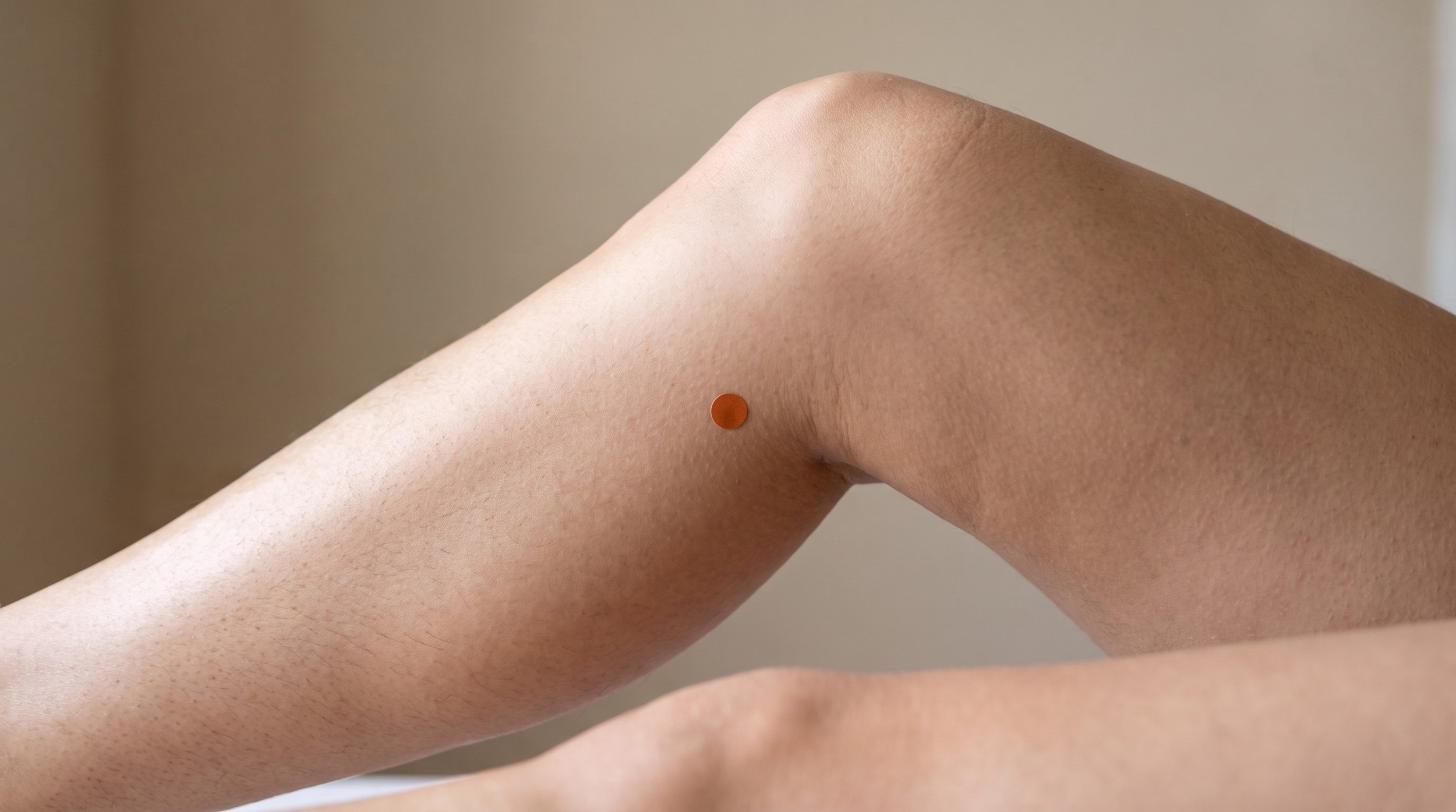
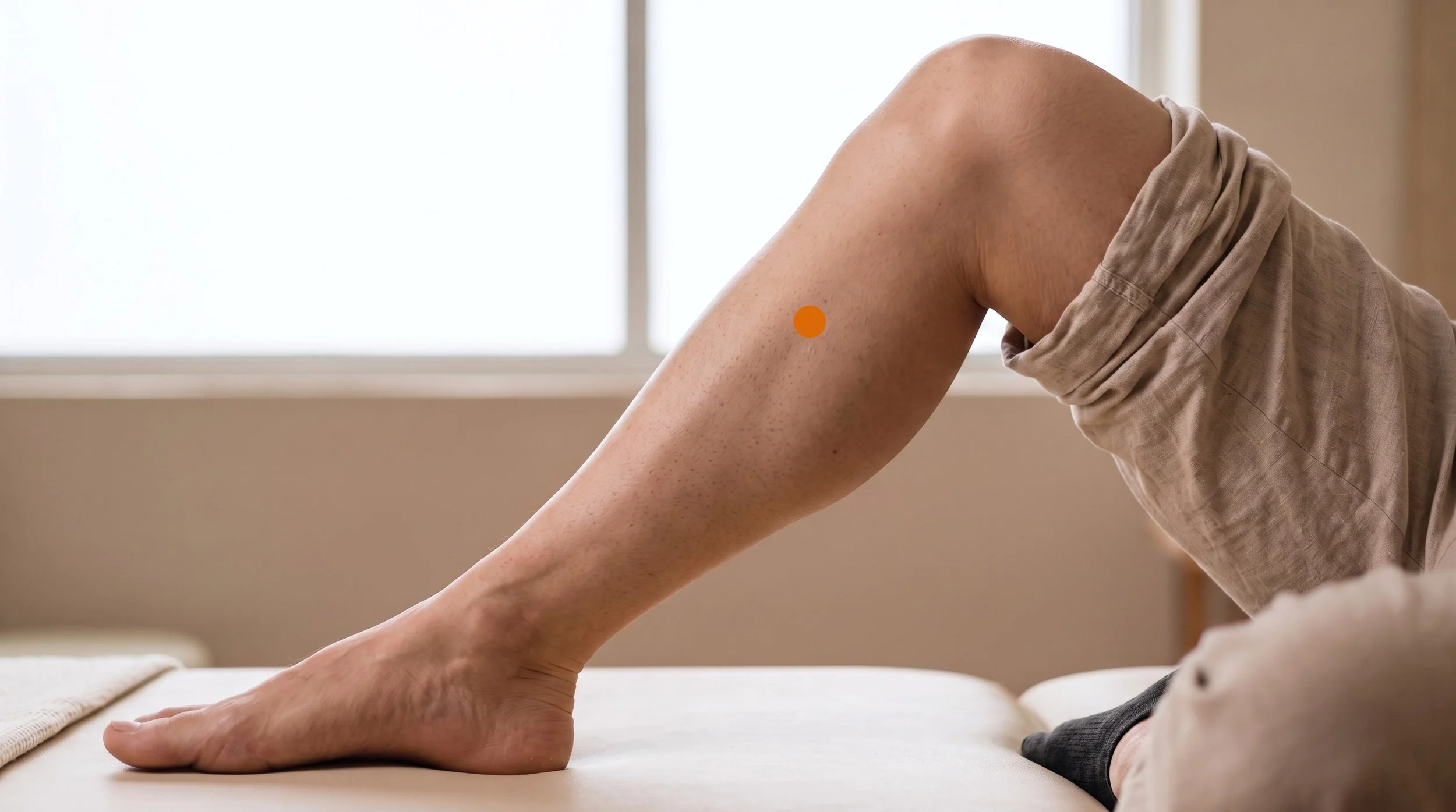
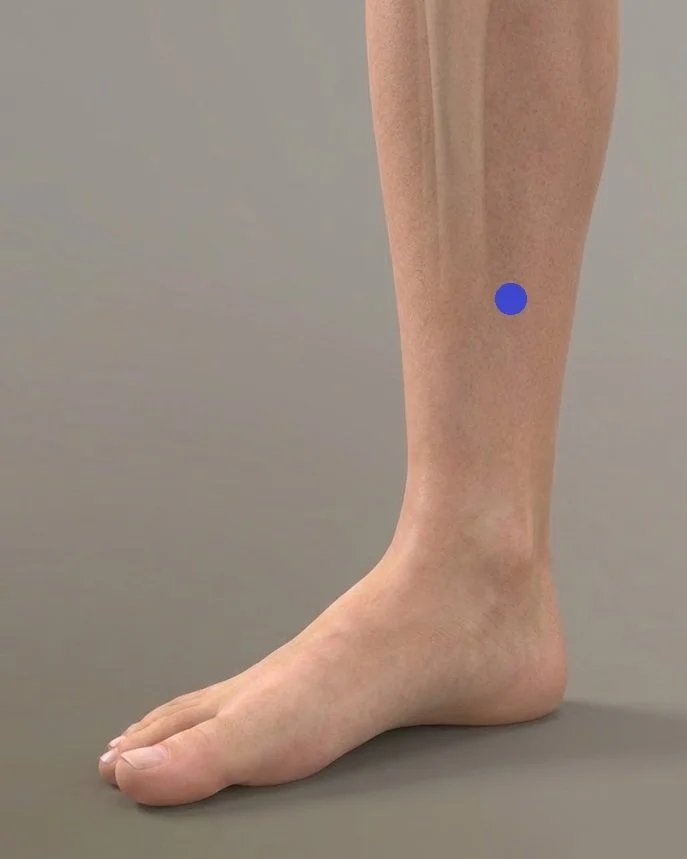
SP8, known in Chinese as Diji and usually translated as Earth Pivot, sits on the inner lower leg about a hand's breadth below the knob of bone at the top of the shin, tucked into the groove just behind the sharp medial edge of the tibia. It's the eighth point of the spleen channel and its xi-cleft (accumulation) point, a category traditionally reserved for sudden, sharp, and severe presentations.
In modern clinical practice that reputation translates into two very different uses: it's one of the first points many acupuncturists reach for during acute menstrual cramping, and it also happens to sit directly over the deep flexor and soleus tissue that gets loaded in medial shin and calf pain. Understanding both requires separating what the classics attributed to this point from what nerve anatomy can actually explain.
- SP8 lies 3 cun below SP9 in the depression posterior to the medial crest of the tibia, with the needle passing through skin and subcutaneous tissue near the saphenous nerve, then into the medial soleus and the flexor digitorum longus, with tibialis posterior and the posterior tibial neurovascular bundle deeper still.
- Traditional sources classify SP8 as the xi-cleft point of the spleen channel and attribute to it the regulation of menstruation, the movement of stagnant blood, the harmonising of the spleen with resolution of damp, and the moderating of acute conditions. These are presented here as classical attributions, not as physiological claims.
- Segmental input from this region reaches roughly the L4 to S1 spinal levels, which explains local effects on the medial shin and calf directly, while effects on pelvic symptoms are better explained by heterosegmental and descending pain control pathways involving spinal, brainstem, and opioid mechanisms (Zhao, 2008).
- A point-specific study found that tenderness at the SP8 region occurred more often, scored higher, and had a lower pressure threshold during menstruation than outside of it in women with primary dysmenorrhea, and that the most tender spot shifted slightly in location between states (Chen et al., 2015).
- The clinical evidence base is honest about its limits: the Cochrane review of acupuncture and acupressure for period pain judged the evidence insufficient and of low or very low quality (Smith et al., 2016), while a later meta-analysis suggested pain reduction favouring acupuncture with similar methodological caveats (Woo et al., 2018).
- De qi at SP8 is typically a deep, heavy ache with a spreading quality along the inner shin, sometimes traveling toward the ankle or up toward the knee, and the point is often noticeably more sensitive in the days surrounding a period.
Are Period Cramps Taking Days Out of Your Month?
At Morningside Acupuncture we use SP8 as a distal anchor in menstrual pain treatment, often combined with SP6, CV4, and LI4, and sometimes with gentle electroacupuncture when cramping is severe. We time treatment around your cycle rather than treating randomly, because most people report the best response when sessions land in the days before the period begins. Your first visit includes a full history, palpation of the inner leg and lower abdomen, and a plan you can follow across two or three cycles. Schedule an appointment and let's build that plan together.
Schedule NowAnatomy of SP8: Why the Medial Tibial Border Is Such an Important Location
Run your thumb down the inner edge of your shin bone and you'll feel a sharp ridge with a soft valley immediately behind it. SP8 sits in that valley, roughly a hand's breadth below SP9 at the level of the medial tibial condyle. The needle enters thin skin and a shallow layer of subcutaneous fat, then passes through the deep fascia into the medial belly of soleus, with the flexor digitorum longus lying beneath and tibialis posterior deeper again in the same compartment.
These are the muscles that decelerate the arch and control the ankle during running, hill work, and long days on hard city pavement, which is why this strip of the leg so often turns up tender in people who have never given it a thought.
Sensory supply to the overlying skin comes largely from the saphenous nerve, a branch of the femoral nerve carrying roughly L3 to L4 input, while the deeper muscular targets sit in tibial nerve territory spanning about L4 to S1 and below. That segmental arrangement explains the local half of the story cleanly: needling here delivers input to the same spinal levels that receive information from the deep calf, so mechanically driven medial shin and calf pain can respond to stimulation at the point itself.
The pelvic half is different. The uterus reports to thoracolumbar and sacral levels rather than to L4, so effects on menstrual pain are more plausibly explained by non-segmental mechanisms: diffuse inhibitory control, brainstem-mediated descending inhibition, and endogenous opioid signaling that dampens pain processing broadly rather than locally (Zhao, 2008). Somato-autonomic reflexes may also shift pelvic vascular tone, which is one reason researchers have tracked uterine artery flow indices during needling of nearby spleen channel points (Ma et al., 2010).
The great saphenous vein runs superficially and slightly anterior to this point, and varicosities are common enough in this region that a quick visual check before needling is worth the second it takes. Deeper in the compartment sit the posterior tibial artery, veins, and nerve, so angling steeply and posteriorly with a long needle is unnecessary and best avoided.
Classical texts describe perpendicular or oblique insertion of 1 to 1.5 cun, while several modern textbooks list a more conservative 0.5 to 1 cun; both are reasonable, and depth should track the patient's build and the tissue you're actually trying to reach. Moxibustion is traditionally described as suitable here.
Related Flexor Digitorum Longus Trigger Points Related Acupuncture For Tibialis Posterior PainSP8 at a Glance: Classification, Location, and Clinical Use
| Category | Detail |
|---|---|
| Traditional Name | Diji (Earth Pivot), the eighth point of the spleen channel |
| Channel Classification | Spleen channel of the foot taiyin (SP8, also written Spleen 8) |
| Point Categories | Xi-cleft (accumulation) point of the Spleen channel. Xi-cleft points on the yin channels are traditionally credited with an additional influence on blood disorders. No five-shu, hui-meeting, or extraordinary vessel designations are attributed to this point in the standard references. |
| Precise Location | Medial lower leg, 3 cun inferior to SP9, in the depression just posterior to the medial crest of the tibia. Easiest landmark: one handbreadth below SP9, or roughly the junction of the upper third and lower two thirds of a line from the popliteal crease to the tip of the medial malleolus. |
| Tissue Stimulated | Skin and subcutaneous tissue near the saphenous nerve, medial soleus, flexor digitorum longus, and deeper tibialis posterior in the deep posterior compartment |
| Needle Depth / Direction | Perpendicular or oblique insertion, commonly 0.5 to 1.5 cun depending on the source and the patient's build. Moxibustion is traditionally described as applicable. |
| De Qi Sensation | Deep, heavy, dull ache with a spreading or radiating quality along the inner shin, occasionally traveling toward the ankle or knee. Often sharply tender to palpation during menstruation. |
| Primary Clinical Uses | Acute menstrual cramping, irregular menstruation, medial shin and calf pain, and, in classical listings, abdominal distention and fullness |
| Common Point Combinations |
|
Deadman's A Manual of Acupuncture places SP8 among the xi-cleft points, described in traditional theory as sites where channel qi and blood are said to collect and plunge deeper, which is why the whole category was reserved for sudden and painful presentations and why the yin channel members of the group also carry blood-related indications.
Because the spleen was traditionally said to govern blood, and because its channel was described as entering the lower abdomen and meeting the conception vessel near CV3 and CV4, SP8 was credited with a specific action on stagnant blood in the uterus, appearing in classical lists for painful periods, irregular cycles, and abdominal masses in women.
A secondary traditional function, harmonising the spleen and resolving damp, accounts for the older indications clustered around fullness, poor appetite, difficult urination, swelling, and vaginal discharge, particularly when those complaints traveled alongside menstrual problems. What makes the classical picture striking is the regional scheme it belongs to: the Ode to Elucidate Mysteries assigns SP8 governance of the lower body while SP21 takes the upper and ST25 the middle, and a Ming dynasty investigation of channel points went so far as to claim that almost no lower-body disorder fell outside its scope. In the old correspondence system, the lower region was earth, which is precisely how a point on the inner shin came to be called Earth Pivot.
Why SP8 Is Used for Cramping That Starts in the Pelvis, Not the Leg
The obvious question about SP8 is why a point below the knee would matter for pain in the lower abdomen. The straightforward segmental answer doesn't work here, because the uterus sends its sensory traffic to thoracolumbar and sacral levels while the inner shin reports to roughly L4 and neighbouring segments. What likely does the work is broader modulation.
Strong stimulation at any well-innervated site recruits descending inhibitory pathways from the brainstem and triggers release of endogenous opioids and other neurotransmitters that reduce pain processing across regions rather than only at the segment stimulated (Zhao, 2008). Individual patient data from large chronic pain trials show effects of a modest but persistent size compared with sham and no-acupuncture controls, which is roughly the scale of benefit worth expecting (Vickers et al., 2018).
There may also be an autonomic and vascular component. Investigators studying spleen channel points near SP8 have measured uterine artery flow indices before and after needling and reported immediate reductions in menstrual pain alongside changes in those measures (Ma et al., 2010), and a separate controlled study reported shifts in prostaglandin levels after electroacupuncture in women with primary dysmenorrhea (Shi et al., 2011).
Since prostaglandin-driven uterine contraction and reduced perfusion are central to how period pain is currently understood, these are plausible mechanistic threads, though single small studies should be treated as hypothesis-generating rather than settled.
The point-specific finding that interests us most clinically is simpler. When researchers palpated the SP8 area in women with primary dysmenorrhea, tenderness appeared more frequently, felt more intense, and required less pressure to provoke during menstruation than outside it, and the most tender spot didn't always sit exactly on the textbook coordinate (Chen et al., 2015). That's a practical argument for palpating rather than measuring: the reactive spot in the SP8 region during a painful cycle is a real, findable target, and it tends to be the one that produces the most convincing de qi.
What the Research Shows for SP8
A fair reading of the research on SP8 has to start with a caveat: almost no trial isolates this point. Studies of acupuncture for period pain test whole protocols, most often built around SP6, CV4, and lower abdominal points, with SP8 appearing as one component among several. That means the literature can tell us something about the approach SP8 belongs to, and very little about SP8 on its own. The exception is a small body of acupoint-characterisation work that has used SP8 specifically as a study site.
Read together, the picture is one of plausible but unproven benefit, with systematic reviews consistently flagging low study quality as the limiting factor rather than negative findings.
| Study | Type | Focus | Key Finding |
|---|---|---|---|
| Smith et al., 2016 | Cochrane systematic review | Acupuncture and acupressure for primary dysmenorrhoea | Reviewers concluded there was insufficient evidence to determine whether acupuncture or acupressure helps, with evidence quality rated low to very low across comparisons. |
| Woo et al., 2018 | Systematic review and meta-analysis | Efficacy and safety of acupuncture in women with primary dysmenorrhea | Pooled results favoured acupuncture for pain reduction, though the authors flagged methodological weaknesses that limit how much confidence the estimate deserves. |
| Chen et al., 2015 | Comparative observational point study | Tenderness characteristics at Diji (SP8) during and outside menstruation | Tenderness at the SP8 area was more frequent, more intense, and provoked at lower pressure during menstruation, and its precise location varied between states. |
| Ma et al., 2010 | Randomized controlled trial | Electroacupuncture at a nearby spleen channel point versus GB39 and a non-meridian point, with uterine artery flow measures | The spleen channel point produced greater immediate menstrual pain relief than the comparison sites, offering preliminary support for point specificity. |
| Shi et al., 2011 | Randomized controlled mechanistic trial | Prostaglandin levels after electroacupuncture in primary dysmenorrhea | Changes in prostaglandin levels accompanied immediate analgesia, suggesting a possible biochemical route worth further study. |
| Armour et al., 2017 | Exploratory randomized controlled trial | Treatment timing and mode of stimulation for period pain | All groups improved substantially, with no clear superiority for a particular timing or stimulation mode in this exploratory sample. |
| Vickers et al., 2018 | Individual patient data meta-analysis | Acupuncture for chronic pain conditions | Effects were superior to both sham and no-acupuncture controls and persisted over time, though the difference from sham was modest. |
Medial Shin or Calf Pain That Flares Every Time You Run?
The SP8 region sits right over the soleus and the deep toe flexors, the same tissue that tends to get overloaded in medial shin pain and stubborn calf tightness. We combine acupuncture at spleen channel points with dry needling of soleus, flexor digitorum longus, and tibialis posterior, then pair it with loading advice so the tissue tolerates your mileage again. New York runners are a big part of our practice, and we treat the leg as a system rather than a single sore spot. Book a session and get assessed properly.
Schedule NowSP8 in the Context of Trigger Point Work
Acupuncture is defined by the tool, an acupuncture needle, and that same filiform needle covers hundreds of styles including dry needling. At SP8 the two approaches converge neatly, because the point sits directly over tissue that shows up repeatedly in myofascial assessment of the lower leg. The medial soleus and the deep toe flexors are documented sources of referred pain into the calf, medial ankle, and sole, and taut bands in this compartment are common in runners, dancers, and anyone logging long distances on unforgiving surfaces (Simons et al., 1999).
When a patient's complaint is medial shin or calf pain rather than pelvic pain, we treat the SP8 region as a myofascial target: palpate for the band, needle into it, and look for a local twitch response rather than aiming for a textbook coordinate.
In a typical session at Morningside, SP8 might be one insertion in a sequence that includes soleus, flexor digitorum longus, tibialis posterior, and often the gastrocnemius above, with electroacupuncture added if the presentation is stubborn or highly irritable. The same needling can serve two purposes at once in patients who have both leg symptoms and menstrual pain, though we're careful not to overclaim: local myofascial release and pelvic pain modulation are different mechanisms that happen to share an address.
What matters clinically is matching the technique to the complaint, and following the needling with loading, calf strength work, and gait or footwear adjustments where they're indicated.
SP8 Menstrual Pain Treatment at NYC's Highest-Rated Acupuncture Clinic
Morningside Acupuncture is the highest-rated acupuncture and dry needling clinic in New York City with over 500 five-star Google reviews, and menstrual health is one of our most requested areas of care. Our licensed acupuncturists integrate classical point selection like SP8 and SP10 with modern pain science, myofascial assessment, and clear at-home guidance. Whether your goal is fewer painkillers, less disruption at work, or simply a calmer cycle, we'll track progress cycle by cycle. Schedule your visit at our Midtown Manhattan clinic today.
Schedule NowFrequently Asked Questions
What does SP8 feel like when needled?
Most people describe a deep, heavy ache rather than a sharp pain, sometimes with a spreading or electric quality that travels down toward the ankle or up toward the knee. That sensation is de qi, and it's the response practitioners are looking for. During menstruation the point often feels considerably more tender than usual, so we tend to use lighter stimulation at first and build up based on how you respond. Some soreness for a few hours afterward is normal and typically settles quickly.
Why use a point on the lower leg for pain in the lower abdomen?
Because pain modulation isn't limited to the segment you needle. Strong stimulation at a well-innervated distal site recruits descending inhibitory pathways from the brainstem and endogenous opioid systems that reduce pain processing more broadly (Zhao, 2008). There may also be autonomic effects on pelvic vascular tone, which is why researchers have measured uterine artery flow during needling of nearby spleen channel points (Ma et al., 2010). Practically speaking, distal points are also easy to access, comfortable to lie on, and can be stimulated during a session without disturbing the abdomen.
Can I press SP8 myself between sessions?
Yes, and it's one of the more accessible self-care points. Sit with your knee bent, find the inner edge of your shin bone, slide about one hand's breadth down from the bony prominence below the knee, and roll your thumb into the soft groove just behind the bone until you find the sorest spot. Apply firm, steady pressure that registers as a strong ache but never as sharp pain, hold for 30 to 60 seconds, release, and repeat two or three times on each leg. Small circular pressure works just as well as static pressure. Many patients find it most useful two or three days before their period begins and during the first day or two of cramping, repeating two or three times a day. Stop if you get numbness, tingling, or pain that lingers, and skip the area entirely if you have varicose veins there.
Is SP8 safe to needle?
In trained hands, yes. The main considerations are the great saphenous vein running superficially and slightly forward of the point, which should be avoided, and the posterior tibial artery, veins, and nerve sitting deep in the compartment, which is a reason to keep depth reasonable and avoid steep posterior angling. Varicose veins, skin infection, or compromised circulation in the lower leg are reasons to needle elsewhere. Points on the lower spleen channel are traditionally approached with caution during pregnancy, so tell your acupuncturist if you are or might be pregnant and let them adjust the plan. Adverse events from acupuncture in this region are uncommon and generally limited to brief soreness or minor bruising.
Where exactly is SP8 located?
On the medial side of the lower leg, 3 cun below SP9, in the depression immediately posterior to the medial crest of the tibia. The simplest way to find it is to locate SP9 at the lower border of the medial tibial condyle, then measure one handbreadth (four finger widths) straight down and slip your thumb just behind the shin bone's edge. An alternative reference divides a line from the popliteal crease to the tip of the medial malleolus and places the point at the junction of the upper third and the lower two thirds. In practice, palpation trumps measurement: research on SP8 found the most tender spot shifts slightly depending on physiological state (Chen et al., 2015), so we needle the reactive point within that small area.
References
- Deadman, P., Al-Khafaji, M., & Baker, K. (2009). A manual of acupuncture. Journal of Chinese Medicine Publications.
- Maciocia, G. (2005). The foundations of Chinese medicine: A comprehensive text for acupuncturists and herbalists (2nd ed.). Elsevier Churchill Livingstone.
- Maciocia, G. (2006). The channels of acupuncture: Clinical use of the secondary channels and eight extraordinary vessels. Churchill Livingstone Elsevier.
- Cunningham, P. M. (2000). Acupuncture points: A practical guide to classical and modern usage. Odyssey Press.
- Kim, H. (2008). Handbook of Oriental medicine (3rd ed.). Harmony & Balance Press.
- Simons, D. G., Travell, J. G., & Simons, L. S. (1999). Travell & Simons' myofascial pain and dysfunction: The trigger point manual, Vol. 1: Upper half of body (2nd ed.). Williams & Wilkins.
- Smith, C. A., Armour, M., Zhu, X., Li, X., Lu, Z. Y., & Song, J. (2016). Acupuncture for dysmenorrhoea. Cochrane Database of Systematic Reviews, 2016(4), CD007854. https://doi.org/10.1002/14651858.CD007854.pub3 [VERIFY BEFORE PUBLISHING]
- Woo, H. L., Ji, H. R., Pak, Y. K., Lee, H., Heo, S. J., Lee, J. M., & Park, K. S. (2018). The efficacy and safety of acupuncture in women with primary dysmenorrhea: A systematic review and meta-analysis. Medicine, 97(23), e11007. https://doi.org/10.1097/MD.0000000000011007
- Chen, S., Miao, Y., Nan, Y., Wang, Y., Zhao, Q., He, E., Sun, Y., & Zhao, J. (2015). The study of dynamic characteristic of acupoints based on the primary dysmenorrhea patients with the tenderness reflection on Diji (SP 8). Evidence-Based Complementary and Alternative Medicine, 2015, 158012. https://doi.org/10.1155/2015/158012
- Ma, Y. X., Ma, L. X., Liu, X. L., Ma, Y. X., Lv, K., Wang, D., Liu, J. P., Xing, J. M., Cao, H. J., Gao, S. Z., & Zhu, J. (2010). A comparative study on the immediate effects of electroacupuncture at Sanyinjiao (SP6), Xuanzhong (GB39) and a non-meridian point, on menstrual pain and uterine arterial blood flow, in primary dysmenorrhea patients. Pain Medicine, 11(10), 1564-1575. https://doi.org/10.1111/j.1526-4637.2010.00949.x
- Shi, G. X., Liu, C. Z., Zhu, J., Guan, L. P., Wang, D. J., & Wu, M. M. (2011). Effects of acupuncture at Sanyinjiao (SP6) on prostaglandin levels in primary dysmenorrhea patients. The Clinical Journal of Pain, 27(3), 258-261. https://doi.org/10.1097/AJP.0b013e3181fb27ae
- Armour, M., Dahlen, H. G., Zhu, X., Farquhar, C., & Smith, C. A. (2017). The role of treatment timing and mode of stimulation in the treatment of primary dysmenorrhea with acupuncture: An exploratory randomised controlled trial. PLOS ONE, 12(7), e0180177. https://doi.org/10.1371/journal.pone.0180177
- Zhao, Z. Q. (2008). Neural mechanism underlying acupuncture analgesia. Progress in Neurobiology, 85(4), 355-375. https://doi.org/10.1016/j.pneurobio.2008.05.004
- Vickers, A. J., Vertosick, E. A., Lewith, G., MacPherson, H., Foster, N. E., Sherman, K. J., Irnich, D., Witt, C. M., & Linde, K. (2018). Acupuncture for chronic pain: Update of an individual patient data meta-analysis. Journal of Pain, 19(5), 455-474. https://doi.org/10.1016/j.jpain.2017.11.005
Disclaimer: This web site is intended for educational and informational purposes only. Reading this website does not constitute providing medical advice or any professional services. This information should not be used for diagnosing or treating any health issue or disease. Those seeking medical advice should consult with a licensed physician. Seek the advice of a medical doctor or other qualified health professional for any medical condition. If you think you have a medical emergency, call 911 or go to the emergency room. No acupuncturist-patient relationship is created by reading this website or using the information. Morningside Acupuncture PLLC and its employees and contributors do not make any express or implied representations with respect to the information on this site or its use. For any legal interpretation of scope of practice in your state, consult a licensed attorney or regulatory authority.
Read more from our blog