SP9 Acupuncture Point (Yinlingquan)
SP9 Acupuncture Point
The Yin Mound Spring Below the Medial Knee: Anatomy, Mechanism, and Why This He-Sea Point Anchors Treatment for Knee Pain and Swelling
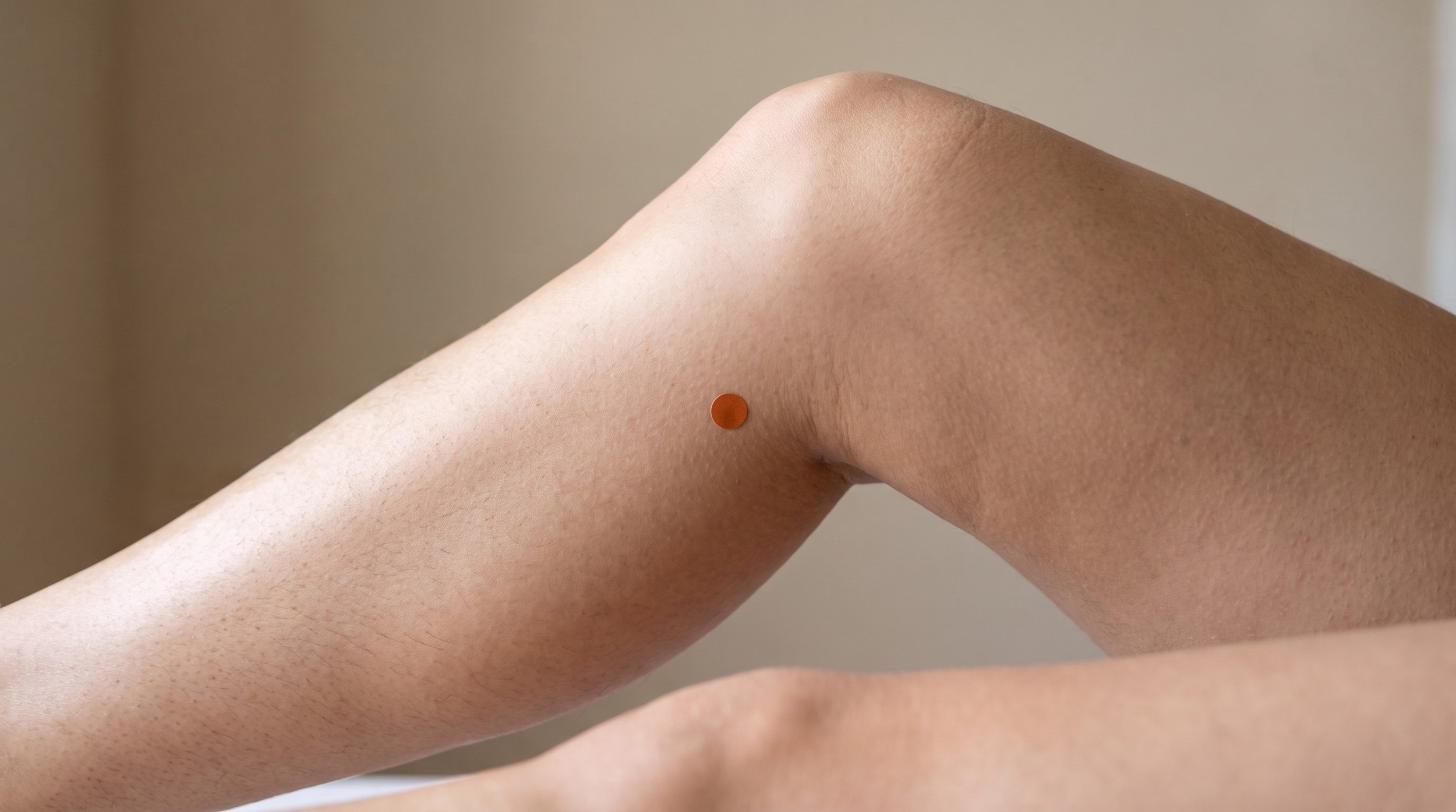
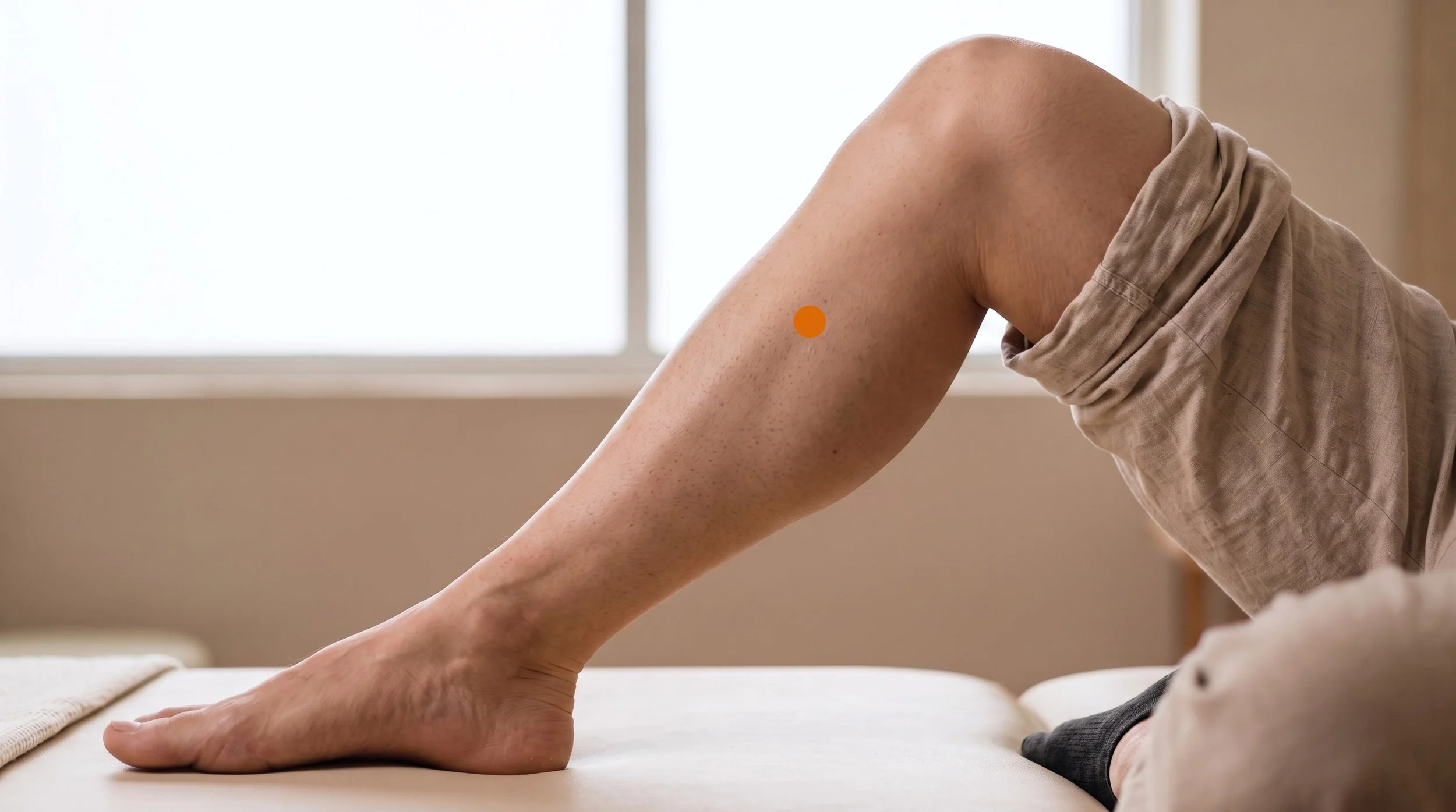
The SP9 acupuncture point, known in Chinese as Yinlingquan and translated as Yin Mound Spring, sits on the inner side of the lower leg in the soft hollow just under the flare of the medial tibial condyle, where the bone turns and the calf muscles begin. It's the he-sea point and the water point of the Spleen channel, and in classical texts it's the address you go to when tissue feels boggy, heavy, or waterlogged, especially below the waist. In a modern clinic, spleen 9 earns its place for a much more concrete reason: it lands in a richly innervated corridor that shares spinal segments with the medial knee, the pes anserine region, and the deep posterior calf, which makes it a practical needling target for medial knee pain, swelling around the joint, tight calves, and the heavy-leg complaints that come with prolonged standing or long days on New York City sidewalks.
- SP9 is located in the depression between the inferior border of the medial condyle of the tibia and the posterior border of the tibia, and it sits at roughly the same height as GB34 on the outer leg, which is why the two are so often needled as a medial and lateral pair (Deadman et al., 2007).
- Classical sources categorize SP9 as the he-sea and water point of the Spleen channel and traditionally credit it with resolving dampness, opening the water passages, and benefiting the lower jiao; translated into clinical language, that's a point used for swelling, fluid retention, digestive heaviness, and lower-body symptoms (Deadman et al., 2007).
- The needle passes through skin supplied by the saphenous nerve into the origin region of the medial gastrocnemius and soleus, so the sensation and the therapeutic input travel through L3 to L5 segmental pathways that also serve the medial knee joint capsule (Deadman et al., 2007; Cheng, 1987).
- Needling activates small-diameter afferents that recruit spinal segmental inhibition and brainstem-mediated descending pain control, along with local vasodilation and changes in muscle tone, which is the mechanism most likely to explain why a point below the joint may reduce pain felt inside it (Zhao, 2008).
- SP9 is one of the most consistently used acupoints in knee osteoarthritis trials, appearing alongside GB34, ST35, EX-LE4, and ST36 in protocols pooled by systematic reviews, so most of the evidence tests it as part of a formula rather than on its own (Chen et al., 2024; Yu et al., 2021).
- De qi at SP9 is usually described as a deep, dull, spreading ache under the bone edge that may travel down the inner calf or up toward the knee; a sharp or electric line down toward the ankle suggests contact with a saphenous nerve branch and calls for repositioning.
Is Your Knee Pain Worse on the Inner Side?
Medial knee pain that flares with stairs, squatting, or long walks often involves the pes anserine region, the medial joint line, and an overworked medial calf. At Morningside Acupuncture, we use SP9 as part of a targeted plan that pairs local knee points with dry needling of the muscles that load the joint. We assess how you move first, then needle what's actually driving the pain. Book a session and let's map your knee properly.
Schedule NowAnatomy of SP9: Why the Hollow Below the Medial Tibial Condyle Is Such an Important Location
Run a fingertip up the groove behind the inner shin bone and it will drop into a soft pocket just as the tibia flares into its medial condyle. That pocket is SP9. Under the skin and a thin layer of subcutaneous fat, the needle enters dense fascia at the transition between the tibial periosteal border and the muscular origins of the medial head of gastrocnemius and the soleus, with the popliteus and deeper posterior compartment lying further in (Deadman et al., 2007). Just anterior and slightly below, the conjoined tendons of sartorius, gracilis, and semitendinosus form the pes anserine attachment, a common site of irritation in runners, cyclists, and anyone with a valgus knee posture. This region loads heavily during walking, stair climbing, and single-leg stance, which is why patients so often report tenderness here without ever having thought about it.
The nerve geography is what makes SP9 clinically useful rather than merely anatomical. Cutaneous supply comes from the saphenous nerve and the medial crural cutaneous branches, derived from the femoral nerve at roughly L3 and L4, and these same segments contribute to the sensory innervation of the medial knee joint and its capsule (Cheng, 1987). Deeper input from the calf musculature enters the cord around L5 to S2. Needling here therefore delivers a strong afferent barrage into spinal segments that already receive traffic from the painful joint, and this convergence is the most plausible reason a point below the knee may change how the knee itself feels. Sustained stimulation of small-diameter muscle afferents also recruits descending inhibitory pathways from the brainstem, along with local release of vasoactive peptides that increase blood flow around the needled tissue (Zhao, 2008).
Deeper and slightly posterior to the point lie the posterior tibial vessels and the tibial nerve, while the great saphenous vein runs superficially in the vicinity, so clean, controlled technique matters more than depth (Cheng, 1987). Standard practice is perpendicular insertion of 1 to 1.5 cun, angled into the space beneath the condyle rather than jammed into periosteum (Deadman et al., 2007). Practitioners visually check for varicosities before needling, avoid them entirely, and adjust immediately if a patient reports a sharp electric sensation traveling toward the inner ankle, which suggests the needle is close to a saphenous branch. In patients with significant swelling or compromised circulation, we use finer needles, shorter retention, and lighter stimulation.
Related Best Acupuncture Points For Knee Pain Related Acupuncture For Knee PainSP9 at a Glance: Classification, Location, and Clinical Use
| Category | Detail |
|---|---|
| Traditional Name | Yinlingquan (Yin Mound Spring), SP9, also written spleen 9 or SP-9 |
| Channel Classification | Spleen channel of the foot taiyin, lower leg, medial aspect |
| Point Categories | He-sea point of the Spleen channel; Water point of the Spleen channel within the five-shu system |
| Precise Location | On the medial side of the lower leg, in the depression between the inferior border of the medial condyle of the tibia and the posterior border of the tibia; level with GB34 on the lateral side |
| Tissue Stimulated | Skin and subcutaneous fascia over the medial tibial border, the origin region of the medial gastrocnemius and soleus, with the deeper posterior compartment including tibialis posterior nearby |
| Needle Depth / Direction | Perpendicular insertion 1 to 1.5 cun, directed into the hollow beneath the tibial condyle rather than into periosteum; moxibustion is traditionally applied here |
| De Qi Sensation | Deep, dull, heavy ache under the bone edge, often spreading down the inner calf or upward toward the knee; sharp or electric sensations toward the inner ankle mean the needle should be repositioned |
| Primary Clinical Uses | Knee pain, especially medial knee pain with swelling; leg heaviness and fluid retention; medial lower leg and calf pain; digestive complaints including abdominal distention and loose stools; urinary and lower abdominal symptoms as traditionally described |
| Common Point Combinations |
|
In the classical literature summarized by Deadman and colleagues, SP9 is the Spleen channel's premier point for what the tradition calls dampness, a pattern that describes heaviness, swelling, sluggish digestion, discharge, and a general sense of being waterlogged rather than any measurable substance. Because it's both the he-sea point and the water point, it was traditionally attributed the actions of regulating the Spleen and resolving dampness, opening and moving the water passages, and benefiting the lower jiao, and its classical indication lists cluster into four recognizable groups: abdominal and digestive complaints, urinary and genital symptoms, generalized swelling of the limbs, and pain or swelling of the knee and leg (Deadman et al., 2007). Older texts went so far as to claim that few pains of the middle and lower body fall outside its reach, and commentators noted that it drains excess far better than it supplements deficiency, in contrast to points like SP3. What's striking about the classical pattern is how tightly it maps onto one anatomical theme: a point sitting at the drainage-heavy, gravity-dependent inner leg was assigned nearly every complaint that involves fluid pooling downward, long before anyone described venous or lymphatic return.
Why SP9 Is Used for Swollen Knees and Heavy, Puffy Lower Legs
The first part of the answer is segmental. Sensory fibers from the skin and fascia at SP9 travel in the saphenous nerve and enter the spinal cord at roughly L3 and L4, the same levels that carry sensation from the medial knee joint and its capsule (Cheng, 1987). When a needle produces de qi at SP9, it floods those segments with input from small-diameter afferents, which can dampen the transmission of pain signals arriving from the joint itself. This is why patients sometimes notice the knee feeling looser during a treatment in which nothing was needled directly at the joint line.
The second part is systemic. Sustained needle stimulation engages descending inhibitory pathways involving endogenous opioid, serotonergic, and noradrenergic systems, and it triggers local axon-reflex responses that increase blood flow in the needled tissue (Zhao, 2008). For a swollen, stiff medial knee, both effects matter: reduced pain sensitivity makes movement more tolerable, and better local circulation combined with restored calf muscle pump activity gives the tissue a better chance to clear the puffiness that accumulates during the day. We frame this cautiously, since acupuncture doesn't drain fluid mechanically, but the combination of pain relief and improved movement is often what patients experience as lighter legs.
There's also a practical mechanical reason SP9 gets used so much. The medial gastrocnemius and soleus originate in this region, and when they're chronically shortened, the knee sits in a stiffer, more compressed pattern. Needling into that origin zone can reduce local tenderness and improve tolerance for calf stretching and loading, which is exactly what a rehab plan needs. Acupuncture works best here as one input among several, alongside strength work and graded activity.
What the Research Shows for SP9
It's worth being clear about what the research does and doesn't say. Almost no trial isolates a single point, so SP9 has been studied as a member of standard knee protocols rather than on its own, and reviews reflect the quality limits of the underlying trials, including blinding problems inherent to needling studies. The most honest summary is that acupuncture protocols containing SP9 have shown modest benefits for chronic knee pain in pooled analyses, that effect sizes shrink against sham comparisons, and that individual trials disagree. That's a reasonable evidence base for a low-risk adjunct, not a reason to promise outcomes.
| Study | Type | Focus | Key Finding |
|---|---|---|---|
| Manheimer et al., 2010 | Cochrane systematic review | Acupuncture for peripheral joint osteoarthritis, including the knee | Sham-controlled trials showed small statistically significant benefits that fell short of the review's clinical relevance threshold, while waiting-list comparisons showed larger effects the authors attributed partly to expectation. |
| Vickers et al., 2018 | Individual patient data meta-analysis | Acupuncture for chronic pain conditions including osteoarthritis | Acupuncture was associated with better pain outcomes than both sham and no-acupuncture controls, with effects that persisted over months rather than disappearing immediately after treatment. |
| Chen et al., 2024 | Systematic review and meta-analysis | Durability of acupuncture effects after treatment ends in knee osteoarthritis | SP9 was among the most frequently selected acupoints across included trials, and pooled results suggested benefits for pain and function that may persist for a period after treatment, with variable trial quality. |
| Hinman et al., 2014 | Randomized clinical trial | Needle and laser acupuncture for chronic knee pain in adults over 50 | Modest improvements over 12 weeks were not clinically meaningful compared with sham, a result that tempers expectations and remains widely debated in the field. |
| Yu et al., 2021 | Randomized controlled trial | Local knee points including SP9 and GB34 compared with distal points and sham | All groups reported pain reduction after a single session, with distal point selection performing comparatively well, suggesting point choice interacts with mechanism in ways still being worked out. |
| Jiménez-del-Barrio et al., 2022 | Systematic review and meta-analysis | Dry needling of myofascial trigger points in hip or knee osteoarthritis | Very low certainty evidence suggested short-term reductions in pain intensity and improvements in physical function, supporting dry needling as an adjunct rather than a stand-alone treatment. |
Do Your Legs Feel Heavy, Puffy, or Swollen by Evening?
Traditionally, SP9 is the point practitioners reach for when the lower legs feel waterlogged and stiff, and modern practice keeps it in rotation for swelling around a cranky knee and for that end-of-day heaviness after standing all day. We combine it with SP6, ST36, and gentle calf work to support circulation and comfort. Treatment is calm, precise, and tailored to your presentation. Schedule a visit and see how your legs feel after a few sessions.
Schedule NowSP9 in the Context of Trigger Point Work
Acupuncture is defined by the tool, an acupuncture needle, and it spans hundreds of styles, including dry needling. That framing matters at SP9, because the point sits directly over tissue that trigger point practitioners target for their own reasons. The medial head of gastrocnemius and the upper soleus both originate in this neighborhood, and taut bands there commonly refer discomfort into the medial calf, the back of the knee, and occasionally the arch of the foot. Just anterior, the pes anserine tendons and the medial retinaculum can become tender in patients with knee osteoarthritis or repetitive loading from running and stair climbing.
At Morningside Acupuncture, we frequently combine classical point selection at SP9 and GB34 with dry needling of the medial gastrocnemius, soleus, tibialis posterior, and quadriceps depending on what the exam reveals. The point-based needling handles segmental and systemic pain modulation while the trigger point work addresses the specific bands limiting knee flexion or calf extensibility. We then reinforce the session with calf loading, hip strength work, and gait or footwear advice, since needling that isn't followed by better movement tends to give shorter-lived relief.
SP9 Knee Pain Treatment at NYC's Highest-Rated Acupuncture Clinic
Morningside Acupuncture is the highest-rated acupuncture and dry needling clinic in New York City with over 500 five-star Google reviews, and knee pain is one of the conditions we treat most. We blend classical point selection like SP9 and GB34 with trigger point dry needling of the gastrocnemius, soleus, and quadriceps to address both the joint and the tissue pulling on it. Every plan includes movement guidance so results hold between visits. Schedule your appointment today.
Schedule NowFrequently Asked Questions
What does SP9 feel like when needled?
Most patients feel a deep, heavy, dull ache directly under the edge of the shin bone once the needle reaches the right layer. That sensation, called de qi, often spreads downward into the inner calf or upward toward the knee, and it may come with a brief sense of fullness or warmth. It shouldn't feel sharp, burning, or electric; a zinging line toward the inner ankle usually means the needle is near a saphenous nerve branch, and your practitioner should adjust it right away. Some soreness for a day afterward is common and typically fades quickly.
Why needle below the knee instead of directly on the painful joint?
Because the tissue at SP9 shares spinal segments with the medial knee joint, needling there feeds strong input into the same cord levels that process pain from the joint, which can reduce transmission without irritating an already inflamed area (Zhao, 2008). It also reaches the muscle origins that compress and stiffen the knee during walking and stairs. In practice, we usually do both: local points around the joint line plus SP9 and GB34 as a medial and lateral pair, since that combination reflects both classical practice and the protocols used in most knee osteoarthritis trials (Chen et al., 2024).
Can I press SP9 myself between sessions?
Yes, acupressure at SP9 is straightforward and low risk. Sit with your knee bent and slide your thumb up the groove just behind the inner shin bone until it drops into the hollow beneath the bony flare of the tibia. Angle your thumb slightly upward and inward under that ledge, then apply steady, moderate pressure for 30 to 60 seconds until you feel a dull ache rather than sharpness. Rest for 15 seconds and repeat two or three times per leg, once or twice daily. Finish with 20 ankle pumps and a gentle calf stretch, which tends to make the effect last longer. Skip it if you have varicose veins, active swelling from an unexplained cause, broken skin, or a recent injury in that area, and back off if pressure produces tingling down toward your ankle.
Is SP9 safe to needle?
In trained hands, yes. The standard depth is 1 to 1.5 cun perpendicular into the space below the tibial condyle (Deadman et al., 2007). The main considerations are the great saphenous vein running superficially nearby and saphenous nerve branches in the region, so practitioners inspect for varicosities, avoid visible veins, and reposition immediately if a patient reports electric sensations (Cheng, 1987). Mild bruising is the most common side effect. Patients on blood thinners, with significant lower limb swelling of unclear origin, with a history of deep vein thrombosis, or with compromised circulation should tell their practitioner so technique can be adjusted or the point substituted.
Where exactly is SP9 located?
For sp 9 point location, sit with the knee slightly bent and find the bony bump on the inner side of the top of the shin, the medial condyle of the tibia. Then slide your finger along the groove just behind the inner edge of the shin bone and travel upward until it falls into a depression right below that condyle. That depression is SP9. A useful cross-check is that it sits at about the same height as GB34 on the outer side of the leg, just below and in front of the head of the fibula (Deadman et al., 2007).
References
- Deadman, P., Al-Khafaji, M., & Baker, K. (2009). A manual of acupuncture. Journal of Chinese Medicine Publications.
- Cheng, X. (Ed.). (1999). Chinese acupuncture and moxibustion (Rev. ed.). Foreign Languages Press.
- Zhao, Z. Q. (2008). Neural mechanism underlying acupuncture analgesia. Progress in Neurobiology, 85(4), 355-375. https://doi.org/10.1016/j.pneurobio.2008.05.004
- Vickers, A. J., Vertosick, E. A., Lewith, G., MacPherson, H., Foster, N. E., Sherman, K. J., Irnich, D., Witt, C. M., & Linde, K. (2018). Acupuncture for chronic pain: Update of an individual patient data meta-analysis. Journal of Pain, 19(5), 455-474. https://doi.org/10.1016/j.jpain.2017.11.005
- Manheimer, E., Cheng, K., Linde, K., Lao, L., Yoo, J., Wieland, S., van der Windt, D. A. W. M., Berman, B. M., & Bouter, L. M. (2010). Acupuncture for peripheral joint osteoarthritis. Cochrane Database of Systematic Reviews, 2010(1), CD001977. https://doi.org/10.1002/14651858.CD001977.pub2
- Chen, H., Shi, H., Gao, S., Fang, J., Yi, J., Wu, W., Liu, X., & Liu, Z. (2024). Durable effects of acupuncture for knee osteoarthritis: A systematic review and meta-analysis. Current Pain and Headache Reports, 28(7), 709-722. https://doi.org/10.1007/s11916-024-01242-6
- Hinman, R. S., McCrory, P., Pirotta, M., Relf, I., Forbes, A., Crossley, K. M., Williamson, E., Kyriakides, M., Novy, K., Metcalf, B. R., Harris, A., Reddy, P., Conaghan, P. G., & Bennell, K. L. (2014). Acupuncture for chronic knee pain: A randomized clinical trial. JAMA, 312(13), 1313-1322. https://doi.org/10.1001/jama.2014.12660
- Yu, W. Z., Huang, C. M., Ng, H. P., & Lee, Y. C. (2021). Distal acupoints outperform proximal acupoints in treating knee osteoarthritis: A randomized controlled trial. Evidence-Based Complementary and Alternative Medicine, 2021, 4827123. https://doi.org/10.1155/2021/4827123
- Jiménez-del-Barrio, S., Medrano-de-la-Fuente, R., Hernando-Garijo, I., Mingo-Gómez, M. T., Estébanez-de-Miguel, E., & Ceballos-Laita, L. (2022). The effectiveness of dry needling in patients with hip or knee osteoarthritis: A systematic review and meta-analysis. Life, 12(10), 1575. https://doi.org/10.3390/life12101575
Disclaimer: This web site is intended for educational and informational purposes only. Reading this website does not constitute providing medical advice or any professional services. This information should not be used for diagnosing or treating any health issue or disease. Those seeking medical advice should consult with a licensed physician. Seek the advice of a medical doctor or other qualified health professional for any medical condition. If you think you have a medical emergency, call 911 or go to the emergency room. No acupuncturist-patient relationship is created by reading this website or using the information. Morningside Acupuncture PLLC and its employees and contributors do not make any express or implied representations with respect to the information on this site or its use. For any legal interpretation of scope of practice in your state, consult a licensed attorney or regulatory authority.
Read more from our blog