SP5 Acupuncture Point (Shangqiu)
SP5 Acupuncture Point (Shangqiu)
The Shang Mound in Front of the Inner Ankle Bone: Anatomy, Mechanism, and Why This Small Medial Ankle Point Earns Its Place in Sprain and Digestive Protocols
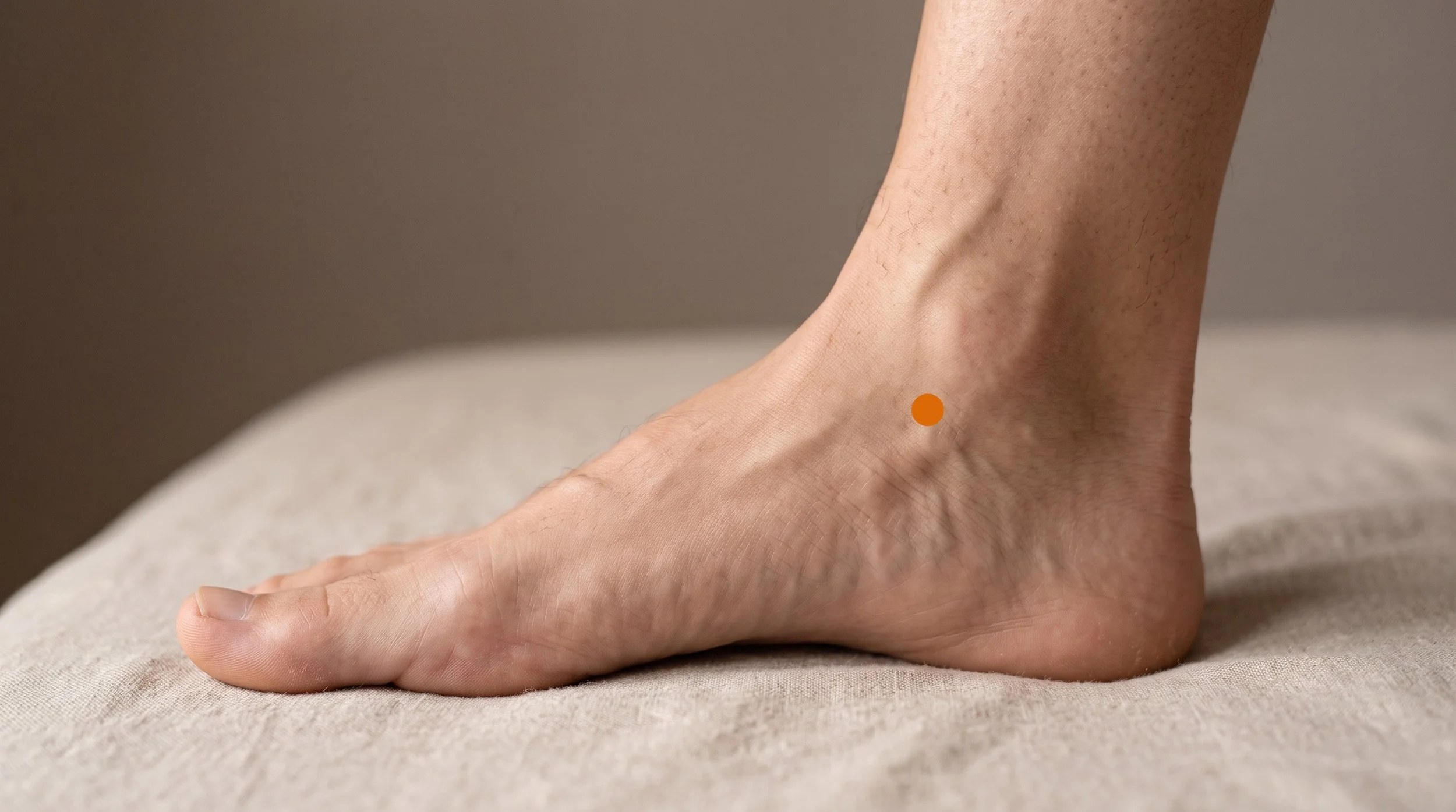
SP5 (Shangqiu, often translated as Shang Mound or Metal Mound) sits in the small hollow just in front of and below the bony bump on the inside of your ankle, at the corner where a line down the front border of the medial malleolus meets a line along its lower border. It's the Jing-river and Metal point of the Spleen channel, which in classical terms makes it the child point used to drain the channel, and in practical terms makes it one of the most reliably useful needling locations on the medial ankle.
The sp5 acupuncture point matters clinically because that little depression sits directly over the deltoid ligament complex and the tendon corridor of tibialis anterior and posterior, the exact tissue that gets loaded in eversion strain, chronic medial ankle stiffness, and the long tail of a rolled ankle. Classical sources also list Shangqiu for sluggish digestion, heaviness, and fatigue, and those traditional attributions are worth understanding on their own terms.
- Location and layers: SP5 is found in the depression at the junction of the anterior and inferior borders of the medial malleolus. The needle passes through thin skin and subcutaneous fascia into a ligament and tendon-rich corner shared by the deltoid ligament complex and the tendons of tibialis anterior and posterior, which is why the point is so anatomically specific.
- Traditional categories, translated: as the Jing-river and Metal point of the Spleen channel, SP5 is traditionally classified as the child point of an earth channel and was used to reduce patterns described as excess (Deadman et al., 2001). In modern language, we treat it as a segmentally relevant distal point at a joint that is dense with mechanoreceptors and nociceptors.
- Nerve story: cutaneous supply at the medial ankle comes largely from the saphenous nerve, roughly the L4 segment, with nearby branches of the superficial fibular nerve. Needling here recruits A-delta and C fiber afferents that feed dorsal horn circuits and engage descending inhibitory pathways involving endogenous opioids, serotonin, and noradrenaline (Zhao, 2008).
- Research picture: reviews of acupuncture for ankle sprain report symptom improvement over usual care, but the trials are small and often methodologically weak, so the honest reading is promising rather than settled (Park et al., 2013; Liu et al., 2020). For persistent pain generally, individual patient data meta-analysis supports modest but real effects that persist over time (Vickers et al., 2018).
- Clinical framing: we rarely use SP5 alone. It's typically paired with GB40 on the lateral side for a medial and lateral ankle bracket after sprain, threaded toward ST41 across the front of the joint, or combined with SP6 and proximal points when the presentation includes digestive complaints alongside heaviness in the legs.
- De qi at SP 5 ankle: most people feel a dull, slightly spreading ache or a heavy pressure right around the joint line, sometimes traveling toward the arch or the front of the ankle. It shouldn't feel electric or radiate sharply into the foot, and shallow insertion (0.2 to 0.3 cun) is standard here (Deadman et al., 2001).
Still Guarding That Ankle Months After the Sprain?
Ankles that never fully settle usually have three problems at once: irritated ligament tissue, stiff joint mechanics, and calf and shin muscles that have quietly stopped sharing the load. At Morningside Acupuncture we use SP5 together with lateral ankle points and dry needling of tibialis posterior and anterior to address all three in the same visit. We also check how you're loading the foot when you walk, so the treatment holds between sessions. Schedule a visit and let's get the ankle moving confidently again.
Schedule NowAnatomy of SP5: Why the Front Corner of the Medial Malleolus Is Such an Important Location
Slide a finger down the front edge of your inner ankle bone and then forward along its lower border, and the two lines meet in a soft hollow. That's spleen 5. The skin here is thin and the subcutaneous layer is sparse, so the needle reaches functional tissue quickly: the superficial fascia, then the anterior fibers of the deltoid ligament complex, with the tendon of tibialis anterior crossing just laterally and the tibialis posterior tendon curving behind and beneath the malleolus toward the navicular.
This corner is loaded every time the foot pronates, every time you push off from a slightly collapsed arch, and every time an eversion or high-torque sprain stresses the medial restraints. Chronic runners, dancers, and anyone walking New York pavement in flat shoes tend to accumulate stiffness and low-grade tenderness in exactly this spot.
Sensory supply at the sp 5 ankle location comes mainly from the saphenous nerve, which carries roughly L4 segmental information, with branches of the superficial fibular nerve contributing nearby. That segmental identity is the practical hinge of the point. Needling into ligament and tendon territory recruits small-diameter A-delta and C afferents plus deep mechanoreceptors, and those inputs converge in the dorsal horn with afferents from the joint capsule and surrounding tendons.
The result is not a mystical signal but ordinary neurophysiology: local axon reflex vasodilation, altered dorsal horn processing, and activation of descending inhibitory pathways from the periaqueductal gray and rostral ventromedial medulla that use endogenous opioid, serotonergic, and noradrenergic signaling (Zhao, 2008). Locally, needling also nudges blood flow and mechanotransduction in stiff ligament and fascial tissue, which may partly explain why a joint that felt tight before the treatment often feels freer immediately after.
Deep to the point sit the dorsal venous network of the foot, the medial tarsal branches, and the medial plantar artery territory, so this is a location for careful, shallow technique rather than depth. Standard needling is perpendicular insertion of about 0.2 to 0.3 cun, or a transverse insertion that runs beneath the tendons toward ST41 at the front of the ankle, a threading approach recorded in the classical literature and still used today for joint-line complaints (Deadman et al., 2001; Kim, 2016).
Because the ankle retinaculum and tendon sheaths are right there, we avoid aggressive manipulation and never needle through visibly swollen, hot, or acutely inflamed tissue. Clean technique and single-use sterile needles are non-negotiable at any point this close to a joint capsule.
Related Ankle Sprain Treatment NYC Related Pain Finder Leg Ankle FootSP5 at a Glance: Classification, Location, and Clinical Use
| Category | Detail |
|---|---|
| Traditional Name | Shangqiu (Shang Mound, also translated as Metal Mound) |
| Channel Classification | Spleen channel of the Foot Taiyin, fifth point of the channel |
| Point Categories | Jing-river point of the Spleen channel; Metal point of the five-shu sequence; by five phase reasoning the child point of the earth channel, traditionally used to drain patterns described as excess |
| Precise Location | Medial ankle, in the depression where a line along the anterior border of the medial malleolus meets a line along its inferior border, roughly midway between the tip of the malleolus and the navicular tuberosity |
| Tissue Stimulated | Superficial fascia, anterior deltoid ligament complex, and the adjacent tendon corridor of tibialis anterior and tibialis posterior; saphenous nerve territory, approximately L4 |
| Needle Depth / Direction | Perpendicular 0.2 to 0.3 cun, or transverse beneath the tendons directed toward ST41 across the front of the ankle |
| De Qi Sensation | Dull, spreading ache or heavy pressure around the medial joint line, sometimes traveling toward the arch or the front of the ankle; should not be sharp or electric |
| Primary Clinical Uses | Medial ankle pain and stiffness, ankle sprain rehabilitation, ligament-territory joint complaints; traditionally listed for sluggish digestion, abdominal distention, loose stools, and heaviness or fatigue in Spleen-pattern language |
| Common Point Combinations |
|
In the classical literature summarized by Deadman and colleagues, Shangqiu is credited with fortifying the Spleen and resolving dampness, benefiting the sinews and bones, and calming the spirit, and its indication lists cluster into three recognizable groups: digestive and fluid complaints (abdominal distention, rumbling, loose or undigested stools, constipation, poor appetite, facial puffiness, jaundice), musculoskeletal complaints centered on stiff, swollen, heavy joints and ankle pain, and mental-emotional states ranging from lethargy and excessive rumination to agitation, disturbed sleep, and low mood.
The commentary explains this range through five phase reasoning: as the Metal and Jing-river point, Shangqiu was regarded as the child point of the earth channel and therefore appropriate for draining, and the Illustrated Classic of Acupuncture Points on the Bronze Man is cited for exactly that use.
The Spiritual Pivot is invoked twice, once for the idea that Jing-river points of the yin channels suit disease seated in sinew and bone, and once for the notion that they suit disorders of the voice, which is how classical sources connect this ankle point to a stiff tongue root and impaired speech, and how later authors such as Maciocia list it for dry cough (Maciocia, 2015). What's striking is not the theory but the anatomical consistency: a point chosen for stiff, swollen joints happens to sit directly on ligament tissue at a joint that stiffens and swells more predictably than almost any other in the body.
Why SP5 Is Used for Both Stubborn Medial Ankle Stiffness and Classical Digestive Complaints
The ankle application is straightforward once you look at the anatomy. SP5 sits over the deltoid ligament complex and the tendon corridor that stabilizes the medial arch, and afferents from that tissue enter the cord around L4 alongside afferents from the joint capsule, the retinaculum, and the surrounding tendon sheaths. Because those inputs converge on shared dorsal horn neurons, stimulating one part of the segment can change how the whole neighborhood is processed.
That's the segmental convergence story, and it's why a needle placed precisely in this depression often reduces the diffuse, hard-to-localize ache that lingers after a sprain has technically healed.
Beyond the segment, needling recruits descending inhibitory control. Experimental work has repeatedly shown that acupuncture stimulation activates brainstem circuits that release endogenous opioids, serotonin, and noradrenaline at the spinal level, dampening nociceptive transmission well beyond the site of insertion (Zhao, 2008). That systemic component is one reason distal needling can help, and why pooled patient-level data across chronic pain conditions show effects that are modest but consistent and that persist over months rather than vanishing immediately after treatment (Vickers et al., 2018).
The digestive indications need more careful framing. Classical texts assigned Shangqiu to a pattern language rather than to a diagnosis, so listings for bloating, loose stools, and fatigue reflect traditional attribution, not demonstrated organ-specific effects of this individual point.
That said, needling does produce measurable autonomic changes, and trials of acupuncture for functional dyspepsia have reported improvements in symptoms alongside changes in gastric slow wave activity and gastrin (Jin et al., 2015), with a larger randomized trial in postprandial distress syndrome reporting benefit over sham (Yang et al., 2020). Those protocols used multi-point prescriptions, typically anchored on abdominal and lower leg points, and SP5 would be a supporting member of such a protocol rather than its centerpiece.
What the Research Shows for SP5
It's worth being explicit about what the evidence can and can't tell us. No trial has tested SP5 in isolation, and clinical studies almost always evaluate multi-point protocols in which this point may or may not appear. So the reasonable question is not whether shangqiu works by itself, but whether acupuncture protocols that include medial ankle and Spleen channel points show benefit for the problems we use them for, and how confident we should be in that literature.
For ankle injury the answer is cautiously encouraging with clear methodological caveats; for chronic pain more broadly the evidence base is considerably stronger; for the classical digestive indications, trials exist but they test whole prescriptions rather than this point.
| Study | Type | Focus | Key Finding |
|---|---|---|---|
| Park et al., 2013 | Systematic review and meta-analysis | Acupuncture for ankle sprain, 17 randomized trials with 1,820 participants | More participants reported global symptom improvement with acupuncture than with control, though the authors judged trial quality to be generally poor and urged caution in interpretation. |
| Liu et al., 2020 | Systematic review and meta-analysis | Acupuncture therapy for acute ankle sprain, efficacy and safety | Pooled results suggested acupuncture may improve pain and function in acute ankle sprain, with the usual limitations of small trials and inconsistent blinding. |
| Vickers et al., 2018 | Individual patient data meta-analysis | Acupuncture for chronic musculoskeletal, headache, and osteoarthritis pain across roughly 20,000 patients | Acupuncture was superior to both sham and no-acupuncture controls, with effects that decreased only modestly over about a year. |
| Yang et al., 2020 | Randomized clinical trial | Acupuncture for postprandial distress syndrome, a functional dyspepsia subtype | Acupuncture improved symptom response rates compared with sham acupuncture, supporting a role for multi-point protocols in functional upper gastrointestinal complaints. |
| Jin et al., 2015 | Single-blinded randomized controlled trial | Acupuncture at classical points versus non-points in functional dyspepsia, with gastric slow wave and gastrin measures | The classical point group showed greater symptom and quality of life improvement, which the authors related to changes in gastric slow wave activity and serum gastrin. |
| Zhao, 2008 | Narrative review of experimental literature | Neural mechanisms of acupuncture analgesia | Needle stimulation activates spinal and supraspinal circuits releasing endogenous opioids and monoamines, offering a plausible physiological basis for distal point effects. |
Heaviness, Bloating, and Tired Legs at the End of the Day?
Classical sources grouped digestive sluggishness, heaviness, and low energy under one pattern and used points like Shangqiu within that framework. We don't claim to move energy, but we do use these points to modulate autonomic tone and give the nervous system a reliably calming input while addressing the musculoskeletal load you're carrying. Treatment plans are individualized and paced, and we're clear about what acupuncture can and can't do. Book a consultation and we'll build a plan around your actual symptoms.
Schedule NowSP5 in the Context of Trigger Point Work
Acupuncture, as we define it, is the use of an acupuncture needle, and that includes dry needling. At Morningside we treat SP5 as one input in a regional plan rather than a standalone intervention. The tendons that pass this corner belong to muscles higher up the leg, so a stiff, achy medial ankle often traces back to tibialis posterior, tibialis anterior, flexor digitorum longus, or the intrinsic foot muscles.
Tibialis posterior in particular is known to refer pain along the Achilles region and into the mid foot, and tibialis anterior refers toward the front of the ankle and great toe (Simons et al., 1999), which is exactly the overlap zone where patients point when they describe ankle pain that moves around.
A typical session might combine shallow needling at the shangqiu point and GB40 to address the joint line from both sides, a threaded insertion toward ST41 if the front of the ankle feels blocked in dorsiflexion, and dry needling of taut bands in tibialis posterior and anterior to reduce the tensile load those tendons transmit across the malleolus. We then reassess dorsiflexion range, single-leg balance, and gait before you leave.
The point itself is not a trigger point, but its neighborhood is dense with the tissue that generates persistent medial ankle symptoms, and treating both together tends to hold better than treating either alone.
SP5 Ankle Pain Treatment at NYC's Highest-Rated Acupuncture Clinic
Morningside Acupuncture is the highest-rated acupuncture and dry needling clinic in New York City with over 500 five-star Google reviews, and medial ankle complaints are a routine part of our week. We combine precise point work at the shangqiu point with myofascial dry needling, joint mobility work, and clear home guidance. You'll leave knowing what we treated and why. Schedule your appointment today.
Schedule NowFrequently Asked Questions
What does SP5 feel like when needled?
Most people describe a dull, slightly heavy ache that spreads a short distance around the inner ankle, sometimes toward the arch or the front of the joint. Because the skin here is thin and the point sits over ligament and tendon tissue, the initial insertion can feel briefly sharp before settling into that heavier de qi sensation. It should not feel electric, shooting, or numbing down into the foot. If it does, tell your acupuncturist and the needle will be adjusted right away.
Why needle the ankle for digestive symptoms rather than the abdomen?
In classical theory, Shangqiu belongs to the Spleen channel and was assigned digestive functions within that framework, which is a traditional attribution rather than a demonstrated organ-specific effect. In modern terms, distal needling produces measurable autonomic and central nervous system changes, including activation of descending inhibitory pathways (Zhao, 2008), and clinical trials for functional dyspepsia typically combine distal leg points with abdominal points rather than choosing one or the other (Yang et al., 2020). We generally do the same, using SP5 as a supporting point alongside abdominal and lower leg points when digestive symptoms are part of the picture.
Can I press SP5 myself between sessions?
Yes, and it's an easy one to find. Sit with the foot resting on the opposite knee, trace down the front edge of your inner ankle bone until it meets the lower border, and settle into the soft hollow at that corner. Press with your thumb at a firmness that feels like a satisfying ache rather than sharp pain, hold for 30 to 60 seconds, release, and repeat two or three times per side. Small circular pressure for a minute or two also works well. Twice a day is plenty, and skip it entirely if the area is swollen, bruised, hot, or acutely injured.
Is SP5 safe to needle?
In trained hands it's a low-risk point, but it deserves respect because of what sits nearby. The dorsal venous network of the foot, small tarsal arteries, tendon sheaths, and the ankle joint capsule are all in the vicinity, which is why standard technique is shallow, 0.2 to 0.3 cun perpendicular or a transverse thread beneath the tendons toward ST41 (Deadman et al., 2001). Practitioners avoid needling through broken, infected, hot, or acutely swollen tissue and avoid forceful manipulation this close to a joint. Minor bruising is the most common side effect. Anyone on anticoagulants, with a bleeding disorder, or with a recent ankle surgery or implant should mention it before treatment.
Where exactly is SP5 located?
SP5 is on the inner ankle, in the depression formed where a straight line drawn along the front border of the medial malleolus meets a line drawn along its lower border. Another way to find it is to locate the midpoint between the tip of the inner ankle bone and the tuberosity of the navicular bone, then feel for the soft hollow just anterior and inferior to the malleolus (Kim, 2016). It is distinct from SP6, which sits about three cun higher on the back edge of the tibia, and from LV4, which lies a bit further forward and lateral near the tibialis anterior tendon.
References
- Deadman, P., Al-Khafaji, M., & Baker, K. (2009). A manual of acupuncture. Journal of Chinese Medicine Publications.
- Maciocia, G. (2005). The foundations of Chinese medicine: A comprehensive text for acupuncturists and herbalists (2nd ed.). Elsevier Churchill Livingstone.
- Kim, H. (2008). Handbook of Oriental medicine (3rd ed.). Harmony & Balance Press.
- Simons, D. G., Travell, J. G., & Simons, L. S. (1999). Travell & Simons' myofascial pain and dysfunction: The trigger point manual, Vol. 1: Upper half of body (2nd ed.). Williams & Wilkins.
- Park, J., Hahn, S., Park, J. Y., Park, H. J., & Lee, H. (2013). Acupuncture for ankle sprain: Systematic review and meta-analysis. BMC Complementary and Alternative Medicine, 13, 55. https://doi.org/10.1186/1472-6882-13-55
- Liu, X., Zhang, J., Wang, S., et al. (2020). Efficacy and safety of acupuncture therapy for patients with acute ankle sprain: A systematic review and meta-analysis of randomized controlled trials. Evidence-Based Complementary and Alternative Medicine, 2020, 9109531. https://doi.org/10.1155/2020/9109531
- Vickers, A. J., Vertosick, E. A., Lewith, G., MacPherson, H., Foster, N. E., Sherman, K. J., Irnich, D., Witt, C. M., & Linde, K. (2018). Acupuncture for chronic pain: Update of an individual patient data meta-analysis. Journal of Pain, 19(5), 455-474. https://doi.org/10.1016/j.jpain.2017.11.005
- Yang, J. W., Wang, L. Q., Zou, X., Yan, S. Y., Wang, Y., Zhao, J. J., et al. (2020). Effect of acupuncture for postprandial distress syndrome: A randomized clinical trial. Annals of Internal Medicine, 172(12), 777-785. https://doi.org/10.7326/M19-2880
- Jin, Y., Zhao, Q., Zhou, K., Jing, X., Yu, X., Fang, J., Liu, Z., & Zhu, B. (2015). Acupuncture for functional dyspepsia: A single blinded, randomized, controlled trial. Evidence-Based Complementary and Alternative Medicine, 2015, 904926. https://doi.org/10.1155/2015/904926
- Zhao, Z. Q. (2008). Neural mechanism underlying acupuncture analgesia. Progress in Neurobiology, 85(4), 355-375. https://doi.org/10.1016/j.pneurobio.2008.05.004
Disclaimer: This web site is intended for educational and informational purposes only. Reading this website does not constitute providing medical advice or any professional services. This information should not be used for diagnosing or treating any health issue or disease. Those seeking medical advice should consult with a licensed physician. Seek the advice of a medical doctor or other qualified health professional for any medical condition. If you think you have a medical emergency, call 911 or go to the emergency room. No acupuncturist-patient relationship is created by reading this website or using the information. Morningside Acupuncture PLLC and its employees and contributors do not make any express or implied representations with respect to the information on this site or its use. For any legal interpretation of scope of practice in your state, consult a licensed attorney or regulatory authority.
Read more from our blog