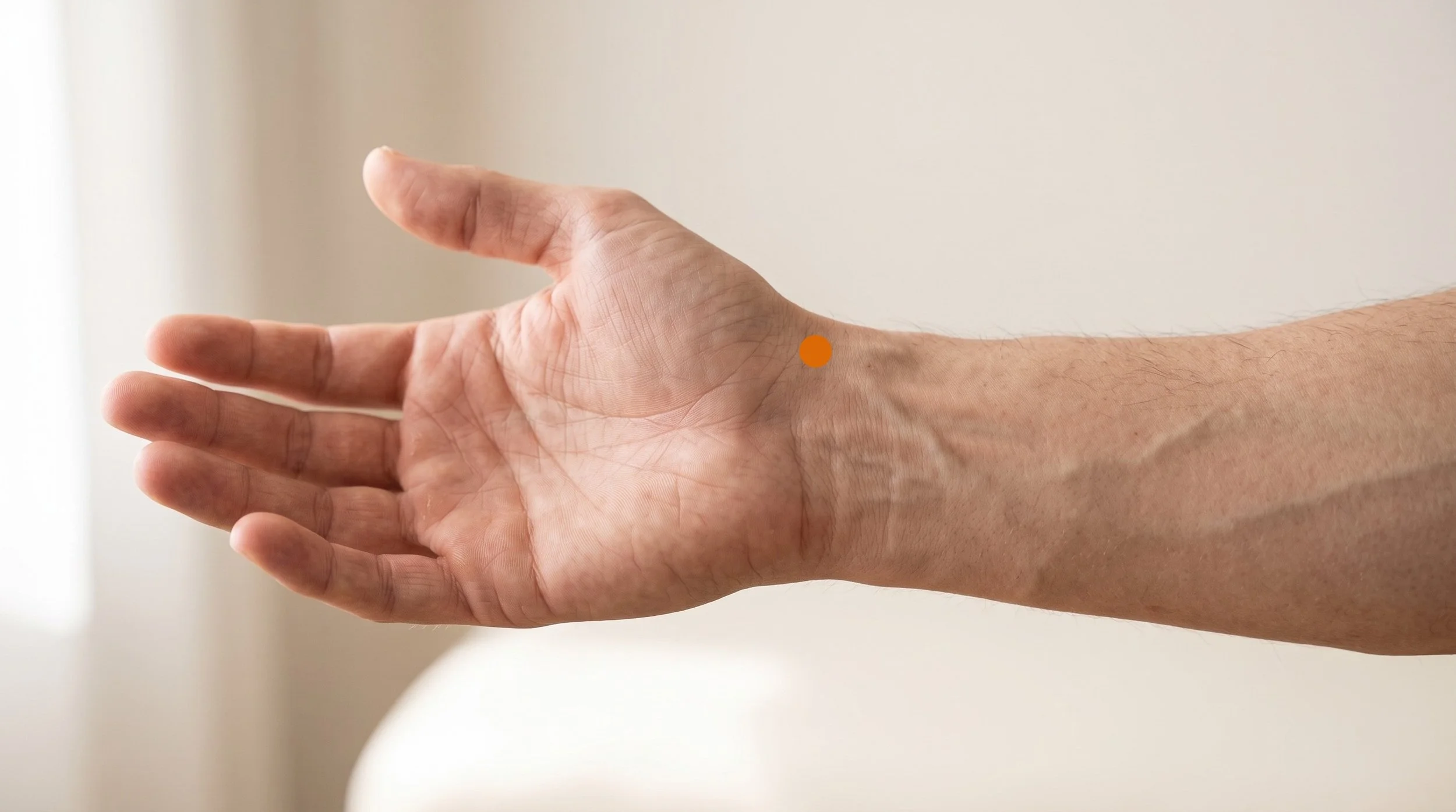
Taiyang Acupuncture Point (M-HN-9)
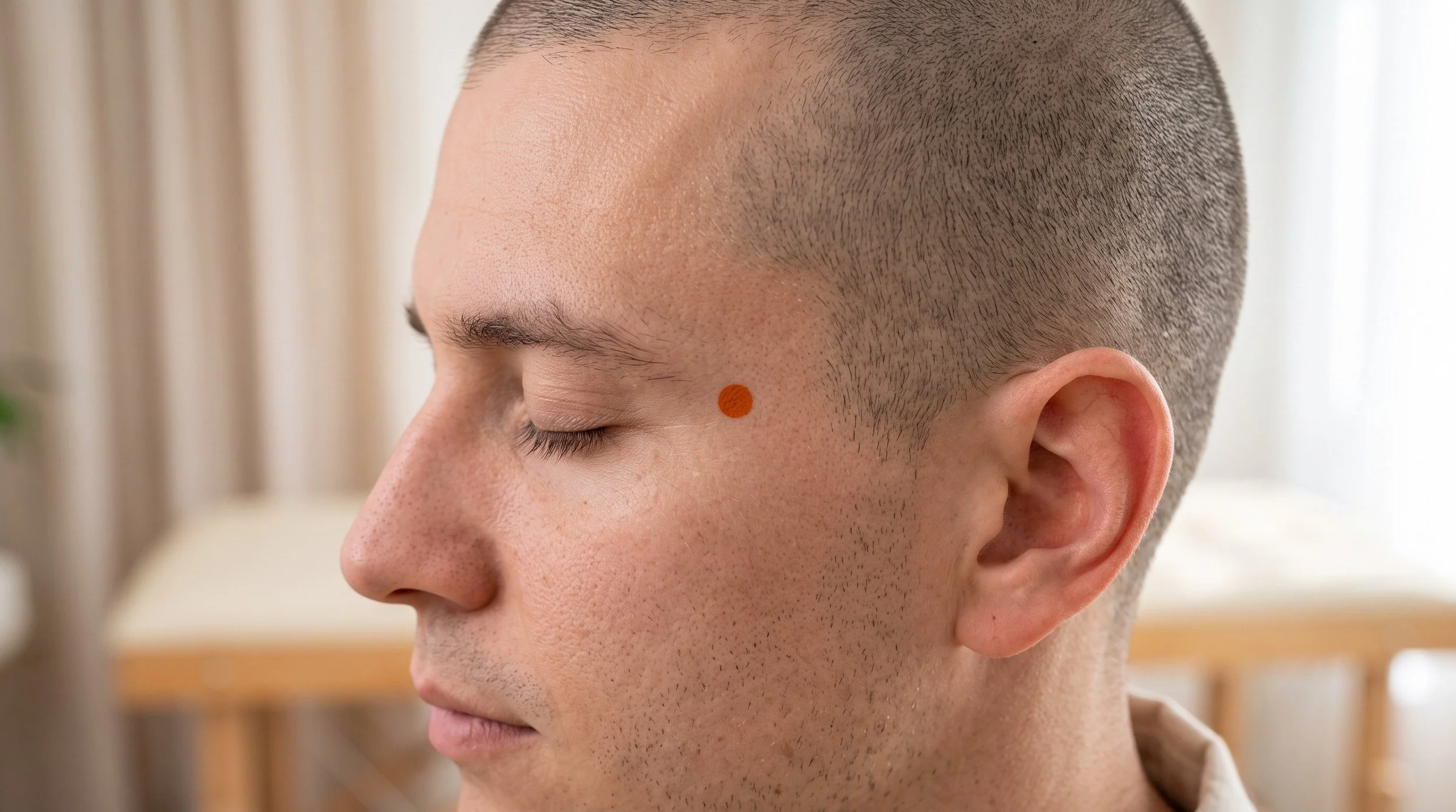
Taiyang Acupuncture Point
Supreme Yang at the Temple: Anatomy, Mechanism, and Why This Extra Point Anchors Treatment for One-Sided Headache, Eye Strain, and Jaw Tension
Taiyang (M-HN-9), often written as EX-HN-5 in modern texts and translated as Supreme Yang, is one of the best known extra points in acupuncture, meaning it sits outside the fourteen numbered channels yet appears in almost every headache protocol written in the last thousand years. You'll find it in the soft, tender hollow of the temple, roughly a thumb's width behind the midpoint between the end of the eyebrow and the outer corner of the eye, in the same patch of tissue people instinctively rub after a long day at a screen.
That instinct is anatomically well aimed: the taiyang acupuncture point sits over the temporalis muscle and the temporal fossa, in a field crossed by branches of the trigeminal nerve and by the superficial temporal artery, which is why this small area maps so cleanly onto temporal headache, migraine-pattern head pain, eye discomfort, and jaw clenching.
- Location and layers: the taiyang point lies in the tender temple depression about 1 cun behind the midpoint between the lateral end of the eyebrow and the outer canthus, with thin skin, a subcutaneous plane carrying the superficial temporal vessels, the temporal fascia, and the anterior fibers of temporalis underneath (Deadman et al.).
- Traditional attributions, translated: classical sources describe Taiyang as eliminating wind, clearing heat, reducing swelling, and freeing the local channel to relieve pain, which in modern language corresponds to a local point used for trigeminal-territory pain, temple congestion, and irritable eye symptoms rather than to any measurable flow of energy (Deadman et al.).
- Nerve story: needling here recruits the auriculotemporal and zygomaticotemporal branches of the trigeminal nerve, whose afferents converge in the trigeminocervical complex, the same relay implicated in migraine and referred head pain, and repeated stimulation may engage descending inhibitory pathways that damp nociceptive transmission (Zhao, 2008).
- Research picture: Cochrane reviews of acupuncture for episodic migraine and for tension-type headache report reductions in headache frequency compared with usual care, with smaller and less certain differences against sham needling (Linde et al., 2016a; Linde et al., 2016b), and Taiyang is one of the points that recurs across the trial protocols those reviews pooled (Zheng et al., 2010).
- Clinical framing: this is a local point, so we rarely use it alone; it's typically combined with GB20, LI4, or LR3 and with needling of the temporalis and jaw muscles when clenching is part of the picture, since individual patient data show acupuncture effects for chronic pain are modest but persist over months (Vickers et al., 2018).
- De qi here is distinctive: patients usually report a dull, spreading pressure or heaviness across the temple that can travel toward the eyebrow or behind the eye, not a sharp sting, and the sensation often eases within seconds as the temporalis lets go.
Tired of Temple Headaches That Start Behind Your Eyes?
At Morningside Acupuncture in NYC we use Taiyang as a local anchor for one-sided and temporal headaches, usually paired with GB20 at the base of the skull and distal points on the hand and foot. We assess whether your pattern is driven by jaw clenching, screen strain, neck tension, or a migraine cycle, then build the point selection around that. Most patients feel the temple soften during the first session. Schedule a visit and let's map your headache pattern properly.
Schedule NowAnatomy of TAIYANG: Why the Temple Depression Is Such an Important Location
Run a finger back from the outer end of your eyebrow toward your hairline and you'll drop into a shallow, tender hollow just behind the bony rim of the orbit. That's Taiyang. The skin here is thin and mobile, the subcutaneous layer is loose and holds the superficial temporal artery and vein along with a network of small sensory nerves, and beneath a sheet of temporal fascia lie the fan-shaped anterior fibers of the temporalis muscle filling the temporal fossa. Temporalis is a jaw closer, so it loads every time you clench, chew, brace during stress, or hold a forward head posture at a desk.
Add hours of sustained near-focus at a screen and you get the familiar combination this area produces: a tight band across the temple, pressure behind the eye, and tenderness that flares under light fingertip pressure.
The clinically important detail is the nerve supply. This territory is served by the auriculotemporal branch of the mandibular division and the zygomaticotemporal branch of the maxillary division of the trigeminal nerve, so a needle at Taiyang delivers input straight into the trigeminal system. Trigeminal afferents from the face, dura, and cranial vessels converge with upper cervical afferents in the trigeminocervical complex, which is why temple pain, eye discomfort, jaw tension, and upper neck stiffness so often travel together and why treating one region can shift another.
Segmental input of this kind is thought to modulate dorsal horn and brainstem processing, while repeated needling also engages descending inhibitory pathways involving the periaqueductal gray and endogenous opioid systems (Zhao, 2008). Trigger points in temporalis add a mechanical layer, since they characteristically refer pain across the temple, into the eyebrow, and toward the upper teeth, a pattern patients frequently describe as a headache with a dental quality (Simons et al., 1999).
Safety at Taiyang is mostly about the vessels. The superficial temporal artery is palpable in this region and is deliberately avoided, so we palpate before insertion and choose an angle that stays clear of the pulse. Standard conventions are perpendicular insertion of about 0.5 to 0.8 cun, transverse threading directed posteriorly toward GB8 for 1 to 1.5 cun in temporal headache, or shallow oblique insertion; classical practice also used pricking to bleed for red, swollen eyes and one-sided headache (Deadman et al.).
Because the tissue is vascular and thin, a small bruise is the most common side effect, which is why we needle gently, use fine needles, and apply brief pressure on withdrawal. Deep perpendicular needling is unnecessary here, and it isn't done.
Related Best Acupuncture Points For Headaches Related Acupuncture For Temporalis Muscle PainTAIYANG at a Glance: Classification, Location, and Clinical Use
| Category | Detail |
|---|---|
| Traditional Name | Taiyang (Supreme Yang), also written Tai Yang |
| Channel Classification | Extra point of the head and neck, numbered M-HN-9 in the miscellaneous point system and EX-HN-5 in modern Chinese texts; it isn't assigned to any of the fourteen channels |
| Point Categories | None of the channel classifications apply. Taiyang has no five-shu status, no meeting or crossing designation, and no extraordinary vessel intersection because it sits outside the channel system entirely. It is grouped with the extra points, and the traditional actions recorded for it are eliminating wind and clearing heat, reducing swelling and stopping pain, and activating the local channel to relieve pain. |
| Precise Location | At the temple, in the tender depression roughly 1 cun posterior to the midpoint between the lateral end of the eyebrow and the outer canthus of the eye |
| Tissue Stimulated | Thin temple skin, loose subcutaneous tissue containing the superficial temporal vessels and small trigeminal branches, temporal fascia, and the anterior fibers of temporalis, a common site for temporalis trigger points |
| Needle Depth / Direction | Perpendicular 0.5 to 0.8 cun, transverse threading posteriorly toward GB8 for 1 to 1.5 cun, shallow oblique insertion anteriorly, or classical pricking to bleed; the palpable superficial temporal artery is avoided |
| De Qi Sensation | A dull, spreading pressure or heaviness across the temple, sometimes traveling toward the eyebrow or behind the eye, often with a quick sense of release as the temporalis softens; sharp or burning sensations aren't expected and prompt the needle to be adjusted |
| Primary Clinical Uses | Temporal and one-sided headache, migraine-pattern head pain, eye strain and eye discomfort, jaw clenching and temporalis tension, facial pain in the trigeminal territory |
| Common Point Combinations |
|
According to A Manual of Acupuncture, Taiyang first appears in the tenth century Sagelike Prescriptions from the Taiping Era, though the authors note it was almost certainly in use long before that, since the martial arts tradition already recognized the temple as a vulnerable spot where a strike could be lethal.
The classical actions attributed to it are eliminating wind, clearing heat, reducing swelling, stopping pain, and freeing the local channel, and traditional indication lists cluster into three groups: one-sided headache with dizziness, painful conditions of the face and teeth including trigeminal neuralgia and facial deviation, and disorders of the eyes ranging from redness, swelling, and pain to dim vision. Two treatment habits stand out in that record.
The point was frequently joined to GB8 Shuaigu by threading for temporal headache, and it was regularly pricked to bleed for hot, inflamed eyes, with the Ode of the Jade Dragon recommending bilateral bleeding for dim vision. What's striking is how tightly this traditional cluster tracks a single anatomical territory: everything in the classical list, from headache to eye symptoms to facial pain, falls within the trigeminal nerve's distribution, which suggests early practitioners were reading a real neuroanatomical map through the vocabulary available to them.
Why TAIYANG Is Used for Jaw Clenching and Eye Strain, Not Just Headaches
Patients are often surprised that a point on the temple gets used for a jaw problem or for tired, aching eyes. The explanation is convergence. The temple is supplied by branches of the trigeminal nerve, and trigeminal afferents from the face, jaw muscles, eye region, cranial blood vessels, and dura all funnel into the same brainstem relay, the trigeminocervical complex, which also receives input from the upper cervical nerves. When that pool of neurons is sensitized, ordinary input starts to feel like pain and the discomfort spreads across territories that share the relay.
Needling at Taiyang delivers strong, well-localized input into that same segmental field, and segmental stimulation of this kind is one of the better-characterized routes by which acupuncture appears to modulate nociceptive processing (Zhao, 2008).
There's a muscular layer to it as well. The temporalis sits directly under this point and is a frequent site of active trigger points in people who clench or grind, with referral patterns that reproduce temple headache, brow pain, and even toothache-like symptoms (Simons et al., 1999).
Needling that reaches taut bands in the anterior temporalis may reduce local mechanical sensitivity and improve tissue blood flow, and needling therapies targeting the masticatory muscles have been examined in network meta-analyses of masticatory muscle pain, which suggest benefit while noting that trial quality and comparators vary considerably (Al-Moraissi et al., 2023).
The broader mechanism isn't only local. Repeated needling has been shown to recruit descending inhibitory systems involving the periaqueductal gray, the rostral ventromedial medulla, and endogenous opioid and monoamine signaling, which helps explain why effects can outlast the session itself (Zhao, 2008).
Neuroimaging work in migraine, using protocols that commonly include Taiyang alongside GB20 and distal points, reports changes in activity across pain-processing and default mode regions after treatment courses, though these studies are small and heterogeneous and are best read as mechanistic clues rather than proof of a specific effect for any single point (Li et al., 2023).
What the Research Shows for TAIYANG
A caution worth stating up front: almost no high-quality trial tests Taiyang on its own. Headache research evaluates multi-point protocols, and Taiyang is usually one local point among six to ten, so the evidence below tells you how the treatment package performs, not how much of the result belongs to this particular spot.
What the literature does establish is that Taiyang is a consistent fixture of those protocols, appearing in standardized migraine prescriptions and in the trials pooled by the major reviews, and that acupuncture for headache shows reductions in attack frequency compared with usual care, with narrower and less certain margins over sham needling.
| Study | Type | Focus | Key Finding |
|---|---|---|---|
| Linde et al., 2016a | Cochrane systematic review | Acupuncture for the prevention of episodic migraine | Adding acupuncture to usual care reduced headache frequency, with effects at least comparable to prophylactic drug treatment, though differences from sham acupuncture were smaller. |
| Linde et al., 2016b | Cochrane systematic review | Acupuncture for the prevention of tension-type headache | The review concluded acupuncture may be effective for frequent episodic and chronic tension-type headache, while calling for more comparisons against other active treatments. |
| Vickers et al., 2018 | Individual patient data meta-analysis | Acupuncture across chronic pain conditions including headache | Effects were statistically significant compared with sham and no-acupuncture controls and appeared to persist over roughly a year, with modest effect sizes. |
| Zheng et al., 2010 | Systematic review of trial protocols | Point selection in randomized trials of acupuncture for migraine | Taiyang appeared among the points recommended for bilateral use in a standardized migraine protocol, alongside GB20, with de qi and manual stimulation suggested. |
| Al-Moraissi et al., 2023 | Network meta-analysis of randomized trials | Acupuncture and dry needling for masticatory muscle pain | Needling therapies compared favorably with control interventions for masticatory muscle pain, though the authors highlight variable trial quality. |
| Li et al., 2023 | Meta-analysis of fMRI studies | Brain regions modulated by acupuncture in migraine | Pooled imaging data suggest acupuncture alters activity in pain-processing regions in migraine, with the caveat that samples are small and protocols differ. |
Clenching, Grinding, and That Constant Temple Ache?
The temporalis is one of the most common sources of temple and tooth-area pain, and Taiyang sits directly over its anterior fibers. Our acupuncturists combine gentle needling at this point with targeted dry needling of temporalis and jaw muscle trigger points, plus practical advice on jaw posture and screen habits. It's a focused, well-tolerated approach for people who wake up with a tight jaw and finish the day with a headache. Book an appointment to get evaluated.
Schedule NowTAIYANG in the Context of Trigger Point Work
Taiyang is one of the clearest examples of a classical point that sits on top of a well-mapped myofascial target. The anterior temporalis lies immediately deep to it, and taut bands in this muscle refer pain across the temple, into the eyebrow and eye region, and toward the upper teeth, which is close to the classical indication list for the point itself (Simons et al., 1999).
In practice, that means the same needle can serve two frameworks at once: a traditional local point for temporal headache and a trigger point technique for a clenching-related muscle. We palpate the temple in horizontal sweeps, identify the tender bands, and needle superficially and precisely, keeping clear of the superficial temporal artery.
At Morningside Acupuncture we rarely treat the temple in isolation. A typical session for clenching-driven headache combines Taiyang with dry needling of the temporalis and masseter, assessment of the lateral pterygoid when jaw opening is limited or the joint clicks, and needling of the upper trapezius and suboccipital region when neck involvement is obvious.
Distal points such as LI4 are often added to increase the overall dose, since needling therapies for masticatory muscle pain generally perform better when the whole pain-generating chain is addressed rather than a single tender spot (Al-Moraissi et al., 2023). We finish with practical loading advice: jaw resting position, screen distance and break intervals, and simple ways to notice clenching before it builds.
TAIYANG Headache and Migraine Treatment at NYC's Highest-Rated Acupuncture Clinic
Morningside Acupuncture is the highest-rated acupuncture and dry needling clinic in New York City with over 500 five-star Google reviews, and headache care is one of the things we treat most often. We combine classical point selection at Taiyang with modern trigger point needling, neck assessment, and simple between-session self-care so your results carry between visits. Every plan is built around your specific headache pattern rather than a template. Schedule your first session and start tracking real change.
Schedule NowFrequently Asked Questions
What does TAIYANG feel like when needled?
Most people feel a dull, spreading pressure or a heavy fullness across the temple that can travel toward the eyebrow or the back of the eye. Because the skin here is thin and richly innervated, the initial insertion can be briefly more noticeable than at points on the arms or legs, but the sensation typically settles within a few seconds. Many patients describe a distinct softening as the temporalis lets go, and some notice their eyes feel less strained by the end of the session. Sharp, burning, or radiating electrical sensations aren't expected, and your acupuncturist will adjust or remove the needle if you report them.
Why treat the temple when my headache feels like it's behind my eye or in my jaw?
Because those regions share a nerve supply and a common relay in the brainstem. The temple, the eye region, the jaw muscles, and the upper neck all send sensory information into the trigeminocervical complex, so pain generated in one area is routinely felt in another. Needling at Taiyang delivers input directly into that shared territory, which is why it's used for eye discomfort and jaw tension as well as for head pain (Zhao, 2008). The classical indication list points in exactly the same direction, grouping headache, eye disorders, toothache, and facial pain together under one temple point.
Can I press TAIYANG myself between sessions?
Yes, and it's one of the easiest points to self-treat as a temple pressure point. Find the tender hollow about a thumb's width behind the midpoint between the end of your eyebrow and the outer corner of your eye, then use the pad of your index or middle finger rather than a fingertip nail. Apply steady, moderate pressure or slow circular movement for 30 to 60 seconds per side, breathing normally, and repeat two or three times with short rests. Both sides at once with the thumbs or index fingers works well. Keep the pressure comfortable rather than forceful, avoid pressing directly on any pulse you can feel, and stop if you get dizzy or if pressure sharply increases the headache. Two or three short rounds a day is plenty, and it pairs nicely with a screen break and a few minutes of looking at something far away.
Is TAIYANG safe to needle?
In trained hands it has a good safety record, but it deserves respect. The superficial temporal artery is palpable in this area and is avoided by palpating first and choosing an angle away from the pulse, and because the tissue is thin and vascular, a small bruise is the most common side effect. Needling here is shallow by convention, using perpendicular insertion of about 0.5 to 0.8 cun or transverse threading toward GB8, and deep perpendicular needling isn't used (Deadman et al.). Tell your practitioner if you take blood thinners, bruise easily, or have had recent facial procedures, and let them know right away about any sharp pain, since this is a sensitive area where technique matters.
Where exactly is TAIYANG located?
Place one fingertip at the outer end of your eyebrow and another at the outer corner of your eye, then find the midpoint between them. Move back toward your ear about 1 cun, roughly the width of your own thumb at the knuckle, and you'll drop into a soft depression in the temple just behind the bony edge of the eye socket. That hollow is Taiyang, also written as M-HN-9 or EX-HN-5. It's usually tender to press, especially if you clench your jaw or spend long hours at a screen, and the tenderness itself is a helpful landmark. The point is treated bilaterally in most headache protocols, though it's often needled on the affected side only in strictly one-sided pain.
References
- Deadman, P., Al-Khafaji, M., & Baker, K. (2009). A manual of acupuncture. Journal of Chinese Medicine Publications.
- Simons, D. G., Travell, J. G., & Simons, L. S. (1999). Travell & Simons' myofascial pain and dysfunction: The trigger point manual, Vol. 1: Upper half of body (2nd ed.). Williams & Wilkins.
- Maciocia, G. (2005). The foundations of Chinese medicine: A comprehensive text for acupuncturists and herbalists (2nd ed.). Elsevier Churchill Livingstone.
- Linde, K., Allais, G., Brinkhaus, B., Fei, Y., Mehring, M., Vertosick, E. A., Vickers, A., & White, A. R. (2016a). Acupuncture for the prevention of episodic migraine. Cochrane Database of Systematic Reviews, 2016(6), CD001218. https://doi.org/10.1002/14651858.CD001218.pub3
- Linde, K., Allais, G., Brinkhaus, B., Fei, Y., Mehring, M., Shin, B. C., Vickers, A., & White, A. R. (2016b). Acupuncture for the prevention of tension-type headache. Cochrane Database of Systematic Reviews, 2016(4), CD007587. https://doi.org/10.1002/14651858.CD007587.pub2
- Vickers, A. J., Vertosick, E. A., Lewith, G., MacPherson, H., Foster, N. E., Sherman, K. J., Irnich, D., Witt, C. M., & Linde, K. (2018). Acupuncture for chronic pain: Update of an individual patient data meta-analysis. Journal of Pain, 19(5), 455-474. https://doi.org/10.1016/j.jpain.2017.11.005
- Zhao, Z. Q. (2008). Neural mechanism underlying acupuncture analgesia. Progress in Neurobiology, 85(4), 355-375. https://doi.org/10.1016/j.pneurobio.2008.05.004
- Zheng, H., Chen, M., Wu, X., Li, Y., & Liang, F. R. (2010). Manage migraine with acupuncture: A review of acupuncture protocols in randomized controlled trials. The American Journal of Chinese Medicine, 38(4), 639-650. https://doi.org/10.1142/S0192415X10008111
- Al-Moraissi, E. A., Goddard, G., & Christidis, N. (2023). Are acupuncture and dry needling effective in the management of masticatory muscle pain: A network meta-analysis of randomised clinical trials. Journal of Oral Rehabilitation, 50(1), 87-97. https://doi.org/10.1111/joor.13382 [VERIFY BEFORE PUBLISHING]
- Li, M., Huang, H., Yao, L., Yang, H., Ma, S., Zheng, H., Zhong, Z., Yu, S., Yu, B., & Wang, H. (2023). Effect of acupuncture on the modulation of functional brain regions in migraine: A meta-analysis of fMRI studies. Frontiers in Neurology, 14, 1036413. https://doi.org/10.3389/fneur.2023.1036413
Disclaimer: This web site is intended for educational and informational purposes only. Reading this website does not constitute providing medical advice or any professional services. This information should not be used for diagnosing or treating any health issue or disease. Those seeking medical advice should consult with a licensed physician. Seek the advice of a medical doctor or other qualified health professional for any medical condition. If you think you have a medical emergency, call 911 or go to the emergency room. No acupuncturist-patient relationship is created by reading this website or using the information. Morningside Acupuncture PLLC and its employees and contributors do not make any express or implied representations with respect to the information on this site or its use. For any legal interpretation of scope of practice in your state, consult a licensed attorney or regulatory authority.
Read more from our blog